Surveyor 2 to 7
NASA / JPL (US) · Lander · 1966Partial
Six-mission conclusion of the US Surveyor program, Sep 1966 to Feb 1968: four soft-landed (Surveyors 3, 5, 6, 7), two failed (2 crashed, 4 vanished). Apollo 12 later visited Surveyor 3, the only robotic craft humans have ever returned to.
TL;DR· 7 min read
Between September 1966 and January 1968 NASA and JPL flew Surveyors 2 through 7: four soft-landed and two failed, Surveyor 2 crashing southeast of Copernicus and Surveyor 4 vanishing minutes before touchdown. Surveyor 5 made the first chemical analysis of soil on another world, Surveyor 6 hopped about 10 ft in the first liftoff from another celestial body, and Surveyor 7 reached the highlands at Tycho. Apollo 12 later walked to Surveyor 3 and cut off its camera, the only time humans have returned to a robotic spacecraft on another world.
Surveyor 1 made America's first soft landing look easy, succeeding on the program's first try. The other six Surveyors were where the program earned its reputation, and where the myths pile up. English coverage fixates on the false claim that Earth bacteria survived on Surveyor 3's camera, and skips the genuinely remarkable facts: Surveyor 6 performed the first liftoff from another world, Surveyor 7 was a highlands science flagship at Tycho, and Surveyor 3 is the only robotic spacecraft humans have ever walked back to, when Apollo 12 landed beside it and cut off its camera to bring home.
Facts as of July 20, 2026, from the sources listed below.
4 of 6
of Surveyors 2 to 7 soft-landed successfully
1
robotic craft humans have ever returned to (Surveyor 3, by Apollo 12)
1
first liftoff from another world (Surveyor 6's hop, 17 Nov 1967)
77,570images
returned by the four successful landers (3, 5, 6, 7)
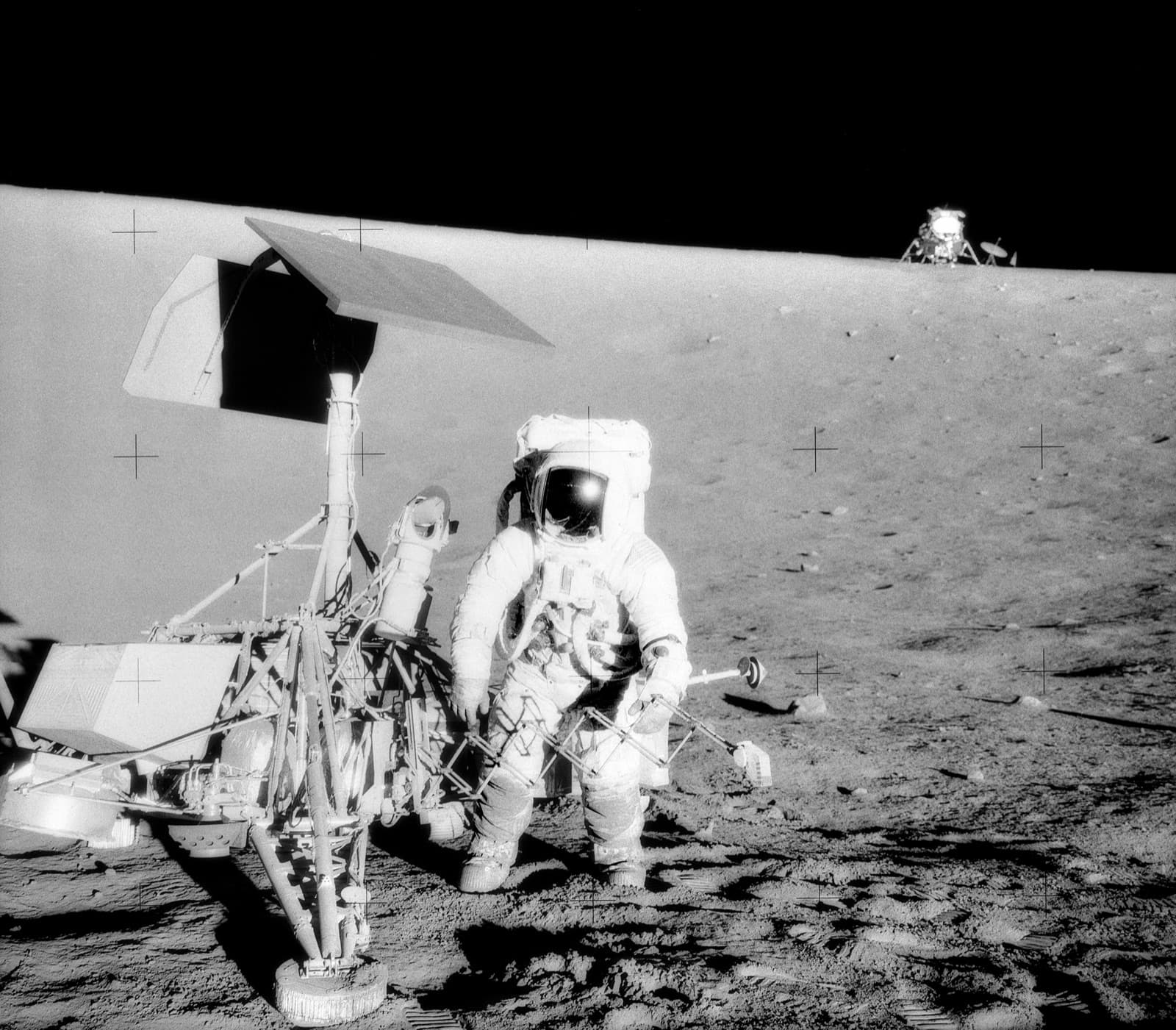
Commonly wrong. The most repeated Surveyor 3 story is a myth. When Apollo 12 brought its camera back, a lab found live Streptococcus mitis inside and reported that Earth bacteria had survived 31 months on the Moon. The result never passed peer review, and later NASA reanalysis (Glavin et al. 2010) concluded the sample was almost certainly contaminated after return, in the Lunar Receiving Laboratory, where technicians handled the camera with bare forearms and it had travelled home in a porous bag rather than a sealed container. No organism is known to have survived on the lunar surface. Two smaller errors recur: the Apollo 12 to Surveyor 3 distance is usually quoted as 600 feet (about 183 m), while LROC positions put it closer to 155 to 157 m; and Surveyor 3's landing is sometimes dated 19 April 1967 (the date in US time zones), but touchdown was 20 April 1967 at 00:04 UT.
01Mission facts
Program scope
Surveyors 2 to 7 flew from Sep 20, 1966 to Jan 7, 1968; four landed successfully (3, 5, 6, 7) and two failed (2 crashed, 4 lost on descent)↗
Builder and launch vehicle
Spacecraft built by Hughes Aircraft, managed by NASA's Jet Propulsion Laboratory, launched on Atlas-Centaur from Cape Canaveral↗
Surveyor 2 failure
Launched Sep 20, 1966; one of three vernier thrusters failed to ignite for a midcourse correction on Sep 21, throwing the craft into a spin (39 attempts to fire it failed); it crashed Sep 23, 1966 southeast of Copernicus near 5.5 N, 12 W↗
Surveyor 3 landing
Launched Apr 17, 1967; landed Apr 20, 1967 at 00:04 UT in southeastern Oceanus Procellarum; reflective rocks confused its descent radar and the vernier engines failed to cut off, so it bounced twice before settling↗
Surveyor 3 site (LROC)
LROC mean-observed position 3.0162 S, 336.5820 E; Apollo 12's LM sat at 3.0128 S, 336.5781 E, about 155 to 157 m away↗
Apollo 12 visit to Surveyor 3
On Nov 19 to 20, 1969, Pete Conrad and Alan Bean walked to Surveyor 3 and cut off its television camera, scoop and cabling to return to Earth after 31 months on the Moon; the camera is now in the Smithsonian National Air and Space Museum↗
Surveyor 4 failure
Launched Jul 14, 1967 toward Sinus Medii; radio contact cut out two seconds before retro-rocket cutoff on Jul 17, about two and a half minutes before touchdown, with the retrorocket suspected to have exploded; no wreck has been identified↗
Surveyor 5 rescue and first soil chemistry
Launched Sep 8, 1967; controllers nursed it through a near-fatal helium-regulator leak to land Sep 11 in Mare Tranquillitatis, where its alpha-scattering instrument made the first chemical analysis of soil on another world (basaltic, more than half oxygen by atom)↗
Surveyor 6 hop
Landed Sinus Medii Nov 10, 1967; on Nov 17, 1967 it fired its vernier engines for 2.5 seconds, rose about 10 ft and set down some 8 ft to the west, the first liftoff from another celestial body↗
Surveyor 7 at Tycho
Launched Jan 7, 1968; landed Jan 10, 1968 on the ejecta blanket north of Tycho at 40.97 S, 11.44 W, the only Surveyor to reach the lunar highlands; ran a camera, alpha-scattering analyzer (three samples) and soil-mechanics scoop↗
Surveyor 7 laser detection
On Jan 20, 1968 its camera detected two argon lasers aimed at it from Kitt Peak National Observatory, Arizona and Table Mountain, Wrightwood, California, an early pointing and optical-communication test; contact was lost Feb 21, 1968, ending the program↗
Images returned by the four successful landers
Surveyor 3 returned 6,326; Surveyor 5 about 20,018; Surveyor 6 about 29,952; Surveyor 7 about 21,274 (over 77,000 combined), feeding Apollo site selection and lander design↗
Site: 3.0162°S, 23.4180°W · Surveyor 3 site, southeastern Oceanus Procellarum (Apollo 12 landed about 155 to 157 m away) (source)
02Mission timeline
20 Sep 1966
Surveyor 2 launches from Cape Canaveral toward Sinus Medii
23 Sep 1966
Surveyor 2 crashes southeast of Copernicus after a thruster failed to fire and the craft tumbled
17 Apr 1967
Surveyor 3 launches
20 Apr 1967
Surveyor 3 lands in Oceanus Procellarum, bouncing twice when its engines failed to cut off
14 Jul 1967
Surveyor 4 launches toward Sinus Medii
17 Jul 1967
Surveyor 4 signal is lost about two and a half minutes before touchdown, retrorocket suspected to have exploded
8 Sep 1967
Surveyor 5 launches
11 Sep 1967
Surveyor 5 lands in Mare Tranquillitatis after a helium-leak descent; its alpha-scattering instrument makes the first chemical analysis of soil on another world
7 Nov 1967
Surveyor 6 launches
10 Nov 1967
Surveyor 6 lands in Sinus Medii
17 Nov 1967
Surveyor 6 fires its verniers and hops about 10 ft, the first liftoff from another celestial body
7 Jan 1968
Surveyor 7 launches
10 Jan 1968
Surveyor 7 lands on the Tycho ejecta blanket, the only Surveyor to reach the highlands
20 Jan 1968
Surveyor 7 detects two argon lasers aimed at it from Earth observatories
21 Feb 1968
Final contact with Surveyor 7 ends the Surveyor program
19 Nov 1969
Apollo 12 lands beside Surveyor 3; the crew later cuts off and returns its camera, the only human revisit to a robotic craft on another world
Teal dots: events that physically happened in flight or on the Moon. Grey: announcements, namings, contracts, and targets.
03The mission
Surveyor 1 made it look easy, nailing America's first soft landing on its first try in June 1966. The other six Surveyors were where the program earned its reputation: a run of ambition, failure, rescue, and one genuinely strange sequel. Between September 1966 and January 1968, NASA and JPL flew Surveyors 2 through 7, built by Hughes Aircraft and launched on Atlas-Centaur, to prove the Moon could be landed on safely and to characterize the ground Apollo would touch. Four of the six succeeded; two did not.
The failures bracketed the run. Surveyor 2, launched 20 September 1966, was coasting toward Sinus Medii when one of its three vernier thrusters refused to fire for a midcourse correction. The uneven thrust threw the spacecraft into a spin that controllers could not stop despite 39 attempts to light the stubborn engine, and it crashed southeast of Copernicus on 23 September. Surveyor 4, launched 14 July 1967, flew a flawless descent toward the same target until its radio signal cut out two seconds before retro-rocket cutoff, about two and a half minutes from touchdown. Engineers suspected the solid retrorocket had exploded. It remains the program's ghost, a spacecraft that vanished with no wreck ever identified.
The successes grew bolder. Surveyor 5 nearly died on the way down in September 1967 when a helium regulator sprang a near-fatal leak, but JPL and Hughes controllers improvised a descent that set it on a crater slope in Mare Tranquillitatis, where its alpha-scattering instrument returned the first chemical analysis of soil on another world: basaltic, more than half oxygen by atom. Surveyor 6 landed in Sinus Medii that November and then did something no craft had ever done, firing its vernier engines for 2.5 seconds on 17 November to lift about 10 feet off the surface and set back down some 8 feet to the west. It was the first liftoff from another celestial body, a small rehearsal for the far larger one Apollo would attempt.
Surveyor 7, the program's science flagship, broke the pattern of aiming at smooth mare plains. In January 1968 it set down on the rugged ejecta blanket north of the bright crater Tycho, the only Surveyor to reach the lunar highlands, and ran the full instrument suite: a survey camera, the alpha-scattering analyzer across three samples, and a soil-mechanics scoop. On 20 January its camera detected two argon lasers aimed at it from observatories at Kitt Peak, Arizona and Table Mountain, California, an early pointing and optical-communication test across a quarter of a million miles. Contact was lost on 21 February 1968, closing the Surveyor program.
The strangest chapter belongs to Surveyor 3. It bounced twice on landing in April 1967 when reflective rocks confused its descent radar and the engines failed to cut off, then settled and worked normally in Oceanus Procellarum. Thirty-one months later, on 19 November 1969, Apollo 12's Intrepid touched down within about 155 to 157 metres of it. Pete Conrad and Alan Bean walked over, photographed the weathered lander, and cut off its television camera and scoop to bring home, the only time in history humans have returned to a robotic spacecraft on another world. The camera is now in the Smithsonian National Air and Space Museum.
04In pictures
Tap a photo to enlarge.
05Sources
- NASA Science: Lunar Rangers and Surveyors program page
- NASA Science: Surveyor 2 mission page
- NASA Science: Surveyor 3 mission page
- NASA Science: Surveyor 4 mission page
- NASA Science: Surveyor 5 mission page
- NASA Science: Surveyor 6 mission page
- NASA Science: Surveyor 7 mission page
- NASA Science resource: Apollo 12 and Surveyor 3
- LROC Spacecraft Related Coordinates (Surveyor 3 and Apollo 12 positions)
- Wikipedia: Reports of Streptococcus mitis on the Moon
- Space.com: Moon Microbe Mystery Finally Solved
- LPI: The Surveyor Program
azmth is independent and is not affiliated with or endorsed by NASA, CNSA, Roscosmos, ISRO, JAXA, or any other space agency or company named on this page.