Luna 3
USSR (OKB-1) · Flyby · 1959Success
Looped behind the Moon and photographed the far side on 7 Oct 1959; 17 of 29 film frames were received by 18 Oct, and contact was lost 22 Oct 1959.
TL;DR· 5 min read
Luna 3 took the first pictures of the Moon's far side. On 7 October 1959 it exposed 29 frames and developed the film on board; the first transmission attempts failed at long range, and 17 resolvable images, covering about 70 percent of the hidden hemisphere, were received by 18 October. They showed a cratered, mountainous face with almost none of the near side's dark maria, forcing revisions to theories of lunar evolution and giving us names that stuck, including Mare Moscoviense and the crater Tsiolkovskiy.
Three weeks after Luna 2 hit the Moon, Luna 3 looped behind it and photographed what no human had ever seen: the far side. On 7 October 1959 it exposed 29 frames of film, developed them on board, and later radioed 17 usable pictures home, covering about 70 percent of the hidden hemisphere, though the pictures are often described as catching all of it.
Facts as of July 20, 2026, from the sources listed below.
29
film frames of the never-before-seen far side
~70%
of the far side covered
17
usable images radioed back to Earth
40min
minutes of photography that redrew the Moon
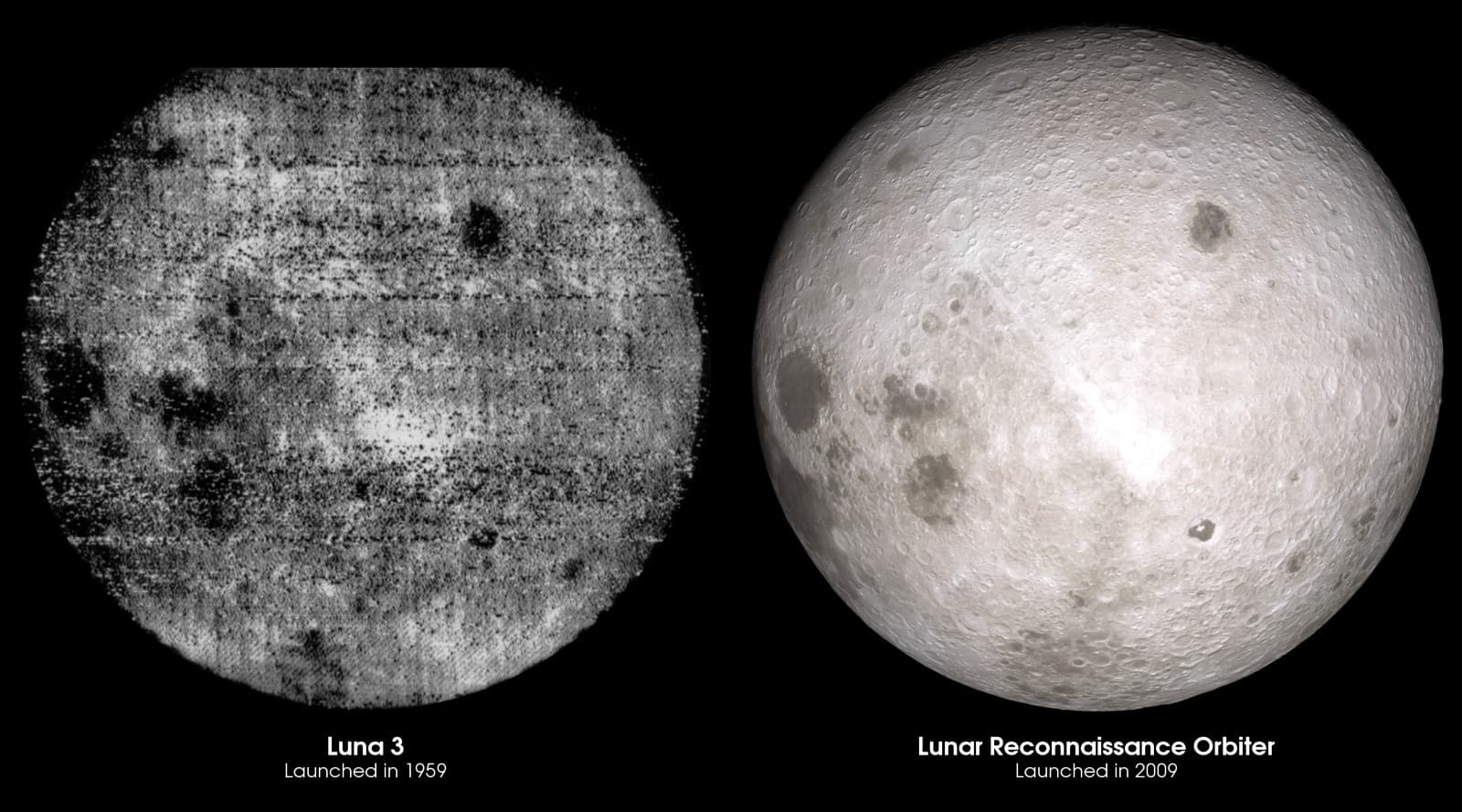
Commonly wrong. Luna 3 did not photograph 'the entire far side': its 29 frames covered about 70 percent of it, and only 17 came back in resolvable form (some histories count as few as 12 usable). The pictures were not live television: film was developed, fixed and dried on board, then scanned and transmitted days later, mostly as the probe neared Earth. The two closest-approach figures in circulation differ in reference frame and do not conflict: 6,200 km (NSSDCA) is altitude above the surface, while the ~7,900 km on the retired NASA page (citing Siddiqi) is distance from the Moon's center; subtract the ~1,737 km mean lunar radius and they agree. The evocative Genetrix spy-balloon film story is widely repeated (The Space Review states it as fact) but rests on secondary Russian accounts.
01Mission facts
Launch
4 October 1959, 00:43:40 UT, Tyuratam (Baikonur), on an 8K72 (no. I1-8)↗
Spacecraft
278.5 kg Ye-2A 'Automatic Interplanetary Station'; 130 cm long, 120 cm max diameter; solar cells, spin-stabilized, gas-jet attitude control↗
Trajectory
Highly elliptical Earth orbit of ~48,280 x 468,300 km; passed the Moon's south polar region and returned over the north↗
Closest approach
6,200 km above the surface, 6 October 1959 at 14:16 UT (NSSDCA); sources giving ~7,900 km (NASA's retired page, citing Siddiqi) measure from the Moon's center, which minus the ~1,737 km lunar radius matches NSSDCA↗
Photography
7 October 1959, first frame 03:30 UT at 63,500 km, last frame 40 minutes later at 66,700 km; 29 frames covering ~70% of the far side↗
Camera
Yenisey-2 dual-lens system (200 mm f/5.6 and 500 mm f/9.5), 40-frame 35 mm radiation-resistant film, onboard develop/fix/dry, CRT scanner up to 1,000 lines↗
Film provenance (reported)
Film designated ASh-1, reportedly recovered from downed American Genetrix reconnaissance balloons↗
Images returned
17 resolvable but noisy photographs received by 18 October 1959; contact lost 22 October↗
Fate
Believed to have burned up in Earth's atmosphere in March or April 1960; may have survived in orbit until after 1962↗
Naming legacy
Mare Moscoviense and crater Tsiolkovskiy named from these images; 'Mare Desiderii' later found to be a composite and dropped↗
02Mission timeline
4 Oct 1959
Launch at 00:43:40 UT from Tyuratam (Baikonur), two years to the day after Sputnik 1
6 Oct 1959
14:16 UT: Closest approach: 6,200 km above the surface (about 7,900 km from the Moon's center) over the south polar region
7 Oct 1959
03:30 UT: First photograph of the lunar far side, taken from 63,500 km; 29 frames follow over 40 minutes
8 Oct 1959
First transmission attempts fail due to weak signal at long range
18 Oct 1959
17 resolvable but noisy photographs received as the spacecraft nears Earth
22 Oct 1959
Contact lost
Mar to Apr 1960
Believed to have burned up in Earth's atmosphere (NSSDCA notes it may have survived in orbit past 1962)
Teal dots: events that physically happened in flight or on the Moon. Grey: announcements, namings, contracts, and targets.
03The mission
Luna 3 was a different machine from its impactor predecessors: a 278.5 kg pressurized cylinder of the Ye-2A class, with solar cells on its body, thermal-control shutters, gas jets for attitude control, and photocells to lock onto the Sun and Moon. Instead of escaping Earth entirely, its 8K72 launcher placed it on 4 October 1959 at 00:43:40 UT (two years to the day after Sputnik) into a huge elliptical orbit of roughly 48,280 x 468,300 km, just far enough to swing around the Moon and come back.
The heart of the spacecraft was the Yenisey-2 phototelevision system: a fixed dual-lens camera (200 mm f/5.6 for the full disk, 500 mm f/9.5 for close-ups) loaded with 40 frames of temperature- and radiation-resistant 35 mm film, an automatic onboard developing unit, and a flying-spot scanner that read the negatives at up to 1,000 lines for radio transmission. The whole spacecraft rotated to point the camera. A widely repeated detail, restated as fact by The Space Review's 2024 anniversary history, is that the film itself, designated ASh-1, was salvaged from American Genetrix spy balloons downed over Soviet territory.
Flying over the Moon's south polar region at 14:16 UT on 6 October (closest approach 6,200 km above the surface per NSSDCA; the ~7,900 km in some sources is the same pass measured from the Moon's center), Luna 3 continued to the far side, which the Sun was then illuminating. At 03:30 UT on 7 October its photocell found the sunlit disk and the automated sequence began: 29 frames in 40 minutes, taken from 63,500 to 66,700 km out, covering about 70 percent of the far side. The film was then developed, fixed and dried on board, and the spacecraft swung back toward Earth.
Getting the pictures home was nearly as hard as taking them. Transmission attempts from 8 October failed at long range because of weak signal; as the spacecraft neared Earth, 17 resolvable but noisy photographs had been received by 18 October. Contact was lost on 22 October 1959, and the probe is believed to have burned up in Earth's atmosphere in March or April 1960, though NSSDCA notes it may have survived in orbit past 1962.
The grainy frames redrew the Moon. They revealed a hemisphere with almost none of the dark maria that cover the near side, mountainous and saturated with craters, forcing revisions to theories of lunar evolution. Features first seen in them took Soviet names that stuck, including Mare Moscoviense and the crater Tsiolkovskiy, while the announced Mare Desiderii was later found to be a composite and dropped. The far side Luna 3 introduced stayed out of reach until LRO mapped it in detail from 2009 and China's Chang'e 6 finally returned samples from it in June 2024.
04In pictures
Tap a photo to enlarge.
05Sources
- NSSDCA Master Catalog: Luna 3 (Wayback snapshot, 2 Jul 2025; canonical page temporarily offline)
- NASA Solar System Exploration, In Depth: Luna 03 (retired page, Wayback snapshot 2 May 2022)
- NASA Science: First Photo of the Lunar Far Side
- NASA Science: First Close-up of the Far Side of Moon
- NASA SVS 4109: Lunar Far Side, From Luna 3 to LRO (2 Oct 2013)
- The Space Review: Sixty-five years since the first lunar farside images (Trevor Williams, 7 Oct 2024)
- LROC: Chang'e 6 First Look (far-side sample-return site, for the legacy thread)
azmth is independent and is not affiliated with or endorsed by NASA, CNSA, Roscosmos, ISRO, JAXA, or any other space agency or company named on this page.