Ranger Program
NASA / JPL (US) · Program · 1961Success
Nine spacecraft, 1961 to 1965: six straight failures, then Rangers 7, 8 and 9 returned the first US close-up images of the Moon before crashing into it. Program complete; last impact 24 Mar 1965 in Alphonsus crater.
TL;DR· 7 min read
Ranger's first six spacecraft failed, and then Rangers 7, 8 and 9 sent home 17,267 close-up photographs of the Moon between July 1964 and March 1965, showing the surface would bear a lander's weight and feeding Apollo landing-site planning. Only the four Block III craft were built to photograph and crash: Block II carried a balsa-wood seismometer capsule, and Block I never headed for the Moon at all. Ranger 9's final pictures were converted for near-real-time television.
The Ranger program is remembered for its triumphant finish, the live "crash-dive" pictures of the Moon that fed Apollo landing-site planning, but it earned that ending the hard way: the first six Rangers all failed, and Congress was investigating the program the same week Ranger 6 hit the Moon with dead cameras. A correction most coverage skips: not every Ranger was a camera impactor. Only the final four (Block III) were built to photograph and crash. The middle three carried a balsa-wood seismometer capsule meant to survive a rough landing, and the first two never went near the Moon at all.
Facts as of July 20, 2026, from the sources listed below.
9
spacecraft launched, Aug 1961 to Mar 1965
6
failed missions before the first success (Rangers 1 to 6)
17,267
images returned by the three successful Rangers (7, 8, 9)
$170M
approximate total program cost
Commonly wrong. Several recurring errors. (1) "Every Ranger was a camera that crashed into the Moon." Only Block III (Rangers 6 to 9) were pure camera impactors. Block II (Rangers 3 to 5) carried a balsa-wood-cushioned capsule with a seismometer meant to survive a rough landing, and Block I (Rangers 1 to 2) were Earth-orbit engineering test flights that never headed for the Moon. (2) "Ranger 7 was the first US spacecraft to reach the Moon." Ranger 4 got there first, impacting the far side on 26 April 1962 (launched 23 April), but it was dead on arrival and returned nothing; Ranger 7 was the first to return images. (3) "Ranger 6's cameras were badly designed." The hardware was sound; the failure was an arc-over after the TV system inadvertently powered on for roughly 67 seconds during booster staging. That was an electrical event, and the camera design played no part in it. (4) "Ranger 9 was broadcast truly live." The images were relayed and converted for near-real-time commercial television under the banner "Live from the Moon," but there was a short processing delay; the broadcast was close to real time without being instantaneous. (5) Image counts drift between sources: NASA's mission pages and NSSDCA give Ranger 7 as 4,316 images, while some NASA history articles round to 4,308 or "more than 4,300."
01Mission facts
Program
Nine uncrewed spacecraft launched 23 August 1961 to 21 March 1965, managed by NASA's Jet Propulsion Laboratory; total cost about $170 million↗
Three block designs
Block I (Rangers 1 to 2): Earth-orbit engineering test flights. Block II (Rangers 3 to 5): lunar probes carrying a TV camera and a balsa-wood-cushioned seismometer capsule to rough-land. Block III (Rangers 6 to 9): pure camera impactors with six TV cameras and no landing capsule↗
Block I outcome
Ranger 1 (23 Aug 1961) and Ranger 2 (18 Nov 1961) were stranded in low Earth orbit when the Agena B upper stage failed to restart; neither left for the Moon↗
Ranger 4
Launched 23 Apr 1962; on 26 Apr 1962 it became the first US spacecraft to reach the Moon, impacting the far side, but a central-computer/timer failure left it dead on arrival and it returned no images or data↗
Ranger 6 failure
Launched 30 Jan 1964; impacted Mare Tranquillitatis on target on 2 Feb 1964, but the TV system returned nothing; a review board blamed an arc-over after the cameras inadvertently switched on for about 67 seconds during booster separation↗
Ranger 7
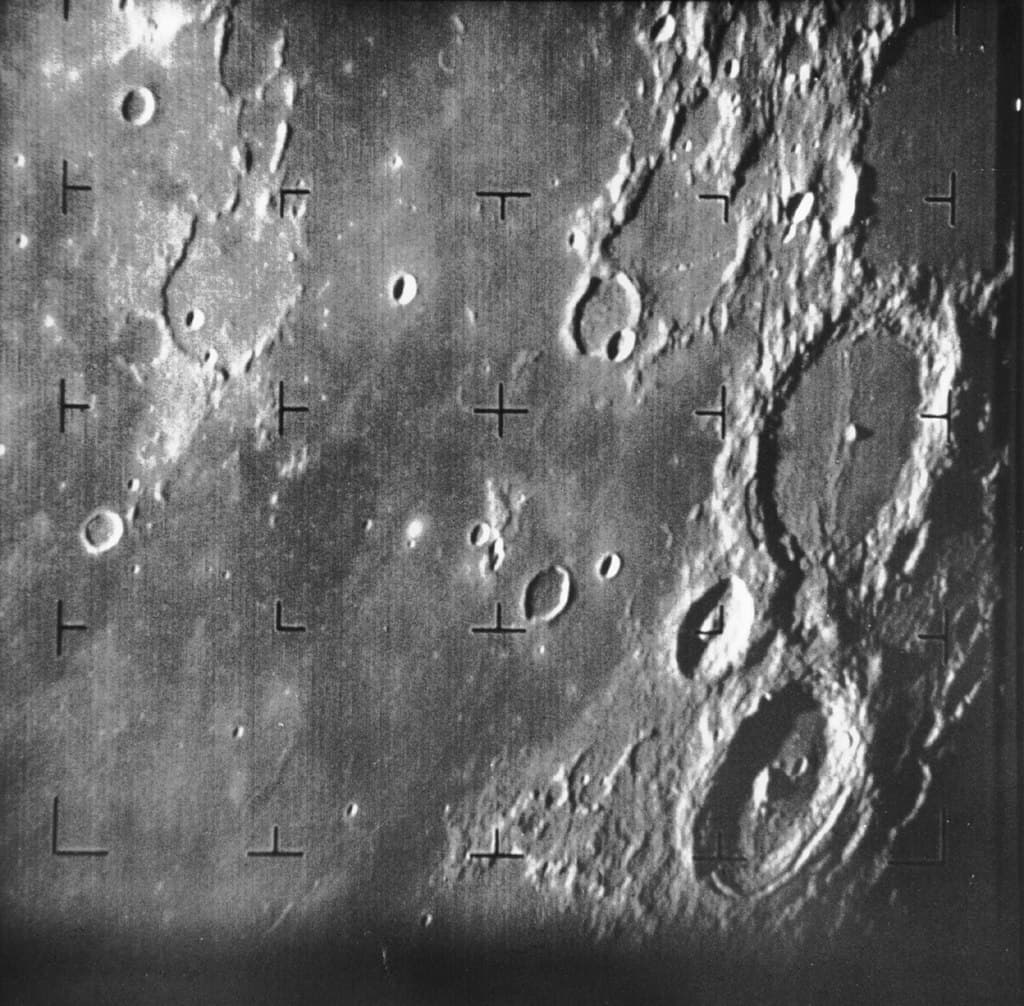
Launched 28 Jul 1964, impacted 31 Jul 1964; returned 4,316 images of Mare Cognitum in its final 17 minutes, the first US close-up photographs of the Moon↗
Mare Cognitum naming
The impact area, between Mare Nubium and Oceanus Procellarum, was renamed Mare Cognitum, Latin for "the Known Sea," to mark the first lunar region seen close-up↗
Ranger 8
Launched 17 Feb 1965, impacted 20 Feb 1965; returned 7,137 images of Mare Tranquillitatis, near where Apollo 11 would land in 1969↗
Ranger 9
Launched 21 Mar 1965, impacted 24 Mar 1965 at 14:08 UT in Alphonsus crater; returned 5,814 images, with pictures converted for near-real-time broadcast on commercial television↗
Ranger 7 impact crater
The 14 m crater Ranger 7 dug was later identified in Lunar Reconnaissance Orbiter imagery at 10.634 S, 339.323 E (20.677 W) in Mare Cognitum↗
Management
James D. Burke was project manager for the failing Rangers 1 to 5; Harris M. Schurmeier took over and oversaw the three successful Block III missions↗
Legacy
The last three Rangers' photographs helped confirm the lunar surface would bear a lander's weight and fed Apollo landing-site planning, leading into the Surveyor soft-landers↗
Site: 10.6340°S, 20.6770°W · Ranger 7 impact crater, Mare Cognitum (the Known Sea), between Mare Nubium and Oceanus Procellarum; 14 m crater identified in LRO imagery (source)
02Mission timeline
23 Aug 1961
Ranger 1 launches as a Block I engineering test flight but is stranded in low Earth orbit by an Agena B upper-stage failure; Ranger 2 meets the same fate on 18 Nov 1961
26 Jan 1962
Ranger 3, the first Block II lunar probe, misses the Moon by roughly 36,800 km and enters solar orbit
26 Apr 1962
Ranger 4 (launched 23 Apr) becomes the first US spacecraft to reach the Moon, hitting the far side, but a computer failure leaves it dead and it returns no data
18 Oct 1962
Ranger 5 misses the Moon by about 725 km after a power failure and drifts into solar orbit; none of the Block II seismometer capsules ever reach the surface
2 Feb 1964
Ranger 6 (launched 30 Jan), the first pure camera impactor, hits Mare Tranquillitatis on target, but its television system is dead; the failure comes just as NASA prepares to defend its budget to Congress
31 Jul 1964
Ranger 7 (launched 28 Jul) redeems the program, returning 4,316 images of the region soon renamed Mare Cognitum in its last 17 minutes before impact
20 Feb 1965
Ranger 8 (launched 17 Feb) sends back 7,137 images of Mare Tranquillitatis before impacting near the future Apollo 11 site
24 Mar 1965
Ranger 9 (launched 21 Mar) crashes into Alphonsus crater at 14:08 UT after returning 5,814 images, some broadcast to American living rooms nearly as they arrived
Teal dots: events that physically happened in flight or on the Moon. Grey: announcements, namings, contracts, and targets.
03The mission
Ranger was NASA's first dedicated attempt to look the Moon in the face, and for three years it was a public embarrassment. Managed by the Jet Propulsion Laboratory, the nine spacecraft came in three distinct designs. Block I (Rangers 1 and 2) were engineering test flights never meant to reach the Moon, and both were stranded in low Earth orbit in 1961 when the Atlas-Agena's upper stage refused to restart. Block II (Rangers 3, 4 and 5) were lunar probes carrying a TV camera plus a balsa-wood-cushioned capsule holding a seismometer that was supposed to survive a rough landing on the surface. Ranger 3 missed the Moon entirely, Ranger 4 reached it but arrived dead, and Ranger 5 missed as well. Not one capsule ever touched down.
Block III abandoned the landing capsule and committed fully to the crash-dive: six television cameras and no attempt to survive, photographing the surface at ever-higher resolution until the spacecraft slammed into it. Ranger 6 flew this profile perfectly, launching 30 January 1964 and impacting Mare Tranquillitatis on 2 February exactly where intended, except its cameras were dead. A review board found the television system had inadvertently powered on for about 67 seconds during booster separation, and the resulting arc-over destroyed it. It was, by most countings, the sixth Ranger failure in a row, and it landed at the worst possible moment, just as NASA had to defend its budget to Congress.
Everything turned on Ranger 7. Launched 28 July 1964, it reached the Moon on 31 July with its cameras working, and in the final 17 minutes it transmitted 4,316 images, the first close-up photographs of the Moon by an American spacecraft, ending with a frame taken 2.3 seconds before impact that resolved features about 15 inches across. Scientists were so struck that they renamed the impact region, between Mare Nubium and Oceanus Procellarum, as Mare Cognitum: the Known Sea. The pictures showed the maria were not knife-edged and treacherous but gently undulating, exactly the reassurance Apollo mission planners needed.
The last two Rangers pressed the advantage. Ranger 8 returned 7,137 images of Mare Tranquillitatis in February 1965, sweeping across terrain near where Apollo 11 would land four years later. Ranger 9, on 24 March 1965, aimed straight into the 108 km crater Alphonsus, a suspected site of past volcanic activity, and pointed its cameras forward along the flight path. NASA converted the incoming pictures for commercial television and captioned them "Live from the Moon," letting millions of Americans watch the crater floor rush up in the moments before the signal cut out. Ranger 9 returned 5,814 images and struck at 14:08 UT.
Ranger's arc is the through-line of early US lunar exploration: a program that failed six times, survived a congressional inquiry and a wholesale management shake-up, and then delivered exactly what Apollo required. Between them Rangers 7, 8 and 9 sent home 17,267 photographs and proved the surface would bear weight, handing the baton to the Surveyor soft-landers and the Lunar Orbiter mappers that followed.
04In pictures
Tap a photo to enlarge.
05Sources
- NASA History: 60 Years Ago: Ranger 7 Photographs the Moon (blocks, per-mission outcomes, Mare Cognitum, impact imagery)
- NASA Science: Ranger 7 mission page (4,316 images, turning point, Apollo landing-site planning)
- NASA Science: Ranger 9 mission page (Alphonsus crater, forward-pointing cameras, course correction)
- NASA Science: Ranger 8 mission page (7,000+ images, impact near the Apollo 11 site)
- LROC (Arizona State University): Making an Impact on History (Ranger 7 crater identified at 10.634 S, 339.323 E, 14 m)
- Wikipedia: Ranger program (program scope, cost, Block designs, management)
- Wikipedia: Ranger 6 (television-system arc-over, 67-second premature power-on, 2 Feb 1964 impact)
- Wikipedia: Ranger 9 (launch/impact times, 5,814 images, live network broadcast)
- Lunar and Planetary Institute: The Ranger Program
azmth is independent and is not affiliated with or endorsed by NASA, CNSA, Roscosmos, ISRO, JAXA, or any other space agency or company named on this page.