Soviet Crewed Lunar Program
USSR · Program · 1964Cancelled
Cancelled May 1974 and kept secret until the late 1980s: the USSR's two-track effort to beat Apollo. Cosmonaut-class Zond hardware looped the Moon uncrewed, but all four launches of the N1 Moon rocket failed and no Soviet ever left Earth orbit.
TL;DR· 8 min read
The USSR did race for the Moon, in secret, with two programs: L1/Zond, to loop one cosmonaut around the Moon on a Proton, and N1/L3, to land one. Alexei Leonov led the landing group. The 105-metre N1 rocket failed on all four uncrewed launches, one of them falling back onto its own pad in one of the largest non-nuclear explosions ever made. Glushko cancelled the effort in May 1974, and none of it was officially admitted until glasnost.
For decades the Soviet Union insisted it had never been in a Moon race, and much of the English-language record took that at face value. It was a cover story. Behind the secrecy ran two parallel crewed programs: the L1/Zond effort to loop a cosmonaut around the Moon on a Proton, and the N1/L3 effort to land one on it. Alexei Leonov, the first human to walk in space, trained to be the first to walk on the Moon. The landing program died because its rocket, the 105-metre N1, failed on all four uncrewed test launches, once falling back onto its own pad in one of the largest non-nuclear explosions ever made. None of it was officially admitted until glasnost.
Facts as of July 20, 2026, from the sources listed below.
4
N1 Moon-rocket launches, 1969 to 1972, none successful
30
NK-15 engines on the N1 first stage
1
cosmonaut the LK lander would set down (vs Apollo's 2)
1974
cancelled, then kept secret until the late 1980s
Commonly wrong. Several myths cling to this program. (1) 'The USSR was never really in a Moon race.' It was: a funded, decreed effort with assigned crews and flight hardware; it simply lost and then denied it until glasnost. (2) 'The N1 kept blowing up on the launch pad.' Only the second flight (5L, July 3, 1969) fell back onto the pad; the other three failed in flight at roughly 68, 50 and 107 seconds. (3) 'Two cosmonauts would have landed, like Apollo.' Only one landed in the LK; the second stayed in the LOK, and the transfer was made by external spacewalk. There was no docking tunnel. (4) The Zond flights are sometimes called lunar 'orbiters', but they were free-return circumlunar loops, with no orbit insertion. (5) The cancellation was not purely technical; the fixes for the N1's engines were in hand, but Glushko's 1974 takeover and the fact that Apollo had already won made the political decision to cancel straightforward.
01Mission facts
Program go-ahead
Aug 3, 1964 Central Committee/Council of Ministers decree set the goal of a crewed lunar landing, split into the L1 circumlunar effort and the N1-L3 landing effort, both using lunar-orbit rendezvous↗
Two parallel programs
L1/Zond: a stripped Soyuz 7K-L1 sent around the Moon on a Proton-K. N1/L3: the giant N1 rocket carrying the LOK orbiter and LK lander for a landing↗
N1 rocket
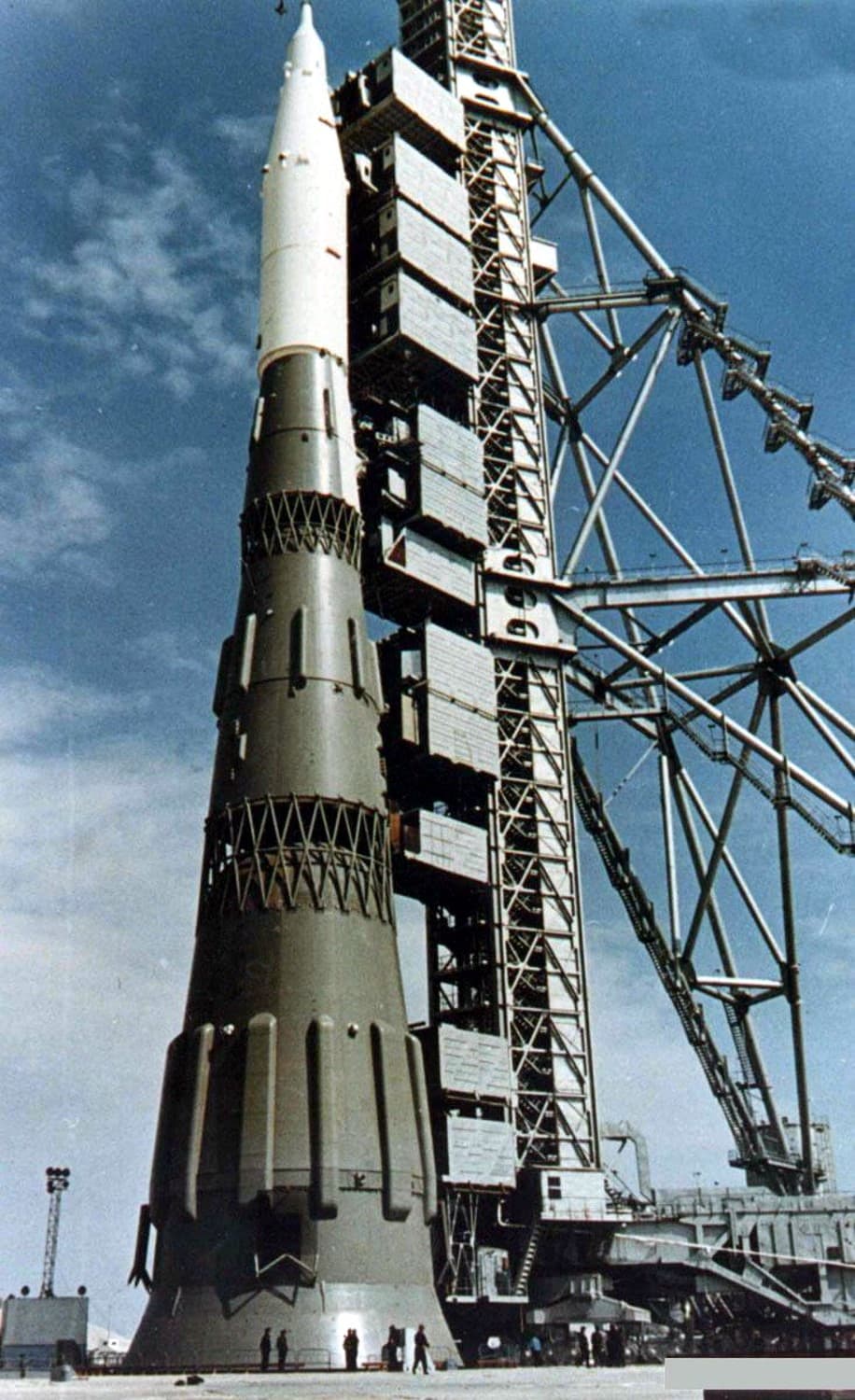
105.3 m tall, about 2,750 t at liftoff, 30 NK-15 engines on the first stage (Block A) producing roughly 45,780 kN of sea-level thrust; the largest engine cluster ever flown on a first stage↗
L3 landing architecture
Two-cosmonaut LOK (Soyuz 7K-LOK) orbiter plus a single-cosmonaut LK lander; the crew member transferred from LOK to LK by an external spacewalk rather than through an internal tunnel↗
LK lander
Launch mass about 5,560 to 6,525 kg; the single Blok E engine (about 20 kN) handled both final descent and ascent; roughly 40% the mass of Apollo's Lunar Module↗
Assigned cosmonauts
The landing group was led by Alexei Leonov, the strongest candidate to be first Soviet on the Moon, with Oleg Makarov as LOK pilot; backup pairs included Valeri Bykovsky and Pavel Popovich↗
N1 flight 3L
Feb 21, 1969, Baikonur Site 110; the KORD control system shut the engines down about 68 seconds after liftoff after a fire in the tail; the rocket was destroyed↗
N1 flight 5L (pad disaster)
Jul 3, 1969; a first-stage engine exploded at liftoff, the rocket rose about 200 m, fell back onto Launch Complex 110 and detonated, leveling the pad in one of the largest artificial non-nuclear explosions on record; rebuilding took roughly 18 months↗
N1 flights 6L and 7L
6L (Jun 27, 1971, 23:15 UTC Jun 26) lost roll control and broke up near 50 seconds; 7L (Nov 23, 1972) flew farthest but a propellant line burst near first-stage shutdown at about 107 seconds↗
LK uncrewed Earth-orbit tests
Three T2K articles flew successfully under Cosmos cover names: Cosmos 379 (Nov 24, 1970), Cosmos 398 (Feb 26, 1971) and Cosmos 434 (Aug 12, 1971); the LK was judged ready for a crewed flight↗
Cosmos 434 Australian scare
When the last LK test article reentered over Australia on Aug 22, 1981, the Soviet Foreign Ministry publicly admitted it was an 'experimental unit of a lunar cabin' and carried no nuclear material↗
Cancellation
In May 1974 chief designer Vasily Mishin was fired and replaced by Valentin Glushko, who halted the N1 and the crewed lunar landing; the N1 was formally closed out in 1976, the program never publicly admitted until glasnost↗
02Mission timeline
3 Aug 1964
Decree formally sets the crewed lunar goal, splitting it into the L1 circumlunar and N1-L3 landing programs
2 Mar 1968
Zond 4, an uncrewed L1 circumlunar test, flies away from the Moon; its self-destruct fires on a failed reentry over the Gulf of Guinea
15 Sep 1968
Zond 5 loops the Moon and returns with two tortoises: the first circumlunar flight-and-return by any nation
10 Nov 1968
Zond 6 circles the Moon but a gasket leak depressurizes the cabin, killing the biological payload; the parachute cuts early and the capsule crashes in Kazakhstan, though its film is recovered
21 Feb 1969
First N1 launch (3L) from Baikonur; a tail fire triggers engine shutdown at about 68 seconds and the rocket is lost
3 Jul 1969
Second N1 (5L) falls back onto Launch Complex 110 seconds after liftoff and detonates, wrecking the pad in one of the largest non-nuclear explosions ever recorded
7 Aug 1969
Zond 7 flies a fully successful circumlunar mission with color photography, the only L1 flight that would have been safe for a crew, weeks after Apollo 11 had already landed
20 Oct 1970
Zond 8 completes another successful circumlunar flight and Indian Ocean recovery
24 Nov 1970
Cosmos 379, the first uncrewed LK lander test, flies in Earth orbit under a cover name
26 Feb 1971
Cosmos 398, the second LK Earth-orbit test, succeeds
27 Jun 1971
Third N1 (6L, 23:15 UTC on Jun 26) loses roll control and breaks up around 50 seconds
12 Aug 1971
Cosmos 434, the third and last LK test, flies successfully; the lander is declared ready for crew
23 Nov 1972
Fourth N1 (7L) flies farthest but a propellant line bursts near staging at about 107 seconds; it is the last N1 ever launched
May 1974
Mishin is fired and Glushko cancels the N1 and the crewed lunar landing; two nearly complete rockets are scrapped
22 Aug 1981
The Cosmos 434 LK test article reenters over Australia; Moscow admits it was a 'lunar cabin' and carried no nuclear material
1989
Under glasnost the USSR finally acknowledges the N1-L3 program and publishes its history
Teal dots: events that physically happened in flight or on the Moon. Grey: announcements, namings, contracts, and targets.
03The mission
The Soviet crewed lunar effort was really two programs wearing one secret. The first, L1, aimed to send a single cosmonaut looping around the Moon on a free-return trajectory, using a stripped-down Soyuz (the 7K-L1) thrown by a Proton-K. Its uncrewed tests flew under the innocuous 'Zond' label. Zond 4 (March 1968) tested the ship on a trajectory pointed away from the Moon and self-destructed on a botched reentry. Zond 5 (September 1968) made history as the first spacecraft to circle the Moon and return, carrying two steppe tortoises. Then Zond 6 (November 1968) circled the Moon but sprang a cabin leak that killed its biological payload and crashed on landing. When Apollo 8 put humans around the Moon that December, the political case for a crewed Zond collapsed. Zond 7 (August 1969) and Zond 8 (October 1970) both flew flawlessly, proving the hardware, but by then there was nothing left to win.
The second, harder program was N1-L3: an actual landing. The plan mirrored Apollo's lunar-orbit rendezvous but on a tighter budget. A single N1 would send the L3 complex to lunar orbit, where two cosmonauts rode the LOK orbiter (a lunar Soyuz variant). One of them would spacewalk across to the tiny LK lander, descend alone, spend a few hours on the surface, then ride the LK's single engine back up to redock. Alexei Leonov, already famous as the first person to walk in space, led the landing group and was the man expected to leave the first Soviet bootprint. The LK itself worked: three uncrewed test articles, launched under the Cosmos 379, 398 and 434 designations between 1970 and 1971, flew their descent-and-ascent engine cycles in Earth orbit and the lander was cleared for a crew.
The program lived or died on the N1, and the N1 died. Standing 105 metres tall and clustering thirty NK-15 engines on its first stage alone, it was arguably the most complex rocket ever built, and it was never test-fired as a complete stage before flight because there was no stand big enough. All four launches failed on the first stage. Flight 3L (February 21, 1969) caught fire in the tail and shut down near 68 seconds. Flight 5L (July 3, 1969) was the catastrophe: an engine exploded at liftoff, the rocket climbed a couple hundred metres, fell back onto Launch Complex 110 and went off in a blast ranked among the largest artificial non-nuclear explosions in history, gutting the pad for a year and a half. Flight 6L (June 27, 1971) spun out of control on roll; flight 7L (November 23, 1972) flew farthest before a propellant line ruptured near staging.
There was a fix coming. The unflown fifth vehicle, 8L, carried upgraded, reusable NK-33 engines and the problems that doomed the earlier flights were understood. But time and politics had run out. In May 1974 Vasily Mishin, who had inherited the program after Sergei Korolev's death in 1966, was removed and replaced by his old rival Valentin Glushko, who promptly killed the N1 and the whole crewed landing plan in favor of space stations and a future heavy-lift design of his own. Two nearly finished rockets were dismantled; tooling and hardware were scrapped or, notoriously, repurposed into shelters and rubbish. The program was formally wound up in 1976.
What makes this history unusual is that it stayed buried. Through the 1970s and 1980s the USSR maintained that it had never raced for the Moon at all, that lunar exploration had always been a job for robots like Luna and Lunokhod. Western analysts pieced together the N1 from spy-satellite photos and the occasional slip, but hard confirmation came only with glasnost in the late 1980s, when Soviet engineers began publishing memoirs and photographs of the rocket they had been ordered to forget. The strange afterlife of Cosmos 434, the LK test article that reentered over Australia in 1981 and forced Moscow to admit publicly that it was a piece of a Moon lander, was one of the few cracks in that silence before the whole story finally came out.
04In pictures
Tap a photo to enlarge.
05Sources
- Wikipedia: Soviet crewed lunar programs (L1, N1-L3, crews, cancellation, secrecy)
- Wikipedia: N1 (rocket) (four launch attempts, dates, causes, cancellation)
- Boris Chertok, Rockets and People, Vol. IV: The Moon Race (NASA SP-2011-4110), the insider Soviet memoir translated into English
- RussianSpaceWeb (Anatoly Zak): N1 moon rocket, launch record and secrecy
- Encyclopedia Astronautica (Mark Wade): Soviet Lunar Landing and L3, crew assignments
- Wikipedia: LK (spacecraft) (lander mass, Blok E, Cosmos 379/398/434 tests)
- Wikipedia: Cosmos 434 (last LK test, 1981 Australian reentry and 'lunar cabin' admission)
- Wikipedia: Zond 6 (depressurization, parachute failure, film recovery)
- Wikipedia: Largest artificial non-nuclear explosions (N1 5L pad blast ranking)
azmth is independent and is not affiliated with or endorsed by NASA, CNSA, Roscosmos, ISRO, JAXA, or any other space agency or company named on this page.