Lunar Prospector
NASA (US) · Orbiter · 1998Success
Impacted Shoemaker crater near the lunar south pole July 31, 1999, ending 18 months of mapping; the hoped-for water plume never appeared, and the crater now bears the name of the man whose ashes it holds.
TL;DR· 7 min read
Lunar Prospector was the $63 million spinning drum that made lunar polar water a mainstream idea: seven weeks into mapping, in March 1998, its neutron spectrometer found hydrogen packed into the cold traps at both poles. Its deliberate crash into a shadowed south polar crater on July 31, 1999 lofted no detectable water plume, a null result LCROSS redeemed a decade later. It also carried an ounce of geologist Eugene Shoemaker's ashes, still the only human remains on the Moon, inside the crater the IAU named for him in 2000.
Lunar Prospector is the $63 million spinning drum that made lunar polar water a mainstream idea: seven weeks into mapping, its neutron spectrometer found hydrogen packed into the cold traps at both poles. It is remembered for two endings, one scientific and one human. The deliberate crash into a south polar crater on July 31, 1999 lofted no detectable water plume, a null result LCROSS redeemed a decade later, and the spacecraft carried an ounce of geologist Eugene Shoemaker's ashes, which remain, as of July 2026, the only human remains on the Moon.
Facts as of July 20, 2026, from the sources listed below.
$63M
total mission cost, including the Athena II launch and a year of operations
300kg
fueled mass of the spin-stabilized drum, flown with no onboard computer
6Btons
upper estimate of polar water ice inferred from its hydrogen data (September 1998)
1.7km/s
speed of the deliberate impact into Shoemaker crater, July 31, 1999
Commonly wrong. Four persistent errors in English coverage. (1) "Lunar Prospector discovered water on the Moon." Its neutron spectrometer detected hydrogen; that hydrogen was most plausibly water ice, but neutron data cannot distinguish ice from other hydrogen-bearing material, and the team said so at the time. The direct measurement came only with LCROSS in 2009. (2) "The final impact experiment failed," or worse, "proved there was no ice." The plume hunt was an end-of-mission bonus billed as a long shot; the small spacecraft hit at a shallow angle with a tiny fraction of the impact energy LCROSS later brought, so the null result carried little evidential weight, and LCROSS found abundant ice ten years later. (3) "Many people's ashes are on the Moon" (a claim that spread with 2024 Peregrine coverage). Peregrine carried roughly 95 memorial capsules but never reached the Moon; as of July 2026 the only human remains on the lunar surface are the single ounce of Eugene Shoemaker's ashes Lunar Prospector delivered in 1999. (4) "It crashed into Shoemaker crater" needs a tense check for 1999-vintage sources: the target crater was unnamed at impact (informally called Mawson in some accounts) and received the IAU name Shoemaker in 2000, after and because of the impact.
01Mission facts
Launch
January 7, 1998, 02:28:44 UT (9:28 p.m. EST January 6), Athena II from Space Launch Complex 46, Cape Canaveral↗
Program
First competitively selected Discovery Program mission (chosen February 28, 1995); PI Alan Binder, NASA Ames management, Lockheed Martin built; the launch was the Athena II's maiden flight↗
Mission cost
$63 million total, including the spacecraft, instruments, launch vehicle, and a year of operations↗
Spacecraft
660 lb (300 kg) spin-stabilized drum; five instruments (gamma-ray, neutron, and alpha particle spectrometers, magnetometer/electron reflectometer) plus the Doppler Gravity Experiment↗
Lunar orbit
First of three insertion burns January 11, 1998; final maneuver January 15, 1998 circularized the 100 km polar mapping orbit (118-minute period)↗
Hydrogen at the poles
March 1998: epithermal neutron dips of 3.4% (north) and 2.2% (south); initial estimate 10 to 300 million metric tons of water ice mixed at 0.3 to 1% into polar crater soils↗
Revised ice estimate
September 1998, with the first Science papers: up to 3 billion metric tons per pole (6 billion total), more than ten times the March figure↗
Extended mission
Orbit lowered to about 25 miles (40 km) in December 1998, then to about 9 x 28 miles (15 x 45 km) on January 28, 1999, for higher-resolution mapping↗
Deliberate impact
July 31, 1999, into the permanently shadowed Shoemaker crater at about 3,800 mph (1.7 km/s); Earth-based telescopes detected no water plume↗
Shoemaker memorial
Carried a portion of Eugene Shoemaker's ashes in a capsule arranged by Carolyn Porco, its brass foil wrap etched with Comet Hale-Bopp, Barringer Crater, and a Romeo and Juliet passage↗
Only remains on the Moon
Shoemaker's ashes were the only human remains on the Moon as of January 2024, and still are as of July 2026: the 2024 Peregrine lander carrying ~95 memorial capsules failed before reaching the Moon↗
Crater named (2000)
The IAU approved the name Shoemaker in 2000 for the 51.82 km crater centered at 88.14 S, 45.91 E, honoring the astrogeologist whose remains the impact delivered↗
Site: 88.1400°S, 45.9100°E · Shoemaker crater, lunar south pole (crater center; the crash point on the permanently shadowed floor has never been located) (source)
02Mission timeline
28 Feb 1995
Selected as the first peer-reviewed, competitively chosen mission of NASA's Discovery Program
7 Jan 1998
Launch at 02:28:44 UT on the maiden flight of the Athena II from Cape Canaveral's Launch Complex 46
11 Jan 1998
First of three lunar orbit insertion burns captures Lunar Prospector after a 105-hour cruise
15 Jan 1998
Final correction maneuver circularizes the 100 km polar mapping orbit; global mapping begins
Mar 1998
NASA announces neutron spectrometer evidence for water ice mixed into shadowed crater soils at both poles
Sep 1998
Ice estimate revised upward more than tenfold, to as much as 6 billion metric tons, as the first results appear in Science
Dec 1998
Extended mission begins: orbit lowered to about 40 km
28 Jan 1999
Orbit lowered again, to roughly 15 by 45 km, for the mission's sharpest data
31 Jul 1999
Deliberate impact into a permanently shadowed south polar crater at 09:52:02 UT; telescopes watch for a water plume and see none
2000
The IAU names the impact crater Shoemaker, making it both instrument and headstone
9 Oct 2009
LCROSS, targeted with hydrogen maps descended from Lunar Prospector's, strikes Cabeus crater and finally measures the water ice
Teal dots: events that physically happened in flight or on the Moon. Grey: announcements, namings, contracts, and targets.
03The mission
Lunar Prospector was NASA's first dedicated lunar science mission since the Apollo era, flown on a budget that would barely cover a single instrument on a flagship. Selected on February 28, 1995 as the first competitively chosen mission of the agency's new faster-better-cheaper Discovery Program, it was led by principal investigator Alan Binder of the Lunar Research Institute, managed by NASA Ames, and built by Lockheed Martin in Sunnyvale, California, for a total mission cost of 63 million dollars including the rocket and a year of operations. The rocket was itself a first: Lunar Prospector rode the maiden flight of Lockheed Martin's Athena II from Launch Complex 46 at Cape Canaveral on the night of January 6, 1998 (02:28:44 UT on January 7), a quarter century after Apollo 17's crew had left the Moon.
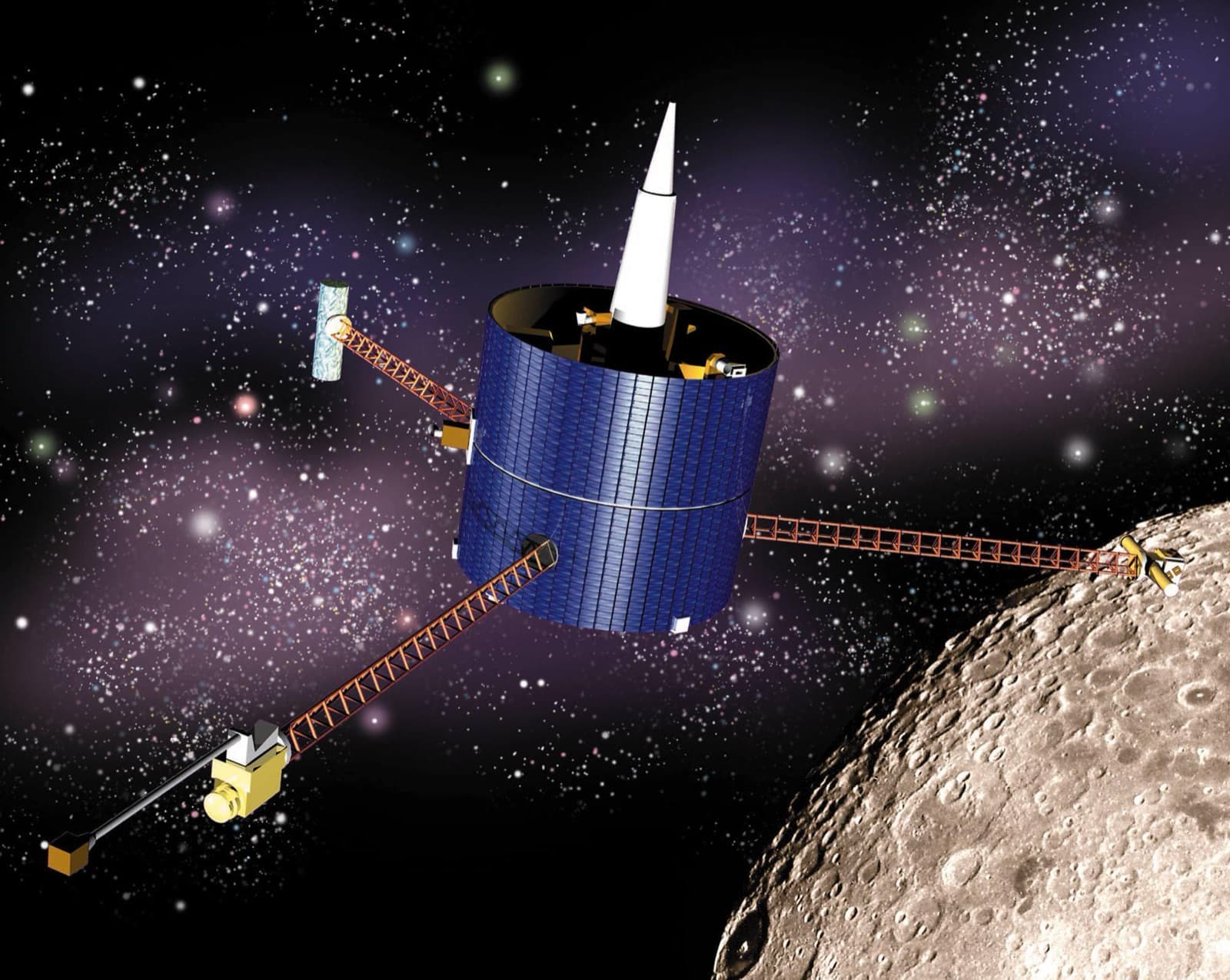
The spacecraft was aggressively simple. A spin-stabilized, solar-cell-covered graphite-epoxy drum of about 300 kg fueled, it carried no onboard computer and was flown entirely by command from the ground, its instruments held clear of the body on three deployed booms: gamma-ray, neutron, and alpha particle spectrometers plus a magnetometer and electron reflectometer, with the radio link itself doubling as a sixth investigation, the Doppler Gravity Experiment. After a 105-hour cruise, the first of three insertion burns captured it on January 11, 1998, and a final trim on January 15 set the mapping orbit: 100 km up, pole to pole every 118 minutes, while the Moon rotated its entire surface beneath the spacecraft.
The headline came fast. In March 1998, after seven weeks of mapping, the team announced that epithermal neutron counts dipped 3.4 percent over the north polar region and 2.2 percent over the south: the signature of hydrogen, most plausibly water ice scattered through the permanently shadowed craters at roughly 0.3 to 1 percent of the soil, an estimated 10 to 300 million metric tons in total. By September 1998, with the first results published in Science, the estimate had grown more than tenfold, to as much as 3 billion metric tons per pole buried under dry regolith. The team was careful about what a neutron spectrometer can and cannot say; Binder put it plainly: "The data do not tell us definitively the form of the water ice." Alongside the water story, the mission compiled the first global maps of surface composition from gamma-ray data, charted the Moon's strange magnetized crustal patches, and sharpened the lunar gravity map that every later orbiter has refined. In December 1998 the orbit was lowered to about 40 km, then on January 28, 1999 to roughly 15 by 45 km, trading lifetime for resolution.
The ending was designed as one last experiment. On July 31, 1999 at 09:52:02 UT, controllers steered Lunar Prospector into a permanently shadowed crater near the south pole at about 1.7 km/s, timed and aimed so that any water vapor kicked above the rim might climb into sunlight and be spotted from Earth. Hubble and ground-based observatories watched; no plume or spectral trace of water appeared. The team had billed it as a long shot, and the null result settled nothing: a 300 kg spacecraft arriving at a shallow angle carried a small fraction of the impact energy of the roughly 2,300 kg Centaur stage that LCROSS would drop on Cabeus crater in 2009, guided by polar hydrogen maps directly descended from Lunar Prospector's, to finally measure the water Prospector's neutrons had implied.
The mission also carried a passenger. Eugene Shoemaker, the founder of astrogeology, trainer of Apollo astronauts, and co-discoverer of Comet Shoemaker-Levy 9, had been kept from flying to the Moon himself by a medical disqualification and died in a car crash in Australia in July 1997. At the suggestion of planetary scientist Carolyn Porco, and arranged as a commercial memorial flight by Celestis with NASA's cooperation, an ounce of his ashes rode to the Moon in a small polycarbonate capsule wrapped in brass foil etched with images of Comet Hale-Bopp and Barringer Crater and a passage from Romeo and Juliet. Days after launch, Navajo Nation President Albert Hale objected that placing remains on the Moon desecrated a sacred body; NASA apologized and promised consultation before any future remains flights, a pledge that resurfaced in 2024 when the Peregrine lander flew about 95 memorial capsules and the Navajo Nation objected again. Peregrine never reached the Moon, so the ounce of Shoemaker's ashes inside the crater the IAU named for him in 2000 remains, as of July 2026, the only human remains on the lunar surface.
04In pictures
Tap a photo to enlarge.
05Sources
- NASA Science: Lunar Prospector mission page (launch time, instruments, orbit, extended mission, impact, ashes)
- Lunar Prospector Mission Handbook, Lockheed Martin, April 1998 (Discovery selection Feb 28 1995, $63M cost, maiden Athena II flight, team, spacecraft design, no onboard computer)
- Lozier et al., AAS 98-323: Lunar Prospector Mission Design and Trajectory Support (LOI burns Jan 11 1998, 100 km circularization Jan 15 1998)
- NASA Ames release via ScienceDaily, March 1998: Lunar Prospector Finds Evidence of Ice at Moon's Poles (neutron dips, 10-300 million ton estimate)
- NASA Ames release via ScienceDaily, September 1998: Latest Findings Indicate Larger Amounts of Water Ice (up to 6 billion metric tons)
- Astronomy.com: What we learned by crashing Lunar Prospector into the Moon (impact speed, plume result, Binder quote; see highStakes for two errors in this source)
- USGS Gazetteer of Planetary Nomenclature, Feature 5494: Shoemaker (51.82 km, 88.14 S 45.91 E, approved 2000)
- The Planetary Society: Eugene Shoemaker profile (death, ashes capsule design by Carolyn Porco, Hale-Bopp and Barringer Crater foil, Romeo and Juliet passage)
- Spokesman-Review, January 15, 1998: Navajos Upset After Ashes Sent to Moon; NASA Apologizes
- Scientific American, January 2024: Human Remains Are Headed to the Moon despite Objections (Shoemaker's ashes on the Moon; Peregrine capsule counts ~70 Celestis + ~25 Elysium; Navajo objections 1998 and 2024)
- Celestis: Luna 01 flight page (commercial arrangement, first lunar memorial flight, NASA cooperation)
- NASA: The Naming of Tooley Crater (LROC PSR mosaic of Shoemaker crater's shadowed floor)
- Astrobotic/Voyager, July 13, 2026: Voyager awarded $298M NASA contract under completed Astrobotic acquisition (Griffin Mission One NET November 2026; status check for the only-remains claim)
azmth is independent and is not affiliated with or endorsed by NASA, CNSA, Roscosmos, ISRO, JAXA, or any other space agency or company named on this page.