SMART-1
ESA (Europe) · Orbiter · 2003Success
Impacted the Moon Sep 3, 2006: last signal 05:42:22 UT from Lacus Excellentiae; the infrared flash was recorded from Hawaii, and LRO images located the 4 by 20 m impact gouge in 2017.
TL;DR· 7 min read
SMART-1 was Europe's first mission to the Moon and, by ESA's count, the second spacecraft to fly ion propulsion as its main engine. It stretched 82 kg of xenon across a spiral of just over 13 months from Earth orbit to lunar capture in November 2004, then ran a 110-million-euro science mission from polar orbit that made the first unambiguous remote-sensing detection of calcium on the Moon. It ended on September 3, 2006 with a deliberate, targeted impact in Lacus Excellentiae whose 20-metre scar was identified in LRO images in 2017.
SMART-1 was Europe's first mission to the Moon, and, by ESA's count, only the second spacecraft to fly ion propulsion as its main engine, after NASA's Deep Space 1. It stretched 82 kg of xenon across a spiral of just over 13 months from Earth orbit to lunar capture, ran a 110-million-euro science mission from polar orbit, and ended on September 3, 2006 with a finale nobody should mistake for a failure: a deliberate, targeted impact in Lacus Excellentiae whose infrared flash was caught by a telescope in Hawaii, and whose 20-metre scar was finally identified in Lunar Reconnaissance Orbiter images in 2017.
Facts as of July 20, 2026, from the sources listed below.
82kg
of xenon carried the mission from Earth orbit to the Moon
4,958hours
of ion engine operation across the mission
€110M
total cost, including launch, operations and a dozen experiments
2km/s
impact speed at a one-degree grazing angle, Sep 3, 2006
Commonly wrong. Four recurring errors. (1) "SMART-1 was the first spacecraft to fly an ion engine." It was not: NASA's Deep Space 1 flew ion primary propulsion from 1998, and ESA's own overview calls SMART-1 the second mission to use ion propulsion as its primary system, a count that itself overlooks Japan's Hayabusa, launched with ion main engines in May 2003, four months before SMART-1. The genuine firsts are narrower and better: first European spacecraft to travel to and orbit the Moon, and the first capture of an ion-propelled spacecraft into orbit around another celestial body. (2) The journey length is quoted anywhere from 13 to 16 months. Launch (September 27, 2003) to lunar capture (November 15, 2004) took about 13 and a half months; reaching the final science orbit took until February 27, 2005, which is where the 16-to-17-month figure comes from. (3) Stale impact coordinates: pre-impact ESA pages predicted 36.44 S, 46.25 W, the impact-night estimate was 34.4 S, 46.2 W, and the actual scar found in LRO images in 2017 sits at 34.262 S, 46.193 W; pages still quoting the prediction are off by about two degrees of latitude. (4) Casual writeups say the mission "crashed" as if it were lost: the impact was a designed finale, steered across June and July 2006 specifically so telescopes on Earth could watch it happen.
01Mission facts
Launch
September 27, 2003, 23:14 UT, Ariane 5 Flight 162 from Kourou, French Guiana, riding as an auxiliary passenger with two commercial telecom satellites into a 742 x 36,016 km transfer orbit↗
Spacecraft
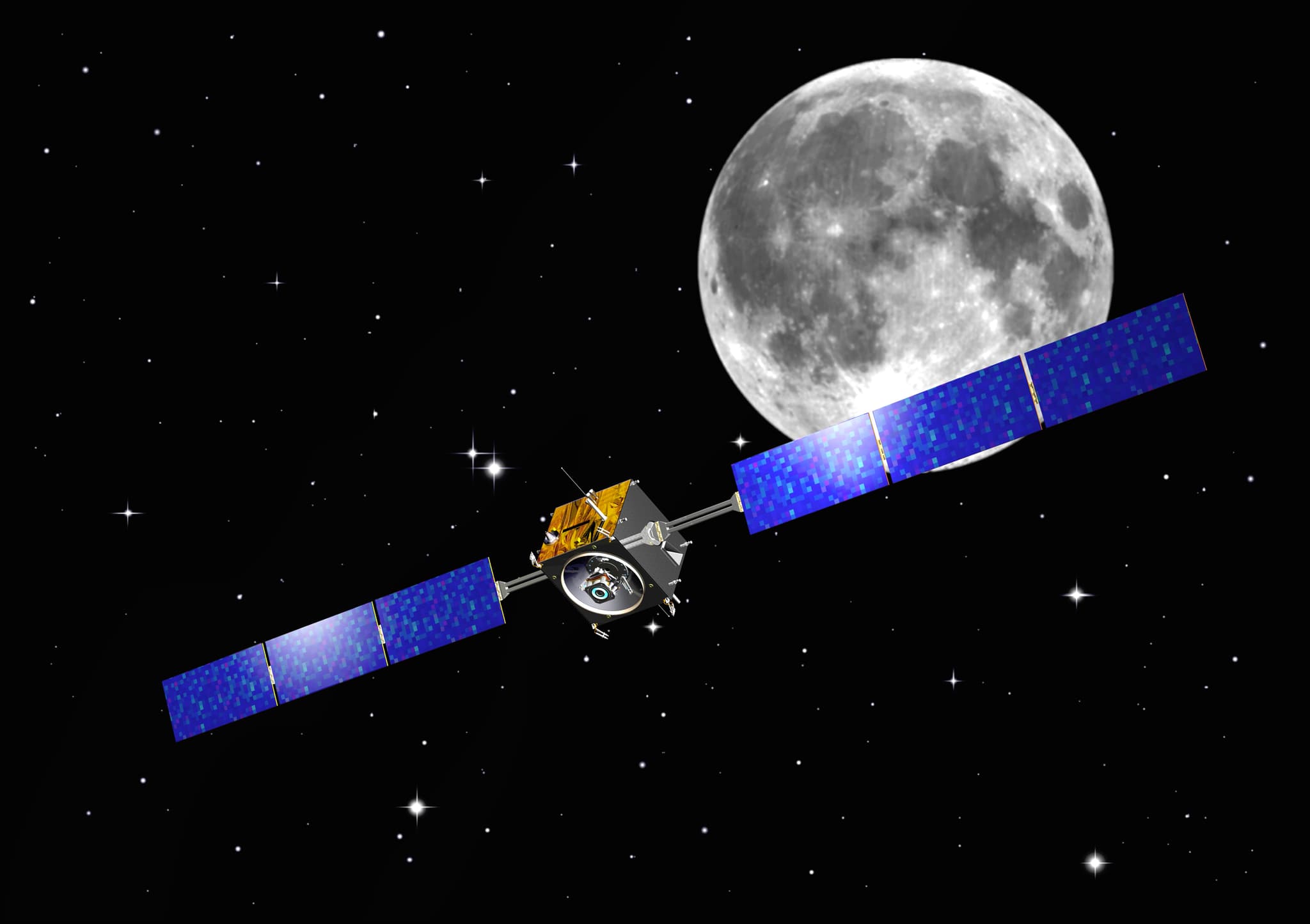
367 kg at launch, including a 19 kg science payload; about 14 m across with solar arrays deployed↗
Propulsion
Snecma PPS-1350 Hall-effect ion engine: 0.07 N of thrust from up to 1,350 W of solar power, fed by 82 kg of xenon↗
Propulsion firsts
By ESA's count, the second mission ever to use ion propulsion as its primary propulsion system, after NASA's Deep Space 1 (launched October 1998); Japan's Hayabusa, launched May 2003, was also already flying ion main propulsion. Unambiguously the first European spacecraft to travel to and orbit the Moon↗
Lunar capture
November 15, 2004, during a five-day braking thrust, after a cruise of about 13 months from geostationary transfer orbit↗
Ion engine totals
4,958.3 hours of thruster operation across the mission; final firing September 17, 2005, with the xenon effectively exhausted↗
Science orbit
Polar ellipse from roughly 300 to 3,000 km altitude, pericentre between 300 and 450 km near the Moon's south pole↗
Instruments
AMIE miniaturized camera, D-CIXS X-ray spectrometer, SIR infrared spectrometer and the XSM X-ray solar monitor, packed into a 19 kg payload↗
Calcium first
January 15, 2005: D-CIXS makes the first unambiguous remote-sensing detection of calcium on the Moon, over Mare Crisium, using a solar flare as its X-ray source↗
Mission cost
110 million euros total, including the launch, operations and a dozen experiments; developed in under four years↗
Impact
September 3, 2006: last signal at 05:42:22 UT via ESA's New Norcia station; impact at about 2 km/s on a roughly 1-degree grazing trajectory at 34.4 S, 46.2 W in Lacus Excellentiae (Lake of Excellence)↗
Flash observed from Earth
The 3.6 m Canada-France-Hawaii Telescope on Mauna Kea recorded the infrared impact flash at 2.12 microns and a debris cloud travelling some 80 km in about 130 seconds; the impact came on lunar orbit 2,890↗
Site: 34.2620°S, 46.1930°W · Lacus Excellentiae (Lake of Excellence) impact gouge (source)
02Mission timeline
27 Sep 2003
Launch at 23:14 UT as an auxiliary passenger on Ariane 5 Flight 162 from Kourou, into a 742 x 36,016 km geostationary transfer orbit
30 Sep 2003
The PPS-1350 ion engine fires in space for the first time, on the fourth orbit; months of perigee thrust arcs follow, the longest 56.7 hours
15 Nov 2004
Lunar capture during a five-day braking thrust: the first time electric propulsion carries a spacecraft to capture by the gravity of another celestial body
15 Jan 2005
During a solar flare, D-CIXS makes the first unambiguous remote-sensing detection of calcium on the Moon, over Mare Crisium
27 Feb 2005
Spiral-down complete: SMART-1 settles into its operational polar science orbit (science observations had already begun in January during the descent)
17 Sep 2005
Final ion engine firing, closing the books at 4,958.3 hours of thruster operation with the xenon effectively spent
19 Jun to 2 Jul 2006
With the xenon gone, a two-week series of manoeuvres on the small hydrazine attitude thrusters steers the inevitable impact away from an unobserved far-side end (due August 17) to the near side, in view of Earth-based telescopes; provision is made for minor trims in late July, August and early September
3 Sep 2006
Impact in Lacus Excellentiae on lunar orbit 2,890; New Norcia loses the signal at 05:42:22 UT, and CFHT in Hawaii records the infrared flash and debris cloud
2017
The impact scar is identified in Lunar Reconnaissance Orbiter camera images: a 4 m wide, 20 m long gouge at 34.262 S, 46.193 W (identification credited P. Stooke/B. Foing et al. 2017; Stooke's analysis published in Icarus, 2019)
Teal dots: events that physically happened in flight or on the Moon. Grey: announcements, namings, contracts, and targets.
03The mission
SMART-1 (Small Missions for Advanced Research in Technology 1) was ESA's first mission to the Moon, flown in the long quiet stretch between the 1990s scouts (Hiten, Clementine, Lunar Prospector) and the 2007 wave from Japan and China. The mission statement was blunt: prove that Europe could fly a planetary mission fast and cheap, with solar-electric propulsion as the headline technology. The result was a 367 kg spacecraft with a body about one metre across and 14 metre solar wings, built under Swedish Space Corporation as prime contractor, developed in under four years for 110 million euros including launch, operations and a dozen experiments.
It left Earth on September 27, 2003 as the cheapest kind of passenger: an auxiliary payload on Ariane 5 Flight 162 out of Kourou, sharing the fairing with the commercial telecom satellites INSAT-3E and e-Bird. Released into a geostationary transfer orbit of 742 x 36,016 km, it lit its Snecma PPS-1350 Hall-effect ion engine for the first time on September 30, during the fourth orbit, and began the climb: 0.07 newtons of thrust, applied patiently in arcs (the longest a 56.7-hour continuous burn), spiralling outward through the radiation belts for over 13 months. Lunar capture came on November 15, 2004 during a five-day braking thrust. By ESA's count SMART-1 was the second mission to use ion propulsion as its primary drive, after NASA's Deep Space 1 (Japan's Hayabusa, launched that May, was already flying to an asteroid on its own ion engines), and this was the first time an ion-propelled spacecraft had been captured into orbit around another celestial body.
From a polar ellipse of roughly 300 x 3,000 km, pericentre near the south pole, SMART-1 spent about a year and a half surveying the Moon with a 19 kg payload of deliberately miniaturized instruments. The AMIE camera mapped the surface and the polar illumination, identifying a peak of quasi-eternal sunlight near Shackleton crater of the kind future bases could use for solar power. D-CIXS, an X-ray spectrometer squeezed into a 15-centimetre cube weighing under five kilograms, used solar flares as its light source: on January 15, 2005 it made the first unambiguous remote-sensing detection of calcium on the Moon, over Mare Crisium, and it went on to the first detection of titanium and the first global X-ray fluorescence mapping of the surface. SIR, the first infrared spectrometer flown around the Moon, picked out pyroxene and olivine in crater walls and central peaks.
The xenon ran out first. The engine fired for the last time on September 17, 2005, after 4,958.3 hours of operation, and from there gravity set the clock: orbital perturbations were dragging the low point of the orbit down, and with no xenon left there was no escape. ESA turned the inevitable into an experiment. A two-week series of manoeuvres between June 19 and July 2, 2006, flown on the spacecraft's small hydrazine attitude thrusters, moved the impact point from the unobservable far side to the near side, timed and placed for Earth-based telescopes. On September 3, 2006, on its 2,890th lunar orbit, SMART-1 came in at about 2 km/s on a one-degree grazing slope over Lacus Excellentiae, the Lake of Excellence, a volcanic plain in the mid-southern latitudes it had photographed in advance with its own camera. ESA's New Norcia station lost the signal at 05:42:22 UT, and on Mauna Kea the 3.6 m Canada-France-Hawaii Telescope caught the infrared flash at the predicted spot, followed by a debris cloud that swept some 80 km across the surface in about 130 seconds.
The flash gave a first fix on the grave: 34.4 S, 46.2 W. Eleven years later, in 2017, the scar itself was identified in Lunar Reconnaissance Orbiter camera images: a gouge about 4 m wide and 20 m long at 34.262 S, 46.193 W, cut north to south across a small crater, with brighter ejecta fanned downrange. The propulsion experiment paid off on schedule. SMART-1's combination of low continuous thrust with lunar gravity assists rehearsed the technique ESA's BepiColombo mission went on to use on its long cruise to Mercury, and the mission's more-science-for-less-money model became ESA's template for doing planetary exploration on a small budget.
04In pictures
Tap a photo to enlarge.
05Sources
- ESA press release: Impact landing ends SMART-1 mission to the Moon (impact time, location, speed, spacecraft, instruments)
- ESA Science & Technology: SMART-1 launch phase (launch time, Flight 162, GTO parameters, first ion firing, longest burn)
- ESA: SMART-1 overview (first European Moon orbiter, second primary ion propulsion mission by ESA's count, 367 kg, 13-month cruise)
- ESA: Ion engine gets SMART-1 to the Moon (November 15, 2004 capture, ~5,000 hours, 82 kg xenon, 3.5 km/s delta-v)
- ESA: SMART-1 operations (0.07 N thrust, 1,350 W, 300 to 3,000 km polar orbit)
- NASA Science: SMART-1 mission page (launch 23:14:46 UT, Ariane 5G V162, PPS-1350, 4,958.3 engine hours, final firing Sept 17, 2005, Feb 27, 2005 operational orbit, first electric-propulsion capture by another body)
- ESA: SMART-1 detects calcium on the Moon (January 15, 2005 solar flare, Mare Crisium, D-CIXS)
- ESA: SMART-1 science highlights (first IR spectrometer at the Moon, first global X-ray fluorescence mapping, titanium, peak of quasi-eternal sunlight)
- ESA: SMART-1 impact flash and debris, crash scene investigation (CFHT flash at 2.12 microns, 80 km debris cloud, orbit 2,890, last-signal timings)
- ESA: SMART-1 towards final impact (June 19 to July 2, 2006 hydrazine manoeuvres, 2 km/s grazing arrival, expected crater size, pre-impact coordinate prediction)
- ESA: SMART-1, the first spacecraft of the future (110 million euro cost, under four years development)
- ESA image: SMART-1's crash site (2017 LROC identification, 34.262 S, 46.193 W, 4 x 20 m gouge)
- Stooke 2019, Icarus 321 (pp. 112-115): Identification of the SMART-1 spacecraft impact location on the Moon
- ESA: How SMART-1 has made European space exploration smarter (solar-electric propulsion legacy for BepiColombo)
- Phys.org: Image, SMART-1's crash site (Stooke/Foing identification details, gouge dimensions)
azmth is independent and is not affiliated with or endorsed by NASA, CNSA, Roscosmos, ISRO, JAXA, or any other space agency or company named on this page.