Is there a new crater on the Moon?
Facts as of 16 September 2026
Yes. McGetchin crater, 222 m across, formed on the Moon between 11 April and 22 May 2024 when a small asteroid or comet fragment hit the surface. It was found in 2025 in images from NASA’s Lunar Reconnaissance Orbiter (LRO), and two papers in Science Advances announced it on 16 September 2026. It was a natural impact, not a spacecraft or a rocket.
Where is McGetchin crater?
At 1.3536°N, 67.1765°E, on the eastern part of the Moon’s near side. The crater sits on or near the boundary between the bright highlands and the dark mare plains, just inside the outer ring of the Crisium impact basin (a ring 1,080 km across), 20 km east of Mare Spumans and southeast of the crater Dubyago N. That position is the crater’s centre as measured on a 3 m LRO terrain model (Robinson et al. 2026), and Powell et al. 2026 give the same value. The IAU Gazetteer rounds it to 1.35°N, 67.18°E, a point about 150 m away and outside the crater, so use the four-decimal figure.
You can see where it is on our 3D Moon. It has its own marker for natural impacts there, kept separate from the places human hardware has reached.
How big is the new Moon crater, and how rare is it?
Very big for a new crater, and rare. McGetchin is 222 m across and 43 m deep, about three times wider than the previous largest new crater found since LRO’s mission began in 2009, a 70 m crater that formed in Mare Humorum in October 2012. Crater production models put an impact this size at about once every 132 years on the Moon. That is a model average, not an observed rate; NASA puts it at about once a century or longer.
| Quantity | Figure | Kind |
|---|---|---|
| Diameter, rim to rim | 222 m (213 to 231 m) | Measured |
| Depth | 43 m | Measured |
| Depth to diameter | 0.19 | Measured |
| Rim height above the old surface | 7.7 m (median) | Measured |
| Largest ejected boulders | 13 × 9 × 3 m and 8 × 7 × 2 m | Measured |
| Formed | between 11 April and 22 May 2024 | Bounded by images |
| Impact energy | About 6.5 × 10¹³ J | Estimate |
| How often an impact this size happens | About once every 132 years | Model average |
| Previous largest new lunar crater | 70 m, Mare Humorum, October 2012 | Measured |
The energy figure is Robinson and colleagues' estimate, and it rests on two assumptions: an impactor 3 g/cm³ dense arriving at 15 km/s. That is about 27 times the 2.4 × 10¹²J estimated for the 70 m crater. Neither paper gives the size of the object that hit. NASA's own estimate, which it says will appear in a future paper, is "a comet or asteroid the size of a three- to six-story building". Robinson and colleagues say only "a small cometary or asteroidal fragment".
Robinson and colleagues describe McGetchin as the largest contemporary impact crater found in the Solar System. For comparison, the new crater that formed on Mars on 24 December 2021 in Amazonis Planitia, which NASA/JPL called one of the largest ever seen forming, is about 150 m across.
How was the new crater found?
Robert Wagner of Intuitive Machines, where the LRO camera team now works under a NASA contract, spotted it in 2025 while checking data from LRO’s Wide Angle Camera, in a routine comparison of new images of the surface with older ones. The sources disagree on when: NASA says 24 October 2025, both papers say autumn 2025, and the LRO camera team’s own post says late summer 2025. What stood out was a bright spot of fresh ejecta. The crater itself is only about two Wide Angle Camera pixels wide.
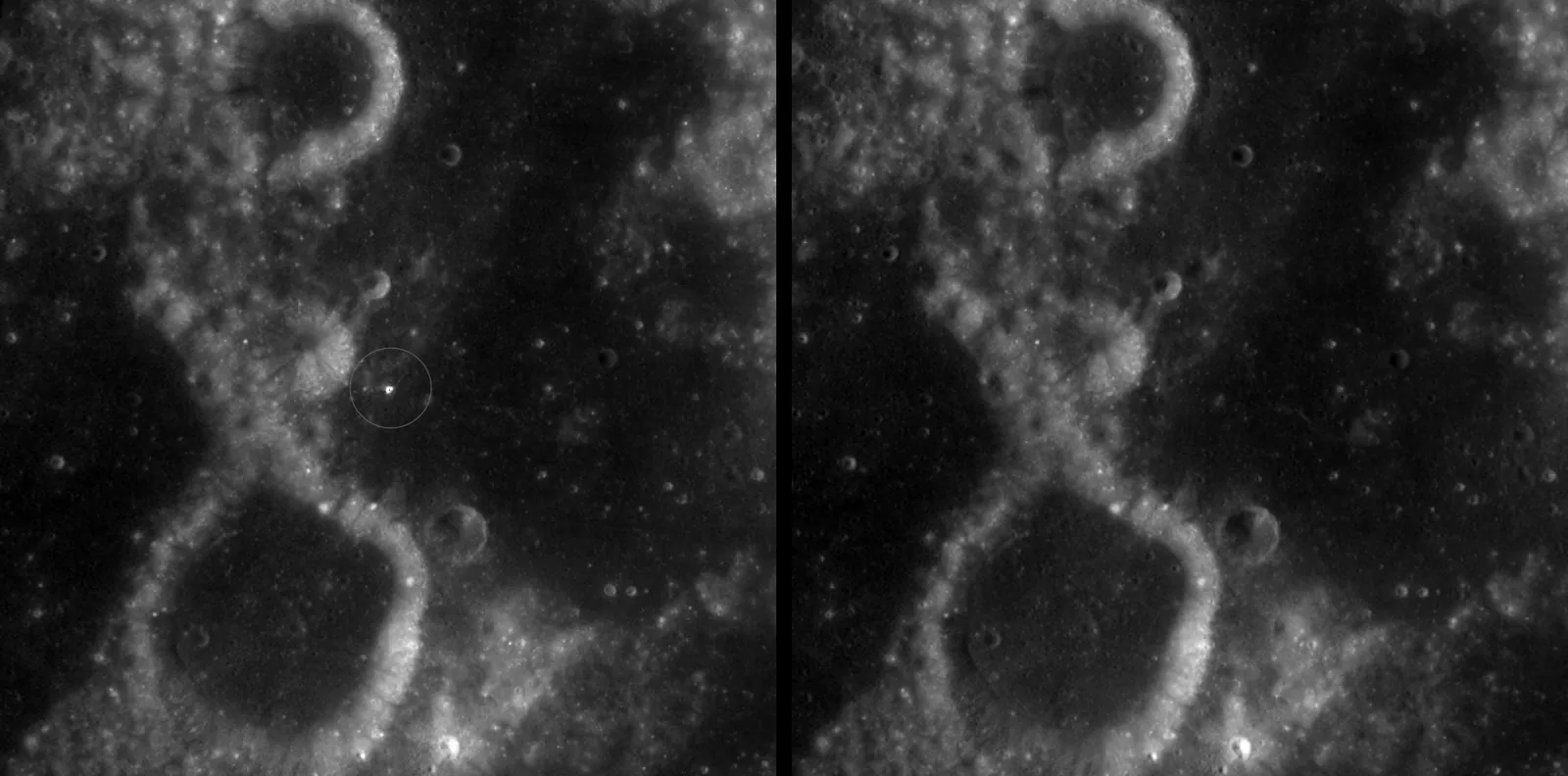
Once it was spotted, LRO's Diviner instrument began observing the site on 1 November 2025, and the Narrow Angle Camera photographed it in detail. Stereo images taken on 25 and 26 December 2025 produced the 3 m terrain model that the crater's position, size and depth are measured on. NASA says LRO has found at least 1,000 new craters over its mission; the Diviner paper calls McGetchin by far the largest.
Before and after
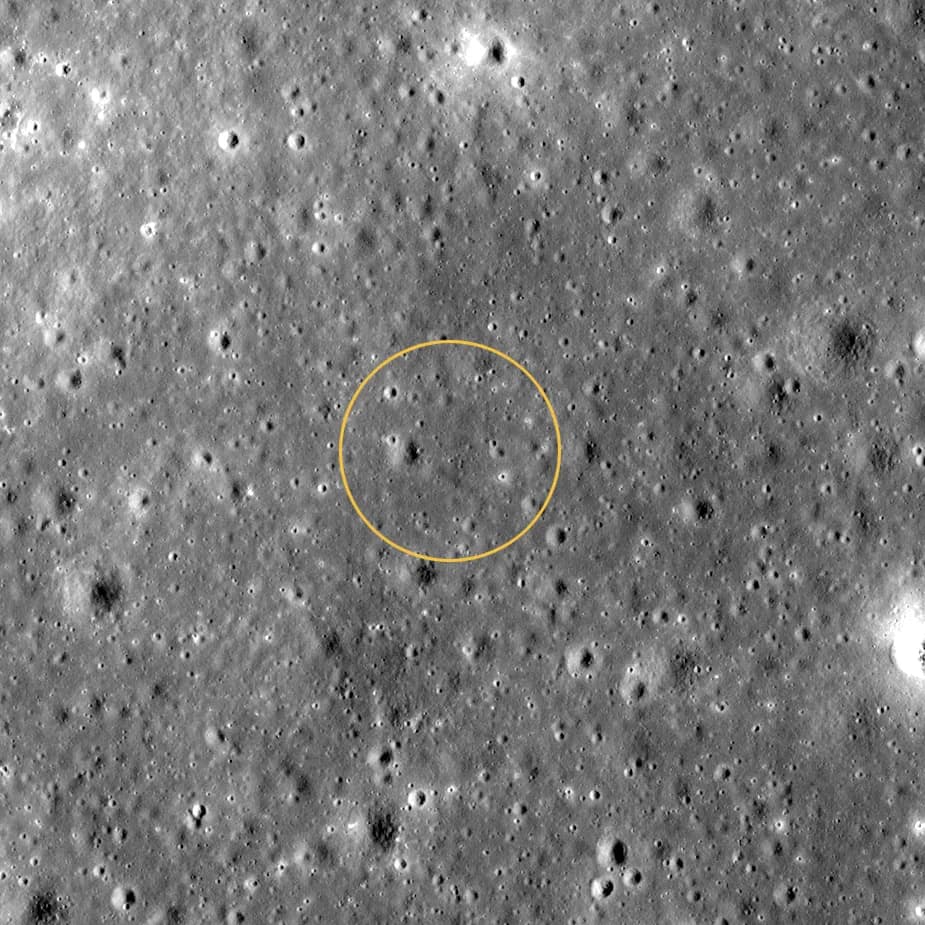
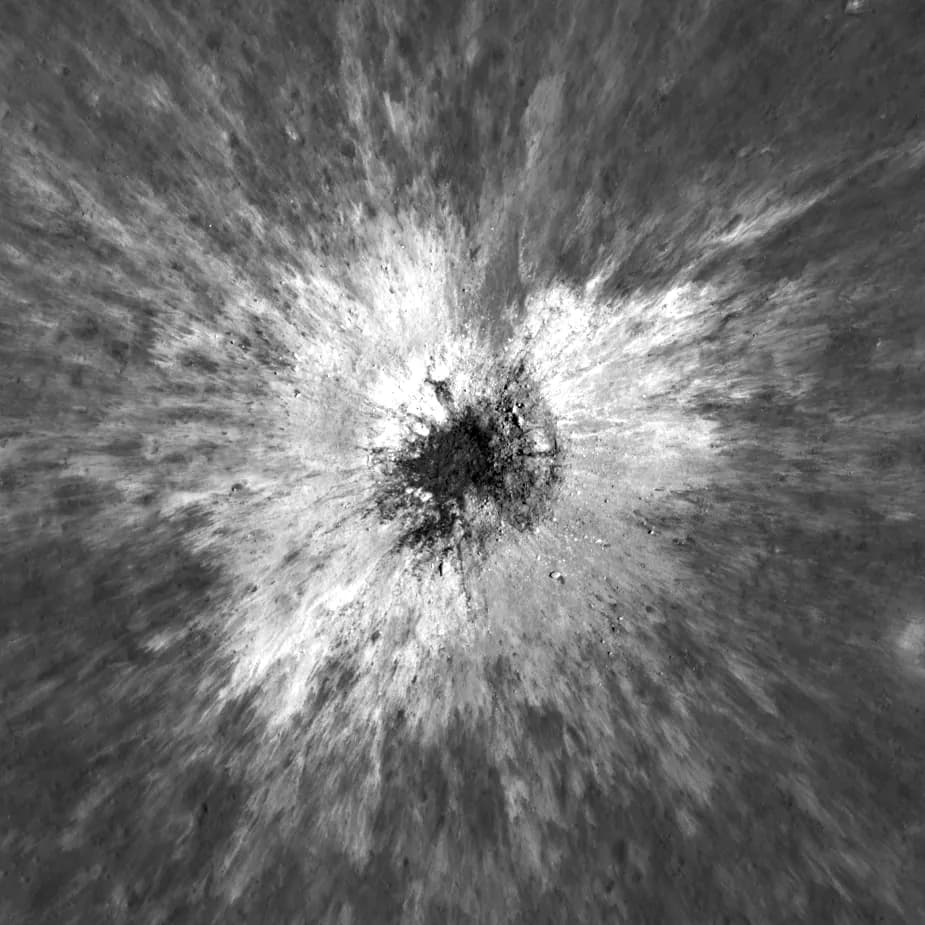
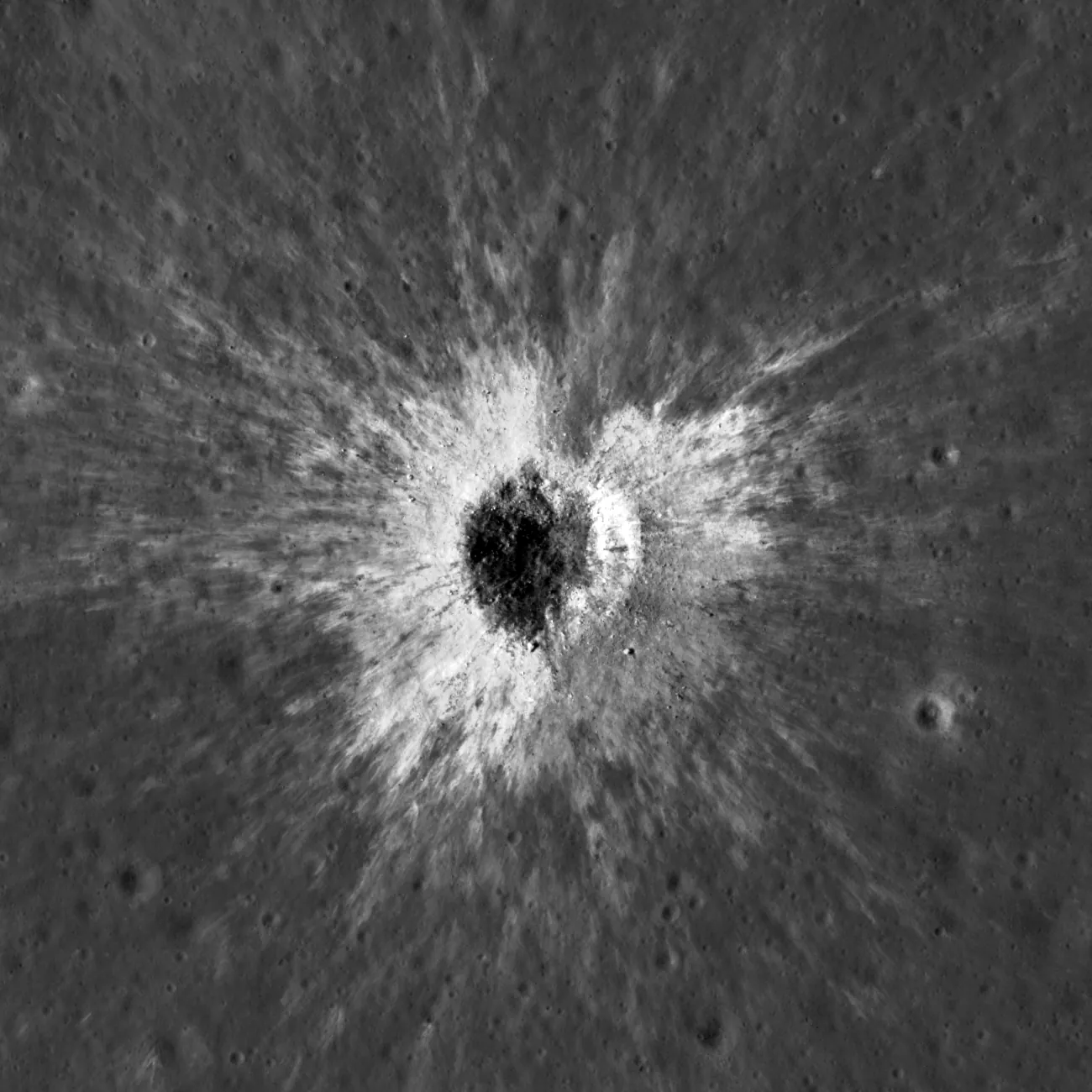
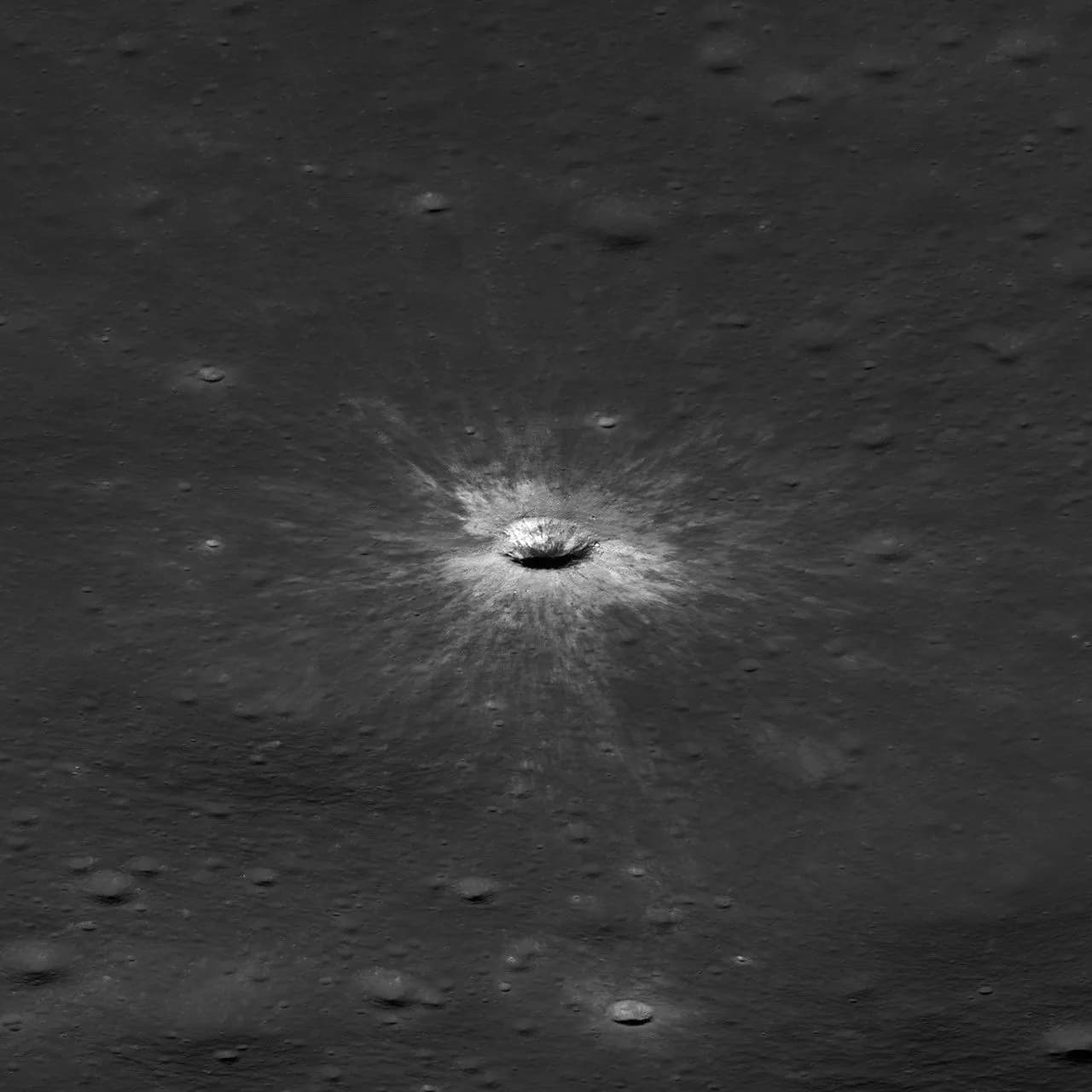
The same patch of ground, 925 m wide, in 2018 and in December 2025. Drag the divider to compare. The Sun was at a different angle in each, so the older ground differs in tone as well.
What did the impact do to the surface?
Far more than its size suggests. A continuous blanket of ejecta reaches a median of about 258 m from the crater’s centre, with boulders up to 13 m long thrown onto the rim and its flanks. Beyond that, a bright zone of disturbed ground extends to about 15 km, and patchier, darker disturbance reaches more than 100 km away. At night LRO’s Diviner instrument sees a cold spot about 7 km wide that is 8 to 9 K cooler than its surroundings, because the impact fluffed up the loose surface soil.
The largest block, 13 by 9 by 3 m, sits on the southern rim. The LRO camera team says the ejecta arrived in at least two waves, and that the fastest material, jetted out at the start of the impact, must have left at steeper angles than usually assumed: more than 10 degrees rather than about 2. The Diviner team measured the cold spot's largest difference at 8.61 K, and found that every new crater larger than about 30 m they studied has a cold spot of its own.

Can I see the new crater from Earth?
No. At the Moon’s distance a crater 222 m wide spans only about 0.12 arcseconds, far too small to pick out from Earth, and McGetchin lies towards the Moon’s eastern limb, where the ground is seen at a steep slant. No impact flash was reported, and the crater was only found in spacecraft images more than a year later.
Is this the crater the SpaceX rocket made?
No. McGetchin was made by a natural impact in 2024, and every primary source puts it down to a comet or asteroid fragment. It is not the crater a spent Falcon 9 upper stage made on 5 August 2026, which is about 18 m across and near Einstein crater on the western limb, and it is not the double crater a rocket body left on the far side in 2022. McGetchin is far larger than either.
The two rocket impacts have pages of their own, Falcon 9 upper stage (2025-010D) and WE0913A (2022 rocket body), and so does the question Did a SpaceX rocket crash into the Moon?
Why is it called McGetchin?
It is named after Thomas R. McGetchin (1936 to 1979), an American geologist and planetary scientist. He became director of the Lunar Science Institute in 1977, and it was renamed the Lunar and Planetary Institute under him. The LRO camera team proposed the name, and the International Astronomical Union approved it on 4 May 2026, months before the crater was announced.
Robinson and colleagues use an ejecta model McGetchin published with M. Settle and J. W. Head in 1973 to estimate how much of the new rim is ejecta. The main-belt asteroid 2891 McGetchin, discovered in 1980, is a different object and has nothing to do with this impact.
Sources
- Robinson et al., A new 222-m diameter lunar crater, Science Advances 12, eaeh7812 (16 September 2026)
- Powell et al., New lunar crater reveals extensive distal regolith modification, Science Advances 12, eaeh9568 (16 September 2026)
- IAU Gazetteer of Planetary Nomenclature: McGetchin (feature 16447)
- LROC: Spectacular McGetchin Crater (16 September 2026)
- NASA: NASA’s Moon Orbiter Spots New, ‘Once-in-Century’ Moon Crater (16 September 2026)
- USRA: NASA's Lunar Reconnaissance Orbiter discovers a new 222-m diameter lunar crater (16 September 2026)
- Speyerer et al., Planetary Science Journal 7, 73 (2026): the 70 m crater of 2012
- Geological Society of America: Memorial to Thomas R. McGetchin
- NASA/JPL: the new Mars crater of 24 December 2021
Not affiliated with NASA, Intuitive Machines, or any space agency. The crater's position, size, depth, boulders and night-time temperatures are measured. The impact energy is an estimate that depends on an assumed density and speed, how often such impacts happen is a model average, and the impactor's size is NASA's estimate, not a published result. The photographs are used under their sources' terms with the credit given under each one, and are not part of azmth's CC BY data.