Artemis IV (Artemis 4)
Announced
TL;DR· 1 min read
Artemis IV is now the first crewed Moon landing of the program, targeted early 2028 (as of September 28, 2026), having inherited the landing in the February 2026 renumbering. Four astronauts fly to lunar orbit aboard Orion; two descend to the south pole region for about a week, at one of nine candidate landing regions. The lander is deliberately unassigned, Starship HLS or Blue Moon, and a March 2026 NASA OIG report called it too early to judge whether either can be readied for a 2028 landing.
The first Artemis Moon landing is Artemis IV, targeted early 2028 (as of September 28, 2026). The lander is deliberately unassigned (Starship HLS or Blue Moon): NASA says lander readiness will determine which provider flies the crew. A March 2026 NASA OIG report flags schedule risk for both landers.
Facts as of September 28, 2026, from the NASA sources listed below.
early 2028
Targeted launch
~1week
On the surface
9
Candidate landing regions
2
Astronauts to the surface
Targets are NASA's current plan (as of September 28, 2026) and can change.
Announced, not flown. Dates and details on this page describe NASA's current plan and can change; every claim carries its announcement date. The Artemis schedule has been restructured before (February 27, 2026).
01Mission facts
Significance
First crewed lunar landing since Apollo 17 in December 1972
Profile
Four astronauts launch on SLS with Orion; two descend to the surface, two remain in orbit
Surface science
Field geology, sample collection and return, and deployed experiments
Landing area
Lunar south pole region (candidate regions under evaluation)
Lander
Not yet assigned (SpaceX Starship HLS or Blue Origin Blue Moon)
02Crew
The crew is not yet announced.
03The mission
Artemis IV inherited the landing after the February 2026 renumbering. Four astronauts will fly to lunar orbit aboard Orion; two will transfer to a commercial lander, descend to the south pole region, and spend about a week on the surface before returning to Orion for the trip home. NASA describes the mission as "one of the most complex undertakings of engineering and human ingenuity in the history of deep space exploration."
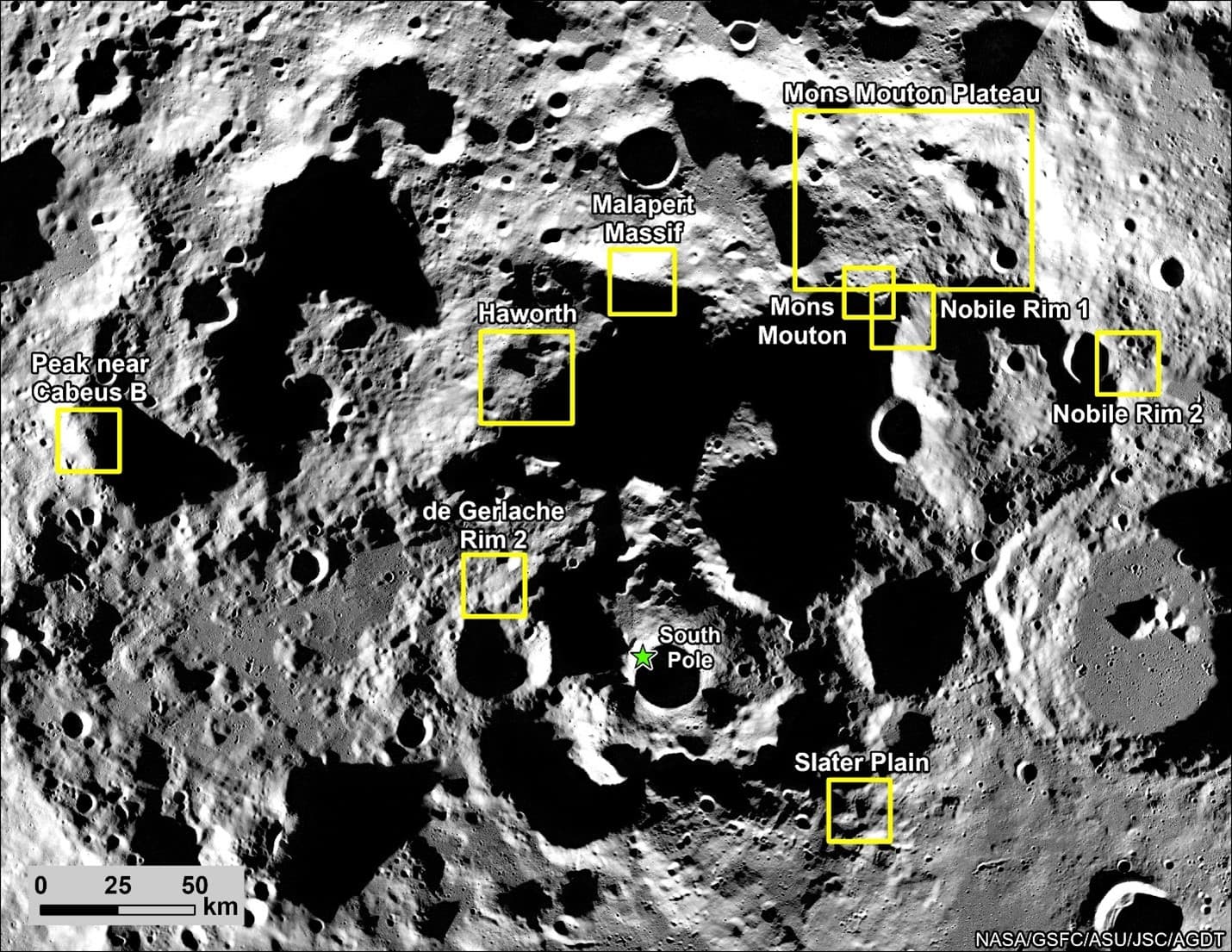
The south pole is the target because permanently shadowed craters there may hold water ice, a resource for any sustained presence. Which of the nine candidate regions hosts the landing will be narrowed as the mission matures.
The nine candidate landing regions (announced October 28, 2024): Peak near Cabeus B, Haworth, Malapert Massif, Mons Mouton Plateau, Mons Mouton, Nobile Rim 1, Nobile Rim 2, de Gerlache Rim 2, Slater Plain. Candidate regions for the first Artemis landing, announced for what was then Artemis III and carried over to Artemis IV after the February 2026 renumbering.
Schedule risk, on the record: A March 2026 NASA Office of Inspector General report found that SpaceX's lander would not be ready for the old June 2027 landing date, and that it was too early to judge whether proposals to speed up either lander could meet a 2028 landing date. At the time, SpaceX had yet to fly its ship-to-ship cryogenic propellant transfer test or an uncrewed lunar landing, and Blue Origin's crewed lander had not yet passed its critical design review. (NASA OIG).
04Launch architecture in flux
NASA states that the interim cryogenic propulsion stage will be replaced with a new second stage, and that it is "no longer planning to use the Exploration Upper Stage or Mobile Launcher 2, as development of both has faced delays." On March 6, 2026, NASA’s Marshall Space Flight Center posted its intent to buy the replacement from United Launch Alliance without competition: modified Centaur V upper stages, two for flight and one spare, for Artemis IV and Artemis V. NASA’s justification calls the Centaur "the only existing in-space propulsion stage capable of meeting the SLS upper stage design parameters and performance characteristics, while also meeting NASA’s schedule." Artemis III, which stays in low Earth orbit, flies a spacer in place of an upper stage (as of September 28, 2026).
05After Artemis IV
NASA targets Artemis V, a further lunar surface mission, by late 2028 (as of September 28, 2026), and about one lunar surface mission per year after that. Artemis V is also when NASA expects to begin building its Moon base (per the March 2026 architecture update).
06Sources
- NASA: Artemis architecture announcement (Feb 27, 2026)
- NASA: Artemis IV mission page
- NASA: landing regions update (Oct 2024)
- NASA OIG: lander program schedule risks (2026)
- NASA MSFC: sole-source justification for Centaur V upper stages, Artemis IV and V (Mar 6, 2026)
azmth is independent and is not affiliated with or endorsed by NASA.