Transits of Venus
The next transit of Venus is on 10 to 11 December 2117. How transits measured the Sun's distance, from Horrocks in 1639 to SDO, Hinode and Hubble in 2012.
TL;DR· 19 min read
A transit of Venus is the rare crossing of Venus over the Sun's face, possible only in early June or early December and arriving in pairs eight years apart with gaps of over a century. Halley proposed timing transits to measure the Sun's distance, and expeditions in 1761, 1769, 1874 and 1882 tried; Lomonosov concluded from what he saw in 1761 that Venus has an atmosphere. In 2012 SDO, Hinode and Hubble treated Venus as a stand-in exoplanet. The next transit is on 10 to 11 December 2117.
When is the next transit of Venus?
The next transit of Venus is on 10 to 11 December 2117 (UT), and the one after on 8 December 2125; the last was on 5 and 6 June 2012. A transit is the few hours in which Venus, passing between Earth and the Sun, is seen as a small black disc crossing the Sun's face. It can happen only when that passage falls in early June or early December, the two times of year when Venus crosses the plane of Earth's orbit, so transits come in pairs eight years apart separated by gaps of more than a century: 1631 and 1639, 1761 and 1769, 1874 and 1882, 2004 and 2012. Edmond Halley showed in 1716 how timing a transit from distant places could give the distance to the Sun, and the expeditions of 1761, 1769, 1874 and 1882 were sent round the world to do it. In 1761 Mikhail Lomonosov saw light at the planet's edge as it left the Sun and concluded that Venus has an atmosphere. In 2004 and 2012 the transit became a rehearsal for studying planets around other stars, watched from orbit by NASA's Solar Dynamics Observatory, Japan's Hinode and, by way of the Moon, the Hubble Space Telescope.
- 243 yearslength of the cycle in which transits recur: a pair 8 years apart, a gap of 121.5 or 105.5 years, another pair
- 7transits seen so far: 1639, 1761, 1769, 1874, 1882, 2004 and 2012 (the predicted 1631 transit went unseen)
- 2117year of the next transit, on 10 to 11 December (UT), followed by 8 December 2125
Venus circles the Sun inside Earth's orbit, and each time it overtakes Earth it passes between us and the Sun, a moment called inferior conjunction. Usually it slips by above or below the solar disc, because its orbit is tilted against ours. NASA's transit catalogue, compiled by Fred Espenak, gives the condition: Venus's orbit crosses Earth's orbital plane in early June and early December, and only a conjunction falling on one of those crossings puts the planet in front of the Sun. Eight Earth years hold almost exactly thirteen orbits of Venus, so a transit is often repeated eight years later; but Venus reaches each rendezvous about 2.45 days early, and after a pair the alignment drifts out of reach until the opposite node comes round, 105.5 or 121.5 years on. The whole pattern repeats every 243 years.
What an observer sees is modest. In 2004 and 2012 Venus was about one thirty-second of the Sun's width and took more than six hours from first contact, when its edge touches the Sun, to fourth, when it leaves. The dimming is tiny. In 2004 the ACRIM 3 radiometer on NASA's ACRIMSAT satellite measured it: Glenn Schneider, Jay Pasachoff and Richard Willson report a fall of about 1.4 watts per square metre at mid-transit, close to 0.1 per cent, matching the area of the Sun that Venus covered.
Kepler's prediction came to nothing. His Rudolphine Tables of 1627 foresaw a transit in December 1631, and Pierre Gassendi prepared to watch from Paris, but, as Britain's HM Nautical Almanac Office tells it, the tables could not show that it would happen before sunrise in western Europe. Eight years later Jeremiah Horrocks, working from his own recalculation of Venus's motion, predicted the 1639 transit and caught it from Much Hoole, near Preston in Lancashire, shortly before sunset on 4 December (24 November in the Julian calendar England still used). The Almanac Office calls this the first successful observation of a transit of Venus and thinks the only other observer was his friend William Crabtree in Manchester, whom Horrocks had urged by letter to watch. Costantino Sigismondi's reconstruction adds that Horrocks found Venus far smaller than Kepler supposed and put the Sun's distance at the equivalent of about 95.7 million km.
Edmond Halley turned the spectacle into an instrument. In a 1716 paper in the Philosophical Transactions, reproduced on NASA's eclipse site in its 1809 translation, he recalled timing a transit of Mercury from St Helena and argued that Venus, much nearer Earth, would serve far better. Observers far apart in latitude see Venus cross the Sun along slightly different chords, so the transit lasts measurably different times for them; from those differences follows the solar parallax, the tiny angle Earth's radius makes as seen from the Sun, and with it the Sun's distance. Halley claimed it could be found to within its five-hundredth part. A note appended to the 1809 translation is sober: 1761 proved much less favourable than he expected, because the motion of Venus's node was poorly known, and he had added two angles that should have been subtracted.
The first test came on 6 June 1761, 26 May in Russia's Old Style calendar. Vladimir Shiltsev and Igor Nesterenko, writing in the Russian magazine Science First Hand in 2012, count more than 170 astronomers returning from 117 expeditions. The St Petersburg Academy staffed its own observatory and sent observers to Irkutsk and Selenginsk, while the French abbé Jean Chappe d'Auteroche observed from Tobolsk. The harvest was thin: Amédée Guillemin's Le Ciel (1877) blames stations whose transit durations differed too little and the practical difficulties of installing the observers.
Mikhail Lomonosov, at his house on the Fontanka in St Petersburg, cared more about physics than the clock. His report describes a two-lens telescope four and a half feet long, which the 2012 reconstruction team identifies as an early Dollond achromat, with a deliberately weak filter of lightly smoked glass. As Venus approached, the Sun's edge turned indistinct, as though smudged. At egress, when the planet's leading edge was about a tenth of its diameter from the limb, a bump of light rose on the Sun's edge ahead of it and then vanished. He reasoned that Venus 'is surrounded by a considerable atmosphere of air, such as (if not greater than) the one that pours around our terrestrial globe', the bump being sunlight refracted in it. Russian writers call the effect the Lomonosov phenomenon.
Whether he saw what he believed he saw became a live argument before the 2012 transit. Jay Pasachoff and William Sheehan, in the Journal of Astronomical History and Heritage in 2012, concluded that Lomonosov inferred the atmosphere from observations related to the black drop, an optical effect unconnected with Venus's air, and that the credit should go instead to several observers of 1761 and 1769 who may have seen the aureole genuinely, David Rittenhouse in 1769 perhaps with the strongest claim. Shiltsev answered in the same journal in 2014 that Lomonosov's claim remains the strongest, since he was the first to publish a comprehensive report and the first to explain the aureole in detail. The camps overlap more than their titles suggest: Shiltsev and Nesterenko accept that the smeared limbs at first and last contact most likely came from telescope imperfections and Earth's turbulent air, so the quarrel narrows to the thin glow and the bump. By their account the discovery was credited for over a century and a half to Johann Schröter and William Herschel, who in 1790 saw small bright horns on a half-lit Venus, and Soviet astronomers publicly restored Lomonosov's priority only in the 1950s.
The 2012 transit offered a test. Alexandre Koukarine, Igor Nesterenko, Yuri Petrunin and Shiltsev re-enacted the observation with eighteenth-century refractors. Koukarine, at Lick Observatory in California, used a 4.5-foot Dollond achromat and a filter passing about 1/6,000 of the light, and saw bright whiskers curling round Venus and then the full arc. Their paper concludes that Lomonosov's telescope was fully adequate to detect the arc if his technique was followed. In 2014 Igor and Alfiya Nesterenko argued in Priroda that the 1761 figures are sketches of an image projected behind the eyepiece, with Sun and Venus in proportion to within 0.5 per cent. Lomonosov's own telescope, they note, was lost during the Second World War; in 2014 they had begun assembling a close copy, meant to be handed on for the transit of 2117.
The 1769 transit, on 3 and 4 June, went better. Lieutenant James Cook and the astronomer Charles Green, on a voyage sponsored by the Royal Society, observed from Point Venus on Tahiti under a cloudless sky. Maximilian Hell watched from Vardø in Arctic Norway, and Pulkovo's history records that Catherine II herself took part in the Russian observations. Chappe d'Auteroche went to Baja California and died there, of yellow fever according to the Nautical Almanac Office and of typhus according to Shiltsev and Nesterenko. Guillaume Le Gentil was clouded out at Pondicherry; from Manila, his first choice, he would have seen it. The timings still scattered. Guillemin gives the solar parallax from 1769 as between 8.50 and 8.88 arcseconds, roughly 155 to 148 million km for the Sun's distance, and Johann Encke's reanalysis as 8.57 arcseconds (about 153.5 million km), long adopted and later found too small.
Why could skilled observers with good clocks do no better? Cook named the problem. His journal for 3 June 1769, quoted by Pasachoff and Sheehan, describes 'an Atmosphere or dusky shade round the body of the planet which very much disturbed the times of the Contacts'. Near second and third contact the black disc seems to cling to the Sun's edge by a dark ligament, the black drop, and the instant of contact smears across many seconds. It was long blamed on Venus's atmosphere, and still is in places: announcing the 2012 transit, the Special Astrophysical Observatory of the Russian Academy of Sciences explained the dark bridge that way. Glenn Schneider, Pasachoff and Leon Golub separated its main contributors with NASA's TRACE spacecraft at the 1999 transit of Mercury, a planet without an atmosphere: the telescope's blurring of the image combined with the steep darkening of the Sun towards its edge. Espenak concludes that timings of the accuracy Halley needed are impossible because of seeing and diffraction, though 1761 and 1769 still gave astronomers their first good value for the Sun's distance.
By 1874 photography, better clocks and telegraphed longitudes promised the precision the eighteenth century had lacked, and the Almanac Office counts expeditions from a dozen countries, sent from Vladivostok and Peking to Kerguelen and New Zealand. Pulkovo Observatory's history describes a commission under Otto Struve that equipped every station from Pulkovo, including two Dollond telescopes that had served in 1769; 27 stations were chosen, 25 of them in Russia. At Simon Newcomb's request Lieutenant Mikhail Onatsevich joined the Americans at Vladivostok with a six-inch refractor, and Karl Struve, the Russian envoy in Japan, took part in the observations there (with Austrian and Mexican parties, says the Pulkovo history, though the Japanese accounts name no Austrian one). On the day the weather at every Russian station was unsettled, though Bernhard Hasselberg's reduction of the photographs taken at Posyet harbour was published in 1877.
Japan hosted three of the 1874 expeditions, before Tokyo University or the Tokyo Astronomical Observatory existed. The National Astronomical Observatory of Japan tells how the Meiji government asked David Murray, the American adviser to the Ministry of Education, to explain; his memorandum, 'Venus crossing the Sun', made the case for helping them. The United States observed from Ōhirayama in Nagasaki, now Hoshitoriyama; Jules Janssen's French party from Konpira-yama in Nagasaki, with a detachment on Suwayama in Kobe; and Mexico, which by NAOJ's account sent parties to Japan alone, from Nogeyama and Yamate in Yokohama under Francisco Díaz Covarrubias. The government strung a telegraph line from the Yokohama telegraph office to the Mexican station, letting it exchange signals with the American and French parties for longitude and send results to Greenwich. The weather split the outcome. At Nagasaki it prevented a full observation, says the Astronomical Society of Japan, though Nagasaki Prefecture's citation says Janssen's party of six succeeded; Yokohama was clear, and the French detachment at Kobe photographed the transit.
The places survive. Janssen's sandstone monument, inscribed in French, stands behind the Konpira shrine; Nagasaki Prefecture listed it as a historic site on 13 July 1960, and an observing pier found 24 m to the east in 1993 was added in 1995 because it also helps locate the reference point used to fix Japan's first geodetic origin. Kobe keeps a granite column in Suwayama Park, and Yokohama has 1974 centenary monuments and, in a private garden, the Nogeyama telescope pier. The Astronomical Society of Japan named the three sites Japan Astronomical Heritage for fiscal 2021, a decision of 10 January 2022, recalling that the historian Saitō Kuniji called the visitors 'the black ships of science'. Across the sea, a Chinese naked-eye sunspot record of 9 December 1874 probably shows the transit itself, misread as a sunspot, Hisashi Hayakawa and colleagues argued in 2019.
Photography was the century's great hope, and the aureole turned up on at least one plate. Guillemin reproduced, with Janssen's permission, a photographic proof of the 1874 transit showing a faint luminous ring round the black disc. His text says the proof was obtained at Kobe and his preface calls it a proof of the transit 'observed by him at Kobe'; the Japanese heritage citation agrees on Kobe for the photographs but places Janssen himself at Nagasaki and credits Kobe to his detachment.
The second transit of the pair, on 6 December 1882, was visible in full from South and Central America and eastern North America. The United States sent eight expeditions and France ten, while Russia and Austria, according to the Almanac Office, stayed out, unconvinced that a transit was still the best way to measure the solar parallax. In 1890 Newcomb combined the 1874 and 1882 observations into a parallax of 8.79 arcseconds, which Sigismondi quotes as 8.794 plus or minus 0.018 beside today's adopted 8.794148: a Sun about 149.6 million km away. In 2012 the International Astronomical Union redefined the astronomical unit as a conventional length of exactly 149,597,870,700 m, citing the accuracy of modern ranging.
Nobody alive had seen a transit of Venus when 2004 approached, as Schneider, Pasachoff and Golub noted in 2003. The European Southern Observatory and its partners made it a public campaign, VT-2004, to repeat Halley's measurement: 1,510 observers sent 4,550 contact timings, and the analysis in Paris gave 149,608,708 km with an uncertainty of 11,835 km, 0.007 per cent above the radar value. The science moved to the atmosphere. Paolo Tanga and colleagues describe their 2004 measurements as the first photometric analysis of the aureole, relating its brightness along the limb to the scale height of the south polar atmosphere and the height of the cloud tops. Pascal Hedelt's team, with the Vacuum Tower Telescope on Tenerife, picked out carbon dioxide absorption in Venus's upper atmosphere, a rehearsal for reading the air of planets around other stars.
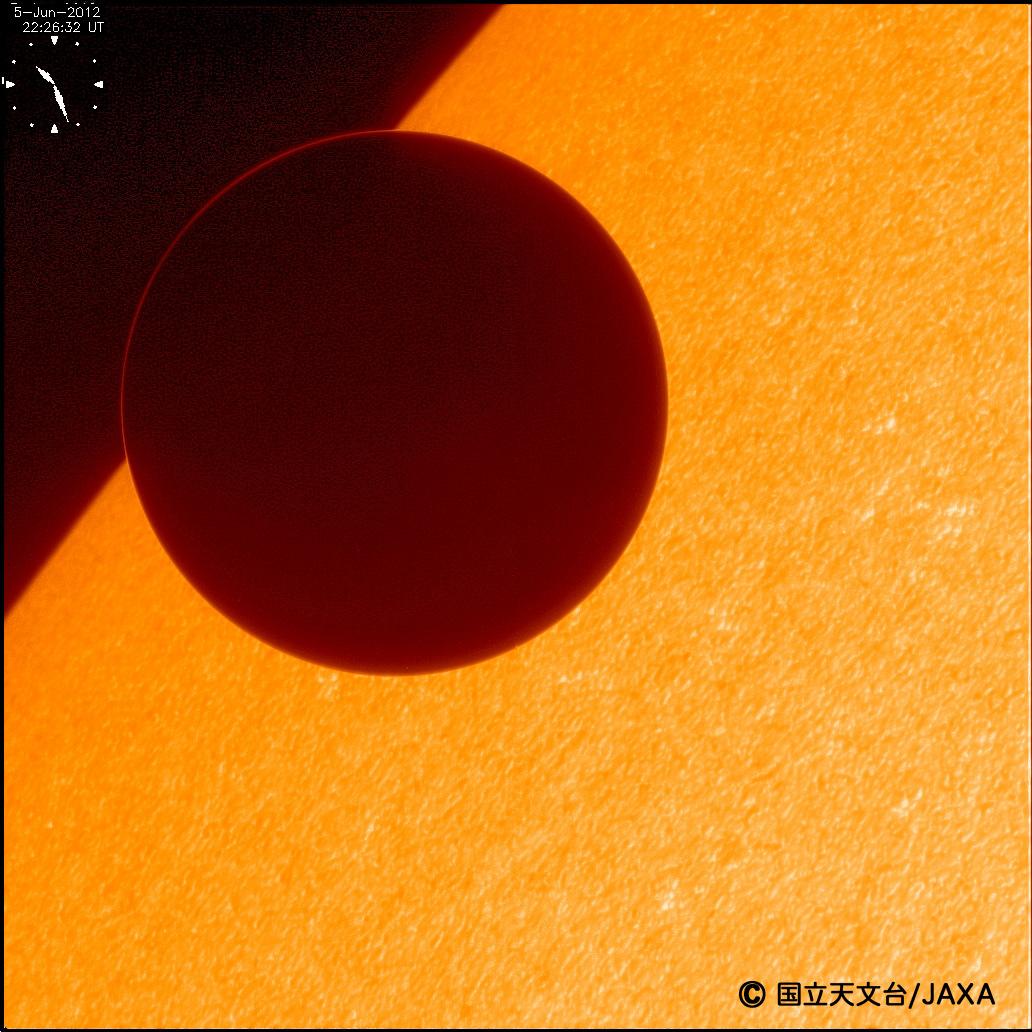
On 5 and 6 June 2012 NASA's Solar Dynamics Observatory recorded the transit in high definition. Cyril Pere, Tanga and colleagues point out that it was the first transit to occur with a spacecraft in orbit around Venus: ESA's Venus Express observed the planet during the event. Hinode, the solar observatory of JAXA and the National Astronomical Observatory of Japan, caught the aureole. ISAS released Solar Optical Telescope images from around 07:30 Japan time on 6 June, just before second contact, in which sunlight refracted by Venus's atmosphere makes the planet's edge shine like a ring of light, and Hinode's X-ray telescope watched Venus approach against the corona. Fabio Reale and colleagues used Hinode and SDO images to measure Venus's radius: about 80 km above the solid body in visible light, where clouds and haze are opaque, and more than 70 km larger again in extreme ultraviolet and soft X-rays, marking the densest layers of the ionosphere. Pere's team modelled the aureole in SDO images against Venus Express data and derived a haze scale height of 4.8 plus or minus 0.5 km above 80 km.
The Hubble Space Telescope cannot point at the Sun, so its observers used the Moon as a mirror. Program 12537, 'Venus observed as an extrasolar planet', led by David Ehrenreich of the Université de Grenoble, aimed to catch the sliver of reflected sunlight that had passed through Venus's atmosphere, about one part in 100,000 according to NASA's preview, as a test for reading an Earth-sized exoplanet's air. The MAST archive shows that it ran: STIS spectra of a lunar target labelled MOON-HIPPARCHUS-C from 15:32 UT on 5 June to 10:58 UT on 6 June 2012, with ACS and WFC3 images alongside. The widely reproduced picture of the crater Tycho is a rehearsal image from 11 January 2012. A search on 26 September 2026 found no refereed paper reporting what the transit data showed.
The next pair falls on 10 to 11 December 2117 and 8 December 2125, both at the December node. Venus keeps passing close in the meantime: at its passage between Earth and the Sun on 24 October 2026, JPL's Horizons ephemeris puts it about 6.5 degrees south of the Sun's centre, more than ten times the Sun's apparent width, so that passage misses the disc (Venus in the sky follows it). Mercury crosses the Sun about thirteen or fourteen times a century, Espenak notes, so it is the Venus event that stays rare, and the copy of Lomonosov's telescope the Nesterenkos mean to leave behind waits for 2117.
What we know
Why transits are rare
Venus's orbit crosses Earth's orbital plane in early June and early December; a transit happens only when Venus passes between Earth and Sun (inferior conjunction) at one of those crossings. NASA's catalogue counts 81 transits from 2000 BCE to 4000 CE, 44 in June and 37 in December.
The 243-year pattern
Eight Earth years (2,922 days) nearly equal thirteen Venus orbits, but Venus arrives about 2.45 days early each time, so a pair of transits 8 years apart is followed by a gap of 105.5 or 121.5 years before the other node takes over. The sequence 8 + 105.5 + 8 + 121.5 repeats every 243 years (88,756 days), in series much like eclipse saroses.
The ledger
Since the telescope: 7 December 1631, 4 December 1639, 6 June 1761, 3 to 4 June 1769, 9 December 1874, 6 December 1882, 8 June 2004 and 5 to 6 June 2012. Next: 10 to 11 December 2117 and 8 December 2125 (UT). West of the date line the 2012 transit fell on 5 June.
What a transit looks like
In 2004 and 2012 Venus's disc was about 1/32.6 of the Sun's width (semi-diameters 29 and 945 arcseconds), crossed at about 4 arcminutes an hour, and took over six hours. Four contacts mark the event: I and II at ingress, III and IV at egress.
1631: predicted, unseen
Kepler's Rudolphine Tables (1627) predicted the December 1631 transit. Gassendi planned to watch from Paris, but it happened on 7 December before sunrise in western Europe, which the tables were not accurate enough to show.
1639: Horrocks and Crabtree
Jeremiah Horrocks predicted and observed the 4 December 1639 transit (24 November in England's Julian calendar) from Much Hoole near Preston, shortly before sunset; HM Nautical Almanac Office calls it the first successful observation of a transit of Venus and names William Crabtree in Manchester as the likely only other observer.
Halley's method (1716)
Timing the transit's duration from places far apart in latitude would give the solar parallax, which Halley claimed could be found to within its 500th part. A note appended to the 1809 English translation adds that 1761 was less favourable than he expected, because Venus's node was poorly known.
Lomonosov, 1761
From St Petersburg on 6 June 1761 (26 May Old Style), Mikhail Lomonosov saw the Sun's limb blur at ingress and a bright bump on it at egress, and concluded that Venus has an atmosphere like Earth's, if not greater. His report appeared in Russian in July and in German in August 1761.
Lomonosov: the dispute
Pasachoff and Sheehan (2012) say he inferred the atmosphere from black-drop effects and credit others who may have seen the aureole genuinely, Rittenhouse perhaps with the strongest claim; Shiltsev (2014) says his priority claim is the strongest, as the first to publish a full report and a detailed explanation. Both readings are published in the same journal.
Lomonosov: 2012 re-enactment
Koukarine, Nesterenko, Petrunin and Shiltsev observed the 2012 transit with antique Dollond refractors and concluded that Lomonosov's telescope was fully adequate to detect the arc of light if his described technique was used.
1769 and the parallax
Guillemin (1877) gives the solar parallax from the 1769 observations as between 8.50 and 8.88 arcseconds (about 155 to 148 million km), and Encke's reanalysis as 8.57, a value long adopted and later found too small.
1874 in Russia
Pulkovo Observatory equipped the Russian effort under Otto Struve: 27 stations were chosen, 25 on Russian territory, but on the day the weather at every Russian station was unsettled.
1874 Japan sites
United States and French parties observed at Nagasaki, a French detachment at Kobe and a Mexican party at Yokohama. The Astronomical Society of Japan says bad weather prevented a full observation at Nagasaki (Nagasaki Prefecture's own citation says Janssen's party succeeded), while Kobe obtained photographs and Yokohama had clear sky. The Astronomical Society of Japan named the three sites Japan Astronomical Heritage for fiscal 2021 (decided 10 January 2022).
1882 and Newcomb
The US sent eight expeditions and France ten, while Russia and Austria stayed out of the international effort. In 1890 Simon Newcomb derived a solar parallax of 8.79 arcseconds from the 1874 and 1882 observations.
The black drop
The dark ligament that spoiled contact timings comes from the telescope's blurring combined with the Sun's limb darkening, as TRACE observations of the 1999 transit of Mercury showed; Venus's atmosphere does not cause it.
2004: the Sun's distance again
ESO's VT-2004 campaign collected 4,550 contact timings from 1,510 observers and derived 149,608,708 km with an uncertainty of 11,835 km, 0.007 per cent above the radar value.
2004: the dimming
ACRIM 3 on ACRIMSAT measured the Sun's total irradiance fall by about 1.4 W per square metre (about 0.1 per cent) at mid-transit, a rehearsal for exoplanet transit photometry.
Solar Dynamics Observatory, 2012
NASA's SDO and the Hinode satellite monitored the 5 to 6 June 2012 transit, and Reale et al. (2015) used their images to measure Venus's apparent radius in several bands: about 80 km above the solid body in visible light and more than 70 km larger again in extreme ultraviolet and soft X-rays.
Hinode, 2012
ISAS released Hinode Solar Optical Telescope images from about 07:30 Japan time on 6 June 2012, just before second contact, showing sunlight refracted in Venus's atmosphere as a ring of light on the planet's edge.
Hubble, 2012
HST program 12537, 'Venus observed as an extrasolar planet' (PI David Ehrenreich), observed sunlight reflected by the Moon through the transit with STIS, ACS and WFC3 (the MAST archive lists the exposures, 5 to 6 June 2012) to look for Venus's atmospheric fingerprint. A search on 26 September 2026 found no refereed results paper.
What happened, and when
- 7 Dec 1631A transit predicted from Kepler's tables takes place before sunrise in western Europe and is not seen.
- 4 Dec 1639Jeremiah Horrocks watches Venus on the Sun from Much Hoole, Lancashire; William Crabtree probably sees it from Manchester.
- 1716Edmond Halley publishes his method for finding the Sun's distance from the durations of the 1761 and 1769 transits.
- 6 Jun 1761Transit observed by expeditions worldwide; in St Petersburg Lomonosov sees a bright bump at the Sun's edge as Venus leaves.
- Jul 1761Lomonosov's report, 'The appearance of Venus on the Sun', is printed in Russian (250 copies); a German edition follows in August.
- 3 to 4 Jun 1769Cook observes from Point Venus, Tahiti; Chappe d'Auteroche observes at Cabo San Lucas in Baja California and dies there in an epidemic; Le Gentil is clouded out at Pondicherry.
- 9 Dec 1874Expeditions from a dozen countries observe; American, French and Mexican parties work in Nagasaki, Kobe and Yokohama, and Russian observers watch from stations across the empire.
- 6 Dec 1882Second transit of the pair, visible in full from South and Central America and eastern North America; the US sends eight expeditions and France ten.
- 1890Simon Newcomb derives a solar parallax of 8.79 arcseconds from the 1874 and 1882 observations.
- 8 Jun 2004First transit since 1882; ACRIMSAT measures the Sun dim by about 0.1 per cent, and thousands of public observers time the contacts for ESO's VT-2004.
- 2 Nov 2004ESO announces the VT-2004 result: 149,608,708 km for the Earth to Sun distance, within 0.007 per cent of the radar value.
- 11 Jan 2012Hubble takes test images of the Moon (crater Tycho) to rehearse pointing for the transit.
- 5 to 6 Jun 2012Last transit until 2117: SDO and Hinode image it from Earth orbit while Venus Express observes from Venus orbit, the first transit with a spacecraft there.
- 5 to 6 Jun 2012Hubble takes STIS spectra of sunlight reflected from the Moon (target MOON-HIPPARCHUS-C) from 15:32 UT on 5 June to 10:58 UT on 6 June, with ACS and WFC3 images alongside.
- 2012The IAU General Assembly fixes the astronomical unit at exactly 149,597,870,700 m, replacing the definition tied to the Gaussian gravitational constant.
- 10 Jan 2022The Astronomical Society of Japan names the 1874 observing sites in Nagasaki, Kobe and Yokohama Japan Astronomical Heritage (fiscal 2021).
- 10 to 11 Dec 2117Next transit of Venus (UT), to be followed on 8 December 2125.
In pictures
Tap a photo to enlarge.
Translated from the original sources
Passages from the Russian, Japanese and French sources this page draws on, in azmth's translation. Tap Show original to read the original wording.
Shiltsev and Nesterenko, 'Is it Fortune I see in you, or Venus…', Science First Hand no. 45
Russian · 5 passages
Shiltsev and Nesterenko, 'Is it Fortune I see in you, or Venus…', Science First Hand no. 45 (2012), pp. 60 to 73 (archived PDF)
Open the source“From these observations Councillor Lomonosov reasons that the planet Venus is surrounded by a considerable atmosphere of air, such as (if not greater than) the one that pours around our terrestrial globe.”
Lomonosov's 1761 report, quoted from the Complete Works, vol. 4, pp. 367 to 368.
azmth's translation · Show originalHide original
Russian: «По сим примечаниям господин советник Ломоносов рассуждает, что планета Венера окружена знатною воздушною атмосферою, таковою (лишь бы не большею), какова обливается около нашего шара земного.»
“Lomonosov's international priority was publicly restored by Soviet astronomers only in the 1950s.”
azmth's translation · Show originalHide original
Russian: «Международный приоритет Ломоносова был публично восстановлен советскими астрономами только в 1950-х гг.»
“In Russia, despite bad weather at many observing sites, more than 20 observers reported seeing Lomonosov's rims at the planet's entry onto and/or exit from the Sun's disc (2012).”
azmth's translation · Show originalHide original
Russian: «В России, несмотря на плохую погоду во многих местах, где проводились наблюдения, более 20 исследователей сообщили, что видели ободки Ломоносова на входе и/или на выходе планеты с диска Солнца»
“As Venus left the Sun, when its leading edge began to approach the Sun's edge and was (as far as could be judged by eye) about a tenth of Venus's diameter from it, a bump appeared on the Sun's edge (see A, fig. 1), which grew more distinct the nearer Venus came to leaving (see figs. 3 and 4).”
Lomonosov's 1761 report, quoted from the Complete Works, vol. 4, pp. 367 to 368; his word for the bump is 'pupyr'.
azmth's translation · Show originalHide original
Russian: «При выступлении Венеры из Солнца, когда передний ее край стал приближаться к солнечному краю и был (как просто глазом видеть можно) около десятой доли Венерина диаметра, тогда появился на краю Солнца пупырь (смотри A, фиг. 1), который тем явственнее учинился, чем ближе Венера к выступлению приходила (смотри фиг. 3 и 4).»
“Then events moved very fast: on 28 June 1761 Lomonosov gave the Academy of Sciences an official report of his discovery, on 4 July it went to press, and on 17 July his work in Russian, 'The appearance of Venus on the Sun, observed at the St Petersburg Imperial Academy of Sciences on 26 May 1761', came out in 250 copies, with everything set out in order.”
azmth's translation · Show originalHide original
Russian: «Дальше события происходили очень быстро: 28 июня 1761 г. Ломоносов сделал официальный доклад в Академии наук о своем открытии, а уже 4 июля сдан в печать и 17 июля вышел в свет в 250 экземплярах труд Ломоносова на русском языке «Явление Венеры на Солнце Наблюденное в Санктпетербургской Императорской Академии наук маия 26 дня 1761 года», где все разложено по полочкам.»
Nesterenko and Nesterenko, 'On the way to Lomonosov's telescope', Priroda 2014 no. 5, pp. 27 to 35
Russian · 3 passages
Nesterenko and Nesterenko, 'On the way to Lomonosov's telescope', Priroda 2014 no. 5, pp. 27 to 35 (archived PDF)
Open the source“So we now have full information to recreate the telescope with which Lomonosov made his observations during the transit of Venus in 1761, but which was lost during the Great Patriotic War.”
azmth's translation · Show originalHide original
Russian: «Итак, теперь мы имеем полную информацию для воссоздания телескопа, с которым проводил свои наблюдения Ломоносов во время транзита Венеры в 1761 г., но который был утрачен во время Великой Отечественной войны.»
“The analogue of Lomonosov's telescope that we have begun to assemble will be used for solar observations, and of course we will leave it to our descendants for observing the future transit of Venus across the Sun's disc in 2117.”
azmth's translation · Show originalHide original
Russian: «Аналог телескопа Ломоносова, который мы начали собирать, будет использоваться при наблюдениях Солнца, и конечно же, мы его оставим потомкам для наблюдений будущего транзита Венеры по диску Солнца в 2117 г.»
“As Lomonosov wrote, he used a telescope '…of two lenses 4.5 feet long'.”
Quoted to support the telescope length in the body; the text layer of the Science First Hand PDF renders the same phrase as '4 feet', apparently dropping the ½ glyph.
azmth's translation · Show originalHide original
Russian: «Как писал Ломоносов, он использовал телескоп: «…о двух стеклах длиною в 4.5 фута»»
Izvestiya GAO v Pulkove no. 219, issue 2
Russian · 3 passages
Izvestiya GAO v Pulkove no. 219, issue 2 (2009), history of Pulkovo Observatory, 1874 transit preparations (archived PDF)
Open the source“Twenty-seven places were chosen for the Russian observing stations, 25 of them on Russian territory (1874).”
azmth's translation · Show originalHide original
Russian: «Для размещения русских станций наблюдения было выбрано 27 мест, из которых 25 находились на территории России.»
“However, on the day of the transit of Venus across the Sun's disc the weather at all the stations in Russia was unsettled.”
azmth's translation · Show originalHide original
Russian: «Однако в день прохождения Венеры по диску Солнца погода на всех станциях в России была неустойчивая.»
“Karl (Kirill) Struve, brother of O. V. Struve, took part in the observations together with the Austrian and Mexican expeditions in Japan, where he was at that time the Russian Empire's envoy.”
The superscript 77 is the source's footnote number.
azmth's translation · Show originalHide original
Russian: «Карл (Кирилл) Струве77, брат О.В. Струве, принял участие в наблюдениях вместе с австрийской и мексиканской экспедициями в Японии, где он в то время был послом Российской империи.»
Special Astrophysical Observatory RAS, 'The transit of Venus across the Sun's disc in 2012'
Russian · 1 passage
“Also, because of the atmosphere, at the moment of internal contact of the planet with the edge of the Sun's disc a black bridge appears between it and the shadow of Venus (the 'black drop' effect).”
Quoted as an example of the atmospheric explanation that the TRACE work overturned.
azmth's translation · Show originalHide original
Russian: «Также, из-за наличия атмосферы в момент внутреннего контакта планеты с краем диска Солнца, между ним и тенью Венеры появляется черная перемычка (эффект "Черной капли")»
NAOJ, 2012 transit campaign: the 1874 transit observed in Japan
Japanese · 3 passages
“On 9 December 1874 (Meiji 7), because the whole transit could be observed from Asia including Japan, Britain, Germany, France, Italy, Russia, the United States, Mexico and others observed from as many as 75 places around the world. Of these, the United States, France and Mexico also sent parties to Japan (Mexico to Japan only).”
azmth's translation · Show originalHide original
Japanese: 1874年(明治7年)12月9日、日本を含むアジア地域で、金星の太陽面通過の全過程が観測できるということから、イギリス、ドイツ、フランス、イタリア、ロシア、アメリカ、メキシコなどが世界75箇所もの地点で観測を行いました。そのなかで、アメリカ、フランス、メキシコは日本にも観測隊を派遣しました。(メキシコは日本のみ)
“The Japanese government ran a telegraph line for the Mexican party from the Yokohama telegraph office to the observing site. The leader gratefully used it, which let the party communicate by telegraph with the American and French parties, and it also made longitude observations.”
azmth's translation · Show originalHide original
Japanese: 日本政府はメキシコ隊のため、横浜電信局から観測地点まで電信線を引いています。隊長は感謝しこれを用い、アメリカ隊、フランス隊と電信で連絡がとれるようになり、経度観測も行っています。
“The document Mr Murray submitted to the Ministry of Education, explaining the transit of Venus and asking for cooperation with the parties coming to observe it in Japan, is the one titled 'Venus crossing the Sun' (Kinsei kajitsu).”
azmth's translation · Show originalHide original
Japanese: モルレー氏が、金星の太陽面通過の解説を交えて、日本で観測する観測隊への協力要請を文部省に提出したものが、「金星過日」(きんせいかじつ)という文書です。
Nagasaki Prefecture cultural property database: Nagasaki Venus observation monument and pier
Japanese · 3 passages
“Being, at that time, the fourth time humanity had observed a transit of Venus, it is a cultural property of international significance.”
azmth's translation · Show originalHide original
Japanese: 当時、人類が金星通過を観測した第4回目であるため、国際的にも意義深い文化財である。
“In 1993 an observing pier was discovered 24 m east of this monument.”
azmth's translation · Show originalHide original
Japanese: 平成5年(1993)この記念碑から東に24mの地点で観測台が発見された。
“This monument commemorates the success of the astronomer Janssen, president of the French Academy of Sciences, and his party of six in observing Venus crossing the face of the Sun on 9 December 1874 (Meiji 7).”
azmth's translation · Show originalHide original
Japanese: 明治7年(1874)12月9日、フランス科学院長の天文学者ジャンサン氏一行6名が、太陽面を通過する金星の観測に成功したことを記念した碑である。
Astronomical Society of Japan, 2021
Japanese · 3 passages
Astronomical Society of Japan, 2021 (4th) Japan Astronomical Heritage citation
Open the source“Saito Kuniji called the arrival of the foreign observing parties in Japan under these conditions 'the black ships of science'.”
azmth's translation · Show originalHide original
Japanese: この状況での外国の観測隊の来日を、斉藤国治は「科学の黒船」と呼んだ
“At Nagasaki bad weather prevented a satisfactory observation, but the French party's observation monument and observing pier survive.”
azmth's translation · Show originalHide original
Japanese: 長崎では悪天候のため十分な観測はできなかったが、フランス隊の観測碑と観測台が残されている。
“At Kobe, a detachment of the French party observed from Suwayama (now Suwayama Park, Suwayama-chō, Chūō-ku, Kobe) and succeeded in taking photographs.”
azmth's translation · Show originalHide original
Japanese: 神戸では、フランス隊の分隊が諏訪山(現・諏訪山公園、神戸市中央区諏訪山町)で観測し、写真撮影に成功した。
ISAS/JAXA, Hinode views the transit of Venus
Japanese · 1 passage
ISAS/JAXA, Hinode views the transit of Venus (6 June 2012)
Open the source“Just before Venus moved onto the solar disc from the Sun's north-east limb, the images capture sunlight refracted by Venus's atmosphere making the planet's edge shine like a ring of light.”
azmth's translation · Show originalHide original
Japanese: 金星が太陽の北東の縁から太陽面に入り込む直前に太陽光が金星大気で屈折して金星の縁が光の輪のように光る現象が捉えられています。
Guillemin, The Heavens, 5th edition
French · 2 passages
Guillemin, The Heavens, 5th edition (Paris, 1877), Internet Archive scan at page 946
Open the source“Fig. 360. Venus on the solar disc, 9 December 1874. Luminous aureole, after a photograph by M. Janssen.”
azmth's translation · Show originalHide original
French: «Fig. 360. Vénus sur le disque solaire, le 9 décembre 1874. Auréole lumineuse, d'après une photographie de M. Janssen.»
“Discussion of the [1769] observations gave various fairly concordant values for the solar parallax, which appeared to lie between 8.50 and 8.88 arcseconds. Since then Encke, taking up the discussion again with great care, found 8.57, a figure generally adopted and consistent with the results of other methods, until more recent work by Hansen, Le Verrier, Stone and Powalky led astronomers to consider it too small.”
Page 945 to 946; the scan's OCR reads 'Stoue' for Stone and splits the parallax symbols.
azmth's translation · Show originalHide original
French: «La discussion des observations fournit diverses valeurs assez concordantes pour la parallaxe solaire, qui parut comprise entre 8".50 et 8".88. Depuis, Encke, ayant repris avec un très-grand soin cette discussion, a trouvé 8".57, nombre qui était généralement adopté, et qui concordait avec les résultats d'autres méthodes, quand des travaux plus récents, dus à Hansen, à MM. le Verrier, Stone, Powalky, conduisirent à le considérer comme trop faible.»
Guillemin, The Heavens: Elementary Notions of Physical Astronomy
French · 2 passages
Guillemin, The Heavens: Elementary Notions of Physical Astronomy (Paris, Hachette, 1877), Internet Archive scan of the whole volume
Open the source“a proof of the transit of Venus, observed by him at Kobe (Guillemin's preface, thanking Janssen for permission to reproduce it).”
azmth's translation · Show originalHide original
French: «une épreuve du passage de Vénus, observé par lui à Kobé»
“We have before us, and will reproduce further on, a photographic proof of the transit obtained at Kobe, which we owe to the kindness of M. Janssen; on this proof a faintly luminous aureole can be seen round the black disc of Venus.”
azmth's translation · Show originalHide original
French: «Nous avons sous les yeux et nous reproduirons plus loin une épreuve photographique du passage, obtenue à Kobé, et que nous devons à l'obligeance de M. Janssen; sur cette épreuve, on aperçoit une auréole faiblement lumineuse autour du disque noir de Vénus.»
Sources
- Espenak (NASA GSFC), 2004 and 2012 Transits of Venus
- Espenak (NASA GSFC), Six Millennium Catalog of Venus Transits: 2000 BCE to 4000 CE
- Halley, 'A New Method of Determining the Parallax of the Sun' (1716), English translation of 1809, NASA eclipse site
- HM Nautical Almanac Office, 1631 transit of Venus (archived)
- HM Nautical Almanac Office, 1639 transit of Venus (archived)
- HM Nautical Almanac Office, 1769 transit of Venus (archived)
- HM Nautical Almanac Office, 1874 transit of Venus (archived)
- HM Nautical Almanac Office, 1882 transit of Venus (archived)
- Sigismondi, 'Transits of Venus and the Astronomical Unit: four centuries of increasing precision', arXiv 1301.0296
- Shiltsev, English translation of Lomonosov's 1761 report with commentaries, arXiv 1206.3489
- Pasachoff and Sheehan, 'Lomonosov, the discovery of Venus's atmosphere, and eighteenth century transits of Venus', JAHH 15(1), 3 to 14 (2012)
- Shiltsev, 'The 1761 discovery of Venus' atmosphere: Lomonosov and others', JAHH 17(1), 85 to 112 (2014)
- Koukarine, Nesterenko, Petrunin and Shiltsev, experimental reconstruction of Lomonosov's discovery, arXiv 1208.5286
- Koutchmy, 'Refraction and scattering in the atmosphere of the planet Venus: the Lomonossov arc', arXiv 2207.06760
- Shiltsev and Nesterenko, 'Is it Fortune I see in you, or Venus…', Science First Hand no. 45 (2012), pp. 60 to 73 (archived PDF) · in Russian
- Nesterenko and Nesterenko, 'On the way to Lomonosov's telescope', Priroda 2014 no. 5, pp. 27 to 35 (archived PDF) · in Russian
- Izvestiya GAO v Pulkove no. 219, issue 2 (2009), history of Pulkovo Observatory, 1874 transit preparations (archived PDF) · in Russian
- Special Astrophysical Observatory RAS, 'The transit of Venus across the Sun's disc in 2012' · in Russian
- NAOJ, 2012 transit campaign: the 1874 transit observed in Japan · in Japanese
- Nagasaki Prefecture cultural property database: Nagasaki Venus observation monument and pier · in Japanese
- Astronomical Society of Japan, 2021 (4th) Japan Astronomical Heritage citation · in Japanese
- ISAS/JAXA, Hinode views the transit of Venus (6 June 2012) · in Japanese
- Guillemin, The Heavens, 5th edition (Paris, 1877), Internet Archive scan at page 946 · in French
- Guillemin, The Heavens: Elementary Notions of Physical Astronomy (Paris, Hachette, 1877), Internet Archive scan of the whole volume · in French
- Schneider, Pasachoff and Golub, 'Space studies of the black-drop effect at a Mercury transit', arXiv astro-ph/0310379
- Schneider, Pasachoff and Willson, ACRIM total solar irradiance during the 2004 transit, ApJ 641 (2006), arXiv astro-ph/0512251
- ESO press release eso0433, Summing up the Venus Transit 2004 programme
- Tanga et al., sunlight refraction in the mesosphere of Venus during the 2004 transit, arXiv 1112.3136
- Hedelt et al., Venus transit 2004 and exoplanet transmission spectroscopy, arXiv 1107.3700
- Pere et al., aureole photometry during the 2012 transit, A&A 595 A115 (2016), arXiv 1608.08544
- Reale et al., using the transit of Venus to probe the upper planetary atmosphere, Nature Communications 6, 7563 (2015), arXiv 1507.00195
- NASA, SDO's high def view of 2012 Venus transit
- HubbleSite, Hubble to use Moon as mirror to see Venus transit (4 May 2012)
- STScI, HST program 12537 'Venus observed as an extrasolar planet', Phase II listing
- MAST archive query: HST observations of program 12537 (Moon targets, 11 January and 5 to 6 June 2012)
- ESA/Hubble picture of the week potw1219a, test image of the Moon
- IAU 2012 Resolution B2, re-definition of the astronomical unit (archived PDF)
- Hayakawa et al., a transit of Venus possibly misinterpreted as a naked-eye sunspot in China, Solar Physics (2019), arXiv 1908.02452
- JPL Horizons API, Venus solar elongation from the geocentre, 20 to 30 October 2026
Checked on 26 September 2026. Where the science is unsettled this page says so rather than picking a winner.
azmth is independent and is not affiliated with or endorsed by NASA, Roscosmos, NPO Lavochkin, ESA, JAXA, ISRO, CNSA, or any other space agency or company named on this page.