Venus in the sky
Why Venus is the morning and evening star, why it has phases and an 8-year cycle, where it is in late 2026, and Zoozve, the asteroid named by a typo.
TL;DR· 22 min read
Venus never strays more than about 47 degrees from the Sun, so it shows up only as an evening or a morning star, and it is brightest as a crescent a few weeks before or after it passes between Earth and the Sun. It last did so on 24 October 2026 and is now the morning star. Its appearances repeat almost exactly every eight years. It has no moon: Zoozve is an asteroid that circles the Sun in step with it, and the moon reported between 1645 and 1768 was traced in many cases to background stars in 1887. Aircraft spectra of 1967 found almost no water vapour above its clouds, overturning balloon results, and later aircraft spectra matched the clouds to concentrated sulfuric acid.
Why is Venus called the morning star and the evening star?
Venus is the brightest point in the night sky after the Moon, and because its orbit lies inside Earth's it never strays more than about 47 degrees from the Sun. So it appears only in the west after sunset or in the east before dawn, which is why it is called the evening star and the morning star. Through a telescope it shows phases like the Moon's, and it shines brightest as a crescent, when it is close to Earth and about a quarter lit. Its appearances repeat on an eight-year rhythm. It passed between Earth and the Sun on 24 October 2026 and has been the morning star since, at its brightest in late November and farthest from the Sun on 3 January 2027. Venus has no moon. Its nearest thing to a companion is Zoozve, an asteroid that keeps pace with it around the Sun and owes its name to a slip by the artist of a children's poster. Because Venus hugs the Sun and Earth's air blocks parts of its light, it has also been watched from balloons, jets, rockets and telescopes in orbit.
- -4.89 magnitudepeak brightness of this morning apparition in JPL Horizons, 24 to 26 November 2026; Japan's national observatory gives -4.9 on 30 November by its own formula
- 40.8 million kmVenus's distance from Earth when it passed between Earth and the Sun on 24 October 2026, 6.5 degrees south of the Sun (Horizons)
- 20asteroids known to share Venus's orbit in January 2026 (Carruba, Sfair and Winter); Zoozve among them; none is a moon
Venus is back in the dawn sky. It passed between Earth and the Sun on 24 October 2026, and on 4 November JPL's Horizons ephemeris puts it 17 degrees west of the Sun and 42.9 million km from Earth, a thin crescent with 4 percent of its disk in sunlight, shining at magnitude -4.4. Three things make it so bright: Venus comes nearer to Earth than any other planet, it is almost Earth's size, and its unbroken cloud reflects most of the light that falls on it. Seen from 40 degrees north it rises about 80 minutes before the Sun, and by 25 November, near its brightest, more than three hours before.
Because its orbit lies inside Earth's, Venus can never appear far from the Sun. Its angle from the Sun peaked at 45.9 degrees to the east on 15 August 2026. So the planet is seen only in the west after sunset or in the east before sunrise, never in the middle of the night. NASA notes that the ancients even took the two guises for two objects. Korean keeps a word for one: the Standard Korean Language Dictionary defines gaebap-baragi as Venus seen in the western sky around evening, beside saetbyeol, the everyday name for the planet. Japan's FUJIN balloon team spells out the cost: from the ground an inner planet can be observed only in the short time when the Sun has set and the planet is still up.
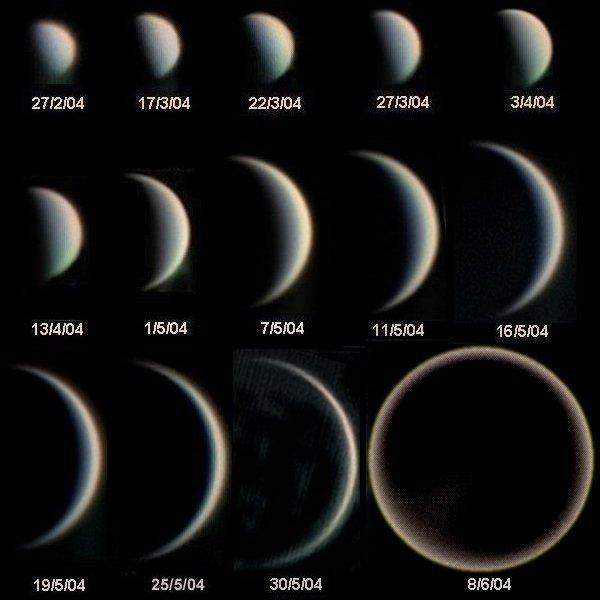
Galileo turned his telescope on the evening Venus around October 1610 and watched it change shape. On 1 January 1611 he wrote from Florence to Giuliano de' Medici in Prague to unscramble an anagram sent some weeks before. Rearranged, its letters read 'the mother of loves imitates the shapes of Cynthia', which he glossed as 'Venus imitates the figures of the Moon'. He described a small round disk that grew, became a perfect half circle and was now thinning into horns, its diameter about five times what it had been at first. The letter draws two conclusions: that the planets are dark bodies, and 'that Venus most necessarily turns around the Sun'.
Those phases explain how Venus's brightness behaves. At superior conjunction, beyond the Sun, the disk is fully lit but small: on 6 January 2026 it was 9.75 arcseconds across and magnitude -3.91. As Venus swings toward Earth the lit fraction shrinks while the disk swells, and the product of the two peaks when the planet is a crescent a fifth to a quarter lit, four to five weeks before or after inferior conjunction. The 2026 peaks, -4.80 in the evening sky and -4.89 in the morning, are more than twice as bright as the full disk of January. At inferior conjunction the disk is at its largest, 61 arcseconds, but only 0.6 percent lit and lost in the Sun's glare.
Which day counts as greatest brilliancy depends on the definition. Japan's National Astronomical Observatory lists the evening peak on 19 September 2026 at magnitude -4.8 and the morning one on 30 November at -4.9. NAOJ computes it from the lit fraction of the disk divided by the squares of Venus's distances from the Sun and Earth, and calls it 'a guide to the magnitude maximum' that does not match it exactly. The Korea Astronomy and Space Science Institute (KASI) calls the November event 'greatest shining area', at 23:00 Korean time on 29 November. From Horizons' illuminated fraction and apparent diameter, the lit area peaks at 23:00 UTC on 18 September, already the 19th in Japan, and 14:00 UTC on 29 November. Horizons' own magnitude model reaches a flat maximum of -4.804 from 23 to 25 September and -4.890 from 24 to 26 November; NAOJ notes that the magnitude peak is 'not necessarily the more accurate one'.
Inferior conjunction, when Venus passes between Earth and the Sun, fell on 24 October 2026. KASI defines it as the moment Venus and the Sun share the same apparent ecliptic longitude and gives 13:00 Korean time, 04:00 UTC; Horizons gives 03:44 UTC. The least distance, 40.81 million km, followed at about 02:00 UTC on 25 October. Venus passed about 6.5 degrees south of the Sun, so there was no transit. NASA's transit catalogue explains that transits currently fall within a day of 7 June or 9 December; the last two came in June 2004 and June 2012, and the next is due in December 2117 (see transits of Venus).
Every 583.92 days, NSSDCA's synodic period, Venus returns to the same place relative to Earth and the Sun. Five such cycles last 2,919.6 days, 2.4 days short of eight calendar years and close to thirteen Venus years, so the calendar of its appearances nearly repeats. Horizons places inferior conjunctions on 26 October 2018, 24 October 2026 and 21 October 2034, each about two and a half days earlier than the last. The conjunctions in between are spread around the sky, each roughly 144 degrees of ecliptic longitude short of the one before, and October 2026 brought Venus back to 211 degrees, close to where it stood in 2018. Five points spaced that way, joined in order, trace a five-pointed star (see Venus time).
NAOJ expects Venus to brighten from magnitude -4.2 at the start of November to -4.9 late in the month. It reaches greatest western elongation, 46.95 degrees, on 3 January 2027 and stays a morning object until superior conjunction on 12 August 2027; ESA's Solar Orbiter is due to swing past it at 22:58 UTC on 24 December 2026, about 948 km above the surface (see Venus flybys). Venus's close approaches to Earth, down to 38.2 million km in NSSDCA's figures, are why it is called Earth's nearest neighbour. Averaged over time the answer changes. In a Physics Today commentary of March 2019, Tom Stockman, Gabriel Monroe and Samuel Cordner calculated a mean distance of 1.14 astronomical units from Earth to Venus and 1.04 to Mercury, and showed that Mercury is on average the nearest planet to every other planet.
Venus has no moon. NSSDCA's planetary fact sheet lists none for Venus or for Mercury, and NASA calls Venus one of only two planets without one. It does have company. The asteroid 2002 VE68 was found on 11 November 2002 by the LONEOS survey in Arizona, a discovery NASA credits to Brian Skiff. Seppo Mikkola, Paul Wiegert and colleagues soon showed it to be a quasi-satellite of Venus, and the International Astronomical Union's naming bulletin of 5 February 2024 calls it the first-identified quasi-satellite of a major planet. The name was an accident. Alex Foster, drawing a solar-system poster for children, read the start of the designation as letters and wrote Zoozve. Latif Nasser of the radio show Radiolab traced the slip with NASA's Liz Landau and suggested that Skiff ask for the name to be made official.
Zoozve orbits the Sun. JPL's Small-Body Database gives it a period of 225 days, matching Venus, on a stretched orbit (eccentricity 0.41) that crosses Earth's path. NASA defines quasi-satellites as asteroids that orbit the Sun while staying close to a planet. Horizons puts it 47.3 million km from Venus on 4 November 2026, 4.4 million km farther than Earth. A moon would have to stay within about 1 million km, the reach of Venus's Hill sphere. Carlos and Raúl de la Fuente Marcos calculated in 2012 that it has been in this state for at least 7,000 years and will stay for about 500 more. Its passes of Earth mostly come eight years apart; the latest, on 2 November 2026 at 6.02 million km, left it around magnitude 15.6, far too faint for the eye.
The asteroid belongs to a small, mostly unseen population. In 2017 the de la Fuente Marcos brothers counted four known co-orbitals of Venus, among them the Trojan 2013 ND15 near the L4 point, and proposed 2015 WZ12 as a fifth. By January 2026 Valerio Carruba, Rafael Sfair and Othon Winter counted twenty, in a preprint on the newest, 2025 TV10, which may leave its shared orbit within about 1,200 years. They are faint and awkwardly placed: in a 2014 simulation by the same authors, nearly 70 percent of the modelled objects pass nearest Earth less than 90 degrees from the Sun. None stays for good. A 2022 study led by Yang-Bo Xu found that Venus Trojans cannot survive the age of the Solar System, and that the faint dust ring seen along Venus's orbit is more likely dust caught for a while in the same resonance.
Why a planet so close to Earth's size kept no moon is still open. A preprint posted on 25 August 2026 by Stephen Kane, Franck Selsis, Jeremy Leconte and Sean Raymond models how tides from the Sun and from a moon would reshape a young Venus that had one. If early Venus spun once in about 12 hours or less, a lunar-mass moon could survive to the present. With spin slower than about 15 hours, or a moon more than about twice the Moon's mass, the orbit decays until tides pull the moon apart, within 0.03 to 1.7 billion years in one of their two tidal models. To match today's planet, Venus must both lose its moon and slow to its present 243-day rotation, and the authors find a limited range of starting conditions that does both through tides alone, with no later catastrophe needed.
Astronomers once thought Venus had a moon. A memoir read to the Paris Academy of Sciences in May 1761 by Baudouin de Guémadeuc quotes Cassini's account of a faint body imitating Venus's phase in 1672 and 1686, recalls James Short's sighting of 1740, and reports that an observer named Montaigne at Limoges saw on 3 May 1761, 20 arcminutes from Venus, a small faint crescent a quarter of the planet's diameter. From three sightings in four days Baudouin derived an orbit of 9 days 7 hours. The phantom is remembered as Neith, after an Egyptian goddess. Paul Stroobant, in a study presented to the Royal Academy of Belgium on 10 May 1887, found background stars at the reported places for many sightings, Montaigne's included. For Cassini's two he found no star and suggested, 'for want of anything better', a mistake in the date.
Besides the Sun's glare, Earth's own air stands in the way. Water vapour above a telescope absorbs the same infrared bands that would show water on Venus, and in the stratosphere, the FUJIN team notes, the sky stays dark even by day. On 28 November 1959 the sealed gondola of Strato-Lab High IV rose from the Stratobowl in South Dakota, carrying Commander Malcolm D. Ross and Charles B. Moore with a Schmidt telescope and spectrograph from John Strong's laboratory at Johns Hopkins University. StratoCat's flight record gives a ceiling of 79,000 ft and a landing in Kansas after about 28 hours, near Frankfort in its narrative and near Blaine in its data table; Gregory Kennedy's Strato-Lab history on the same site gives 81,000 ft and a 16-inch telescope. StratoCat's biography of Strong says the flight detected water vapour on Venus and that other experts disputed the claim.
Strong's group then took the crew out. In a letter dated 27 March 1964 in the Astrophysical Journal, M. Bottema, William Plummer and Strong report that the 1959 telescope and spectrometer, rebuilt as an automatic 30 cm daytime instrument, rode a balloon to 26.5 km on 21 February 1964 and scanned the water band at 1.13 micrometres in sunlight reflected by Venus. Checking the air still above them against sunlight scattered off a white cloth, and finding the Doppler shift of Venus's motion in the absorption lines, they concluded that most of the signal came from Venus. How much water that meant hung on the unknown pressure at the cloud tops, so they gave a range of mixing ratios spanning a factor of about thirty.
Aircraft soon overturned that picture. On 14 May and 11 June 1967 Gerard Kuiper's Arizona group flew a spectrometer at around 37,000 ft on NASA's Convair 990 jet and recorded Venus from 1 to 2.5 micrometres. Their report, dated 15 November 1967, finds the Venus atmosphere essentially devoid of water vapour and ice crystals, and the larger amounts derived from balloons and ground observatories spurious. In 1974 J. B. Pollack and colleagues compared aircraft spectra of Venus with candidate materials and found that only a solution of 75 percent or more sulfuric acid matched the strong absorption near 3 micrometres; airborne spectra analysed in 1978 put the concentration at 84 plus or minus 2 percent. In mid-March 1979, three months into the Pioneer Venus Orbiter mission, the Kuiper Airborne Observatory recorded the first spectra of the Venus disk at wavelengths of 37 to 91 micrometres.
Sounding rockets bought minutes above nearly all the air. D. C. Evans reported Venus's ultraviolet reflectivity from a rocket-borne spectrograph in 1966, and an Aerobee recorded its spectrum from 120 to 180 nm (Bottema, Fastie and Moos, 1969). University of Colorado flights in September 1988 and March 1991 showed sulfur dioxide to be the main absorber at 190 to 230 nm; their instrument could point within 18 degrees of the Sun, while, the authors note, instruments in Earth orbit were held to at least 45. On 15 August 1994 the EUVS payload recorded Venus's far-ultraviolet airglow at five times the previous resolution and showed that emissions credited to argon in Venera 11 and 12 data came from something else. VeSpR, the Venus Spectral Rocket, flew from White Sands on 26 November 2013, reached 300 km and watched Venus for 4 minutes 10 seconds to measure the ratio of deuterium to hydrogen in its upper atmosphere.
Telescopes in Earth orbit kept a longer watch. The International Ultraviolet Explorer detected sulfur dioxide in 1979; its observations of January 1987 and April 1988 showed the cloud-top amount had fallen about eightfold since then, from 380 to 50 parts per billion, and the same study made the first identification of sulfur monoxide there (see volcanoes on Venus). On 13 March 1995 the Hopkins Ultraviolet Telescope, flying on Space Shuttle Endeavour's Astro-2 mission, recorded a far-ultraviolet spectrum of Venus in which carbon monoxide Hopfield-Birge bands were detected for the first time. Chandra observed Venus on 10 and 13 January 2001 for the first X-ray view of the planet: solar X-rays make oxygen and carbon atoms 120 to 140 km up fluoresce, so the X-ray crescent is brightest at the rim. In December 2010 and January 2011 Hubble's STIS spectrograph mapped sulfur oxides at 70 to 80 km in coordination with ESA's Venus Express.
JAXA calls Hisaki (SPRINT-A), launched on the first Epsilon rocket on 14 September 2013, 'the world's first space telescope for planetary observation'; it studied in extreme ultraviolet how the solar wind interacts with the air of Venus and Mars until it was switched off on 8 December 2023, ten years into a mission designed for one. A University of Tokyo team led by Gaku Nishiyama used Venus's chance appearances beside Earth in Himawari-8 and Himawari-9 infrared images to follow its cloud-top temperatures from July 2015 to February 2025; from orbit, they note, Earth hides the Sun even when Venus is close to it. Hokkaido University's 1.6 m Pirka telescope at Nayoro reported long-term Venus monitoring and polarimetry in 2018, and a Subaru COMICS team published mid-infrared cloud-top images in 2014. Still unflown in early November 2026 are FUJIN-2, a 1.4 tonne balloon telescope meant to identify the unknown ultraviolet absorber from a JAXA balloon campaign in Australia (in development on its project page, dated May 2023), and LAPYUTA, an ultraviolet space telescope on ISAS's list of future plans.
Korea's Venus project also stays in Earth orbit. The Planetary Atmospheres Group of the Institute for Basic Science (IBS) in Daejeon, led by Yeon Joo Lee, ran a campaign from September to November 2023 in which ten ground instruments, from Bohyeonsan to Calar Alto, Nayoro and Ussuriysk, observed Venus while Akatsuki and BepiColombo watched from space. Its CLOVE project plans CubeSats in low Earth orbit that observe Venus as a single point of light, each for three years and, with successors, for up to 15. The first, CLOVESat-1, is being built by NanoAvionics under a contract whose work kicked off on 10 January 2025; in January 2026 the Seoul Economic Daily reported a launch around June or July 2026 on a Falcon 9. No launch had been reported by 4 November 2026. In India, a Giant Metrewave Radio Telescope team reported in 2017, from archival data of March 2004, what it calls the first interferometric images of Venus below 620 MHz; the brightness temperatures fall well below those at higher frequencies, a trend thermal models have not explained.
What we know
Sky on 4 November 2026
Morning sky: 17.2 degrees west of the Sun, 42.9 million km from Earth, 58.2 arcseconds across, 4.3 percent lit, magnitude -4.38 at 00:00 UTC (Horizons; astronomy-engine gives the same position and -4.40). From latitude 40 degrees north it rises about 80 minutes before the Sun on 4 November and about 3 hours 10 minutes before it on 25 November; from 35 degrees south, about an hour before and just under two hours before on the same dates (astronomy-engine).
Brightness
NASA calls Venus the third brightest object in the sky after the Sun and the Moon. NSSDCA gives a maximum visual magnitude of -4.8; Horizons puts the 2026 peaks at -4.804 in the evening sky (23 to 25 September) and -4.890 in the morning sky (24 to 26 November). At superior conjunction on 6 January 2026 the fully lit disk was magnitude -3.91, so the crescent at its best is more than twice as bright.
Distance and size
NSSDCA: 38.2 to 261.0 million km from Earth, and 9.7 to 66.1 arcseconds across; 41.39 million km and 60.0 arcseconds on average at inferior conjunction. In 2026 Horizons gives 9.75 arcseconds at superior conjunction (6 January, 256 million km) and 61.2 arcseconds near inferior conjunction (25 October, 40.8 million km).
Elongation limit
Venus reached 45.89 degrees east of the Sun on 15 August 2026 and reaches 46.95 degrees west on 3 January 2027 (Horizons; KASI lists 46 degrees at 16:00 Korean time on 15 August). Chandra's 2001 release rounds the limit to 'never exceeds 48 degrees', which is why the evening and morning stars never appear at midnight.
Greatest brilliancy, two definitions
Japan's national observatory (NAOJ) lists greatest brilliancy on 19 September 2026 (-4.8) and 30 November 2026 (-4.9), computed from the lit fraction divided by the squared distances to the Sun and Earth, which it calls 'a guide to the magnitude maximum'; KASI calls the November event 'greatest shining area' at 23:00 Korean time on 29 November. The lit area, computed from Horizons' illuminated fraction and apparent diameter, peaks at 23:00 UTC on 18 September and 14:00 UTC on 29 November, while Horizons' magnitude peaks on 23 to 25 September and 24 to 26 November.
Inferior conjunction, 24 October 2026
KASI: 13:00 Korean time (04:00 UTC), defined by equal apparent ecliptic longitude; Horizons: 03:44 UTC by the same definition. In right ascension the conjunction falls at about 13:05 UTC on 22 October. Least distance 40.81 million km at about 02:00 UTC on 25 October. Ecliptic latitude -6.5 degrees, so no transit.
Retrograde loop, 2026
Venus is stationary in right ascension at 14:00 UTC on 2 October and 15:00 UTC on 11 November (Horizons), 23:00 on 2 October and 00:00 on 12 November in Korean time (KASI), and moves westward against the stars between those dates.
Eight-year cycle
Synodic period 583.92 days (NSSDCA); five of them make 2,919.6 days, 2.4 days short of eight calendar years. Horizons puts inferior conjunctions on 31 October 2002, 29 October 2010, 26 October 2018, 24 October 2026 and 21 October 2034. NASA's transit catalogue gives the drift as about 2.45 days per eight years.
Transits
The last two transits of Venus were on 8 June 2004 and 5 to 6 June 2012 (greatest transit 6 June 2012 at 01:29 UT); the next are on 10 to 11 December 2117 and 8 December 2125, according to NASA's six-millennium catalogue, which notes that transits currently fall within a day of 7 June and 9 December.
Zoozve: identity
(524522) Zoozve = 2002 VE68, discovered 11 November 2002 by the LONEOS survey at Anderson Mesa (station 699). The IAU naming citation of 5 February 2024 calls it 'the first-identified quasi-satellite of a major planet (Venus)' and records that artist Alex Foster misread the designation as letters; the name was suggested by Latif Nasser.
Zoozve: orbit and size
JPL Small-Body Database (orbit 95, solution of 3 November 2026): Aten class, flagged near-Earth and potentially hazardous; semi-major axis 0.724 au, eccentricity 0.41, inclination 9.04 degrees, period 225 days, perihelion 0.427 au, aphelion 1.02 au, absolute magnitude 20.54, rotation 13.5 hours. NASA estimates 200 to 500 m across from its brightness.
Zoozve: how far from Venus
Horizons puts Zoozve between 42.7 and 118.3 million km from Venus through 2026 and 2027 (5-day steps); at 00:00 on 4 November 2026 it was 47.3 million km from Venus while Earth was 42.9 million km away. The radius of Venus's Hill sphere in the same service is 167.1 Venus radii, about 1.01 million km.
Zoozve: passes of Earth
JPL's close-approach data list passes within 0.1 au mostly eight years apart (with longer gaps, such as 1911 to 1930), always between late October and early December: 19:10 UTC on 2 November 2026 at 6.02 million km (about magnitude 15.6 in Horizons), next 31 October 2034 at 6.46 million km, and the closest between 1900 and 2200 on 19 November 2149 at 3.51 million km. De la Fuente Marcos (2012) finds it has been a quasi-satellite for at least 7,000 years and will remain one for about 500 more.
Other co-orbitals
Four known in 2017: (322756) 2001 CK32, 2002 VE68, 2012 XE133 and the L4 Trojan 2013 ND15, with 2015 WZ12 a possible fifth (de la Fuente Marcos). Twenty known by January 2026, the newest 2025 TV10, which may leave the co-orbital state in about 1,200 years (Carruba, Sfair and Winter, preprint).
Why no moon
Kane, Selsis, Leconte and Raymond (preprint of 25 August 2026, accepted by The Astrophysical Journal according to its arXiv record): a lunar-mass moon survives if early Venus spun in about 12 hours or less; for spin slower than about 15 hours, or a moon above about 2 lunar masses, tides drive it to destruction within about 0.03 to 1.7 billion years in their constant-Q model. A later catastrophic event is possible but not required.
The phantom moon
Reported by Fontana (1645), Cassini (25 January 1672 and 1686), Short (3 November 1740), Montaigne at Limoges (3 to 11 May 1761), Copenhagen observers (1761 and 1764) and Horrebow (1768). Houzeau proposed a small planet at 0.844 au in 1884; the phantom is known as Neith, after an Egyptian goddess (Stevenson, Physics Today, 2014). Stroobant's study, presented on 10 May 1887, matched many sightings to stars and put Cassini's down to a probable error in the date.
Closest planet, two answers
Venus makes the closest approaches (38.2 million km minimum, NSSDCA). Averaged over time Mercury is nearer: 1.04 au against 1.14 au for Venus, by the point-circle method of Stockman, Monroe and Cordner in Physics Today (12 March 2019).
Balloons and aircraft
Strato-Lab High IV (28 to 29 November 1959, crew Ross and Moore; ceiling 79,000 ft in StratoCat's flight record, 81,000 ft in Gregory Kennedy's history on the same site); an automatic 30 cm Johns Hopkins balloon telescope at 26.5 km on 21 February 1964; NASA's Convair 990 on 14 May and 11 June 1967; Learjets from 1968; the Kuiper Airborne Observatory, whose far-infrared spectra of the Venus disk date from mid-March 1979.
Sounding rockets
Ultraviolet reflectivity (Evans, reported 1966); an Aerobee spectrum from 120 to 180 nm (Bottema, Fastie and Moos, 1969); University of Colorado flights in September 1988 and March 1991 that pointed within 18 degrees of the Sun; EUVS on 15 August 1994; VeSpR from White Sands on 26 November 2013, 300 km high, 4 minutes 10 seconds on Venus.
Telescopes in Earth orbit
IUE (SO2 detected 1979; eightfold fall to 1987 and 1988), Hubble (ultraviolet image 24 January 1995; STIS spectra 28 December 2010 to 27 January 2011 with Venus Express), the Hopkins Ultraviolet Telescope on Astro-2 (13 March 1995), Chandra (10 and 13 January 2001), JAXA's Hisaki (2013 to 2023) and Himawari-8 and 9 (July 2015 to February 2025).
Korea and CLOVE
IBS's Planetary Atmospheres Group plans CubeSats in low Earth orbit to watch Venus for up to 15 years. Work on CLOVESat-1's flight system under contract kicked off on 10 January 2025; in January 2026 the Seoul Economic Daily reported a launch around June or July 2026 on a Falcon 9. By 4 November 2026 no launch had been reported on the group's news page (latest item still 21 August 2026) or in news coverage found by web searches.
What happened, and when
- 1 Jan 1611Galileo, writing from Florence, decodes the anagram he had sent weeks earlier: Venus imitates the shapes of the Moon. He had followed the evening Venus through its phases since about October 1610.
- 3 to 11 May 1761At Limoges an observer named Montaigne reports a faint crescent about 20 arcminutes from Venus on four evenings; Baudouin derives a 9-day, 7-hour orbit for the supposed moon.
- 10 May 1887Paul Stroobant presents his study of the 'enigmatic satellite of Venus' to the Royal Academy of Belgium, matching many sightings, Montaigne's included, to background stars.
- 28 to 29 Nov 1959Strato-Lab High IV lifts Malcolm Ross and Charles Moore from the Stratobowl, South Dakota, with a Johns Hopkins telescope and spectrograph; about 28 hours later it lands in Kansas.
- 21 Feb 1964An automatic 30 cm balloon telescope at 26.5 km records the 1.13 micrometre water band in light from Venus.
- 14 May and 11 Jun 1967Kuiper's group flies a spectrometer in the lower stratosphere on NASA's Convair 990 and finds the Venus atmosphere 'essentially devoid of water vapor and ice crystals'.
- Mid-Mar 1979The Kuiper Airborne Observatory records the first spectra of the Venus disk between 110 and 270 wavenumbers (about 37 to 91 micrometres), three months into the Pioneer Venus Orbiter mission.
- 24 Jan and 13 Mar 1995Hubble images the cloud tops in ultraviolet from about 114 million km; seven weeks later the Hopkins Ultraviolet Telescope on Space Shuttle Endeavour detects carbon monoxide Hopfield-Birge bands in Venus's spectrum.
- 10 and 13 Jan 2001Chandra takes the first X-ray view of Venus: a crescent that glows brightest at the rim.
- 11 Nov 2002LONEOS at Anderson Mesa, Arizona, discovers 2002 VE68, soon shown to be a quasi-satellite of Venus.
- 14 Sep 2013JAXA launches Hisaki on the first Epsilon rocket; its extreme-ultraviolet spectrometer watches Venus, Mars and Jupiter from Earth orbit until 8 December 2023.
- 26 Nov 2013VeSpR rides a Terrier-Black Brant from White Sands to 300 km and observes Venus for 4 minutes 10 seconds to measure the deuterium to hydrogen ratio.
- 5 Feb 2024The IAU names 2002 VE68 Zoozve, after a slip by the artist of a children's poster, who read the start of its designation as letters.
- 15 Aug 2026Greatest eastern elongation, 45.9 degrees: Venus is at its farthest from the Sun in the evening sky.
- 19 to 25 Sep 2026Greatest brilliancy of the evening apparition: 19 September by NAOJ's luminosity formula, 23 to 25 September by Horizons' magnitude model; about -4.8 either way.
- 24 Oct 2026Inferior conjunction at 03:44 UTC (Horizons; 13:00 Korean time in KASI's almanac). Venus passes 6.5 degrees south of the Sun, 40.8 million km from Earth, and moves into the morning sky.
- 2 Nov 2026Zoozve makes its eight-yearly pass of Earth at 6.02 million km, around magnitude 15.6; the next comes on 31 October 2034.
- 24 to 30 Nov 2026Greatest brilliancy of the morning apparition: 24 to 26 November by Horizons' magnitude model (-4.89), 30 November by NAOJ's luminosity formula (-4.9).
- 3 Jan 2027Greatest western elongation, 46.95 degrees; Venus stays in the morning sky until superior conjunction on 12 August 2027.
In pictures
Tap a photo to enlarge.
Translated from the original sources
Passages from the Japanese, Korean, French and Italian sources this page draws on, in azmth's translation. Tap Show original to read the original wording.
Le Opere di Galileo Galilei, Edizione nazionale, vol. XI, letter 451, Galileo to Giuliano de' Medici, 1 January 1611
Italian · 2 passages
Le Opere di Galileo Galilei, Edizione nazionale, vol. XI, letter 451, Galileo to Giuliano de' Medici, 1 January 1611 (archive.org scan)
Open the source“So the words I sent you transposed, which read Haec immatura a me iam frustra leguntur o y, when put in order say Cynthiae figuras aemulatur mater amorum [the mother of loves imitates the shapes of Cynthia], that is, Venus imitates the figures of the Moon.”
Letter 451, Florence, 1 January 1611; the archive.org OCR misreads amorum, which the same volume prints correctly elsewhere.
azmth's translation · Show originalHide original
Italian: “Le parole dunque che mandai trasposte, et che dicevano Haec immatura a me iam frustra leguntur o y, ordinate Cynthiae figuras aemulatur mater amorum, ciò è che Venere imita le figure della luna.”
“the other [question settled], that Venus most necessarily turns around the Sun, as do Mercury and all the other planets, a thing well believed by the Pythagoreans, Copernicus, Kepler and me, but not proved to the senses, as it now is for Venus and Mercury.”
azmth's translation · Show originalHide original
Italian: “l’altra, che Venere necessariissimamente si volge intorno al sole, come anco Mercurio et tutti li altri pianeti, cosa ben creduta da i Pittagorici, Copernico, Keplero et me, ma non sensatamente provata, come hora in Venere et in Mercurio.”
A. H. Baudouin de Guémadeuc, Mémoire sur la découverte du satellite de Vénus
French · 2 passages
A. H. Baudouin de Guémadeuc, Mémoire sur la découverte du satellite de Vénus (Paris, 1761; Wellcome Library copy on archive.org)
Open the source“Since the year 1686, when M. Cassini thought he saw a satellite near Venus, all astronomers have looked for it with the greatest care; but apart from M. Short, who saw it once in 1740, we see only suspicions and fruitless efforts.”
Long s modernised; checked against the page scan.
azmth's translation · Show originalHide original
French: «Depuis l’année 1686, où M. Cassini crut appercevoir un Satellite près de Vénus, tous les Astronomes l’ont cherché avec le plus grand soin; mais, excepté M. Short qui le vit en 1740 une seule fois, nous ne voyons que des soupçons & des efforts inutiles»
“Yet what was his surprise when, on 3 May at half past nine in the evening, he saw with a 9-foot telescope, 20 minutes of arc from Venus, a small faint crescent oriented the same way as that of Venus, its diameter a quarter of the main planet's.”
Of the Limoges observer Montaigne, spelled Montagne in the memoir.
azmth's translation · Show originalHide original
French: «Cependant quelle fut sa surprise lorsque le 3 Mai à 9 h. ½ du soir, il apperçut avec une Lunette de 9 pieds à 20ᵐ de distance de Vénus, un petit croissant foible & situé de la même manière que celui de Vénus, son diamètre ayant le ¼ de celui de la Planette principale.»
Same volume, full text on archive.org
French · 2 passages
“Figure 4 shows us that here again the observer took stars for the satellite of Venus.”
Stroobant, 1888, on Montaigne's observations of 3, 4, 7 and 11 May 1761; OCR 'éloiles' corrected.
azmth's translation · Show originalHide original
French: «La figure 4 nous montre qu’ici encore l’observateur a pris des étoiles pour le satellite de Vénus.»
“The explanation that seems most plausible to us, to account for these appearances, is to assume that an error crept into the date, the observations having been published several years after they were made; this hypothesis may be accepted for want of anything better.”
On Cassini's sightings of 1672 and 1686 and Mayer's.
azmth's translation · Show originalHide original
French: «L'explication qui nous paraît la plus plausible, pour rendre compte de ces apparitions, est d'admettre qu'il s'est glissé une erreur dans la date, les observations ayant été publiées plusieurs années après qu’elles avaient été faites; cette hypothèse peut être admise à défaut de mieux.»
National Astronomical Observatory of Japan: sky information, September 2026
Japanese · 1 passage
“It shines brightly low in the west after sunset and reaches greatest brilliancy on the 19th. Its brightness is magnitude -4.6 to -4.8. In the last third of the month its altitude drops and it becomes hard to find.”
NAOJ, September 2026, for Tokyo.
azmth's translation · Show originalHide original
Japanese: 日の入り後の西の低空で明るく輝き、19日には最大光度となります。明るさはマイナス4.6等からマイナス4.8等。下旬になると高度が下がり、見つけにくくなります。
National Astronomical Observatory of Japan: sky information, October 2026
Japanese · 1 passage
“It reaches inferior conjunction on the 24th, and from then on it lies low in the east before sunrise. Its apparent position is close to the Sun, so it will be hard to observe.”
NAOJ, October 2026, read 4 November 2026.
azmth's translation · Show originalHide original
Japanese: 24日に内合となり、以後は日の出前の東の低空に位置するようになります。見かけの位置が太陽に近く、観察は難しいでしょう。
National Astronomical Observatory of Japan: sky information, November 2026
Japanese · 1 passage
“It brightens in the south-eastern sky before sunrise and reaches greatest brilliancy on the 30th. At the start of the month it is magnitude -4.2, but late in the month, at greatest brilliancy, it reaches -4.9.”
NAOJ, November 2026.
azmth's translation · Show originalHide original
Japanese: 日の出前の南東の空で光度を上げ、30日に最大光度となります。月初の明るさはマイナス4.2等ですが、最大光度となる下旬にはマイナス4.9等に達します。
National Astronomical Observatory of Japan, Ephemeris Computation Office, Koyomi Wiki: planetary magnitudes and greatest brilliancy
Japanese · 2 passages
National Astronomical Observatory of Japan, Ephemeris Computation Office, Koyomi Wiki: planetary magnitudes and greatest brilliancy (definition of greatest brilliancy)
Open the source“Greatest brilliancy is a guide to the magnitude maximum. The luminosity formula is a more general and simpler quantity than the magnitude formula, and the two do not match exactly.”
The same page defines the luminosity as L = k / r² / d², k being the illuminated fraction, r Venus's distance from the Sun and d its distance from Earth.
azmth's translation · Show originalHide original
Japanese: 最大光度は等級極大の目安となります。光度の式は等級の式に比べて一般的かつ簡易な量であり、完全に一致するわけではありません。
“A planet's brightness varies widely, depending also on the state of its surface and other factors, so the magnitude maximum is not necessarily the more accurate one.”
azmth's translation · Show originalHide original
Japanese: 惑星の明るさは惑星表面の状態などにも左右されてばらつきが大きく、必ずしも等級の極大の方が正確という訳ではありません。
Korea Astronomy and Space Science Institute: monthly astronomical phenomena and glossary
Korean · 3 passages
Korea Astronomy and Space Science Institute: monthly astronomical phenomena and glossary (queried for August to December 2026)
Open the source“The times of inferior and superior conjunction are the times when the Sun and an inner planet (Mercury, Venus) have the same apparent ecliptic longitude; when the inner planet is between the Sun and Earth it is inferior conjunction, and when the Sun is between the inner planet and Earth it is superior conjunction.”
KASI glossary; the same almanac lists Venus's inferior conjunction at 13:00 on 24 October 2026 and its greatest shining area at 23:00 on 29 November 2026, Korean time.
azmth's translation · Show originalHide original
Korean: “내합과 외합의 시각은 태양과 내행성 (수성, 금성)의 시황경이 같게 되는 시각이며, 내행성이 태양과 지구 사이에 있는 경우를 내합, 내행성과 지구 사이에 태양이 있을 때를 외합이라 한다.”
“Inferior conjunction of Venus, 13:00”
KASI monthly almanac for October 2026, entry for 24 October, Korean time (read 4 November 2026).
azmth's translation · Show originalHide original
Korean: “금성의 내합 13:00”
“Venus greatest shining area, 23:00”
KASI monthly almanac for November 2026, entry for 29 November, Korean time (read 4 November 2026).
azmth's translation · Show originalHide original
Korean: “금성 최대 빛나는 면적 23:00”
National Institute of Korean Language, Standard Korean Language Dictionary: gaebap-baragi
Korean · 1 passage
“gaebap-baragi, noun. (Astronomy) A word for Venus seen in the western sky around evening. Same as taebaekseong.”
Entry for gaebap-baragi.
azmth's translation · Show originalHide original
Korean: “개밥-바라기「명사」 『천문』 저녁 무렵 서쪽 하늘에 보이는 ‘금성’을 이르는 말.=태백성.”
National Institute of Korean Language, Standard Korean Language Dictionary: saetbyeol
Korean · 1 passage
“saetbyeol, noun, sense 1: the everyday word for Venus. Near-synonyms: gyemyeong, gyemyeongseong, myeongseong, seoseong, sinseong, hyoseong.”
Entry for saetbyeol, sense 1.
azmth's translation · Show originalHide original
Korean: “샛-별「명사」 「1」 ‘금성’을 일상적으로 이르는 말.≒계명, 계명성, 명성, 서성, 신성, 효성.”
Kanazawa University space systems laboratory: FUJIN project page
Japanese · 2 passages
Kanazawa University space systems laboratory: FUJIN project page (12 May 2023)
Open the source“Seen from Earth an inner planet is always near the Sun, so from the ground it can be observed only in the very limited time when the Sun has set and the planet is still up. In the stratosphere, where the sky is dark even by day, an inner planet near the Sun can be observed at high contrast while the Sun is up.”
azmth's translation · Show originalHide original
Japanese: 内惑星は地球から見ると必ず太陽のそばにあるため,地上からは「太陽が沈んでいて,かつ惑星が出ている」ごく限られた時間しか観測できません.昼でも空が暗い成層圏では,太陽が出ている間も太陽の近くにある内惑星を高いコントラストで観測することができます.
“FUJIN-2, now in development, aims to observe Venus in JAXA's balloon experiment in Australia.”
Page dated 12 May 2023.
azmth's translation · Show originalHide original
Japanese: 現在開発中のFUJIN-2は,JAXAのオーストラリア気球実験で金星を観測することを目標にしています.
University of Tokyo, School of Science press release
Japanese · 2 passages
University of Tokyo, School of Science press release (30 June 2025): Venus cloud-top temperatures from Himawari-8 and 9
Open the source“Observing Venus's atmosphere from space with weather satellites has advantages: unlike observation from the ground it is free of the effects of Earth's atmosphere, and because the Sun is hidden by Earth, observation is possible even when Venus and the Sun appear close together.”
azmth's translation · Show originalHide original
Japanese: 気象衛星を用いた宇宙空間からの金星大気観測には、地上からの観測と異なり地球大気による影響が無く、更に太陽が地球で隠されることで金星と太陽が見かけ上近い時でも観測ができるというメリットがあります。
“This study used images of Venus caught in infrared pictures taken by Japan's weather satellites Himawari-8 and -9 to estimate the cloud-top temperature of Venus's atmosphere from July 2015 to February 2025.”
azmth's translation · Show originalHide original
Japanese: 本研究では日本の気象衛星ひまわり8・9号が撮影した赤外画像に映り込んだ金星画像を用い、2015年7月から2025年2月までの期間の金星大気の雲頂温度を推定しました
JAXA ISAS: Hisaki mission page
Japanese · 1 passage
“The world's first space telescope for planetary observation, carrying an extreme ultraviolet spectrometer. By studying the interaction between the solar wind and the atmospheres of terrestrial planets such as Venus and Mars, and observing plasma flowing from Jupiter's moon Io, it investigates the early Solar System environment and the energy source of Jupiter's plasma.”
azmth's translation · Show originalHide original
Japanese: 極端紫外線分光器を搭載した、世界初の惑星観測用の宇宙望遠鏡。金星や火星といった地球型惑星の大気と太陽風の相互作用を調べ、木星の衛星イオから流出するプラズマを観測することにより、初期の太陽系環境や、木星プラズマのエネルギー源を調べる。
JAXA ISAS: Hisaki project site, end of operations
Japanese · 1 passage
JAXA ISAS: Hisaki project site, end of operations (8 December 2023)
Open the source“The spectroscopic planet observatory Hisaki carried out its transmitter shut-off operation on 8 December 2023 and ended its mission as a space telescope dedicated to planets.”
azmth's translation · Show originalHide original
Japanese: 惑星分光観測衛星「ひさき」は、2023年12月8日停波運用を実施し、惑星専用の宇宙望遠鏡としての使命を終えました。
JAXA ISAS: LAPYUTA future mission page
Japanese · 1 passage
JAXA ISAS: LAPYUTA future mission page (still listed under future plans, read 4 November 2026)
Open the source“Mars and Venus are now too harsh for liquid water to exist at the surface, but they are thought to have had warm climates and seas in the past. One key to finding out why these were lost is atmospheric escape, the leaking of a planet's air into space.”
azmth's translation · Show originalHide original
Japanese: 火星や金星は現在、地表に液体の水が存在できないほど過酷な環境ですが、過去には温暖な気候と海があったと考えられています。それがなぜ失われたのかを探るカギのひとつが、惑星の大気が宇宙空間へ逃げていく「大気流出」です。
S. Takagi, Y. Takahashi, M. Sato, Planetary observations with Hokkaido University's Pirka telescope
Japanese · 1 passage
S. Takagi, Y. Takahashi, M. Sato, Planetary observations with Hokkaido University's Pirka telescope (Tohoku University symposium proceedings, 2018)
Open the source“The Pirka telescope and its instruments began full operation in 2011 with the aim of observing planets with priority. The primary mirror is 1.6 m across, among the largest in the world for a planetary telescope.”
azmth's translation · Show originalHide original
Japanese: ピリカ望遠鏡とその搭載観測装置は、惑星を優先的に観測することを目的として 2011 年に本格運用を開始した。主鏡口径は 1.6 m であり、その大きさは惑星観測用の望遠鏡としては世界最大級である。
Seoul Economic Daily
Korean · 2 passages
Seoul Economic Daily (21 January 2026): Korean small satellite to probe the mysteries of Venus
Open the source“It does not enter orbit around Venus; it observes Venus from low Earth orbit as a single point source of light.”
Seoul Economic Daily, 21 January 2026, on CLOVE.
azmth's translation · Show originalHide original
Korean: “금성 궤도에 직접 진입하지 않고 지구 저궤도에서 금성을 하나의 점광원처럼 관측한다.”
“Launch is expected around June or July. NanoAvionics, a European satellite maker, was selected through an international tender. The launch will be on SpaceX's Falcon 9.”
azmth's translation · Show originalHide original
Korean: “발사는 6~7월께 이뤄질 예정이다. 위성은 국제 입찰을 통해 유럽의 위성 제작 기업 나노애비오닉스가 선정됐다. 발사는 스페이스X의 팰컨9을 통해 진행된다.”
Yonhap (23 June 2023): small satellite to be launched by 2026 for Korea's first Venus exploration
Korean · 1 passage
“[Yeon Joo Lee] said: 'In 2026 we will put into low Earth orbit and operate a small satellite carrying a payload to observe the reflectance and polarisation of Venus.'”
Yonhap, 23 June 2023.
azmth's translation · Show originalHide original
Korean: “"2026년 지구 저궤도에 금성 반사도와 편광률을 관측할 탑재체를 실은 초소형위성을 띄워 운용할 것"이라고 말했다.”
Sources
- JPL Horizons API: geocentric observer table for Venus, hourly, 1 August 2026 to 15 February 2027 (magnitude, illumination, diameter, range, elongation, ecliptic position), fetched 26 September and again 4 November 2026
- JPL Horizons API: Venus ecliptic positions and range, 2002 to 2035, 6-hour steps, used with the same table for the Sun (COMMAND '10') to find conjunctions
- JPL Horizons API: Venus-centred vectors of 524522 Zoozve, 2026 to 2027
- JPL Horizons API: Solar Orbiter (-144) Venus-centred vectors, 24 December 2026, one-minute steps in UT (refined at one-second steps: closest 22:57:48 UTC, about 948 km above the surface; trajectory fitted to 17 September 2026, queried 4 November 2026)
- JPL Small-Body Database: 524522 Zoozve (2002 VE68), orbit 95 (solution of 3 November 2026), physical and discovery data
- JPL SBDB close-approach data: Zoozve passes of Earth, 1900 to 2200
- astronomy-engine 2.1.19 (Don Cross), the ephemeris library azmth uses to cross-check Venus's position, brightness and rise times, 4 to 25 November 2026
- NSSDCA: Venus fact sheet (synodic period, distances, apparent diameters, magnitude, albedo)
- NSSDCA: Planetary fact sheet (number of moons, rings)
- NASA Science: Venus facts (brightness, Zoozve, rings, Mercury's proximity)
- National Astronomical Observatory of Japan: sky information, September 2026 · in Japanese
- National Astronomical Observatory of Japan: sky information, October 2026 · in Japanese
- National Astronomical Observatory of Japan: sky information, November 2026 · in Japanese
- National Astronomical Observatory of Japan, Ephemeris Computation Office, Koyomi Wiki: planetary magnitudes and greatest brilliancy (definition of greatest brilliancy) · in Japanese
- Korea Astronomy and Space Science Institute: monthly astronomical phenomena and glossary (queried for August to December 2026) · in Korean
- National Institute of Korean Language, Standard Korean Language Dictionary: gaebap-baragi · in Korean
- National Institute of Korean Language, Standard Korean Language Dictionary: saetbyeol · in Korean
- F. Espenak, NASA GSFC: Transits of Venus, six millennium catalogue
- IAU WGSBN Bulletin 4, no. 2 (5 February 2024): naming citation of (524522) Zoozve
- C. and R. de la Fuente Marcos, On the dynamical evolution of 2002 VE68 (MNRAS 427, 2012)
- C. and R. de la Fuente Marcos, Asteroid 2013 ND15: Trojan companion to Venus (MNRAS 439, 2014)
- C. and R. de la Fuente Marcos, Transient co-orbitals of Venus: an update (RNAAS 1, 2017)
- V. Carruba, R. Sfair, O. C. Winter, The dynamically hazardous asteroid 2025 TV10 (arXiv preprint, 29 January 2026)
- Y.-B. Xu et al., Trojan asteroids and co-orbital dust ring of Venus (A&A 666, 2022)
- S. R. Kane, F. Selsis, J. Leconte, S. N. Raymond, Tidal Demise: the evolution and fate of a hypothetical Venus moon (arXiv preprint, 25 August 2026, v3 21 September 2026; accepted for publication in The Astrophysical Journal, per the arXiv record read 4 November 2026)
- D. J. Stevenson, Making the Moon (Physics Today, 2014), Caltech repository copy: the name Neith and the puzzle of Venus's missing moon
- T. Stockman, G. Monroe, S. Cordner, Venus is not Earth's closest neighbor (Physics Today, 12 March 2019)
- Le Opere di Galileo Galilei, Edizione nazionale, vol. XI, letter 451, Galileo to Giuliano de' Medici, 1 January 1611 (archive.org scan) · in Italian
- A. H. Baudouin de Guémadeuc, Mémoire sur la découverte du satellite de Vénus (Paris, 1761; Wellcome Library copy on archive.org) · in French
- P. Stroobant, Étude sur le satellite énigmatique de Vénus (Mémoires couronnés, Académie royale de Belgique, tome 49, 1888), Persée record · in French
- Same volume, full text on archive.org · in French
- StratoCat: Strato-Lab High IV flight record, 28 November 1959
- StratoCat Stratopedia: John D. Strong
- G. Kennedy, Strato-Lab: an evolutionary stratospheric balloon project (StratoCat): High IV at 81,000 ft with a 16-inch telescope
- M. Bottema, W. Plummer, J. Strong, Water vapor in the atmosphere of Venus (ApJ 139, 1021, 1964), ADS scan
- F. F. Forbes, G. P. Kuiper, High altitude spectra from NASA CV 990 jet, part 1: Venus (LPL Communications, 1967), NTRS
- NASA: History of airborne astronomy at NASA
- J. B. Pollack et al., Aircraft observations of Venus' near-infrared reflection spectrum (Icarus 23, 1974), NTRS
- J. B. Pollack et al., Properties of the clouds of Venus from airborne observations (Icarus 34, 1978), NTRS
- H. H. Aumann, J. V. Martonchik, G. S. Orton, Airborne spectroscopy of Venus in the far infrared (Icarus 49, 1982), NTRS
- D. C. Evans, Ultraviolet reflectivity of Venus and Jupiter (1966), NTRS
- M. Bottema, W. G. Fastie, H. W. Moos, Rocket measurement of ultraviolet spectra of Venus and Jupiter (1969), NTRS
- W. E. McClintock, C. A. Barth, R. A. Kohnert, Sulfur dioxide in the atmosphere of Venus, 1: sounding rocket observations (Icarus 112, 1994), NTRS
- S. A. Stern et al., The 825 to 1110 angstrom EUV spectrum of Venus (Icarus 122, 1996), NTRS
- NASA PDS Atmospheres Node: VeSpR archive
- R. R. Conway et al., IUE detection of sulfur dioxide in the atmosphere of Venus (GRL 6, 1979), NTRS
- C. Y. Na, L. W. Esposito, T. E. Skinner, IUE observations of Venus SO2 and SO (JGR 95, 1990), NTRS
- ESA/Hubble: Venus cloud tops viewed by Hubble (opo9516g)
- P. D. Feldman et al., Far-ultraviolet spectroscopy of Venus and Mars with the Hopkins Ultraviolet Telescope on Astro-2 (arXiv, 2000)
- Chandra press release: Chandra captures Venus in a whole new light (29 November 2001)
- K. L. Jessup et al., Coordinated Hubble Space Telescope and Venus Express observations of Venus' upper cloud deck (Icarus 258, 2015), Oxford repository record
- JAXA ISAS: Hisaki mission page · in Japanese
- JAXA ISAS: Hisaki project site, end of operations (8 December 2023) · in Japanese
- University of Tokyo, School of Science press release (30 June 2025): Venus cloud-top temperatures from Himawari-8 and 9 · in Japanese
- JAXA ISAS: LAPYUTA future mission page (still listed under future plans, read 4 November 2026) · in Japanese
- Kanazawa University space systems laboratory: FUJIN project page (12 May 2023) · in Japanese
- S. Takagi, Y. Takahashi, M. Sato, Planetary observations with Hokkaido University's Pirka telescope (Tohoku University symposium proceedings, 2018) · in Japanese
- Crossref: T. M. Sato et al., Cloud top structure of Venus revealed by Subaru/COMICS mid-infrared images (Icarus 243, 2014)
- N. Mohan et al., Radio observation of Venus at meter wavelengths using the GMRT (Icarus 297, 2017)
- N. Mohan et al., Polarisation and brightness temperature observations of Venus with the GMRT (arXiv, 2019)
- IBS Planetary Atmospheres Group: completion of the 2023 International Venus Observation Campaign (1 February 2024)
- IBS Planetary Atmospheres Group: CLOVESat-1 kick-off meeting (9 January 2025)
- IBS Planetary Atmospheres Group: news index, latest item 21 August 2026 (read again 4 November 2026)
- Yonhap (23 June 2023): small satellite to be launched by 2026 for Korea's first Venus exploration · in Korean
- Seoul Economic Daily (21 January 2026): Korean small satellite to probe the mysteries of Venus · in Korean
Checked on 4 November 2026. Where the science is unsettled this page says so rather than picking a winner.
azmth is independent and is not affiliated with or endorsed by NASA, Roscosmos, NPO Lavochkin, ESA, JAXA, ISRO, CNSA, or any other space agency or company named on this page.