Venus Express
ESA · Europe · Orbiter · 2006 · Radar, and the return Success
Ended. Venus Express lost contact on 28 November 2014, most likely because its propellant ran out, and ESA declared the mission over on 16 December 2014. A last, intermittent signal was heard on 19 January 2015.
TL;DR· 16 min read
Venus Express was ESA's Venus orbiter, built on the Mars Express design, and it studied the planet's atmosphere from orbit between 2006 and 2014. It mapped the swirling south polar vortex and the speeding cloud-top winds, discovered an ozone layer and a frigid layer at 125 km, measured water escaping to space as hydrogen and oxygen, and spotted signs of recent volcanism. With its propellant nearly gone it dipped into the upper atmosphere at about 130 km in 2014, and contact was lost on 28 November 2014.
What did Venus Express discover?
Venus Express, the European Space Agency's Venus orbiter from 2006 to 2014, found a thin ozone layer about 100 km up and a frigid layer near 125 km, and measured hydrogen and oxygen escaping to space in the proportions of water. It also tracked a shape-shifting double vortex over the south pole, clocked cloud-top winds speeding up from about 300 to 400 km/h, and found what ESA in 2015 called the best evidence yet for active volcanism. Launched on 9 November 2005 and built quickly on the Mars Express design, it spent eight and a half years at Venus on a mission planned for 500 days. In mid-2014, with its propellant nearly gone, ESA dipped it into the upper atmosphere at about 130 km for about a month: ESA had never before used aerobraking on any of its planetary missions. Contact was lost on 28 November 2014, and its fall into the atmosphere was never seen.
Facts as of 26 September 2026, from the sources listed below.
- 8.6 yearsin Venus orbit, from 11 April 2006 to loss of contact on 28 November 2014, on a mission planned for 500 days
- 129.2 kmlowest pass through the atmosphere in the 2014 aerobraking experiment, on 11 July (ESA, November 2014; its July release predicted 129.1 km)
- 2:1ratio of hydrogen to oxygen escaping from the night side, measured by ASPERA: the proportions of water
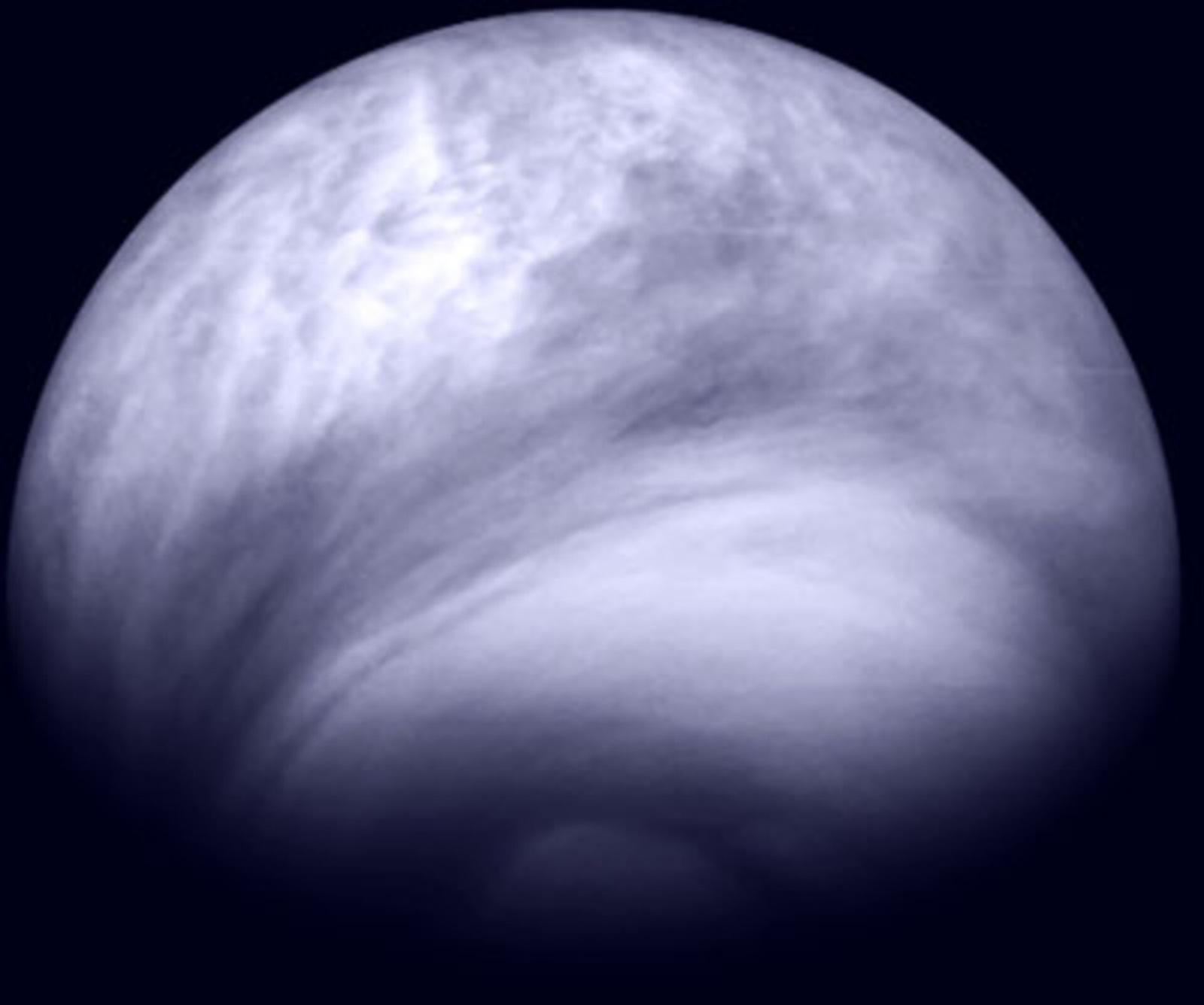
From April 2006 to November 2014 the European Space Agency's Venus Express circled the planet, a near copy of Mars Express rebuilt for a world where sunlight is four times as strong as at Mars. ESA's own FAQ explains the name by the speed of the project, promising less than three years from approval to launch; lift-off came three years and four days after the final go-ahead of November 2002. Planned for 500 days, it worked for eight and a half years, was sent on a deliberate dive through the upper atmosphere as its propellant ran low, and fell silent in the winter of 2014 to 2015.
The mission was proposed in March 2001 to reuse the Mars Express design on strict terms: the same equipment and industrial teams, ready for the 2005 launch window. ESA's Science Programme Committee agreed unanimously on 11 July 2002 to start work, but that autumn Italy, responsible for part of the payload, could not fully commit its funding by the October deadline. On 4 and 5 November 2002 the committee endorsed a rescue: Italy would supply spare parts of the VIRTIS and PFS experiments, and ESA would add 8.5 million euros to integrate the Italian hardware and fill the gaps. Science director David Southwood told scientists and industry to 'go to work to go to Venus!'
Copying a Mars spacecraft for Venus meant turning its thermal design inside out. ESA enlarged the radiators and halved the solar arrays, whose cells alternate with strips of mirror so the panels would not peak at 250 °C. Seen from Venus, Earth can lie in any direction relative to the Sun, so a second high-gain antenna from the Rosetta design faced the opposite way to the main dish. Sources give the launch mass as 1,240 kg or 1,270 kg.
Seven instruments flew: SPICAV, an ultraviolet and infrared spectrometer led from France by Jean-Loup Bertaux, with a new solar-occultation channel, SOIR (ESA lists Belgian and Russian institutes as co-leads); VIRTIS, an imaging spectrometer led by Giuseppe Piccioni in Rome and Pierre Drossart in Paris; PFS, the Planetary Fourier Spectrometer; ASPERA-4, for escaping ions and energetic neutral atoms; the magnetometer MAG; VeRa, which used the radio link itself to sound the atmosphere; and the camera, VMC, from the Max Planck Institute for Solar System Research (MPS). Two lost capability. NSSDCA records PFS as not operational from launch (the Planetary Society reported in July 2007 that its scanner mirror was stuck in the launch position), the loss of the VIRTIS-M infrared channel when its cryocooler failed in October 2008, and a drop in S-band signal level at the end of 2006.
The launch, planned for 26 October 2005 at the opening of a window that closed on 24 November, was postponed because of contamination of the fairing, NSSDCA records. A Soyuz-FG with a Fregat upper stage finally lifted off from Baikonur on 9 November 2005 at 03:33:34 UT. The next day ESA's new deep-space antenna at Cebreros, west of Madrid, received its first X-band signal, from Venus Express, and ESA dates the start of the station's operations from that signal.
Venus Express reached Venus on 11 April 2006, 153 days and 400 million km after launch. Its main engine started at 07:10:29 UT spacecraft time, according to NASA's mission page; NSSDCA gives 07:17:14 UT, the moment the signal reached Earth. ESA said that morning that the burn of about 50 minutes had slowed the craft relative to Venus from 29,000 to about 25,000 km/h. Further burns took it from a capture orbit of about nine days to its working orbit on 7 May 2006: polar, 24 hours long, from about 250 km above the north polar region to 66,000 km over the south pole. Routine science began on 4 June.
Far out over the south pole the instruments could watch for hours; near pericentre they gained detail, though ESA notes the craft passed too close to the north pole for detailed imaging of the vortex there. Correcting the orbit against the Sun's pull every 40 to 50 days used propellant, and ESA warned in 2010 that it would run out in 2015 unless drag could be used to lower the orbit. The first extension came on 23 February 2007, moving the end from September 2007 to early May 2009; CNES records later ones to the end of 2014, and ASI mentions one to the end of 2016. Counts differ: CNES says four, NASA five and INAF six.
Between 12 and 19 April 2006, still in the capture orbit, VIRTIS imaged a double-eyed vortex over the south pole. Years of follow-up showed its core changing shape within a day, from an S or a figure of eight to near chaos, and ESA's summary calls it more variable than any comparable polar vortex known in the Solar System. Studies of VMC images led by Igor Khatuntsev in Moscow and Toru Kouyama in Japan found average cloud-top winds between 50 degrees north and south rising from about 300 km/h in 2006 to 400 km/h over six Earth years, and ESA said in 2013 that no one could explain why. Nils Müller of DLR found surface features seen by VIRTIS displaced by up to 20 km from where Magellan's rotation period placed them, as if the day were on average 6.5 minutes longer (how long a day lasts on Venus). ESA wrote in 2014 that any link between faster winds and slower spin remained unknown.
In October 2006 Bertaux told ESA's French service that he did not expect to find ozone on Venus in any notable quantity, because it would have been detected already. Five years later SPICAV found it, in the tenuous amounts his remark allowed for, by watching stars set through the planet's limb; ESA announced the thin night-side layer on 6 October 2011, with Franck Montmessin as lead scientist. The 2011 release placed it at about 100 km, four times higher than Earth's and a hundred to a thousand times less dense; ESA's 2014 summary gives 90 to 120 km and a thickness of 5 to 10 km. In the models ESA cited, sunlight splits carbon dioxide on the day side and winds carry the oxygen to the night side, where some recombines as ozone without any biology.
Other results filled in the chemistry of the upper atmosphere. SOIR's solar occultations, analysed over five years by Arnaud Mahieux, revealed a permanent temperature minimum near 125 km along the day-night line, around minus 175 °C and at some heights below the freezing point of carbon dioxide, although Mahieux cautioned in 2012 that bright patches which could be ice might have other causes. ASPERA found hydrogen escaping from the night side at about twice the rate of oxygen, the proportions of water, while deuterium is enriched high up because it escapes less easily (oceans and the greenhouse). Lightning is less settled: ESA's May 2014 summary described bursts identified by their electromagnetic signature, but a 2018 critical review by Ralph Lorenz called the claimed detections and non-detections qualitatively contradictory, while concluding that the preponderance of observations supports some kind of frequent electrical activity.
On volcanoes the evidence accumulated without closing the case. A 2010 study led by Sue Smrekar of JPL used VIRTIS emissivity data at three hotspots, Imdr, Themis and Dione Regiones, to identify little-weathered lava flows, which ESA has aged three ways: a few hundred thousand to 2.5 million years (its Italian release), no more than 2.5 million years and possibly much less (the 2014 end-of-mission release), and perhaps a few thousand to a few tens of thousands of years (its highlight page). Sulfur dioxide above the clouds rose sharply after arrival and then fell to about a tenth over six years, Emmanuel Marcq of LATMOS reported in 2012; sunlight destroys the gas within days, so it must have been lifted recently, and his team left open whether eruptions or the circulation did it, noting that Pioneer Venus had seen a similar decline. In 2015 Eugene Shalygin of MPS reported four transient hotspots in VMC images along a rift near Ozza and Maat Montes, one estimated at about 1 square km and 830 °C. ESA and the paper call the rift Ganiki Chasma, a name missing from the IAU gazetteer, which has Ganis Chasma there and the plain Ganiki Planitia to the north. In 2022 J. Brossier and colleagues read low Magellan radar emissivity along Ganis Chasma as geologically recent volcanism matching the transient anomalies, and suggested activity there for at least the last few decades.
The spacecraft also served as an instrument. In drag passes between 2008 and 2010, down to 175 km, ground stations tracked its deceleration, and ESA reported in 2010 that the polar atmosphere at those heights was about 60 percent thinner than predicted. Routine science ended on 15 May 2014 and the aerobraking experiment began: the pericentre was allowed to sink from 190 km, and from 18 June to 11 July the craft skimmed the atmosphere at 131 to 135 km, with small burns lowering it further. ESA's release of 11 July expected 129.1 km the next day; its November summary gives a minimum of 129.2 km on 11 July, and the December release rounds the campaign to 130 to 135 km. Fifteen burns from 12 July raised the pericentre to about 460 km. ESA wrote in 2016 that aerobraking had never before been used on any of its planetary missions.
At those depths the atmosphere proved more variable than expected and about four times denser by day than by night. In April 2016 a team led by Ingo Müller-Wodarg of Imperial College London reported in Nature Physics that the polar atmosphere at 130 to 140 km averaged minus 157 °C, up to 70 degrees colder than the reference model built from Pioneer Venus data, and 22 to 40 percent less dense. ESA's factsheet for EnVision, read on 26 September 2026, plans 11 months of aerobraking to reach that mission's science orbit.
Afterwards the pericentre sank again, and ESA planned raising burns for 23 to 30 November 2014, assuming some propellant was left. Full contact was lost on 28 November; the partial, unstable links that followed showed the craft losing attitude control, most likely because the propellant ran out about halfway through the burns, said mission manager Patrick Martin. ESA declared the mission over on 16 December. Controllers kept listening for the bare carrier: around 15:00 UTC on 18 January 2015 its level jumped by more than 30 dB for about a minute, and the last intermittent detection came on 19 January. Martin said on 23 January that the signal was gone, while the spacecraft might continue orbiting under conditions that did not allow a signal to be received. No observation of its entry exists, so this page gives it no point on the globe (what we left at Venus).
Radio telescopes outside ESA's network also listened. The PRIDE experiment recorded its X-band carrier with VLBI dishes in China, Russia, Australia and Japan in five occultation sessions, four in 2012 and one on 23 March 2014, according to a 2019 study by T. M. Bocanegra-Bahamon and colleagues. In 2014 China's 65 m Tianma telescope held the signal through a complete occultation behind Venus (China and Venus).
A naming trap waits for anyone moving between ESA's two Express missions. On Venus Express, VMC is the Venus Monitoring Camera, a wide-angle camera imaging in four wavelengths, led by Wojciech Markiewicz of MPS. On Mars Express, VMC is the Visual Monitoring Camera, an engineering camera fitted to confirm the separation of Beagle 2 and later used for outreach as the Mars webcam. This page's cloud images and 2015 hotspots come from the Venus camera.
Giuseppe Piccioni summed up the mission for INAF's news service on 17 December 2014: the team had squeezed the spacecraft and every instrument aboard for the greatest possible scientific return. ESA wrote in November 2014 that it had sent back more data than all previous missions to Venus combined, and the EnVision factsheet names Venus Express among the missions it builds on, alongside the Venera programme, Pioneer Venus and Magellan, and says it will also use findings from Akatsuki.
Mission facts
Organisations
European Space Agency (prime contractor EADS Astrium, Toulouse)
Builder
EADS Astrium in Toulouse, prime contractor for ESA, leading a consortium of 25 companies from 14 European countries (ESA's German documentation). The design reuses Mars Express; ESA's French launch release says the reuse halved the cost of the mission.
Launch mass
1,240 kg in NSSDCA and ESA's French launch release; 1,270 kg in JPL Horizons, NASA's mission page, CNES and ESA's German documentation. Both include 93 kg of instruments and 570 kg of propellant.
Main engine
415 N bipropellant engine plus eight 10 N thrusters (NSSDCA); ESA's German documentation gives the main engine as 400 N.
Cost
ESA's FAQ: about 220 million euros for development, launch and operations, including 15 million euros for the instrument institutes, against more than 400 million euros had it been built from scratch. NSSDCA gives the same 220 million total, of which 82.4 million euros is for satellite construction and instrument integration and 37 million for the launch (it does not itemise the rest). DLR's April 2006 release gave the total cost as only 85 million euros without saying what that figure covers.
Launch
9 November 2005 at 03:33:34 UT (04:33 CET) on a Soyuz-FG/Fregat from launch pad 6 at Baikonur, after a slip from 26 October that NSSDCA attributes to contamination of the launch fairing.
Cruise
153 days and 400 million km in ESA's arrival release, NSSDCA and Horizons; ESA's FAQ says the journey lasted 162 days.
Orbit insertion
11 April 2006. Main engine start 07:10:29 UT spacecraft time (NASA) or 07:17:14 UT Earth-received (NSSDCA); burn of about 50 minutes (ESA arrival release; 50 min 14 s from NSSDCA's start and end times) or 53 minutes (ESA FAQ, MPS); planned before launch at about 51 minutes (ESA, 7 November 2005) or 53 (ESA's French launch release); delta-V 1,246.28 m/s (NSSDCA).
Working orbit
Reached 7 May 2006 after 16 orbits: 24 hours, polar, about 250 by 66,000 km, with pericentre at about 80 N (ESA) or 78 N (NSSDCA), later drifting about 3 degrees a year and crossing the pole in October 2009.
Instruments
ASPERA-4 (IRF Kiruna), MAG (IWF Graz), PFS (IFSI Rome), SPICAV/SOIR (Service d'Aéronomie, with BIRA-IASB and IKI), VeRa (Universität der Bundeswehr München), VIRTIS (IASF Rome and Paris Observatory) and VMC (MPS).
Instrument faults
NSSDCA records PFS as not operational since launch because of a malfunction (the Planetary Society reported in July 2007 that its scanner mirror was stuck in the launch position, leaving it staring at its calibration target), a drop in S-band signal level at the end of 2006, and the loss of the VIRTIS-M infrared channel when its cryocooler failed in October 2008.
Extensions
CNES lists ESA extensions decided on 2 October 2009 (to the end of 2012) and 19 November 2010 (to the end of 2014); ESA's own releases add 23 February 2007 (to May 2009) and 4 February 2009 (to the end of 2009). CNES counts four extensions, NASA five, INAF six.
Ozone layer
Found by SPICAV stellar occultations on the night side (ESA, 6 October 2011): about 100 km up and 100 to 1,000 times less dense than Earth's; ESA's 2014 summary gives 90 to 120 km, 5 to 10 km thick.
Cold layer
Around minus 175 °C at about 125 km along the day-night line, from five years of solar occultations (ESA, 1 October 2012) made by SOIR, whose team reports a permanent temperature minimum at 125 km (Mahieux et al. 2012).
Aerobraking experiment
Pericentre lowered from 17 May; about a month between 131 and 135 km; lowest 129.2 km on 11 July; passes of about 100 s; orbital period cut from 24 h to 22 h 20 min; 15 burns after the campaign ended on 12 July raised the pericentre to 460 km. ESA's December 2014 release dates the core phase 18 June to 11 July and the return to about 460 km to 26 July.
End of mission
Raising burns planned for 23 to 30 November 2014; full contact lost 28 November; end declared 16 December (ESA, 16 December 2014). ESA's operations blog: carrier spike of more than 30 dB around 15:00 UTC on 18 January 2015; last intermittent detection 19 January 2015.
Cebreros DSA 2
ESA's 35 m deep-space antenna 77 km west of Madrid, formally inaugurated in September 2005; the station page dates the start of operations to the first X-band signal, received from Venus Express on 10 November 2005.
Mission timeline
- Mar 2001 to Jul 2002Venus Express is proposed in March 2001 to reuse the Mars Express design; ESA's Science Programme Committee agrees unanimously on 11 July 2002 to start work.
- 4 to 5 Nov 2002After Italy cannot fully commit its payload funding by an October deadline, the committee gives the final go-ahead with ESA adding 8.5 million euros toward the Italian instruments.
- 26 Oct 2005Planned launch date (04:43 GMT), inside a window open until 24 November; the launch slips, which NSSDCA attributes to contamination of the fairing.
- 9 Nov 2005Launch at 03:33:34 UT on a Soyuz-FG/Fregat from Baikonur.
- 10 Nov 2005ESA's new Cebreros antenna receives its first X-band signal, from Venus Express, starting the station's operations.
- 11 Apr 2006Orbit insertion: a burn of about 50 minutes, seen on Earth from 09:17 CEST (07:17 UT), slows the craft from 29,000 to about 25,000 km/h relative to Venus.
- 12 to 19 Apr 2006VIRTIS images the double-eyed vortex over the south pole from the capture orbit.
- 7 May 2006After 16 orbits the craft reaches its 24-hour, 250 by 66,000 km polar working orbit; routine science begins on 4 June.
- 23 Feb 2007The Science Programme Committee extends the mission to early May 2009, the first of several extensions.
- Oct 2008The VIRTIS-M cryocooler fails, disabling the instrument's infrared channel.
- Jul 2008 to Apr 2010Drag experiment passes down to 175 km find the polar upper atmosphere about 60 percent thinner than predicted.
- 6 Oct 2011ESA announces the SPICAV detection of an ozone layer about 100 km up.
- 15 May 2014Routine science operations end, and the pericentre is allowed to drop naturally toward the atmosphere.
- 18 Jun to 11 Jul 2014Aerobraking at 131 to 135 km, reaching a lowest pass of 129.2 km on 11 July.
- 12 to 26 Jul 2014Fifteen burns raise the pericentre to about 460 km.
- 28 Nov 2014Full contact is lost during raising burns, most likely as the propellant runs out.
- 16 Dec 2014ESA declares the mission ended.
- 18 to 19 Jan 2015A carrier spike of more than 30 dB around 15:00 UTC on 18 January; the last intermittent detection on 19 January. The 22 January pass hears nothing.
A filled dot marks something that physically happened. A hollow one marks an announcement, a naming or a target.
In pictures
Tap a photo to enlarge.
Translated from the original sources
Passages from the French, German and Italian sources this page draws on, in azmth's translation. Tap Show original to read the original wording.
CNES: Venus Express
French · 2 passages
“The mission, initially 500 days long, was extended four times and ended on 28 November 2014.”
azmth's translation · Show originalHide original
French: «La mission d'une durée initiale de 500 jours a été prolongée à quatre reprises et s'est achevée le 28 novembre 2014»
“1,270 kg: mass of the probe.”
azmth's translation · Show originalHide original
French: «1270 kg : masse de la sonde»
ESA (French), PR 13-2006: L'Europe remporte un nouveau succès planétaire
French · 1 passage
“This morning at 09:17 Paris time, a 50-minute firing of the main engine reduced the probe's speed relative to Venus from 29,000 to about 25,000 km/h, allowing it to be captured by the planet's gravity field.”
azmth's translation · Show originalHide original
French: «Ce matin, à 9h17 (heure de Paris), l'allumage du moteur principal pendant une durée de 50 minutes a permis de réduire de 29 000 à environ 25 000 km/h la vitesse relative de la sonde par rapport à Vénus, permettant ainsi sa capture par le champ de gravité de la planète.»
ESA (French), PR 50-2005: Venus Express entame son périple vers la planète voilée
French · 3 passages
“This 1,240 kg probe was built for ESA by a European industrial team led by EADS Astrium with 25 main contractors in 14 countries.”
azmth's translation · Show originalHide original
French: «Cette sonde de 1 240 kg a été réalisée pour l'ESA par une équipe industrielle européenne menée par EADS Astrium et comptant 25 contractants principaux répartis dans 14 pays.»
“A second firing will be needed to reach the final operational orbit: a polar orbit travelled in 12 hours, coming within 250 km of the planet and reaching out to 66,000 km, to allow both close-up observations and a global view.”
The orbit flown took 24 hours.
azmth's translation · Show originalHide original
French: «Un second allumage sera nécessaire pour atteindre l'orbite opérationnelle définitive : une orbite polaire parcourue en 12 heures, s'approchant jusqu'à 250 km de la planète et s’en éloignant jusqu’à 66 000 km, afin d’autoriser aussi bien des observations rapprochées qu’une vision globale.»
“Venus Express largely reuses the architecture developed for Mars Express, which shortened the manufacturing cycles and halved the cost of the mission while preserving its scientific objectives.”
azmth's translation · Show originalHide original
French: «Venus Express réutilise en grande partie l’architecture développée pour Mars Express, ce qui a permis de réduire les cycles de fabrication et de diviser par deux le coût de la mission tout en préservant les objectifs scientifiques.»
ESA (French), 5 October 2006: De Mars à Vénus, avec Spicam et Spicav
French · 2 passages
“When the Venus Express mission was decided, in 2003, a spare model of SPICAM was recovered and slightly modified to become SPICAV.”
ESA's English pages date the go-ahead to 2002.
azmth's translation · Show originalHide original
French: «Lorsque la mission Venus Express a été décidée, en 2003, un modèle de rechange de Spicam a été récupéré et légèrement modifié pour devenir Spicav (Spectroscopy for Investigation of Characteristics of the Atmosphere of Venus).»
“'On Venus we do not really expect to find ozone in any notable quantity, because if there were any, it would already have been detected,' says Jean-Loup Bertaux.”
SPICAV detected a tenuous ozone layer, 100 to 1,000 times less dense than Earth's, in 2011.
azmth's translation · Show originalHide original
French: «« Sur Vénus, on ne s’attend pas vraiment à trouver de l’ozone en quantité notable, car s’il y en avait, on l’aurait déjà détecté », estime Jean-Loup Bertaux.»
MPS: Venus Express project page
German · 3 passages
“On 11 April 2006 at 10:10 CEST the ESA spacecraft Venus Express successfully entered a polar orbit around our neighbouring planet Venus.”
azmth's translation · Show originalHide original
German: „Am 11. April 2006 um 10.10 Uhr MESZ ist die ESA-Raumsonde Venus Express erfolgreich in eine polare Umlaufbahn um den Nachbarplaneten Venus eingeschwenkt.“
“The main engine had previously braked the probe for 53 minutes and placed it in an orbit very close to the one calculated in advance.”
azmth's translation · Show originalHide original
German: „Das gezündete Haupttriebwerk hatte die Sonde zuvor 53 Minuten lang abgebremst und sie in eine Bahn gebracht, die der vorausberechneten sehr nahe kommt“
“MPS has lead responsibility for the Venus Monitoring Camera VMC and shares responsibility for the plasma instrument ASPERA-4.”
azmth's translation · Show originalHide original
German: „Das MPS ist hauptverantwortlich für die Venus Monitoring Camera VMC und mitverantwortlich für das Plasmainstrument Aspera-4.“
ESA (German): Dokumentation, Die Raumsonde Venus Express
German · 3 passages
“1,270 kg, of which 93 kg payload and 570 kg propellant.”
azmth's translation · Show originalHide original
German: „1270 kg, davon 93 kg Nutzlast und 570 kg Treibstoff“
“More than three quarters of the surface of the two solar wings consists of special mirrors, called optical surface reflectors (OSRs).”
azmth's translation · Show originalHide original
German: „Die Oberfläche der beiden Sonnensegel besteht zu mehr als drei Vierteln aus Spezialspiegeln, so genannten Optical Surface Reflectors (OSRs).“
“Thrust of the main engine: 400 newtons.”
NSSDCA gives 415 N.
azmth's translation · Show originalHide original
German: „Schubkraft des Hauptantriebs 400 Newton“
DLR, 5 April 2006: Europäische Mission Venus Express erreicht den geheimnisvollen Planeten Venus
German · 2 passages
“The total cost of Venus Express is only 85 million euros, because the project builds on the earlier Rosetta and Mars Express missions.”
ESA's FAQ gives about 220 million euros.
azmth's translation · Show originalHide original
German: „Die Gesamtkosten für Venus Express liegen bei nur 85 Millionen Euro, da das Projekt auf den vorausgegangenen Missionen Rosetta und Mars Express aufbaut.“
“The Venus Monitoring Camera (VMC) from the Max Planck Institute for Solar System Research in Katlenburg-Lindau, whose sensor for visible and near-infrared light comes from the DLR Institute of Planetary Research, is designed to record the dynamics of the Venus atmosphere in images.”
azmth's translation · Show originalHide original
German: „Die Venus Monitoring Camera (VMC) vom Max-Planck-Institut für Sonnensystemforschung (MPS) in Katlenburg-Lindau - deren Sensor für das sichtbare Licht und das nahe Infrarot vom DLR-Institut für Planetenforschung stammt - ist dafür ausgelegt, die Dynamik der Venusatmosphäre in Bildern festzuhalten.“
Media INAF, 17 December 2014: Grazie, Venus Express!
Italian · 3 passages
“Eight years of full operation, as we said, well beyond the rosiest expectations of the initial mission plan, which had been concentrated into just 500 days, and which was instead extended no fewer than six times.”
azmth's translation · Show originalHide original
Italian: “Otto anni di piena operatività dicevamo, che sono andati ben oltre le più rosee aspettative indicate dal programma iniziale di missione, che era stato concentrato in soli 500 giorni. E che invece è stato prolungato di ben sei volte.”
“We 'squeezed' the probe far and wide, with all the instruments on board, to get truly the maximum in scientific return.”
Giuseppe Piccioni, VIRTIS principal investigator
azmth's translation · Show originalHide original
Italian: “Abbiamo ‘spremuto’ per lungo e per largo la sonda con tutti gli strumenti a bordo per avere veramente il massimo in termini di ritorno scientifico.”
“down to 'skimming' it at a limit altitude of less than 130 kilometres.”
ESA's own figures give 129.1 to 129.2 km at the lowest.
azmth's translation · Show originalHide original
Italian: “fino a ‘sfiorarlo’ alla quota limite di neanche 130 chilometri”
ASI: Venus Express, esplorazione dell'atmosfera di Venere
Italian · 2 passages
“Given the excellent results, the potential and the perfect functioning of the spacecraft, on 23 February 2007 the SPC unanimously approved extending the mission to May 2009, later prolonged further to the end of 2016.”
azmth's translation · Show originalHide original
Italian: “Visti gli ottimi risultati ottenuti e le potenzialità e la perfetta funzionalità dello spacecraft, il 23 febbraio 2007 l’SPC ha approvato all’unanimità l’estensione della missione fino a maggio 2009, ulteriormente prorogata fino alla fine del 2016.”
“After a journey of about 150 days it reached Venus on 11 April 2006, and after a series of manoeuvres (directed from ESA's control centre in Darmstadt, Germany) to reduce its speed, it entered its final orbit on 7 May.”
azmth's translation · Show originalHide original
Italian: “Dopo un viaggio di circa 150 giorni, ha raggiunto Venere l’11 aprile 2006, e dopo una serie di manovre (guidate dal centro di controllo ESA di Darmstadt in Germania) per ridurre la velocità, è entrata nella sua orbita definitiva il 7 maggio.”
ESA (Italian), 13 April 2010: Colate di lava su Venere osservate con occhi italiani
Italian · 2 passages
“The observations reveal that erupting volcanoes appeared on Venus in a period between a few hundred thousand and 2.5 million years ago.”
azmth's translation · Show originalHide original
Italian: “Le osservazioni rivelano che su Venere apparvero dei vulcani eruttivi in un periodo compreso tra alcune centinaia di migliaia e 2,5 milioni di anni fa.”
“Giuseppe Piccioni is Principal Investigator of VIRTIS, together with Pierre Drossart of LESIA in Meudon, near Paris.”
azmth's translation · Show originalHide original
Italian: “Giuseppe Piccioni è Ricercatore Principale di VIRTIS, insieme a Pierre Drossart del Laboratoire d'Etudes Spatiales et d'Instrumentation en Astrophysique (LESIA) a Meudon, vicino a Parigi.”
Sources
- ESA, Venus Express overview
- ESA, Venus Express FAQs
- ESA, 6 November 2002: No more doubts about ESA's Venus Express
- ESA PR 13-2006, 11 April 2006: Venus Express enters orbit
- ESA, 9 May 2006: Venus Express has reached final orbit
- ESA, 11 July 2014: Venus Express rises again
- ESA Science and Technology, 11 November 2014: Venturing into the upper atmosphere of Venus
- ESA, 16 December 2014: Venus Express goes gently into the night
- ESA Rocket Science blog, 23 January 2015: Venus Express, the last shout
- NSSDCA Master Catalog: Venus Express (Wayback Machine copy of 20 August 2025; the live catalogue returned an error page on 26 September 2026)
- JPL Horizons object data for spacecraft -248
- NASA Science: Venus Express
- ESA, 6 October 2011: ESA finds that Venus has an ozone layer too
- ESA, 1 October 2012: A curious cold layer in the atmosphere of Venus
- ESA, 10 February 2012: Could Venus be shifting gear?
- ESA, 18 June 2013: The fast winds of Venus are getting faster
- ESA, 3 December 2012: Have Venusian volcanoes been caught in the act?
- ESA, 18 June 2015: Hot lava flows discovered on Venus
- ESA Science and Technology, April 2016: Venus Express' swansong experiment sheds light on Venus' polar atmosphere
- ESA, Cebreros DSA 2 station page
- The Planetary Society, 23 July 2007: Venus Express PFS fails to respond to a swift kick
- R. Lorenz, Lightning detection on Venus: a critical review, Progress in Earth and Planetary Science (2018)
- T. M. Bocanegra-Bahamon et al., Venus Express radio occultation observed by PRIDE (2019)
- USGS Gazetteer of Planetary Nomenclature: Ganis Chasma
- ESA, 10 February 2009: ESA extends missions studying Mars, Venus and Earth's magnetosphere
- ESA, 27 February 2007: Mars Express and Venus Express operations extended
- ESA, 15 May 2008: Key molecule discovered in Venus's atmosphere (hydroxyl)
- ESA, 28 November 2007: Caught in the wind from the Sun (ASPERA ion escape)
- ESA, 7 October 2010: Venus Express finds planetary atmospheres such a drag
- ESA, 16 May 2014: Venus Express gets ready to take the plunge
- ESA Science and Technology: Major discoveries by Venus Express, shape-shifting polar vortices
- ESA Science and Technology: Major discoveries by Venus Express, recent volcanism?
- ESA Science and Technology: Major discoveries by Venus Express, ozone layer
- ESA Science and Technology: Major discoveries by Venus Express, water loss
- ESA Science and Technology: Major discoveries by Venus Express, a magnetic surprise
- ESA: Venus Express orbiter instruments
- ESA: Venus Express Principal Investigators
- ESA, 11 April 2006: Venus Express talks to Earth
- ESA PR 45-2005, 18 October 2005: Venus Express ready for lift-off
- ESA, 7 November 2005: Venus Express set for launch to the cryptic planet (launch window)
- ESA PR 40-2005, 15 September 2005: ESA's new deep-space antenna in Cebreros becomes a reality
- ESA: Mars Express instruments (Visual Monitoring Camera)
- ESA: EnVision factsheet
- USGS Gazetteer of Planetary Nomenclature: Ganiki Planitia
- ESA (French), PR 13-2006: L'Europe remporte un nouveau succès planétaire · in French
- CNES: Venus Express · in French
- ESA (French), PR 50-2005: Venus Express entame son périple vers la planète voilée · in French
- ESA (French), 5 October 2006: De Mars à Vénus, avec Spicam et Spicav · in French
- MPS: Venus Express project page · in German
- ESA (German): Dokumentation, Die Raumsonde Venus Express · in German
- DLR, 5 April 2006: Europäische Mission Venus Express erreicht den geheimnisvollen Planeten Venus · in German
- Media INAF, 17 December 2014: Grazie, Venus Express! · in Italian
- ASI: Venus Express, esplorazione dell'atmosfera di Venere · in Italian
- ESA (Italian), 13 April 2010: Colate di lava su Venere osservate con occhi italiani · in Italian
- E. V. Shalygin et al., Active volcanism on Venus in the Ganiki Chasma rift zone, Geophysical Research Letters 42 (2015)
- J. Brossier, M. S. Gilmore and J. W. Head, Extended rift-associated volcanism in Ganis Chasma, Venus detected from Magellan radar emissivity, Geophysical Research Letters (2022)
- A. Mahieux et al., Densities and temperatures in the Venus mesosphere and lower thermosphere retrieved from SOIR on board Venus Express: carbon dioxide measurements at the Venus terminator, JGR Planets 117 (2012)
- S. E. Smrekar et al., Recent hotspot volcanism on Venus from VIRTIS emissivity data, Science 328 (2010)
- E. Marcq et al., Variations of sulphur dioxide at the cloud top of Venus's dynamic atmosphere, Nature Geoscience 6 (2013)
- F. Montmessin et al., A layer of ozone detected in the nightside upper atmosphere of Venus, Icarus 216 (2011)
- S. Barabash et al., The loss of ions from Venus through the plasma wake, Nature 450 (2007)
- G. Piccioni et al., First detection of hydroxyl in the atmosphere of Venus, Astronomy and Astrophysics 483 (2008)
- I. V. Khatuntsev et al., Cloud level winds from the Venus Express Monitoring Camera imaging, Icarus 226 (2013)
- T. Kouyama et al., Long-term variation in the cloud-tracked zonal velocities at the cloud top of Venus deduced from Venus Express VMC images, JGR Planets 118 (2013)
- N. T. Mueller et al., Rotation period of Venus estimated from Venus Express VIRTIS images and Magellan altimetry, Icarus 217 (2012)
- I. C. F. Müller-Wodarg et al., In situ observations of waves in Venus's polar lower thermosphere with Venus Express aerobraking, Nature Physics 12 (2016)
- ESA Science and Technology: Major discoveries by Venus Express, snow on Venus?
- USGS Gazetteer of Planetary Nomenclature: Venus feature list (shapefile of named features)
Facts on this page were verified on 26 September 2026. Where sources disagree, the disagreement is stated rather than resolved silently.
azmth is independent and is not affiliated with or endorsed by NASA, Roscosmos, NPO Lavochkin, ESA, JAXA, ISRO, CNSA, or any other space agency or company named on this page.