Venus missions that lost the competition
NASA and ESA proposal teams · Multinational · Programme · 1994 · Never flew Cancelled
None of these proposals flew as designed, though DAVINCI and VERITAS, turned down in 2017, won in revised form in June 2021. No Venus mission has won New Frontiers, NASA's larger competition, and NASA left Venus out of the draft for its next round, now expected in 2027.
TL;DR· 20 min read
Between 1995 and 2017, Venus bids reached a NASA final round at least seven times and lost every time: VMPM, VESAT, Vesper twice, SAGE, DAVINCI and VERITAS. Balloons (VEVA, VALOR) and three New Frontiers bids (VISAGE, VICI, VOX) never got that far, and in Europe Lavoisier and the European Venus Explorer were not chosen. DAVINCI and VERITAS won in 2021, but no Venus mission has yet won New Frontiers.
Which Venus missions did NASA turn down?
NASA has picked its smaller planetary missions by open competition since 1994, and Venus teams kept entering. At least seven times a Venus bid reached a NASA final round and lost: the Venus Multiprobe Mission to Stardust in 1995, VESAT to Genesis and CONTOUR in 1997, Vesper to MESSENGER and Deep Impact in 1999 and to GRAIL in 2007, the SAGE lander to OSIRIS-REx in 2011, and DAVINCI and VERITAS to Lucy and Psyche in 2017. More bids, among them balloons, landers and orbiters, never reached a final round, and in Europe Lavoisier (2000) and the European Venus Explorer (2007 and 2010) offered ESA probes and balloons and were turned down. The losing designs still paid off: their people and instruments came back, and DAVINCI, VERITAS and ESA's EnVision were all chosen in June 2021.
Facts as of 4 November 2026, from the sources listed below.
- 7NASA final-round losses by Venus bids traced here, 1995 to 2017: VMPM, VESAT, Vesper twice, SAGE, DAVINCI and VERITAS
- 16small probes the Venus Multiprobe Mission would have dropped into the atmosphere, for $202 million, had it beaten Stardust in 1995
- 170 kgmass of the Russian descent craft, with 25 kg of instruments, that IKI worked out for the 2007 European Venus Explorer
Discovery, NASA's line of cost-capped planetary missions, has been filled by open competition since 1994. Each call brings in a few dozen proposals led by principal investigators; NASA names a handful of finalists, pays them to refine their designs, and then picks one or two to build. By law the agency does not publish the losing proposals, so what survives of them is what their teams chose to present at conferences and in papers. This page gathers the Venus bids that can be documented that way, from the Discovery line and the larger New Frontiers line, together with two European efforts, Lavoisier and the European Venus Explorer. Two NASA concept papers that have not been traced to any competition are included too, because they belong to the same search, after Magellan, for a way back to Venus.
Those two show how wide the thinking ran. The Venus Interior Structure Mission (VISM), described by E. R. Stofan and colleagues at JPL in a 1993 workshop report, would have set three seismometer landers in a triangle, two about 250 km apart and the third 1,000 km away, with an orbiting carrier relaying their data. To last six months to a year on the surface, each lander would use a radioisotope heat source driving a Stirling engine to keep its interior at 25 °C and make electricity. At NASA's Glenn Research Center, Geoffrey Landis argued from 2001 that Venus suits a solar aeroplane: above the clouds sunlight is comparable to or stronger than on Earth, the pressure is Earth-like, and the planet turns so slowly that an aircraft keeping pace with the roughly 95 m/s wind at 65 to 75 km could stay in daylight without batteries for the night. Glenn's 2004 design was sized to fit a small aeroshell on a Discovery-class mission. Neither concept has been traced here into a formal proposal.
Discovery's 1994 call drew 28 proposals, three of them for Venus: a Venus Composition Probe from Larry Esposito of the University of Colorado, the Venus Environmental Satellite from Kevin Baines of JPL, and the Venus Multiprobe Mission (VMPM) from Richard Goody of Harvard. On 28 February 1995 NASA made VMPM one of three finalists. Its 16 small probes, modelled on the Pioneer Venus small probes, would have fallen from 60 km to the ground with temperature and pressure sensors four times more sensitive than Pioneer's, while four radio telescopes around the Pacific rim tracked their signals to measure winds to 0.05 m/s or better. The target was the superrotation, which Goody's team called a major unsolved problem of planetary science for over 30 years. VMPM would have launched on a Delta II in June 1999 for $202 million. On 22 November 1995 NASA chose Stardust, which it said was rated highest in scientific content.
VESAT came back stronger. Its 1994 description placed a small orbiter in a circular orbit 30,000 km up, inclined 45 degrees, from which it would map the deep atmosphere's winds, temperatures and trace gases in three dimensions every day, with operations cheap enough to run from a university. In the next round, on 23 April 1997, NASA made it one of five finalists: an orbiter led by Baines carrying an imager, a near-infrared spectrograph, a temperature mapper and an X-band radar, at a total cost of $173 million. On 20 October 1997 NASA picked Genesis and CONTOUR. The 1994 paper's author list begins with F. Taylor and ends with Baines, while NASA's releases name Baines as the proposer, the role that counts in Discovery.
Thirty proposals answered the 1998 call, and on 12 November NASA gave five of them $375,000 each for four-month studies. One was the Venus Sounder for Planetary Exploration, Vesper, from Gordon Chin of NASA Goddard: an orbiter with four instruments to measure the composition and circulation of the middle atmosphere, at $195.8 million. A balloon bid submitted that June by Ronald Greeley of Arizona State University with JPL, the Venus Exploration of Volcanoes and Atmosphere (VEVA), did not make the cut. VEVA would have floated two balloons at 60 km for seven days, each dropping a large chemistry sonde on arrival and later four small imaging sondes onto targeted sites; 5 km above the ground a small gliding parachute would open to slow each sonde, so that it could send pictures up to its balloon near the surface (the paper's general multisonde concept puts the braking at about 3 km and allows 15 to 30 minutes of imaging). On 7 July 1999 NASA picked MESSENGER and Deep Impact.
Chin's team tried again. On 30 October 2006 Vesper was one of three missions given $1.2 million concept studies under a $425 million cost cap, described by NASA as a Venus chemistry and dynamics orbiter. A 2011 conference summary by Chin, which does not say which round it describes, lists three investigations, a submillimetre line spectrometer behind a 50 cm telescope, a near-ultraviolet and infrared imager, and radio occultation, from a polar circular orbit over two Venus years; the 1998 release had counted four instruments. NASA's release of 11 December 2007 announced GRAIL instead.
Baines, meanwhile, turned to balloons. The Venus Aerostatic-Lift Observatory for in-situ Research (VALOR), proposed to Discovery in 2004 and 2006 according to his team's later abstracts, would have floated, as the team described it in 2009, near 55 km in the middle cloud layer for several weeks, drifting north from temperate latitudes towards the polar vortex. It would have sampled all the noble gases and their isotopes, xenon and krypton included, while radio telescopes on Earth measured its winds in all three components. Neither bid was selected. In 2008 the team described Nuclear Polar VALOR, a month-long balloon over a pole powered by an Advanced Stirling Radioisotope Generator, since sunlight there is too weak; it was one of nine NASA-funded studies of missions that could use the new generator.
Radar was the next idea. In 2009 Virgil Sharpton of the University of Alaska Fairbanks, with Boeing and Alliance Spacesystems, presented RAVEN (RAdar at VENus), a Discovery mission of about $425 million built around the C-band radar made for Canada's RADARSAT Constellation. In each Venus day it could image about a quarter of the planet at 30 m per pixel, or about 3% at 3 m, against Magellan's roughly 100 m. NASA's 2010 call drew 28 proposals; from NASA's counts by destination, the blogger Van Kane tallied seven for Venus, four of them reportedly radar mappers. None was among the three finalists named on 5 May 2011.
Of the 27 proposals sent in for the 2014 call, two Venus missions reached the final five on 30 September 2015: DAVINCI, a descent probe led by Lori Glaze of Goddard, and VERITAS, a radar and infrared orbiter led by Suzanne Smrekar of JPL. On 4 January 2017 NASA picked Lucy and Psyche. Esposito, with J. R. Hall and T. Schofield, had presented a Venus Atmosphere and Surface Explorer (VASE) at a planetary science meeting in November 2014; its abstract could not be opened for this page, so neither its design nor whether it was submitted is described here. In September 2019 Esposito and his team at the Laboratory for Atmospheric and Space Physics (LASP) presented HOVER, the Hyperspectral Observer for Venus Reconnaissance, as a proposed mission: an orbiter for the clouds, chemistry, circulation and rock types of Venus and for signs of volcanic eruptions, with the Southwest Research Institute and the University of Cologne as partners. A news report in Indonesian that October listed it beside DAVINCI and VERITAS as a Venus proposal before NASA, but no NASA or team document found for this page confirms that it was formally entered in the 2019 Discovery round. The four finalists named on 13 February 2020 included DAVINCI+ and VERITAS and not HOVER, and on 2 June 2021 NASA selected those two to fly.
In the larger New Frontiers line, the Venus bids answered one standing theme, the Venus In Situ Explorer (VISE). The 2003 decadal survey pictured it as a lander that analyses the atmosphere on the way down, takes a core of the surface, and then inflates a balloon to carry the sample into cooler air for slower analysis. Van Kane noted in 2009 that, as far as he knew, no New Frontiers proposal had been that elaborate. The theme stayed on NASA's list all the same: it was one of six allowed in the New Frontiers 4 call and one of seven NASA named for New Frontiers 5 in November 2020.
Esposito's Surface and Atmosphere Geochemical Explorer (SAGE) went furthest. JPL's Team X worked up a SAGE baseline in March 2003, and a NASA chart from that September shows two landers, one for the plains and one for tessera, each descending in under an hour and working two hours on the ground; Van Kane links this two-lander version to the second New Frontiers competition. In December 2009 SAGE became one of three New Frontiers 3 finalists, each given $3.3 million for a one-year concept study, and the Planetary Society described a probe that would take data on the way down, land, and measure rock both as found and after abrading its weathered skin. Esposito's October 2009 slides, as summarised on Van Kane's blog with notes by Bruce Moomaw, gave about an hour of descent, about three hours on the surface, an arm reaching 3 to 10 cm into the ground, and a combined laser-induced breakdown and Raman spectrometer plus a neutron-activated gamma-ray spectrometer for the rock. On 25 May 2011 NASA announced OSIRIS-REx, noting that a mission to the surface of Venus had been among the three concept studies reviewed.
New Frontiers 4 drew 12 proposals in April 2017, and two were Venus landers. VISAGE, Esposito's successor to SAGE, was a lander dropped by a flyby carrier that relayed its data; in a few hours on the ground, with no control from Earth, it would drill samples from two depths, bring them inside for analysis, and photograph the drill sites before and after. VICI, the Venus In situ Composition Investigations led by Lori Glaze, would have sent two landers to the tessera highlands, which are thought to be the oldest surviving surface on the planet. Each carried a mass spectrometer and a tunable laser spectrometer for the descent, and on the ground a laser instrument firing through a window plus a gamma-ray spectrometer. On 20 December 2017 NASA chose CAESAR and Dragonfly as finalists and gave VICI technology money to develop its Venus Element and Mineralogy Camera to operate under the harsh conditions on Venus.
A third Venus team entered New Frontiers 4 with an orbiter. The Venus Origins Explorer (VOX), led by Suzanne Smrekar of JPL with the German Aerospace Center, paired an orbiter carrying the VISAR interferometric radar, the VEM emissivity mapper and Ka-band gravity tracking, the same three investigations VERITAS carries, with an Atmosphere Sampling Vehicle that would dip into the well-mixed atmosphere and hand a gas sample to its VOCE instrument for noble gas measurement. VOX was not a finalist either.
The Venus In Situ Explorer is still waiting. Once DAVINCI, VERITAS and EnVision had been chosen, NASA dropped it from the New Frontiers 5 themes in September 2022, and its draft call of January 2023 left it out; a National Academies committee, naming programmatic balance as the main reason, agreed in February 2025, while calling VISE a high priority for later rounds. NASA has not yet issued the final call: its planetary science director, Louise Prockter, said in March 2026 that it was expected in 2027. The decadal survey for 2023 to 2032 lists VISE among eight themes for New Frontiers 6, asking for what the losing landers promised: atmospheric cycles, chemistry between surface and air, and the make-up of surface rock, studied in ways that cannot be managed from orbit or from a single descent profile.
Europe's probe-and-balloon proposals of this period came out of Paris. Lavoisier, led by Eric Chassefière of the Service d'Aéronomie with laboratories in eight countries, IKI in Moscow among them, went to ESA's call for the flexible missions F2 and F3 at the beginning of 2000. It paired a descent probe for noble gas and isotope measurements with three small helium balloons floating at just 10 km, where the dense air lets a 2 cubic metre balloon lift up to 60 kg. Carried by winds that the team put at typically a thousand kilometres a day even low down, the balloons would work for days or weeks and then be deflated to land. ESA did not select it for assessment study. A CNES seminar in July 2004 recorded that Lavoisier had also been put forward in a 2002 call for ideas as an ESA cornerstone mission, and that CNES's own Solar System working group was not then putting new Venus missions forward.
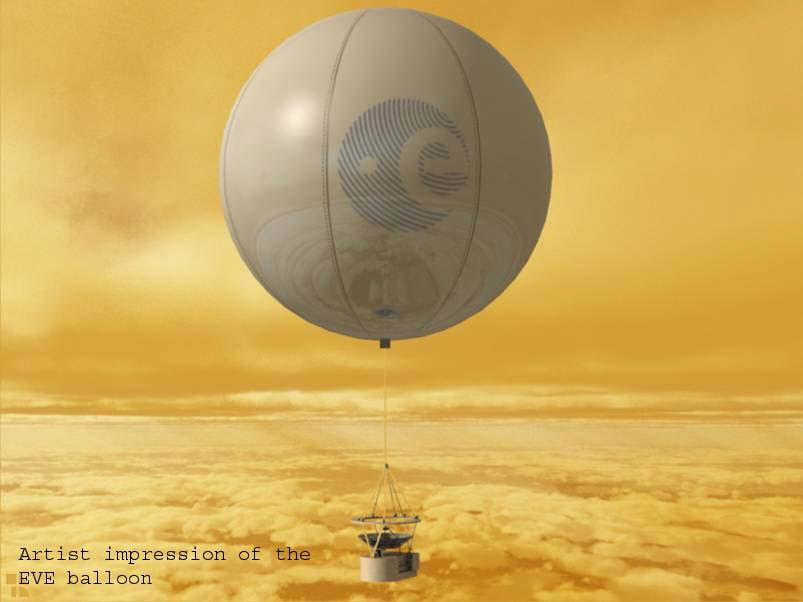
Chassefière's next bid was larger. The European Venus Explorer (EVE) went to ESA's opening Cosmic Vision call in 2007 as a medium-class mission with Russian and Japanese partners. A balloon between 50 and 60 km (45 to 60 km in the letter of intent) would carry a gas chromatograph mass spectrometer once around the planet in about seven days; a Russian descent probe would fall for 60 minutes and work 30 minutes on the surface, aiming at the tesserae; and an orbiter would relay their data and then do its own science for two years. On 17 and 18 October 2007 ESA's Space Science Advisory Committee chose its candidates from 50 proposals, and EVE was not one of them. Its authors later wrote that it lost for programmatic reasons while being rated highly for science.
Japan's contribution was an unusual balloon. EVE's papers describe an optional JAXA balloon filled with water vapour, floating at 35 km below the clouds. Naoki Izutsu and Takeshi Imamura of JAXA and Manabu Yamanaka of Kobe University explained the concept, then under study by ISAS's balloon engineering group, on the old PLANET-C (Akatsuki) project website; Imamura was also one of EVE's authors. In their account, water travels to Venus as liquid in a thousandth of the volume of gas, boils into steam below 42 km, and lifts a 1 kg system that would float for a month or more at about 35 km, where the air is 180 °C at 5.8 bar and the wind circles Venus in about 10 days.
Seen from Moscow, EVE offered a way to merge with Venera-D. V. Karfidov's Russian-language catalogue describes a 2007 proposal for a joint mission: an ESA orbiter based on Venus Express, a Russian lander of 170 kg with 25 kg of instruments, and a European balloon plus a low-flying Japanese one at about 35 km. IKI's 2008 annual report confirms that its scientists worked out the science tasks and a 25 kg payload for a 170 kg descent craft for EVE. The timings differ by source: the EVE papers give 60 minutes of descent and 30 on the surface, while the Russian catalogue by V. Karfidov gives 65 minutes and 15 to 30. Had the joint mission gone ahead, Karfidov writes, Russia would have put off its long-lived lander indefinitely, but no mutually acceptable solution with ESA was reached.
What EVE was also depends on who describes it. Karfidov's catalogue says ESA considered EVE in the early 2000s under the name Venus Entry Probe, and describes it with two spacecraft, a Venus Polar Orbiter and a Venus Elliptical Orbiter. ESA's own page presents the Venus Entry Probe as one of its technology reference studies: those two orbiters plus a balloon at 55 km meant to circle Venus twice in about 14 days, dropping small probes as ballast. EVE's 2007 letter of intent, written by scientists outside ESA, cites that study for the balloon technologies it needed.
By 2010 the Russian timetable no longer fitted, with Venera-D then expected before 2020 and ESA's third medium-class launch (M3) set for 2022 to 2023, so the team, with Colin Wilson of Oxford as lead author, cut EVE to a single balloon. Submitted in December 2010, it would float at 55 km, where the air is about 25 °C at 0.5 bar, for at least ten days, long enough for one full circuit, and talk directly to Earth after a flyby carrier relayed its opening two hours. CNES ran a phase 0 study in 2010 and would have supplied the envelope and inflation system, with ESA providing the gondola and delivery; an orbiter from Russia or India was discussed. EVE did not reach the M3 shortlist, from which ESA picked PLATO on 19 February 2014 over EChO, LOFT, MarcoPolo-R and STE-QUEST.
The losing bids are visible in the missions that won. VOX's orbiter carried the VERITAS investigations, and VERITAS was chosen with DAVINCI on 2 June 2021; eight days later ESA selected EnVision. Those winners now face their own risk: the White House budget request for 2027 leaves out DAVINCI, VERITAS and the US radar for EnVision, which the Planetary Society reads as ending them, and as of 1 November 2026 Congress had not passed NASA's budget for that year. For Venus balloons, landers and aircraft that were studied but never entered in a competition, see Landers, balloons and rovers on the drawing board.
Mission facts
Organisations
Proposing teams in NASA's Discovery and New Frontiers competitions (JPL, NASA Goddard, NASA Glenn, LASP, Harvard, Arizona State, University of Alaska Fairbanks) and European teams led from Paris and Oxford with CNES, IKI and ISAS, proposing to ESA
VISM (1993)
A JPL concept for three seismometer landers in a triangle (two about 250 km apart, the third 1,000 km away), relayed by an orbiting carrier and meant to last six months to a year, each cooled to 25 °C by a Stirling engine driven by a radioisotope heat source.
Venus solar airplane (2001 to 2004)
Geoffrey Landis of NASA Glenn found that a small solar aeroplane flying at or above the roughly 95 m/s cloud-top wind, 65 to 75 km up, could stay in sunlight continuously; the design was sized for a small aeroshell on a Discovery-class mission.
VMPM
One of three Venus proposals among 28 in the 1994 Discovery round, and a finalist on 28 February 1995: 16 small probes dropped into the atmosphere to study its circulation, launched on a Delta II in June 1999 at a total cost to NASA of $202 million.
VESAT
A Discovery finalist on 23 April 1997: an orbiter led by Kevin Baines of JPL to study atmospheric chemistry and meteorology with an imager, a near-infrared spectrograph, a temperature mapper and an X-band radar, at a total cost of $173 million.
Vesper (1998)
A Discovery finalist on 12 November 1998: an orbiter with four instruments for the composition and circulation of the middle atmosphere, led by Gordon Chin of NASA Goddard, at a total cost of $195.8 million.
Vesper (2006)
A Venus chemistry and dynamics orbiter given one of three $1.2 million Discovery concept studies on 30 October 2006, with a $425 million cost cap for any mission chosen to proceed.
VEVA
Submitted to Discovery in June 1998 by a team led by Ronald Greeley of Arizona State University: two balloons at 60 km for seven days, two atmospheric chemistry sondes and eight small imaging sondes released to targeted sites.
VALOR and Nuclear Polar VALOR
Kevin Baines's JPL balloon concept, proposed to Discovery in 2004 and 2006; its 2008 successor would ride the winds at 55 km over a polar region for a month on power from an Advanced Stirling Radioisotope Generator.
RAVEN (2009)
Virgil Sharpton's Discovery radar orbiter of about $425 million, reusing the C-band radar built for Canada's RADARSAT Constellation: about 25% of Venus at 30 m per pixel, or about 3% at 3 m, per Venus day.
VASE (2014)
Venus Atmosphere and Surface Explorer, a November 2014 planetary science meeting abstract by L. W. Esposito with J. R. Hall and T. Schofield; its text could not be opened for this page.
HOVER (2019)
A LASP orbiter for Venus clouds, chemistry, dynamics and surface, presented in September 2019 as a proposed mission, with the Southwest Research Institute providing the project scientist and the University of Cologne a radio occultation investigation. A press report lists it in the 2019 Discovery round; no NASA or team document found confirms that.
SAGE
One of three New Frontiers 3 finalists named in December 2009, each given $3.3 million for a one-year concept study: a probe that measures the atmosphere on the way down, lands, and analyses rock as found and after abrading its surface.
VISAGE (2017)
Esposito's New Frontiers 4 lander: a flyby carrier relays data during a few hours on the surface with no ground control, as it drills at two depths and analyses the samples inside.
VICI (2017)
Led by Lori Glaze of Goddard. Not a finalist, but on 20 December 2017 NASA gave it technology funds to develop the Venus Element and Mineralogy Camera, which uses lasers on a lander to measure the mineralogy and elemental composition of surface rocks.
VOX (2017)
Suzanne Smrekar's orbiter with the VISAR radar, VEM spectrometer and Ka-band gravity, plus an Atmosphere Sampling Vehicle that dips into the atmosphere to feed a noble gas instrument (VOCE).
Venus In Situ Explorer (VISE)
One of seven themes NASA named for New Frontiers 5 in November 2020, dropped from that list in September 2022 after DAVINCI, VERITAS and EnVision were chosen, and listed among eight themes for New Frontiers 6 in the decadal survey for 2023 to 2032.
New Frontiers 5 call
Not yet issued. NASA's New Frontiers 5 page, read on 4 November 2026, says NASA has not approved its release, and in March 2026 planetary science director Louise Prockter said NASA expected to release it in 2027. Its theme list has had no Venus entry since September 2022.
Lavoisier (2000)
A descent probe plus three balloons deployed below the cloud deck, proposed by teams from eight European countries to ESA's F2/F3 call at the beginning of 2000 and not selected for the assessment study.
EVE 2007
A balloon at 50 to 60 km for 7 days, a Russian descent probe (60 minutes of descent, 30 on the surface) and a polar relay orbiter; not chosen in ESA's 2007 selection round, for programmatic reasons according to its team.
Mission timeline
- 1993JPL's Venus Interior Structure Mission, a three-lander seismic network, is described at an LPI workshop on planetary instruments.
- 28 February 1995NASA names the Venus Multiprobe Mission one of three Discovery finalists, from 28 proposals.
- 22 November 1995NASA chooses Stardust; VMPM will not fly.
- 23 April 1997VESAT is one of five Discovery finalists, at $173 million.
- 20 October 1997NASA selects Genesis and CONTOUR instead.
- 12 November 1998Vesper is one of five Discovery finalists, at $195.8 million.
- 7 July 1999NASA picks MESSENGER and Deep Impact; Vesper is not chosen.
- January 2000Lavoisier, a descent probe and three low-altitude balloons, is proposed to ESA's call for the flexible missions F2 and F3.
- 30 October 2006Vesper is one of three Discovery concept studies, each given $1.2 million.
- 17 to 18 October 2007ESA's Space Science Advisory Committee picks Cosmic Vision candidates from 50 proposals; the European Venus Explorer is not among them.
- 11 December 2007NASA announces GRAIL; Vesper loses a second time.
- December 2009SAGE becomes a New Frontiers 3 finalist with $3.3 million for a one-year study.
- December 2010A single-balloon European Venus Explorer is proposed for ESA's M3 slot.
- 25 May 2011NASA selects OSIRIS-REx over the other two concept studies, a lunar far side sample return and a mission to the surface of Venus (SAGE).
- 4 January 2017Lucy and Psyche beat the Discovery finalists DAVINCI and VERITAS.
- 20 December 2017New Frontiers 4 finalists are CAESAR and Dragonfly; VICI receives technology development funds.
- 13 February 2020NASA names four Discovery 2019 finalists, DAVINCI+ and VERITAS among them; HOVER, presented in 2019 as a proposed Venus orbiter, is not on the list.
- 5 November 2020NASA lists seven themes for New Frontiers 5, the Venus In Situ Explorer among them.
- 2 June 2021NASA selects DAVINCI+ and VERITAS, both turned down in 2017, to fly; ESA chooses EnVision eight days later.
- 7 September 2022NASA's advance notice for New Frontiers 5 lists six themes, without the Venus In Situ Explorer; the draft call of 10 January 2023 keeps it out.
- 25 February 2025A National Academies report agrees that the Venus In Situ Explorer should stay out of New Frontiers 5, for programmatic balance after DAVINCI, VERITAS and EnVision, and calls it a high priority for later rounds.
- 16 March 2026NASA's planetary science director says the next New Frontiers call is expected in 2027.
- 23 April 2026The Planetary Society reads the White House budget request for 2027, which does not name them, as ending DAVINCI, VERITAS and the US radar for EnVision, NASA's whole Venus portfolio.
- 14 May 2026The Planetary Society reports New Frontiers 5 at least three years behind schedule, with no action since mid-2023.
A filled dot marks something that physically happened. A hollow one marks an announcement, a naming or a target.
In pictures
Tap a photo to enlarge.
Translated from the original sources
Passages from the Russian, Japanese, French and Indonesian sources this page draws on, in azmth's translation. Tap Show original to read the original wording.
CNES, Séminaire de prospective scientifique spatiale, Paris, 6 and 7 July 2004, proceedings
French · 1 passage
CNES, Séminaire de prospective scientifique spatiale, Paris, 6 and 7 July 2004, proceedings (Wayback copy)
Open the source“the definition of other missions to Venus, which was presented in the 2002 call for ideas (the Lavoisier mission as an ESA cornerstone), will probably become topical again in the future, but is not being put forward by the Solar System group for now.”
azmth's translation · Show originalHide original
French: «la définition d'autres missions vers Vénus, qui a été présentée dans l'appel à idées 2002 (mission Lavoisier comme pierre angulaire Esa), reviendra probablement d'actualité dans le futur, mais n'est pas mise en avant par le groupe Système solaire pour l'instant.»
V. Karfidov, Projects of European and Asian interplanetary probes 2001 to 2010
Russian · 4 passages
V. Karfidov, Projects of European and Asian interplanetary probes 2001 to 2010 (Kosmonavtika, 2021; Wayback copy of epizodsspace)
Open the source“In 2007 a proposal appeared to combine the Venera-D project with ESA's European Venus Explorer (EVE) programme.”
azmth's translation · Show originalHide original
Russian: «В 2007 году появилось предложение о совмещении проекта «Венера-Д» с программой ESA «European Venus Explorer» (EVE).»
“Small balloon probes were also to be delivered to Venus to study its atmosphere: a European one and a low-flying Japanese one, which was to float at an altitude of about 35 km. The lander was to have a mass of 170 kg, including 25 kg of scientific instruments. Descent time in the atmosphere 65 minutes, working time on the surface of Venus 15 to 30 minutes.”
azmth's translation · Show originalHide original
Russian: «Предполагалось доставить на Венеру также небольшие аэростатные зонды для исследований атмосферы Венеры - европейский и японский низколетящий, который должен плавать в атмосфере на высоте около 35 км. Посадочный аппарат должен иметь массу 170 кг, в т.ч. 25 кг научной аппаратуры. Время спуска в атмосфере - 65 мин, время работы на поверхности Венеры - 15-30 минут.»
“Had a decision been taken on a joint Russian-European Venus probe, the task of building a 'long-lived' landing station would have been put off to an indefinite future. However, a mutually acceptable solution with ESA could not be reached.”
azmth's translation · Show originalHide original
Russian: «В случае принятия решения о совместной российско-европейской венерианской АМС, задача создания «долгоживущей» посадочной станции была бы отложена на неопределенное будущее. Однако, достичь взаимоприемлемого решения с ESA не удалось.»
“The European Venus Explorer (EVE) was a project considered by ESA in the early 2000s, called Venus Entry Probe until 2007.”
Footnote markers omitted from the quotation.
azmth's translation · Show originalHide original
Russian: ««European Venus Explorer» («EVE») - проект, рассматривавшийся ESA в начале 2000-х годов, до 2007 года называвшийся «Venus Entry Probe».»
IKI RAN, annual report 2008, section 3.3, projects at the research stage
Russian · 1 passage
“In parallel, within the research work, the science tasks and the scientific payload (25 kg) of a craft descending to the surface of Venus with a total mass of 170 kg were considered, as part of preparing proposals for the European EVE mission (Cosmic Vision programme 2007).”
azmth's translation · Show originalHide original
Russian: «Параллельно в рамках НИР были рассмотрены научные задачи и состав научной аппаратуры ( 25 кг ) спускаемого на поверхность Венеры аппарата с общей массой 170 кг в рамках подготовки предложений для европейской мисси EVE (программа Cosmic Vision 2007).»
N. Izutsu, M. Yamanaka and T. Imamura, Planetary exploration by balloon and Japan's Venus balloon plan, PLANET-C project website
Japanese · 3 passages
N. Izutsu, M. Yamanaka and T. Imamura, Planetary exploration by balloon and Japan's Venus balloon plan, PLANET-C project website (JAXA)
Open the source“In the plan, the balloon floats for more than a month at about 35 km, below the concentrated sulfuric acid clouds that lie between 46 and 70 km. At this height the air is at 180 °C and 5.8 bar, and a wind blows that circles Venus in about 10 days.”
azmth's translation · Show originalHide original
Japanese: 計画では,高度46〜70 kmに分布する濃硫酸の雲の下,高度約35 kmに,気球を1ヶ月以上浮遊させる.この高度の大気の温度は180℃,圧力は5.8 barであり,金星を約10日で1周する風が吹いている.
“With water vapour, the lifting gas can be carried to Venus as liquid water, in one thousandth of the volume and with no pressure vessel.”
azmth's translation · Show originalHide original
Japanese: 水蒸気を用いれば,金星までの輸送中は高圧容器無しに液体の水として1/1000の容積で運ぶことができる.
“The balloon introduced here is a system with a total mass of 1 kg, and very compact, at about 0.018 cubic metres when stowed in the entry capsule.”
azmth's translation · Show originalHide original
Japanese: ここで紹介した気球は総重量1 kgのシステムで,エントリーカプセル搭載時の容積は約0.018 m3と非常にコンパクトである.
CNN Indonesia, Ilmuwan usul NASA mulai misi ke Venus, 25 October 2019
Indonesian · 1 passage
“Lastly, the Hyperspectral Observer for Venus Reconnaissance (HOVER), to examine the clouds, chemistry, dynamics and surface of Venus to better understand its climate.”
The report lists it after DAVINCI and VERITAS as the three proposals before NASA, and wrongly credits VEXAG with submitting them.
azmth's translation · Show originalHide original
Indonesian: “Terakhir, Hyperspectral Observer untuk Venus Reconnaissance (HOVER) untuk memeriksa awan, kimia, dinamika, dan permukaan Venus untuk lebih memahami iklimnya.”
Sources
- NASA release 95-19, Missions to the Moon, Sun, Venus and a comet picked for Discovery, 28 February 1995 (NSSDCA copy, with the list of 28 proposals)
- NASA release 95-209, Comet sample return mission picked as next Discovery flight, 22 November 1995 (NSSDCA copy)
- NSSDCA, the three final candidates for the fourth Discovery mission (Stardust, Suess-Urey, Venus Multi-Probe)
- R. E. Young, R. M. Goody et al., Venus Multiprobe Mission, International Venus Workshop 2001 (NTRS)
- F. Taylor et al. (with K. Baines), VESAT: The Venus Environmental Satellite Discovery Mission, 1994 (NTRS)
- NASA release 97-78, Five Discovery mission proposals selected for feasibility studies, 23 April 1997 (NSSDCA copy)
- NASA release 97-240, Genesis and CONTOUR selected, 20 October 1997 (NSSDCA copy)
- NASA release 98-203, Five Discovery mission proposals selected for feasibility studies, 12 November 1998 (NSSDCA copy)
- NASA, Selection of MESSENGER and Deep Impact, 7 July 1999 (NSSDCA copy)
- NASA release 06-342, Discovery Program selections, 30 October 2006 (NSSDCA copy)
- NASA release 07-274, GRAIL selected, 11 December 2007 (NSSDCA copy)
- G. Chin, Vesper, Venus chemistry and dynamics orbiter: a NASA Discovery mission proposal, AOGS 2011 extended abstract (NTRS)
- E. R. Stofan et al., Venus Interior Structure Mission (VISM), LPI Technical Report 93-02 (NTRS)
- G. A. Landis, Exploring Venus by Solar Airplane, 2001 (NTRS)
- G. A. Landis, Solar Airplane Concept Developed for Venus Exploration, NASA Glenn, 2004 (NTRS)
- J. A. Cutts et al., Venus Aerobot Multisonde Mission, AIAA Balloon Technology Conference 1999 (NTRS)
- K. H. Baines et al., In-situ exploration of Venus by balloon, LPSC 2009 abstract 1238
- Van Kane, AGU future mission abstracts (reproduces the 2008 Nuclear Polar VALOR abstract), Future Planetary Exploration, November 2008
- Van Kane, ASRG missions: Venus balloon (reproduces the Nuclear Polar VALOR abstract of Baines and Balint), January 2009
- Van Kane, Proposed Discovery Venus radar mission (reproduces Sharpton et al., AGU 2009), 3 November 2009
- Van Kane, Discovery Next (2010 proposals by destination), February 2014
- NASA release 11-132, Discovery finalists, 5 May 2011 (NSSDCA copy)
- NASA release 15-196, Discovery finalists including DAVINCI and VERITAS, 30 September 2015 (NSSDCA copy)
- NASA release 17-003, Lucy and Psyche selected, 4 January 2017 (NSSDCA copy)
- OpenAlex record, Esposito, Hall and Schofield, Venus Atmosphere and Surface Explorer, DPS meeting, November 2014
- L. W. Esposito and the HOVER team, Hyperspectral Observer for Venus Reconnaissance, EPSC-DPS 2019 abstract 340
- NASA, NASA selects four possible missions to study the secrets of the solar system, 13 February 2020
- NASA, NASA selects 2 missions to study lost habitable world of Venus, 2 June 2021
- Bruce Betts, NASA selects three new missions for New Frontiers studies, The Planetary Society, 30 December 2009
- R. M. Jones, SAGE baseline design from March 2003 Team X studies (NTRS record)
- Van Kane, A New Frontiers Venus lander, March 2009 (VISE quote and the 2003 two-lander chart)
- Van Kane, SAGE New Frontiers proposal (enhanced), January 2010
- NASA release 11-163, NASA to launch new science mission to asteroid in 2016, 25 May 2011 (Wayback copy)
- Van Kane, Here is what we know about the 12 proposals for NASA's next New Frontiers mission, The Planetary Society, 10 August 2017
- L. W. Esposito, VISAGE: a proposed New Frontiers mission, LPSC 2017 abstract 2444
- S. Smrekar et al., Venus Origins Explorer (VOX), a proposed New Frontier mission, VEXAG 2017 abstract 8031
- S. Smrekar et al., VERITAS: a proposed Discovery mission, EPSC-DPS 2019 abstract 1124
- NASA, NASA invests in concept development for missions to comet, Saturn moon Titan, 20 December 2017
- National Academies, Origins, Worlds, and Life: A Decadal Strategy for Planetary Science and Astrobiology 2023-2032, chapter 22
- Jack Kiraly, House appropriators advance key NASA funding bill, The Planetary Society, 14 May 2026
- NASA, Second Community Announcement: advance notice regarding the New Frontiers 5 announcement of opportunity, 5 November 2020 (NASA Astrobiology copy, posted 6 November 2020)
- NASA, Fifth Community Announcement: advance notice regarding forthcoming release of the New Frontiers 5 announcement of opportunity, 7 September 2022 (six mission themes, the Venus In Situ Explorer no longer among them)
- National Academies, Proposed Science Themes for NASA's Fifth New Frontiers Mission, 25 February 2025, chapter 3 (Finding 7 on the Venus In Situ Explorer)
- NASA, New Frontiers 5 programme page (NASA has not approved release of the call; last modified 24 August 2023, read 4 November 2026)
- NASA Science, SARA grant solicitations page (final New Frontiers 5 call estimated no earlier than 2026; updated 10 June 2026)
- Jeff Foust, NASA grappling with planetary science funding shortfall, SpaceNews, 18 March 2026
- Casey Dreier, The FY 2027 NASA budget request, The Planetary Society, 23 April 2026
- SpacePolicyOnline, What's happening in space policy, November 1 to 8, 2026 (all 12 FY2027 appropriations bills still unfinished)
- E. Chassefière et al., The Lavoisier mission, Advances in Space Research 29 (2002) 255-264 (HAL record)
- E. Chassefière et al., Lavoisier: a low altitude balloon network for probing the deep atmosphere and surface of Venus, 2005 (NTRS)
- CNES, Séminaire de prospective scientifique spatiale, Paris, 6 and 7 July 2004, proceedings (Wayback copy) · in French
- E. Chassefière et al., EVE letter of intent for Cosmic Vision 2015-2025, 2007 (Wayback copy of the EVE site)
- EVE team website, 2007 mission baseline (Wayback copy)
- EVE team website, mission baseline of the 2010 proposal (Wayback copy)
- E. Chassefière, C. Wilson and the EVE team, EPSC 2010 abstract 363
- E. Chassefière et al., European Venus Explorer (EVE): an in-situ mission to Venus, Experimental Astronomy 23 (2009) (Oxford ORA record)
- C. Wilson et al., The 2010 European Venus Explorer (EVE) mission proposal, Experimental Astronomy 33 (2012) 305-335 (Oxford ORA record)
- ESA, Cosmic Vision 2015-2025: and the candidate missions are..., 19 October 2007
- ESA, ESA selects planet-hunting PLATO mission, 19 February 2014
- ESA, ESA selects revolutionary Venus mission EnVision, 10 June 2021
- ESA Science and Technology, Venus Entry Probe technology reference study
- V. Karfidov, Projects of European and Asian interplanetary probes 2001 to 2010 (Kosmonavtika, 2021; Wayback copy of epizodsspace) · in Russian
- IKI RAN, annual report 2008, section 3.3, projects at the research stage · in Russian
- N. Izutsu, M. Yamanaka and T. Imamura, Planetary exploration by balloon and Japan's Venus balloon plan, PLANET-C project website (JAXA) · in Japanese
- CNN Indonesia, Ilmuwan usul NASA mulai misi ke Venus, 25 October 2019 · in Indonesian
Facts on this page were verified on 4 November 2026. Where sources disagree, the disagreement is stated rather than resolved silently.
azmth is independent and is not affiliated with or endorsed by NASA, Roscosmos, NPO Lavochkin, ESA, JAXA, ISRO, CNSA, or any other space agency or company named on this page.