DAVINCI
NASA Goddard · United States · Atmospheric probe · 2030 · Announced In development
In development. DAVINCI now aims to launch in late December 2030, a year earlier than planned, and to release its probe for the plunge through the atmosphere of Venus on 3 October 2032. Congress funded it for fiscal year 2026 after the White House proposed ending it; funding for 2027 is not yet decided.
TL;DR· 17 min read
DAVINCI is a NASA Discovery mission to drop an instrumented titanium sphere through the atmosphere of Venus onto the Alpha Regio highlands, after flybys by its carrier spacecraft. Selected in 2021, it now aims to launch in late December 2030, a year earlier than its previous plan, with the probe to be released for its descent on 3 October 2032. The White House proposed ending it for fiscal year 2026 and left it out of the 2027 request; Congress set a 99.0 million dollar minimum for 2026, and 2027 funding is still being decided.
When will DAVINCI launch to Venus?
DAVINCI, NASA's next mission to Venus, aims to launch in late December 2030, a year sooner than its previous plan, and to release its probe for the plunge through the planet's atmosphere on 3 October 2032. A carrier spacecraft is to fly past Venus and let go of that probe, a titanium sphere just under a metre across, which is to fall for about an hour onto Alpha Regio, a highland of wrinkled, cracked ground called tessera that NASA says no earlier probe studied or photographed. On the way down the sphere is to sample the air, including its noble gases, and photograph the mountains from below the clouds. NASA selected the mission in June 2021. Since 2025 it has also been at the centre of a budget fight: the White House proposed ending it and left it out of its 2027 request, while Congress wrote a 99.0 million dollar minimum for fiscal year 2026 into law. This page covers the mission and that fight.
Facts as of 4 November 2026, from the sources listed below.
- Dec 2030launch target the principal investigator gave in October 2026, which he said brings launch forward 54 weeks from the previous plan of December 2031
- 99.0 million USDFY2026 minimum set by Public Law 119-74 and allotted in NASA's July 2026 spending plan
- 59.7 minutesreference descent time from entry to touchdown in the 2022 design (57 to 67 minutes at 99 percent confidence)
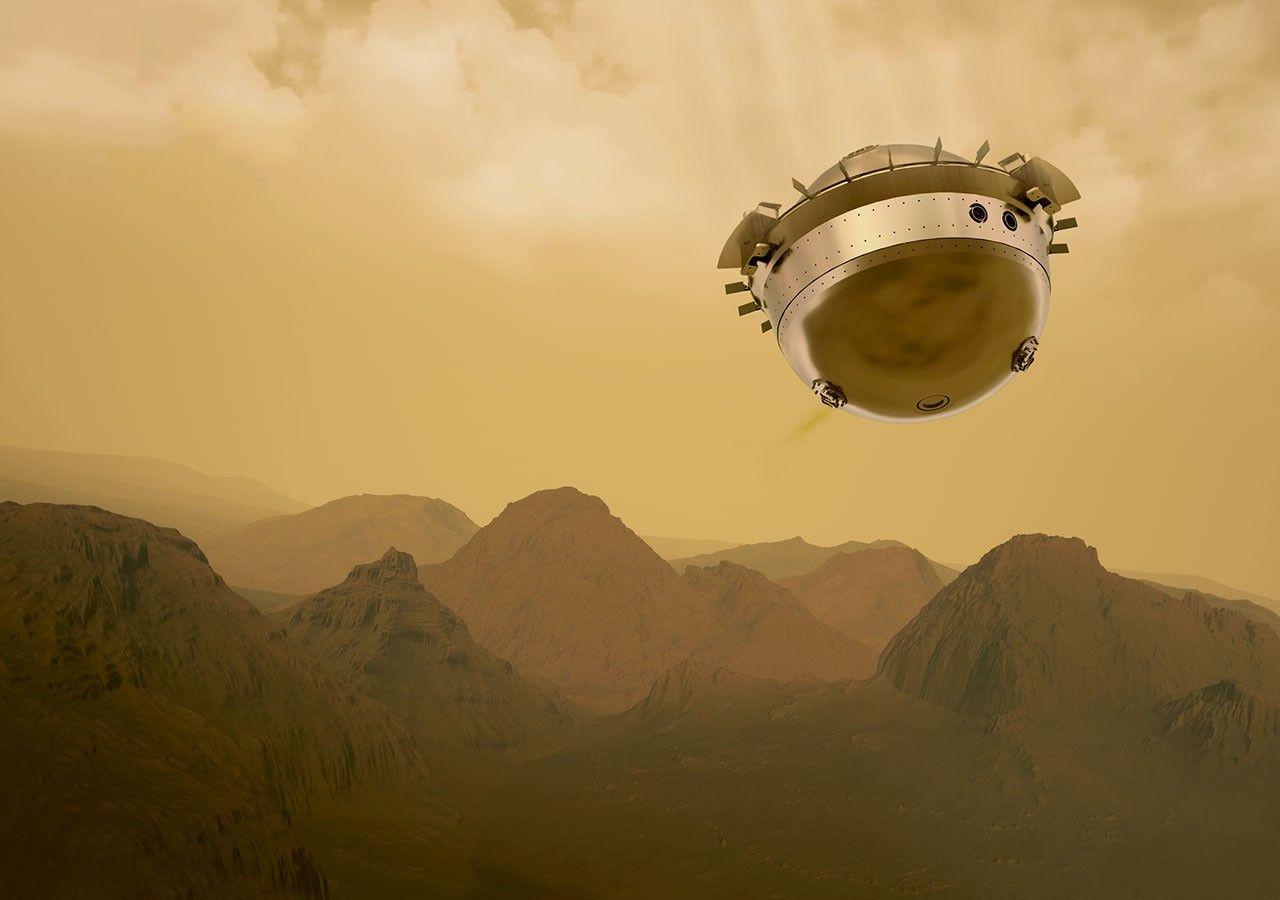
Two spacecraft are to travel to Venus as one. A carrier that Lockheed Martin Space in Denver will build is to fly past the planet, filming the clouds in ultraviolet light and mapping heat that escapes from the surface at night. It is then to release the descent sphere, a sealed titanium vessel just under a metre across carrying five instruments, which is to hang under a parachute, drop free and fall onto Alpha Regio, radioing its measurements to the carrier for relay to Earth. NASA's Goddard Space Flight Center leads the mission, with James Garvin as principal investigator. NASA's update of 24 September 2026 has it working toward approval to enter final design and fabrication, and all hardware tested so far is engineering models and test units.
The idea is older than the selection. NASA named DAVINCI a Discovery finalist on 30 September 2015, with Lori Glaze of Goddard as principal investigator, then picked the asteroid missions Lucy and Psyche on 4 January 2017. The team came back as DAVINCI+, and when NASA named four finalists on 13 February 2020 it explained that the plus referred to imaging. On 2 June 2021 NASA selected DAVINCI+ and VERITAS together, awarding each about 500 million dollars for development and expecting both to launch between 2028 and 2030. The team's 2022 mission paper and NASA's pages since drop the plus.
Noble gases were measured at Venus in the late 1970s, by the Pioneer Venus Large Probe and by Soviet Venera probes, but only in part: according to the 2022 mission paper, only neon and argon have been measured robustly, the two reported krypton abundances differ by a factor of fifteen, and xenon has only upper limits. Because noble gases do not react, their amounts and isotopes record what the planet was built from and how much of its early air escaped. Water is the other target. Pioneer Venus measured the deuterium to hydrogen ratio at about 100 times Earth's after its inlet clogged with sulfuric acid droplets; ground-based work gives 120 plus or minus 40 times, and Venus Express data suggest the ratio may rise markedly with altitude. A high ratio could mean the water of evaporated oceans was lost to space, that Venus never had oceans and lost hydrogen from a steam atmosphere, or that water outgassed within the last billion years escaped; the paper cites work for each. Whether Venus once had oceans remains unsettled.
Alpha Regio was chosen because it is thought to be old ground. It is a tessera, terrain that NASA describes as found so far only on Venus and covering about 8 percent of its surface: cracked and wrinkled highlands named for their resemblance to a parquet floor. Alpha Regio stands about 1.6 km above the surrounding lava plains. Tesserae may be the oldest surfaces on the planet, and NASA notes that infrared images suggest some could hold silica-rich rock like the granite of Earth's continents, rock that on Earth forms with the involvement of water, the 2022 paper adds. Those are hypotheses the mission is meant to test. By combining Magellan radar altimetry with Arecibo Observatory radar images, the team has sharpened its maps of Alpha Regio tenfold, to scales below 1 km, NASA reported in October 2024.
Before the drop, the carrier is to observe Venus on two flybys (the 2022 design; NASA Langley's June 2026 abstract has the probe landing after one). Its four VISOR cameras are to image the sunlit clouds in the ultraviolet band of their unidentified absorber and, on the night side, map surface heat leaking through the clouds. CUVIS, a Goddard technology demonstration spectrometer, is to help identify that absorber, which NASA says takes up to half the sunlight Venus receives.
Most of the engineering goes into the sphere. In the 2022 design it is a hermetically sealed titanium vessel of 200 kg, close in size to the Pioneer Venus Large Probe. Its gas inlets stay capped until set altitudes, and drag plates and spin vanes control the fall. Layered insulation and phase-change material keep the electronics within limits while the air outside heats toward 460 degrees Celsius. Engineering papers from NASA Langley call the sphere Zephyr. Lockheed Martin is responsible for the entry system around it: a sphere-cone aeroshell with a carbon-carbon heat shield, a backshell and two parachutes.
About an hour separates entry from touchdown. In the sequence published in 2022, entry begins at about 145 km; the parachutes deploy, the heat shield falls away at around 70 km, and from there the two spectrometers sample the gas all the way down. About 32 minutes after entry the main parachute is released and the sphere falls freely while the descent imager takes near-infrared pictures straight down. Simulations put touchdown 57.04 to 66.7 minutes after entry at 99 percent confidence, with a reference of 59.7 minutes. The design meets every science goal before then and the sphere need not survive landing, but the paper says it has power for about 18 more minutes of work if it does.
Five instruments ride inside. The Venus Mass Spectrometer and the Venus Tunable Laser Spectrometer draw on the Sample Analysis at Mars suite on the Curiosity rover: NASA says the first will study noble gases and trace compounds from about 68 km altitude to near the surface, and the second measures isotope ratios. The Venus Atmospheric Structure Investigation records pressure, temperature, winds and accelerations, the Venus Descent Imager looks down in near-infrared light through a sapphire window in the sphere's base, and VfOx, a student-built sensor, measures oxygen fugacity in the lowest part of the atmosphere. NASA says imaging begins below the clouds at about 40 km and that processing should reach nearly 1 m per pixel.
Dates have moved in both directions since 2021. The 2022 mission paper laid out a launch in June 2029 and delivery of the sphere to Alpha Regio on 21 June 2031, a date chosen for good lighting under the clouds. NASA's FY2025 budget request, published in 2024, then cited budget constraints in reducing DAVINCI's funding and moving the launch to a 2031 to 2032 opportunity. It also records a life-cycle cost estimate of 1.2 to 1.6 billion dollars, made in June 2021 as Phase B opened; it and the 500 million dollars of 2021 measure different things, since the Discovery cost cap excludes the launch vehicle and operations.
Through 2026 the date moved forward. The Goddard team's March abstract for the Lunar and Planetary Science Conference says Headquarters directed planning for a launch no earlier than 2031 and that a trade study put it on target for December 2031, with entry and descent in April 2034. At the same conference on 17 March, Natasha Johnson of Goddard said the mission now targeted December 2030, releasing the probe in January 2033, according to Space.com. Langley engineers in June still called December 2031 the current baseline, with a one-year acceleration under consideration, while NASA Ames slides of 29 June say development is being accelerated toward a 2030 launch. In early October Garvin told the Venus Exploration Analysis Group that the team had brought the launch forward 54 weeks to late December 2030 on a low-energy trajectory: a Venus flyby in early 2032 is to set up the probe's release for its descent on 3 October 2032, and the carrier should keep enough fuel to enter orbit later, Ars Technica reported on 14 October. NASA's mission page gives no date, and we found no NASA document recording the new date as a formal baseline.
Hardware has been tested in the meantime. A full-scale unit of the sphere was run through the descent temperature profile in early 2021, and in October 2023 a test article dropped from a helicopter over the Utah Test and Training Range fell for 30 seconds, its motion in good agreement with pre-flight models in initial comparisons. In 10 helicopter flights over Crater Island, Utah, from 23 to 25 June 2026, a camera tuned to DAVINCI's near-infrared wavelengths photographed descents lasting nearly 40 minutes; from the images alone the team rebuilt the terrain in three dimensions and told silica-rich rock from iron-rich rock, NASA reported on 14 July. From 28 August to 10 September an engineering model of the probe was taken six times to 465 degrees Celsius in a furnace at Rex Heat Treat in Bedford, Pennsylvania, and came through every cycle unscathed, NASA said on 24 September. Langley's slides put the next reviews in early 2027 for the descent sphere and early 2028 for the entry systems.
The other half of this story is a US budget fight. It began on 30 May 2025, when NASA's technical supplement to the President's FY2026 budget request said that to achieve cost savings DAVINCI, VERITAS and EnVision were eliminated, with zero for DAVINCI in every year from FY2026 to FY2030 and no funding for the Venus Technology project. The Planetary Society counted at least 41 NASA missions the plan would cancel.
Congress answered in two voices. Senate Report 119-44, of 17 July 2025, directed NASA to continue DAVINCI and VERITAS with not less than 99.0 and 36.1 million dollars respectively, plus 68.9 million for the VenSAR radar, NASA's contribution to ESA's EnVision; the House committee's report of 12 September 2025 did not mention Venus. The final bill, Public Law 119-74 of 23 January 2026, makes the amounts in the joint explanatory statement's table minimums, and that table lists DAVINCI at 99.0 million dollars. VERITAS and VenSAR are not in the table; their amounts rest on the Senate report, which the joint statement says carries the same weight as its own language unless otherwise noted. NASA has since pulled out of VenSAR, citing its budget, a NASA programme scientist confirmed in October 2026 (Ars Technica).
NASA's allocation came months later. At a town hall in March, Louise Prockter, director of NASA's planetary science division, said the bill gave planetary science 2.54 billion dollars, about 200 million less than the year before, so not everything could continue; it provided 99 million dollars for DAVINCI, she said, according to Space.com. NASA's July 2026 spending plan settled the numbers: 2,581.9 million dollars for Planetary Science (the joint statement's table shows 2,541.2 million), 99.0 million for DAVINCI and 24.0 million for VERITAS, less than the Senate's 36.1 million.
The second round began on 3 April 2026. NASA's FY2027 request asks for 18,829.1 million dollars for the agency, against 24,438.3 million enacted for FY2026, and does not name DAVINCI, VERITAS or EnVision, neither describing their cancellation nor funding them. Casey Dreier of the Planetary Society, analysing the request on 23 April, read it as eliminating NASA's entire Venus portfolio and observed that no other destination in the Solar System faced a comparable elimination.
The argument is not over. The House Appropriations Committee's draft FY2027 report, for its markup of 13 May 2026, names missions from NEO Surveyor to the Uranus Orbiter and Probe, but not Venus. By 30 October the committee had cleared all twelve FY2027 bills, but the full House had passed only three, none of them the bill that funds NASA, and the Senate Appropriations Committee had finalised none, SpacePolicyOnline reported. A continuing resolution, Public Law 119-103, funds the government at the FY2026 rate until 11 December 2026, and DAVINCI's 99.0 million dollars from FY2026 remain available until 30 September 2027. Congress returns on 9 November with every FY2027 bill unfinished. Ars Technica reported that ending NASA's part in EnVision and cancelling Mars Sample Return freed money for DAVINCI and VERITAS.
NASA describes DAVINCI, should it fly, as the first U.S.-led mission into the atmosphere of Venus since 1978 and its probe as the first spacecraft to descend through that atmosphere since the Soviet Vega 2 lander in 1985. Its descent images, NASA says, would be the first photographs of the surface in more than 40 years, after the Venera landers (Venera 9 and 10, Venera 13 and 14), and the first taken of tessera terrain.
Mission facts
Organisations
NASA (Goddard Space Flight Center; carrier and entry system by Lockheed Martin Space)
Full name
Deep Atmosphere Venus Investigation of Noble gases, Chemistry, and Imaging (NASA mission pages). Senate Report 119-44 and NASA's budget documents write Deep Atmospheric; the team's LPSC 2026 abstract writes Deep Atmosphere of Venus. Proposed in 2020 and selected in 2021 as DAVINCI+.
Status (as of 4 Nov 2026)
Phase B, NASA's preliminary design phase (the team's LPSC 2026 abstract reports "classical Phase B activities"), working toward approval to move into final design and fabrication (NASA, 24 September 2026); we found no later record of that approval. Hardware so far is engineering models and test units; an engineering model of the probe passed six Venus-temperature furnace runs ending 10 September 2026.
Launch date
Current target: late December 2030 on a very low delta-V trajectory, 54 weeks earlier than the previous plan, with a Venus flyby in early 2032 setting up the probe's release for its descent on 3 October 2032 (principal investigator James Garvin at a Venus Exploration Analysis Group meeting in early October 2026, via Ars Technica, 14 October 2026). Earlier written baseline: December 2031, probe arriving in 2034 (April 2034 and early 2034 in Goddard's March 2026 abstract; mid-2034 in Langley's June 2026 abstract, whose slides say a one-year acceleration is being considered). Natasha Johnson gave December 2030 with probe release in January 2033 at LPSC on 17 March 2026 (Space.com), and NASA Ames slides of 29 June 2026 say development is being accelerated toward a 2030 launch. NASA's mission page (modified 14 July 2026) gives no date, and we found no NASA document recording December 2030 as a formal baseline.
Flybys before the drop
Two in the FY2025 budget description and the 2022 design. Langley's June 2026 abstract says the mission uses two flybys and also that the probe lands after one flyby. The October 2026 plan, as Ars Technica reported it, names a flyby in early 2032 ahead of the descent.
Leadership
Principal investigator James Garvin, NASA Goddard, which manages the project and builds the probe. Lockheed Martin Space in Denver will build the carrier; the 2022 mission paper also makes it responsible for the entry system. The Discovery Program is managed at NASA Marshall (by its Planetary Missions Program Office, per NASA's 2021 release). The 2015 proposal was led by Lori Glaze (NASA release, 2015).
Target
Alpha Regio, a tessera highland; IAU centre 25.5 degrees S, 0.3 degrees E, diameter 1,897 km. The 2022 descent corridor's error ellipse is about 310 km long.
Descent sphere
Sealed titanium pressure vessel, 0.98 m by 0.85 m and 200 kg in the 2022 design. NASA's September 2026 post calls it yoga-ball-sized.
Descent
Entry at about 145 km; parachute deployment and heat-shield release around 70 km; main parachute released about 32 minutes after entry; touchdown 57.04 to 66.7 minutes after entry at 99 percent confidence (reference 59.7 min) at 18.7 m/s. Not required to survive; about 18 minutes of surface work possible if it does.
Probe instruments
Venus Mass Spectrometer (VMS), Venus Tunable Laser Spectrometer (VTLS), Venus Atmospheric Structure Investigation (VASI), Venus Descent Imager (VenDI) and the student-built Venus Oxygen Fugacity sensor (VfOx).
Carrier instruments
VISOR, four cameras for ultraviolet cloud imaging and nightside near-infrared surface emission; CUVIS, an ultraviolet spectrometer technology demonstration aimed at the unknown absorber.
Planned data return
About 65 gigabits including up to 500 descent images (FY2025 budget, 2024); at least 60 gigabits (2022 paper). Mission duration after arrival: two years and one month.
Cost
About 500 million dollars awarded at selection (2021), matching the Discovery 2019 cost cap (500 million in FY2019 dollars), which excludes launch vehicle and operations. Estimated life-cycle cost at entry to Phase B (June 2021): 1.2 to 1.6 billion dollars.
Funding by year
FY2023 operating plan 20.2 million dollars (FY2025 request); FY2024 operating plan 30.3 million (FY2026 request); FY2026 spending plan 99.0 million.
Budget fight: FY2026 request (30 May 2025)
DAVINCI, VERITAS and EnVision eliminated 'to achieve cost savings', with zero for DAVINCI in FY2026 to FY2030 and no money for the Venus Technology project.
Budget fight: FY2026 enacted (23 Jan 2026)
Public Law 119-74 makes the joint statement's table binding as minimums; the table lists DAVINCI at 99.0 million dollars. VERITAS (36.1 million) and VenSAR (68.9 million) rest on Senate Report 119-44. Science funds are available until 30 September 2027.
Budget fight: NASA's FY2026 spending plan (July 2026)
DAVINCI 99.0 million dollars, VERITAS 24.0 million, Discovery 260.7 million, Planetary Science 2,581.9 million.
Budget fight: FY2027 request (3 Apr 2026)
DAVINCI, VERITAS and EnVision not named; Discovery other missions 111.5 million dollars with 'None' under major changes; Planetary Science 1,875.7 million.
Budget fight: FY2027 in Congress (as of 4 Nov 2026)
House Appropriations Committee draft report for its 13 May 2026 markup: Planetary Science 2.5 billion dollars, no mention of Venus. By 30 October the House committee had cleared all twelve FY2027 bills and the House had passed three, none of them the Commerce, Justice, Science bill that funds NASA; the Senate Appropriations Committee had finalised none (SpacePolicyOnline). Continuing resolution (Public Law 119-103, signed 2 September) at the FY2026 rate to 11 December 2026. Congress returns from its election recess on 9 November.
Mission timeline
- 30 Sep 2015NASA names DAVINCI, led by Lori Glaze of Goddard, one of five Discovery finalists, with a 63-minute descent planned and 3 million dollars for a concept study.
- 4 Jan 2017NASA selects Lucy and Psyche for flight; DAVINCI is not chosen.
- 13 Feb 2020DAVINCI+ becomes one of four Discovery finalists; the plus stands for its imaging.
- Jan to Feb 2021A full-scale engineering test unit of the descent sphere is run through Venus temperature profiles.
- 2 Jun 2021NASA selects DAVINCI+ and VERITAS, about 500 million dollars each, with launches expected in 2028 to 2030.
- Oct 2023A descent sphere test article is dropped from a helicopter over the Utah Test and Training Range for a 30-second fall.
- Dec 2023NASA Headquarters approves DAVINCI's Level 1 requirements, according to the team.
- 2024NASA's FY2025 budget request cuts DAVINCI's funding and moves launch from 2029 to a 2031 to 2032 opportunity.
- 30 May 2025The FY2026 budget request proposes eliminating DAVINCI, VERITAS and EnVision.
- 17 Jul 2025Senate Report 119-44 provides not less than 99.0 million dollars for DAVINCI.
- 23 Jan 2026Public Law 119-74 is signed, making 99.0 million dollars for DAVINCI a statutory minimum.
- 17 Mar 2026Natasha Johnson of Goddard tells LPSC the mission now targets a December 2030 launch and a January 2033 probe release, earlier than the December 2031 in her team's written abstract, according to Space.com.
- 3 Apr 2026The FY2027 budget request omits DAVINCI, VERITAS and EnVision entirely.
- 22 to 26 Jun 2026Langley engineers present December 2031 as the current baseline and a one-year acceleration as under consideration.
- 23 to 25 Jun 2026Ten helicopter flights over Crater Island, Utah, test a prototype of the probe's descent imaging system.
- Jul 2026NASA's FY2026 spending plan allots DAVINCI 99.0 million dollars.
- 28 Aug to 10 Sep 2026An engineering model of the probe survives six furnace runs to 465 degrees Celsius at Rex Heat Treat, Bedford, Pennsylvania.
- 2 Sep 2026Public Law 119-103 continues FY2026 funding rates until 11 December 2026.
- Oct 2026At a Venus Exploration Analysis Group meeting, James Garvin says the launch has moved 54 weeks earlier, to late December 2030, with the probe to be released for its descent on 3 October 2032, Ars Technica reports on 14 October.
A filled dot marks something that physically happened. A hollow one marks an announcement, a naming or a target.
In pictures
Tap a photo to enlarge.
Sources
- NASA Science: DAVINCI mission page (modified 14 July 2026)
- NASA Science: DAVINCI science and instruments (March 2026)
- NASA: DAVINCI beats heat in preparation for Venus descent (24 Sep 2026)
- NASA: Utah helicopter flights test DAVINCI (14 Jul 2026)
- NASA: DAVINCI's many firsts at Venus (16 Dec 2024)
- NASA: old data yields new secrets as DAVINCI preps (17 Oct 2024)
- NASA release 15-196: five Discovery finalists (30 Sep 2015)
- NASA release 17-003: Lucy and Psyche selected (4 Jan 2017)
- NASA release 20-016: four Discovery finalists (13 Feb 2020)
- NASA release 21-073: DAVINCI+ and VERITAS selected (2 Jun 2021)
- Garvin et al., Revealing the Mysteries of Venus: The DAVINCI Mission, Planetary Science Journal 3:117 (2022), NTRS copy
- Garvin et al., DAVINCI science update 2026, LPSC abstract 1685
- Dutta et al. (NASA Langley), Modeling the Big Plunge: DAVINCI EDL, IPPW June 2026
- Feldman et al. (NASA Ames), DAVINCI Thermal Protection System, EDL seminar 29 June 2026
- Dutta et al., Results from the helicopter drop test of the DAVINCI descent sphere (2024)
- Andreini et al., Entry, descent and landing simulation for DAVINCI (Nov 2024 abstract)
- Martinez et al., VISTA project for DAVINCI (Apr 2025 abstract)
- NASA FY2025 budget request, congressional justification (2024)
- NASA FY2026 budget request, technical supplement (30 May 2025)
- NASA FY2027 full budget request (3 Apr 2026)
- Senate Report 119-44 (17 Jul 2025)
- House Report 119-272 (12 Sep 2025)
- Joint explanatory statement, Division A (CJS), January 2026
- Public Law 119-74 (23 Jan 2026)
- NASA FY2026 spending plan for P.L. 119-74 (July 2026)
- House Appropriations Committee FY2027 CJS report (markup 13 May 2026)
- Public Law 119-103, continuing appropriations (2 Sep 2026)
- Space.com, Sharmila Kuthunur: NASA's decade of Venus may bank on 1 probe (27 Mar 2026)
- Planetary Society, Casey Dreier: the FY2027 NASA budget request (23 Apr 2026)
- Planetary Society, Jack Kiraly: FY2026 budget advocacy success (15 Jan 2026)
- Planetary Society, Asa Stahl: missions NASA may be forced to abandon (3 Jun 2025)
- SpacePolicyOnline: what's happening in space policy, 20 to 26 Sep 2026
- USGS Gazetteer of Planetary Nomenclature: Alpha Regio
- Space.com: rocket issues delay first private mission to Venus (3 Sep 2026)
- Ars Technica, Stephen Clark: things are finally looking up for NASA's first missions to Venus in a generation (14 Oct 2026)
- SpacePolicyOnline, Marcia Smith: government spending on civil space topped 42 billion dollars in FY2026 (30 Oct 2026)
- SpacePolicyOnline: what's happening in space policy, 1 to 8 Nov 2026
Facts on this page were verified on 4 November 2026. Where sources disagree, the disagreement is stated rather than resolved silently.
azmth is independent and is not affiliated with or endorsed by NASA, Roscosmos, NPO Lavochkin, ESA, JAXA, ISRO, CNSA, or any other space agency or company named on this page.