EnVision
ESA · Multinational · Orbiter · 2031 · Announced In development
In development. ESA's own pages give a November 2031 launch, while reports since September 2026 say it has moved to 2032, after NASA pulled out of supplying the main radar. Europe is developing its own radar, VeraSAR.
TL;DR· 16 min read
EnVision is ESA's next Venus orbiter. From a low polar orbit it will map the surface by radar, in places as finely as 10 m, probe beneath it with a radar sounder, track gases with three spectrometers and measure gravity by radio, to learn how active Venus is today. It was selected in 2021 and adopted in 2024, and Thales Alenia Space holds the contract to build it. ESA's pages give a November 2031 launch; reports since September 2026 say 2032, after NASA pulled out of supplying the radar and Europe took on its own, VeraSAR. ESA's science director has called 2033 the last feasible launch year.
When will the EnVision mission launch?
EnVision is the European Space Agency's next Venus orbiter, due to launch in November 2031 according to ESA's own pages, while news reports since September 2026 say the launch has moved a year later, to 2032. Those reports tie the delay to NASA's decision, for budget reasons, to pull out of supplying the mission's main radar; Europe is developing its own, VeraSAR, to the same requirements. From a low polar orbit, EnVision will map the surface by radar, in places as finely as 10 m, probe beneath it with a radar sounder, track gases with three spectrometers and measure the planet's gravity by radio, to find out how active Venus is today. ESA selected it in June 2021 and adopted it in January 2024, and Thales Alenia Space holds the 367 million euro contract to build it. ESA now spells the name Envision. This page also covers each instrument and the earlier EnVision proposals that ESA passed over.
Facts as of 4 November 2026, from the sources listed below.
- Nov 2031launch month on ESA's own pages, re-read 4 Nov 2026 (the Cosmos timeline says Dec 2031); Ars Technica reported 2032 in Sep and Oct 2026
- 2033last feasible launch year, per ESA director of science Carole Mundell on 8 Jan 2026
- 10 mfinest planned radar resolution, over targets of up to 100 x 100 km
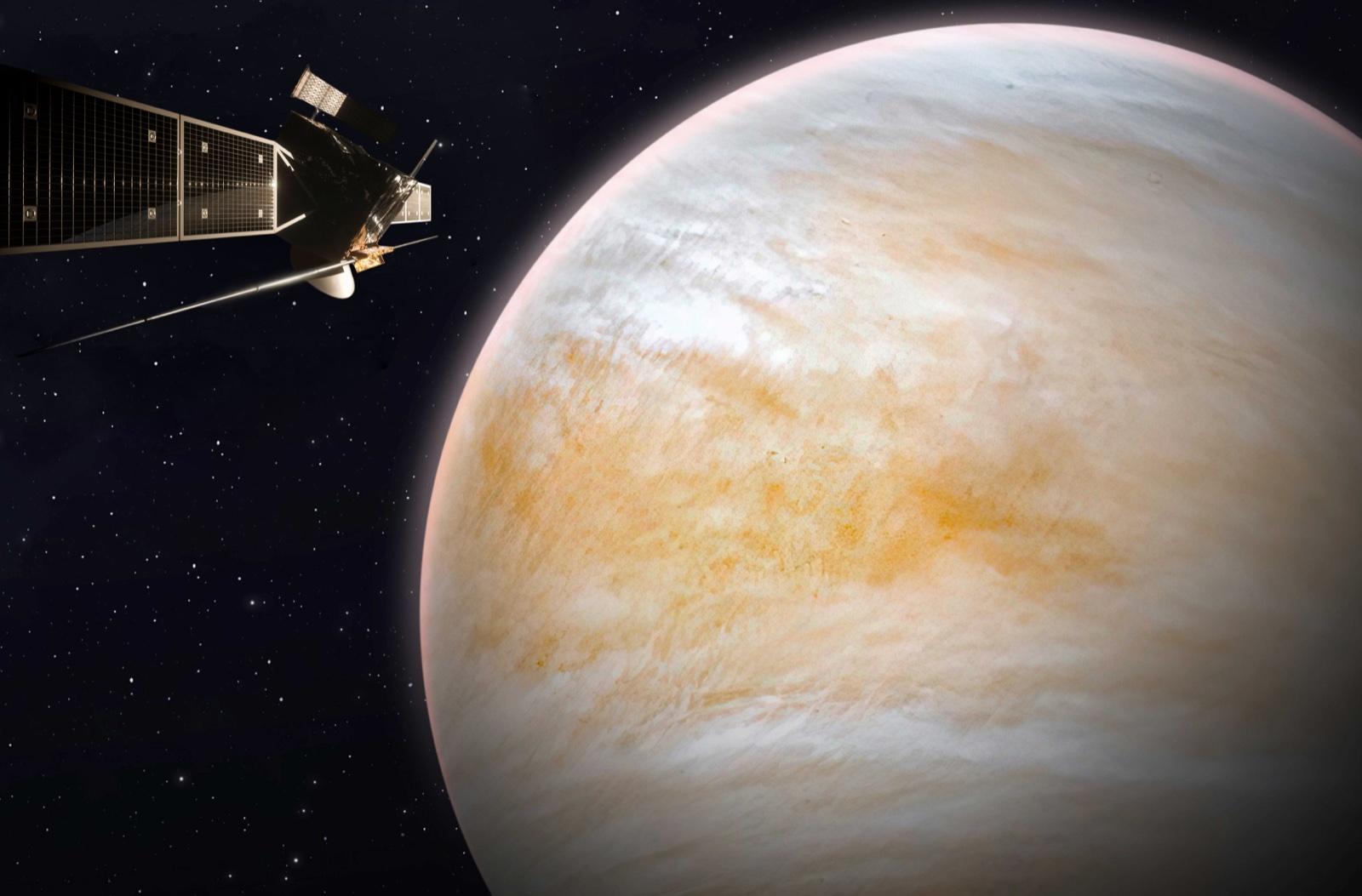
Two launch dates for EnVision are in circulation. ESA's own pages, re-read on 4 November 2026, say November 2031 (the esa.int factsheet, the mission hub and the Cosmos mission page, which adds back-up years of 2032 and 2033), and so does the French space agency CNES. ESA's UK news story of 13 May 2026 says 2031, the Cosmos timeline, last updated in December 2025, says December 2031, and ESA's abstract for the Europlanet Science Congress (EPSC), updated on 2 July 2026, says 'early 2030s'. On 10 September 2026 Ars Technica reported, in the reporter's words and without a quotation, that ESA had delayed the launch by a year to 2032 so European teams could deliver a radar, and gave 2032 again on 14 October. eeNews Europe gave the same year, and the French sites Clubic and Journal du Geek repeated it, both citing Ars. No ESA page gives 2032, so this page treats it as a reported slip to the earlier of ESA's two back-up years.
The radar is the cause. NASA agreed to supply EnVision's S-band synthetic aperture radar, VenSAR, from its Jet Propulsion Laboratory (JPL), with Deep Space Network support, in return for US places on the science team. At the September congress, ESA project scientist Anne Grete Straume-Lindner told Ars that 'it is looking like they are not able to provide the radar', while a NASA spokesperson said 'NASA conversations with ESA regarding Envision are ongoing'. At a meeting of NASA's Venus Exploration Analysis Group in early October, NASA program scientist Nick Lang confirmed that the agency was pulling out, citing its budget: 'That decision was not an easy one.' ESA's Envision news page now says NASA's contribution 'is in the process of being withdrawn', and ESA's radar page describes VeraSAR in its place. Ars reported that dropping the radar, along with cancelling Mars Sample Return, freed money for NASA's own Venus missions.
Behind those statements sits a year of US budget trouble. The White House's 2026 budget request proposed ending the contribution; on 17 July 2025 the Senate Appropriations Committee answered with a report whose bill provided 68.9 million dollars to keep VenSAR in development. On 8 January 2026 ESA's director of science, Carole Mundell, said VenSAR had recently passed its preliminary design review, and set the hard edge of the problem: EnVision must leave in 2033 at the latest, or wait at least three years for the next workable alignment of the planets. NASA's 2027 budget request, published in April 2026, does not mention EnVision or VenSAR, and The Planetary Society's analysis of 23 April 2026 reads it as eliminating the US contribution. Ars reports that a joint NASA and ESA Venus Science Coordination group has been suspended.
Europe's fallback took shape through the spring. On 26 March 2026 ESA called for scientists to join a EuroSAR Science Team and announced a competitive Phase B1, the stage that matures a design, for a European radar it described as a backup to VenSAR. Its requirements were kept identical to VenSAR's so the science and the spacecraft would not change, and ESA targeted a June 2026 kick-off. The science team, appointed in June and chaired by Alice Le Gall of LATMOS, renamed the instrument VeraSAR (Venus radiometer altimeter and SAR); it includes Richard Ghail of Royal Holloway, first author of the EnVision proposals from 2011 onward. Ars reports that industrial teams in the United Kingdom and Italy hold study contracts. ESA had not named them by early November 2026, and no primary source seen for this page confirms the date Phase B1 actually began.
A European radar is where EnVision began. The concept appeared online in August 2011 in Experimental Astronomy, answering ESA's call for a medium-size mission launching in 2022, and that early EnVision was a different machine: a five-year mission whose payload ran from a radar interferometer to a Doppler lidar and a magnetometer. A three-instrument version was passed over in ESA's fourth medium-class call (M4) on 4 June 2015, when ESA chose Ariel, Thor and Xipe for further study. A 2016 abstract by Ghail, Colin Wilson and Thomas Widemann explains the shift: the M4 version had been squeezed by the mass and volume of a Soyuz launch, while the fifth call allowed an Ariane 6.2, so cost became the limit. The radar then derived from the United Kingdom's low-cost NovaSAR-S, with pass-to-pass interferometry to measure centimetre-scale ground movement. The M5 proposal went in during October 2016, aiming at a 2029 launch.
EnVision went through a Phase 0 study with Theseus and SPICA in 2018, and Phase A began in 2019. That is when NASA's contribution was set, moving the radar from a British design to a JPL one that kept the name VenSAR; Space.com reported in January 2026 that it had originally been meant to be built by Airbus in the United Kingdom. The modes ESA lists today, stereo topography among them, do not include interferometry, and the Cosmos page notes that radar stereo, unlike interferometry, does not use the phase of the signal.
ESA's Assessment Study Report, the 'Yellow Book' of February 2021, fixed the design put to the vote: an Ariane 62 launch in a window opening on 29 May 2032 and a dry mass of 1.35 tonnes. On 10 June 2021 ESA's Science Programme Committee chose EnVision over Theseus as the fifth medium-class mission of Cosmic Vision, and ESA gave 2031 as the earliest launch, with options in 2032 and 2033. Adoption on 25 January 2024 moved EnVision into implementation, with an Ariane 6 launch in 2031, and ESA and NASA signed their memorandum of understanding in the first quarter of 2024.
The spacecraft grew on the way. ESA now describes a box of about 2 by 2 by 3 m when stowed, weighing about 4.1 tonnes fuelled and 1.7 tonnes dry, to launch on an Ariane 64 from Kourou. Some pages lag. CNES's page, last modified on 6 October 2025, still names an Ariane 62, a dry mass of 1.6 tonnes, a stowed size of 2 by 2 by 2 m and an end of mission in January 2039.
Industry came on board in two steps. ESA's Cosmos timeline dates the choice of Thales Alenia Space as prime contractor to December 2024, and the contract, worth 367 million euros according to the company's Italian release, was signed on 28 January 2025 in Brussels. That release expected a system preliminary design review in May 2026 and full authorisation for construction (phases C and D) in June 2026; ESA's timeline instead lists the spacecraft preliminary design review for the third quarter of 2026. No ESA or company statement found by early November 2026 confirms either milestone. In May 2026 OHB Space UK signed a preliminary authorisation to proceed with Thales Alenia Space for the assembly, integration and testing of the spacecraft, a role European Spaceflight values at about 24 million euros.
At Venus, reaching the science orbit is a long job in itself. The spacecraft first brakes into a very high, elongated orbit; ESA's study manager Thomas Voirin said in 2022 that insertion would be at roughly 250,000 km, after which repeated dips into the upper atmosphere, as low as 130 km, would bring the orbit down to about 500 km. In his words, 'Envision as currently conceived cannot take place without this lengthy phase of aerobraking.' The duration differs by source: about 16 months in 2021, 11 months on today's ESA pages, 18 on the CNES page, about a year for Thales Alenia Space and 'up to two years' in ESA's 2022 technology story.
Its final orbit is near-polar, inclined 87° to 89°, at about 220 to 510 km, with a period of about 92 minutes on the Cosmos mission page and 94 on the factsheet; older ESA and industry documents give an upper altitude of 540 km. Because Venus turns so slowly, coverage builds up over the nominal science phase of six Venus sidereal days, about four Earth years, which ESA's Cosmos pages start in mid-2034.
Two radars share the job of seeing through the clouds. VeraSAR keeps the requirements set for VenSAR: regions of up to 1,000 by 1,000 km imaged at 30 m and targets of up to 100 by 100 km at 10 m, in HH and HV polarisations, plus stereo, radiometry and altimetry. ESA says the radar will distinguish features more than ten times smaller than Magellan could, and comparisons with Magellan's images and with its own repeat passes are meant to reveal volcanic, tectonic and landscape-forming change. The second radar, VESPER (formerly the Subsurface Radar Sounder), is procured by the Italian space agency ASI with Lorenzo Bruzzone as lead scientist. It looks straight down at 9 MHz through a deployable dipole antenna 16 m across.
How deep VESPER will see depends on who is describing it, and on the rock. The Cosmos instrument page, working from Venus-like basalts measured in the laboratory, gives an average penetration of about 600 m. The ESA factsheet says 'down to one kilometre' and the Yellow Book 'the top kilometre', while ASI and the University of Trento wrote in 2021 of a few hundred metres. The sounder will survey about a fifth of the planet densely and more than 80 percent sparsely, looking for buried craters, stacked lava flows and the inner structure of the ridged terrain called tesserae.
Three spectrometers make up the VenSpec suite, led by DLR, the German aerospace centre. VenSpec-M maps the night-side glow of the hot surface through near-infrared windows in the clouds, a method ESA says VIRTIS pioneered on Venus Express. VenSpec-H, from BIRA-IASB in Belgium, measures water vapour and its heavy form HDO near the ground and, at 30 to 40 km, those two with carbonyl sulfide and sulfur dioxide. VenSpec-U, from LATMOS with CNES building it, maps sulfur dioxide, sulfur monoxide and the still unidentified ultraviolet absorber at the cloud tops. DLR sketches how they would work together: VenSpec-M would see the heat of fresh lava, VenSpec-H the water vapour an eruption released and VenSpec-U its sulfur dioxide high above.
Radio science, the sixth investigation, needs no instrument box of its own. VeRSE (formerly RSE), led by Caroline Dumoulin of LPG Nantes with CNES leading procurement, uses the spacecraft's X- and Ka-band links. Tracking should yield a gravity field resolved to about 150 to 200 km everywhere, improving on Pioneer Venus and Magellan, and measure the tidal Love number k2, which constrains the size and state of the core in the absence of seismometers. As the spacecraft passes behind the planet, the fading signal will sound the atmosphere from about 90 km down to 35 km, and ESA's page says the Ka-band link will measure gaseous and liquid sulfuric acid at about 45 to 55 km for the first time.
ESA frames all this with a short list of questions: how the surface and interior evolved, how active Venus is today, how geology shapes the atmosphere and climate, and whether evidence of past water survives in the oldest rocks. The case rests partly on hints of possible volcanic hotspots from Venus Express, and ESA presented it as working alongside NASA's VERITAS and DAVINCI; the science itself is covered in Volcanoes on Venus and Oceans and the greenhouse. On 17 June 2024 ESA named Yeon Joo Lee of Korea's Institute for Basic Science a VenSpec co-investigator, which Yonhap reported gives unrestricted access to VenSpec data at no cost to Korea.
What remains open in November 2026 is mostly the calendar. ESA's own pages have not said whether its long-listed 2032 back-up is now the plan, and ESA has not named the industrial team that will build VeraSAR. For a launch at the end of 2031, ESA's timeline puts arrival in the second quarter of 2033 and the start of science in mid-2034; it has published no equivalent dates for a 2032 departure. The fixed point is the 2033 limit Mundell gave in January.
Mission facts
Organisations
European Space Agency (ESA), with Thales Alenia Space as prime contractor; NASA, which was to supply the VenSAR radar, is withdrawing its contribution, and ESA is developing a European radar, VeraSAR, in its place
Name and class
Spelled EnVision in the proposals and early ESA releases, Envision on ESA pages since. Fifth medium-class (M5) mission of ESA's Cosmic Vision plan, selected 10 June 2021 (ESA's Cosmos timeline files the selection under May 2021) and adopted 25 January 2024.
Status (as of 4 Nov 2026)
In implementation (Phases B2/C/D since adoption). ESA's timeline lists the spacecraft preliminary design review for Q3 2026 and the mission system requirements review for Q4 2026; no ESA or company statement found confirms that the design review has taken place. System requirements review completed July 2025.
Launch date (as read on 4 Nov 2026)
November 2031 (esa.int factsheet and hub, Cosmos mission page, CNES; the Cosmos page adds back-ups in 2032 and 2033); 2031 (ESA UK story, 13 May 2026); December 2031 (Cosmos timeline, updated Dec 2025); 2032 (Ars Technica, 10 Sep and 14 Oct 2026, in the reporter's words; also eeNews Europe on 10 Sep). ESA's July 2026 EPSC abstract says 'early 2030s'.
Launch deadline
2033 at the latest, or a wait of at least three years for the next opportunity (Carole Mundell, ESA briefing of 8 Jan 2026, reported by Space.com).
Launcher
Ariane 64 from Kourou. The February 2021 Assessment Study Report had baselined an Ariane 62 launch in a window opening on 29 May 2032.
Spacecraft
Three-axis stabilised, about 2 x 2 x 3 m stowed, about 4.1 t at launch and 1.7 t dry, about 3 kW, fixed 2.54 m high-gain antenna, X and Ka band. CNES (page modified 6 Oct 2025) gives 1.6 t dry and 2 x 2 x 2 m; the 2021 study gave 1.35 t dry.
Main engine
LEROS 4 from Nammo (UK): 1 kN, MON-3/MMH, specific impulse about 320 s; TRL 5 in November 2023, critical design review in 2024.
Cruise and aerobraking
Cruise about 15 months (ESA; the CNES page says 6). Aerobraking: 11 months (current factsheet and Cosmos), about 16 months (2021 selection release and study report), about a year (Thales Alenia Space, 2025), 18 months (CNES), 'up to two years' (ESA, 2022).
Science orbit
Quasi-polar, inclination 87 to 89 deg, altitude about 220 to 510 km; period about 92 min (Cosmos) or 94 min (factsheet). The 2021 release gave 220 to 540 km; CNES gives 210 to 520 km.
Science phase
Six Venus cycles (about four Earth years), starting in the mid-2030s (mid-2034 on the Cosmos pages); about 210 Tbit of data (200 on the Cosmos mission page), with calibrated data public less than six months after downlink.
Prime contractor
Thales Alenia Space Italia; contract of 367 million euros signed 28 January 2025 in Brussels (ESA's Cosmos timeline and the EPSC 2026 abstract date the award to December 2024). Preselected industrial core team: OHB (mechanical, thermal, propulsion) and Thales Alenia Space France (attitude control, aerobraking analysis).
Assembly, integration and test
OHB Space UK, under a preliminary authorisation to proceed with Thales Alenia Space signed in May 2026 at Bristol; European Spaceflight values the work at about 24 million euros.
VenSAR (NASA JPL)
S-band radar at 3.2 GHz (9.4 cm): 30 m imaging of selected regions, 10 m over subregions, stereo, radiometry, scatterometry, polarimetry. Passed its preliminary design review by January 2026 (Mundell). NASA is now withdrawing it, and ESA's Cosmos radar page, once VenSAR's, describes VeraSAR instead.
VeraSAR (European radar)
Called EuroSAR in ESA's call of 26 March 2026 (Phase B1 kick-off targeted June 2026, six to nine months, same requirements as VenSAR); named VeraSAR (Venus radiometer altimeter and SAR) by its science team, appointed June 2026 and chaired by Alice Le Gall of LATMOS (Cosmos team page). ESA's Cosmos radar page now presents it as the mission's radar, with altimetry to a vertical resolution of 2.5 m.
NASA's role (as of 4 Nov 2026)
Being withdrawn. ESA's Envision news page says NASA's contribution 'is in the process of being withdrawn', following NASA's FY2026 operating plan; NASA program scientist Nick Lang confirmed the decision at a VEXAG meeting in early October 2026, citing budget limits (Ars Technica, 14 Oct 2026). NASA's FY2027 budget request (April 2026) does not mention EnVision or VenSAR. The Senate Appropriations Committee's FY2026 report (17 Jul 2025) had provided 68.9 million dollars for VenSAR.
VESPER (formerly SRS)
Nadir sounding radar procured by ASI, lead scientist Lorenzo Bruzzone (Trento): 9 MHz centre, 6 MHz bandwidth, 200 W, deployable dipole antenna (16 m across, per ESA in 2022). Penetration: about 600 m average (Cosmos), 'down to one kilometre' (factsheet), a few hundred metres (ASI).
VenSpec-M
Near-infrared mapper, DLR (lead scientist Giulia Alemanno): 14 bands spanning 0.79 to 1.51 micron, six of them seeing the surface through windows between 0.86 and 1.18 micron, for surface emissivity and signs of active volcanism. DLR also leads the VenSpec suite.
VenSpec-H
High-resolution infrared spectrometer, BIRA-IASB (lead Severine Robert) with OIP Sensor Systems, for H2O and HDO near the ground and H2O, HDO, OCS and SO2 at 30 to 40 km; four bands at a resolving power of about 8,000 (Paris Observatory EnVision site).
VenSpec-U
Ultraviolet imaging spectrometer, LATMOS with CNES (lead Emmanuel Marcq): 190 to 380 nm and 205 to 235 nm, for SO, SO2 and the unknown UV absorber at the cloud tops.
VeRSE (formerly RSE)
Radio science led by Caroline Dumoulin (LPG Nantes) with Pascal Rosenblatt and Silvia Tellmann: gravity field resolved to better than 200 km everywhere, tidal Love number k2, and radio occultation, with Ka-band measurements of sulfuric acid vapour and droplets at about 45 to 55 km. Ultra-stable oscillator by BHE (Hungary).
Mission timeline
- 17 Aug 2011An EnVision concept is published online in Experimental Astronomy (issue dated April 2012) as an answer to ESA's call for a medium-size mission launching in 2022.
- 4 Jun 2015ESA picks Ariel, Thor and Xipe from 27 proposals to its M4 call for further study; EnVision's M4 version is not among them.
- Oct 2016EnVision is submitted to ESA's M5 call, aiming at a 2029 launch.
- May to Nov 2018EnVision, Theseus and SPICA go through a Phase 0 study in ESA's Concurrent Design Facility.
- 2019Phase A (feasibility) begins; NASA's contribution is set as the VenSAR radar plus Deep Space Network support.
- Feb 2021ESA's Assessment Study Report baselines an Ariane 62 launch in a window opening on 29 May 2032.
- 10 Jun 2021ESA's Science Programme Committee selects EnVision as the M5 mission over Theseus; earliest launch given as 2031, with options in 2032 and 2033.
- Published 3 Mar 2022SENER's prototype of a candidate 16 m antenna for the subsurface sounder is hung from a balloon with a full-size spacecraft mock-up more than 200 m above the ground; ESA says it works as expected.
- 25 Jan 2024ESA adopts the mission, moving it into implementation, with an Ariane 6 launch foreseen in 2031.
- Q1 2024ESA and NASA sign the memorandum of understanding for NASA's participation.
- 17 Jun 2024ESA names Yeon Joo Lee of Korea's Institute for Basic Science a co-investigator on the VenSpec suite.
- 28 Jan 2025ESA signs the 367 million euro prime contract with Thales Alenia Space in Brussels.
- Jul 2025The spacecraft system requirements review is completed.
- 8 Jan 2026Carole Mundell says VenSAR has passed its preliminary design review, that ESA is in constant contact with NASA, and that 2033 is the last feasible launch year.
- 26 Mar 2026ESA calls for a EuroSAR Science Team and announces a competitive Phase B1 for a European radar as a backup to VenSAR, with kick-off targeted for June 2026.
- May 2026OHB Space UK signs a preliminary authorisation to proceed with Thales Alenia Space for assembly, integration and testing of the spacecraft.
- Jun 2026The European radar's science team is appointed and names the instrument VeraSAR.
- 8 and 10 Sep 2026ESA's project scientist presents EnVision's status at EPSC 2026 in The Hague on 8 September; on 10 September Ars Technica reports that NASA looks unable to provide the radar and that the launch has slipped to 2032, a change ESA's own pages still did not show on 4 November.
- Oct 2026At a meeting of NASA's Venus Exploration Analysis Group, NASA program scientist Nick Lang confirms that NASA is ending its radar contribution, citing budget limits, as Ars Technica reports on 14 October. ESA's Envision news page says the contribution is 'in the process of being withdrawn'.
A filled dot marks something that physically happened. A hollow one marks an announcement, a naming or a target.
In pictures
Tap a photo to enlarge.
Translated from the original sources
Passages from the Italian, French, German and Korean sources this page draws on, in azmth's translation. Tap Show original to read the original wording.
CNES: EnVision
French · 3 passages
CNES: EnVision (modified 6 Oct 2025)
Open the source“Launch planned for November 2031.”
CNES project page, marked as modified on 6 October 2025.
azmth's translation · Show originalHide original
French: «Lancement prévu en novembre 2031»
“6 months of cruise, 18 months of aerobraking and 4 years of operational mission.”
Figures that differ from ESA's current 15-month cruise and 11 months of aerobraking.
azmth's translation · Show originalHide original
French: «6 mois de croisière, 18 mois d’aérofreinage et 4 ans de mission opérationnelle»
“November 2031: launch of the EnVision mission on the Ariane 62 launcher.”
ESA's factsheet now gives Ariane 64.
azmth's translation · Show originalHide original
French: «Novembre 2031 : Lancement de la mission EnVision à bord du lanceur Ariane 62.»
ASI: EnVision
Italian · 1 passage
ASI: EnVision (10 Jun 2021)
Open the source“at depths of the order of a few hundred metres (ASI on the reach of the radar sounder).”
azmth's translation · Show originalHide original
Italian: “a profondità dell’ordine di alcune centinaia di metri”
Università di Trento press release
Italian · 1 passage
Università di Trento press release (10 Jun 2021)
Open the source“It will be the very first time that a radar sounder operates on our twin planet.”
Lorenzo Bruzzone, University of Trento release of 10 June 2021; ASI's release of the same day carries the same sentence.
azmth's translation · Show originalHide original
Italian: “Sarà la prima volta in assoluto che un radar sounder opererà sul nostro pianeta gemello.”
Media INAF interview with Lorenzo Bruzzone
Italian · 2 passages
Media INAF interview with Lorenzo Bruzzone (12 Jun 2019)
Open the source“EnVision, one of the three candidates competing in ESA's M5 selection (Media INAF's own introduction to its interview with Lorenzo Bruzzone, 12 June 2019).”
azmth's translation · Show originalHide original
Italian: “EnVision, una delle tre candidate in gara per la selezione M5 dell’Esa”
“for the first time in a planetary setting we will also do differential radar interferometry (Bruzzone in 2019, describing a mode the current radar no longer lists).”
azmth's translation · Show originalHide original
Italian: “per la prima volta in ambito planetario faremo anche interferometria radar differenziale”
Thales Alenia Space press release
Italian · 2 passages
Thales Alenia Space press release (28 Jan 2025)
Open the source“with a total value of 367 million euros (the prime contract signed on 28 January 2025).”
azmth's translation · Show originalHide original
Italian: “del valore complessivo di 367 Milioni di Euro”
“full authorisation to proceed with Phase C/D is expected in June 2026.”
azmth's translation · Show originalHide original
Italian: “l’autorizzazione completa a procedere con la Fase C/D è prevista a Giugno 2026”
DLR: Europa begibt sich auf den Weg zur Venus
German · 2 passages
DLR: Europa begibt sich auf den Weg zur Venus (25 Jan 2024)
Open the source“Leadership and coordination of the entire VenSpec suite lie with the DLR Institute of Planetary Research.”
azmth's translation · Show originalHide original
German: „Die Leitung und Koordination der gesamten VenSpec Suite liegt beim DLR-Institut für Planetenforschung.“
“Launch is foreseen for 2031; the mission is planned to run from 2034 to 2038.”
DLR, 25 January 2024.
azmth's translation · Show originalHide original
German: „Der Start ist für 2031 vorgesehen, Missionsdauer ist von 2034 bis 2038 geplant.“
Yonhap (26 Jun 2024): IBS joins EnVision
Korean · 2 passages
“The co-investigator can access VenSpec suite observation data without restriction.”
azmth's translation · Show originalHide original
Korean: “공동연구자는 벤스펙 수트의 관측자료에 제한 없이 접근할 수 있다.”
“There is no Korean cost share in the EnVision mission, which is on the scale of 500 million euros (744.5 billion won).”
azmth's translation · Show originalHide original
Korean: “5억유로(7천445억원) 규모의 엔비전 임무에서 한국 측 분담비는 없다.”
Journal du Geek
French · 1 passage
Journal du Geek (13 Sep 2026)
Open the source“ESA has already pushed Envision's launch back from 2031 to 2032.”
Journal du Geek, 13 September 2026, which names Ars Technica as its source.
azmth's translation · Show originalHide original
French: «l’ESA a déjà repoussé le lancement d’Envision de 2031 à 2032»
Clubic (11 Sep 2026)
French · 1 passage
“The European Space Agency is therefore building a replacement radar and postponing the probe's launch to 2032, before the launch window to the planet closes in 2033.”
Clubic, 11 September 2026, which names Ars Technica as its source.
azmth's translation · Show originalHide original
French: «L’Agence spatiale européenne construit donc un radar de remplacement et reporte le lancement de la sonde à 2032, avant que la fenêtre de tir vers la planète ne se referme en 2033.»
Sources
- ESA: Envision factsheet (read 4 Nov 2026)
- ESA: Envision mission hub (read 4 Nov 2026)
- ESA Cosmos: Envision mission description
- ESA Cosmos: Envision timeline (last updated December 2025)
- ESA Cosmos: Envision latest news (read 4 Nov 2026)
- ESA Cosmos: VeraSAR radar page (formerly VenSAR, read 4 Nov 2026)
- ESA Cosmos: Envision team (includes VeraSAR science team)
- ESA Cosmos: VESPER (formerly SRS)
- ESA Cosmos: VeRSE radio science
- ESA Cosmos: VenSpec-M
- ESA Cosmos: VenSpec-U
- ESA Cosmos: VenSpec suite
- ESA: Call for the EnVision EuroSAR Science Team (26 Mar 2026)
- Straume-Lindner, Pacros et al., EPSC2026-613 abstract (updated 2 Jul 2026)
- EPSC 2026 session TP11 programme (EPSC2026-613 presented on 8 Sep 2026)
- ESA: ESA selects revolutionary Venus mission Envision (10 Jun 2021)
- ESA: We're heading for Venus, ESA approves Envision (25 Jan 2024)
- ESA: Signed and sealed, Envision can move towards construction (28 Jan 2025)
- ESA UK: UK company starts work on Envision Venus voyager (13 May 2026)
- ESA: Readying spacecraft to surf Venus' atmosphere (28 Jul 2022)
- ESA: Aerial antenna for Venus mission test (3 Mar 2022)
- ESA: Three candidates for ESA's next medium-class science mission (4 Jun 2015)
- ESA: EnVision Assessment Study Report, ESA/SCI(2021)1 (February 2021)
- Ghail, Wilson and Widemann, LPSC 2016 abstract 1511: EnVision M5 proposal
- Ghail et al., EnVision M5 proposal, arXiv:1703.09010
- Ghail et al., EnVision: taking the pulse of our twin planet (Experimental Astronomy 33, issue dated April 2012), Lancaster EPrints record
- Ghail et al. 2011, Experimental Astronomy, DOI record (published online 17 Aug 2011 per Crossref metadata)
- Ars Technica (Stephen Clark, 10 Sep 2026): Europe will go it alone on Venus mission after NASA yanks radar instrument
- Ars Technica (Stephen Clark, 14 Oct 2026): report from the VEXAG meeting on NASA's Venus missions and Envision
- eeNews Europe (10 Sep 2026)
- Space.com (Tereza Pultarova, 12 Jan 2026): Mundell briefing of 8 Jan 2026
- US Senate Report 119-44 (17 Jul 2025)
- The Planetary Society (Casey Dreier, 23 Apr 2026): Analyzing the FY 2027 NASA budget request
- NASA FY2027 full budget request (April 2026)
- Paris Observatory (LIRA) EnVision site: instruments
- BIRA-IASB: VenSpec-H
- European Spaceflight (15 May 2026): OHB Space UK
- CNES: EnVision (modified 6 Oct 2025) · in French
- ASI: EnVision (10 Jun 2021) · in Italian
- Università di Trento press release (10 Jun 2021) · in Italian
- Media INAF interview with Lorenzo Bruzzone (12 Jun 2019) · in Italian
- Thales Alenia Space press release (28 Jan 2025) · in Italian
- DLR: Europa begibt sich auf den Weg zur Venus (25 Jan 2024) · in German
- Yonhap (26 Jun 2024): IBS joins EnVision · in Korean
- Journal du Geek (13 Sep 2026) · in French
- Clubic (11 Sep 2026) · in French
Facts on this page were verified on 4 November 2026. Where sources disagree, the disagreement is stated rather than resolved silently.
azmth is independent and is not affiliated with or endorsed by NASA, Roscosmos, NPO Lavochkin, ESA, JAXA, ISRO, CNSA, or any other space agency or company named on this page.