Pioneer Venus Orbiter
NASA Ames · United States · Orbiter · 1978 · The surface years Success
Ended. Pioneer Venus Orbiter worked in orbit around Venus from 4 December 1978 until its last signal reached Earth on 8 October 1992, and then burned up in the atmosphere. A European version, studied in 1972 and 1973, never flew.
TL;DR· 16 min read
NASA's Pioneer Venus Orbiter entered orbit around Venus on 4 December 1978. Planned to work for 243 days, it lasted almost 14 years. It mapped the heights of most of the surface by radar, watched sulfur dioxide at the cloud tops fall tenfold, and studied how the solar wind meets a planet with no magnetic field. It began as a Goddard design called Planetary Explorer, nearly became a European mission until an ESRO vote in March 1973, and burned up in the atmosphere in October 1992 after its fuel ran out.
When did Pioneer Venus Orbiter reach Venus?
Pioneer Venus Orbiter, also called Pioneer Venus 1 and Pioneer 12, reached Venus on 4 December 1978, when it fired its braking rocket behind the planet and went into orbit. Asif Siddiqi's NASA chronicle of deep space missions calls it the first American spacecraft to orbit Venus, about three years after the Soviet Union's Venera 9 and 10. Built to last 243 days, one turn of Venus on its axis, it kept working for almost 14 years and 5,056 orbits. Its radar mapped the heights of most of the surface, an ultraviolet spectrometer saw sulfur dioxide above the clouds fall tenfold (a change that may point to volcanic eruptions), and plasma instruments measured, orbit after orbit, how the solar wind strikes a planet with no magnetic field of its own. For a year in 1972 and 1973 it might have been a European mission. It ran out of fuel and burned up in the atmosphere of Venus in October 1992.
Facts as of 3 October 2026, from the sources listed below.
- 14 yearsin Venus orbit, from 4 December 1978 to 8 October 1992, on a mission designed to last one Venus sidereal day (243 Earth days)
- 93 %of the globe mapped by the radar altimeter, in its team's 1980 report (Pettengill and others); SP-461 says more than 90 percent
- 5,056 orbitsflown; no telemetry came back after periapsis on the 5,056th, on 8 October 1992 (Strangeway, 1993)
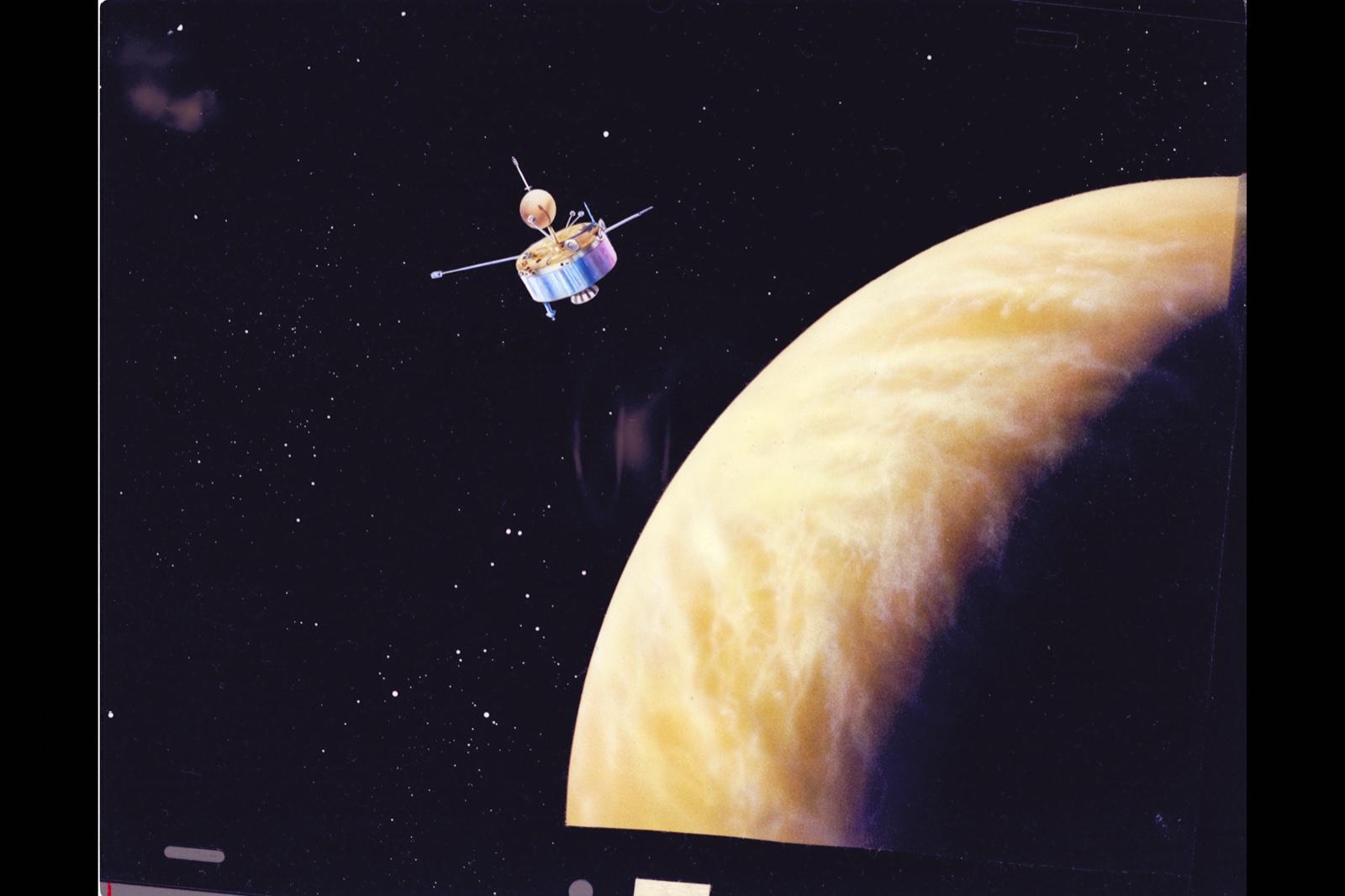
The orbiter began as one half of a cheaper idea. In January 1969 NASA's Goddard Space Flight Center published A Venus Multiple-Entry-Probe Direct-Impact Mission, a study by R. M. Goody, D. M. Hunten, V. Suomi and N. W. Spencer, and by the end of that year NASA had merged the probe carrier with a Planetary Explorer orbiter into what it called a universal bus. According to SP-461, NASA's 1983 history of the project, the idea was one spin-stabilised spacecraft on a Thor-Delta rocket that could either release entry probes into Venus or brake into orbit around it. A 1970 study by the Space Science Board and NASA's Lunar and Planetary Missions Board, the Purple Book, endorsed the idea with launches from 1975 and mission costs kept under $200 million.
Money moved the schedule before any hardware existed. In the autumn of 1970 there was no chance of funding a start in time for 1975, so the plan slipped to multiprobes in 1976 to 1977 and an orbiter in 1978. Then, SP-461 records, the Planetary Explorer programme was discontinued at Goddard in November 1971, and by January 1972 it had been transferred to Ames Research Center and renamed Pioneer Venus.
The mission Ames defined in 1972 looked different from the ones that flew: a Science Steering Group's 'Orange Book' called for two identical multiprobe spacecraft in December 1976 to January 1977 and an orbiter in 1978 designed to work for one Venus sidereal day. Two teams, led by Hughes Aircraft and TRW, won design contracts in October 1972 and were then told to compare the small Thor/Delta with the larger Atlas/Centaur; SP-461 says the extra $10 million or so for Atlas-Centaur cost no more than miniaturising both designs for Thor-Delta. Hughes's final report records that NASA selected the Atlas/Centaur in mid-April 1973 and moved the multiprobe launch to August 1978, leaving the orbiter's May to June 1978 dates unchanged. SP-461, written a decade later, dates the slip to August 1972 and blames Congress's failure to authorise a start in fiscal 1974; the Hughes report was written at the time.
For about a year the 1978 orbiter might have been European. ESRO, the European Space Research Organisation, had studied a low-cost Venus orbiter in 1971, according to the ESA historian Arturo Russo, and after an ESRO and NASA meeting in Washington on 18 April 1972 the project was tied to Pioneer Venus. NASA would provide the basic spacecraft; ESRO would add the braking motor, integrate the payload, test the spacecraft and hand it back for launch (SP-461 adds that ESRO would also supply the high-gain antenna).
It was lost in a vote. ESRO's advisory committee weighed it in early 1973 against HELOS, an X-ray astronomy satellite, and the IMP Daughter satellite, a partner for a NASA magnetosphere mission. Russo records that NASA had told ESRO it could not start Pioneer Venus in 1974 and was unsure of 1975, so a European commitment carried the risk of cancellation in Washington, while ESRO needed a project that could begin in 1974. The committee recommended the other two. At the Scientific Programme Board on 27 March 1973 France, backed by Belgium, argued for the Venus Orbiter and moved to postpone the HELOS decision. The motion lost by five votes to four, with Denmark abstaining, and the winners flew as ISEE-2 and Exosat. NASA built the orbiter alone.
Washington still had to pay for the American mission. Congress approved the project in August 1974 as a new start for fiscal 1975 (Siddiqi records it as NASA's formal approval). Hughes won the flight hardware contract in November with one bus for both missions, a spinning drum that swept its instruments across Venus, with a high-gain dish despun to stay on Earth. A last crisis came in June 1975, when the House of Representatives voted to cut $48 million tied to the mission. A slip to the 1980 window would have meant a redesign and, SP-461 estimates, as much as $50 million more; scientists and the press argued for the money, and both spacecraft were launched in 1978. NSSDCA puts the orbiter's cost at $125 million to build and operate for its first ten years.
Sources disagree on the orbiter's mass: 553 kg at launch in NSSDCA's catalogue, 517 kg in orbit on NSSDCA's older project page, and 582 kg in Siddiqi's chronicle and on NASA's mission page. An Atlas-Centaur launched it from Cape Canaveral at 13:13 UT on 20 May 1978 on a long Type II path; the Pioneer Venus Multiprobe, launched on 8 August on a shorter one, arrived five days after it. On 4 December the orbiter passed behind Venus and out of contact, and seven minutes later, at 15:58 UT, its braking rocket fired. Within two orbits the period was trimmed to 24 hours, so that periapsis came at the same time each Earth day.
Its orbit was part of the experiment: it carried the spacecraft through the ionosphere and upper atmosphere once a day and across the bow shock, where the solar wind is deflected around the planet, twice per revolution. Four of its twelve instruments looked at the planet, seven sampled what the spacecraft flew through, and a gamma-ray burst detector watched the sky, while the radio signal itself carried experiments on occultation, gravity, drag and turbulence.
At each low pass the radar mapper timed echoes from directly below. Gordon Pettengill's team reported in 1980 that the map covered 93 percent of the globe at better than 150 km resolution, and SP-461 notes that Venus's heights cluster around one level, where Earth's cluster around two. Siddiqi writes 93 percent of the band from 74° N to 63° S, at 75 km, but that band is itself about 93 percent of the planet's area (azmth's arithmetic). The map gave shape to two highland masses: Ishtar Terra in the north, about the size of Australia, and Aphrodite Terra near the equator, about the size of Africa in SP-461, while Pettengill's team described a massive equatorial region the size of South America. On Ishtar stood Maxwell Montes, 10.8 km above the mean surface in Siddiqi's figure. The mapper was switched off on 19 March 1981 and on again in 1991 to look at southern regions the early orbit could not reach, and its data outlived the spacecraft: NASA's global views of Venus from the Magellan era fill some gaps in Magellan's coverage with Pioneer Venus Orbiter data. See Mapping Venus.
Above the clouds the orbiter watched a planet change. The cloud photopolarimeter built ultraviolet pictures and followed the dark markings that circle Venus in about four days, and infrared observations implied what Siddiqi calls a clearing in the atmosphere over the north pole. The ultraviolet spectrometer started an argument that has outlived the spacecraft. L. W. Esposito reported in Science in 1984 that sulfur dioxide at the cloud tops, and the fine haze above them, had fallen by more than a factor of ten over the first five years, from values at arrival far above earlier upper limits. Because Venus had looked similar in the late 1950s, he argued for episodic injection, possibly by volcanic eruptions with an energy comparable to Krakatoa's in 1883. Emmanuel Marcq's team found another tenfold fall between 2007 and 2012 in Venus Express data and concluded in December 2012 that such injections recur on decadal timescales, but left the cause open: buoyant volcanic plumes or, with no active volcanism at all, long-period oscillations of the atmospheric circulation. See Volcanoes on Venus.
Lightning divided the team too. From December 1978, when periapsis moved into darkness, the electric field detector picked up intense, impulsive bursts of noise, and its investigators read them as radio waves from lightning, like signals attributed to lightning by the Soviet Venera 11 and 12 landers. An optical search found nothing: SP-461 reports that the orbiter's star sensor saw no statistically significant difference between the dark hemisphere and deep space, and reads this as a hint that lightning may be rare on the night side. In 1986 Harry Taylor (the orbiter's ion mass spectrometer investigator) and Paul Cloutier argued in Science that the bursts came from plasma instabilities generated locally, coinciding with troughs in the night-side ionosphere and showing no clustering over highlands. Ralph Lorenz's critical review of 2018 concluded that the balance of all observations supports some kind of frequent electrical activity on Venus, while optical searches are not consistent with lightning at Earth's rate. No observation cited here has settled it.
Space physicists used the orbiter for 14 years on one question: what happens when the solar wind hits a planet with no magnetic field of its own? It confirmed that Venus has little if any internal field, recorded crossings of the bow shock and of the ionopause, the boundary where the ionosphere holds the solar wind off, and in 1979 found flux ropes, twisted bundles of magnetic field inside the ionosphere (Russell and Elphic). Tracking of its radio signal later produced the GVM-1 gravity model of 1993 (Nerem, Bills and McNamee). In 1985 and 1986 the ultraviolet spectrometer also measured hydrogen, oxygen and carbon from comet Halley near perihelion.
After July 1980 the team stopped fighting the Sun's pull, which raised periapsis a little every orbit, to save propellant. Periapsis rose to about 2,309 km on 4 July 1986 by Strangeway's count (NSSDCA rounds it to 2,290 km), then began to fall. The long wait had a scientific reward: solar activity, high when periapsis was low in 1978 to 1980, was intermediate by the time periapsis came back down, so the same instruments could compare the upper atmosphere and ionosphere under different levels of solar activity. Magellan entered Venus orbit on 10 August 1990, and for more than two years two American orbiters worked at Venus at once.
In May 1992 the final phase began, with periapsis to be held low until the hydrazine ran out. The spacecraft was tired, its solar cells giving a spin-averaged 4 A against 13 A early in the mission. Of the original 32 kg of hydrazine (Strangeway and SP-461; NSSDCA says 32 kg per tank), about 2.3 kg was thought to remain, with a high degree of uncertainty, possibly enough to keep the orbiter flying until periapsis reached the day side. Apparently it was not. The burn before orbit 5,050 delivered less velocity than expected, and the attitude trim that followed fell short. NSSDCA and Siddiqi say periapsis was held between 150 and 250 km in this phase, but the navigation ephemeris archived in NASA's Planetary Data System shows it lower at the end: 148 km on 22 September, 131 km on 7 October. No telemetry came back after periapsis on orbit 5,056, and the last transmission reached Earth at 19:22 UT on 8 October 1992. Strangeway's plot of the final orbits shows the spacecraft had needed only three more raising manoeuvres to survive into the day-side ionosphere.
Nobody saw the end. The low passes happened behind Venus as seen from Earth, and no source found for this page gives an entry point. The last periapsis with data, on orbit 5,055, came at 19:46:28 UT on 7 October 1992 at 11.9° S, 89.2° E, 130.8 km above the 6,050 km sphere the ephemeris uses, before dawn at about 04:20 local solar time by azmth's calculation, consistent with the report by C. T. Russell and colleagues that the magnetometer sampled the post-midnight ionosphere until about 04:30. Carried forward one orbit, the steady trends of the last week put the next periapsis near 11.9° S, 90.7° E at about 128 km. That is azmth's extrapolation, and the orbiter may have survived further passes. The papers from its final weeks, collected in Geophysical Research Letters in December 1993, found the night-side ionosphere much reduced compared with solar maximum, while the night-side neutral atmosphere had barely changed. No source found reports any part of it surviving to the surface; see What we left at Venus.
Mission facts
Organisations
NASA Ames Research Center (spacecraft built by Hughes Aircraft Company); origins at NASA Goddard; proposed European half by ESRO
Names
Pioneer Venus Orbiter, Pioneer Venus 1, Pioneer 12, PVO; international designation 1978-051A, catalogue number 10911 (NSSDCA).
Launch
20 May 1978 at 13:13:00 UT on Atlas-Centaur AC-50 (Atlas no. 5030D) from Launch Complex 36A, Cape Canaveral.
Mass (four figures)
553 kg at launch including 179 kg of propellant, and 374 kg in the summary box, which is that launch mass less the propellant (NSSDCA catalogue); 517 kg in orbit (NSSDCA project page); 582 kg (Siddiqi, copied by NASA's mission page). Science payload 45 kg.
Spacecraft
Hughes-built cylinder 2.5 m across and 1.2 m high, almost 4.5 m tall with its antenna mast; spin-stabilised at about 5 rpm; 7.4 m² of solar cells giving 312 W at Venus; 1.09 m despun dish; 18,000 N solid orbit insertion motor.
Orbit insertion
4 December 1978 at 15:58 UT (7:58 a.m. Pacific time in SP-461), seven minutes after the spacecraft passed behind Venus; SP-461 gives the planned burn as almost 30 seconds and about 3,780 km/h (2,349 mph).
Working orbit
Inclination 105.6°, apoapsis 66,900 km, eccentricity 0.843, period 24.03 h, periapsis near 17° N. The first orbit took 23 h 11 min (Siddiqi); its periapsis was 378.7 km (NSSDCA).
Instrument count
Twelve instruments were selected on 4 June 1974, plus radio science experiments (SP-461). NSSDCA counts 17 experiments, Siddiqi and NASA's mission page list 16 items, and the PDS Atmospheres Node says 16 instruments; the totals differ in how the radio science is counted.
Radar mapper
Switched off on 19 March 1981 and switched on again in 1991 for southern regions (Siddiqi). Coverage: 93 percent of the globe at better than 150 km resolution (Pettengill and others, 1980); more than 90 percent, from 73° N to 63° S (SP-461); '93% of the band between 74° N and 63° S' at 75 km (Siddiqi, who also writes 73° N elsewhere in the entry). That band is itself about 93 percent of the planet's area (azmth's arithmetic): on the instrument team's figure the map covered nearly all of it, while Siddiqi's wording would mean about 86 percent of the globe.
Relief measured
Radii from 6,049 to 6,062 km; 60 percent of the surface within 500 m of the modal radius of 6,051.1 km; about 5 percent more than 2 km above the mean radius of 6,051.5 km (Pettengill and others, 1980).
Highest point
Maxwell Montes, 10.8 km above the mean surface (Siddiqi); SP-461 says points on Ishtar Terra rise to about 11 km above the mean radius.
Periapsis history
Held between 142 and 253 km until July 1980, then left to rise. Highest: 2,309 km on 4 July 1986, orbit 2,768 (Strangeway); NSSDCA gives about 2,290 km.
Sulfur dioxide
Fell by more than a factor of ten at the cloud tops over the first five years, together with the haze above the clouds (Esposito, 1984).
Comet Halley
The ultraviolet spectrometer measured hydrogen, oxygen and carbon from the comet from late December 1985 to early March 1986, near perihelion.
Hydrazine
Strangeway gives 32 kg (70 lb) at the start and about 2.3 kg left before the 1992 entry phase; SP-461 says each of the two tanks could hold 35 lb (about 16 kg), which matches that total, while NSSDCA's catalogue says each tank held 32 kg.
Last periapsis with data
Orbit 5,055, 19:46:28 UT on 7 October 1992 (the file's sample time, 19:46:27.748, to the nearest second), at 11.9° S, 89.2° E and 130.8 km above a 6,050 km sphere, according to the ephemeris in NASA's Planetary Data System.
Last transmission
Received at 19:22 UT on 8 October 1992, as the orbit decayed; the spacecraft burned up soon after.
Cost
$125 million to build and operate for the first 10 years (NSSDCA). The programme had been conceived with a total cost below $200 million (SP-461).
Planetary Explorer (member)
Goddard's universal bus, one spin-stabilised Thor-Delta spacecraft to carry either entry probes or an orbiter; discontinued at Goddard in November 1971, transferred to Ames Research Center by January 1972 and renamed Pioneer Venus.
Site: 11.87°S, 89.2°E · last measured periapsis, 7 October 1992 · position estimated (source)
Mission timeline
- Jan 1969Goddard publishes A Venus Multiple-Entry-Probe Direct-Impact Mission; by the end of the year NASA merges the probe carrier and a Planetary Explorer orbiter into one universal bus.
- Nov 1971 to Jan 1972Planetary Explorer is discontinued at Goddard and transferred to Ames Research Center, which renames it Pioneer Venus.
- Dec 1971A Goddard report describes a radar altimeter for the Planetary Explorer universal bus, meant to map the northern hemisphere in one Venus day.
- 18 Apr 1972An ESRO and NASA meeting in Washington links a European Venus orbiter to Pioneer Venus: NASA would supply the bus, ESRO the motor, integration and testing.
- 2 Oct 1972Hughes (with General Electric) and TRW (with Martin Marietta) start $500,000 system design studies for a 1976 to 1977 multiprobe and a 1978 orbiter.
- 27 Mar 1973ESRO's Scientific Programme Board rejects, 5 votes to 4 with Denmark abstaining, a French motion to postpone the HELOS decision that would have kept the Venus Orbiter in contention; Council confirms the choice of the IMP Daughter satellite and HELOS on 11 and 12 April.
- Mid-Apr 1973NASA selects the Atlas/Centaur and moves the multiprobe from December 1976 or January 1977 to August 1978; the orbiter keeps its May to June 1978 dates.
- 4 Jun 1974NASA selects the payloads: twelve instruments for the orbiter, plus radio science experiments.
- Aug 1974Congress approves Pioneer Venus as a new start for fiscal 1975 (SP-461); Siddiqi records it as NASA's formal approval.
- 20 May 1978Launch on Atlas-Centaur AC-50 from Cape Canaveral at 13:13 UT.
- 4 Dec 1978The solid motor fires behind Venus at 15:58 UT and the orbiter enters a 23 h 11 min orbit, trimmed to 24 hours within two orbits.
- 19 Mar 1981The radar mapper is switched off; Siddiqi says it had mapped 93 percent of the band between 74° N and 63° S.
- Dec 1985 to Mar 1986The ultraviolet spectrometer measures hydrogen, oxygen and carbon from comet Halley near perihelion.
- 1991The radar mapper is switched on again to look at southern regions its early orbit could not reach.
- May 1992The final phase begins: periapsis is held low with the last of the hydrazine.
- 7 Oct 1992Last periapsis with data, orbit 5,055, at about 131 km above 11.9° S, 89.2° E, before dawn.
- 8 Oct 1992The last transmission reaches Earth at 19:22 UT (NSSDCA); Strangeway reports no telemetry after the periapsis of orbit 5,056, and the orbiter is destroyed in the atmosphere.
A filled dot marks something that physically happened. A hollow one marks an announcement, a naming or a target.
In pictures
Tap a photo to enlarge.
Sources
- NSSDCA Master Catalog: Pioneer Venus Orbiter (1978-051A)
- NSSDCA: Pioneer Venus Project Information (older project page)
- Fimmel, Colin and Burgess, Pioneer Venus, NASA SP-461 (1983), via NTRS
- Siddiqi, Beyond Earth: A Chronicle of Deep Space Exploration, 1958 to 2016 (NASA, 2018), entry 157
- NASA Science: Pioneer Venus 1
- PDS Atmospheres Node: Summary of the Pioneer Venus Mission
- Strangeway, The Pioneer Venus Orbiter entry phase, Geophysical Research Letters 20, 2715 (1993), author's HTML copy via the Internet Archive
- PDS Planetary Plasma Interactions Node: PVO VSO ephemeris, orbit 5055
- PDS PPI: PVO ephemeris bundle readme
- Hughes Aircraft, System Design of the Pioneer Venus Spacecraft, Final Report vol. 1, Executive Summary (July 1973)
- Hughes Aircraft (R. S. Kelly), System Design of the Pioneer Venus Spacecraft, vol. 12, International Cooperation (July 1973)
- Russo, The definition of a scientific policy: ESRO's satellite programme in 1969 to 1973, ESA HSR-6 (1993), via the Internet Archive
- NTRS: Altimeter and radiometer for a Venus orbiter mission (Goddard, December 1971)
- Pettengill and others, Pioneer Venus radar results: altimetry and surface properties, JGR 85 (1980)
- Esposito, Sulfur dioxide: episodic injection shows evidence for active Venus volcanism, Science 223 (1984)
- Marcq and others, Variations of sulphur dioxide at the cloud top of Venus's dynamic atmosphere, Nature Geoscience 6 (2013)
- Taylor and Cloutier, Venus: dead or alive?, Science 234 (1986)
- Lorenz, Lightning detection on Venus: a critical review, Progress in Earth and Planetary Science 5 (2018)
- Russell and Elphic, Observation of magnetic flux ropes in the Venus ionosphere, Nature 279 (1979)
- Nerem, Bills and McNamee, A high resolution gravity model for Venus: GVM-1, GRL 20 (1993)
- Klebesadel and others, The Pioneer Venus Orbiter Gamma Burst Detector, IEEE TGRS GE-18 (1980)
- NTRS: Pioneer Venus measurements of H, O and C production in comet P/Halley near perihelion (A&A 187, 1987)
- Russell and others, The magnetic state of the lower ionosphere during Pioneer Venus entry phase, GRL 20 (1993)
- Kasprzak and others, Neutral composition measurements by the Pioneer Venus Neutral Mass Spectrometer during Orbiter re-entry, GRL 20 (1993)
- NASA Photojournal PIA00104: Venus computer simulated global view centred at 180 degrees east (gap fill with Pioneer Venus Orbiter data)
- NAIF: Pioneer Venus Orbiter (PIONEER12) SPK kernels
- PDS PPI data directory: Pioneer Venus Orbiter data sets, including bow shock and ionopause location sets
Facts on this page were verified on 3 October 2026. Where sources disagree, the disagreement is stated rather than resolved silently.
azmth is independent and is not affiliated with or endorsed by NASA, Roscosmos, NPO Lavochkin, ESA, JAXA, ISRO, CNSA, or any other space agency or company named on this page.