Venera 9 and Venera 10
NPO Lavochkin · Soviet Union · Lander · 1975 · The surface years Success
Ended. Both landers were still working when their orbiting relays flew out of range, after 53 and 65 minutes on 22 and 25 October 1975. The orbiters sent data into 1976 and remain listed in orbit around Venus in Jonathan McDowell's catalogue (checked 5 November 2026).
TL;DR· 22 min read
In October 1975 the Soviet twins Venera 9 and Venera 10 each put an orbiter around Venus and a lander on its surface. On 22 October the Venera 9 lander sent the first picture from the surface of Venus, a rocky slope under diffuse daylight, and its orbiter became the first artificial satellite of Venus. Venera 10 sent a view of a slab-covered plain three days later. Both landers were still working when their orbiting relays flew out of range after 53 and 65 minutes.
When was the first picture taken on the surface of Venus?
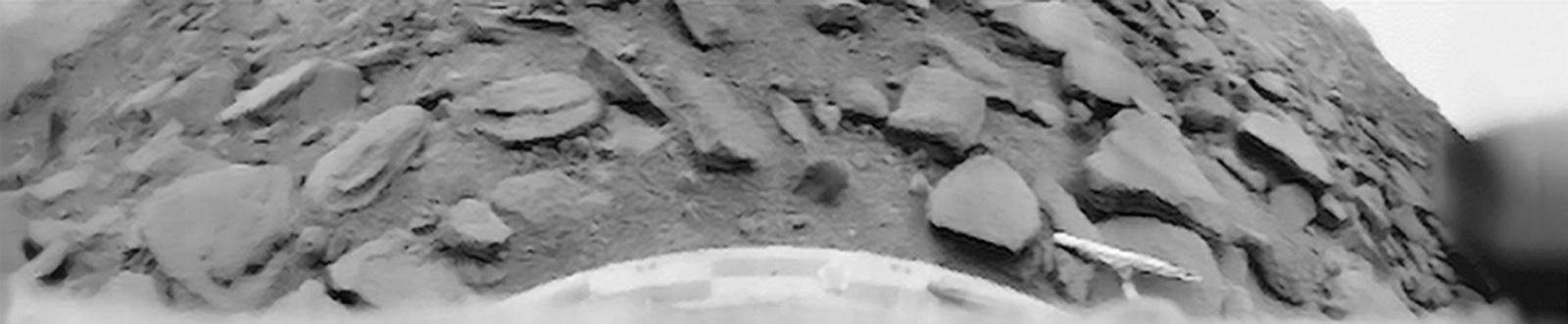
The first picture from the surface of Venus came from the Soviet lander Venera 9 on 22 October 1975: a black and white view of sharp-edged rocks on a steep slope. Its builder, NPO Lavochkin, calls these the world's first photographs sent from the surface of another planet. Three days later the twin Venera 10 sent a second view, of broad, flat slabs on a plain far to the south. Each station was an orbiter carrying a lander sealed inside a 2.4 m sphere. Both orbiters braked into orbit as their landers came down and relayed the landers' signals to Earth, and Venera 9 became the first artificial satellite of Venus. Contact with the landers lasted 53 and 65 minutes and ended when the relays flew out of range; inside, the landers were still below 60 °C and working. The orbiters stayed on into 1976 to study the clouds, the ionosphere and the solar wind.
Facts as of 5 November 2026, from the sources listed below.
- 53 and 65 minutesof transmission from the surfaces of Venus by the Venera 9 and Venera 10 landers, each ended when its orbiting relay flew out of range
- 48.3 hoursorbital period of Venera 9, the first artificial satellite of Venus, from 22 October 1975 (NSSDCA)
- 150 kmradius of the error circle around each published landing point; neither lander's exact position is known
In 1972 Venera 8 had shown that a lander could survive on the surface of Venus for about an hour, and Soviet planners decided the next step needed a new machine. For the first time since launches to Venus began in 1961, the Soviet Union let the October 1973 window pass while NPO Lavochkin built it, according to the Russian edition of Marov and Huntress's history of Soviet probes. The result, which the bureau calls series 4V, borrowed the heavy bus that had carried Mars 2 to Mars 7 and rode the four-stage Proton-K. Each station weighed about five times as much as the 3MV probes before it. Plans at first used the carrier as a flyby relay; NPO Lavochkin and the Space Research Institute (IKI) pushed instead for an orbiter, and won, which is how Venus got its first artificial satellites.
At the heart of the orbiter was a cylinder of propellant tanks, 110 cm across, holding UDMH and nitrogen tetroxide for a restartable KTDU-425A engine underneath. A pressurised ring 2.35 m across circled the base and held the control systems and science instruments. Two solar panels spanned 6.7 m, a 1.6 m dish talked to Earth, and helical antennas on the panels listened for the lander. Venera 9 set off weighing 4,936 kg and Venera 10 5,033 kg, of which 1,093 kg and 1,159 kg were propellant; Marov and Huntress explain the difference by a longer orbit-insertion burn planned for Venera 10. NPO Lavochkin says two near copies flew to raise the odds of success and to study the surface at two sites.
Inside a 2.4 m entry sphere, which with its contents weighed 1,560 kg, rode a 660 kg machine 2 m tall: an 80 cm titanium pressure sphere wrapped in 12 cm of honeycomb insulation and a thin outer skin, a hollow crush ring underneath to take the impact, and above it a 2.1 m disc brake topped by a cylinder that held the parachutes, the cloud instruments and a helical antenna. Before separation the orbiter blew cold gas through two pipes to chill the lander to minus 10 °C, and a store of lithium nitrate trihydrate soaked up heat as it melted, at about 30 °C according to Mitchell and 33 °C according to Marov and Huntress. The payload comprised a gamma-ray spectrometer and densitometer for the ground, photometers and nephelometers for the clouds, a mass spectrometer, thermometers, barometers, accelerometers, a cup anemometer on top of the disc, and two cameras.
A. S. Selivanov's team, with Yu. M. Gektin, built the cameras, and Mitchell compares them with the same team's Luna 9 camera: a scanning mirror fed the view to a photometer one line at a time, a principle NPO Lavochkin likens to mechanical television. Each camera looked out through a cylindrical quartz window 1 cm thick from about 90 cm above the ground, tilted down so that its strip ran from the landing ring out to the horizon on both sides. A panorama held 115 useful pixels per line, each coded in 6 bits plus a parity bit, at 3.5 s per line, so one sweep took about 30 minutes over a 256 bit/s channel. The picture size, Mitchell writes, was set by the telemetry rate and an estimated minimum lifetime of 30 minutes, although Marov and Huntress say the thermal protection was meant to keep the lander working for about two hours. Because the Venera 8 light readings had been dim, each lander also carried floodlamps.
Getting pictures home forced an unusual flight plan. Photographs needed daylight, and the sunlit side of Venus that October was hidden from Earth, so a lander there had no direct radio path. The answer was to relay through the carrier. Two days before arrival each station released its sphere on a collision course, fired its engine to move onto a flyby path, and fired again at closest approach to brake into orbit, timed so that the new satellite rose into view of the landing zone just as the lander began to transmit. NPO Lavochkin says the relay raised the information capacity of the radio link by two orders of magnitude.
The Venera 9 sphere met the atmosphere at 10.7 km/s on 22 October, 20.5° below the horizon, and peaked at about 170 g. At about 65 km, by the 1976 yearbook's account, the lid of the parachute compartment blew off and a pilot chute and a second parachute pulled away the upper part of the shell; a drag chute then opened, the transmitter came on, and four seconds later the lower hemisphere fell away. At about 62 km, now at 50 m/s, the lander opened three main canopies with 180 m² between them and spent some 20 minutes drifting through the clouds while its photometers and nephelometers worked. Near 50 km it cut the parachutes loose. For the remaining 55 minutes it fell under the disc brake alone, which the thickening air turned into a landing at about 7 m/s. The fast fall through the hot lower air was deliberate: less time there meant a cooler lander.
Touchdown came at 8 h 13 min 07 s in the yearbook, which names no time zone; read as Moscow time, that is Siddiqi's 05:13:07 UT, when the landing signal reached Earth. The ground was a slope strewn with angular rocks. The 1976 Soviet encyclopedia yearbook put its steepness at about 30°; the Russian edition of Marov and Huntress gives a 15 to 20° slope with the lander itself tilted 10 to 15° by uneven ground; Mitchell gives 20°; and a 2018 analysis by S. P. Buslaev and colleagues at NPO Lavochkin, noting that the onboard inclinometer read a lander tilt of about 30°, puts the slope at 20 to 30°, well beyond the 10° slopes the Soviet landers were designed for. Pyrotechnic charges blew off the camera caps, but one cap stuck (Mitchell blames the outside pressure), so a single camera did all the work. It swept a 174° panorama, reversed, and covered 124° of a second pass before the orbiter drew out of range after 53 minutes. At that moment the inside of the lander was below 60 °C and its equipment still working, NPO Lavochkin says.
What the picture showed was a jumble of flat and sharp-edged stones a few tens of centimetres across with finer soil between them, the white rim of the landing ring along the bottom and the horizon in the corners. Light, in the yearbook's words, was about 10,000 lux, like midday at mid-latitudes under a complete overcast. NPO Lavochkin read the scatter of rocks as a young surface, 1 to 10 million years old, and so as evidence that Venus is geologically active. The floodlamps turned out to be unnecessary and were left off later landers. Venera 8 had measured its light near the terminator, while both 1975 landers came down in early afternoon: 13:12 and 13:42 local solar time, according to Marov and Huntress. Four years earlier the Mars 3 lander had sent 14.5 or 20 seconds of image signal from Mars, which Siddiqi describes as a grey background with no detail.
Above, the Venera 9 orbiter had fired 247.3 m/s on 20 October to leave the collision course and 922.7 m/s on 22 October to brake. NSSDCA gives the orbit as 1,500 by 111,700 km with a 48.3 hour period at 34.17°, trimmed within days to 1,547 by 112,144 km. A TASS communique quoted by NPO Lavochkin marked the moment: after 136 days of flight and more than 300 million km, Venera 9 had become the first artificial satellite of Venus in history, and its lander had returned a picture of the surface at 90 times Earth's pressure and 485 °C.
Venera 10 followed three days behind. Its sphere separated on 23 October, the orbiter swerved with 242.2 m/s, and on 25 October it braked by 976.5 m/s into a 1,500 by 114,000 km orbit of 49.38 hours at 29.5°, later adjusted to 1,651 by 113,923 km. The Venera 10 lander came down on much gentler ground, about 2,200 km from its twin by the Soviet figure. Its tilt was about 8° according to NSSDCA's gallery and to Marov and Huntress, and only a few degrees according to Buslaev and colleagues. Again one lens cap stuck. The working camera scanned 63° forward, 184° in reverse and 17° forward again, by Mitchell's count, and its panorama shows broad, flat slabs with darker, finer material between them, which the yearbook read as a plain or plateau. Contact lasted 65 minutes and again ended with the relay geometry; Siddiqi notes the lander had been designed for 30.
The arrival dates are settled: the Soviet prints of the two panoramas, processed by IPPI, the Academy's Institute for Information Transmission Problems, are captioned 22.10.1975 and 25.10.1975, and the 1976 yearbook, NPO Lavochkin, NSSDCA's catalogue and Siddiqi agree. The Venera 10 touchdown time is a different matter. NSSDCA's spacecraft catalogue and Marov and Huntress give entry at 01:02 UT and touchdown at 02:17 UT. Siddiqi pairs the same 01:02 entry with touchdown at 05:17:06 UT, which would imply a descent of more than four hours, and NSSDCA's own image catalogue also says 05:17 UT. The 1976 yearbook gives entry at 7 h 00 min and touchdown at 8 h 13 min 06 s, with no time zone; in Moscow time that is 04:00 and 05:13:06 UT. NPO Lavochkin says each descent took about 75 minutes, so the first and third pairs are each self-consistent, and they sit about three hours apart, the same offset as between the yearbook's Venera 9 time and the UT that NSSDCA and Siddiqi give for it. That hints at a time-zone conversion made twice along the chain; lacking the original TASS text, this page carries all three readings.
Surface measurements also exist in several versions. TASS gave 485 °C at the Venera 9 site in 1975, and NSSDCA repeats it. The 1976 yearbook and NPO Lavochkin's project page give 460 °C and 90 atm for both sites. The Russian edition of Marov and Huntress gives 455 ± 5 °C and 85 ± 3 bar at Venera 9 and 464 °C and 91 ± 3 bar at Venera 10. Wind from the cup anemometers was 0.4 to 0.7 m/s at Venera 9 and 0.8 to 1.3 m/s at Venera 10 in the yearbook; NSSDCA and Air & Cosmos print an unattributed 3.5 m/s. The gamma-ray spectrometers found potassium, thorium and uranium at levels the yearbook matched with basalt. The densitometer, a paint-roller-shaped probe with a caesium-137 source laid on the ground after landing, gave about 2.8 g/cm³. NPO Lavochkin adds that 5 to 10 percent of the Sun's energy reaches the ground, scattered by the clouds.
During each descent the nephelometers fired pulses of light into the passing air and measured how it scattered. The Russian edition of Marov and Huntress says these readings for the first time revealed the structure of the clouds of Venus: a main deck from about 65 km down to 49 km in three layers, 62 to 57, 57 to 52 and 52 to 49 km, holding three sizes of particle between about 0.5 and 6 micrometres. The measured refractive index, 1.46, fitted sulfuric acid better than water. Below 49 km a thinner haze reached down to about 25 km, with largely clear air beneath. Two instruments disappointed. The mass spectrometers misbehaved, which Marov and Huntress blame on an unsuitable cleaning procedure before launch and probable fouling of the inlets by cloud particles, and a high ratio of argon-36 to argon-40 that they recorded went unpublished at the time. The near-infrared water-vapour photometer gave figures that later spectroscopy showed to be wrong, though the 1976 yearbook had reported them.
With the landers silent, the orbiters turned to the planet. Venera 9's line-scanning cameras, one violet and one ultraviolet, returned 17 cloud surveys between 26 October and 25 December 1975, Mitchell reports. Siddiqi says no pictures from the Venera 10 orbiter were ever released and that it is unclear whether it carried a camera; NSSDCA says some reports indicated one, and Marov and Huntress list separate camera passbands for each orbiter. Radiometers found cloud-top brightness temperatures of 233 to 235 K on the day side and about 244 K at night. A nightglow spectrometer recorded a glow unlike Earth's night sky, later identified as molecular oxygen bands, and on Venera 9 it also saw flashes that NPO Lavochkin still presents as lightning 25 times more energetic than Earth's; Mitchell writes that they are believed to be lightning, while Marov and Huntress note that Venera 10 did not confirm them, so the question stays open. Radio signals grazing the planet in 50 occultation sessions (NPO Lavochkin; Mitchell counts 19) showed a night-side ionosphere changing shape from day to day, and a bistatic radar experiment bounced 32 cm signals off 55 strips near the edge of the disc at about 10 km resolution. The magnetometers found no field of the planet's own, and the plasma instruments sampled both sides of the bow shock.
One orbiter instrument came from France. Jacques Blamont, his student Jean-Loup Bertaux and Vladimir Kurt built a photometer to measure sunlight scattered by the hydrogen around Venus in the Lyman-alpha line, and its readings gave a temperature of about 450 °C at the base of the exosphere, according to both Air & Cosmos and Marov and Huntress. Blamont, quoted by Air & Cosmos, said that the instrument worked perfectly on both satellites, but that his team learned nothing about where it sat, when it was switched on or where it pointed, and got measurements from five orbits in all. Accounts of the French share differ: NSSDCA credits a French 350 nm ultraviolet photometer, Siddiqi French-made ultraviolet cameras, and Marov and Huntress a French ultraviolet spectrometer plus French work on the photopolarimeters.
Built for three months at Venus, the orbiters lasted at least that long; how much longer depends on the source. NPO Lavochkin says Venera 9 existed until 27 April 1976, after a Soviet statement of 22 March 1976, cited by Siddiqi, that the main orbital task was complete. For Venera 10 Siddiqi has data until at least June 1976, and Air & Cosmos prints 15 September 1977 without naming its source. NSSDCA and Marov and Huntress say the transmitters failed after about three months, although the same Russian edition also credits the orbiters with more than a hundred further orbits, over 200 days at about 48 hours each. McDowell's GCAT catalogue still lists both in Venus orbit, but no source consulted reports a later observation, and JPL's Horizons lookup found no Venera craft on 5 November 2026. Mitchell's catalogue says the Venera 9 orbiter's digital image data and ephemeris have become available. Both orbiters are listed among what we left at Venus.
Both landers came down near Beta Regio, in NSSDCA's words. E. L. Akim and V. A. Stepanyants placed Venera 9 within 150 km of 31.01° N, 291.64° E and Venera 10 within 150 km of 15.42° N, 291.51° E, and in 2001 A. M. Abdrakhimov of the Vernadsky Institute mapped both circles on Magellan radar mosaics. In each, about 60 percent of the ground is wrinkle-ridged plains of mafic lava, which he judged the likeliest material under each lander, and the flat view at Venera 10 fits plains better than the tessera that fills about 15 percent of its circle. Mitchell reports that high-resolution radar suggests the Venera 9 slope is a wall of the rift valley Aikhulu Chasma. NSSDCA's rounder coordinates (31.7° N, 291° E and 16° N, 291° E) sit 93 and 80 km from these centres. Six sources checked give a separation of about 2,200 km (NSSDCA's gallery says 2,100), although the published centres are about 1,650 km apart by calculation. More in landing on Venus.
Copies of the first pictures from the surface came off a phototelegraph machine at the deep space communications centre in Yevpatoria, where Leonid Ksanfomaliti watched the Venera 9 strip emerge on 22 October 1975. The pictures were printed in First Panoramas of the Surface of Venus, a 1979 collection edited by M. V. Keldysh. Don P. Mitchell rebuilt the complete transmissions from surviving 6-bit digital data, some of it found on tapes exchanged between the Soviet Union and Brown University, and from photographs in that book. His three-stage Venera 9 panel, ending with gaps filled by an inpainting algorithm, carries his credit in Siddiqi's Beyond Earth and appears uncredited, with a Venera 10 counterpart, on NPO Lavochkin's anniversary page. Ted Stryk's enlargements for The Planetary Society head this page.
A single stone on the Venera 9 panorama has had a second career. Symmetric and about 40 cm across (30 cm in a 1978 description), it was called by geologists a strange stone with a rod-shaped protrusion and a knobbly surface. A 1978 book, Planets Rediscovered, quoted in Nauka i Zhizn, noted that the object had not moved in the eight minutes before the camera swept back over it and judged it most likely an oddly shaped stone, perhaps a volcanic bomb. In the same magazine in 2012 Ksanfomaliti, of the Space Research Institute, argued that it and objects on later panoramas may be signs of life, and quoted the camera designer Gektin as saying his team disliked that interpretation but could find no other explanation for what they saw. The 1978 book had also warned that the picture was too coarse for detail; see life on Venus.
Its design outlived the mission. Mitchell counts ten Venus missions flown on this bus between 1975 and 1984, from Venera 9 through Venera 11 and 12, Venera 13 and 14 and the radar mappers Venera 15 and 16 to the Vega pair. The pair's record card, signed by a Soviet sport federation commissioner, claimed an absolute world record for mass placed in Venus orbit and noted pennants bearing Lenin's bas-relief on the orbiters and state emblems on the landers.
Mission facts
Organisations
NPO Lavochkin and the USSR Academy of Sciences (Soviet Union)
Series and serial numbers
NPO Lavochkin calls the pair its 4V series (Western references write 4V-1). A Soviet record card reproduced by NPO Lavochkin lists the craft logbooks as No. 660 for Venera 9, issued 19 March 1975, and No. 661 for Venera 10, issued 8 April 1975; Siddiqi gives the same numbers.
Venera 9: launch
8 June 1975 at 02:38:00 UT on a Proton-K with a Blok D-1 upper stage (8K82K no. 286-01), Site 81/24, Baikonur.
Venera 10: launch
14 June 1975 at 03:00:31 UT on a Proton-K with a Blok D-1 upper stage (8K82K no. 285-02), Site 81/24, Baikonur.
Masses
4,936 kg (Venera 9) and 5,033 kg (Venera 10) on the path to Venus, including 1,093 kg and 1,159 kg of propellant. Dry orbiters 2,283 kg and 2,314 kg; NSSDCA's summary box rounds Venera 10 to 2,300 kg. Each entry sphere weighed 1,560 kg with a 660 kg lander inside. Air & Cosmos (2020) prints 1,500 kg and 642 kg.
Venera 9 orbiter: orbit
Braked on 22 October 1975 with a 922.7 m/s burn. NSSDCA: 1,500 by 111,700 km altitude, 48.3 h, 34.17°, trimmed within days to 1,547 by 112,144 km at 34.15°. Siddiqi: 1,510 by 112,200 km at 34° 10′. The Russian edition of Marov and Huntress gives NSSDCA's figures in one passage but 7,600 by 118,000 km at 30° in another; those two heights exceed NSSDCA's by roughly the radius of Venus and appear to be distances from its centre.
Venera 10 orbiter: orbit
Braked on 25 October 1975 with a 976.5 m/s burn into 1,500 by 114,000 km, 49.38 h, 29.5° (NSSDCA), later 1,651 by 113,923 km at 29.1°. Siddiqi prints 1,620 by 113,000 km at 29° 30′; Air & Cosmos 1,665 by 113,880 km.
Venera 9 lander: arrival
Entry on 22 October 1975 at 6 h 58 min at 20.5° below the local horizon, per the Soviet encyclopedia yearbook for 1976, which names no time zone (read as Moscow time, 03:58 UT); NPO Lavochkin gives 20 to 23° and Mitchell 20°. The yearbook's touchdown, 8 h 13 min 07 s, matches Siddiqi's 05:13:07 UT, which he notes is when the landing signal reached Earth.
Venera 9 lander: site
Within 150 km of 31.01° N, 291.64° E (Akim and Stepanyants, used by Abdrakhimov in 2001, whose mapped area takes in north-eastern Beta Regio; NSSDCA says near Beta Regio). NSSDCA prints 31.7° N, 291° E, 93 km away; Siddiqi 31.01° N, 290.64° E, 91 km away and probably a digit slip.
Venera 10 lander: touchdown time
25 October 1975, published three ways: 02:17 UT after entry at 01:02 UT (NSSDCA spacecraft catalogue; Marov and Huntress); 05:17:06 UT after entry at 01:02 UT (Siddiqi; NSSDCA's own image catalogue also gives 05:17 UT); 8 h 13 min 06 s after entry at 7 h 00 min (1976 yearbook, no zone named; 05:13:06 UT if Moscow time). The original TASS wording was not found.
Venera 10 lander: site
Within 150 km of 15.42° N, 291.51° E (Akim and Stepanyants via Abdrakhimov 2001, whose mapped area takes in south-eastern Beta Regio; also Siddiqi, Mitchell and Marov and Huntress). NSSDCA prints 16° N, 291° E, 80 km away.
Surface temperature and pressure
Venera 9: 485 °C and about 90 atmospheres in the 1975 TASS communique and NSSDCA; 455 ± 5 °C and 85 ± 3 bar in Marov and Huntress. Venera 10: 464 °C and 91 ± 3 bar (Marov and Huntress); 465 °C and 92 atmospheres (NSSDCA). The 1976 yearbook and NPO Lavochkin give one pair for both sites: 460 °C and 90 atm. Air & Cosmos (2020) prints 457 °C and 90 atmospheres without naming a site.
Surface wind
0.4 to 0.7 m/s at Venera 9 and 0.8 to 1.3 m/s at Venera 10 in the 1976 yearbook. NSSDCA (for Venera 10) and Air & Cosmos (for the landers in general) give 3.5 m/s, without saying where the figure comes from.
Surface rock
Gamma-ray spectrometry gave potassium 0.3 percent, thorium 0.0002 percent and uranium 0.0001 percent, which the 1976 yearbook compares with basalt. Density 2.8 ± 0.1 g/cm³ at Venera 10 (yearbook); 2.7 to 2.9 at both sites (Marov and Huntress); 2.88 at Venera 9 (Mitchell).
Cameras
Two optical-mechanical telephotometers per lander from A. S. Selivanov's team, looking through 1 cm quartz windows from about 90 cm above the ground. 115 image pixels per line, 6 bits plus a parity bit, 3.5 s per line and about 30 minutes per panorama at 256 bit/s.
Descent
Parachute lid off at about 65 km; three main canopies (180 m² in total) open at about 62 km for roughly 20 minutes in the clouds; parachutes cut near 50 km; a 2.1 m disc brake alone slows the fall to about 7 m/s at touchdown. Descent took about 75 minutes according to NPO Lavochkin.
Relay link
Each lander sent 256 bit/s to its orbiter on two metre-band channels; the orbiter passed the data to Earth at about 3 kbit/s in real time and taped it for replay. NPO Lavochkin says the relay raised the information capacity of the link by two orders of magnitude.
Orbiters: end of mission
Designed for three months in orbit. Venera 9: primary task declared complete on 22 March 1976 (Siddiqi); existed until 27 April 1976 (NPO Lavochkin), transmitted until then (Air & Cosmos, 2020). Venera 10: data until at least June 1976 (Siddiqi); until 15 September 1977 (Air & Cosmos). NSSDCA: each transmitter failed after three months. The Russian edition of Marov and Huntress says the same, yet also credits the orbiters with more than a hundred further orbits after the landings, which at about 48 hours an orbit is over 200 days. McDowell's GCAT Lunar and Planetary Register (updated 2 November 2026) still lists both as in orbit with no end date: Venera 9 at 1,500 by 111,700 km and 34 degrees, Venera 10 at 1,400 by 114,000 km and 29.5 degrees.
Orbiters: instruments
Violet and ultraviolet cloud cameras, an infrared spectrometer (1.6 to 2.8 micrometres), an infrared radiometer (8 to 28 micrometres), photopolarimeters, a nightglow spectrometer, a Lyman-alpha hydrogen photometer built by Jacques Blamont's French team with Vladimir Kurt (Air & Cosmos), a magnetometer, plasma analysers and particle detectors, plus radio occultation and a 32 cm bistatic radar.
Records and emblems
The Soviet record card claims an absolute world record for mass placed in orbit around Venus and records for mass landed and for time working on the surface. The orbiters carried pennants with a bas-relief of Lenin; the landers carried state emblems bearing the Soviet coat of arms.
Site: 31.01°N, 291.64°E · Venera 9 lander, near Beta Regio · position estimated, ±150 km (source)
Mission timeline
- 8 Jun 1975Venera 9 lifts off from Baikonur at 02:38:00 UT on a Proton-K with a Blok D-1 upper stage.
- 14 Jun 1975Venera 10 follows at 03:00:31 UT. It is 97 kg heavier than its twin and carries 66 kg more propellant for a longer orbit-insertion burn.
- 16 and 21 Jun 1975First trajectory corrections, for Venera 9 and then Venera 10.
- 15 and 18 Oct 1975Second corrections aim each station at its atmospheric entry point.
- 20 Oct 1975The Venera 9 entry sphere separates; the orbiter fires 247.3 m/s to leave the collision course for a flyby path.
- 22 Oct 1975The Venera 9 orbiter brakes by 922.7 m/s into a 48-hour orbit, the first artificial satellite of Venus. Its lander enters at 6 h 58 min by the 1976 yearbook (03:58 UT if Moscow time) and touches down at 05:13:07 UT (Earth-received time, Siddiqi), returns the first surface panorama and stays in contact for 53 minutes.
- 23 Oct 1975The Venera 10 sphere separates and its orbiter swerves onto a flyby path with a 242.2 m/s burn.
- 25 Oct 1975The Venera 10 orbiter brakes by 976.5 m/s into orbit, and its lander touches down about 2,200 km from Venera 9 by the Soviet figure and transmits for 65 minutes. The touchdown time is published three different ways.
- 26 Oct to 25 Dec 1975The Venera 9 orbiter returns 17 violet and ultraviolet cloud surveys; part of the 26 October survey is retransmitted at double resolution.
- Oct 1975 to Mar 1976The two orbiters make 50 radio occultation sessions (October and November 1975, March 1976) and a bistatic radar survey of 55 areas near the edge of the visible disc.
- 28 Feb 1976IPPI, the Soviet Academy's Institute for Information Transmission Problems, dates its processed prints of both panoramas; these are the prints later distributed by NSSDCA.
- 22 Mar 1976Soviet announcement that the orbiters' main task is complete.
- 27 Apr 1976NPO Lavochkin says the Venera 9 orbiter 'existed until 27 April 1976', and Air & Cosmos that it transmitted until then; NSSDCA and Marov and Huntress give about three months.
- Jun 1976The Venera 10 orbiter is still returning data according to Siddiqi. Air & Cosmos (2020) gives a much later end, 15 September 1977.
- 2001A. M. Abdrakhimov of the Vernadsky Institute maps both 150 km landing circles on Magellan radar mosaics and finds wrinkle-ridged volcanic plains the likeliest ground under each lander.
- May 2012Leonid Ksanfomaliti argues in Nauka i Zhizn that an odd 40 cm object on the Venera 9 panorama might be alive; geologists had called it a strange stone.
A filled dot marks something that physically happened. A hollow one marks an announcement, a naming or a target.
In pictures
Tap a photo to enlarge.
Translated from the original sources
Passages from the Russian and French sources this page draws on, in azmth's translation. Tap Show original to read the original wording.
NPO Lavochkin, project page Venera-9, Venera-10
Russian · 3 passages
“Two minutes after landing the transmission of the television panorama began. These were the world's first photographs transmitted from the surface of another planet.”
azmth's translation · Show originalHide original
Russian: «Спустя 2 минуты после посадки начиналась передача телевизионной панорамы. Это были первые в мире фотографии, переданные с поверхности другой планеты.»
“At the landing sites of the descent craft the temperature and pressure at the surface were 460 °C and 90 atm.”
azmth's translation · Show originalHide original
Russian: «В местах посадки СА температура и давление у поверхности составили 460°С и 90 атм.»
“Optical measurements showed that the energy characteristics of Venusian lightning exceed those of terrestrial lightning by a factor of 25.”
azmth's translation · Show originalHide original
Russian: «Данные оптических измерений показали, что энергетические характеристики венерианских молний в 25 раз превосходят параметры земных молний.»
NPO Lavochkin, 45 years since the launch of Venera-9 and -10
Russian · 5 passages
NPO Lavochkin, 45 years since the launch of Venera-9 and -10 (8 June 2020), with a TASS communique and a Soviet record card
Open the source“This made it possible to raise the information capacity of the radio link by two orders of magnitude and to transmit data from points not visible from Earth.”
azmth's translation · Show originalHide original
Russian: «Это позволило повысить информативность радиолинии на два порядка и обеспечить передачу информации из точек, не видимых с Земли.»
“The descent, first on parachutes and then on the braking disc, lasted about 75 minutes.”
azmth's translation · Show originalHide original
Russian: «Снижение, сначала на парашютах, а затем на тормозном экране, продолжалось около 75 мин.»
“Transmission from the Venera-9 lander lasted 53 minutes. When contact ended the temperature inside the craft did not exceed 60 °C, and the equipment on board was still working properly.”
azmth's translation · Show originalHide original
Russian: «Передача информации с посадочного аппарата «Венера-9» длилась 53 минуты. На момент прекращения связи температура внутри аппарата не превышала 60°С, и бортовая аппаратура продолжала исправно функционировать.»
“The orbiters were designed to work as artificial satellites of Venus for three months, but they worked much longer. Venera-9 existed until 27 April 1976.”
azmth's translation · Show originalHide original
Russian: «Орбитальные аппараты были рассчитаны на функционирование в качестве искусственных спутников Венеры в течение трёх месяцев, однако они проработали намного дольше. «Венера-9» просуществовала до 27 апреля 1976 года.»
“For the first time, in the atmosphere of Venus at a pressure 90 times greater than on Earth and a temperature of 485 degrees Celsius, a unique image of the surface of Venus at the landing site has been obtained (TASS communique of October 1975, as quoted by NPO Lavochkin).”
azmth's translation · Show originalHide original
Russian: «Впервые в условиях атмосферы планеты Венера при давлении в 90 раз большем, чем на Земле, и температуре 485 градусов по Цельсию получено уникальное изображение поверхности Венеры на месте посадки»
NPO Lavochkin, Federation of Aviation Sport of the USSR general information card for Venera 9 and Venera 10
Russian · 1 passage
NPO Lavochkin, Federation of Aviation Sport of the USSR general information card for Venera 9 and Venera 10 (scan on the 45th-anniversary page, 8 June 2020)
Open the source“For the first time in the world, practically simultaneous independent scientific measurements and panoramic imaging of the surface were carried out in two different areas of the surface of Venus.”
Transcribed from a photograph of the Soviet record card on NPO Lavochkin's anniversary page; the card also lists logbooks No. 660 for Venera 9, issued 19 March 1975, and No. 661 for Venera 10, issued 8 April 1975.
azmth's translation · Show originalHide original
Russian: «Впервые в мире в двух различных районах поверхности планеты Венера проведены практически одновременные независимые научные измерения и панорамные съемки поверхности.»
Epizody kosmonavtiki, Venera-9 page reproducing the Soviet encyclopedia yearbook for 1976 and the Russian edition of Marov and Huntress
Russian · 11 passages
Epizody kosmonavtiki, Venera-9 page reproducing the Soviet encyclopedia yearbook for 1976 and the Russian edition of Marov and Huntress (Web Archive copy, May 2024)
Open the source“The descent craft of Venera-9 and Venera-10 soft-landed on the side of Venus lit by the Sun but invisible from Earth on 22 and 25 October respectively, at 8 h 13 min 07 s and 8 h 13 min 06 s (Soviet encyclopedia yearbook for 1976. It names no time zone; read as Moscow time, the Venera 9 time matches Siddiqi's UT).”
azmth's translation · Show originalHide original
Russian: «СА станций «Венера-9» и «Венера-10» совершили мягкую посадку на освещенной Солнцем, но невидимой с Земли стороне Венеры соответственно 22 и 25 октября в 8 час 13 мин 07 сек и в 8 час 13 мин 06 сек.»
“According to the Venera-9 descent craft the local wind speed at the surface is 0.4 to 0.7 m/s, and according to the Venera-10 descent craft 0.8 to 1.3 m/s (1976 yearbook).”
azmth's translation · Show originalHide original
Russian: «По данным СА «Венера-9», местная скорость ветра на поверхности составляет 0,4-0,7 м/сек, по данным СА «Венера-10»,- 0,8- 1,3 м/сек.»
“The measured density of the rock of Venus at the Venera-10 landing site is 2.8 ± 0.1 g/cm3 (1976 yearbook).”
azmth's translation · Show originalHide original
Russian: «Измеренная величина плотности породы Венеры в месте посадки СА «Венера-10» составляет 2,8 ± 0,1 г/см3.»
“The Venera-9 descent craft landed on a slope of considerable steepness (about 30 degrees) (1976 yearbook).”
azmth's translation · Show originalHide original
Russian: «СА «Венера-9» совершил посадку на склоне значительной крутизны (~30°).»
“For the first time since launches to Venus began in 1961, the Soviet Union passed up the October 1973 Venus launch opportunity while the new spacecraft was being developed (Russian edition of Marov and Huntress).”
azmth's translation · Show originalHide original
Russian: «Впервые после начала запусков на Венеру в 1961 году Советский Союз пропустил возможность запуска на Венеру в октябре 1973 года, пока шла разработка новой космической станции.»
“At first the spacecraft was to be used as a flyby vehicle with a relay to support the landing programme, but NPO Lavochkin and IKI campaigned energetically for an orbiter (Russian edition of Marov and Huntress).”
azmth's translation · Show originalHide original
Russian: «Вначале предполагалось использовать космическую станцию в качестве пролетного аппарата с ретранслятором для обеспечения посадочной программы, но НПО имени Лавочкина и ИКИ энергично агитировали за орбитальный аппарат»
“These measures and the lifetime of the batteries ensured that the station could work for about two hours after landing (Russian edition of Marov and Huntress).”
azmth's translation · Show originalHide original
Russian: «Эти меры и время жизни аккумуляторов обеспечивали функционирование станции в течение примерно двух часов после посадки»
“The landing site lay on a slope of 15 to 20 degrees, and the lander itself was initially tilted at 10 to 15 degrees because of uneven ground (Venera 9, Russian edition of Marov and Huntress).”
azmth's translation · Show originalHide original
Russian: «Место посадки располагалось на откосе с наклоном от 15 до 20°, а сам посадочный аппарат сначала был наклонен под углом 10-15° из-за неровностей поверхности.»
“On 22 October the braking engine was fired again, giving the station 922.7 m/s, and Venera-9 entered orbit as an artificial satellite of Venus with a period of 48.30 h, an orbital inclination of 30°, a pericentre height of 7,600 km and an apocentre height of 118,000 km (Russian edition of Marov and Huntress).”
azmth's translation · Show originalHide original
Russian: «22 октября был повторно произведен запуск тормозного двигателя, сообщивший станции скорость 922,7 м/с, и «Венера-9» вышла на орбиту искусственного спутника Венеры с периодом 48,30 ч, наклонением орбиты 30°, высотой в перицентре 7600 км и в апоцентре 118 000 км.»
“For three months the orbiter carried out scientific observations, which were interrupted by a fault in the onboard transmitter (Venera 9, Russian edition of Marov and Huntress).”
azmth's translation · Show originalHide original
Russian: «В течение 3-х месяцев орбитальный аппарат проводил научные наблюдения, которые были прерваны сбоем в работе бортового передатчика.»
“When contact ended the temperature inside the craft did not exceed 60 °C, and the equipment on board was still working (1976 yearbook, of both landers).”
azmth's translation · Show originalHide original
Russian: «В момент прекращения связи температура внутри аппаратов не превышала 60 °С, и бортовая аппаратура продолжала функционирование.»
Epizody kosmonavtiki, Venera-10 page
Russian · 7 passages
Epizody kosmonavtiki, Venera-10 page (Web Archive copy, May 2024)
Open the source“The lander entered the atmosphere of Venus at an angle of 22.5 degrees on 25 October at 01:02 Universal Time and at 02:17 touched the surface at about 8 m/s at 15.42 N, 291.51 E, about 2,200 km from the Venera-9 landing site (Russian edition of Marov and Huntress).”
azmth's translation · Show originalHide original
Russian: «Посадочный аппарат вошел в атмосферу Венеры под углом 22,5° 25 октября в 01:02 по Всемирному времени и в 02:17 коснулся поверхности на скорости около 8 м/с на 15,42° с. ш. и 291,51° в. д., на расстоянии около 2200 км от места посадки «Венеры-9».»
“The surface temperature was 455 ± 5 °C and the pressure 85 ± 3 bar, and the measured wind speed varied from 0.4 to 0.7 m/s (Venera 9 lander, Russian edition of Marov and Huntress).”
azmth's translation · Show originalHide original
Russian: «Температура на поверхности составила 455 ± 5 °С, давление 85 ± 3 бар, а измеренная скорость ветра изменялась от 0,4 до 0,7 м/с.»
“The mass spectrometers did not work normally, because of an unsuitable cleaning procedure before launch and probable contamination of the inlet system by cloud particles.”
azmth's translation · Show originalHide original
Russian: «Масс-спектрометры не работали в штатном режиме из-за малопригодной процедуры очистки перед запуском и вероятного загрязнения впускной системы облачными частицами.»
“The near-infrared photometry results intended to determine the relative abundance of water vapour in the atmosphere turned out to be wrong, as later spectral studies proved.”
azmth's translation · Show originalHide original
Russian: «Результаты фотометрии в ближней инфракрасной области, предназначенные для определения относительного содержания в атмосфере водяных паров, оказались ошибочными, что было доказано последующими спектральными исследованиями.»
“It was not necessary to switch on the camera floodlamps, and they were dropped from later programmes.”
azmth's translation · Show originalHide original
Russian: «Включать лампы подсветки для камер не потребовалось, и они были исключены из дальнейших программ.»
“The airglow spectrometer on Venera-9 found evidence of lightning on the night side, which was not, however, confirmed by the measurements of Venera-10.”
azmth's translation · Show originalHide original
Russian: «Спектрометр собственного свечения атмосферы на «Венере-9» обнаружил свидетельства молний на ночной стороне, что не было, однако, подтверждено измерениями «Венеры-10».»
“After work with the descent craft was complete, the orbital modules made more than a hundred further orbits of Venus, carrying out an extensive research programme (Russian edition of Marov and Huntress).”
azmth's translation · Show originalHide original
Russian: «После завершения работы со спускаемыми аппаратами, орбитальные модули совершили еще более ста витков вокруг Венеры, проведя обширную программу исследований.»
S. P. Buslaev, V. A. Vorontsov, O. S. Grafodatsky, analysis of the Venera 9 to 14 and Vega landings, Inzhenernyi zhurnal: nauka i innovatsii
Russian · 4 passages
S. P. Buslaev, V. A. Vorontsov, O. S. Grafodatsky, analysis of the Venera 9 to 14 and Vega landings, Inzhenernyi zhurnal: nauka i innovatsii (2018)
Open the source“Given that the Soviet Venus landers were designed for landing on slopes of up to 10 degrees only, it is clear that landing future spacecraft on the surface of Venus in tessera regions is a problem.”
azmth's translation · Show originalHide original
Russian: «Учитывая то, что советские венерианские аппараты были спроектированы для посадок на склоны только до 10°, становится ясно, что посадка перспективных космических аппаратов на поверхность Венеры в районах тессеры представляет собой проблему»
“The tilt of the Venera-10 spacecraft was only a few degrees, and similar processing of its panoramic images showed that it had landed on a relatively level surface.”
azmth's translation · Show originalHide original
Russian: «Угол наклона космического аппарата «Венера-10» составлял всего несколько градусов, и аналогичная обработка его панорамных снимков показала, что космический аппарат сел на относительно ровную поверхность.»
“the onboard inclinometer of Venera-9 recorded a tilt of the descent craft of about 30 degrees after landing (Buslaev, Vorontsov and Grafodatsky, 2018).”
azmth's translation · Show originalHide original
Russian: «бортовой наклономер аппарата «Венера-9» зафиксировал наклон спускаемого аппарата после посадки на угол около 30°»
“At the same time, calculations and tests had shown that a successful landing on a 30 degree slope was unlikely with the model of Venusian soil adopted in the design (Buslaev, Vorontsov and Grafodatsky, 2018).”
azmth's translation · Show originalHide original
Russian: «В то же время расчеты и испытания показывали, что удачная посадка на склон с углом наклона 30° была маловероятна при модели грунта Венеры, принятой при проектировании.»
L. V. Ksanfomaliti, Zhizn, kazhetsya, nashli, Nauka i Zhizn No. 5, 2012
Russian · 2 passages
“It caught my interest on 22 October 1975, as soon as the strip with the panorama crawled out of the bulky phototelegraph machine at the Yevpatoria deep space communications centre.”
azmth's translation · Show originalHide original
Russian: «Меня он заинтересовал 22 октября 1975 года, сразу как только лента с панорамой выползла из громоздкого фототелеграфного аппарата в евпаторийском Центре дальней космической связи.»
“Geologists cautiously called it a strange stone with a rod-shaped protrusion and a knobbly surface.”
azmth's translation · Show originalHide original
Russian: «Геологи осторожно назвали его «странным камнем со стержнеобразным выступом и бугорчатой поверхностью».»
Philippe Varnoteaux
French · 3 passages
Philippe Varnoteaux (named in the author note; the site byline shows Pierre-Francois Mouriaux), Il y a 45 ans, les sondes Venera 9 et 10 devoilaient la surface venusienne, Air & Cosmos (27 October 2020)
Open the source“Although my student Jean-Loup Bertaux and I, with Vladimir Kurt, built an instrument that worked perfectly on both satellites, we could learn nothing about its position on board, when it was switched on or its viewing directions, and in the end obtained measurements (very interesting ones, as it happens) during only five orbits, whereas the satellites worked [longer] (Jacques Blamont, as quoted by Air & Cosmos; the closing word falls outside the quotation marks in the article).”
azmth's translation · Show originalHide original
French: «Bien que mon élève Jean-Loup Bertaux et moi-même avons fabriqué avec Vladimir Kurt un instrument qui marcha parfaitement sur les deux satellites, nous ne pûmes rien savoir sur son emplacement à bord, sa mise en marche, les directions de visée…et n’obtînmes finalement de mesures (fort intéressantes d’ailleurs) que pendant cinq orbites alors que les satellites fonctionnèrent»
“that of Venera 9 transmitted until 27 April 1976 and that of Venera 10 until 15 September 1977 (of the orbiters).”
azmth's translation · Show originalHide original
French: «celui de Venera 9 transmet jusqu’au 27 avril 1976 et celui de Venera 10 jusqu’au 15 septembre 1977.»
“The Venera 9 and 10 landers worked for 53 and 65 minutes respectively, then communications ceased because of the extreme heat and/or the high pressure (a claim Soviet sources contradict).”
azmth's translation · Show originalHide original
French: «Les atterrisseurs de Venera 9 et 10 fonctionnent respectivement 53 et 65 minutes, puis les communications cessent en raison de la chaleur extrême et/ou de la forte pression.»
Sources
- NPO Lavochkin, project page Venera-9, Venera-10 · in Russian
- NPO Lavochkin, 45 years since the launch of Venera-9 and -10 (8 June 2020), with a TASS communique and a Soviet record card · in Russian
- NPO Lavochkin, Federation of Aviation Sport of the USSR general information card for Venera 9 and Venera 10 (scan on the 45th-anniversary page, 8 June 2020) · in Russian
- Epizody kosmonavtiki, Venera-9 page reproducing the Soviet encyclopedia yearbook for 1976 and the Russian edition of Marov and Huntress (Web Archive copy, May 2024) · in Russian
- Epizody kosmonavtiki, Venera-10 page (Web Archive copy, May 2024) · in Russian
- NSSDCA, Venera 9 orbiter, 1975-050A (Web Archive copy, December 2024; the live catalogue still returned an error on 5 November 2026)
- NSSDCA, Venera 9 descent craft, 1975-050D (Web Archive copy, December 2024)
- NSSDCA, Venera 10 orbiter, 1975-054A (Web Archive copy, December 2024)
- NSSDCA, Venera 10 descent craft, 1975-054D (Web Archive copy, December 2024)
- Asif A. Siddiqi, Beyond Earth: A Chronicle of Deep Space Exploration, 1958 to 2016 (NASA SP-2018-4041), entries 148 and 149
- Don P. Mitchell, First Pictures of the Surface of Venus
- Don P. Mitchell, Soviet Venus images catalogue
- A. M. Abdrakhimov, Geologic mapping of Venera 9 landing site region, LPSC XXXII (2001), abstract 1601
- A. M. Abdrakhimov, Geologic mapping of Venera 10 landing site region, LPSC XXXII (2001), abstract 1632
- S. P. Buslaev, V. A. Vorontsov, O. S. Grafodatsky, analysis of the Venera 9 to 14 and Vega landings, Inzhenernyi zhurnal: nauka i innovatsii (2018) · in Russian
- L. V. Ksanfomaliti, Zhizn, kazhetsya, nashli, Nauka i Zhizn No. 5, 2012 · in Russian
- Philippe Varnoteaux (named in the author note; the site byline shows Pierre-Francois Mouriaux), Il y a 45 ans, les sondes Venera 9 et 10 devoilaient la surface venusienne, Air & Cosmos (27 October 2020) · in French
- NSSDCA Photo Gallery: Venus (surface views)
- NSSDCA image catalogue, Venera 9 lander
- PDS Geosciences Node, Venera data page
- The Planetary Society, Venus surface panorama from Venera 9 (Ted Stryk)
- The Planetary Society, Venus surface panorama from Venera 10 (Ted Stryk)
- JPL Horizons lookup API, query 'Venera'
- NSSDCA image catalogue, Venera 10 lander
- J. McDowell, GCAT Lunar and Planetary Register (lprcat), updated 2 November 2026
Facts on this page were verified on 5 November 2026. Where sources disagree, the disagreement is stated rather than resolved silently.
azmth is independent and is not affiliated with or endorsed by NASA, Roscosmos, NPO Lavochkin, ESA, JAXA, ISRO, CNSA, or any other space agency or company named on this page.