Venera 13 and Venera 14
NPO Lavochkin · Soviet Union · Lander · 1982 · The surface years Success
Ended. The Venera 13 lander worked on the surface of Venus for 127 minutes on 1 March 1982, and Venera 14 for 57 minutes on 5 March. Their flyby carriers went on into orbit around the Sun and were last heard from in April 1983.
TL;DR· 19 min read
The Soviet twins Venera 13 and Venera 14 landed on Venus on 1 and 5 March 1982, roughly 900 to 1,000 km apart. They sent back colour panoramas of the surface and analysed rock drilled from the ground, finding two different basalts. Venera 13 worked for 127 minutes; Venera 14 managed 57, because its carrier's failing engine left it flying past too close to relay for longer. The Venera 13 carrier then rehearsed the Venus to Halley route later flown by Vega.
When did Venera 13 land on Venus?
Venera 13 landed on Venus on 1 March 1982, and its twin Venera 14 came down on 5 March, roughly 900 to 1,000 km to the south-east. Venera 13 worked on the surface for 127 minutes, against a design life of 32, until reception was ended by command from Earth. The two Soviet landers sent back what their builder, NPO Lavochkin, calls the first colour panoramas of the surface of Venus, and each drilled out a rock sample and analysed it on board: two different basalts, one unusually rich in potassium. Venera 14's flyby carrier had a failing engine and passed the planet too close, which shortened its radio window, yet the lander still completed its programme in 57 minutes. Afterwards the Venera 13 carrier fired its engine twice more to rehearse the Venus to Halley route that Vega 1 and 2 flew in 1985 and 1986.
Facts as of 26 September 2026, from the sources listed below.
- 127 minutesof transmission from the surface by the Venera 13 lander on 1 March 1982, against a design life of 32 minutes
- 57 minutesof transmission by the Venera 14 lander on 5 March 1982, cut short by its carrier's failing engine
- 4.0 and 0.2 % K2Opotassium oxide in the rock drilled at Venera 13 and at Venera 14 (Surkov et al., 1982): two different basalts
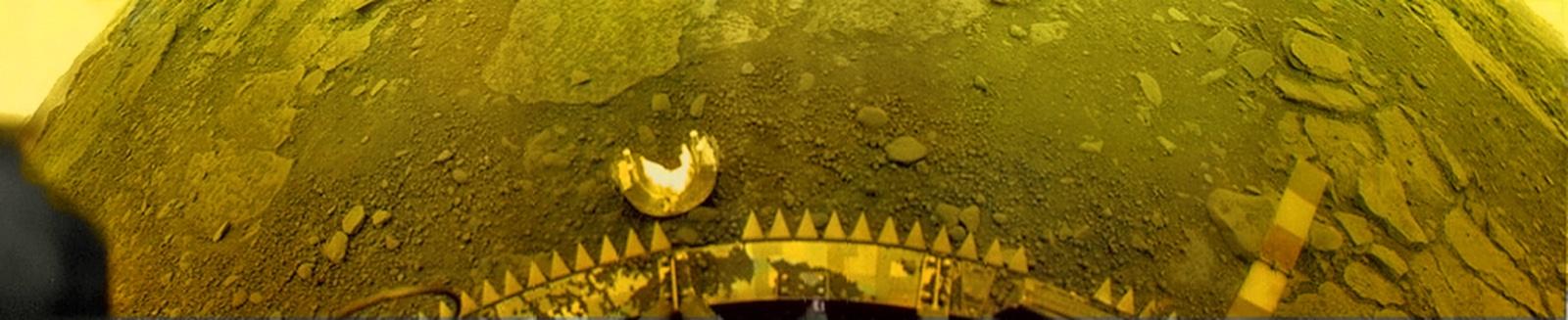
Venera 13 and Venera 14 were twin stations built by NPO Lavochkin and launched five days apart from Baikonur, on 30 October and 4 November 1981. They came after Venera 11 and 12, whose landers reached the surface in 1978 but sent no pictures because the covers over their camera windows never came off, and whose soil analysers also failed. Siddiqi says the new pair had been meant to fly in 1980 and that those failures forced a longer redesign.
The redesign was tested to the edge of failure. NPO Lavochkin says 18 experimental machines were built to check the changes. For the camera covers alone 39 kinds of test were planned and 78 carried out: the descent craft was heated to 450 °C, dropped from a height to imitate a landing, and only then were the covers fired off. The new units ended with a working margin of 20.5 against a calculated 7.5. Don Mitchell adds that metal teeth were fitted around the landing ring to steady the lander aerodynamically and stop the spinning and oscillation that may have damaged the previous pair.
The carrier was the 4V platform, a propellant cylinder with the KTDU-425A engine beneath, two solar wings and a 1.6 m dish, topped by a 2.4 m entry sphere (NSSDCA). The descent craft weighed about 1.64 tonnes and the part that reached the ground 750 kg (760 kg in NSSDCA). The Soviet encyclopedia yearbook for 1983 describes that lander as two heat-proof pressure compartments, one spherical and one ellipsoidal, under a rigid braking disc and standing on a crushable toroidal ring. The sphere held the radios, battery, soil analyser and two cameras looking out through windows; the drill, a soil probe and a colour test chart sat outside on the ring.
Mitchell's table of the lander experiments names the scientist in charge of each, among them Istomin's mass spectrometer and Mukhin's Sigma-2 gas chromatograph from the Institute for Space Research (IKI), Moroz's spectrophotometers, Marov's nephelometer, Surkov's hygrometer and two X-ray analysers, Barmin's drill, Kemurdzhian's PrOP-V penetrometer, Avduevsky's accelerometer and thermometers, Selivanov's two cameras and Ksanfomaliti's Groza-2 package with radio receiver, microphone and seismometer. The carriers flew an Austrian magnetometer and Soviet-French gamma-ray burst detectors alongside Soviet instruments, according to the Soviet encyclopedia yearbooks.
Venera 13's first correction, on 10 November 1981, added 2.47 m/s in a two-second burn. Afterwards six channels of the Konus instrument and a photomultiplier in another detector were found dead, and the spherical gas tanks were running cold, so the craft was tilted slightly off the Sun to warm them. February was spent checking the relay radios and tape recorders (one recorder failed) and chilling the descent craft in stages, to minus 12.3 °C by separation. A 5.13 m/s correction on 21 February was followed on 27 February, two days out, by separation and a 224.35 m/s burn that bent the carrier onto its flyby path, close to plan.
The flyby session opened on 1 March 1982, 122 days after launch; the relayed signal came down to the 70 m P-2500 antenna at Yevpatoria in Crimea, and the descent was received for 61 minutes. In the 1983 yearbook's account the sphere slowed from 11.2 km/s to about 300 m/s, parachutes opened at 64.5 to 66.5 km (62 km in NPO Lavochkin's 2022 article, 63 km in NSSDCA) and the shell fell away; below the clouds the parachute was cast off (at 47 km, says NSSDCA) and the lander fell for about an hour on its braking disc alone, reaching no more than 8 m/s at the ground. Sixty-two minutes after entry the Venera 13 lander touched down on a plain east of Phoebe Regio. NSSDCA and Siddiqi time the landing at 03:57:21 UT; Siddiqi, Mitchell and a 2022 NPO Lavochkin article put the impact at about 7.5 m/s.
The drill started 32 seconds after contact. For four minutes the telemetry carried the drill's progress and the other instruments; then the pictures began. NPO Lavochkin says the panorama transmission lasted 127 minutes, long enough for both cameras to send their views twice through each set of filters and to start a third cycle, and that reception was then ended by command from Earth. The planned life had been 32 minutes. Selivanov's camera team counted 11 panoramas of about 170 degrees and 10 fragments of 60 degrees; the state archive RGANTD counts 14 colour and 8 black and white images; Siddiqi writes of eight panoramas.
Around the lander the instruments read 462 °C, 88.7 atmospheres and 3 kilolux of daylight, at 1.9 km above the 6,050 km reference radius, according to NPO Lavochkin (457 °C and 89 atmospheres in the 1982 yearbook and NSSDCA). The pictures of the surface show pale plates of bedrock among dark soil; NPO Lavochkin reports that scientists read it as ancient, heavily eroded crust largely buried in crushed fine material. Comparing successive frames, Selivanov's team saw soil on the landing ring shift, most likely blown by the wind, and contrasts change, perhaps as clouds moved overhead; the lander, tilted about 8 degrees, may itself have shifted slightly near the 50th minute. The bureau still describes the changes of tint and mean illumination as unexplained.
Colour needs care. Each camera scanned through clear, red, green and blue filters, and colour views were assembled from the separations. NPO Lavochkin puts the surface's unusual colour down to the dense atmosphere absorbing the blue part of sunlight. A chart painted in heat-resistant enamel was unfolded in view as a reference, yet Mitchell writes that the colour balance of the Venera 13 and 14 images has never been calculated with complete satisfaction, partly because the cameras' radiometric response is uncertain.
At the centre of the mission was the drill. Mitchell describes a head that bored for two minutes before pyrotechnic charges broke seals and the outside pressure drove the cuttings through an airlock into a chamber inside the hull, held at 30 °C and about 0.05 atmospheres (NSSDCA). There Surkov's spectrometer irradiated the sample with plutonium and iron radioisotope sources and counted the fluorescence with four proportional counters. Surkov's 1982 report gives 38 spectra from Venera 13 (RGANTD says 40) and a rock rich in potassium: 4.0 per cent K2O, 45.1 per cent SiO2 and 11.4 per cent MgO. The team compared it with potassium alkaline basalt, a rock uncommon on Earth and found mainly on oceanic islands and in rifts; NSSDCA words it as weakly differentiated melanocratic alkaline gabbroids, similar to leucitic basalt. At the same site the PrOP-V probe and the landing accelerometer both found ground that behaved like compacted fine-grained sand, weaker and less dense than crystalline igneous rock, at least near the surface, according to NPO Lavochkin; Mitchell summarises the impact data at both sites as hard rock with a crumbly surface.
Venera 14's cruise was rougher. It made a 7.3 m/s first correction on 14 November that NPO Lavochkin describes as within tolerance, then showed the same faults as its sister: four Konus channels failed and the gas tanks cooled sharply. Controllers tilted the craft to warm the tanks and their temperature leapt, which the bureau reads as a sign that the insulation blankets had simply been torn off. The tilt chilled valves of the reserve pneumatic system, their rubber seals apparently cracked and its nitrogen leaked away, and cells in the battery reversed polarity, cutting its capacity. NSSDCA tells the correction story differently, with an error in the first manoeuvre and extra burns on 23 November 1981 and 25 February 1982; the bureau's day-by-day account has no burn on 23 November.
Worse came from the engine. At the second correction, on 25 February, the engine delivered 5.37 m/s instead of 7.27, enough to move the landing point by 400 km. The replayed tape showed the thrust oscillating and sagging, averaging 700 to 800 kgf against the 1,000 kgf of the low-thrust mode, and the engine had been cut off by its safety timer. Specialists blamed seized bearings in the turbopump; over-cooled oxidiser and a leaking gas-generator valve were put forward later. A total failure during the much larger divert burn would have sent the carrier into the atmosphere behind its lander, leaving nothing to relay the data, so the safety time was extended by a minute.
Separation came on 3 March. Tracking showed the divert burn had delivered 171.4 m/s instead of 227.8 m/s, a shortfall of 56.4 m/s. For 68 seconds the thrust had wandered between 340 and 680 kgf; then the turbopump failed and the engine ran on tank pressure alone. The carrier passed Venus at 26,050 km, which NPO Lavochkin says was 10,000 km closer than needed to receive the whole lander programme; NSSDCA and Siddiqi give 36,000 km, close to the distance the bureau's figures imply was needed. A lower pass is a faster one, and the radio window shrank: ballistics experts worked out 17 minutes of guaranteed reception after landing, enough for the soil analyser's data and one black and white panorama, and 32 minutes with no margin, enough to add a panorama through the red filter.
On 2 March the lander had been chilled for 11 hours, to minus 14.5 °C, to stretch its life. It touched down on 5 March, 121 days after launch, at 03:56:16 UT by azmth's calculation (03:56:15 in McDowell's catalogue). The transmitters came on at 63.5 km and the parachute was released at about 47 km. NPO Lavochkin logged the first signal at 5 h 58 min 11 s and touchdown at 7 h 0 min 11 s, 62 minutes 20 seconds after the transmitters started. These are Moscow times (UT+3) of reception on Earth: the Doppler team's record spans 05:58:02 to 08:36:50 Moscow time, and the signal took 3 minutes 55 seconds to arrive from Venus. NSSDCA's 07:00:10 UT and Siddiqi's 07:00:11 UT carry that reception reading under a UT label; a touchdown at 07:00 UT would fall well over an hour after the Doppler record ends. The team's plot puts Venera 13's touchdown near 07:01 Moscow time, which fits NSSDCA's 03:57:21 UT plus three hours and the light time. The bureau places the lander at 13°15' S, 310°09', about 1,000 km from Venera 13 and, by azmth's calculation, about 490 km from its aim point of 16° ± 1° S, 314° ± 1°.
For the first four minutes the telemetry carried the drill's progress and the Arakhis analyser's data, and NPO Lavochkin has the camera covers blown off after that; a microphone trace that Mitchell annotates puts the cover charges before the drilling, about 33 seconds in (he labels it Venera 13; the 1982 acoustic paper prints the same shape for Venera 14). The first camera finished its cycle in the 31st minute and the second completed a full cycle 56 minutes after landing. In the 57th minute the signal fell below the level at which information could be extracted, and NPO Lavochkin records that the Venera 14 programme had been carried out in full. The site was hotter and lower than Venera 13's: 465 °C, 94.7 atmospheres and 10 kilolux at 1.3 km above the reference radius. The pictures show a flat surface of layered slabs with little loose soil, which the bureau calls less weathered and so younger. Surkov's team measured 20 spectra and a composition close to the tholeiitic basalts of Earth's ocean floor, with only 0.2 per cent K2O. The same paper gives Venera 14 only 53 minutes on the surface, against 57 elsewhere, unexplained.
One Venera 14 episode is widely retold. The PrOP-V arm swung out on springs to press a stamp into the ground and turn it, measuring strength and electrical conductivity. Siddiqi writes that one of the ejected camera covers fell exactly where the probe was about to work, so that it tested the cover instead of the soil. Mitchell tells it differently: the penetrometer landed inside the ejected cap but may still have pushed through to the rock beneath. NPO Lavochkin's page reports mechanical results for Venera 13 only. Without the PrOP-V team's own report, both readings stand.
The pair also made what NPO Lavochkin calls the first seismic measurements on the planet. The Groza-2 seismometer, sensitive only to vertical motion, recorded nothing on Venera 13. On Venera 14 Ksanfomaliti's team found two events, about 950 and 1,361 seconds after landing, that matched no operation of the lander and no change in the wind, and concluded that microseisms may have been recorded; NSSDCA cautions that they may have come from the lander itself. The package's microphone reported the level of noise in a 400 to 2,500 Hz band, continuously for four minutes and then in 8-second cuts: the cover charges, the drill, and a steady signal the team read as wind. Calibrated in a wind tunnel, that gave 0.35 to 0.39 m/s at Venera 14; at Venera 13 the channel sat at its upper limit, equal to 0.57 m/s or more, until 4,765 seconds, then fell to 0.51 m/s. Doppler tracking of the Venera 13 descent, the only one reduced in the first report, found westward winds at every height, near 50 m/s through most of the atmosphere and no more than 1 to 2 m/s at the surface.
On the way down the gas instruments sampled the atmosphere again. The mass spectrometers returned about 250 spectra: a neon-20 to neon-22 ratio of 11.8, above Earth's and below the Sun's, krypton and xenon each at 10 to 100 parts per billion, the xenon measured only by Venera 14, whose instrument alone had been purged of the xenon used in its preparation. The chromatographs made nine analyses from 58 km downwards and reported hydrogen, hydrogen sulfide and carbonyl sulfide, which the authors said had been identified in Venus's air for the first time, plus a peak they presumed to be sulfur hexafluoride. About 90 per cent of the ultraviolet sunlight was absorbed above 58 km. The hygrometers put water vapour at 0.2 per cent by volume between 50 and 46 km, the chromatographs at 700 parts per million; the bureau reads the water results as a strongly dehydrated atmosphere, and credits the pair with direct proof that sulfur is the main element of the cloud layer.
Where exactly the landers sit is known only roughly. In 1982 Surkov's team put Venera 13 on rolling upland and Venera 14 on flat lowland, provinces then estimated from Pioneer Venus radar to cover 65 and 27 per cent of the planet; Siddiqi says the Venera 13 site was picked with information NASA passed on from the Pioneer Venus Orbiter. With Magellan radar, A. M. Abdrakhimov of the Vernadsky Institute later mapped both areas, in Navka Planitia east of Phoebe Regio, around circles centred on 7.55° S, 303.69° E and 13.05° S, 310.19° E (the positions Siddiqi also prints), each with a 150 km radius of probable error that he cites to a 1993 paper by Akim and Stepanyants. About 90 per cent of the Venera 13 circle is wrinkle-ridged plains, the likeliest source of its sample. The Venera 14 circle is 53 per cent lobate lava plains, 27 per cent wrinkle-ridged plains and 14 per cent rift terrain, with a gentle volcanic dome and caldera inside it. Older coordinates differ from these by up to about 70 km, and the sites come out 891 to 947 km apart depending on the set used, against the round 1,000 km of Soviet texts.
After the flybys both carriers went on into orbit around the Sun, still measuring the solar wind and cosmic radiation. Venera 13's carrier had one more job. As early as 1980, NPO Lavochkin writes, it had been decided that the next expedition, in 1984, would approach Venus and then Comet Halley; rehearsal burns were planned on one 4V1M carrier, and Venera 13 was chosen. On 10 June 1982 it fired for 47.8 seconds and 192 m/s, imitating the aim at the comet encounter point; on 14 October it added 69.08 m/s in 17.3 seconds. No propellant was left for the planned third burn, but the bureau judged the Venus to Halley trajectory proven, and Vega 1 and 2 flew it. NSSDCA and Siddiqi also credit Venera 14's carrier with one engine test for Vega, on 14 November 1982, which the bureau's account does not mention. The last session with Venera 14 was on 9 April 1983, and the last signal from Venera 13 came on 25 April 1983.
Thirty years later the panoramas returned to the news. In January 2012 Leonid Ksanfomaliti of IKI published in Astronomicheskii Vestnik, explicitly for discussion, an analysis of nine Venera 13 panoramas in which objects appeared, changed or vanished between frames, among them a disc, a black rag and a scorpion that, as RIA Novosti reported, showed up about 90 minutes after the cameras started and was gone 26 minutes later. He proposed that some of them had the properties of living beings. Within days Mitchell argued that the scorpion came from the way the picture was encoded, since it appears in the version sent by time-pulse modulation and is absent from the pulse-code version; IKI's Oleg Korablev called the idea wishful thinking; the journal's editor, Mikhail Marov, said he very strongly doubted it. Siddiqi records that Ksanfomaliti kept publishing such claims until 2014 and that all of them could be explained by the technical limits of sending the images to Earth. The wider question is covered at life on Venus.
Both landers remain on the surface, probably within their 150 km circles, and the jettisoned shell halves and parachutes presumably came down in the same regions; the inventory is at what we left at Venus. PDS Geosciences states that none of the Venera data have been archived in NASA's Planetary Data System, although its Venera page offers the Venera 13 and 14 lander images. The state archive RGANTD holds more than 30 photographic records of the mission, among them the flight lander, the panoramas, and the pennant and badge that Venera 13 carried to Venus.
Mission facts
Organisations
NPO Lavochkin and the USSR Academy of Sciences (Soviet Union)
Designation
NPO Lavochkin calls the pair series 4V1M; Siddiqi's NASA chronicle writes 4V-1M No. 760 (Venera 13) and No. 761 (Venera 14). NSSDCA lists COSPAR IDs 1981-106A and 1981-110A for the carriers, 1981-106D and 1981-110D for the descent craft.
Launches
Venera 13 on 30 October 1981 at 09:04:22.5 Moscow decree time and Venera 14 on 4 November 1981 at 08:31:16.1, both on Proton-K from Baikonur (06:04 and 05:31 UT in Siddiqi). NPO Lavochkin names the upper stage Blok DM; Siddiqi writes Blok D-1 (11S824M).
Venera 13 mass
4,397.85 kg at launch, of which the descent craft 1,643.72 kg and the lander on the surface 750 kg, with 629.68 kg of propellant (NPO Lavochkin). NSSDCA gives 4,363 kg and a 760 kg lander.
Venera 14 mass
4,394.5 kg at launch, of which the descent craft 1,632.71 kg and the lander 750 kg, with 641.35 kg of propellant (NPO Lavochkin). NSSDCA gives 4,395 kg.
Test campaign
NPO Lavochkin built 18 experimental machines to check the changes from Venera 11 and 12, and ran 78 tests of the camera-cover release against 39 planned, heating the descent craft to 450 °C and dropping it first.
Venera 13 landing
1 March 1982, 03:57:21 UT (NSSDCA, Siddiqi), 62 minutes after entry, on a plain east of Phoebe Regio; landing speed about 7.5 m/s (Siddiqi, Mitchell).
Venera 13 site conditions
462 °C, 88.7 atmospheres, 3 kilolux, 1.9 km above the 6,050 km reference radius (NPO Lavochkin). The 1982 Soviet encyclopedia yearbook and NSSDCA give 457 °C and 89 atmospheres.
Venera 13 on the surface
127 minutes (NPO Lavochkin, 1982 yearbook, NSSDCA) against a 32 minute design life (1982 yearbook, NSSDCA); NPO Lavochkin says both cameras sent their panoramas twice through each filter set and began a third cycle before reception was ended by command from Earth.
Venera 14 landing
5 March 1982, 03:56:16 UT at Venus (azmth's calculation; 03:56:15 in McDowell's catalogue). NPO Lavochkin registered touchdown at 7 h 0 min 11 s, which the Doppler team's timings show to be Moscow time (UT+3) on reception, 3 min 55 s after the event. NSSDCA's 07:00:10 UT and Siddiqi's 07:00:11 UT are that Moscow reception reading under a UT label. Site 13°15' S, 310°09' by NPO Lavochkin, against an aim point of 16° ± 1° S, 314° ± 1°.
Venera 14 site conditions
465 °C, 94.7 atmospheres, 10 kilolux, 1.3 km above the reference radius (NPO Lavochkin). NSSDCA gives 470 °C and 94 atmospheres, Siddiqi 470 °C and 93.5.
Venera 14 on the surface
57 minutes in NSSDCA, Siddiqi, the 1982 yearbook and NPO Lavochkin (useful signal lost in the 57th minute); about 60 minutes in the 1983 yearbook; 53 minutes in Surkov's 1982 soil paper.
Venera 14 carrier flyby
26,050 km from Venus after a divert burn 56.4 m/s short, which NPO Lavochkin says was 10,000 km closer than needed for full reception. NSSDCA and Siddiqi give 36,000 km.
Rock at Venera 13
K2O 4.0 ± 0.63 %, SiO2 45.1 ± 3.0 %, MgO 11.4 ± 6.2 %, from 38 X-ray spectra: close to potassium alkaline basalt (Surkov et al., 1982).
Rock at Venera 14
K2O 0.2 ± 0.07 %, SiO2 48.7 ± 3.6 %, CaO 10.3 ± 1.2 %, from 20 spectra: close to the tholeiitic basalt of Earth's ocean crust (Surkov et al., 1982).
Cameras
Two per lander on opposite sides, tilted 50° to the vertical axis (1983 yearbook), scanning through clear, red, green and blue filters (NSSDCA); 252 pixels per vertical line at 9 bits (Mitchell).
Surface wind
0.35 to 0.39 m/s at Venera 14; at Venera 13, 0.57 m/s or more, falling to 0.51 m/s late in the session. Both from the Groza-2 microphone used as an anemometer (Ksanfomaliti et al., 1982); NPO Lavochkin gives 0.3 to 0.6 m/s.
Site: 7.55°S, 303.69°E · Venera 13 lander, western Navka Planitia · position estimated, ±150 km (source)
Mission timeline
- 1980NPO Lavochkin dates to 1980 the decision that the next expedition, in 1984, will fly past Venus and on to Comet Halley; rehearsal burns on one 4V1M carrier are planned to prove the route.
- 30 Oct 1981Venera 13 lifts off from Baikonur on a Proton-K at 06:04 UT.
- 4 Nov 1981Venera 14 follows at 05:31 UT.
- 10 and 14 Nov 1981First corrections: 2.47 m/s for Venera 13, 7.3 m/s for Venera 14. On both craft Konus detector channels fail and the gas tanks run cold. NSSDCA adds a Venera 14 manoeuvre on 23 November that NPO Lavochkin does not list.
- 21 and 25 Feb 1982Second corrections. Venera 13's gives 5.13 m/s; Venera 14's engine runs rough and falls 1.9 m/s short, moving its landing point by 400 km.
- 27 Feb 1982The Venera 13 descent craft separates and the carrier burns 224.35 m/s to pass Venus.
- 1 Mar 1982Venera 13 lands at 03:57:21 UT, drills a sample and sends colour panoramas for 127 minutes.
- 3 Mar 1982The Venera 14 descent craft separates; the carrier's divert burn delivers 171.4 m/s instead of 227.8 m/s and it passes Venus at 26,050 km.
- 5 Mar 1982Venera 14 lands at 03:56:16 UT; the signal reaches Earth at 7 h 0 min 11 s Moscow time, the reading NSSDCA prints as 07:00:10 UT. It completes its programme before the signal fades in the 57th minute.
- 10 Jun 1982The Venera 13 carrier fires 192 m/s, imitating the aim at a comet encounter point.
- 14 Oct 1982Second rehearsal burn by Venera 13's carrier, 69.08 m/s; no propellant remains for a third.
- 14 Nov 1982NSSDCA and Siddiqi report an engine test by Venera 14's carrier for the Vega missions; NPO Lavochkin's account does not mention it.
- 9 Apr 1983Last communication session with the Venera 14 carrier.
- 25 Apr 1983Last signal from the Venera 13 carrier.
- Jan 2012Leonid Ksanfomaliti publishes his claim of moving objects in the Venera 13 panoramas; within days Don Mitchell argues that the 'scorpion' comes from the way the image was coded for transmission.
A filled dot marks something that physically happened. A hollow one marks an announcement, a naming or a target.
In pictures
Tap a photo to enlarge.
Translated from the original sources
Passages from the Russian sources this page draws on, in azmth's translation. Tap Show original to read the original wording.
NPO Lavochkin, project page Venera-13, Venera-14
Russian · 31 passages
“62 minutes after the descent craft entered the atmosphere, the lander made a soft landing on plains east of Phoebe Regio (7°30' south latitude and 303°11' longitude).”
azmth's translation · Show originalHide original
Russian: «Спустя 62 минуты после входа СА в атмосферу ПА совершил мягкую посадку в равнинной местности к востоку от области Феба (7°30' южной широты и 303°11' долготы).»
“For the first four minutes, besides information from other scientific instruments, telemetry on the soil-sampling device was transmitted, and then transmission began of the panorama of the surface of Venus, which lasted 127 minutes.”
azmth's translation · Show originalHide original
Russian: «Первые четыре минуты помимо информации с других научных приборов передавалась телеметрия о работе ГЗУ, а затем началась передача панорамы поверхности Венеры, которая длилась 127 минут.»
“In that time the panoramas from both telephotometers were transmitted twice, using each of the on-board filter sets, and a third imaging cycle began.”
azmth's translation · Show originalHide original
Russian: «За это время панорамы с обоих телефотометров были дважды переданы, причем с использованием каждого из бортового комплекта светофильтров, и начался третий цикл съёмки.»
“Reception of information from the lander was ended by command from Earth.”
azmth's translation · Show originalHide original
Russian: «Приём информации с посадочного аппарата был прекращён по команде с Земли.»
“The ambient temperature at the lander's site was 462 °C, the pressure 88.7 atmospheres, the illumination 3 kilolux.”
azmth's translation · Show originalHide original
Russian: «Температура окружающей среды в месте посадки ПА составила 462° С, давление 88,7 атмосфер, освещенность 3 килолюкс.»
“Although the 4V1M series craft largely repeated their predecessors (Venera 11 and 12, series 4V1), 18 experimental machines were built to check all the changes.”
azmth's translation · Show originalHide original
Russian: «Несмотря на то, что КА серии 4В1М во многом повторяли своих предшественников («КА «Венера-11,-12» серии 4В1), для проверки всех изменений было изготовлено 18 экспериментальных машин.»
“For checking the release of the telephotometer covers alone, 39 kinds of test were planned. In reality 78 were carried out.”
azmth's translation · Show originalHide original
Russian: «Только для проверки операции сброса крышек телефотометров запланировано 39 видов испытаний. В реальности проведено 78.»
“This led to a shift of the descent craft's landing point by 400 km.”
azmth's translation · Show originalHide original
Russian: «Это приводило к сдвигу точки посадки спускаемого аппарата на 400 км.»
“In the specialists' opinion, the bearings in the turbopump unit had seized.”
azmth's translation · Show originalHide original
Russian: «По мнению специалистов, произошло затирание подшипников в турбонасосном агрегате.»
“Trajectory measurements made as soon as the signal appeared showed that the correction impulse differed substantially from the calculated one: 171.4 m/s instead of 227.8 m/s.”
azmth's translation · Show originalHide original
Russian: «Траекторные измерения, проведённые сразу после появления сигнала, показали, что импульс коррекции существенно отличается от расчетного: 171,4 м/с вместо 227,8 м/с.»
“However, the impulse the engine delivered was enough for the orbital module not to 'crash' into Venus and to pass it at a distance of 26,050 km. That is 10,000 km closer to the surface of Venus than needed to receive the full volume of information from the lander.”
azmth's translation · Show originalHide original
Russian: «Однако отработанного двигателем импульса хватило, чтобы ОА не «врезался» в Венеру, а прошел от неё на расстоянии 26050 км. Это на 10000 км ближе к поверхности Венеры, чем необходимо для приёма в полном объёме информации с посадочного аппарата.»
“Seventeen minutes were enough to receive the data from the Arakhis instrument and one black and white panorama, and 32 minutes to receive a panorama through the red filter as well.”
azmth's translation · Show originalHide original
Russian: «Семнадцати минут хватало на то, чтобы принять информацию с аппаратуры «Арахис» и одну черно- белую панораму, а за 32 минуты принять панораму еще и под красным фильтром.»
“Contact with the surface of the planet was registered at 7 h 0 min 11 s. The descent from the switching on of the transmitters to touchdown lasted 62 minutes 20 seconds.”
azmth's translation · Show originalHide original
Russian: «В 7 часов 0 минут 11 секунд зафиксировано касание поверхности планеты. Продолжительность спуска от включения передатчиков до момента касания поверхности составила 62 минуты 20 секунд.»
“The Venera 14 lander landed on the surface of the planet about 1,000 km from the landing site of the Venera 13 lander.”
azmth's translation · Show originalHide original
Russian: «Посадочный аппарат «Венеры-14» совершил посадку на поверхность планеты в ~1000 км от места посадки ПА «Венеры-13».»
“In the 57th minute the extraction of useful information from the signal received from the lander stopped because its level fell below the threshold. The programme of the Venera 14 descent craft was thus carried out in full.”
azmth's translation · Show originalHide original
Russian: «На 57-й минуте прекратилось выделение полезной информации из принимаемого с посадочного аппарата сигнала из-за снижения его уровня ниже порогового. Таким образом, программа работы спускаемого аппарата «Венера-14» была выполнена полностью.»
“The ambient temperature at the Venera 14 site was 465 °C, the pressure 94.7 atmospheres, the illumination 10 kilolux, the height 1.3 km relative to the mean level corresponding to a planetary radius of 6,050 km.”
azmth's translation · Show originalHide original
Russian: «Температура окружающей среды в месте посадки «Венеры-14» составила 465°С, давление 94,7 атмосфер, освещенность 10 килолюкс, высота 1,3 км относительно среднего уровня, соответствующего радиусу планеты 6050 км.»
“The fairly flat surface, with pronounced layering, is less weathered, which points to a younger structure.”
azmth's translation · Show originalHide original
Russian: «Довольно ровная, с ярко выраженной расслоенностью, поверхность менее выветрена, что указывает на более молодую структуру.»
“The composition of the rock at the Venera 13 site proved close to potassium alkaline basalts; strongly alkaline basalts were also found, which are fairly rare on Earth”
azmth's translation · Show originalHide original
Russian: «Состав породы в районе посадки «Венеры-13» оказался близким к калиевым щелочным базальтам, обнаружены и сильнощелочные базальты, довольно редко встречающиеся на Земле»
“Thus at the Venera 13 site both experiments showed that the surface soil corresponds in its mechanical properties to compacted fine-grained sand.”
azmth's translation · Show originalHide original
Russian: «Так, в месте посадки «Венеры-13» оба эксперимента показали, что грунт поверхности по своим механическим свойствам соответствует уплотненному мелкозернистому песку.»
“Moreover, comparing a series of panoramas received over the whole transmission session revealed dynamic phenomena: soil that had fallen on the landing platform being blown away, changes in colour tints and fluctuations in mean illumination. The last phenomena are still unexplained.”
azmth's translation · Show originalHide original
Russian: «Причем при сравнении между собой ряда панорам, полученных за весь сеанс передачи, обнаружены динамические явления: сдувание слоя грунта, попавшего на посадочную платформу, изменение цветовых оттенков и колебания средней освещенности. Последние явления до сих пор не объяснены.»
“For the first time colour panoramas of the surface of Venus with an all-round view were obtained.”
azmth's translation · Show originalHide original
Russian: «Впервые получены цветные панорамы поверхности Венеры с круговым обзором.»
“For the first time seismic measurements were made on the planet.”
azmth's translation · Show originalHide original
Russian: «Впервые осуществлялись сейсмические измерения на планете.»
“As early as 1980 a decision was taken that in the following expedition (1984) the spacecraft would approach two space objects in turn: Venus and Comet Halley.”
azmth's translation · Show originalHide original
Russian: «Уже в 1980 году появилось решение о проведении в последующей экспедиции (1984 г.) последовательного сближения КА с двумя космическими объектами - Венерой и кометой Галлея.»
“The first of these corrections, which imitated aiming at the point of encounter with the comet, took place on 10 June 1982.”
azmth's translation · Show originalHide original
Russian: «Первая из таких коррекций, которая имитировала прицеливание в точку встречи с кометой, состоялась 10 июня 1982 года.»
“In principle the ballistic scheme for the flight from Venus to Comet Halley called for three corrections, but on Venera 13 there was simply no propellant left for one more.”
azmth's translation · Show originalHide original
Russian: «В принципе, баллистическая схема перелета от Венеры к комете Галлея предусматривала проведение трех коррекций, но на КА «Венера-13» еще на одну коррекцию топлива просто не осталось.»
“The signal from Venera 13 was received for the last time on 25 April 1983.”
azmth's translation · Show originalHide original
Russian: «Последний раз сигнал с КА «Венера-13» был получен 25 апреля 1983 года.»
“The last communication session with Venera 14 was held on 9 April 1983.”
azmth's translation · Show originalHide original
Russian: «Последний сеанс связи с КА «Венера-14» был проведен 9 апреля 1983 года.»
“Probably the multilayer insulation blankets had simply been torn off them.”
azmth's translation · Show originalHide original
Russian: «Вероятно, маты ЭВТИ с них просто сорвало.»
“At 5 h 58 min 11 s reception of the signal from the descent craft began, with information transmitted on both the decimetre and the centimetre channels.”
azmth's translation · Show originalHide original
Russian: «В 5 часов 58 минут 11 секунд начался приём сигнала со спускаемого аппарата, причём передача информации велась как по дециметровому, так и по сантиметровому каналам.»
“The average thrust was 700 to 800 kg (maximum 836 kg) instead of 1,000 kg”
azmth's translation · Show originalHide original
Russian: «Средняя тяга составила 700-800 кг (максимум 836 кг) вместо 1000 кг»
“Later, the versions put forward for the partial failure of the correction engine were over-cooling of the oxidiser in the feed pipe because of damaged thermal insulation, and a leaking valve on the gas-generator line.”
azmth's translation · Show originalHide original
Russian: «Впоследствии в качестве версий частичного отказа КДУ были выдвинуты: переохлаждение окислителя в расходной трубе в связи с нарушением теплоизоляции, а также негерметичность клапана на линии газогенератора.»
Epizody kosmonavtiki, Venera-13
Russian · 6 passages
Epizody kosmonavtiki, Venera-13 (with Great Soviet Encyclopedia yearbooks 1982 and 1983), archived
Open the source“(Venera 13 descent craft: ambient temperature 457 °C, pressure 89 atm; Venera 14 descent craft: ambient temperature 465 °C, pressure 94 atm)”
1982 yearbook of the Great Soviet Encyclopedia
azmth's translation · Show originalHide original
Russian: «(СА «Венера-13»: t окружающей среды 457°С, давление 89 атм; СА «Венера-14»: t окружающей среды 465°С, давление 94 атм)»
“The Venera 13 descent craft functioned on the surface of the planet for 127 min, the Venera 14 descent craft for 57 min (design time 32 min).”
1982 yearbook
azmth's translation · Show originalHide original
Russian: «СА станции «Венера-13» функционировал на поверхности планеты 127 мин, СА станции «Венера-14» - 57 мин (расчетное время - 32 мин).»
“On 1 March the Venera 13 descent craft entered the atmosphere of Venus and soft-landed on its surface at the point with coordinates 7.5° S and 303.5° longitude.”
1983 yearbook
azmth's translation · Show originalHide original
Russian: «1 марта спускаемый аппарат станции «Венера-13» вошел в атмосферу Венеры и совершил мягкую посадку на ее поверхность в точке с координатами 7°,5 ю. ш. и 303°,5 долготы.»
“The Venera 13 and 14 descent craft carried out experiments in different geological regions of the planet and transmitted information from the surface for about 127 and 60 min respectively.”
1983 yearbook
azmth's translation · Show originalHide original
Russian: «Спускаемые аппараты «Венера-13, 14» проводили эксперименты в различных геологических р-нах планеты и передавали информацию с поверхности в течение ~127 и 60 мин соответственно.»
“The spherical shell reduces the craft's speed in the planet's atmosphere from 11.2 km/s to about 300 m/s, acceptable for deploying the parachute system.”
1983 yearbook
azmth's translation · Show originalHide original
Russian: «Сферическая оболочка гасит скорость аппарата в атмосфере планеты с 11,2 км/сек до величины порядка 300 м/сек, допустимой для ввода парашютной системы.»
“They are inclined at 50° to the vertical axis of the craft.”
1983 yearbook, of the telephotometers
azmth's translation · Show originalHide original
Russian: «Они наклонены к вертикальной оси аппарата на 50°.»
Epizody kosmonavtiki, Venera-14, archived
Russian · 1 passage
“14 November 1982: test correction”
site timeline for Venera 14
azmth's translation · Show originalHide original
Russian: «14 ноября 1982 года - тестовая коррекция»
RGANTD (Russian State Archive of Scientific and Technical Documentation), 'Venera 13: the first colour photopanorama from hell'
Russian · 4 passages
“14 colour and 8 black and white images of the planet's surface were taken.”
azmth's translation · Show originalHide original
Russian: «Было сделано 14 цветных и 8 черно-белых снимков поверхности планеты.»
“In all 40 spectra were obtained and the amounts of the main elements in the sample were established.”
azmth's translation · Show originalHide original
Russian: «Всего было получено 40 спектров и установлено количество основных элементов в пробе.»
“Since then not a single spacecraft has landed on Venus.”
azmth's translation · Show originalHide original
Russian: «С тех пор ни один космический аппарат не совершал посадку на Венеру.»
“RGANTD holds more than 30 photographic documents: the flight article of the Venera 13 lander, the Venera 13 descent scheme, black and white and colour photopanoramas of the planet's surface, and images of the badge and pennant carried on Venera 13.”
azmth's translation · Show originalHide original
Russian: «В РГАНТД хранится более 30 фотодокументов: летное изделие посадочного аппарата АМС «Венера-13», схема спуска АМС «Венера-13», черно-белые и цветные фотопанорамы поверхности планеты, а также изображения знака и вымпела, установленных на АМС «Венера-13».»
NPO Lavochkin, 'A view from another planet: 40 years of Venera 13'
Russian · 1 passage
NPO Lavochkin, 'A view from another planet: 40 years of Venera 13' (30 October 2021)
Open the source“After an hour's flight the craft made a soft landing on plains near the planet's equator.”
azmth's translation · Show originalHide original
Russian: «Спустя час полета аппарат совершил мягкую посадку в равнинной местности близ экватора планеты.»
RIA Novosti, 'Soviet probes may have filmed living creatures on Venus'
Russian · 2 passages
RIA Novosti, 'Soviet probes may have filmed living creatures on Venus' (20 January 2012)
Open the source“In particular, the 'scorpion' appeared at about the 90th minute after the cameras were switched on, and 26 minutes later it disappeared, leaving a groove in the soil in its place.”
azmth's translation · Show originalHide original
Russian: «В частности, "скорпион" появился около 90-й минуты с момента включения камер, а через 26 минут он исчез, а на его месте осталась канавка в грунте.»
“'Without discussing the existing ideas about the impossibility of life in the conditions of Venus, let us make the bold suggestion that the morphological features nevertheless allow us to suppose that some of the objects found have the properties of living beings'”
azmth's translation · Show originalHide original
Russian: «"Не обсуждая существующие представления о невозможности жизни в условиях Венеры, сделаем смелое предположение, что морфологические признаки все же позволяют предположить, что часть найденных объектов имеет свойства живых существ"»
RIA Novosti, '"Life" on Venus was produced by the signal coding method of Soviet probes'
Russian · 2 passages
RIA Novosti, '"Life" on Venus was produced by the signal coding method of Soviet probes' (26 January 2012)
Open the source“In the same image transmitted using time-pulse modulation, that very 'scorpion' appears on the panorama.”
azmth's translation · Show originalHide original
Russian: «На том же изображении, переданном с использованием время-импульсной модуляции на панораме появляется тот самый "скорпион".»
“'This is not pseudoscience, it is a kind of wishful thinking,' he [Oleg Korablev] added.”
azmth's translation · Show originalHide original
Russian: «"Это не псевдонаука, это некое wishful thinking", - добавил он.»
NPO Lavochkin, '40 years since the soft landing of Venera 13 and Venera 14'
Russian · 2 passages
NPO Lavochkin, '40 years since the soft landing of Venera 13 and Venera 14' (1 March 2022)
Open the source“The lander touched down at a speed of 7.5 m/s, bounced once and came to rest at the point with coordinates 7.55° S and 303.69° E.”
azmth's translation · Show originalHide original
Russian: «Посадочный аппарат совершил посадку на скорости 7,5 м/с, один раз подпрыгнул и пришёл в состояние покоя в точке с координатами 7,55° ю. ш. и 303,69° в. д.»
“It touched the surface at the same speed at the point with coordinates 13.055° S and 310.19° E, which is 1,000 km south-west of the Venera 13 landing site.”
azmth's translation · Show originalHide original
Russian: «Он на той же скорости коснулся поверхности в точке с координатами 13,055° ю. ш. и 310,19° в. д., что на 1000 км юго-западнее от места посадки «Венеры-13».»
NSSDCA Photo Gallery, surface photographs from Venera 14
Russian · 1 passage
NSSDCA Photo Gallery, surface photographs from Venera 14 (Soviet black and white print)
Open the source“Venera 14. Processing by IPPI, USSR Academy of Sciences, and TsDKS”
stamped under each strip of the NSSDCA print; IPPI is the Institute for Information Transmission Problems and TsDKS the Centre for Deep Space Communications
azmth's translation · Show originalHide original
Russian: «ВЕНЕРА-14 ОБРАБОТКА ИППИ АН СССР И ЦДКС»
NPO Lavochkin, scan of the Soviet poster 'An outstanding victory in the peaceful exploration of space' on Venera 13
Russian · 2 passages
NPO Lavochkin, scan of the Soviet poster 'An outstanding victory in the peaceful exploration of space' on Venera 13 (published with the 2021 anniversary article)
Open the source“The descent craft of the Soviet automatic station Venera 13 explores the planet Venus”
heading of the Soviet poster scanned by NPO Lavochkin
azmth's translation · Show originalHide original
Russian: «Спускаемый аппарат советской автоматической станции «Венера-13» исследует планету Венера»
“An outstanding victory in the peaceful exploration of space”
heading of the same poster
azmth's translation · Show originalHide original
Russian: «Выдающаяся победа в мирном освоении космоса»
Sources
- NPO Lavochkin, project page Venera-13, Venera-14 · in Russian
- NPO Lavochkin, 'A view from another planet: 40 years of Venera 13' (30 October 2021) · in Russian
- NPO Lavochkin, scan of the Soviet poster 'An outstanding victory in the peaceful exploration of space' on Venera 13 (published with the 2021 anniversary article) · in Russian
- RGANTD (Russian State Archive of Scientific and Technical Documentation), 'Venera 13: the first colour photopanorama from hell' · in Russian
- Epizody kosmonavtiki, Venera-13 (with Great Soviet Encyclopedia yearbooks 1982 and 1983), archived · in Russian
- Epizody kosmonavtiki, Venera-14, archived · in Russian
- RIA Novosti, 'Soviet probes may have filmed living creatures on Venus' (20 January 2012) · in Russian
- RIA Novosti, '"Life" on Venus was produced by the signal coding method of Soviet probes' (26 January 2012) · in Russian
- NSSDCA, Venera 13 carrier (1981-106A), archived
- NSSDCA, Venera 13 descent craft (1981-106D), archived
- NSSDCA, Venera 14 carrier (1981-110A), archived
- NSSDCA, Venera 14 descent craft (1981-110D), archived
- NSSDCA Photo Gallery, Venus
- NSSDCA Photo Gallery, surface photographs from Venera 14 (Soviet black and white print) · in Russian
- Asif A. Siddiqi, Beyond Earth: A Chronicle of Deep Space Exploration, 1958-2016 (NASA, 2018), entries 162 and 163
- Don P. Mitchell, Drilling into the Surface of Venus (Venera 11 to 14)
- Don P. Mitchell, Remote Scientific Sensors
- A. M. Abdrakhimov, Geologic mapping of Venera 13 landing site region, LPSC XXXII (2001), abstract 1653
- A. M. Abdrakhimov, Geologic mapping of Venera 14 landing site region, LPSC XXXII (2001), abstract 1670
- Istomin, Grechnev and Kochnev, Mass spectrometry on the Venera 13 and Venera 14 landers, Sov. Astron. Lett. 8 (1982) 211
- Mukhin et al., Venera 13 and Venera 14 gas-chromatography analysis of the Venus atmosphere composition, Sov. Astron. Lett. 8 (1982) 216
- Surkov et al., Venera 13 and Venera 14 measurements of the water vapor content (with the closing page of Moroz et al.), Sov. Astron. Lett. 8 (1982) 223
- Kerzhanovich et al., Wind velocities estimated from Venera 13 and Venera 14 Doppler measurements, Sov. Astron. Lett. 8 (1982) 225
- Ksanfomaliti et al., Acoustic measurements of the wind velocity at the Venera 13 and Venera 14 landing sites, Sov. Astron. Lett. 8 (1982) 227
- Selivanov et al., sequence of panoramas photographed by the Venera 13 lander, Sov. Astron. Lett. 8 (1982) 235
- Surkov et al., rock composition at the Venera 13 and Venera 14 landing sites, Sov. Astron. Lett. 8 (1982) 237
- Ksanfomaliti et al., seismic measurements on Venera 13 and Venera 14, Sov. Astron. Lett. 8 (1982) 241
- PDS Geosciences Node, Venera missions page
- The Planetary Society, Venus surface panorama from Venera 13, view A
- The Planetary Society, Venus surface panorama from Venera 14, front camera
- NPO Lavochkin, '40 years since the soft landing of Venera 13 and Venera 14' (1 March 2022) · in Russian
- JPL Horizons, Earth to Venus range, 1 to 5 March 1982 (used for light-time corrections)
- J. McDowell, GCAT lander and impact catalogue (landercat), entries D00625 and D00630, updated 24 September 2026
Facts on this page were verified on 26 September 2026. Where sources disagree, the disagreement is stated rather than resolved silently.
azmth is independent and is not affiliated with or endorsed by NASA, Roscosmos, NPO Lavochkin, ESA, JAXA, ISRO, CNSA, or any other space agency or company named on this page.