The atmosphere of Venus
Venus's atmosphere: carbon dioxide at 92 bar, sulfuric acid clouds that circle the planet in four days, and open puzzles from shifting winds to lightning.
TL;DR· 20 min read
Venus's atmosphere is about 96.5 percent carbon dioxide. It presses on the ground at about 92 bar and keeps it near 464 °C, under sulfuric acid clouds whose tops circle the planet in about four days. In 2020 Japan's Akatsuki team showed that waves raised by the Sun's daily heating, called thermal tides, keep those fast winds going near the equator. Still open in September 2026: why the winds sped up from about 85 to 110 m/s between 2006 and 2012, what absorbs ultraviolet light in the clouds, where the haze below them comes from, whether Venus has lightning, and how its nitrogen is layered.
What is the atmosphere of Venus made of?
Venus's atmosphere is about 96.5 percent carbon dioxide and 3.5 percent nitrogen near the ground, with small traces of sulfur dioxide, argon and water vapour. It presses on the surface at about 92 bar, some 90 times the air pressure at sea level on Earth, and keeps the ground at about 464 °C by day and by night. Clouds of sulfuric acid cover the whole planet between about 47 and 70 km up, and their tops circle Venus in about four days, while the ground takes 243 days to turn once. Those basics are well measured. Much of what goes on inside that air is still argued: why the winds have sped up and slowed down over the years, what substance darkens the clouds in ultraviolet light, where the haze below them comes from, whether Venus has lightning, and why the share of nitrogen seems to change with height. This page sets out each puzzle and what has been measured so far, as of September 2026.
- 92 barsurface pressure, with an average surface temperature of 737 K (464 °C) and almost no difference between day and night (NASA Venus fact sheet)
- about 4 daysfor the cloud tops to circle Venus while the ground takes 243 days to turn once: about 60 times the planet's spin (JAXA)
- 1 flashoptical flash caught by Akatsuki's lightning camera in its whole mission, on 1 March 2020, and it may have been a meteor (ISAS)
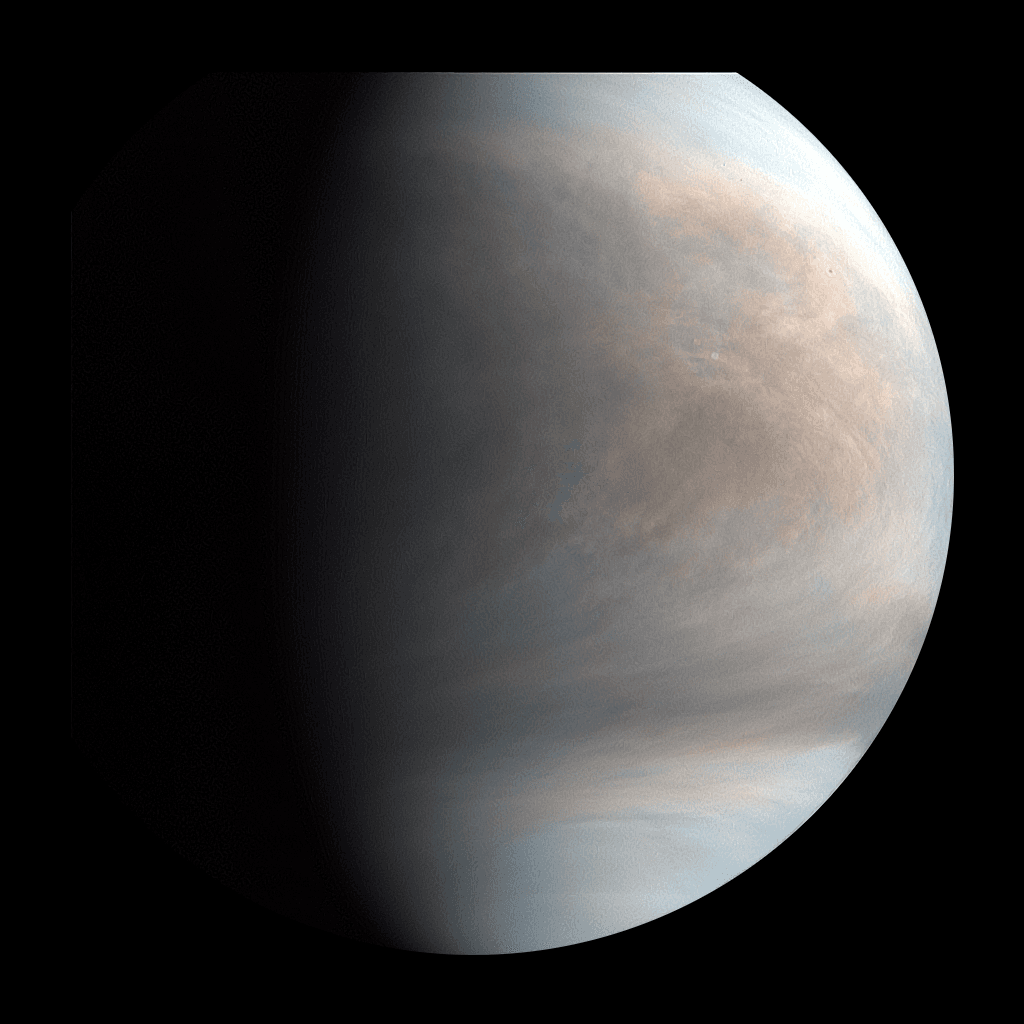
Venus's air is about 96.5 percent carbon dioxide and 3.5 percent nitrogen by volume near the ground, according to NASA's Venus fact sheet. It presses on the surface at about 92 bar and holds the ground at an average of 737 K (464 °C), with almost no difference between day and night. The sulfuric acid clouds lie roughly between 47 and 70 km, and below their base the acid evaporates, so no liquid droplets survive in the hot lower air. Little sunlight gets to the bottom. Summing up Akatsuki in January 2026, JAXA's scientists give the budget as 76 percent of incoming sunlight reflected, 21 percent absorbed in the clouds and 3 percent reaching the surface, against 31, 20 and 49 percent on Earth. NPO Lavochkin reports that illumination measured by the Venera 9 and 10 landers in 1975 showed 5 to 10 percent of the Sun's energy reaching the surface as light scattered by the clouds. Those were readings at two landing sites, while the ISAS figure is a whole-planet budget, so the two measure different things.
People inferred the atmosphere long before anything flew there, and who did it first is still argued. On 6 June 1761 (26 May in the calendar Russia then used) Mikhail Lomonosov watched Venus cross the Sun from his house in St Petersburg. He saw the Sun's edge lose its sharpness as Venus arrived and a bright bulge swell from the solar limb as it left, and his report, printed by the Academy of Sciences that July, concludes that Venus 'is surrounded by a significant air atmosphere' like Earth's, the bulge being sunlight refracted in that air. The commentary in the 1955 Soviet edition of his works defends his priority and treats the French observer Chappe d'Auteroche's account of a ring of atmosphere as unoriginal. In 2012 Jay Pasachoff and William Sheehan concluded that Lomonosov was describing the 'black drop', an optical effect unrelated to any atmosphere, and that observers in 1761 and 1769, Chappe d'Auteroche among them, may have seen the real arc. The same year Alexandre Koukarine, Vladimir Shiltsev and colleagues watched the 2012 transit through antique refractors and concluded that Lomonosov's telescope was fully adequate to see the arc. The transits of Venus page follows the observing campaigns.
Telescopes also worked out what the clouds are made of before any probe touched them. In June 1927 Frank Ross photographed Venus at Mount Wilson and found markings in ultraviolet light that red and infrared exposures do not show; he read them as disturbances in the atmosphere. Bernard Lyot had already measured by eye at Meudon, between 1922 and 1924, how Venus polarises sunlight at different phases, and found the result puzzling and unlike the Moon, Mars or Mercury. In May 1974 James Hansen and J. W. Hovenier showed that the curves require an optically thick cloud of micron-sized liquid droplets with a refractive index of 1.43 to 1.45, consistent with sulfuric acid of about 75 percent strength. With infrared spectra, that made a strong case for sulfuric acid, which the Pioneer Venus probes later confirmed in place. A century after Lyot, Jeremy Bailey and colleagues repeated the measurement (accepted by Icarus in 2026), found the particle sizes in good agreement with earlier determinations, and saw the polar regions behave differently in ultraviolet, most simply explained by a lower cloud top there.
Probes began sampling in 1967. Venera 4's descent capsule, NPO Lavochkin writes, made the first direct measurements of the temperature, density, pressure and chemical composition of Venus's atmosphere on 18 October 1967, and its gas analysers found mostly carbon dioxide, about 90 percent, with very little oxygen or water vapour. Nephelometers on Venera 9 and 10 and then Venera 11 and 12 placed the lower boundary of the clouds at about 48 to 49 km; the 2026 haze study discussed below uses about 47 km.
The clouds' four-day circuit was spotted from the ground by an amateur. In August 1957 Charles Boyer, President of the Court of Appeal in Brazzaville, began photographing Venus through a violet filter with his own 256 mm telescope. Over 68 days he noticed the markings repeating every four days, and Henri Camichel found the same period in plates from the 60 cm reflector at Pic du Midi. Their joint paper of 1961 was cautious: 'similar appearances return approximately every four days', a period that 'could be that of the rotation of Venus, though it cannot be affirmed'. By 1969 Boyer, writing with Pierre Guérin, titled his paper a study of the four day retrograde rotation of the outer cloud layer. The ground itself turns backwards once every 243 days, so the cloud tops outrun it hugely: about 60 times the planet's spin in JAXA's words, more than 50 times in IKI's. ISAS gives the ground's equatorial speed as 1.6 m/s and the wind near 70 km as 100 m/s, a ratio of about 62.
An observational answer, for low latitudes, came six decades later. As ISAS's 2026 retrospective notes, friction with the surface should keep the air turning roughly with the ground, and the slow overturning that carries heat from the equator toward the poles also carries angular momentum away from the equator. A team led by Takeshi Horinouchi of Hokkaido University tracked clouds in Akatsuki's ultraviolet images, added temperatures from the LIR camera, and reported in Science on 24 April 2020 that the fastest flow, at the cloud tops near the equator, is sustained by thermal tides: waves raised as sunlight heats the clouds by day and they cool by night. The tides carry angular momentum toward low latitudes, while other waves and turbulence, long suspected of doing that job, turned out to work weakly against it there. JAXA's release added that observation has limits and uncertainties remain, though the team considered the basic picture secure. The retrospective ties the tides to the 21 percent of sunlight absorbed in the clouds, calls them the main mechanism at least at low latitudes, and leaves the role of other waves at middle and high latitudes unfinished.
While that question was open, Venus Express showed the winds changing. Igor Khatuntsev and colleagues at the Space Research Institute (IKI) in Moscow tracked cloud features in Venus Monitoring Camera images of the southern hemisphere near 70 km from 2006 to 2012, deriving more than 45,000 wind vectors by hand and, in IKI's 2014 account, more than 390,000 automatically (ESA's 2013 release said more than 350,000). IKI puts the mean low-latitude wind at 85 m/s at the start of the mission and 110 m/s by mid 2012. ESA announced the result on 18 June 2013 alongside a parallel study led by Toru Kouyama in Japan, and quoted Khatuntsev: 'Such a large variation has never before been observed on Venus, and we do not yet understand why this occurred.' Both teams also saw faster swings, with low-latitude clouds lapping the planet in 3.9 days on one orbit and 5.3 days on another.
Why the winds change has two competing answers. Yeon Joo Lee and colleagues found in 2019 that the planet's brightness at 365 nm, close to the absorber's peak, changed by a factor of two between 2006 and 2017, enough to alter solar heating at low latitudes by 25 to 40 percent, and their circulation model suggested this could explain the wind changes. Khatuntsev's team, adding Akatsuki's ultraviolet images to cover 2006 to 2021, reported in 2022 a cycle of 12.5 ± 0.5 years in the cloud-top winds, correlated with the ultraviolet albedo and close to the roughly 11 year solar cycle. The Akatsuki team reads its own long series differently. Its 2026 retrospective reports a brown-noise spectrum with no dominant frequency, which suggests the variation may come from the atmosphere's own self-excited behaviour, and calls the link between wind speed and albedo interesting but premature. A cycle paced from outside and fluctuation generated inside cannot both be the whole story; the question is open.
The markings Ross photographed are still unexplained. Something near the cloud tops absorbs between at least 280 and 500 nm, and it plays a critical part in how much sunlight the clouds take in. Akatsuki's UVI camera watched it through a 365 nm filter, and JAXA's image gallery still called it an unidentified substance in September 2026. Clancy Zhijian Jiang and colleagues showed in Science Advances in January 2024 that ferric iron reacts with sulfuric acid to form the minerals rhomboclase and acid ferric sulfate, good candidates for the 200 to 300 nm and 300 to 500 nm features. Jan Spacek and colleagues argued in a 2025 preprint, revised in August 2026, that absorption peaking this strongly near 375 nm needs a very efficient absorber such as conjugated organic molecules, and noted that the planned Rocket Lab mission is meant to test the organic idea. In August 2026 Rakesh Mogul and colleagues posted a preprint, still under review, proposing mixtures of polycyclic aromatic hydrocarbons and iron compounds, the altered remains of cometary dust, which they say match spectra from the cloud tops to below the clouds. None is confirmed.
Dust from space turns up in a second puzzle lower down. Below the cloud base near 47 km the sulfuric acid evaporates, yet Venera, Pioneer Venus and Vega probes all found a persistent layer of solid submicrometre particles there, the lower haze, whose origin Tohoku University calls a fifty-year-old problem. On 13 April 2026 Hiroki Karyu, then a graduate student at Tohoku, and an international team of colleagues published a model in Nature Astronomy. In it, meteor smoke enters at 100 km as grains about a nanometre in radius, is swept up by acid droplets and carried down, and is left behind when the droplets evaporate at the cloud base, where the grains stick together into haze. Influxes of 3 to 300 tonnes a day reproduce the particle sizes the probes measured; Earth receives an estimated 5 to 60 tonnes. The grains also seed the main cloud deck, and their iron is a plausible source of the ultraviolet absorber. Tohoku's Japanese release presents this as the world's first demonstration that the haze is cosmic dust; the paper's wording is narrower, that the dust is sufficient to sustain the haze, a model result still to be tested by measurement. The authors suggest EnVision could check the iron link by following where the ultraviolet absorber goes.
David Allen and John Crawford, writing from the Anglo-Australian Observatory, reported in Nature in January 1984 that the dark side of Venus is anomalously bright in parts of the 1.5 to 2.5 µm band and shows structured cloud patterns whose rotation period, they wrote, is longer than that of any other clouds. The glow is heat from the hot air near the surface, and the middle and lower clouds show up as silhouettes against it. Galileo's Near Infrared Mapping Spectrometer mapped these lower clouds through the night side windows as it approached Venus on 10 February 1990. Akatsuki's IR2 camera imaged the night side in 2016 and, ISAS says, found an equatorial jet in the middle and lower clouds in data from July and August, before the electronics shared by IR1 and IR2 malfunctioned in early December 2016 and left both cameras dormant. ISAS adds that the night side images allow the emissivity of the ground to be estimated, a thread the mapping Venus page takes up.
Lightning has been claimed and doubted since the 1970s. The Groza instrument on Venera 11 and 12, which descended in December 1978, recorded bursts that NPO Lavochkin summarises as electrical discharges in the cloud layer, about as energetic as Earth's lightning but far more frequent, up to 30 a second; L. V. Ksanfomaliti reported them in Nature in 1980 as a discovery of frequent lightning discharges. Lavochkin's Venera 9 and 10 page goes further, stating that optical measurements by the 1975 orbiters showed Venusian lightning 25 times more energetic than Earth's, a claim later optical searches have not borne out. Venus Express's magnetometer found circularly polarised bursts near 100 Hz, which C. T. Russell's team reported in 2007 as whistler waves with the properties expected from lightning in the clouds. Against that, Cassini listened at 0.125 to 16 MHz during two close flybys and heard nothing, though the same receiver easily picked up Earth's lightning, and its team concluded in 2001 that Venus lightning is 'either extremely rare, or very different from terrestrial lightning'. In 2023 Parker Solar Probe data showed night side whistlers travelling toward the planet alongside Langmuir waves, a source that rules out lightning for those waves and suggests whistler-based flash rates may be overestimated. A 2025 chemistry study pulled the other way: the nitric oxide estimated for the lower atmosphere needs lightning that releases at least three times the power Earth's does. These results cannot all be right.
Akatsuki carried a dedicated instrument, the Lightning and Airglow Camera (LAC), built to record a flash's light curve at high time resolution. From October 2016 to August 2017 it saw nothing, although earlier flash-rate estimates gave it a 35 percent chance of catching at least one, and ISAS says that null result led to a reassessment of how often Venus lightning happens. On 1 March 2020 LAC recorded a single flash. Yukihiro Takahashi of Hokkaido University presented it at the American Geophysical Union meeting that December, and National Geographic's Japanese edition reported that his team thought it was either powerful lightning with about ten times the energy of Earth's or a large meteor exploding in the atmosphere. The team's April 2021 preprint describes a transient ten times brighter than a typical terrestrial flash and lasting a few hundred milliseconds, against about a millisecond for ordinary lightning, and judges a bolide possible but improbable given how often meteoroids should arrive. Crossref listed no journal version of that preprint as of 26 September 2026. LAC kept watching and caught nothing more, and the January 2026 retrospective says the upper limit on the flash rate is being tightened.
Even the second ingredient is uncertain. The standard 3.5 percent nitrogen rests on probe measurements below about 45 km in 1978, with a recommended uncertainty of 1.8 percentage points either way; NPO Lavochkin's summary of Venera 11 and 12 says 'about 5%', and the Pioneer Venus gas chromatograph measured 4.60 ± 0.14 percent at 55 km. When MESSENGER passed over the night side on 5 June 2007, its neutron spectrometer gave 5.0 ± 0.4 percent between 60 and 100 km, and Patrick Peplowski and colleagues concluded in Nature Astronomy in 2020 that the upper and lower atmosphere are chemically distinct. Near the ground, the Vega 2 lander's 1985 temperature profile, which Sebastien Lebonnois and Gerald Schubert call the only reliable one for the deep atmosphere so far, looks unstable below 7 km. In 2017 they proposed that nitrogen thins to near zero at the surface, separated from carbon dioxide by density in a layer so hot and dense that it behaves as a supercritical fluid. Daniel Cordier and colleagues (2019) found diffusion far too slow and phase separation unlikely, and suggested diffuse volcanic degassing instead. In November 2025 Rakesh Mogul, Sanjay Limaye and Michael Way published in Geophysical Research Letters a reanalysis of the Pioneer Venus Large Probe's 1978 mass spectra: 2.49 ± 0.10 percent nitrogen, uniformly mixed from 0.2 to 15 km, rising about twofold to 5.21 ± 0.18 percent at 51 to 59 km. It disagrees both with the 3.5 percent standard and with a near-zero surface.
What is settled is the bulk: carbon dioxide air at crushing pressure, sulfuric acid cloud, and heat that barely changes from day to night. Most of what moves or reacts inside it is still argued: why the winds speed up and slow down, what absorbs the ultraviolet, where the haze comes from, whether lightning flashes, and how the gases are layered in the bottom 15 km. The threads connect: meteor dust may feed both the haze and the absorber, and the absorber sets heating that may pace the winds. The same clouds carry the arguments on life on Venus, and the greenhouse that keeps the ground so hot has its own page, oceans and greenhouse.
What we know
Composition near the surface
96.5 percent carbon dioxide and 3.5 percent nitrogen by volume, with trace gases in parts per million: sulfur dioxide 150, argon 70, water 20, carbon monoxide 17, helium 12, neon 7. Mean molecular weight 43.45.
Surface conditions
Pressure 92 bar; density about 65 kg per cubic metre; average temperature 737 K (464 °C) with a day to night range of about zero; surface winds 0.3 to 1.0 m/s; scale height 15.9 km; total mass of the atmosphere about 4.8 × 10²⁰ kg.
Where the sunlight goes
Of the sunlight reaching Venus, 76 percent is reflected, 21 percent is absorbed in the thick clouds and 3 percent reaches the surface, against 31, 20 and 49 percent for Earth; the 21 percent absorbed in the clouds drives the thermal tides that sustain the super-rotation at low latitudes (ISAS retrospective, January 2026).
The 1761 inference (Lomonosov)
Watching the transit of 26 May 1761 (old style) from St Petersburg, Mikhail Lomonosov concluded that Venus 'is surrounded by a significant air atmosphere' like Earth's, and explained a bulge of light at the Sun's edge as sunlight refracted in it.
The 1761 inference, disputed
Pasachoff and Sheehan (Journal of Astronomical History and Heritage, 2012) argue that Lomonosov inferred the atmosphere from observations related to the 'black drop', which has nothing to do with it, and that Chappe d'Auteroche, Bergman and Wargentin (1761) and Wales, Dymond and Rittenhouse (1769) may have made genuine observations of the refraction arc, about three decades before Schroeter's independent demonstration.
Polarimetry (clouds identified from Earth)
Bernard Lyot measured Venus's polarisation by eye at Meudon in 1922 to 1924 and found it 'puzzling'. In 1974 Hansen and Hovenier matched the curves with an optically thick cloud of liquid droplets of effective radius 1.05 µm and refractive index 1.43 to 1.45, consistent with about 75 percent sulfuric acid. A 2026 repeat by Bailey and colleagues reproduced those models with modern codes and found the particle sizes in good agreement with past determinations.
First direct measurements (Venera 4)
On 18 October 1967 Venera 4's descent capsule made what NPO Lavochkin calls the first direct measurements of the temperature, density, pressure and composition of Venus's atmosphere; its gas analysers showed mostly carbon dioxide (about 90 percent) and very little oxygen or water vapour.
Super-rotation discovered (Boyer and Camichel)
From August 1957 the Brazzaville magistrate and amateur astronomer Charles Boyer photographed Venus through a violet filter with his own 256 mm telescope. Over 68 days he found the markings repeating every four days, and Henri Camichel, observing at Pic du Midi with a 60 cm reflector, found the same effect in his images.
Super-rotation, how fast
The ground turns once in 243 Earth days, against the direction of its orbit, and a solar day lasts 117 days. The wind grows with height to a maximum near the top of the cloud layer, which JAXA places at about 50 to 70 km; there the air laps the planet in about 4 days, about 60 times the planet's spin.
Super-rotation, how it is kept going
Horinouchi and colleagues (Science, 24 April 2020), using Akatsuki UVI cloud tracking and LIR temperatures, found that thermal tides carry angular momentum toward low latitudes and sustain the fastest flow at the cloud tops near the equator, while other waves and turbulence work weakly against it there.
Winds sped up (Venus Express)
Cloud tracking in Venus Monitoring Camera images near 70 km over the southern hemisphere showed the mean low-latitude wind rising from 85 m/s in 2006 to 110 m/s by mid 2012, from more than 45,000 vectors tracked by hand over 127 orbits and more than 390,000 tracked automatically over 576 (IKI RAN, 2014; ESA's 2013 release gave more than 350,000 automatic vectors).
A 12.5 year cycle in the winds?
Combining Venus Express and Akatsuki images for 2006 to 2021, more than 46,000 wind vectors show a period of 12.5 ± 0.5 years, a mean zonal wind of −98.6 ± 1.3 m/s and an amplitude of 10.0 ± 1.6 m/s, with UV albedo changes correlated with the winds; the authors suggest internal processes or external forcing, including the solar cycle (Khatuntsev and colleagues, 2022).
Lightning: the Groza result
NPO Lavochkin summarises Venera 11 and 12's Groza experiment (December 1978): electrical discharges occur in the cloud layer, with energy about equal to Earth's lightning but a much higher rate, reaching 30 a second.
Lightning: Venus Express whistlers
Venus Express's magnetometer recorded strong, circularly polarised bursts near 100 Hz lasting 0.25 to 0.5 s, reported by Russell and colleagues (Nature, 29 November 2007) as having the expected properties of whistler-mode waves from lightning in the clouds.
Lightning: Cassini heard nothing
During two close Venus flybys Cassini searched at 0.125 to 16 MHz, the band of lightning static on Earth, and heard no Venus signals, though it detected Earth's lightning easily later: lightning on Venus is 'either extremely rare, or very different from terrestrial lightning' (Gurnett and colleagues, Nature, January 2001).
The Akatsuki flash (1 March 2020)
Akatsuki's Lightning and Airglow Camera recorded a transient ten times brighter than a typical terrestrial lightning flash and lasting a few hundred milliseconds, against about a millisecond on Earth; the team's 2021 preprint judges a bolide possible but improbable given the expected rate of meteoroids at Venus.
The unknown ultraviolet absorber
The absorber is active between at least 280 and 500 nm, and no proposed candidate fully matches all observations. Its decadic absorption coefficient, constrained to peak near 375 nm at 1,278 per cm, implies a very efficient absorber such as conjugated organics at high concentration (Spacek and colleagues, arXiv preprint of 2025, revised August 2026).
The lower haze from meteors
Karyu and colleagues (Nature Astronomy, 13 April 2026) show in a cloud microphysics model that a continuous influx of cosmic dust is sufficient to sustain the lower haze with the particle sizes seen by entry probes, that the grains help form cloud, and that their iron is a plausible source of the ultraviolet absorber.
The night side windows
David Allen and John Crawford, writing from the Anglo-Australian Observatory, reported in Nature (January 1984) that the dark side of Venus is anomalously bright in parts of the 1.5 to 2.5 µm band and shows structured cloud patterns 'whose rotation period is longer than that of any other clouds'.
The nitrogen puzzle
MESSENGER's neutron spectrometer measured 5.0 ± 0.4 percent nitrogen between 60 and 100 km during its flyby of 5 June 2007, 40 percent above the 3.5 percent reported below 50 km, implying chemically distinct upper and lower atmospheres (Peplowski and colleagues, Nature Astronomy, 2020). A 2025 reanalysis of Pioneer Venus mass spectra puts it at 2.49 percent below 15 km.
What happened, and when
- 6 Jun 1761Lomonosov watches the transit of Venus from St Petersburg (26 May, old style) and infers an atmosphere from what he saw at the Sun's edge; in 2012 Pasachoff and Sheehan argue that he was seeing the black drop.
- 1922 to 1924Bernard Lyot measures the polarisation of Venus by eye at Meudon and finds it unlike the Moon, Mars or Mercury.
- Jun 1927Frank Ross photographs Venus on twenty-five nights at Mount Wilson and finds cloud markings in ultraviolet light that red and infrared exposures do not show.
- 1961Charles Boyer and Henri Camichel report violet and ultraviolet photographs in which similar markings return about every four days, and suggest, without affirming it, that this is the rotation period of Venus.
- 18 Oct 1967Venera 4's descent capsule transmits the first direct measurements of the atmosphere, per NPO Lavochkin: mostly carbon dioxide, about 90 percent.
- 1974Hansen and Hovenier show that the polarisation of Venus requires micron-sized droplets with the refractive index of concentrated sulfuric acid.
- Dec 1978Venera 11 and 12 descend with the Groza instrument, which records electrical discharges read as lightning in the cloud layer.
- Jan 1984Allen and Crawford report that the night side glows in parts of the 1.5 to 2.5 µm band, with cloud patterns silhouetted against it.
- 10 Feb 1990Galileo's Near Infrared Mapping Spectrometer maps the lower night side clouds through the infrared windows on its way past Venus.
- 2006 to mid 2012Venus Express's camera records cloud-top winds at low latitudes rising from 85 to 110 m/s.
- 5 Jun 2007MESSENGER passes over the night side at 338 km on its way to Mercury; its neutron spectrometer data later give 5.0 percent nitrogen at 60 to 100 km.
- 1 Mar 2020Akatsuki's Lightning and Airglow Camera records one flash on Venus: powerful lightning or an exploding meteor.
- 24 Apr 2020Akatsuki's team reports in Science that thermal tides maintain the super-rotation at low latitudes.
- 29 Sep 2023Parker Solar Probe whistler waves near Venus are shown to have a source other than lightning (Geophysical Research Letters).
- 28 Nov 2025Mogul, Limaye and Way publish in Geophysical Research Letters a reanalysis of Pioneer Venus Large Probe mass spectra: 2.49 percent nitrogen below 15 km, about 5.2 percent in the clouds.
- 13 Apr 2026Karyu and colleagues propose in Nature Astronomy that meteor dust sustains the lower haze.
- 12 Aug 2026A preprint proposes altered cometary dust, aromatic hydrocarbons plus iron compounds, as the ultraviolet absorber.
In pictures
Tap a photo to enlarge.
Translated from the original sources
Passages from the Russian, Japanese and French sources this page draws on, in azmth's translation. Tap Show original to read the original wording.
Lomonosov, Yavlenie Venery na Solntse
Russian · 2 passages
Lomonosov, Yavlenie Venery na Solntse (1761), text and 1955 commentary
Open the source“From these observations Councillor Lomonosov reasons that the planet Venus is surrounded by a significant air atmosphere, such as (if not greater than) the one poured around our terrestrial globe.”
azmth's translation · Show originalHide original
Russian: «По сим примечаниям господин советник Ломоносов рассуждает, что планета Венера окружена знатною воздушною атмосферою, таковою (лишь бы не большею), какова обливается около нашего шара земного.»
“A report made in such general terms [Chappe d'Auteroche's ring of atmosphere] of course bears no comparison with the exhaustive analysis Lomonosov presents in his scheme in fig. 7 (this volume, p. 369).”
Commentary to the 1955 edition.
azmth's translation · Show originalHide original
Russian: «Сообщение, сделанное в столь общей форме, конечно, не идет ни в какое сравнение с тем исчерпывающим анализом, который представлен Ломоносовым в его схеме на рис. 7 (настоящий том, стр. 369).»
NPO Lavochkin: Venera-4
Russian · 2 passages
“The main result of the Venera 4 flight was the first direct measurements of the temperature, density, pressure and chemical composition of the atmosphere of Venus.”
azmth's translation · Show originalHide original
Russian: «Главным результатом полета станции «Венера-4» стало проведение первых прямых измерений температуры, плотности, давления и химического состава атмосферы Венеры.»
“The gas analysers showed that the atmosphere of Venus is predominantly carbon dioxide (~90%), with a very small content of oxygen and water vapour.”
azmth's translation · Show originalHide original
Russian: «Газоанализаторы показали преимущественное содержание в атмосфере Венеры углекислого газа (~90%) и совсем незначительное содержание кислорода и водяного пара.»
NPO Lavochkin: Venera-9 and -10
Russian · 2 passages
“These measurements showed that 5 to 10% of the solar energy reaches the planet's surface as radiation scattered by the clouds.”
azmth's translation · Show originalHide original
Russian: «Эти измерения показали, что 5-10% солнечной энергии достигает поверхности планеты в виде излучения, рассеянного облаками.»
“Optical measurement data showed that the energy characteristics of Venusian lightning exceed those of terrestrial lightning 25 times.”
azmth's translation · Show originalHide original
Russian: «Данные оптических измерений показали, что энергетические характеристики венерианских молний в 25 раз превосходят параметры земных молний.»
NPO Lavochkin: Venera-11 and -12
Russian · 3 passages
“Analysis of some results of the experiment studying the electrical activity of Venus's atmosphere (Groza) gave the following: electrical discharges occur in the cloud layer; their energy is about the same as that of lightning in Earth's atmosphere, but the discharge rate is much higher and reaches 30 per second.”
azmth's translation · Show originalHide original
Russian: «Анализ некоторых результатов, полученных в эксперименте по исследованию электрической активности атмосферы Венеры («Гроза»), дал следующие сведения: электрические разряды происходят в облачном слое; их энергия примерно такая же, как у молний в атмосфере Земли, но частота следования разрядов намного выше и достигает 30 раз в секунду.»
“Measurements with the scientific instruments established that alongside the main constituent, CO2, the atmosphere of Venus contains a significant amount of nitrogen (about 5%).”
azmth's translation · Show originalHide original
Russian: «Измерениями с помощью научных приборов было установлено, что наряду с основной составляющей CO2 в атмосфере Венеры имеется значительное количество азота (около 5%).»
“Analysis of the nephelometer data confirmed the conclusion drawn from the Venera 9 and Venera 10 descent craft nephelometers that the lower boundary of the clouds lies at about 48 to 49 km.”
azmth's translation · Show originalHide original
Russian: «Анализ информации, полученной с помощью нефелометра, подтвердил вывод, сделанный по результатам нефелометрических измерений спускаемых аппаратов «Венера-9» и «Венера-10», о расположении нижней границы облаков на высоте около 48-49 км.»
IKI RAN press centre: large study of the upper cloud circulation of Venus
Russian · 2 passages
IKI RAN press centre: large study of the upper cloud circulation of Venus (Khatuntsev et al.)
Open the source“The researchers established that over the past Venusian decade the mean zonal flow speed at low latitudes grew from 85 m/s at the start of the mission in 2006 to 110 m/s by mid 2012.”
azmth's translation · Show originalHide original
Russian: «Исследователи установили, что за прошедшее венерианское десятилетие скорость среднего зонального потока в низких широтах выросла с 85 м/с в начале миссии в 2006 г. до 110 м/с к середине 2012 г.»
“At the upper boundary of the clouds the air currents outrun the rotation of the planet's solid body more than 50 times.”
azmth's translation · Show originalHide original
Russian: «На верхней границе облаков воздушные потоки более, чем в 50 раз, обгоняют вращение твердого тела планеты.»
JAXA press release, 24 April 2020: Akatsuki result published in Science
Japanese · 3 passages
“There the atmosphere circles the planet in only about 4 days, a speed reaching about 60 times the rotation.”
azmth's translation · Show originalHide original
Japanese: そこでは、大気が惑星を一周するのがわずか4日程度と、自転の60倍ほどの速さに達します。
“Detailed analysis of images and temperature data from Akatsuki has now made clear that the thermal tide is what carries this acceleration mechanism.”
azmth's translation · Show originalHide original
Japanese: 今回、「あかつき」で得られた画像と温度データの詳細な分析より、この加速機構を担うのが、「熱潮汐波」であることが明らかになりました。
“Observation has its limits and uncertain elements remain, but the research group considers that the fundamentals will not be shaken.”
azmth's translation · Show originalHide original
Japanese: 観測には限度があり、不確定要素は残りますが、研究グループでは基本的なところは揺るがないと考えています。
ISAS News, January 2026: Yamazaki and Satoh, looking back on Akatsuki
Japanese · 5 passages
“On Venus the albedo for sunlight is 76%, 3% reaches the surface of Venus, and the remaining 21% is absorbed by the thick clouds.”
azmth's translation · Show originalHide original
Japanese: 金星では、太陽光のアルベドが76%、3%が金星表面に到達し、残りの21%が厚い雲に吸収される
“Spectral analysis of the time series gave a brown-noise-like spectrum rather than a dominant frequency (which would suggest an external cause). This suggests that the long-term variation of Venus's atmosphere may be caused by the planet's own self-excited behaviour.”
azmth's translation · Show originalHide original
Japanese: 時系列データの変動をスペクトル解析したところ、どこか特定の周波数が卓越する(外部に要因があることを示唆)のではなく、ブラウンノイズ的なスペクトルが得られている。これは金星大気の長期変動が、惑星自身がもつ自励的な振舞いによって引き起こされている可能性を示唆している。
“An interesting correlation was seen between the long-term variations of super-rotation speed and cloud albedo, but it was judged premature for a definite conclusion, and a longer data record is needed.”
azmth's translation · Show originalHide original
Japanese: スーパーローテーションの速さと雲のアルベドの長期変動の間に興味深い相関が見られたが、断定的な結論には時期尚早であり、さらに長期のデータ蓄積が必要であるとされた。
“In the period from October 2016, when LAC began nominal operation, to August 2017, not a single lightning flash event was detected.”
azmth's translation · Show originalHide original
Japanese: LACがノミナル運用を開始した2016年10月から2017年8月までの期間に、雷発光イベントは1件も検出されなかった。
“LAC observation continued, but no further luminous event was captured.”
azmth's translation · Show originalHide original
Japanese: LAC観測を継続したが、追加の発光現象を捉えられなかった。
National Geographic Japan, 5 January 2021: mysterious flash on Venus seen by Akatsuki
Japanese · 1 passage
“Takahashi's team thinks it was either powerful lightning with about ten times the energy of Earth's lightning, or a large meteor that exploded in the atmosphere.”
azmth's translation · Show originalHide original
Japanese: 高橋氏のチームは、地球の雷の約10倍のエネルギーをもつ強力な雷か、大気中で爆発した大きな流星のどちらかだったと考えている。
Tohoku University press release, 14 April 2026: the lower haze of Venus comes from shooting stars
Japanese · 1 passage
“We demonstrated for the first time in the world that the origin of the fine particles drifting in Venus's lower atmosphere (the lower haze), unidentified for about 50 years since their discovery by spacecraft in the 1970s, is cosmic dust.”
Tohoku University release; the paper itself describes a model showing the dust is sufficient.
azmth's translation · Show originalHide original
Japanese: 1970年代の探査機による発見以来、約50年間正体不明だった金星の下層大気に漂う微粒子(下層ヘイズ(注1))の起源が、宇宙塵(注2)であることを世界で初めて実証しました。
Boyer and Camichel, Observations photographiques de la planète Vénus, Annales d'Astrophysique 24, 531
French · 1 passage
Boyer and Camichel, Observations photographiques de la planète Vénus, Annales d'Astrophysique 24, 531 (1961)
Open the source“Similar appearances return approximately every four days. This period could be that of the rotation of Venus, though it cannot be affirmed.”
azmth's translation · Show originalHide original
French: «Des apparences voisines reviennent approximativement tous les quatre jours. Cette période pourrait être celle de la rotation de Vénus sans qu'on puisse toutefois l'affirmer.»
Sources
- NASA NSSDCA, Venus Fact Sheet (updated 11 January 2024)
- ISAS News, January 2026: Yamazaki and Satoh, looking back on Akatsuki · in Japanese
- JAXA press release, 24 April 2020: Akatsuki result published in Science · in Japanese
- ISAS topic, 24 April 2020: how the super-rotation is maintained · in Japanese
- Horinouchi et al., How waves and turbulence maintain the super-rotation of Venus' atmosphere, Science 368, 405 (2020)
- ESA, 18 June 2013: The fast winds of Venus are getting faster
- IKI RAN press centre: large study of the upper cloud circulation of Venus (Khatuntsev et al.) · in Russian
- Khatuntsev et al., Twelve-Year Cycle in the Cloud Top Winds, Atmosphere 13, 2023 (2022)
- Lee et al., Long-term variations of Venus' 365-nm albedo (arXiv 2019)
- NPO Lavochkin: Venera-4 · in Russian
- NPO Lavochkin: Venera-9 and -10 · in Russian
- NPO Lavochkin: Venera-11 and -12 · in Russian
- Lomonosov, Yavlenie Venery na Solntse (1761), text and 1955 commentary · in Russian
- Pasachoff and Sheehan, Lomonosov, the discovery of Venus's atmosphere, and eighteenth century transits of Venus, JAHH 15, 3 (2012)
- Koukarine et al., Experimental reconstruction of Lomonosov's discovery (arXiv 2012)
- Shiltsev, Lomonosov's Discovery of Venus Atmosphere in 1761: English translation (arXiv 2012)
- Ross, Photographs of Venus, ApJ 68, 57 (1928)
- Boyer and Camichel, Observations photographiques de la planète Vénus, Annales d'Astrophysique 24, 531 (1961) · in French
- Dollfus, Charles Boyer and the Rotation of Venus, IAU Colloquium 98 (1988)
- Boyer and Guérin, Etude de la rotation rétrograde, en 4 jours, de la couche extérieure nuageuse de Vénus, Icarus 11, 338 (1969) · in French
- Hansen and Hovenier, Interpretation of the Polarization of Venus, J. Atmos. Sci. 31, 1137 (1974)
- Bailey et al., One Hundred Years of Venus Polarimetry (arXiv 2026, accepted by Icarus)
- Ksanfomaliti, Discovery of frequent lightning discharges in clouds on Venus, Nature 284, 244 (1980)
- Russell et al., Lightning on Venus inferred from whistler-mode waves in the ionosphere, Nature 450 (2007)
- Gurnett et al., Non-detection at Venus of high-frequency radio signals characteristic of terrestrial lightning, Nature 409 (2001)
- George et al., Non-Lightning-Generated Whistler Waves in Near-Venus Space, GRL 50 (2023)
- Constantinou, Shorttle and Rimmer, Powerful lightning on Venus constrained by atmospheric NO (arXiv 2025; Planetary Science Journal)
- Takahashi et al., An optical flash on Venus detected by the AKATSUKI spacecraft (preprint, 2021)
- National Geographic Japan, 5 January 2021: mysterious flash on Venus seen by Akatsuki · in Japanese
- Jiang et al., Iron-sulfur chemistry can explain the ultraviolet absorber in the clouds of Venus, Science Advances 10 (2024)
- Spacek et al., A model of UV-blue absorbance in bulk liquid of Venusian cloud aerosols (arXiv 2025)
- Mogul et al., Altered Cosmic Organics as Venus' Ultraviolet Absorbers (arXiv preprint, 12 August 2026)
- Karyu et al., A cosmic origin of Venus' lower haze, Nature Astronomy (13 April 2026)
- Karyu et al., Cosmic Dust as a Source for the Venusian Lower Haze, EPSC 2026 abstract
- Tohoku University press release, 14 April 2026: the lower haze of Venus comes from shooting stars · in Japanese
- Allen and Crawford, Cloud structure on the dark side of Venus, Nature 307, 222 (1984)
- NASA/JPL PIA00222: Venus lower-level night side clouds as seen by Galileo NIMS
- Akatsuki gallery: Venus night side image by IR2 at 2.26 µm
- Peplowski, Lawrence and Wilson, Chemically distinct regions of Venus's atmosphere revealed by measured N2 concentrations, Nature Astronomy (2020)
- Peplowski et al., arXiv version with flyby details (2019)
- Lebonnois and Schubert, The deep atmosphere of Venus and the possible role of density-driven separation of CO2 and N2, Nature Geoscience 10, 473 (2017)
- Cordier et al., The Physical Origin of the Venus Low Atmosphere Chemical Gradient (arXiv 2019, ApJ)
- Mogul, Limaye and Way, Altitude Profile and Isotopic Composition for N2 From Pioneer Venus Mass Spectra, Geophysical Research Letters 52, e2025GL118909 (28 November 2025)
- Mogul, Limaye and Way, First N2 Profile for Venus' Deep Lower Atmosphere, EGU26-2276 (2026)
Checked on 26 September 2026. Where the science is unsettled this page says so rather than picking a winner.
azmth is independent and is not affiliated with or endorsed by NASA, Roscosmos, NPO Lavochkin, ESA, JAXA, ISRO, CNSA, or any other space agency or company named on this page.