Rocket Lab and MIT: Venus Life Finder
Rocket Lab and MIT · United States · Atmospheric probe · 2027 · Announced In development
In development, with no launch date yet. Its science lead says the probe waits for Rocket Lab's Neutron rocket, which Rocket Lab now expects to make its first flight in 2027.
TL;DR· 17 min read
Venus Life Finder is a 20 kg probe from Rocket Lab and MIT, built to fall through the clouds of Venus with a single laser instrument that looks for the glow of organic material inside cloud droplets during about five minutes in the clouds. First planned for May 2023, it has no launch date: science lead Sara Seager says it waits for Rocket Lab's Neutron rocket, whose first flight Rocket Lab now expects in 2027. MIT's follow-on balloon and sample return missions are studies with no announced flight funding.
When will Rocket Lab's Venus Life Finder launch?
Venus Life Finder, a small probe from Rocket Lab and a team of MIT scientists, has no launch date yet. Its science lead, Sara Seager, says it waits for Rocket Lab's new Neutron rocket, and Rocket Lab now expects Neutron's first flight in 2027. The 20 kg capsule is built to fall through the clouds of Venus and shine a laser on single cloud droplets, looking for the glow that some organic molecules give off, during about five minutes in the cloud layer. It was first meant to launch in May 2023 on Rocket Lab's smaller Electron rocket. MIT counts it as the opening flight of its Morning Star Missions, and this page also covers the two meant to follow: a balloon to test whether the clouds could support life, and a return of cloud samples to Earth.
Facts as of 4 November 2026, from the sources listed below.
- TBClaunch date in Rocket Lab's launches table, October 2026; Seager says the probe waits for Neutron, which Rocket Lab expects to fly first in 2027
- 330 splanned time for measurements inside the cloud layer, between about 45 and 60 km (2022 design)
- 20 kgapproximate probe mass, about 40 cm across, carrying one instrument of under 1 kg
The Rocket Lab probe to Venus still had no launch date on 4 November 2026. Rocket Lab's launches table, in an archived copy of 27 October 2026, lists Venus Life Finder with launch date and launch site 'TBC', and MIT's mission page, read on 4 November, says 'Target launch date: Coming soon!'. 'Rocket Lab moved the project to the Neutron rocket, and we are awaiting Neutron readiness,' Sara Seager, the MIT planetary scientist who leads the science team, told Space.com on 3 September 2026. Neutron, Rocket Lab's new medium-lift launcher, has yet to fly. A first-stage tank ruptured in a pressure test on 21 January 2026, moving its debut from mid-year to late 2026, and on 14 October Rocket Lab said the first launch is now expected in 2027. In a company video Peter Beck, Rocket Lab's founder and chief executive, traced the new delay to voids inside a carbon composite tank dome and said a new target date should follow first-stage tests, due to end in early 2027.
Operator and science lead describe the launcher differently. Rocket Lab's mission page, in its latest archived copy (31 August 2026), still gives the plan as 'using an Electron launch vehicle and Rocket Lab spacecraft', while Seager has said since March 2025 that the probe is going on Neutron. No Rocket Lab release or executive statement confirming Neutron for the Venus mission was found, its October Neutron update included, so this page records the move as the principal investigator's account of the operator's plan. MIT's own page points the same way: an illustration's alt text reads 'illustration of the Rocket Lab Neutron Rocket system'.
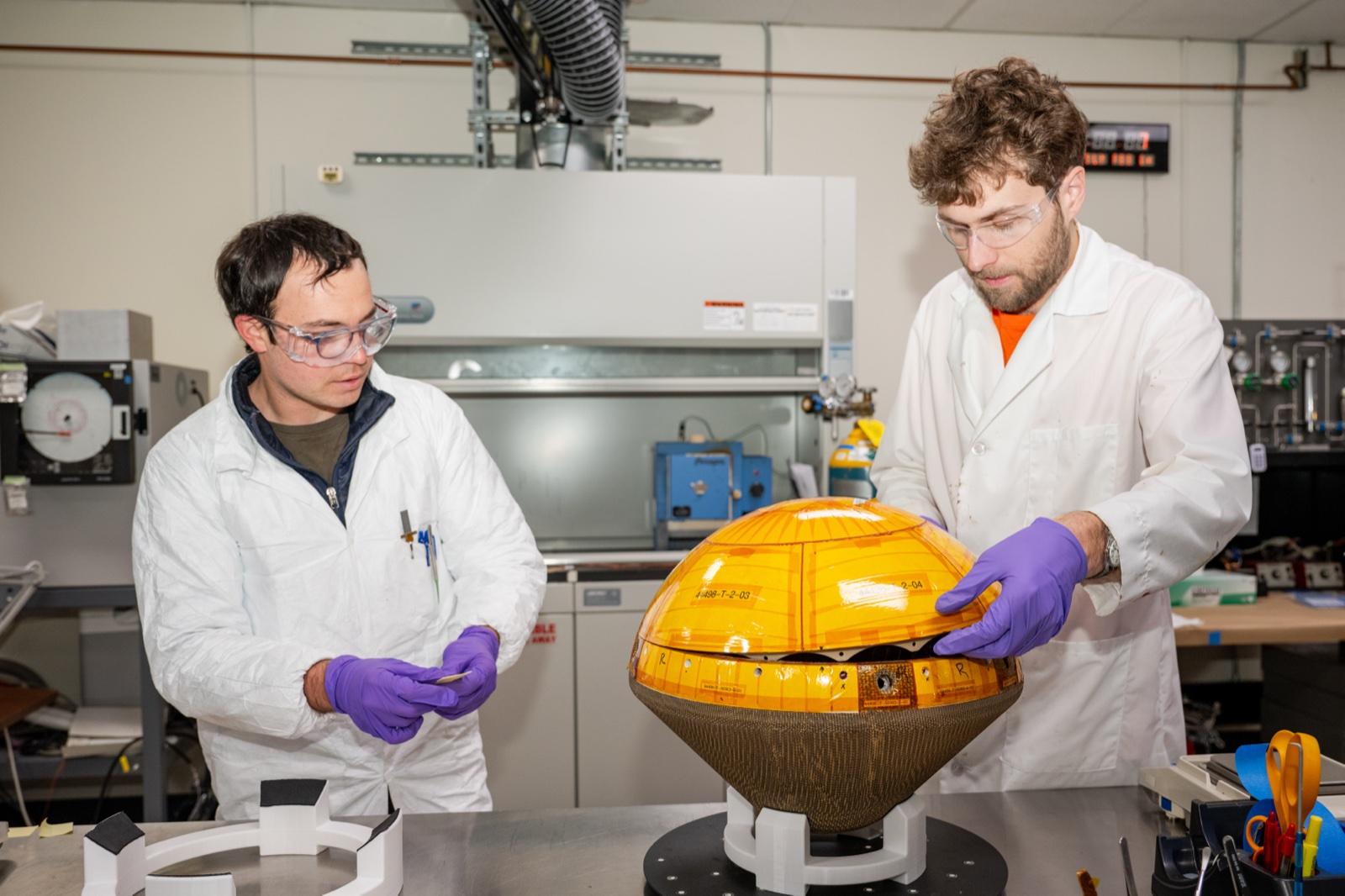
What exists in hardware is the entry probe. Its heat shield uses HEEET, a woven material invented at NASA's Ames Research Center, and NASA says its Small Spacecraft Technology program supported the shield's development for this probe. Space.com reported in September 2026 that NASA transferred the heat shield to Rocket Lab in March 2025, that the pressure vessel is ready, and that 'the Venus probe is now resting in Rocket Lab's Long Beach headquarters'. Seager said in March 2025 that her team had 'completed the instrument build and had our first integration tests with the probe'. No first-hand source describes the state of the cruise spacecraft, and a change of launcher may change that part of the design.
Rocket Lab's interest predates the phosphine claim that put Venus in the news in 2020. Beck said during a company livestream on 5 August 2020: 'I'm working very hard to put together a private mission to go to Venus in 2023.' Six weeks later a team that included Seager and her MIT colleague Janusz Petkowski announced a detection of phosphine in Venus's clouds, a gas that on Earth is made by microbes and by industry. Other astronomers challenged it, and Space.com described it in 2023 as still disputed (see life on Venus). In June 2021 Beck told SpacePolicyOnline that the probe would cross the clouds in 2023 'to measure for phosphine'. The final plan dropped that aim. According to MIT Technology Review, MIT scientists had contacted Beck about using one of his rockets; the instrument they chose cannot detect phosphine, and Seager told the magazine that one able to do so would not fit in the probe.
Their plan grew out of an 18-month study led by MIT in 2020 and 2021, when the team called itself Venus Life Finder Missions (VLF). Breakthrough Initiatives sponsored the study, and its report, posted on 9 December 2021, proposed three missions of rising ambition: a small probe on a Rocket Lab spacecraft, a balloon to measure whether the clouds are habitable, and a return of atmospheric samples to Earth. The team now calls itself the Morning Star Missions to Venus, while Rocket Lab's page keeps the older name. MIT describes the first flight as the 'first-ever largely privately funded mission to Venus', and NASA as 'the first private mission to the planet'. Seager leads the programme, with Petkowski as deputy.
Temperate air is what draws the mission to the cloud deck. About 50 km up, temperatures and pressures resemble those at Earth's surface, while the ground far below is hot enough to melt lead. The study team adds chemical puzzles, among them the unknown ultraviolet absorber and large cloud particles of unknown composition, called Mode 3, identified by a Pioneer Venus probe. 'If there's life on Venus, it's some kind of microbial-type life, and it almost certainly resides inside cloud particles,' Seager told MIT News in 2021. The obstacles are just as plain: the droplets are mostly concentrated sulfuric acid, and MIT News described the air around them as 50 to 100 times drier than Chile's Atacama Desert.
According to the 2022 mission paper by Rocket Lab and MIT authors, the probe is a sphere-cone about 40 cm across and about 20 kg, with its flight computer, radio and instrument sealed in an insulated aluminium pressure vessel. There is no camera. 'We have to be very, very frugal with the data that we're sending back,' Beck told MIT Technology Review.
Everything rides on one instrument of under 1 kg and under 50 W, the Autofluorescence Nephelometer (AFN). It projects a polarised laser beam at 439 to 441 nm through a window in the capsule wall, focused about 20 cm out so that it samples air the probe has not disturbed. Light scattered by each particle gives its size (1 to 10 micrometres), the number of particles and whether they are round; a pure acid droplet should be spherical, so an aspherical particle would point to something else. A third channel records fluorescence between 470 and 520 nm, which some organic molecules emit when lit at that wavelength. 'If we see fluorescence, we know something interesting is in the cloud particles,' Seager said in 2021. 'We can't guarantee what organic molecule it is, or even be certain it's an organic molecule.'
In the 2022 plan, Electron would lift a Rocket Lab Photon spacecraft from New Zealand's Mahia Peninsula. Photon would raise its orbit, pass the Moon for a gravity assist and fire toward Venus on 24 May 2023, then release the probe ahead of a night-side entry in October 2023 (30 minutes ahead in one figure caption, followed by a coast of about two hours in the paper's list of operations). In the paper's timeline the probe is in the clouds from 180 to 520 seconds after entry and is expected to lose signal around 30 minutes after entry, when the pressure vessel reaches its design limit. Measurements below the clouds are 'best effort' only.
Published figures differ, sometimes within one document. For time in the clouds, the 2022 mission paper gives about 330 seconds between about 45 and 60 km in its main text and 'about 5 min' at 48 to 60 km in its abstract; the 2021 MIT announcement and the 2022 summary paper give three minutes, the Planetary Society three to five. For the data path, the mission paper has the probe talking directly to Earth over S-band, though its own list of operations includes a 'relay communications' step; the Planetary Society and SpacePolicyOnline's 2021 account of Beck's plan describe a relay through Photon. For mass, 20 kg (paper), 45 pounds (MIT Technology Review) and 50 pounds (MIT News, 2021) all circulate. This page uses the 2022 paper's numbers as the design of record, with the caveat that a new launcher and cruise stage could revise them.
Three launch targets have come and gone. After the May 2023 baseline passed, Space.com reported on 6 June 2023, citing TechCrunch, that the mission was delayed until at least January 2025, its backup window; a Rocket Lab spokesperson said only that 'our focus right now is on delivering customer missions as a priority'. That window passed too. 'We missed our January 2025 launch window and now wait until the next one summer 2026,' Seager told Leonard David's Inside Outer Space in March 2025, in the same interview in which she said the probe was moving to Neutron. Summer 2026 passed as well.
Cost is part of the point. MIT Technology Review reported in August 2022 that the mission would cost less than 10 million dollars, about 2 percent of the price of each of NASA's Venus missions, and was funded by Rocket Lab, MIT and undisclosed philanthropists. For Rocket Lab the flight is also a test of its own ambitions: the 2022 paper lists maturing the interplanetary Photon and demonstrating a 'high-performance, low-cost, fast-turnaround deep space entry mission' among its goals.
Second in the series, the Habitability Mission would stay in the clouds for days. Its 2022 design was a fixed-altitude balloon 4 m across floating at about 52 km for one to two weeks (one week in the companion Habitability Mission paper). It would measure the acidity of single droplets, metals, organic material and gases including phosphine, and drop four mini probes into the lower clouds; the same papers offer an alternative of one or two large parachute probes, each descending for up to about an hour. On 14 October 2022 the science portal of Estonian broadcaster ERR reported that Tartu Observatory had presented a prototype pH sensor for the mission, and Mihkel Pajusalu, associate professor of space technology there, said the team hoped to send it with the next mission, 'which launches in 2026'.
Since then the balloon plan has grown. MIT's current mission page lists launch in May 2031 and entry in October 2031, seven days at a nominal 52 km, and 30 auto-rotating mini probes of 30 g each, called LEVL probes. A schedule chart on the same page shows a mission concept review in early 2026, of which no public record was found. In September 2026 Space.com reported that Seager's extended team has been developing a balloon 5 m wide able to float for one Earth week. The next payload is meant to identify complex organic molecules, and Seager is careful about what that would prove: 'While this goal will not determine if life is present, it will establish that ingredients for life or molecules potentially used by life are present.' No source found announces flight funding for it.
Bringing Venus's clouds to Earth is the third mission's job, on the argument that ground laboratories can run tests no flight instrument can match. NASA's Innovative Advanced Concepts programme chose Seager's study for Phase I in 2022. Its summary describes a balloon working between 45 and 60 km, collecting gas and up to 1 g of cloud particles, then rising to about 70 km to launch an ascent vehicle to an orbiter that brings the sample home; the 2022 summary paper gives up to a few grams. MIT's current page is more ambitious: a balloon-carried rocket MIT describes as 2-ton would lift up to 500 grams of samples from 60 km to orbit. MIT says such a mission could be implemented 'within the next two decades if investments in technology development start now'; National Geographic Polska wrote in March 2025 that it is planned for the 2040s.
Its authors present the Rocket Lab probe as a brief first look: their 2022 paper calls it 'the first opportunity to probe the Venus cloud particles directly in nearly four decades', and National Geographic Polska dates that gap to the Soviet Vega mission, whose balloons entered the atmosphere in 1985. NASA's DAVINCI is also planned as a descent probe, and VERITAS and ESA's EnVision are orbiters; the MIT team argues that none of the missions NASA and ESA have selected set out to study cloud particles in place. By itself a fluorescence signal would say nothing certain about life, but it could tell the next mission where to look. Until Neutron flies and Rocket Lab names a date, the series consists of an entry probe waiting in Long Beach and two studies.
Mission facts
Organisations
Rocket Lab (launcher, cruise spacecraft and entry probe) with an MIT-led science team under Sara Seager (instrument and science), heat shield from NASA Ames; follow-on Morning Star Missions led by MIT
Names
Rocket Lab titles its mission page Venus Life Finder. MIT calls the flight the Rocket Lab Mission to Venus, the opening mission of its Morning Star Missions to Venus; Venus Life Finder Missions (VLF) was the MIT team's own name during its 2020 to 2021 study.
Status (as of 4 Nov 2026)
Not launched. Rocket Lab's launches table lists Venus Life Finder with launch date TBC, customer N/A and launch site TBC (archived copy of 27 Oct 2026). MIT's mission page, read on 4 Nov 2026, reads 'Target launch date: Coming soon!'
Launcher (two readings)
Rocket Lab's own mission page says 'using an Electron launch vehicle and Rocket Lab spacecraft' (latest archived copy, 31 Aug 2026). Seager says 'Rocket Lab moved the project to the Neutron rocket' (Space.com, 3 Sep 2026; first said in March 2025). Rocket Lab's Neutron update of 14 Oct 2026 does not mention Venus, and no Rocket Lab statement confirming Neutron for this mission was found.
Hardware state
NASA transferred the HEEET heat shield to Rocket Lab in March 2025, the pressure vessel is ready, and the probe is 'now resting in Rocket Lab's Long Beach headquarters' (Space.com, Sep 2026). No first-hand source describes the cruise spacecraft; a same-day rewrite (Gagadget) calls it finalized, which Space.com's article does not say.
Probe
A 45-degree half-angle sphere-cone about 40 cm across with a hemispherical back, about 20 kg, with an aluminium pressure vessel (2 mm baseline wall). MIT Technology Review gives 45 lb and 15 in; MIT News (2021) called it a 50-pound probe.
Instrument
Autofluorescence Nephelometer (AFN): under 1 kg and under 50 W. A 440 nm polarised laser through a capsule window; measures scattered light from single particles and fluorescence at 470 to 520 nm. Built by Droplet Measurement Technologies (Colorado) and Cloud Measurement Solutions (New Mexico).
What it measures
Particle size (1 to 10 micrometres), number density, shape (asphericity) and complex refractive index, plus fluorescence that could indicate organic material. It cannot identify molecules and carries no phosphine sensor.
Time in the clouds (readings differ)
About 330 s between about 45 and 60 km (2022 mission paper, main text); about 5 min at 48 to 60 km (same paper, abstract); three minutes (MIT News 2021 and 2022 summary paper); three to five minutes from 60 to 45 km (Planetary Society).
Planned descent timeline
Probe released 30 min before entry (figure caption), yet the same paper's operations list gives a coast of about 2 h after release; heating, blackout and peak g 40 to 80 s after entry; clouds from 180 s to 520 s; transmission for about 20 more minutes; loss of signal expected about 30 min after entry; surface at about 3,500 to 4,000 s.
Heat shield
HEEET (Heatshield for Extreme Entry Environment Technology), a woven material invented at NASA Ames and designed, NASA says, to protect spacecraft from temperatures up to 4,500 degrees F. NASA's Small Spacecraft Technology program supported its development for this probe. The 2022 paper allowed HEEET or carbon phenolic.
Data path (two readings)
Direct to Earth over an S-band link with a hemispherical antenna (2022 mission paper, whose own operations list also includes a 'relay communications' step). Relayed through the Photon spacecraft (Planetary Society; SpacePolicyOnline's June 2021 account of Beck's plan).
Original flight plan (2022)
Electron from Launch Complex 1, Mahia, New Zealand; Photon raises its orbit to about 70,000 km apogee, uses a lunar gravity assist and injects toward Venus on 24 May 2023; night-side entry in October 2023. Backup window January 2025.
Cost and funding
Reported at less than 10 million dollars, funded by Rocket Lab, MIT and undisclosed philanthropists (MIT Technology Review, Aug 2022). MIT News (Dec 2021) says Breakthrough Initiatives funded the 2021 study.
Team
Sara Seager (MIT) leads; Janusz Petkowski is deputy lead; Christopher Carr is programme engineer and scientist; the AFN team includes Darrel Baumgardner of Droplet Measurement Technologies, first author of the instrument paper; the team page lists Christophe Mandy of Rocket Lab, with two colleagues, under Rocket Lab programme manager, and Jared Atkinson as programme director.
Habitability Mission (2022 design)
A 4 m fixed-altitude balloon at about 52 km for one to two weeks (summary paper; one week in the Habitability Mission paper), dropping four mini probes (two with pH sensors, two with MEMS gas detectors); envelope plus gondola about 45 kg.
Habitability Mission (MIT site, read 4 Nov 2026)
Launch May 2031, entry October 2031; 52 km for 7 days; 30 LEVL mini probes of 30 g each; ORIGIN laser desorption mass spectrometer as primary instrument; entry at 10.92 km/s with a peak of 125 g. Space.com (Sep 2026): Seager's team is developing a 5 m balloon able to float for one Earth week.
Sample Return (NIAC, 2022)
NASA Innovative Advanced Concepts Phase I study: a variable-altitude balloon working between 45 and 60 km collects gas and up to 1 g of cloud particles, rises to about 70 km and launches an ascent vehicle to an orbiter for return to Earth.
Sample Return (MIT site)
A balloon-carried rocket MIT describes as 2-ton would lift up to 500 g of samples from 60 km to orbit. MIT says it could be implemented 'within the next two decades' if technology investment starts now; National Geographic Polska (March 2025) wrote it is planned for the 2040s.
Neutron (as of 4 Nov 2026)
Not flown. On 14 Oct 2026 Rocket Lab announced an adjusted schedule for Neutron's inaugural launch, 'which is now expected to occur in 2027'; the previous target was late 2026. In a company video Peter Beck traced the delay to voids found in a carbon composite tank dome and said a new target date should follow tests of the first stage, expected to finish in the first quarter of 2027 (Space.com, 16 Oct 2026). A Stage 1 tank had ruptured in a hydrostatic test on 21 Jan 2026.
Mission timeline
- 5 Aug 2020In a company livestream Peter Beck says he is 'working very hard to put together a private mission to go to Venus in 2023', using Electron and the Photon bus.
- 14 Sep 2020A team including MIT's Sara Seager and Janusz Petkowski announces a detection of phosphine in Venus's clouds (a disputed result: see life on Venus).
- 3 Jun 2021Beck tells SpacePolicyOnline the probe will cross the cloud layer in 2023 'to measure for phosphine'. The instrument later chosen cannot do so.
- 9 to 10 Dec 2021The 18-month MIT-led Venus Life Finder Mission Study report is published, proposing a Rocket Lab probe, a habitability balloon and an atmosphere sample return.
- 19 Feb 2022NASA's Innovative Advanced Concepts programme posts Seager's Venus cloud sample return study among its 2022 Phase I selections (date shown on NASA's page); MIT says the grant came in April 2022 for a nine-month study.
- Aug 2022Rocket Lab and MIT authors publish the mission design in Aerospace: baseline launch May 2023 on Electron from New Zealand, backup January 2025, entry in October 2023.
- 14 Oct 2022Tartu Observatory presents a prototype single-droplet pH sensor; Mihkel Pajusalu hopes to send it on the second mission, which he says launches in 2026.
- 6 Jun 2023With the May 2023 window passed, Space.com reports (citing TechCrunch) a delay until at least January 2025; Rocket Lab says its focus is on customer missions.
- 27 Feb 2025NASA publishes a photograph of Ames engineers fit-checking the two halves of the probe with its HEEET heat shield installed.
- 2 Mar 2025Seager says the January 2025 window was missed, the next target is summer 2026, the probe is moving from Electron to the unflown Neutron, and the instrument build and first integration tests are done.
- Mar 2025NASA transfers the heat shield to Rocket Lab, according to Space.com's September 2026 report.
- 21 Jan 2026Neutron's first-stage tank ruptures during a hydrostatic pressure test, pushing the rocket's planned debut from mid-2026 to late 2026.
- 11 May 2026A Comment in Nature Communications still says, without naming the mission, that a privately funded atmospheric mission to Venus is 'expected to launch this year'.
- 10 Aug 2026Rocket Lab tells investors Neutron's pad delivery is targeted for Q4 2026 and the window for an end-of-year first launch is narrowing.
- 3 Sep 2026Seager: 'Rocket Lab moved the project to the Neutron rocket, and we are awaiting Neutron readiness.' The probe is reported at Rocket Lab's Long Beach headquarters.
- 14 Oct 2026Rocket Lab moves Neutron's first launch from late 2026 into 2027. Its update does not mention the Venus probe.
- 27 Oct 2026Rocket Lab's launches table still lists Venus Life Finder with launch date and launch site TBC, and MIT's page, read on 4 November, still reads 'Target launch date: Coming soon!'. The summer 2026 target has passed without a launch.
A filled dot marks something that physically happened. A hollow one marks an announcement, a naming or a target.
In pictures
Tap a photo to enlarge.
Translated from the original sources
Passages from the Polish and Estonian sources this page draws on, in azmth's translation. Tap Show original to read the original wording.
National Geographic Polska, 'Niedługo startuje pierwsza prywatna misja na Wenus', 6 Mar 2025
Polish · 5 passages
National Geographic Polska, 'Niedługo startuje pierwsza prywatna misja na Wenus', 6 Mar 2025 (page modified 4 Sep 2026, text still gives a mid-2026 launch)
Open the source“We have now finished building the autofluorescence nephelometer and carried out the first integration tests of the probe that will be dropped into the atmosphere of Venus. Everything is moving forward.”
Janusz Petkowski, deputy PI, to National Geographic Polska, 6 March 2025.
azmth's translation · Show originalHide original
Polish: „Obecnie zakończyliśmy budowę nefelometru autofluorescencyjnego i przeprowadziliśmy pierwsze testy integracyjne sondy, która zostanie zrzucona w atmosferę Wenus. Wszystko idzie naprzód”
“The probe is to launch in mid-2026 aboard Rocket Lab's Neutron rocket.”
Journalist's statement, March 2025: an independent Polish record that the Neutron move and the mid-2026 target were known by then.
azmth's translation · Show originalHide original
Polish: „Sonda ma wystartować w połowie 2026 roku na pokładzie należącej do Rocket Lab rakiety Neutron.”
“Since scientists announced the detection of phosphine in the clouds of Venus on 14 September 2020, interest in our neighbouring planet has not faded.”
azmth's translation · Show originalHide original
Polish: „Odkąd 14 września 2020 roku naukowcy ogłosili wykrycie fosfiny w chmurach Wenus, zainteresowanie naszą sąsiednią planetą nie słabnie.”
“They are considering sending a mission to Venus with a balloon that would drift in the clouds of Venus for several weeks, collecting valuable data on conditions on this extraordinary planet.”
azmth's translation · Show originalHide original
Polish: „Rozważają możliwość wysłania na Wenus misji z balonem, który przez kilka tygodni będzie dryfował w chmurach Wenus, zbierając cenne dane na temat warunków panujących na tej niezwykłej planecie.”
“The Sample Return mission, meanwhile, is planned for the 2040s.”
azmth's translation · Show originalHide original
Polish: „Natomiast misja Sample Return planowana jest na lata 40. naszego wieku.”
Urania, 'Pierwsza prywatna misja na Wenus', Nov 2024
Polish · 1 passage
“Dr Janusz Petkowski, chemist and astrophysicist, deputy head of the MIT Morning Star mission to Venus and deputy head of the science and instrument team of Rocket Lab's mission to Venus.”
Seminar notice for 26 November 2024 at the Space Research Centre of the Polish Academy of Sciences.
azmth's translation · Show originalHide original
Polish: „dr Janusz Pętkowski, chemik i astrofizyk, zastępcą kierownika misji MIT-Morning Star na Wenus oraz zastępcą kierownika zespołu ds. nauki i instrumentów misji Rocket Lab na Wenus”
ERR Novaator, 'Tartu teadlased esitlesid Veenuse pilvede happesuse mõõduriista', 14 Oct 2022
Estonian · 1 passage
“The first probe of the mission series flies next year; we hope to send our sensor on its way with the next mission, which launches in 2026.”
Mihkel Pajusalu, Tartu Observatory, 14 October 2022.
azmth's translation · Show originalHide original
Estonian: “Missioonide seeria esimene sond lendab järgmisel aastal, meie loodame oma sensori teele lähetada järgmise missiooniga, mis stardib aastal 2026.”
GeekWeek INTERIA.PL, 'Pierwsza prywatna misja na Wenus opóźniona', 4 Sep 2026
Polish · 1 passage
“Despite the rocket delays, the research side of the mission is ready, since MIT scientists have already finished building the probe and prepared the key science instruments. (From the article's 'W skrócie' (In brief) box, 4 September 2026; cited on this page as an example of the role reversal noted under commonly wrong. Space.com's original says Rocket Lab provides the probe. The same article's lead also misnames the delayed rocket as Electron.)”
azmth's translation · Show originalHide original
Polish: „Mimo opóźnień rakiety, badawcza strona misji jest gotowa, gdyż naukowcy z MIT ukończyli już konstrukcję sondy oraz przygotowali kluczowe instrumenty naukowe.”
Sources
- Space.com (Leonard David), 'Rocket issues delay 1st-ever private mission to Venus', 3 Sep 2026
- Rocket Lab, launches table (archived 27 Oct 2026)
- Rocket Lab, Venus Life Finder mission page (archived 31 Aug 2026)
- Rocket Lab, news page (archived 23 Oct 2026)
- Rocket Lab, 'Rocket Lab Provides Update on Neutron Development and Adjusts Target Launch Timing', press release, 14 Oct 2026 (as furnished to the SEC, Form 8-K Exhibit 99.1)
- Space.com (Mike Wall), 'Rocket Lab pushes 1st launch of next-gen Neutron rocket to 2027', 16 Oct 2026
- MIT Morning Star Missions, Rocket Lab Mission to Venus
- MIT Morning Star Missions, Venus Habitability Mission
- MIT Morning Star Missions, Atmospheric Sample Return Mission
- MIT Morning Star Missions, Mission Teams
- MIT Morning Star Missions, Venus Life Finder Mission Study Report page
- French et al., 'Rocket Lab Mission to Venus', Aerospace 9, 445 (2022), arXiv 2208.07724
- Seager et al., 'Venus Life Finder Missions Motivation and Summary', Aerospace 9, 385 (2022), arXiv 2208.05570
- Seager et al., 'Venus Life Finder Habitability Mission', Aerospace 9, 733 (2022), arXiv 2211.11443
- Baumgardner et al., 'Deducing the Composition of Venus Cloud Particles with the Autofluorescence Nephelometer (AFN)', Aerospace 9, 492 (2022), arXiv 2209.02054
- Seager et al., 'Venus Life Finder Mission Study' (arXiv 2112.05153, Dec 2021)
- NASA, 'NASA Installs Heat Shield on First Private Spacecraft Bound for Venus', 27 Feb 2025
- NASA NIAC, 'Venus Atmosphere and Cloud Particle Sample Return for Astrobiology' (2022 Phase I)
- Agrawal et al., 'Venus cloud sample return concept for astrobiology', Advances in Space Research (2024), DOI
- Inside Outer Space (Leonard David), 'Private Venus Mission: Taking on the HEEET', 2 Mar 2025
- Space.com, 'The 1st private mission to Venus comes together', 16 Mar 2025
- Space.com (Mike Wall), Rocket Lab plans private Venus mission in 2023, 17 Aug 2020
- SpacePolicyOnline, 'NASA's Going to Venus, and So Is Peter Beck', 3 Jun 2021
- MIT News, 'Newer, nimbler, faster: Venus probe will search for signs of life', 10 Dec 2021
- MIT Technology Review, 'The first private mission to Venus will have just five minutes to hunt for life', 29 Aug 2022
- Space.com, Rocket Lab Venus mission delayed to 2025, 6 Jun 2023
- Spaceflight Now, 'Window for 2026 launch debut of Rocket Lab's Neutron rocket is narrowing', 10 Aug 2026
- The Planetary Society, 'Rocket Lab and MIT's Venus Life Finder mission'
- Nature Communications, Maia and Lefèvre, 'Venus reawakening' (Comment), 11 May 2026
- NASA NSSDCA, Venus Fact Sheet (synodic period)
- National Geographic Polska, 'Niedługo startuje pierwsza prywatna misja na Wenus', 6 Mar 2025 (page modified 4 Sep 2026, text still gives a mid-2026 launch) · in Polish
- Urania, 'Pierwsza prywatna misja na Wenus', Nov 2024 · in Polish
- ERR Novaator, 'Tartu teadlased esitlesid Veenuse pilvede happesuse mõõduriista', 14 Oct 2022 · in Estonian
- Gagadget, 'Private Venus mission is stuck waiting for Rocket Lab's unproven rocket', 3 Sep 2026 (rewrite of the Space.com report; cited for its wording)
- GeekWeek INTERIA.PL, 'Pierwsza prywatna misja na Wenus opóźniona', 4 Sep 2026 · in Polish
- Zhang, Dregni, Petkowski, Seager and Hong, 'Peptides adopt stable omega-loop structures in concentrated sulfuric acid', PNAS 123 (37), e2618039123 (published online 4 Sep 2026)
Facts on this page were verified on 4 November 2026. Where sources disagree, the disagreement is stated rather than resolved silently.
azmth is independent and is not affiliated with or endorsed by NASA, Roscosmos, NPO Lavochkin, ESA, JAXA, ISRO, CNSA, or any other space agency or company named on this page.