Akatsuki, IKAROS and Shin-en
JAXA (ISAS) · Japan · Orbiter · 2010 · Radar, and the return Ended
Ended. JAXA lost contact with Akatsuki at the end of April 2024 and ended the mission on 18 September 2025. The silent spacecraft is thought to be still in orbit around Venus. JAXA ended IKAROS's operations on 15 May 2025, and Shin-en's team never heard it after its first day in May 2010.
TL;DR· 21 min read
Akatsuki was Japan's weather satellite for Venus. Its main engine failed during the 2010 arrival, but five years later to the day it entered orbit on its small thrusters and watched the atmosphere until April 2024, finding among other things evidence that waves from the Sun's daily heating keep the winds racing around the planet. JAXA ended the mission on 18 September 2025, and the silent craft is thought to be still in orbit. Its launch companions were the solar sail IKAROS, which flew past Venus in December 2010, and the student probe Shin-en, which its team never heard after the first day.
What happened to Japan's Akatsuki Venus probe?
Akatsuki was Japan's weather satellite for Venus. Its main engine failed as it tried to enter orbit in December 2010, but five years later to the day it got in on its small steering thrusters, watched the clouds until contact was lost in April 2024, and JAXA ended the mission on 18 September 2025. Its cameras found a 10,000 km standing wave above Aphrodite Terra, a jet and a giant cloud front in the lower clouds, and evidence that waves raised by the Sun's daily heating keep the winds near the equator racing around the planet. It has been silent since April 2024, but it was never steered out of orbit and is thought to be circling Venus still. It launched in May 2010 with the solar sail IKAROS, which flew past Venus on 8 December 2010, and the student probe Shin-en, which its team heard only on its first day.
Facts as of 4 November 2026, from the sources listed below.
- 1,228 secondsburn of four attitude-control thrusters that captured Akatsuki into Venus orbit on 7 December 2015, five years to the day after the main engine failed (ISAS)
- 8+ yearsof Venus atmosphere observation from orbit, December 2015 to April 2024 (JAXA)
- 80,800 kmIKAROS's distance from Venus as it sailed past on 8 December 2010 (JAXA IKAROS blog)
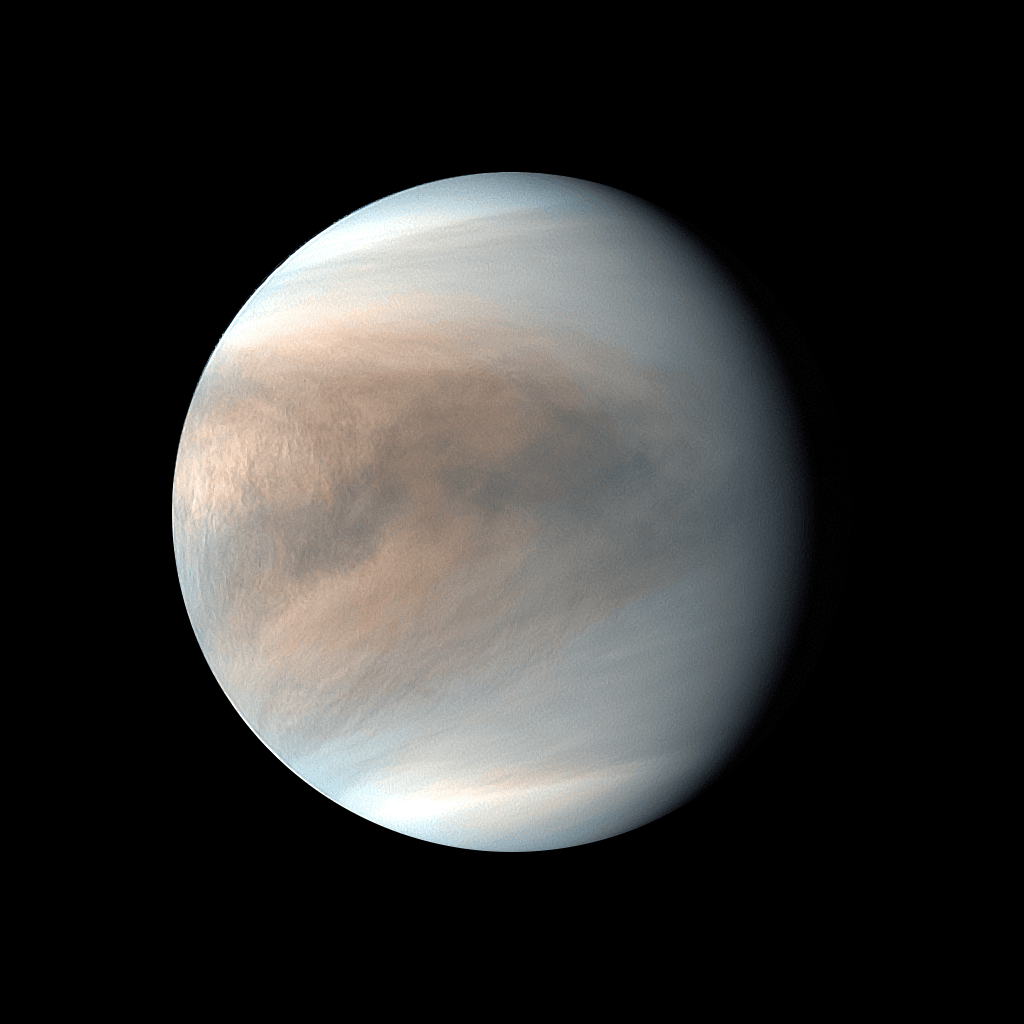
Akatsuki was built to do for Venus what weather satellites do for Earth: watch the atmosphere continuously from orbit and work out the physics that drives it, an aim JAXA describes as founding the field of planetary meteorology. The team set five themes: how the super-rotation works (cloud-top winds that circle the planet in about four days, some 60 times faster than the ground turns), the slow overturning between equator and poles, how the clouds form, whether Venus has lightning, and what the surface emits, including any active volcano. Five cameras (UVI, IR1, IR2, LIR and LAC) watched different heights at once, and an ultra-stable oscillator (USO) turned the radio link into an atmospheric probe. A 2026 ISAS retrospective by Yamazaki Atsushi and Satoh Takehiko calls it the dynamical complement to Europe's Venus Express, whose focus was chemistry.
Japan had looked at Venus before. An ISAS history recalls a group in the late 1970s studying a Venus orbiter and a balloon in the Venus atmosphere as candidates for Japan's first probe beyond Earth's gravity; Halley's comet won instead. The planet returned as PLANET-C, proposed at the ISAS space science symposium in January 2001. The proposal planned a 647 kg orbiter on the solid-fuel M-V rocket in February to April 2007, an Earth swing-by in 2008 and arrival in September 2009, with a plasma package for measuring atmospheric escape as an option that never flew. A project history page by Nakamura Masato (copyright 2008 to 2009) gives the later schedule instead, with observations from December 2010.
The M-V was retired, and in August 2007 the mission moved to the H-IIA. The retrospective says the change came when structural design was nearly finished and that the bigger rocket shook harder than Akatsuki had been built for. Taming the vibration needed about 800 kg of extra mass, supplied by the solar sail demonstrator IKAROS with its adapter, a raising adapter and four small satellites. Akatsuki itself cost about 25 billion yen (about €140 million), which the JST Science Portal says includes the launch.
H-IIA flight 17 lifted off from Tanegashima at 21:58:22 UTC on 20 May 2010 (06:58:22 on 21 May, Japan time). After the second stage's first burn it released three small satellites; after its second burn it set Akatsuki free on the Venus transfer path, about 27 minutes 29 seconds after liftoff, then coasted on and, in the planned order, dropped the PAF900M adapter, IKAROS and the university probe UNITEC-1. The second stage escaped Earth's gravity with them, and Jonathan McDowell's catalogue lists it and the adapter in orbit around the Sun.
IKAROS (Interplanetary Kite-craft Accelerated by Radiation Of the Sun) was a drum 1.6 m across carrying a square sail 14 m on a side and 7.5 microns thick, with thin-film solar cells bonded to it. It weighed 310 kg according to ISAS, or 308 kg including a 16 kg membrane according to the 2025 report, and had its sail unfurled by 9 June 2010. On 15 June (14 June in the 2025 report and McDowell's catalogue) a camera about 6 cm across, DCAM2, sprang off on a spring and radioed back pictures of the whole sail, and DCAM1 followed on 19 June. By mid July JAXA had confirmed acceleration by sunlight and steering with liquid crystal panels on the sail, achievements ISAS describes as world firsts.
IKAROS reached Venus a day after Akatsuki, flying on autonomous sequences because Akatsuki had priority on the ground antennas. Its team blog says it passed about 80,800 km from the planet at 16:39 Japan time on 8 December 2010 (07:39 UTC). The pass was not aimed low for a strong gravity assist, yet Venus still bent the path and raised the craft's speed. Akatsuki, launched onto almost the same orbit, had approached from the sunward side, while IKAROS passed on the side away from the Sun without entering the planet's shadow, so the team concluded that solar sailing had steered it there. Its ALADDIN dust detector counted 2,789 impacts between the orbits of Earth and Venus.
Its attitude propellant was nearly gone by late 2011 (29 November or December, in different JAXA documents), after which the sail slipped into hibernation whenever its angle to the Sun grew too large. It was heard after four hibernations, the last in April and May 2015, each search testing the team's model of how an uncontrolled sail moves; after a fifth began in May 2015 nothing more came. JAXA carried out the transmitter shut-off operation on 15 May 2025 and stopped tracking IKAROS, which McDowell's catalogue lists in orbit around the Sun.
The third traveller was a student project. UNITEC-1, nicknamed Shin-en ('abyss', in Asif Siddiqi's NASA chronicle), was built by the University Space Engineering Consortium (UNISEC), which called it the world's first university-developed deep space satellite. Its archived project page describes a box about 30 by 35 cm with no attitude control, about 25 W of power and a 5.8 GHz amateur-band transmitter. Its main mission was a survival contest between computers from six universities, selected in August 2009, to see which would keep working longest on the way to Venus. The operations plan set arrival for December 2010, 207 days after launch and some 63 million km from Earth.
It went quiet at once. At a JAXA workshop in August 2010, as reported by Mynavi, Kurahara Naomi of the University of Tokyo said signals arrived 45 minutes after separation and from about 270,000 km, beyond the radiation belts, but nothing came on the second pass (16:00 on 22 May to 02:00 on 23 May, Japan time) or afterwards. The team suspected a low battery and unexpected cold. Siddiqi gives the last communication as 15:43 UTC on 21 May at 320,000 km and adds that a beacon was tracked until 31 May, a detail absent from the Japanese accounts. Nobody observed whether Shin-en passed Venus or how close. McDowell's catalogue estimates a pass around 8 December 2010 at about 100,000 km and flags both values as uncertain.
Akatsuki's own arrival went wrong. The insertion burn, VOI-1, on the 500 N class main engine (OME) burning hydrazine with nitrogen tetroxide, began at 08:49 Japan time on 7 December 2010 (23:49 UTC on 6 December). As planned the craft passed behind Venus 103 seconds later, but when it should have reappeared, just after 09:12, there was no signal. NASA's Deep Space Network found a faint signal at Madrid, Goldstone determined an orbit and Usuda reacquired the craft a day later; the retrospective states that without the DSN the whole spacecraft would have been lost. The data showed a large attitude disturbance about 152 seconds into the burn and shutdown at about 158 seconds, against a planned 720 seconds or so. With a fifth of the braking done, Akatsuki swept past Venus at about 550 km (JPL's reconstruction) and into orbit around the Sun.
An investigation for the Space Activities Commission traced the failure through a fault tree to check valve CV-F on the gas line that pressurised the fuel tank. With the valve blocked, fuel pressure fell and the engine ran oxidiser-rich and too hot, and the June 2011 report judged the most likely damage to be a thruster nozzle broken by excessive heat flux, which set the craft turning and made its autonomous control stop the burn. Of 16 candidate causes of the blockage two survived testing: salt, ammonium nitrate, formed where oxidiser and fuel vapour met in the gas line, and contamination caught in the valve. The report also found that design models had underestimated how oxidiser vapour permeates valve seals. JAXA says the lessons shaped the propellant systems of Hayabusa2, SLIM and later craft.
Everything else aboard was healthy, so the team decided to try again. With some fuel already spent, the retrospective says, they chose a path inside Venus's orbit that would let Akatsuki catch the planet up in late 2015. That orbit came within 0.63 AU of the Sun, where heating was three times that at Earth against a design value of two (the retrospective), or about 30 percent above what had been expected at Venus (the 2018 completion review). It survived nine perihelion passages. Main engine test firings in September 2011 failed to give the expected thrust, so from 30 September to 13 October the team dumped about 65 kg of oxidiser, 99 percent of the load, and from 1 to 21 November fired the attitude thrusters at perihelion three times, for 88.6, 90.6 and 63.8 m/s.
The four attitude thrusters together give a little under 20 percent of the main engine's thrust, wrote trajectory designers Ishii Nobuaki and Hirose Chikako, so with the fuel left the far point had to be about 370,000 km. At that size the Sun's tide swings periapsis between about 400 km and 10,000 km every 56 days, a quarter of Venus's year, and a slightly larger swing could drag it to 200 km, where Akatsuki might burn up. The science team wanted an orbit running with the atmosphere's rotation, to slow the clouds' apparent motion. Countless simulations showed that such a retrograde orbit would not fall if the arrival time, height and place balanced the Sun's raising and lowering effects, and the result was designed to stay clear of the atmosphere for more than five years.
The burn was trimmed for safety. The ideal braking was about 202 m/s, which tolerated only 3 percent of excess thrust, so the team asked for 198 m/s, allowing errors from +5 to -10 percent and fixing the burn at 1,228 seconds. A backup burn stood ready to be commanded across the 8.5 minute one-way light time. On 7 December 2015, five years to the day after the first attempt, the four thrusters on the top face fired for the full 1,228 seconds. On 9 December JAXA reported an orbit of 13 days 14 hours between about 400 km and 440,000 km, inclined about 3 degrees to Venus's orbital plane and running with the planet's rotation. ISAS called Akatsuki Japan's first planetary orbiter, and project manager Nakamura Masato later said that when he was sure of success he told the control room, in English, 'Our dreams will come true.'
The orbit cost the science: against the planned 30 hour orbit, the 2025 report says, radio occultations and lightning observations fell to about a tenth. A 15 second burn on 4 April 2016 lengthened the period to 10.8 days, dodging long apoapsis eclipses due in mid 2018 and stretching the possible observing life from about 800 to about 2,000 days; regular science began that month. On 9 December 2016 the electronics shared by the near-infrared cameras began drawing unstable current, and from the next day IR1 and IR2 could not be switched on. JAXA linked the fault to degradation after five unplanned years in a harsher radiation environment.
On arrival day, 7 December 2015, LIR, an uncooled 10 micron camera that reads cloud-top temperature to about 0.3 °C, saw a bow of warmer cloud tops about 10,000 km from north to south that stayed almost in place until 11 December while the 100 m/s winds blew through it. Mapped onto the ground it sat over the western highlands of Aphrodite Terra, which rise to about 5 km, and a simulation showed that a disturbance in the lower atmosphere sends a gravity wave upward that spreads into a bow at about 65 km (Fukuhara and colleagues, Nature Geoscience, 2017). JAXA calls it the largest mountain wave in the solar system. The retrospective adds that such bows grew only in the local afternoon and evening, which standard Venus meteorology struggles to explain.
IR2's single year of night-side images, in which the lower clouds show as silhouettes against heat from below, kept yielding results long after the camera failed. From July 2016 data Horinouchi Takeshi's group found winds at 45 to 60 km forming a jet near the equator, in a layer thought to be uniform and steady (Nature Geoscience, 2017). Kashimura Hiroki's group at Kobe University found planetary-scale streaks in the lower clouds and explained them by simulation as baroclinic instability, the process behind Earth's mid-latitude storms (Nature Communications, 2019). In 2020 Javier Peralta and colleagues reported a sharp cloud discontinuity near 50 km, sometimes more than 7,000 km long, circling the planet in about five days at some 330 km/h, faster than the wind at that height, and present in images back to 1983. In 2026 a study led by Imamura Takeshi explained it as a hydraulic jump, probably triggered by a planet-sized Kelvin wave; that ISAS release gives its length as about 6,000 km.
In 2020 the team reported an answer to the mission's central question. Using UVI cloud-tracked winds and LIR temperatures, Horinouchi and colleagues showed that at low latitudes the thermal tide, a wave raised by daytime heating of the clouds, carries angular momentum toward the equator and keeps the super-rotation going against the slow overturning circulation that would weaken it, while other waves and turbulence push the other way (Science, April 2020). ISAS noted that uncertainties remain, and a 2026 study gives Kelvin waves a part too. In 2021 Fukuya Kiichi, Imamura and colleagues used two years of roughly hourly LIR images to track cloud-top winds by night as well as by day, finding that the night-time north-south flow runs opposite to the daytime flow and settling what ISAS called a 40 year old puzzle (Nature). Radio occultations from Akatsuki and Venus Express, analysed by Ando Hiroki's team, gave temperature profiles from 40 to 85 km across the globe, with the unstable layer deepening toward the poles, the reverse of Earth (Scientific Reports, 2020).
Lightning stayed elusive. LAC, a camera that samples brightness 30,000 times a second, saw no flash from October 2016 to August 2017, although the estimated chance of catching at least one was 35 percent, a null result that prompted a re-evaluation of Venus lightning rates. In March 2020 LAC recorded one natural flash, which the team weighed as lightning, a meteor or something else, and no second one followed. Over eight years, Akatsuki and Venus Express data showed the super-rotation speed and the ultraviolet albedo varying on scales of years to a decade, with a 'brown noise' spectrum lacking a dominant period, which the retrospective reads as a hint that the variation is self-excited by the planet itself. JAXA approved a third extension in April 2024, to March 2029, to gather more than a full solar cycle and separate internal from external causes.
In 2022 a Keio University team led by Fujisawa Yukiko and Sugimoto Norihiko fed cloud-top winds from an intensive campaign in late 2018 into a Venus circulation model, producing what ISAS calls the world's first objective analysis of the Venus atmosphere; the model's overestimated 150 m/s winds settled near 110 m/s. It was opened to all as ALERA-V version 1.0 in May 2026, and the mission's data sit in JAXA's DARTS archive, with radio science to 25 April 2024. Under a NASA and JAXA agreement, eight and then four US participating scientists joined the team, and India's deep space antenna and Germany's Weilheim station gave several tens of percent more occultations than JAXA's Usuda station could have caught alone. In October 2020 Akatsuki joined BepiColombo and the Hisaki telescope in a campaign around one of the Venus flybys.
The end came quietly. In operations at the end of April 2024 a control mode with low attitude precision persisted for a long time, and communication could no longer be established; JPL's trajectory file shows tracking data ending on 26 April. ISAS announced the problem on 29 May 2024, noting that the craft had long outlived its design life of four and a half years. The team searched for about one Venus year, until August 2025, then carried out the shut-off procedure from 09:00 Japan time on 18 September 2025. With the link already dead, the command went out blind, and JAXA reports only that the procedure was carried out.
Where Akatsuki is now is an open question. No deorbit burn was announced, the craft can no longer be commanded, and none of JAXA's end-of-mission documents, the latest dated 13 July 2026, says what its orbit is today, how long that orbit will last, or whether it will eventually enter the atmosphere. JPL Horizons holds a reconstruction fitted to tracking up to 26 April 2024, then an untracked solution to 23 July 2025 and a prediction to 24 August 2025. In the tracked part the lowest periapsis pass comes to about 250 km, on 15 September 2021; in the untracked part the passes fall to about 350 km in May and June 2024 and climb to about 1,100 km by April 2025. The 2018 review found the orbit stable for at least three more years, and the trajectory designers warned of burn-up at 200 km, but none of the sources checked here forecasts the orbit as it stands. McDowell's catalogue, updated 2 November 2026, still lists Akatsuki in Venus orbit: presumed there, silent and untracked.
Much of Akatsuki lives on elsewhere. Its flat slot-array high-gain antenna passed to probes built to save weight, its ISAS digital transponder flew on IKAROS, Hayabusa2 and BepiColombo's Mio and became a deep space standard, and LIR became the TIR camera on Hayabusa2, with descendants on ESA's Hera and RAMSES, according to the 2025 report. A Japanese research group active since the end of 2021 has made crosslink radio occultation, CROVA, the core of a proposed successor in which mother and daughter craft in Venus orbit sound the air between them; JAXA's July 2026 report still lists it as a plan, with no approval or launch date, and the radio science team has proposed Venus occultations from OPENS-0, a Saturn-bound demonstrator that JAXA was still proposing and studying as of December 2025. The JST Science Portal noted in February 2026 that no Venus probe is active; the missions planned next are EnVision, VERITAS, DAVINCI and India's Venus Orbiter Mission.
Mission facts
Organisations
JAXA Institute of Space and Astronautical Science (ISAS) for Akatsuki and IKAROS; the University Space Engineering Consortium (UNISEC) for Shin-en (UNITEC-1)
Akatsuki: names
Akatsuki (Japanese for 'dawn', the hour when Venus shines most beautifully, per JAXA's naming release of 23 October 2009); project name PLANET-C; also called the Venus Climate Orbiter. COSPAR 2010-020D; JPL Horizons and NAIF ID -5.
Akatsuki: launch
21:58:22 UTC on 20 May 2010 (06:58:22 JST on 21 May), H-IIA flight 17 from Tanegashima; separated about 27 min 29 s after liftoff.
Akatsuki: mass (sources differ)
518 kg at launch (JAXA report to MEXT, December 2025); about 520 kg (JAXA release, September 2025); 500 kg including propellant (ISAS mission page); 517.6 kg (Siddiqi); NSSDCA gives 480 kg in its text and 320 kg in its summary box. The 2001 proposal planned about 647 kg wet, 329 kg dry.
Akatsuki: bus and power
Box 1.0 x 1.5 x 1.4 m (JAXA 2025) or 1.04 x 1.45 x 1.40 m (2018 review), two solar paddles of 1.0 x 1.4 m, 5.1 m tip to tip (ISAS). About 500 W at Venus at end of mission (JAXA); NSSDCA's 1.6 x 1.6 x 1.25 m and 'over 1200 W' disagree with both.
Akatsuki: instruments
UVI (283 and 365 nm; NSSDCA prints 263 nm), IR1 (0.90, 0.97, 1.01 microns), IR2 (1.65, 1.735, 2.02, 2.26, 2.32 microns), LIR (10 microns, uncooled bolometer), LAC (lightning and oxygen airglow), and an ultra-stable oscillator (USO) for X-band radio occultation.
Akatsuki: planned orbit
Periapsis 300 km, apoapsis about 80,000 km, period 30 hours, inclination 172 degrees, about two Earth years of observation (2018 review). The 2001 proposal had 300 km by 10 Venus radii and about 21 hours.
Akatsuki: failed insertion (VOI-1)
Burn began 08:49 JST on 7 December 2010 (23:49 UTC on 6 December). A large attitude disturbance came about 152 s in and the engine stopped at about 158 s, against a planned 720 s or so; only about 20 percent of the braking was achieved. JPL's reconstruction puts closest approach at about 550 km.
Akatsuki: cause of the failure
Blockage of check valve CV-F in the gas line pressurising the fuel tank; of 16 candidate causes, salt (ammonium nitrate) formed from oxidiser and fuel vapour, or contamination in the valve, remained. The oxidiser-rich burn most probably broke the thruster nozzle through excessive heat flux (JAXA investigation, June 2011).
Akatsuki: five years around the Sun
Perihelion about 0.63 AU; nine perihelion passages survived. About 65 kg of oxidiser (99 percent of the load) dumped 30 September to 13 October 2011; three perihelion burns on the attitude thrusters, 1 to 21 November 2011 (88.6, 90.6 and 63.8 m/s), set up the 2015 return.
Akatsuki: orbit insertion (VOI-R1)
7 December 2015 (JST): four top-side thrusters fired for 1,228 s. The braking was set at 198 m/s instead of about 202 m/s so that thrust errors of +5 to -10 percent could be tolerated; one-way light time about 8.5 minutes.
Akatsuki: first orbit
Announced 9 December 2015: period about 13 days 14 hours, periapsis about 400 km, apoapsis about 440,000 km, inclination about 3 degrees to Venus's orbital plane, moving in the same direction as Venus's rotation (a retrograde orbit, because Venus spins backwards).
Akatsuki: working orbit
After a 15 s trim on 4 April 2016: apoapsis about 370,000 km, periapsis 1,000 to 10,000 km, period 10.8 days (before: 360,000 km, 10.5 days). JPL's trajectory file shows true periapsis passes as low as about 250 km (15 September 2021, fitted to tracking) and about 350 km (May and June 2024, untracked solution).
Akatsuki: cameras lost
IR1 and IR2 shared electronics that drew unstable current on 9 December 2016; neither camera could be switched on from 10 December. JAXA paused both on 3 March 2017, citing degradation.
Akatsuki: mission phases
Regular operations December 2015 to March 2018; late operations 1 (April 2018 to March 2021) and 2 (April 2021 to March 2024); late operations 3 approved April 2024 for April 2024 to March 2029, cut short the same month.
Akatsuki: end
Contact lost at the end of April 2024 (Horizons: tracking data to 26 April); search for about one Venus year to August 2025; shut-off procedure from 09:00 JST on 18 September 2025. Design life was 4.5 years from launch. JAXA's latest report (13 July 2026) repeats only the summary orbit of its working years, with nothing on where it is now, how long it will stay or its fate.
Akatsuki: cost and output
About 25 billion yen (about €140 million): JAXA's December 2025 report calls it the total development budget, and the JST Science Portal (February 2026) says it includes the launch; 178 papers by October 2025 (ISAS Cosmos blog); 41 master's and 17 doctoral degrees and 19 awards (JAXA, July 2026; its December 2025 report gave 17 awards). Euro amounts on this page are converted at the European Central Bank rate of 5 November 2026 (177.85 yen to the euro).
IKAROS: spacecraft
Drum 1.6 m across and 0.8 m high; square sail about 14 m a side, 20 m across the diagonal, 7.5 microns thick, with thin-film solar cells. 310 kg (ISAS page) or 308 kg including a 16 kg membrane (JAXA, December 2025). Development budget about 1.5 billion yen (about €8.4 million), built in 2.5 years.
IKAROS: Venus flyby
Passed about 80,800 km from Venus at 16:39 JST on 8 December 2010 (07:39 UTC), on the side away from the Sun and outside the planet's shadow; COSPAR 2010-020E.
IKAROS: end
Attitude propellant nearly exhausted late 2011; heard after four hibernations (last in April to May 2015); silent since entering a fifth hibernation in May 2015; shut-off operation 15 May 2025.
Shin-en (UNITEC-1)
University Space Engineering Consortium probe, COSPAR 2010-020F: a box about 30 x 35 cm with a 5.8 GHz amateur-band transmitter and computers from six universities. Mass 15 kg or less (UNISEC), 20 kg (Siddiqi) or 26 kg (McDowell). Its team heard it only on its first day (Siddiqi adds a beacon tracked to 31 May); its planned Venus pass in December 2010 was never observed.
Mission timeline
- Late 1970sAn ISAS group studies a Venus orbiter and a Venus balloon as candidates for Japan's first probe beyond Earth's gravity, then chooses Halley's comet instead.
- Jan 2001PLANET-C proposed at the ISAS space science symposium, for an M-V launch in 2007 and arrival in September 2009.
- Aug 2007The project switches its launch vehicle from the M-V to the H-IIA.
- 20 May 2010H-IIA flight 17 launches Akatsuki, IKAROS and UNITEC-1 (Shin-en) toward Venus at 21:58:22 UTC (06:58:22 on 21 May, Japan time).
- 21 to 22 May 2010Shin-en is heard from about 270,000 km, then falls silent; nothing is received on its second pass.
- May to Jul 2010IKAROS unfurls its sail (26 May to 9 June), photographs it with two free-flying cameras (14 and 19 June; JAXA's 2010 release dates the first pictures 15 June) and proves acceleration by sunlight (9 July).
- 7 Dec 2010VOI-1: Akatsuki's main engine stops after about 158 s of a planned 720 s burn and the craft flies past Venus into solar orbit.
- 8 Dec 2010IKAROS passes Venus at about 80,800 km, at 16:39 JST.
- Sep to Nov 2011Main engine test firings fail; about 65 kg of oxidiser is dumped; three perihelion burns on the attitude thrusters aim Akatsuki at a 2015 reunion.
- 7 Dec 2015VOI-R1: four attitude thrusters fire for 1,228 s and Akatsuki enters Venus orbit (confirmed 9 December).
- 7 Dec 2015LIR images a 10,000 km bow-shaped wave standing over Aphrodite Terra on the first day in orbit.
- 4 Apr 2016A 15 s trim moves Akatsuki to its working orbit of about 10.8 days, ahead of the regular observations JAXA expected from mid April.
- 9 to 10 Dec 2016IR1 and IR2 fail through their shared electronics (pause announced 3 March 2017).
- 24 Apr 2020Horinouchi and colleagues publish in Science that thermal tides maintain the super-rotation at low latitudes.
- End of Apr 2024Contact is lost after a long spell in a control mode with low attitude precision.
- 15 May 2025JAXA carries out IKAROS's shut-off operation, ten years after its last signal.
- 18 Sep 2025JAXA carries out Akatsuki's shut-off procedure from 09:00 JST and ends the mission, 17 months after contact was lost.
- May 2026ALERA-V 1.0, the Akatsuki-based Venus weather analysis, is released (21 May), and the cloud front is explained as a hydraulic jump (26 May).
A filled dot marks something that physically happened. A hollow one marks an announcement, a naming or a target.
In pictures
Tap a photo to enlarge.
Translated from the original sources
Passages from the Japanese sources this page draws on, in azmth's translation. Tap Show original to read the original wording.
JAXA press release: end of Akatsuki operations, 18 September 2025
Japanese · 3 passages
JAXA press release: end of Akatsuki operations, 18 September 2025 (Japanese)
Open the source“From 9 a.m. on 18 September 2025 JAXA carried out the transmitter shut-off procedure for the Venus probe Akatsuki (PLANET-C) and ended the spacecraft's operation.”
azmth's translation · Show originalHide original
Japanese: 宇宙航空研究開発機構(JAXA)は、2025年9月18日午前9時より金星探査機「あかつき」(PLANET-C)の停波作業を実施し、同探査機の運用を終了しました。
“However, in operations at the end of April 2024, starting from a long spell in a control mode with low attitude-keeping precision, communication could no longer be established.”
azmth's translation · Show originalHide original
Japanese: しかし、2024年4月末の運用において、姿勢維持の精度が高くない制御モードが長く続いたことを発端として通信を確立できなくなりました。
“As Japan's first orbiter of a planet other than Earth, Akatsuki observed the Venus atmosphere for more than eight years, producing results in planetary meteorology such as the discovery of the largest mountain wave in the solar system, the explanation of how the super-rotation is maintained, and the introduction of the data assimilation used in Earth meteorology.”
azmth's translation · Show originalHide original
Japanese: 「あかつき」は日本初の地球以外の惑星周回機として、8年間以上にわたり金星大気の観測を継続し、これまで太陽系最大の山岳波の発見や高速大気回転(スーパーローテーション)維持メカニズムの解明、地球の気象学研究で用いられるデータ同化手法の導入など惑星気象学にも関わる科学成果を創出してきました。
ISAS: communication status of Akatsuki, 29 May 2024
Japanese · 1 passage
“The spacecraft has already exceeded its design life of four and a half years after launch and is in its late operations phase; with that in mind we are considering what to do next.”
azmth's translation · Show originalHide original
Japanese: 既に探査機として打上げ後4年半の設計寿命を超えており、後期運用の段階に入っていることも踏まえ、今後の対応について検討しております。
JAXA press release: VOI-1 result, 8 December 2010
Japanese · 1 passage
“The Venus orbit insertion manoeuvre (VOI-1) was carried out from 08:49 on 7 December, but orbit estimation confirmed that the craft could not be put into orbit around Venus.”
azmth's translation · Show originalHide original
Japanese: 金星周回軌道投入マヌーバ(VOI-1)を12月7日8時49分から実施しましたが、軌道推定の結果、金星周回軌道への投入ができなかったことが確認されました。
JAXA investigation report on the VOI-1 failure
Japanese · 4 passages
JAXA investigation report on the VOI-1 failure (part 3), 30 June 2011
Open the source“After a large attitude change about 152 seconds after the start of the burn, the burn stopped at about 158 seconds (it was planned to stop at about 720 seconds).”
azmth's translation · Show originalHide original
Japanese: 燃焼開始後約152秒後の大きな姿勢変動の後,約158秒後に燃焼を停止(予定では約720秒後に燃焼停止)
“From the fault tree analysis, the root cause of the anomaly is estimated to be blockage of check valve CV-F in the gas system piping.”
azmth's translation · Show originalHide original
Japanese: 故障の木解析(FTA)の結果,不具合の根本原因は,ガス系配管の逆止弁CV-Fの閉塞と推定
“Of the 16 candidate causes identified for blocking the check valve, two remained possible: salt formation and contamination caught in the valve.”
azmth's translation · Show originalHide original
Japanese: 逆止弁を閉塞させる原因候補として抽出された16項目について検討を加え,塩の生成とコンタミの噛込みの2項目が原因の可能性として残った.
“Taking these together, we conclude that the effect on the OME was most probably breakage of the thruster nozzle by excessive heat flux (D-1).”
azmth's translation · Show originalHide original
Japanese: これらを総合して,OMEが受けた影響は”熱流束過大によるスラスタノズルの破損”(D-1)である可能性が高いと結論する.
JAXA status report on Akatsuki
Japanese · 2 passages
JAXA status report on Akatsuki (oxidiser dump and perihelion burns), 31 January 2012
Open the source“Detailed analysis of the tank pressure profile and remaining oxidiser showed that about 65 kg of oxidiser, 99 percent of the load, had been dumped.”
azmth's translation · Show originalHide original
Japanese: 探査機のタンク圧力プロファイルと酸化剤残量を詳細に解析した結果,搭載量の99%に相当する約65kgの酸化剤を投棄できたと判断.
“Perihelion orbit control was carried out in three parts (DV#1 to 3) from 1 to 21 November 2011.”
azmth's translation · Show originalHide original
Japanese: 2011年11月1日から21日にわたって,3回に分けて近日点軌道制御(DV#1~3)を実施
Yamazaki and Satoh, Akatsuki retrospective, ISAS, January 2026
Japanese · 11 passages
“It turned out that the thruster nozzle broke during the OME burn, that only about 20 percent of the planned deceleration was achieved so the craft passed Venus, and that there was no immediate way to return it to Venus orbit.”
azmth's translation · Show originalHide original
Japanese: 結果として、OME 噴射中にスラスタノズルが破損し、計画の約 2 割の減速しか達成できず金星を通り過ぎてしまったこと、すぐには金星周回軌道に戻す手立てがないことが判明した。
“Without the support of NASA's DSN, we would have lost the whole spacecraft.”
azmth's translation · Show originalHide original
Japanese: もし、NASA DSN の支援がなければ、探査機全てを失っていただろう。
“It emerged that 800 kg of added mass was needed to ease the vibration conditions, and the small solar power sail demonstrator IKAROS with its mounting adapter, a raising adapter and four small satellites were used to ease them.”
azmth's translation · Show originalHide original
Japanese: 振動条件を緩和するためには 800kg の追加質量が必要であることが判明し、小型ソーラー電力セイル実証機「IKAROS」とその搭載アダプタ、かさ上げアダプタ、4 機の小型衛星が、条件緩和の手段として活用された。
“The retrograde orbit was requested by the science team because making Akatsuki circle in the same direction as Venus's rotation slows its motion relative to the atmosphere and allows more precise observation.”
azmth's translation · Show originalHide original
Japanese: 逆行軌道は、科学チームからの要望で、金星の自転方向と同じ向きに「あかつき」を周回させることで、金星大気との相対運動が遅くなり、より精度が高い観測が可能となるからである。
“But the cruise orbit ran inside Venus's orbit (0.63 AU at closest), so the heat input from the Sun became three times that at Earth's orbit.”
azmth's translation · Show originalHide original
Japanese: ところが、クルージング期の軌道は金星軌道より内側(最も近い時で 0.63AU)を通るため、太陽からの熱入力は地球軌道の 3 倍となった。
“Further, as an important unexpected result, a stationary, giant bow-shaped gravity wave structure about 10,000 km long from north to south was detected in LIR images above Aphrodite Terra.”
azmth's translation · Show originalHide original
Japanese: さらに、想定外の重要な成果として、アフロディーテ大陸上空において、南北方向に約 1 万 km に及ぶ定常的な弓状巨大重力波構造が LIR 画像から検出された。
“A statistical estimate from past occurrence rates, based on the total observing time and area, gave a 35 percent probability that LAC would catch at least one lightning flash.”
azmth's translation · Show originalHide original
Japanese: 過去の発生頻度[5]から観測時間と観測領域の総量に基づいた統計的推定からは、LAC が雷発光を少なくとも 1 度捉えられる確率は 35%であった。
“On theme D, lightning, LAC captured a natural luminous event in the Venus atmosphere in March 2020, and it was examined from many angles, including lightning, a meteor and other light sources.”
azmth's translation · Show originalHide original
Japanese: 課題 D)の雷現象については、2020 年 3 月に LAC 観測により金星大気中の自然発光現象を捉え、雷・流星・その他の発光源を含めた多角的な検討を進めた。
“This suggests that the long-term variation of the Venus atmosphere may be caused by self-excited behaviour of the planet itself.”
azmth's translation · Show originalHide original
Japanese: これは金星大気の長期変動が、惑星自身がもつ自励的な振舞いによって引き起こされている可能性を示唆している。
“For science goals A to C of late operations 3, the aim was to identify the causes of long-term variation through data accumulation and data assimilation, but communication was lost just after the phase began, so it was not achieved.”
azmth's translation · Show originalHide original
Japanese: 後期運用3のフェーズで設定した A)~C)の科学目標に対して、本期間のデータ蓄積とデータ同化手法により、長期変動要因の識別を目標に掲げたが、開始直後通信が途絶したため未達成に終わった。
“Spectral analysis of the variation in the time series gives a spectrum like brown noise, rather than one in which some particular frequency dominates (which would suggest an external cause).”
azmth's translation · Show originalHide original
Japanese: 時系列データの変動をスペクトル解析したところ、どこか特定の周波数が卓越する(外部に要因があることを示唆)のではなく、ブラウンノイズ的なスペクトルが得られている。
JAXA ISAS report to the MEXT space subcommittee on Akatsuki and IKAROS, 16 December 2025
Japanese · 12 passages
“Communication was lost, starting from a long spell in an attitude control mode of low precision. Search operations were carried out for a period of about one Venus year.”
azmth's translation · Show originalHide original
Japanese: 精度が高くない姿勢維持制御モードが長く続いたことを発端として通信途絶。1金星年を目途とする期間の探索運用を実施。
“The frequency of radio occultation and lightning observations fell to about one tenth, so long accumulation became necessary.”
azmth's translation · Show originalHide original
Japanese: 電波掩蔽や雷観測の頻度は1/10程度に減り、長期の積み重ねを要することとなった。
“For Akatsuki radio occultation, drawing on international cooperation built up in the field and with the help of ISRO's deep space station in India (IDSN) and one of Germany's deep space stations (Weilheim), several tens of percent more observations were made than with Usuda alone.”
azmth's translation · Show originalHide original
Japanese: 「あかつき」電波掩蔽では、これまで培ってきた電波掩蔽分野の国際協力体制を活用し、インドISROの深宇宙局(IDSN)とドイツの深宇宙局のひとつ(Weilheim局)の協力を得て、臼田局だけを用いた場合に比べて数割多い観測を実施できた
“After considering various mission forms, the policy of making inter-satellite radio occultation (CROVA) the core was decided.”
azmth's translation · Show originalHide original
Japanese: 様々なミッション形態を検討したうえで、衛星間電波掩蔽(CROVA= Cross-link Radio Occultation of Venus Atmosphere)をコアとする方針を決定。
“In December 2011 IKAROS's propellant was nearly exhausted and attitude control became impossible, so its sun angle grew and it began to go into hibernation mode.”
azmth's translation · Show originalHide original
Japanese: 2011年12月にIKAROSは推薬がほぼ枯渇し、姿勢制御を行うことができなくなったため、太陽角が増大し、冬眠モードに移行するようになった。
“IKAROS was a mission decided in a hurry on the premise of riding with Akatsuki, and had a development period of only 2.5 years, but”
azmth's translation · Show originalHide original
Japanese: IKAROSはあかつきとの相乗りを前提に急遽決まったミッションで、開発期間は2.5年しかなかったが
“Because its specification nearly matched the science need, Akatsuki's uncooled bolometer longwave infrared camera LIR was applied to asteroid exploration and passed on as the TIR camera on Hayabusa2.”
azmth's translation · Show originalHide original
Japanese: 「あかつき」搭載の非冷却ボロメータ型中間赤外カメラ LIR を、その仕様が科学目的とほぼ合致していたため小惑星探査用に適用し、「はやぶさ2」搭載中間赤外カメラ TIR へ継承した。
“Based on the observing technique and international cooperation gained in Akatsuki radio science, radio occultation observations on the outer planet exploration demonstrator OPENS-0 have been proposed.”
azmth's translation · Show originalHide original
Japanese: あかつき電波科学で獲得した観測技術と国際協力体制をもとに、外惑星探査実証機OPENS-0における電波掩蔽観測を提案。
“So the policy was changed to apply the solar power sail to small-class missions, and the OPENS programme is being proposed and studied.”
azmth's translation · Show originalHide original
Japanese: そこで、ソーラー電力セイルを小型計画に適用する方針に変更し、OPENSプログラムを提案・検討中。
“NASA and JAXA exchanged a letter of agreement, and Participating Scientists selected in the United States were accepted as Akatsuki science members (first round 8, second round 4).”
azmth's translation · Show originalHide original
Japanese: NASAとJAXAはLoAを交わし、米国内で選抜されたParticipating Scientistsをあかつきサイエンスメンバーとして受入(第1期:8名、第2期:4名)。
“Compared with a parabolic antenna it has the advantages of being light and collecting little heat. It has been passed on to probes that aim to save weight.”
azmth's translation · Show originalHide original
Japanese: パラボラアンテナと比較して、軽量であり熱を集めにくいという利点がある。軽量化を狙う探査機へ継承されている。
“This transponder was also passed on to IKAROS, Hayabusa2 and BepiColombo/MMO (Mio) and became a standard for deep space probes, and its next-generation version was adopted for DESTINY+.”
azmth's translation · Show originalHide original
Japanese: このトランスポンダは、「IKAROS」、「はやぶさ2」、 「BepiColombo/MMO(みお)」へも継承され深宇宙探査機のスタンダードとなり、次世代版に発展しDESTINY+に採用された。
Akatsuki project completion review, MEXT, 2018
Japanese · 2 passages
“Orbit analysis that takes account of perturbations such as solar gravity and atmospheric drag has confirmed that a stable orbit can be maintained over the next several years (three years or more).”
azmth's translation · Show originalHide original
Japanese: また太陽重力や大気抵抗などの摂動を考慮した軌道解析を行った結果、今後数年(3年以上)に渡り、安定な軌道が維持できることを確認済みである。
“In the new solar orbit the heat input at perihelion was 30 percent above the value expected at Venus”
azmth's translation · Show originalHide original
Japanese: 新たな太陽周回軌道では近日点での熱入力が金星で想定されていた値の三割増しであり
JAXA press release: Venus orbit insertion result, 9 December 2015
Japanese · 1 passage
“Measurement and calculation of the orbit after the attitude thruster burn show that Akatsuki circles Venus every 13 days 14 hours or so, in an ellipse about 400 km up at its closest (periapsis) and about 440,000 km at its farthest (apoapsis), in the same direction as Venus's rotation.”
azmth's translation · Show originalHide original
Japanese: 姿勢制御用エンジン噴射後の探査機軌道の計測と計算の結果、「あかつき」は、金星周回周期約13日14時間、金星に最も近いところ(近金点)では高度約400km、金星から最も遠いところ(遠金点)では高度約44万kmの楕円軌道を、金星の自転と同じ方向に周回していることがわかりました。
Ishii and Hirose, ISAS feature: preparing the orbit insertion
Japanese · 4 passages
“Even all four RCS thrusters together give a little under 20 percent of the OME's thrust.”
azmth's translation · Show originalHide original
Japanese: RCSは4基を合計しても、OMEと比較すると2割弱の推力です。
“If periapsis falls to 200 km altitude, the Venus atmosphere could cause Akatsuki to burn up.”
azmth's translation · Show originalHide original
Japanese: 高度200kmまで下がると金星大気の影響で、「あかつき」が大気中で燃え尽きる可能性が出てきます。
“We were able to propose an orbit that would not fall into the Venus atmosphere for more than five years.”
azmth's translation · Show originalHide original
Japanese: 5年以上金星大気に落下しない軌道を提案することができました。
“The four RCS thrusters kept firing for 1,228 seconds as planned, and VOI-R1 succeeded.”
azmth's translation · Show originalHide original
Japanese: 4基のRCSは計画通り1,228秒間の噴射を継続し、VOI-R1は成功しました。
ISAS: orbit correction result, 8 April 2016
Japanese · 1 passage
“Apoapsis 370,000 km, periapsis 1,000 to 10,000 km, period 10.8 days (orbit before the correction: apoapsis 360,000 km, periapsis 1,000 to 10,000 km, period 10.5 days).”
azmth's translation · Show originalHide original
Japanese: 遠金点37万km、近金点1000-10000km、周期10.8日 (修正前の軌道:遠金点36万km、近金点1000-10000km、周期10.5日)
ISAS: IR1 and IR2 observations paused, 3 March 2017
Japanese · 2 passages
“On 9 December 2016 the current shown by the unit controlling the two cameras became unstable, and in the visible pass on 10 December neither camera could be switched on.”
azmth's translation · Show originalHide original
Japanese: 平成28(2016)年12月9日に2つのカメラを制御する機器が示す電流値が不安定になり、翌12月10日の可視運用では両カメラのスイッチを入れることができなくなりました。
“After successfully entering Venus orbit in December 2015, Akatsuki began full-scale observations in April 2016.”
azmth's translation · Show originalHide original
Japanese: 平成27(2015)年12月に金星周回軌道への投入に成功後、「あかつき」は平成28(2016)年4月から本格観測を開始しました。
Akatsuki project site: orbit information gallery
Japanese · 1 passage
“Orbit data from November 2021 onward are based on planned values (as of November 2021).”
azmth's translation · Show originalHide original
Japanese: 2021年11月以降の軌道データは計画値に基づいたものです。(2021年11月現在)
ISAS: giant bow-shaped wave explained, 17 January 2017
Japanese · 1 passage
“In December 2015 the longwave infrared camera (LIR) on Akatsuki discovered a bow-shaped pattern about 10,000 km long from north to south.”
azmth's translation · Show originalHide original
Japanese: 金星探査機「あかつき」に搭載された中間赤外カメラ(LIR)は2015年12月、南北方向に約10,000kmにおよぶ弓状の模様を発見しました。
ISAS: equatorial jet discovered, 29 August 2017
Japanese · 1 passage
“It was found that at one point in 2016 the flow in the middle and lower cloud region (45 to 60 km) took the form of a jet with its axis near the equator, and it was named the equatorial jet.”
azmth's translation · Show originalHide original
Japanese: 2016年のある時期に、中・下層雲領域(高度45-60km)の風の流れが赤道付近に軸をもつジェット (※1) 状になっていたことがわかり、これを赤道ジェットと命名しました。
ISAS: planetary-scale streaks in the clouds, 9 January 2019
Japanese · 1 passage
“A group led by Assistant Professor Kashimura Hiroki of Kobe University discovered, in observations by the Japanese Venus probe Akatsuki, a giant streak structure in the clouds covering Venus.”
azmth's translation · Show originalHide original
Japanese: 神戸大学大学院理学研究科の樫村博基助教ら研究グループは、日本の金星探査機「あかつき ※1 」による観測で、金星を覆う雲のなかに巨大な筋状構造を発見しました。
ISAS: mechanism maintaining the super-rotation, 24 April 2020
Japanese · 2 passages
“Detailed analysis of images and temperature data from Akatsuki has now shown that the acceleration mechanism is the thermal tide.”
azmth's translation · Show originalHide original
Japanese: 今回、「あかつき」で得られた画像と温度データの詳細な分析より、この加速機構を担うのが、「熱潮汐波」であることが明らかになりました。
“Observation has its limits and uncertainties remain, but the research group considers the fundamentals unshakeable.”
azmth's translation · Show originalHide original
Japanese: 観測には限度があり、不確定要素は残りますが、研究グループでは基本的なところは揺るがないと考えています。
ISAS: night-side circulation, 22 July 2021
Japanese · 1 passage
“What flow pattern arises at the Venus cloud tops at night had been a 40 year old puzzle. It has now been found that at night the north-south wind runs opposite to the daytime direction (Fig. 2).”
azmth's translation · Show originalHide original
Japanese: 金星の雲頂に夜間、どのような流れのパターンが生じるのかは40年来の謎だった。今回、夜間には昼間とは逆方向の南北風が生じることが判明した(図2)。
ISAS: giant cloud discontinuity, 5 August 2020
Japanese · 2 passages
“The cloud discontinuity straddles the Venus equator and at times grows to more than 7,000 km, reaching about 30 degrees of latitude north and south.”
azmth's translation · Show originalHide original
Japanese: 「雲の不連続面」は金星赤道をはさみ、時に南北の緯度およそ30度まで7000 km以上に及ぶほど大きく発達します。
“On cloud-covered Venus, a giant cloud discontinuity has been found racing around at about 330 km/h near 50 km above the ground.”
azmth's translation · Show originalHide original
Japanese: 雲が全球を覆う金星において、巨大な「雲の不連続面」が地面から高度50km付近を時速約330kmの速さで駆け巡っていることがわかりました。
ISAS: the cloud front is a hydraulic jump, 26 May 2026
Japanese · 2 passages
“Investigation by the Venus probe Akatsuki discovered a cloud discontinuity line stretching about 6,000 km north to south, but its cause had remained a mystery.”
azmth's translation · Show originalHide original
Japanese: 金星探査機「あかつき」 (注1) の調査によって南北約6000kmにわたる雲の不連続線が発見されましたが、その成因は謎とされてきました。
“As the mechanism of the super-rotation, attention has focused on the work of a different kind of atmospheric wave, the thermal tide, based on Akatsuki's observations, but a role for the Kelvin wave has now emerged too.”
azmth's translation · Show originalHide original
Japanese: 超回転のメカニズムとして、金星探査機「あかつき」による観測をもとに熱潮汐波という別種の大気波動の働きが注目されてきましたが、ケルビン波の役割も浮上してきました。
ISAS: thermal structure from radio occultation, 27 February 2020
Japanese · 1 passage
“A team led by Ando Hiroki (Kyoto Sangyo University) used Akatsuki to obtain, for the first time in the world, vertical temperature profiles of Venus from 40 to 85 km altitude over the whole globe.”
azmth's translation · Show originalHide original
Japanese: 安藤紘基(京都産業大学)率いる研究チームは、金星探査機「あかつき」を用い、世界で初めて金星の高度40kmから高度85kmにおける気温の高度分布を全球的に取得することに成功しました。
ISAS: first Venus weather dataset, 12 September 2022
Japanese · 1 passage
“By adding observations from JAXA's Venus probe Akatsuki to a data assimilation system for the Venus atmosphere, the team succeeded in making the world's first objective analysis data (weather dataset) of the Venus atmosphere.”
azmth's translation · Show originalHide original
Japanese: 金星大気に対するデータ同化 (※1) システムに、宇宙航空研究開発機構(JAXA)の金星探査機「あかつき」 (※2) から得られる観測データを加えることで、世界で初めての金星大気の客観解析データ(気象データセット) (※3) を作成することに成功しました。
ISAS: ALERA-V released, 21 May 2026
Japanese · 1 passage
“World-first open data: ALERA-V version 1.0, the world's first objective analysis dataset of the Venus atmosphere, fusing Akatsuki observations with numerical simulation, has been released to the public.”
azmth's translation · Show originalHide original
Japanese: 世界初のオープンデータ化:金星探査機「あかつき」の観測データと数値シミュレーションを融合した、世界初の金星大気客観解析データセット「ALERA-V version 1.0」を一般公開しました。
ISAS Cosmos blog: our last presence at Venus has gone silent, 28 October 2025
Japanese · 1 passage
“So far 178 scientific papers have been published on the Akatsuki mission itself and using its data, and more results are expected.”
azmth's translation · Show originalHide original
Japanese: これまでに「あかつき」ミッションそのものについての、および、その観測データを用いた学術論文は178本発表されており、今後もさらなる成果が期待されています。
JST Science Portal: farewell Akatsuki, 25 February 2026
Japanese · 4 passages
“JAXA project manager Nakamura Masato (as he then was) is said to have told those around him in the control room, in English, 'Our dreams will come true', when he became sure of success.”
azmth's translation · Show originalHide original
Japanese: JAXAの中村正人プロジェクトマネージャ(当時)は管制室で成功を確信した時、英語で「Our dreams will come true(アワ・ドリームズ・ウィル・カム・トゥルー、われわれの夢がかなう)」と周囲に語ったという。
“The development cost, including the launch, was about 25 billion yen.”
azmth's translation · Show originalHide original
Japanese: 開発費は打ち上げ費用を含め約250億円。
“There is no active Venus probe, but there seems to be reason for hope in what comes next.”
azmth's translation · Show originalHide original
Japanese: 現役の金星探査機はないが、今後に期待が持てそうだ。
“It was because fuel vapour and oxidiser vapour reacted to form ammonium nitrate, which clogged a valve in the fuel piping.”
azmth's translation · Show originalHide original
Japanese: 燃料の蒸気と酸化剤の蒸気が反応してしまい硝酸アンモニウムができ、これが燃料配管の弁を詰まらせたためだった。
ISAS history: Japan's escape plan
Japanese · 1 passage
ISAS history: Japan's escape plan (late 1970s)
Open the source“They had studied missions such as a Venus orbiter and floating a balloon in the Venus atmosphere, but these tended to lack a certain punch.”
azmth's translation · Show originalHide original
Japanese: 金星オービターや金星大気にバルーンを浮かべるミッションなどを検討したことはあったが、今ひとつ迫力に欠けるきらいがあった。
PLANET-C proposal, January 2001
Japanese · 2 passages
PLANET-C proposal, January 2001 (Wayback copy)
Open the source“After launch the orbiter is placed in a phasing orbit around Earth, leaves Earth in June 2007, and after an Earth swing-by in 2008 enters Venus orbit in September 2009.”
azmth's translation · Show originalHide original
Japanese: オービターは打ち上げ後地球をめぐる Phasing Orbit に投入され 2007 年 6 月に地球を離脱、2008 年の地球スイングバイを経て 2009 年 9 月に金星周回軌道に入る。
“Further, as an option to enrich the orbiter's science, carrying a plasma measurement package is being considered, to clarify the mechanism of atmospheric escape that matters for the evolution of the Venus atmosphere.”
azmth's translation · Show originalHide original
Japanese: さらに金星オービターによるサイエンスをより豊かにするオプションとしてプラズマ測定パッケージを搭載し、金星大気の変遷にとって重要な大気散逸のメカニズムを解明する事を考慮している。
Akatsuki project site: history of the PLANET-C mission
Japanese · 1 passage
“The proposed mission was to send a probe to Venus on the M-V rocket and to observe the Venus atmosphere from orbit for two years or more from December 2010.”
azmth's translation · Show originalHide original
Japanese: 提案されたミッションは金星へM-Vロケットを使って探査機を送り込み、 2010年12月から2年以上にわたって金星の周回軌道から金星大気の観測を行うというものです。
JAXA press release: naming of the Venus probe PLANET-C, 23 October 2009
Japanese · 1 passage
“Akatsuki (dawn) means the time just before sunrise when the eastern sky begins to whiten, the hour when Venus shines most beautifully.”
azmth's translation · Show originalHide original
Japanese: 「あかつき(暁)」とは、日の出直前の東の空が白み始める頃を指し、金星が最も美しく輝く時間です。
JAXA: H-IIA F17 launch result, 21 May 2010
Japanese · 1 passage
“Flight 17 flew normally, and separation of Akatsuki about 27 minutes 29 seconds after liftoff was confirmed.”
azmth's translation · Show originalHide original
Japanese: 17号機は正常に飛行し、打上げ後約27分29秒に「あかつき」を分離した事を確認しました。
JAXA: H-IIA F17 piggyback payloads and separation order
Japanese · 1 passage
“Then, after the second burn of the second stage engine, Akatsuki is separated on the Venus transfer orbit. The rocket then coasts on and separates the PAF900M (Akatsuki separation unit), IKAROS and UNITEC-1 in turn.”
azmth's translation · Show originalHide original
Japanese: その後、第2段エンジン第2回目の燃焼後に金星遷移軌道上であかつきを分離します。さらに、ロケットは慣性飛行を続け、PAF900M(あかつき分離部)、IKAROS、UNITEC-1を順次分離します。
ISAS mission page: IKAROS
Japanese · 1 passage
“It also demonstrated that it was being accelerated by the force of sunlight while controlling its orbit by adjusting the sail's orientation with liquid crystal devices and other means, acquiring solar sail navigation technology. All of these were world firsts.”
azmth's translation · Show originalHide original
Japanese: さらに、太陽の光の力により加速していることを実証すると同時に、液晶デバイス等によってセイルの向きを調整することで軌道制御を行い、ソーラーセイルによる航行技術を獲得しました。これらはいずれも世界初の快挙です。
JAXA press release: IKAROS separation camera photographs the deployed sail, 16 June 2010
Japanese · 1 passage
“On 15 June the separation camera succeeded in photographing the whole of the deployed sail.”
azmth's translation · Show originalHide original
Japanese: 6月15日に分離カメラ※によって、展開後のセイル全景の撮影に成功しました。
IKAROS blog: Venus pass, 10 December 2010
Japanese · 1 passage
“IKAROS passed Venus at a distance of about 80,800 km at 16:39 Japan Standard Time on 8 December.”
azmth's translation · Show originalHide original
Japanese: IKAROSは12月8日日本標準時16:39に,金星距離約80800kmを通過しました.
IKAROS blog: flyby geometry, 12 December 2010
Japanese · 1 passage
“IKAROS passed Venus on the side opposite the Sun. Akatsuki, launched onto almost the same orbit, approached Venus from the sunward side, so IKAROS was guided to the far side of Venus by solar sailing.”
azmth's translation · Show originalHide original
Japanese: IKAROSは金星に対して太陽とは反対側を通過しました.ほぼ同じ軌道に打ち上げられた あかつきは金星に太陽側から接近しましたから,IKAROSはソーラーセイリングによって 金星の反対側に誘導されたことになります.
IKAROS blog: daily report, 26 November 2010
Japanese · 1 passage
“Especially around arrival at Venus, Akatsuki's operations take priority, so IKAROS will cruise making full use of its autonomous functions.”
azmth's translation · Show originalHide original
Japanese: 特に金星到着前後は,あかつきの運用が優先されるため, IKAROSは,自律機能を駆使して,クルージングを行います.
ISAS: end of IKAROS operations, 15 May 2025
Japanese · 1 passage
“On 15 May 2025 JAXA carried out the transmitter shut-off operation for the small solar power sail demonstrator IKAROS and finished its search operations. IKAROS will no longer be tracked, and all operations are over.”
azmth's translation · Show originalHide original
Japanese: 国立研究開発法人宇宙航空研究開発機構(JAXA)は、2025年5月15日に小型ソーラー電力セイル実証機「IKAROS」の停波運用を行い、探索運用を終えました。今後は「IKAROS」の追跡業務は行わず、すべての運用は終了となります。
UNISEC: about UNITEC-1
Japanese · 1 passage
UNISEC: about UNITEC-1 (Wayback copy, 2011)
Open the source“UNITEC-1, riding with JAXA's Planet-C, is the world's first university-developed deep space satellite, to leave Earth's gravitational sphere on an H-II rocket and be sent toward Venus.”
azmth's translation · Show originalHide original
Japanese: UNITEC-1はJAXAのPlanet-Cという衛星の相乗りとして、H-IIロケットにより地球重力圏を離れ、金星に向かって打ち出される世界初の大学開発の深宇宙衛星です。
UNISEC: UNITEC-1 operations plan
Japanese · 1 passage
UNISEC: UNITEC-1 operations plan (Wayback copy)
Open the source“Arrival at Venus is planned for December 2010.”
azmth's translation · Show originalHide original
Japanese: 金星到着は 2010 年 12 月の予定である。
Mynavi: JAXA piggyback satellite workshop report, 2 August 2010
Japanese · 3 passages
“After launch, communication started reasonably well, with a signal received 45 minutes after separation.”
azmth's translation · Show originalHide original
Japanese: 打ち上げ後の通信状況は、衛星分離から45分後に電波受信に成功とまずます。
“The signal on the second pass (16:00 on 22 May to 02:00 on 23 May) could not be received, and reception has remained impossible since.”
azmth's translation · Show originalHide original
Japanese: 2回目のパス(5月22日16時~23日2時)の信号を受信できず、それ以降、信号受信が出来ない状態が継続しているという。
“However, a signal transmitted from around 270,000 km, near the Moon, was received, so it should be safe to take it as fact that vacuum discharge and the Van Allen belts were cleared.”
azmth's translation · Show originalHide original
Japanese: ただし、月近くの27万km付近からの送信電波を受信することには成功したとのことで、真空放電やバンアレン帯をクリアしたことは事実としてとらえて良いはず
JAXA ISAS: results of the Venus probe Akatsuki, report to the Cabinet Office's subcommittee on space science and exploration, 13 July 2026
Japanese · 4 passages
“On 18 September 2025 the transmitter shut-off operation for Akatsuki was carried out, and its operation ended.”
azmth's translation · Show originalHide original
Japanese: 2025年9月18日に「あかつき」の停波運用を実施し、運用終了となった。
“Received 19 awards, beginning with the fiscal 2017 Prize for Science and Technology (research category) of the Minister of Education, Culture, Sports, Science and Technology.”
azmth's translation · Show originalHide original
Japanese: 平成29年度文部科学大臣表彰 科学技術賞(研究部門)をはじめとする19個の賞を受賞
“Akatsuki successor (plan): CROVA”
azmth's translation · Show originalHide original
Japanese: あかつき後継機(案):CROVA
“On 7 December 2015, just after the success of VOI-R1, a giant bow-shaped structure was caught in the map of Venus cloud-top temperature taken by LIR. It was seen continuously until 11 December, but had vanished by January the next year.”
azmth's translation · Show originalHide original
Japanese: 2015年12月7日、VOI-R1成功直後にLIRが取得した金星雲頂の温度マップに、巨大な弓状構造が捉えられた。12月11日まで継続的に見られたが、翌年1月には消失していた。
ISAS mission page: Akatsuki
Japanese · 1 passage
“It also follows the light and dark patterns made when solar ultraviolet is scattered by the Venus clouds to obtain the wind field at cloud-top height. Wavelengths 283 nm and 365 nm.”
azmth's translation · Show originalHide original
Japanese: また太陽光に含まれる紫外線が金星の雲で散乱される際の濃淡の模様を追いかけることで、雲頂高度での風速分布を調べる。観測波長は283nm、365nm。
DARTS: Akatsuki science data archive
Japanese · 1 passage
“This release contains radio science data acquired from 2023-02-07 to 2024-04-25.”
azmth's translation · Show originalHide original
Japanese: 今回のリリースは2023-02-07から2024-04-25までに取得された電波科学データを含みます。
Sources
- JAXA press release: end of Akatsuki operations, 18 September 2025 (Japanese) · in Japanese
- JAXA press release: end of Akatsuki operations, 18 September 2025 (English)
- Yamazaki and Satoh, Akatsuki retrospective, ISAS, January 2026 · in Japanese
- JAXA ISAS report to the MEXT space subcommittee on Akatsuki and IKAROS, 16 December 2025 · in Japanese
- JAXA ISAS: results of the Venus probe Akatsuki, report to the Cabinet Office's subcommittee on space science and exploration, 13 July 2026 · in Japanese
- Akatsuki project completion review, MEXT, 2018 · in Japanese
- ISAS mission page: Akatsuki · in Japanese
- JAXA investigation report on the VOI-1 failure (part 3), 30 June 2011 · in Japanese
- JAXA status report on Akatsuki (oxidiser dump and perihelion burns), 31 January 2012 · in Japanese
- JAXA press release: VOI-1 result, 8 December 2010 · in Japanese
- JAXA press release: Venus orbit insertion result, 9 December 2015 · in Japanese
- Ishii and Hirose, ISAS feature: preparing the orbit insertion · in Japanese
- ISAS: orbit correction result, 8 April 2016 · in Japanese
- ISAS: IR1 and IR2 observations paused, 3 March 2017 · in Japanese
- ISAS: communication status of Akatsuki, 29 May 2024 · in Japanese
- ISAS: giant bow-shaped wave explained, 17 January 2017 · in Japanese
- ISAS: equatorial jet discovered, 29 August 2017 · in Japanese
- ISAS: planetary-scale streaks in the clouds, 9 January 2019 · in Japanese
- ISAS: thermal structure from radio occultation, 27 February 2020 · in Japanese
- ISAS: mechanism maintaining the super-rotation, 24 April 2020 · in Japanese
- ISAS: giant cloud discontinuity, 5 August 2020 · in Japanese
- ISAS: night-side circulation, 22 July 2021 · in Japanese
- ISAS: first Venus weather dataset, 12 September 2022 · in Japanese
- ISAS: ALERA-V released, 21 May 2026 · in Japanese
- ISAS: the cloud front is a hydraulic jump, 26 May 2026 · in Japanese
- ISAS Cosmos blog: our last presence at Venus has gone silent, 28 October 2025 · in Japanese
- JST Science Portal: farewell Akatsuki, 25 February 2026 · in Japanese
- PLANET-C proposal, January 2001 (Wayback copy) · in Japanese
- Akatsuki project site: history of the PLANET-C mission · in Japanese
- Akatsuki project site: orbit information gallery · in Japanese
- ISAS history: Japan's escape plan (late 1970s) · in Japanese
- JAXA press release: naming of the Venus probe PLANET-C, 23 October 2009 · in Japanese
- JAXA: H-IIA F17 launch result, 21 May 2010 · in Japanese
- JAXA: H-IIA F17 piggyback payloads and separation order · in Japanese
- ISAS mission page: IKAROS · in Japanese
- ISAS: end of IKAROS operations, 15 May 2025 · in Japanese
- IKAROS blog: daily report, 26 November 2010 · in Japanese
- IKAROS blog: Venus pass, 10 December 2010 · in Japanese
- IKAROS blog: flyby geometry, 12 December 2010 · in Japanese
- JAXA press release: IKAROS separation camera photographs the deployed sail, 16 June 2010 · in Japanese
- JAXA: IKAROS separation camera images, 16 June 2010 (English)
- UNISEC: about UNITEC-1 (Wayback copy, 2011) · in Japanese
- UNISEC: UNITEC-1 operations plan (Wayback copy) · in Japanese
- Mynavi: JAXA piggyback satellite workshop report, 2 August 2010 · in Japanese
- Asif Siddiqi, Beyond Earth: A Chronicle of Deep Space Exploration, 1958 to 2016 (NASA SP-2018-4041)
- JPL Horizons: Akatsuki / Planet-C (-5) object data
- NSSDCA: Akatsuki record (Wayback capture of 20 September 2026, raw view)
- Jonathan McDowell, GCAT lunar and planetary catalogue (updated 2 November 2026)
- Jonathan McDowell, GCAT heliocentric catalogue (updated 2 November 2026)
- DARTS: Akatsuki science data archive · in Japanese
- Fukuhara et al., 'Large stationary gravity wave in the atmosphere of Venus', Nature Geoscience, 2017 (abstract)
- Horinouchi et al., 'How waves and turbulence maintain the super-rotation of Venus' atmosphere', Science, 2020 (abstract via Europe PMC)
- Fukuya et al., 'The nightside cloud-top circulation of the atmosphere of Venus', Nature, 2021 (abstract via Europe PMC)
- Ando et al., 'Thermal structure of the Venusian atmosphere from the sub-cloud region to the mesosphere as observed by radio occultation', Scientific Reports, 2020 (abstract via Europe PMC)
- European Central Bank: euro reference rate for the Japanese yen (5 Nov 2026: 177.85 yen to the euro), used for the euro amounts on this page
Facts on this page were verified on 4 November 2026. Where sources disagree, the disagreement is stated rather than resolved silently.
azmth is independent and is not affiliated with or endorsed by NASA, Roscosmos, NPO Lavochkin, ESA, JAXA, ISRO, CNSA, or any other space agency or company named on this page.