Volcanoes on Venus
Is Venus still erupting? The evidence from sulfur dioxide, infrared hotspots and changing Magellan radar images, and the argument over its young surface.
TL;DR· 21 min read
Venus is covered in lava plains and about 85,000 mapped volcanoes, and it is probably still volcanically active, though no eruption has been seen as it happened. The case rests on swings of sulfur dioxide above the clouds, fresh-looking lava seen in infrared, short-lived hotspots along the Ganis Chasma rift in 2008, and radar images from 1990 to 1992 that changed at Maat Mons, Sif Mons and Niobe Planitia. Scientists still argue over how the young surface formed and what the folded highlands called tesserae are made of.
Are there active volcanoes on Venus?
Venus is a volcanic world, and it is probably still erupting today, but no eruption has yet been seen as it happened. Lava flows cover at least 85 percent of the surface, and some 85,000 volcanoes have been mapped on it. Since 1984 scientists have gathered clues to present-day activity: swings of sulfur dioxide above the clouds, lava that looks too fresh to have weathered, hotspots that flared and faded along a rift in 2008, and three places where Magellan's radar images changed between 1990 and 1992. Each clue has another possible explanation, and two of the radar changes were challenged in April 2026. This page also covers how the whole surface came to look so young, the folded highlands called tesserae, and a lava tube reported under the plains near Nyx Mons in February 2026.
- about 85,000volcanic edifices catalogued in Magellan radar mosaics (Hahn and Byrne, 2023), about 99 percent of them under 5 km across
- 3places where Magellan images changed between 1990 and 1992 in ways read as fresh lava: Maat Mons, Sif Mons and western Niobe Planitia, the last two disputed since April 2026
- 0eruptions seen as they happened; no spacecraft has worked in orbit around Venus since Akatsuki fell silent in April 2024 (JAXA ended the mission on 18 September 2025)
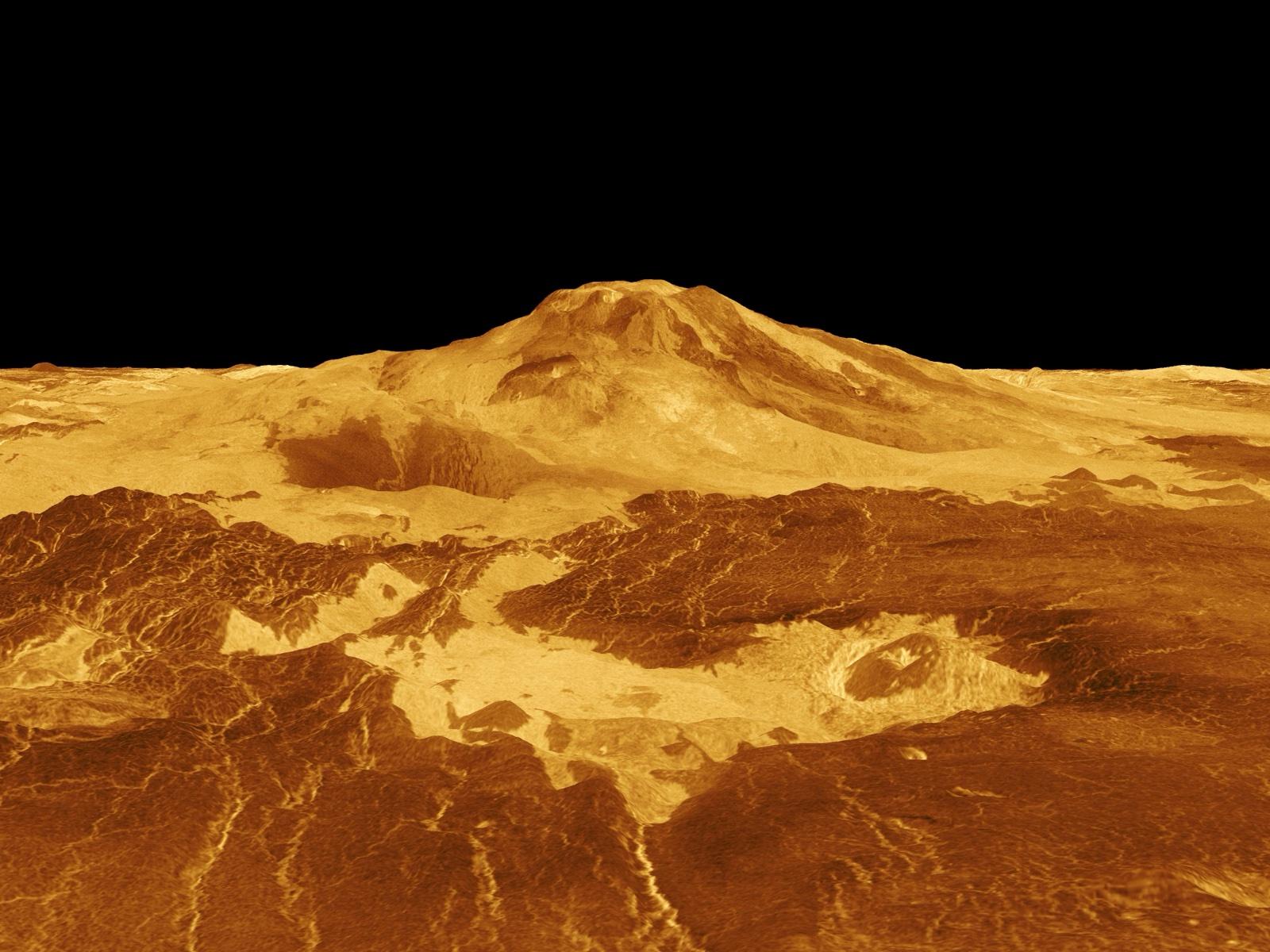
Venus wears its volcanism on the outside. NASA's summary of the Magellan radar results counts at least 85 percent of the surface as volcanic flows and the rest as highly deformed mountain belts, with no sign of Earth-style plate tectonics, and with no water to wear it down, a lava flow there can keep its shape for hundreds of millions of years. Combing Magellan's global mosaics, Rebecca Hahn and Paul Byrne catalogued about 85,000 volcanic edifices in 2023, some 99 percent of them less than 5 km across. Alexander Basilevsky of the Vernadsky Institute and Wojciech Markiewicz of the Max Planck Institute for Solar System Research (MPS) cite a geological map on which volcanic plains alone cover about 70 percent of the planet. Why expect any of this? Volcanism, the two write, is how a planet sheds surplus heat, and a world almost as large and dense as Earth stored comparable heat when it formed and keeps making more from radioactive potassium, thorium and uranium.
Soviet landers brought rock chemistry into the question. On 22 October 1975 Venera 9 sent back a view of a field of fairly large stones, and NPO Lavochkin drew a bold conclusion: a surface like that cannot be older than about a million to ten million years, so Venus is geologically active. Radioactive-element readings at the Venera 9 and 10 sites matched basalt. At the Venera 13 site the soil sampler found rock close to potassium-rich alkaline basalt, while Venera 14 found far less of the alkali elements. The older Venera 8 result is harder to place: NPO Lavochkin likens its potassium, uranium and thorium to terrestrial granites, while Basilevsky and Markiewicz call the same concentrations slightly above typical basalt and suggest the probe sampled one of the steep-sided domes thought to be made of stickier, non-basaltic lava.
Radar gave the planet a geography. Venera 15 made its first radar survey of the surface on 16 October 1983 and, with Venera 16, mapped the north of the planet into 1984. NPO Lavochkin lists small volcanoes on the plains and enormous ones on the Lakshmi plateau, the caldera Colette with radiating frozen lava flows, a lava flow 300 km long, rings 150 to 600 km across that it calls ovoids, and a terrain it names 'parquet'. O. N. Rzhiga's 1988 book counts cone-shaped volcanoes ten times more common on the plains of Venus than on Earth and records the names that stuck. The rings' Russian name means crown; in English they are coronae. The ridged, criss-crossed ground, which Rzhiga describes as found on no other planet, became tessera, from the Greek for tile.
Magellan, which mapped 98 percent of the surface between 1990 and 1992, showed the volcanoes in detail. Maat Mons, a broad shield, is 395 km across in the IAU gazetteer, centred at 0.5 degrees north, 194.6 degrees east in Atla Regio (NASA's 1992 caption says near 0.9 north, 194.5 east). NASA's caption for its 1992 perspective view puts the summit 8 km above the planet's mean surface and almost 5 km above the surrounding terrain; Basilevsky and Markiewicz give about 9 km above the mean level and call it the highest volcano on Venus, and neither source explains the kilometre between them. Either way the flanks are gentle, like those of Mauna Loa, because fluid basaltic lava spreads before it can pile up. Steep-sided domes, which the two compare with Novarupta in Alaska, imply viscous lava, on Earth usually andesite, dacite or rhyolite, though lava frothed with gas under Venus's heavy atmosphere could also do it.
The craters told a stranger story, the one known as global resurfacing. Gerald Schaber and colleagues catalogued 842 impact craters on the first 89 percent of Venus that Magellan mapped, spread almost uniformly, 62 percent pristine and just 4 percent embayed by lava, and implying an average surface age of about 500 million years. Steady, patchy repaving ought to leave some old craters half drowned, so the team read the pattern as a global event or events that ended about 500 million years ago, after which volcanism declined without stopping. Robert Strom, Schaber and Douglas Dawson, classifying differently in 1994, counted 84 percent pristine and 2.5 percent embayed and argued for a global event about 300 million years ago that ended in under 10 million years, with only about 4 to 6 percent of the planet repaved since.
Roger Phillips and colleagues read the same craters another way in 1992. They could not reject a completely random distribution, yet the embayed and faulted craters clustered where craters were scarce overall, mainly in the Aphrodite volcanic and tectonic zone. Their end-member equilibrium model repaves Venus continuously in small patches, about 1 square kilometre a year on average, and the fit they preferred confines resurfacing to a few regions at a time; Strom's team replied that such models leave at least 17 times more embayed craters than are seen. NASA's Magellan summary still lists sudden against gradual repaving as a major unanswered question. The 2025 review led by Justin Filiberto concludes that the evidence for present activity fits ongoing regional events better than catastrophic models. Basilevsky and Markiewicz, counting craters plain by plain, describe volcanism that ran at about the pace of Earth's mid-ocean ridges for the first fifth of roughly the last billion years, then fell by about two orders of magnitude.
The crust has kept moving in its own fashion. In 2021 Byrne, Richard Ghail and colleagues described lowland crustal blocks that have rotated or slid against one another like jostling pack ice, some after the youngest local plains were laid down, with stresses that mantle convection can supply. Coronae, the rings of the Venera maps, reach 2,600 km across at Artemis Corona and are read as places where hot mantle plumes press on the lithosphere. Anna Gülcher and colleagues reproduced their shapes in 2020 with plumes that drip, briefly subduct or spread beneath the crust, and judged at least 37 large coronae, Artemis among them, to be active. In 2025 Gael Cascioli and colleagues found buoyant mantle material beneath 52 of the 75 coronae that Magellan's gravity field can resolve; VERITAS, they add, would resolve 427.
Tesserae, NASA says, may be the oldest surfaces on the planet, and they are where the argument about water meets the volcanoes. NASA puts them at about 8 percent of the surface, found so far only on Venus: cracked and wrinkled highlands that resemble rugged mountains on Earth. Byrne and colleagues reported in 2020 curved, parallel bands in several tesserae, like terraced layers of stacked lava or sediment on Earth, and called tesserae locally the stratigraphically oldest units preserved. Composition is open. George Hashimoto and colleagues found in Galileo's night-side infrared images that most lowlands seem to emit more efficiently than most highlands, and offered silica-rich, granite-like highland rock as one reading; since large bodies of granite need water, Venus may once have had an ocean. Byrne's layers could be volcanic or sedimentary, so they do not settle it. NASA notes that none of the probes that descended between 1966 and 1985 studied or photographed a tessera; its DAVINCI probe is designed to descend over one, Alpha Regio. The water question continues on Oceans and the greenhouse.
Is Venus volcanically active today? One line of evidence comes from above the clouds. In 1984 Larry Esposito reported that Pioneer Venus had watched sulfur dioxide at the cloud tops, and the haze above them, fall more than tenfold over the spacecraft's first five years. Venus had looked similar in the late 1950s, so he proposed episodic injection, perhaps by eruptions as energetic as Krakatoa's in 1883. Emmanuel Marcq and colleagues then saw another tenfold fall between 2007 and 2012 with the SPICAV spectrometer on Venus Express. Sunlight destroys the gas above the clouds within a couple of days, Marcq told ESA, so any rise means something lifted it recently. His team did not choose between buoyant volcanic plumes and slow swings in the atmospheric circulation needing no volcanism at all. See Pioneer Venus Orbiter, Venus Express and, for the chemistry, Atmosphere of Venus.
A second line comes from heat leaking through the clouds. Near 1 micrometre the atmosphere lets through the infrared glow of the hot ground, and weathering changes how strongly a rock glows. In 2010 Suzanne Smrekar and colleagues used the VIRTIS spectrometer to show that lava flows at three Hawaii-like hotspot rises, Imdr, Themis and Dione Regiones, glow more strongly than their surroundings: too fresh, they argued, for the corrosive atmosphere to have altered them. How fresh is disputed. The paper puts them under 2.5 million years and probably about 250,000 or less, ESA's Italian release a few hundred thousand to 2.5 million, and ESA's later mission summary perhaps a few thousand to a few tens of thousands. Basilevsky and Markiewicz object that those ages come from dividing lava volumes by eruption rates, which measures how long a flow took to build up and leaves open when it erupted. In 2020 Filiberto and colleagues measured olivine weathering under Venus-like conditions and concluded that flows lacking its signature are no more than several years old. The 2025 review names Idunn Mons in Imdr Regio, with Maat Mons and Aramaiti Corona, as the places where combined datasets make the best case. A 2010 microwave study by N. V. Bondarenko, James Head and Mikhail Ivanov adds a flow in Bereghinya Planitia that was still warm, they argue, in 1993, though Basilevsky and Markiewicz note that faulty calibration could explain the excess.
The third line, the Ganis Chasma hotspots, is what the lead author, quoted by ESA in 2015, called the most tantalising evidence yet for active volcanism. A team led by Eugene Shalygin of MPS, including Markiewicz and Basilevsky, took night-side images from the Venus Monitoring Camera on Venus Express through the same window and removed the temperature expected from altitude. Along a young rift near Ozza Mons and Maat Mons they found four transient hotspots. The brightest, Object A, brightened between 22 and 24 June 2008 and had faded by 13 October. Clouds smear each spot over more than 100 km, so size and temperature trade against each other. ESA's release of 18 June 2015 gives about 1 square kilometre at 830 degrees C against a 480 degree average; Basilevsky and Markiewicz, writing in Russian in 2016, give about 1,200 degrees C, fully molten basalt, for about 10 square kilometres, or about 1,000 degrees C for 10,000. A smaller source must be hotter to give the same glow, so those figures sit uneasily together; the 2015 paper's own figures were not accessible for this check. ESA's later mission summary calls the volcanic reading by no means certain.
The rift also has a naming problem. The 2015 paper and ESA's release call it Ganiki Chasma, a name the IAU gazetteer does not contain: the rift is Ganis Chasma, approved in 1982 and centred at 18.0 degrees north, 189.0 degrees east, while Ganiki Planitia is a plain centred at 40.0 degrees north, 202.0 degrees east. Basilevsky and Markiewicz, two of the paper's authors, use the gazetteer name in their Russian review.
Magellan may have caught an eruption itself, though it took three decades to notice: this is the Maat Mons volcanic change. Robert Herrick of the University of Alaska Fairbanks spent about 200 hours comparing images of the same ground from different orbits and found a vent on Maat Mons that changed between February and October 1991. In February it was nearly circular, about 2.2 square kilometres; eight months later it had doubled in size, lost its shape and appeared filled to the rim, apparently by a lava lake. The two images looked from opposite directions, so Herrick and Scott Hensley of JPL modelled the vent in different configurations, testing alternatives such as landslides, and concluded that an eruption best explained the change. JPL's release called it the first direct geological evidence of recent volcanic activity on the surface of Venus. The paper in Science, dated 24 March 2023, is more guarded: flows downhill from the vent appear in the second image, but the authors cannot rule out that they were already there and invisible in the first because of the different geometry.
A year later an Italian team reported two more. Davide Sulcanese, Giuseppe Mitri and Marco Mastrogiuseppe compared radar images from 1990 and 1992 and found flow-shaped areas that had grown brighter on the western flank of Sif Mons, a volcano in Eistla Regio, and in western Niobe Planitia. Having weighed microdunes and atmospheric effects, they read the changes as new lava 3 to 20 metres thick. The paper appeared in Nature Astronomy on 27 May 2024, and Mitri told the Italian news agency ANSA that clues had become certainty. On 22 April 2026 the same journal published a rebuttal by S. S. Bhiravarasu and colleagues, Filiberto among them, arguing that the brightness differences are fully consistent with the different viewing geometries of the two cycles and that new flows are implausible in the local geology. The reply, printed alongside, holds that geometry alone cannot produce coherent bright patterns without a steep, continuous slope the topography does not show. Imperial College London, which co-led the challenge, stressed on 28 April 2026 that its team does not rule out present-day volcanism; this radar evidence, it said, is not definitive. We found no further exchange in print by 4 November 2026.
Why the argument turns on geometry can be seen in Magellan's own archive. Slopes facing the radar look bright and slopes facing away look dark, so the same ground changes appearance with look direction and angle. When bright patches appeared in a second-cycle image of the Imdr region from November 1991, mission scientists repeated the first cycle's geometry in July 1992, tentatively ruled out moving soil and blamed ripples or small dunes that look different from east and west. Magellan's resolution is quoted as better than 100 metres (NSSDCA), about 120 metres (a NASA image caption) or 120 to 280 metres depending on geometry (the Trento team). Basilevsky and Markiewicz, who put the best at 100 to 200 metres, want images at least ten times sharper; the Bhiravarasu team asks for clear changes in shape, change detection built for radar taken under varying conditions, and better topography. Two of its members published such a method with Imperial colleagues in September 2026, tested on simulated lava flows and on Iceland's Holuhraun flow.
The newest Magellan result concerns the plumbing: the Nyx Mons lava tube. On 9 February 2026 Leonardo Carrer, Elena Diana and Lorenzo Bruzzone of the University of Trento reported in Nature Communications that a collapse pit near Nyx Mons opens into an empty conduit. They inverted radar echoes from inside the pit, a skylight where a tube's roof has fallen in, about 110 km west of the gazetteer centre of Nyx Mons. Beneath it they infer a conduit about a kilometre across, followed by the radar for at least 300 metres, with a roof at least 150 metres thick and an empty void at least 375 metres high, each figure uncertain by about 75 metres. The paper says the feature is hypothesised to be a lava tube; the university's release says it has shown for the first time that one exists, and describes the 375 metre figure as a depth. Bruzzone suggests the tunnel may run at least 45 km, which sharper radar would have to confirm.
Akatsuki, for about a decade the only spacecraft orbiting Venus, lost contact at the end of April 2024, and JAXA ended its operations on 18 September 2025; its 1 micrometre camera, IR1, meant partly to check for active volcanoes, had been out of action since December 2016. There should be something to see: in 2022 Byrne and Siddharth Krishnamoorthy scaled Earth's eruption record to Venus and estimated as many as 120 eruptions a year. None of the missions meant to look has launched. In October 2026 the teams were aiming for late December 2030 for DAVINCI and November 2032 for VERITAS, though NASA's mission overview still said no earlier than 2031 (checked 4 November 2026). ESA's pages give November 2031 for EnVision; Ars Technica reported 2032 in September and October, after NASA pulled out of supplying its radar. Basilevsky and Markiewicz ended their 2016 review hoping for Russia's Venera-D.
What we know
The short answer (is Venus volcanically active?)
Probably, but unproven. The 2025 review by Filiberto and colleagues in Geochemistry concludes that 'the combination of all evidence strongly indicates that Venus is volcanically active today', and that the best evidence comes from combining datasets at Idunn Mons, Maat Mons and Aramaiti Corona. No eruption has been observed in progress (checked 4 November 2026).
How much of Venus is volcanic
At least 85 percent of the surface is covered by volcanic flows, the remainder by highly deformed mountain belts, with no evidence of Earth-like plate tectonics (NSSDCA summary of Magellan results). A different measure, the Ivanov and Head geological map cited by Basilevsky and Markiewicz (2016), puts volcanic plains alone at about 70 percent, with volcanic edifices a few percent more.
How many volcanoes
About 85,000 edifices, some 99 percent under 5 km across, with a relative lack between 20 and 100 km (Hahn and Byrne, 2023). An older tally from Crumpler and others (1997), cited by Basilevsky and Markiewicz (2016), lists 167 shield volcanoes over 100 km and about 1,000 between 20 and 100 km.
Maat Mons
IAU gazetteer: centre 0.5 N, 194.6 E, diameter 395 km, name approved 1982. NASA's 1992 caption places it near 0.9 N, 194.5 E. Height 8 km above the mean surface and almost 5 km above the surrounding terrain (NASA caption, 1992); about 9 km above the mean level (Basilevsky and Markiewicz, 2016).
Maat Mons volcanic change: what changed
A vent of about 2.2 square km in February 1991 had doubled in size, lost its shape and appeared filled to the rim with lava by October 1991 (Herrick and Hensley, Science 379, 1205 to 1208, 2023).
Maat Mons volcanic change: where
The published figure places the vent near 1.4 N, 165.4 W on a west-longitude grid, which is about 194.6 E and roughly 0.9 degrees north of the gazetteer centre; the paper's exact vent coordinates were not read for this page.
Sif Mons and Niobe Planitia changes
Radar-brightened flows between 1990 and 1992 on the western flank of Sif Mons, a volcano in Eistla Regio (IAU gazetteer centre 22.0 N, 352.4 E), and in the western part of Niobe Planitia, a plain about 5,000 km across (gazetteer centre 21.0 N, 112.3 E); read as new lava 3 to 20 m thick covering about 30 and 45 square km (Sulcanese, Mitri and Mastrogiuseppe, 2024). The coordinates mark the named features' centres; the flows' own positions were not published in the sources read.
The April 2026 challenge
Bhiravarasu and colleagues argue the Sif Mons and Niobe variations are 'fully consistent with different viewing geometries'; the authors' reply says geometry-only readings fail to reproduce the organised bright patterns (both Nature Astronomy 10, 22 April 2026).
Change detection for the next radar missions
In September 2026 an Imperial College London team, including two of the challenge's authors, published a method for comparing Magellan images with sharper radar images from future missions, tested on simulated lava flows in Magellan images and on radar images of Iceland's 2014 to 2015 Holuhraun lava flow (Gao and others, Journal of Geophysical Research: Planets 131, online 20 September 2026). The paper tests the method and reports no new change on Venus.
Ganis Chasma hotspots: what was seen
Four transient near-infrared hotspots in Venus Monitoring Camera images; Object A brightened between 22 and 24 June 2008 and had faded by 13 October 2008 (ESA figure from Shalygin and others, 2015).
Ganis Chasma hotspots: how hot
Readings differ with the size assumed: about 1 square km at 830 °C against a 480 °C average (ESA, 2015); about 1,200 °C for about 10 square km or about 1,000 °C for 10,000 square km (Basilevsky and Markiewicz, 2016).
Ganis Chasma: the name
IAU name Ganis Chasma, centre 18.0 N, 189.0 E, 3,700 km, approved 1982. The 2015 paper and ESA call it 'Ganiki Chasma', a name absent from the gazetteer; Ganiki Planitia is a plain at 40.0 N, 202.0 E.
Unweathered lava (VIRTIS)
High-emissivity lava flows at Imdr, Themis and Dione Regiones (Smrekar and others, 2010). Age readings: under 2.5 million years and probably about 250,000 years or less (paper summary); a few hundred thousand to 2.5 million years (ESA Italy); a few thousand to tens of thousands of years (ESA mission summary); no more than several years (Filiberto and others, 2020, from olivine weathering rates). Basilevsky and Markiewicz (2016) object that the paper's ages come from dividing lava volumes by eruption rates, which measures how long emplacement lasted and leaves its date open.
Sulfur dioxide above the clouds
Fell more than tenfold over Pioneer Venus's first five years (Esposito, 1984) and again tenfold between 2007 and 2012 in Venus Express data (Marcq and others, 2013); causes proposed are volcanic plumes or long-period changes in the atmospheric circulation.
Nyx Mons lava tube: dimensions
Skylight about 1,545 by 1,070 m, collapse about 450 m deep; conduit 1,350 to 525 m wide, roof at least 150 m thick, void at least 375 m high, followed by radar for at least 300 m; uncertainty about 75 m (Carrer, Diana and Bruzzone, Nature Communications, 9 February 2026).
Nyx Mons lava tube: where
Skylight A near 29.9 N, 47.3 E on the paper's Magellan image (framelet fl29n047); Nyx Mons is centred at 30.0 N, 48.5 E, diameter 875 km, name approved 1997.
Global resurfacing: crater counts
842 craters on 89 percent of the planet, 62 percent pristine, 4 percent embayed, average age about 0.5 billion years (Schaber and others, 1992); 84 percent pristine, 2.5 percent embayed, global event about 300 million years ago (Strom, Schaber and Dawson, 1994); equilibrium repaving about 1 square km a year (Phillips and others, 1992).
Tesserae
About 8 percent of the surface, so far found only on Venus (NASA). The terrain was called 'parquet' after the Venera 15 and 16 radar images of 1983 to 1984 (NPO Lavochkin) and named tessera, Greek for tile (Rzhiga, 1988). Locally the stratigraphically oldest units preserved (Byrne and others, 2020).
Coronae
At least 37 large coronae, Artemis among them, judged active from morphology (Gülcher and others, 2020); buoyant mantle beneath 52 of 75 resolved coronae (Cascioli and others, 2025). Artemis Corona is 2,600 km across (IAU).
Expected eruption rate
As many as 120 eruptions a year, about four starting in any 60-day window, scaled from Earth's 1980 to 2021 record (Byrne and Krishnamoorthy, 2022). An estimate; no such eruption has been observed.
Who is watching now
Nobody from orbit (checked 4 November 2026). Akatsuki, the only spacecraft orbiting Venus for about a decade, lost contact at the end of April 2024 and JAXA ended its operations on 18 September 2025; its 1 micrometre camera, meant partly to check for active volcanoes, had been out of action since December 2016. None of the next missions has launched: DAVINCI aims for late December 2030 (its October 2026 plan), VERITAS for November 2032 (its team in October 2026; NASA's mission overview still says no earlier than 2031, and JPL's page says TBD), and EnVision for November 2031 on ESA's pages, or 2032 as Ars Technica reported in September and October 2026.
What happened, and when
- 22 October 1975Venera 9 lands and returns a view of a field of large stones; NPO Lavochkin reads the surface as only a million to ten million years old and Venus as geologically active.
- 1978 to 1983Pioneer Venus measures sulfur dioxide at the cloud tops falling more than tenfold over its first five years; Esposito publishes the volcanic reading on 9 March 1984.
- 16 October 1983Venera 15 makes its first radar survey of the surface; with Venera 16 it maps calderas, a 300 km lava flow, rings later called coronae and the 'parquet' terrain later called tessera.
- 1990 to 1992Magellan maps 98 percent of the surface by radar.
- February and October 1991Magellan images the same vent on Maat Mons twice; the later image shows it enlarged and apparently filled with lava.
- 25 August 1992Schaber and colleagues publish the 842-crater census and the case for global resurfacing; Phillips and colleagues' equilibrium model follows on 25 October 1992.
- 22 to 24 June 2008Venus Express's camera sees Object A on the Ganis Chasma rift brighten; it has faded by 13 October 2008.
- 8 April 2010Smrekar and colleagues publish VIRTIS evidence for unweathered lava at three hotspot rises.
- 2 December 2012Marcq and colleagues report a second tenfold fall in cloud-top sulfur dioxide, 2007 to 2012.
- 17 and 18 June 2015Shalygin and colleagues publish the transient hotspots in Geophysical Research Letters as 'Ganiki Chasma'; ESA announces them the next day.
- 9 December 2016The unit controlling Akatsuki's IR1 camera, meant partly to look for active volcanoes, and its IR2 camera shows unstable current; from 10 December neither camera can be switched on, and JAXA suspends their observations in March 2017.
- 15 March 2023Herrick presents the Maat Mons vent change at the Lunar and Planetary Science Conference; the Science paper is dated 24 March.
- End of April 2024Akatsuki stops communicating after a long spell in a less precise attitude-control mode; recovery attempts over the next year fail.
- 27 May 2024Sulcanese, Mitri and Mastrogiuseppe report changed flows at Sif Mons and Niobe Planitia in Nature Astronomy.
- July 2025 (issue dated December)Filiberto and colleagues' review appears online in Geochemistry and judges that the evidence together strongly indicates present-day activity.
- 18 September 2025JAXA ends operations of Akatsuki, out of contact since the end of April 2024 and for about a decade the only spacecraft orbiting Venus.
- 9 February 2026Carrer, Diana and Bruzzone report an empty lava tube beneath a skylight near Nyx Mons in Nature Communications.
- 22 April 2026Nature Astronomy publishes Bhiravarasu and colleagues' challenge to the 2024 change detections, with the authors' reply.
- 20 September 2026Gao and colleagues at Imperial College London publish a method for comparing Magellan radar images with those of future missions, tested on simulated lava flows and on Iceland's Holuhraun flow.
In pictures
Tap a photo to enlarge.
Translated from the original sources
Passages from the Russian, Italian and Japanese sources this page draws on, in azmth's translation. Tap Show original to read the original wording.
NPO Lavochkin, Venera 9 and Venera 10
Russian · 1 passage
“The Venera 9 landing site was a scatter of fairly large stones. The age of a surface of this type cannot be great (10^6 to 10^7 years; the page prints the exponents flat) and consequently Venus is a geologically active planet.”
azmth's translation · Show originalHide original
Russian: «Место посадки "Венеры-9" представляло собой россыпь довольно крупных камней. Возраст поверхности такого типа не может быть большим (106-107 лет) и, следовательно, Венера является геологически активной планетой.»
NPO Lavochkin, Venera 13 and Venera 14
Russian · 2 passages
“The composition of the rock at the Venera 13 landing site proved close to potassium alkaline basalts; strongly alkaline basalts were also found, which are fairly rare on Earth (the sentence continues: mainly on ocean islands and in the rift zones of the world ocean).”
azmth's translation · Show originalHide original
Russian: «Состав породы в районе посадки «Венеры-13» оказался близким к калиевым щелочным базальтам, обнаружены и сильнощелочные базальты, довольно редко встречающиеся на Земле»
“The analysis showed that the soil at the Venera 14 landing site contains considerably less of the alkali elements than the rock at the Venera 13 site.”
azmth's translation · Show originalHide original
Russian: «Проведенный анализ показал, что грунт в районе посадки «Венеры-14» содержит значительно меньше щелочных элементов по сравнению с породой в месте посадки «Венеры-13».»
NPO Lavochkin, Venera 8
Russian · 1 passage
“In its content of radioactive elements and their ratio, the Venusian soil resembles terrestrial granitic rocks.”
azmth's translation · Show originalHide original
Russian: «По содержанию радиоактивных элементов и по их соотношению венерианский грунт напоминает земные гранитные породы.»
NPO Lavochkin, Venera 15 and Venera 16
Russian · 3 passages
“Small volcanoes are visible on the plains, and on the Lakshmi Plateau they are enormous. For example, the volcanic caldera Colette measures 100 by 75 km. A radial system of frozen lava flows spreads from it. A lava flow 300 km long was found.”
azmth's translation · Show originalHide original
Russian: «На равнинах видны небольшие вулканы, а на Плато Лакшми они огромны. Например, вулканическая кальдера Колетт имеет размер 100 х 75 км. От нее исходит радиальная система застывших лавовых потоков. Обнаружен лавовый поток длиной 300 км.»
“A specific type of Venusian terrain, called 'parquet', was also discovered, along with much else that was unexpected and interesting.”
azmth's translation · Show originalHide original
Russian: «Обнаружен также специфический тип венерианской местности, названный «паркет», и еще много неожиданного и интересного.»
“16 October 1983: the first survey of the surface of Venus was carried out.”
azmth's translation · Show originalHide original
Russian: «16 октября 1983 года – проведена первая съемка поверхности Венеры.»
O. N. Rzhiga, A New Era in the Study of Venus
Russian · 3 passages
O. N. Rzhiga, A New Era in the Study of Venus (Znanie, Moscow, 1988), chapter on geology, on astronaut.ru
Open the source“These zones, which have a distinctive surface pattern and are not found on other planets, received the name 'tessera' ('tile' from the Greek).”
azmth's translation · Show originalHide original
Russian: «Эти зоны, имеющие специфический рисунок поверхности и не встречающиеся на других планетах, получили наименование «Тессера» («черепица» с греческого).»
“In many places on the plains of Venus cone-shaped formations resembling terrestrial and Martian volcanoes are seen. They occur ten times more often than on Earth.”
azmth's translation · Show originalHide original
Russian: «Во многих местах на равнинах Венеры наблюдаются конусообразные образования, похожие на земные и марсианские вулканы. Они встречаются в 10 раз чаще, чем на Земле.»
“These formations, not found on other planets, received the name 'venets' (crown).”
azmth's translation · Show originalHide original
Russian: «Эти образования, невстречающиеся на других планетах, получили наименование «Венец».»
A. T. Basilevsky and W. J. Markiewicz, Vulkanizm planety Venera: proshloe i nastoyashchee
Russian · 15 passages
A. T. Basilevsky and W. J. Markiewicz, Vulkanizm planety Venera: proshloe i nastoyashchee (Volcanism of Venus, past and present), Priroda no. 9 (2016), on Elementy
Open the source“Volcanic processes serve as the means by which a planet rids itself of surplus heat.”
azmth's translation · Show originalHide original
Russian: «Вулканические процессы служат средством избавления планеты от излишков тепла.»
“Among them stand out the large ones (167 edifices) [wider than 100 km; the sentence continues with about 1,000 of intermediate size, 20 to 100 km, and cites ref. 10, Crumpler, Aubele, Senske and others, 1997].”
azmth's translation · Show originalHide original
Russian: «Среди них выделяются крупные (167 построек)»
“Shield plains occupy about 17% of the surface of Venus.”
azmth's translation · Show originalHide original
Russian: «Щитовые равнины занимают около 17% поверхности Венеры.»
“[Maat Mons is] one of the largest (about 400 km across) and the highest (about 9 km above the mean surface level) on Venus.”
azmth's translation · Show originalHide original
Russian: «один из самых крупных (диаметром ~400 км) и самый высокий (~9 км над средним уровнем поверхности) на Венере»
“In popular literature it is often shown with strong exaggeration of the vertical axis (fig. 9).”
azmth's translation · Show originalHide original
Russian: «Нередко в популярной литературе его показывают с сильным преувеличением по вертикальной оси (рис. 9).»
“The Venera 8 spacecraft, which landed within an area of shield plains, determined by gamma spectrometry potassium, uranium and thorium in the surface material at concentrations somewhat above those typical of basalts.”
azmth's translation · Show originalHide original
Russian: «КА «Венера-8», совершивший посадку в пределах участка щитовых равнин, гамма-спектрометрическим методом определил содержания калия, урана и тория в материале поверхности в концентрациях, несколько превышающих типичные для базальтов.»
“During the first 20% of the time mentioned, the average global rate of volcanic activity on Venus was comparable with the volcanism of Earth's mid-ocean ridges, and during the following 80% it fell by about two orders of magnitude.”
azmth's translation · Show originalHide original
Russian: «В течение упомянутых первых 20% времени средний глобальный темп вулканической активности на Венере был сравним с вулканизмом срединно-океанических хребтов Земли, а в течение последующих 80% снизился примерно на два порядка»
“This possibility cannot be excluded, but papers have appeared explaining the strong variations of SO2 in the atmosphere above the clouds by purely 'meteorological' factors.”
azmth's translation · Show originalHide original
Russian: «Такую возможность исключить нельзя, но появились работы, объясняющие сильные вариации содержаний SO2 в надоблачной атмосфере чисто «метеорологическими» факторами»
“Analysis of VMC camera measurements in one of the rift zones of Venus (Ganis Chasma, 18 N, 189 E) found 'hot' spots that appear and after some time disappear, evidently caused by eruptions of volcanic lava (figs 13 and 14).”
azmth's translation · Show originalHide original
Russian: «При анализе результатов измерений камерой VMC в одной из рифтовых зон Венеры (каньон Ганис, 18° с. ш., 189° в. д.) были обнаружены появляющиеся и через некоторое время исчезающие «горячие» пятна, которые, очевидно, вызваны извержениями вулканической лавы (рис. 13, 14).»
“It turned out that if the most powerful hot spot, A, has an area of about 10 km² (3 by 3 km), the observed emission requires a temperature of about 1200 °C. This corresponds to fully molten basaltic lava.”
The next sentence gives about 1000 °C, partly crystallised lava, for about 10,000 km².
azmth's translation · Show originalHide original
Russian: «Оказалось, что если наиболее мощная горячая точка А имеет площадь около 10 км² (3×3 км), то наблюдаемое излучение требует температуры около 1200°С. Это соответствует полностью расплавленной базальтовой лаве.»
“the activity of the latter [the hot spots] was recorded in 2008 to 2009, whereas the Magellan mission ended in 1994.”
azmth's translation · Show originalHide original
Russian: «активность последних была зарегистрирована в 2008–2009 гг., а миссия «Магеллан» завершилась в 1994 г.»
“At present the best image resolution is 100 to 200 m, and to characterise the types of volcanic formation already identified and to search for new ones the resolution must be improved by at least an order of magnitude.”
azmth's translation · Show originalHide original
Russian: «Сейчас максимальное разрешение изображений составляет 100–200 м, а для характеристики уже выделенных типов вулканических образований и поиска новых необходимо улучшить разрешение как минимум на порядок.»
“Judging by the global geological mapping of Venus carried out by M. A. Ivanov and J. W. Head from analysis of images taken by the Magellan side-looking radar in 1990 to 1994, volcanic plains occupy about 70% of the planet's surface.”
The next sentence gives volcanic edifices a much smaller share, a few percent.
azmth's translation · Show originalHide original
Russian: «Судя по результатам глобального геологического картирования Венеры, которое выполнили М. А. Иванов и Дж. У. Хэд по данным анализа изображений, полученных радаром КА «Магеллан» в 1990–1994 гг. в режиме бокового обзора, вулканические равнины занимают около 70% поверхности планеты»
“Here, however, a gross error was made, and the article's reviewers did not notice it. The point is that dividing a volume by its rate of accumulation gives not an age but the duration of accumulation.”
About the 2010 VIRTIS paper's lava ages.
azmth's translation · Show originalHide original
Russian: «Здесь, однако, была допущена грубая ошибка, и рецензенты статьи ее не заметили. Дело в том, что деление объема на темп его накопления дает не возраст, а длительность накопления.»
“True, the observed effect could have been due to inadequate calibration of the data.”
About the microwave emission excess in Bereghinya Planitia.
azmth's translation · Show originalHide original
Russian: «Правда, наблюдаемый эффект мог быть связан с неадекватной калибровкой данных»
INAF Media, lava flows on Venus found in Magellan data
Italian · 2 passages
INAF Media, lava flows on Venus found in Magellan data (28 May 2024)
Open the source“The results, obtained by an all-Italian team led by Davide Sulcanese of the University of Pescara and published in Nature Astronomy, support the hypothesis that Venus is still volcanically active today.”
azmth's translation · Show originalHide original
Italian: “I risultati, ottenuti da un team tutto italiano guidato da Davide Sulcanese dell’Università di Pescara e pubblicati su Nature Astronomy, offrono sostegno all’ipotesi che Venere sia attualmente ancora attivo dal punto di vista vulcanico”
“"There were clues to possible activity on Venus and now we have certainty," Giuseppe Mitri of d'Annunzio University, who carried out the study with Sulcanese and Marco Mastrogiuseppe of Sapienza University of Rome, told ANSA.”
azmth's translation · Show originalHide original
Italian: “«Si avevano indizi su una possibile attività su Venere e ora ne abbiamo la certezza», ha detto all’Ansa Giuseppe Mitri della ‘d’Annunzio’, che ha realizzato lo studio con Sulcanese e Marco Mastrogiuseppe, dell’Università Sapienza di Roma.”
University of Trento press office, Anche Venere ha i suoi tunnel
Italian · 3 passages
University of Trento press office, Anche Venere ha i suoi tunnel (February 2026)
Open the source“The University of Trento has shown for the first time the existence of an emptied lava tube beneath the planet's surface.”
azmth's translation · Show originalHide original
Italian: “L’Università di Trento ha dimostrato per la prima volta l’esistenza di un tubo di lava svuotato nel sottosuolo del pianeta.”
“We interpret the structure as a possible lava tube (pyroduct), with an estimated diameter of about one kilometre, a roof thickness of at least 150 metres, and extending underground to a depth of at least 375 metres.”
The paper gives 375 m as the height of the empty void.
azmth's translation · Show originalHide original
Italian: “Interpretiamo la struttura come un possibile tubo di lava (pirodotto), con un diametro stimato di circa un chilometro, uno spessore del tetto di almeno 150 metri e che si estende nel sottosuolo per una profondità di almeno 375 metri”
“[the morphology, altimetry and other aligned openings] lead to the hypothesis that the tunnel beneath the Venusian surface could extend for at least 45 kilometres.”
azmth's translation · Show originalHide original
Italian: “portano a formulare l’ipotesi che il tunnel nel sottosuolo venusiano potrebbe estendersi per almeno 45 chilometri.”
ESA Italia, Colate di lava su Venere osservate con occhi italiani
Italian · 2 passages
ESA Italia, Colate di lava su Venere osservate con occhi italiani (2010)
Open the source“The observations reveal that erupting volcanoes appeared on Venus in a period between a few hundred thousand and 2.5 million years ago.”
azmth's translation · Show originalHide original
Italian: “Le osservazioni rivelano che su Venere apparvero dei vulcani eruttivi in un periodo compreso tra alcune centinaia di migliaia e 2,5 milioni di anni fa.”
“The evidence comes from ESA's Venus Express mission, in orbit around the planet since April 2006, and uses a scientific instrument called VIRTIS, which was developed largely in Italy.”
azmth's translation · Show originalHide original
Italian: “La prova giunge dalla missione Venus Express dell'Agenzia Spaziale Europea, che si trova in orbita intorno al pianeta dall'aprile 2006, e utilizza uno strumento scientifico, chiamato VIRTIS, che è stato sviluppato per larga parte in Italia.”
ISAS, Akatsuki spacecraft page
Japanese · 1 passage
ISAS, Akatsuki spacecraft page (instrument descriptions)
Open the source“[IR1, the 1 µm camera] uses wavelengths near 1 µm that see through to below Venus's clouds and near the surface and, by comparing infrared intensity at different wavelengths, investigates the motion of lower-atmosphere clouds, the distribution of water vapour, the mineral composition of the surface, and whether there are volcanoes that are still active.”
azmth's translation · Show originalHide original
Japanese: 金星の雲の下や地表付近まで透視できる1μm付近の波長を利用し、異なる波長の赤外線の強度を比べることで、下層大気の雲の動きや水蒸気の分布、地表面の鉱物組成、また活動を続けている火山の有無などを調べる。
ISAS topics, status of IR1 and IR2
Japanese · 1 passage
ISAS topics, status of IR1 and IR2 (December 2016)
Open the source“On 9 December 2016 the current shown by the unit controlling Akatsuki's 1 µm camera (IR1) and 2 µm camera (IR2) became unstable, and in the visible pass the next day, 10 December, neither camera could be switched on.”
azmth's translation · Show originalHide original
Japanese: 「あかつき」に搭載されている1 μm カメラ(IR1)と2 μm カメラ(IR2)は、平成28(2016)年12月9日に2つのカメラを制御する機器が示す電流値が不安定になり、翌12月10日の可視運用では両カメラのスイッチを入れることができなくなりました。
JAXA press release, end of Akatsuki operations
Japanese · 2 passages
JAXA press release, end of Akatsuki operations (18 September 2025)
Open the source“From 9 a.m. on 18 September 2025, JAXA carried out the transmitter shut-off procedure for the Venus probe Akatsuki (PLANET-C) and ended the spacecraft's operation.”
azmth's translation · Show originalHide original
Japanese: 宇宙航空研究開発機構(JAXA)は、2025年9月18日午前9時より金星探査機「あかつき」(PLANET-C)の停波作業を実施し、同探査機の運用を終了しました。
“However, in operations at the end of April 2024, starting from a prolonged spell in a control mode with low attitude-keeping precision, communication could no longer be established.”
azmth's translation · Show originalHide original
Japanese: しかし、2024年4月末の運用において、姿勢維持の精度が高くない制御モードが長く続いたことを発端として通信を確立できなくなりました。
ISAS Cosmos blog, Kinsei yuiitsu no shūkaiki, tsui ni chinmoku suru
Japanese · 1 passage
ISAS Cosmos blog, Kinsei yuiitsu no shūkaiki, tsui ni chinmoku suru (Venus's only orbiter finally falls silent, 28 October 2025)
Open the source“For about ten years Akatsuki served as the only spacecraft orbiting Venus, our neighbour closer to the Sun than Earth, and its main purpose was to study the climate of Venus.”
azmth's translation · Show originalHide original
Japanese: およそ10年にわたり、「あかつき」は地球よりも太陽により近い隣人、金星を周回する唯一の探査機として活躍し、その主な目的は金星の気候を調査することでした。
Sources
- Filiberto and others, Assessing the evidence for active volcanism on Venus: current limitations and prospects for future investigations, Geochemistry 85, 126316 (2025); abstract read via OpenAlex
- Herrick and Hensley, Surface changes observed on a Venusian volcano during the Magellan mission, Science 379, 1205 to 1208 (2023)
- JPL news, NASA's Magellan Data Reveals Volcanic Activity on Venus (15 March 2023)
- Sulcanese, Mitri and Mastrogiuseppe, Evidence of ongoing volcanic activity on Venus revealed by Magellan radar, Nature Astronomy 8, 973 to 982 (2024)
- JPL news, Ongoing Venus Volcanic Activity Discovered With NASA's Magellan Data (2024)
- Bhiravarasu and others, Challenges to detecting present-day volcanism on Venus, Nature Astronomy 10, 485 to 488 (22 April 2026)
- Sulcanese, Mitri and Mastrogiuseppe, Reply to: Challenges to detecting present-day volcanism on Venus, Nature Astronomy 10, 489 to 492 (22 April 2026)
- Carrer, Diana and Bruzzone, Radar-based observation of a lava tube on Venus, Nature Communications 17 (9 February 2026), open-access text on PubMed Central
- University of Trento press office, Anche Venere ha i suoi tunnel (February 2026) · in Italian
- University of Trento release on EurekAlert, English version (February 2026)
- Shalygin and others, Active volcanism on Venus in the Ganiki Chasma rift zone, Geophysical Research Letters 42, 4762 to 4769 (2015)
- ESA, Hot lava flows discovered on Venus (18 June 2015)
- ESA multimedia, Brightness changes in Ganiki Chasma (2015)
- ESA Science and Technology, Venus Express major discoveries: recent volcanism?
- Smrekar and others, Recent hotspot volcanism on Venus from VIRTIS emissivity data, Science 328, 605 to 608 (2010)
- ESA, Venus is alive, geologically speaking (2010)
- ESA Italia, Colate di lava su Venere osservate con occhi italiani (2010) · in Italian
- Filiberto and others, Present-day volcanism on Venus as evidenced from weathering rates of olivine, Science Advances 6 (2020)
- Esposito, Sulfur dioxide: episodic injection shows evidence for active Venus volcanism, Science 223, 1072 to 1074 (1984)
- Marcq and others, Variations of sulphur dioxide at the cloud top of Venus's dynamic atmosphere, Nature Geoscience 6 (2013)
- ESA, Have Venusian volcanoes been caught in the act? (2012)
- Bondarenko, Head and Ivanov, Present-day volcanism on Venus: evidence from microwave radiometry, Geophysical Research Letters (2010)
- Schaber and others, Geology and distribution of impact craters on Venus: what are they telling us?, Journal of Geophysical Research 97 (1992)
- Phillips and others, Impact craters and Venus resurfacing history, Journal of Geophysical Research 97 (1992)
- Strom, Schaber and Dawson, The global resurfacing of Venus, Journal of Geophysical Research 99 (1994)
- NSSDCA, Magellan mission to Venus
- Marchi, Rufu and Korenaga, Long-lived volcanic resurfacing of Venus driven by early collisions, Nature Astronomy (2023)
- Byrne and others, A globally fragmented and mobile lithosphere on Venus, PNAS 118 (2021)
- Byrne and others, Venus tesserae feature layered, folded, and eroded rocks, Geology 49 (2020)
- Hashimoto and others, Felsic highland crust on Venus suggested by Galileo Near-Infrared Mapping Spectrometer data, Journal of Geophysical Research 113 (2008)
- Gülcher and others, Corona structures driven by plume-lithosphere interactions and evidence for ongoing plume activity on Venus, Nature Geoscience 13 (2020)
- Cascioli and others, A spectrum of tectonic processes at coronae on Venus revealed by gravity and topography, Science Advances (2025)
- Hahn and Byrne, A morphological and spatial analysis of volcanoes on Venus, Journal of Geophysical Research: Planets (2023)
- Byrne and Krishnamoorthy, Estimates on the frequency of volcanic eruptions on Venus, Journal of Geophysical Research: Planets 127 (2022)
- A. T. Basilevsky and W. J. Markiewicz, Vulkanizm planety Venera: proshloe i nastoyashchee (Volcanism of Venus, past and present), Priroda no. 9 (2016), on Elementy · in Russian
- O. N. Rzhiga, A New Era in the Study of Venus (Znanie, Moscow, 1988), chapter on geology, on astronaut.ru · in Russian
- NPO Lavochkin, Venera 15 and Venera 16 · in Russian
- NPO Lavochkin, Venera 9 and Venera 10 · in Russian
- NPO Lavochkin, Venera 13 and Venera 14 · in Russian
- NPO Lavochkin, Venera 8 · in Russian
- INAF Media, lava flows on Venus found in Magellan data (28 May 2024) · in Italian
- NASA Photojournal, PIA00106: 3-D perspective view of Maat Mons
- NASA Photojournal, PIA00267: cycle 1, 2 and 3 images of the Imdr region
- NASA Photojournal, PIA00247: left- and right-looking images of the Lavinia region
- NASA Photojournal, PIA00218: interior of Ovda Regio
- IAU/USGS Gazetteer of Planetary Nomenclature: Ganis Chasma
- IAU/USGS Gazetteer of Planetary Nomenclature: Ganiki Planitia
- IAU/USGS Gazetteer of Planetary Nomenclature: Maat Mons
- IAU/USGS Gazetteer of Planetary Nomenclature: Nyx Mons
- USGS Venus nomenclature bulk file (checked for 'Ganiki Chasma', Bereghinya Planitia, Aramaiti Corona)
- NASA, DAVINCI's many firsts at Venus
- NASA, DAVINCI science
- NASA DAVINCI blog, 24 September 2026
- JAXA press release, end of Akatsuki operations (18 September 2025) · in Japanese
- ISAS, Akatsuki spacecraft page (instrument descriptions) · in Japanese
- ISAS topics, status of IR1 and IR2 (December 2016) · in Japanese
- JPL, VERITAS mission page (launch date TBD, checked 4 November 2026)
- Ars Technica, Europe will go it alone on Venus mission after NASA yanks radar instrument (September 2026)
- Ars Technica, Stephen Clark: things are finally looking up for NASA's first missions to Venus in a generation (VEXAG meeting report: DAVINCI late December 2030, VERITAS November 2032, EnVision 2032; 14 October 2026)
- ESA, Envision mission page (planned launch November 2031, checked 4 November 2026)
- Imperial College London news, Research casts doubt on claims of present-day volcanism on Venus (28 April 2026)
- Gao and others, Surface change detection on Venus: an inter-mission comparison framework between Magellan and future radar images, Journal of Geophysical Research: Planets 131, e2026JE009994 (online 20 September 2026); abstract read via OpenAlex
- ISAS Cosmos blog, Kinsei yuiitsu no shūkaiki, tsui ni chinmoku suru (Venus's only orbiter finally falls silent, 28 October 2025) · in Japanese
Checked on 4 November 2026. Where the science is unsettled this page says so rather than picking a winner.
azmth is independent and is not affiliated with or endorsed by NASA, Roscosmos, NPO Lavochkin, ESA, JAXA, ISRO, CNSA, or any other space agency or company named on this page.