Venera 8
Lavochkin design bureau · Soviet Union · Lander · 1972 · Into the atmosphere Success
Ended 22 July 1972, after about 50 minutes of signals from the surface of Venus. The best estimate puts the lander within about 150 km of 10.7° S, 335.25° E, in eastern Vasilisa Regio.
TL;DR· 17 min read
Venera 8 made the first landing on the sunlit side of Venus, on 22 July 1972, and sent data from the surface for about 50 minutes. Its light meters showed that there is enough daylight on the ground to take pictures, which Venera 9 and 10 did in 1975. It also measured the winds on the way down, the density of the soil and the natural radioactivity of the rock, which the Soviet team likened to granite.
When did Venera 8 land on Venus?
Venera 8 landed on Venus on 22 July 1972, the first spacecraft to come down on the planet's sunlit side. Its job was to find out whether enough daylight reaches the ground to take pictures, since Venera 7 had landed in 1970 but on the night side. The 495 kg capsule touched down in the early morning, with the Sun 5.5° above the horizon, and for about 50 minutes reported 470 °C, about 90 atmospheres, almost no wind and a dim twilight of about 350 lux. That was enough light: three years later Venera 9 and 10 sent back the first pictures from the surface. Venera 8 also found soil whose natural radioactivity looked more like granite than basalt, a puzzle still without a settled answer.
Facts as of 5 November 2026, from the sources listed below.
- 50 min 11 sof transmission from the surface in Roscosmos's 2022 release on its declassified documents; NSSDCA and Marov and Huntress give 63 minutes
- 350 ± 150 luxdaylight at the landing site with the Sun 5.5° up, per Lavochkin; enough to plan cameras for the next landers
- 4 % potassiummeasured in the ground by gamma-ray counting, with 2.2 ppm uranium and 6.5 ppm thorium, a mix Soviet scientists likened to granite
By 1972 one Soviet capsule had sent data from the surface of Venus. Venera 7 had come down on the night side in December 1970 and sent a faint signal for 23 minutes, enough for Lavochkin to correct its model of the lower atmosphere. It left the engineers sketching the next, much larger landers with a question: could a camera see anything down there? Venera 8 was built to find out, so its lander had to come down in daylight, something Venera 4, 5, 6 and 7 had not been designed to do. It was the last of Lavochkin's first-generation Venus stations, the V-72 inside the bureau, and Lavochkin records its flight programme as completed in full.
Lavochkin rebuilt the descent vehicle around what Venera 7 had measured. Its account says the revised atmosphere model let the design pressure fall from 150 to 105 atmospheres and the design temperature from 540 °C to 493 °C. Marov and Huntress put the old limit at 180 bar. The two figures may measure different things: Don P. Mitchell describes 150 atm and 540 °C as the capacity of the test chamber built for Venera 7, and 180 atm as a crush margin that Babakin and his deputy V. G. Perminov had set privately. A thinner titanium hull saved 38.5 kg for instruments and a stronger parachute. Inside the hull, lithium nitrate trihydrate soaked up heat as it melted at 30 °C, an idea Marov and Huntress say was first proposed and flown on Venera 8. Babakin, who died in 1971, did not see it fly; on 5 August 1972 Sergey Kryukov, speaking as Lavochkin's chief designer, told Pravda that the descent vehicle was almost completely new.
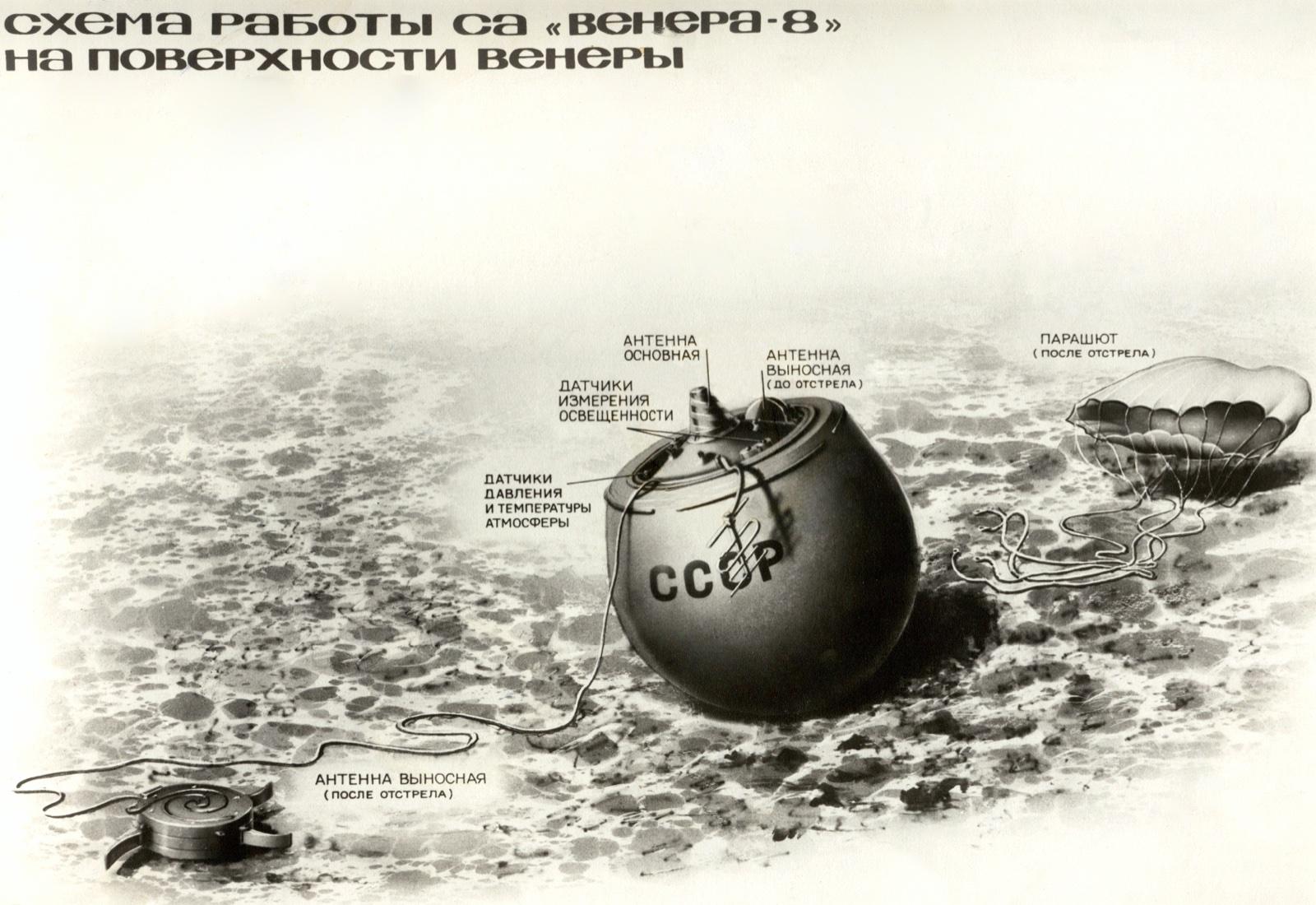
Daylight brought a radio problem. In the 1972 window the sunlit part of Venus that could still see Earth was a crescent near the morning terminator, and from there Earth would stand 30 to 50° from the local vertical by Lavochkin's figure (38° in Ainsworth and Herman). Venera 7's antenna had a narrow ±45° pattern, and its loose capsule had made the signal swing. So the main helical antenna's pattern was reshaped from an egg to a funnel suited to Earth low in the sky (Marov and Huntress; Mitchell), and a second antenna was added: a flat, petalled disc thrown out on a cable after landing, with a gravity switch to connect whichever face ended up on top. A 1971 design diagram in the RGANTD archive, published by IKI in 2025, shows the intended routine on the ground: 31 minutes through the ejected antenna, a switch to the main antenna, then replay of stored gamma-spectrometer data until the lander failed.
Its instruments were chosen for a lander that would sit in daylight on rock. Thermometers and barometers measured the atmosphere, in Mitchell's list. Two IOV-72 photometers read light through a fibre-optic guide, the IAV-72 was a chemical colour test for ammonia, and the GS-4 gamma-ray spectrometer, calibrated on terrestrial rocks, counted the natural gamma rays of potassium, uranium and thorium. The bus, unchanged from earlier flights, carried a cosmic ray instrument and, according to IKI's history page, an added LA-4 instrument for neutral hydrogen.
Venera 8 left Baikonur on 27 March 1972 on a Molniya-M with a Blok NVL upper stage, at 04:15:06 UT by IKI's history page (NSSDCA prints 04:15:01), and arrived 117 days later after a single course correction. Its twin, launched on 31 March, never left Earth orbit because the NVL stage failed, and was named Kosmos 482. Marov and Huntress call Venera 8's launch the last use of the 8K78 Molniya in the Soviet lunar and planetary programme, though the twin flew on the same type four days later.
On 22 July the lander separated at 07:40 UT by the spacecraft clock (07:44 in NSSDCA's bus record, which matches Earth-received time). It met the atmosphere at 11.6 km/s, took up to 335 g and slowed to 250 m/s. The reefed parachute opened near 60 km by NSSDCA's and Marov and Huntress's account (about 55 km in Lavochkin's). Near 30 km a cord made to melt at 200 °C let the canopy open fully. NSSDCA says the parachute copied Venera 7's in stronger materials, because the earlier one had torn.
Fifty-five minutes under the parachute ended with touchdown at 12:28:40 Moscow time (09:28:40 UT), according to Roscosmos's release of 8 September 2022, in agreement with NSSDCA's descent-craft record in spacecraft time. The signal took about 3.6 minutes to reach Earth, so NSSDCA's bus record gives 09:32 UT and an epizodsspace timeline 12:32 Moscow time. Lavochkin gives a vertical speed at contact of 8.3 m/s, NSSDCA's descent-craft record 6.5 m/s. It was 6:24 in the morning, local solar time, with the Sun about 5.5° up and the terminator about 500 km away by Lavochkin's figure. For the entry point NSSDCA gives about 500 km in its bus record and about 600 km in its descent-craft record, the figure Ainsworth and Herman (1974) give for the start of the descent, before the wind carried the capsule sideways.
How long it then kept talking depends on the source. Roscosmos's 2022 release and Siddiqi give 50 minutes 11 seconds, Lavochkin, RGANTD and IKI a round 50, and the epizodsspace timeline fifty minutes from its own 12:32 landing time to 13:22 Moscow time. NSSDCA and Marov and Huntress give 63 minutes, the latter split into 13 minutes on the main antenna, 20 on the ejected antenna and a last 30 on the main antenna again, although Lavochkin's page says the main antenna worked only during the descent. None of these matches the 1971 plan, and no source read here explains the extra 13 minutes. Lavochkin says all systems and instruments worked normally throughout; NSSDCA and Siddiqi put the end down to the surface conditions.
At the surface the sensors read 470 ± 8 °C and a pressure that each source writes a little differently. Lavochkin, IKI and Siddiqi give 90 ± 1.5 atmospheres; the 1973 yearbook writes 90 ± 1.5 kg/cm², about 88 bar; Marov and Huntress give 93 ± 1.5 bar. NSSDCA's descent-craft record gives 95 bar (its bus record says 90 atmospheres) and notes good agreement with modern values extrapolated to the mean planetary radius; this page could not trace the 95 bar figure to a Soviet publication. The yearbook adds that the day-side profiles of temperature and pressure showed no noticeable difference from the night side.
Light was the question the mission had been built for, and the photometers answered it in 27 readings. Illumination fell steeply down to about 35 km (NSSDCA notes a decrease and Siddiqi a sharp change between 35 and 30 km); below that, Mitchell writes, the light dimmed no faster than clear carbon dioxide would dim it, the first evidence that the cloud deck had a floor. Marov and Huntress describe a main cloud layer from 65 to 49 km, a thinner haze down to 32 km and relatively clear gas underneath, and Lacis and Hansen, fitting the curve in Science in 1974, needed at least three scattering layers. On the ground Lavochkin gives 350 ± 150 lux, the yearbook text 100 to 300 lux for the same moment, and both extrapolate at least 1,000 to 3,000 lux with the Sun overhead, plenty for photography. Three years later the cameras on Venera 9 and 10 worked in that light.
Winds came from the Doppler shift of the carrier, and the published reductions differ more than any other result. Lavochkin's figures are 50 to 60 m/s at 50 km and 0 to 2 m/s in the lowest 11 km, blowing from the terminator toward the day side, the same way the planet turns. Marov and Huntress give about 100 m/s at 50 km falling to about 1 m/s below 10 km, and read the profile as evidence of superrotation, the circulation that carries the upper atmosphere round far faster than the solid planet spins. Ainsworth and Herman reworked the data in 1974, placing the lower edge of the '4-day' retrograde wind layer near 44 km and finding surface winds of order 0.1 m/s. In 1977 they rebutted Young's 1975 argument that a 140 m/s wind at 45 km reported from Venera 8 was spurious. The capsule drifted about 60 km sideways on the way down by Marov and Huntress's count, about 80 km by Ainsworth and Herman's.
The radar altimeter returned 35 heights, from 45.5 km to 0.9 km. Marov and Huntress read two rises of about 1,000 m and 2,000 m along the drift track, a depression about 2,000 m deep and a gentle slope up to the landing point; Mitchell summarises the same data as 1.2 km of relief. Two readings of echo strength gave a density of about 1.4 g/cm³, which the Soviet reports took to mean a fairly loose surface layer.
Potassium, uranium and thorium were the spectrometer's targets, measured during the descent and twice on the surface: 4 percent potassium, 2.2 ppm uranium and 6.5 ppm thorium (the yearbook writes the uranium as 0.0002 percent). Lavochkin's summary is that the soil resembles terrestrial granitic rocks in both the amount and the ratio of these elements. Every later Venera lander found something closer to basalt, as Marov and Huntress point out, and the reading became a puzzle. In Magellan radar images Basilevsky, Nikolaeva and Weitz (1992) found mottled plains, steep-sided domes and a possible collapsed caldera inside the landing circle, and listed lamprophyres, mostly mafic dike rocks from magmas enriched in incompatible elements, among possible terrestrial analogues; Weitz and Basilevsky (1993) named a steep-sided dome, lamprophyre-like lavas or ash beds as the likeliest material. Basilevsky (1997) found an unusual density of small volcanic shields and, calling the idea very tentative, suggested slow magma supply might explain the enrichment. In 2016 Basilevsky and Markiewicz called the concentrations somewhat above those typical of basalt and suggested they might come from steep-sided domes. None of these papers claims a settled answer; Basilevsky (1997) proposed the site as a target for future geochemistry missions.
Ammonia has had a longer afterlife. The IAV-72 analyser changed colour at about 46 and 33 km, which the team read as 0.01 to 0.1 percent ammonia by volume. Goettel and Lewis argued in 1974 that such levels could not coexist with the other gases measured, and A. T. Young later suggested that sulfuric acid, which also turns the indicator, had produced a false positive. Marov and Huntress accept that explanation and turn it into a discovery, the first hint of sulfuric acid in the clouds, and NSSDCA likewise credits the mission with a detection of sulfuric acid. Since 2021 the ammonia reading has been revived. Bains and colleagues, in PNAS, called it a tentative detection and built a model of cloud chemistry around ammonia, adding that only new measurements inside the clouds can resolve the discrepancies; Cleland and Rimmer argued in 2022 that it was set aside mainly because it clashed with the assumption of chemical equilibrium. In May 2025 IKI's Dmitry Gorinov said ammonia on Venus is extremely scarce or absent. The question belongs with the wider debate on life on Venus.
As planned, the bus burned up in the atmosphere after returning its own readings. The lander presumably lies inside its 150 km circle with its parachute and ejected disc antenna, part of what we left at Venus. The stranded twin came down on 10 May 2025, in the Indian Ocean by IKI's account, one calculated solution among several. Venera 9 and 10 moved on to Lavochkin's second generation, five times the size of the V-72 and launched on Proton rockets, in Mitchell's account. In the same May 2025 interview, IKI scientists described the lander they hoped to fly on Venera-D as carrying pressure and temperature sensors and an active gamma-ray spectrometer, successor to Venera 8's passive one, and hoped work on those instruments would begin soon; the interview gives no launch date.
Mission facts
Organisations
Lavochkin design bureau (USSR)
Designation
V-72, serial 3V No. 670 (Siddiqi). COSPAR 1972-021A for the station and 1972-021D for the descent craft in NSSDCA's catalogue. Lavochkin's own page calls the lander the descent vehicle of 'Venera-72', and Roscosmos's 2022 release quotes a State Commission decision of 28 April 1972 on 'object V-72 No. 670 [Venera-8]' and No. 671 [Kosmos-482].
Builder
Lavochkin design bureau (Siddiqi: GSMZ imeni Lavochkina). Chief designer Georgy Babakin died in 1971 (Mitchell); on 5 August 1972 Sergey Kryukov, as Lavochkin's chief designer, told Pravda that the descent vehicle's construction was almost completely new (quoted by Siddiqi).
Mass
1,184 kg at launch (Lavochkin, IKI), of which the descent vehicle was 495 kg (IKI, the 1973 Great Soviet Encyclopedia yearbook, NSSDCA, Siddiqi). NSSDCA's facts box rounds the station to 1,180 kg.
Launch
27 March 1972 from Baikonur on a Molniya-M with a Blok NVL upper stage. IKI's history page gives 7 h 15 min 6.231 s Moscow time (04:15:06 UT), matching Roscosmos's 07:15:06 Moscow time (2022) and Siddiqi's 04:15:06 UT; NSSDCA prints 04:15:01 UT.
Cruise
117 days and more than 300 million km, with one trajectory correction on 6 April 1972 and 86 communication sessions (1973 yearbook text on epizodsspace).
Entry
Entered at 11.6 km/s at an angle of 77° and slowed to 250 m/s under loads of up to 335 g (Lavochkin; angle from NSSDCA). Siddiqi quotes a shock-layer gas temperature above 12,000 °C.
Parachute
Reefed opening near 60 km (NSSDCA; Lavochkin and Roscosmos's 2022 release say about 55 km), instruments on at about 50 km, full 2.5 m² canopy near 30 km when a 'glass nitron' cord melted at 200 °C. Descent under the parachute lasted 55 minutes.
Touchdown time
12:28:40 Moscow time (09:28:40 UT) in Roscosmos's release of 8 September 2022, the same as NSSDCA's descent-craft record in spacecraft time. The signal reached Earth about 3.6 minutes later, hence the 09:32 UT (12:32 Moscow) in other listings.
Landing site
Circle centred on 10.70° S, 335.25° E in eastern Vasilisa Regio (Abdrakhimov 2001, who cites Akim and Stepanyants, 1993, for its 150 km radius of probable error). The same centre appears in NSSDCA, Mitchell, Siddiqi and the Russian edition of Marov and Huntress; Roscosmos's 2022 release rounds it to 10° S, 335° E.
Local conditions
Landed about 500 km from the morning terminator (Lavochkin, Siddiqi). For the entry point NSSDCA's bus record also gives about 500 km, its descent-craft record about 600 km, the figure Ainsworth and Herman give for the start of the descent. Local solar time 6:24, solar zenith angle 84.5° (NSSDCA), so the Sun stood about 5.5° above the horizon.
Touchdown speed
8.3 m/s vertical (Lavochkin, Roscosmos 2022). NSSDCA's descent-craft record gives 6.5 m/s.
Time on the surface
50 minutes 11 seconds (Roscosmos 2022, Siddiqi), given as 50 minutes by Lavochkin, RGANTD and IKI. 63 minutes in NSSDCA and in Marov and Huntress, who split it 13 minutes on the main antenna, 20 on the ejected antenna, 30 on the main antenna.
Surface temperature and pressure
470 ± 8 °C. Pressure 90 ± 1.5 atmospheres (Lavochkin, Siddiqi), written 90 ± 1.5 kg/cm² in the 1973 yearbook, 93 ± 1.5 bar in Marov and Huntress and 95 bar in NSSDCA's descent-craft record (its bus record says 90 atmospheres).
Light
350 ± 150 lux at the surface with the Sun at 5.5° (Lavochkin, IKI); the 1973 yearbook text gives 100 to 300 lux. Both extrapolate at least 1,000 to 3,000 lux with the Sun overhead. 27 photometer readings in all (Marov and Huntress, Mitchell).
Winds
From the Doppler shift of the radio carrier: 50 to 60 m/s at 50 km and 0 to 2 m/s below 11 km, blowing from the terminator toward the day side (Lavochkin). Marov and Huntress give about 100 m/s at 50 km; Ainsworth and Herman (1974) put the lower edge of the '4-day' retrograde wind layer (111 m/s in their paper) near 44 km and give about 0.1 m/s at the surface.
Ammonia
0.01 to 0.1 percent by volume from the IAV-72 colour test at about 46 and 33 km (Lavochkin). Later attributed to sulfuric acid reacting with the indicator (Marov and Huntress); revived as a tentative detection by Bains and colleagues in 2021.
Rock chemistry
GS-4 gamma-ray spectrometer: 4 percent potassium, 2.2 ppm uranium, 6.5 ppm thorium (Marov and Huntress, Mitchell). Lavochkin: the soil resembles terrestrial granitic rocks in the content and ratio of its radioactive elements.
Soil and relief
35 radar altimeter readings from 45.5 km down to 0.9 km; two echo-strength readings gave a loose surface layer with a density of about 1.4 g/cm³ (Lavochkin; counts from Marov and Huntress and Mitchell).
Site: 10.7°S, 335.25°E · eastern Vasilisa Regio · position estimated, ±150 km (source)
Mission timeline
- 1971A design diagram for the 'V-72' lander sets out its planned surface routine: 31 minutes through the ejected antenna, a switch to the main antenna, then replay of stored gamma-spectrometer data until failure (RGANTD Arch. No. 4-146, published by IKI in 2025).
- 27 Mar 1972Launch from Baikonur at 7 h 15 min Moscow time (04:15 UT) on a Molniya-M with a Blok NVL stage. From a parking orbit the stage fires for 243 s and sends the 1,184 kg station toward Venus at 11.5 km/s.
- 31 Mar 1972A second station of the same design and with the same instruments is launched, but the Blok NVL stage fails and it stays in Earth orbit, named Kosmos 482.
- 6 Apr 1972The single trajectory correction of the cruise, aimed at bringing the lander down in the chosen area at the planned time.
- 28 Apr 1972A State Commission decision orders work on V-72 No. 670 (Venera 8) to continue on schedule, and the descent craft of the stranded No. 671 (Kosmos 482) to be separated from its orbital compartment before work on it stops (quoted in Roscosmos's 2022 release).
- 22 Jul 1972, 07:40 UTThe descent vehicle separates from the bus (NSSDCA's descent-craft record, in spacecraft time, and Siddiqi; the 1973 yearbook gives 10:40 Moscow time). NSSDCA's bus record says 07:44, which matches the Earth-received time 3 min 36 s later.
- 22 Jul 1972, about 08:33 UTEntry at 11.6 km/s and 77°; by about 08:33 UT (spacecraft time) the capsule has slowed to about 250 m/s at 67 km. The reefed parachute opens near 60 km, instruments switch on at about 50 km (08:34:17) and the canopy opens fully near 30 km (08:45:04), per NSSDCA's descent-craft record. Marov and Huntress and NSSDCA's bus record give 08:37 UT for entry, which would match Earth-received time. Siddiqi reaches the same 08:37 by adding 57 minutes to his 07:40 separation; Marov and Huntress put separation 53 minutes before entry.
- 22 Jul 1972, 09:28:40 UTTouchdown on the sunlit side at 8.3 m/s, 12:28:40 Moscow time. Earth hears it at about 09:32 UT.
- 22 Jul 1972, about 10:19 UTLast signal from the surface, 50 minutes 11 seconds after touchdown by the Roscosmos count (the epizodsspace timeline gives 13:22 Moscow time, which fits Earth-received time). NSSDCA gives 63 minutes.
- 5 Aug 1972Chief designer Sergey Kryukov tells Pravda the descent vehicle's construction was almost completely new.
- Sep 1973Marov and colleagues publish the temperature, pressure and wind results in the Journal of the Atmospheric Sciences; Vinogradov's gamma-ray paper follows in Icarus in November.
- 1974Goettel and Lewis argue that the ammonia reading cannot be squared with the other gases measured in the atmosphere.
- 31 May 1974Lacis and Hansen, in Science, fit the Venera 8 light profile with at least three scattering layers and a cloud optical thickness of about 10 or more.
- 25 Oct 1992Basilevsky, Nikolaeva and Weitz publish a geology of the landing circle from Magellan radar images: mottled plains, steep-sided domes and a possible collapsed caldera.
- 2001Abdrakhimov maps eastern Vasilisa Regio and finds the landing circle about 75 percent shield plains, with a pancake dome on its northern edge.
- Dec 2021Bains and colleagues, in PNAS, treat the Venera 8 ammonia reading as a tentative detection and build a cloud-chemistry model around it.
- 8 Sep 2022Roscosmos publishes, for the first time, part of the declassified documents on the mission (letters and decisions from 1971 and 1972). Its release gives the landing time as 12:28:40 Moscow time and 50 minutes 11 seconds of reception after landing.
- 10 May 2025The descent capsule of Venera 8's twin, Kosmos 482, re-enters after 53 years in Earth orbit; IKI and Roscosmos place the fall in the Indian Ocean, one of several calculated solutions, and no sighting has been reported.
A filled dot marks something that physically happened. A hollow one marks an announcement, a naming or a target.
In pictures
Tap a photo to enlarge.
Translated from the original sources
Passages from the Russian sources this page draws on, in azmth's translation. Tap Show original to read the original wording.
NPO Lavochkin, project page 'Automatic Interplanetary Station Venera 8'
Russian · 7 passages
“After 55 minutes of smooth descent on the parachute through the atmosphere the vehicle landed on the sunlit side of Venus 500 km from the morning terminator near the equator, the vertical speed at the moment of contact being 8.3 m/s. Reception of the radio signal and telemetry continued for another 50 minutes after landing.”
azmth's translation · Show originalHide original
Russian: «После 55 минут плавного спуска на парашюте в атмосфере аппарат совершил посадку на освещенной стороне Венеры в 500 км от утреннего терминатора вблизи экватора, причем вертикальная скорость в момент касания составила 8,3 м/с. Прием радиосигнала и телеметрической информации продолжался еще в течение 50 минут после посадки.»
“Instead of the design pressure of 150 atmospheres, 105 atmospheres was adopted, and instead of 540 degrees, 493 degrees C.”
azmth's translation · Show originalHide original
Russian: «Вместо расчетного давления 150 атмосфер было принято 105 атмосфер, а вместо 540° - 493°С.»
“The main helical antenna worked only during the descent, and after landing an additional antenna was 'thrown out' of the descent vehicle.”
azmth's translation · Show originalHide original
Russian: «Основная спиральная антенна работала только на участке снижения, а после посадки из спускаемого аппарата "выбрасывалась" дополнительная антенна.»
“The measurements show a zonal wind directed from the terminator toward the day side, that is, in the direction of the planet's own rotation.”
azmth's translation · Show originalHide original
Russian: «Измерения свидетельствуют о наличии широтного ветра, направленного от терминатора на дневную сторону, то есть в направлении собственного вращения планеты.»
“In its content of radioactive elements and in their ratio, the Venusian soil resembles terrestrial granitic rocks.”
azmth's translation · Show originalHide original
Russian: «По содержанию радиоактивных элементов и по их соотношению венерианский грунт напоминает земные гранитные породы.»
“Operating scheme of the Venera-8 descent vehicle on the surface of Venus.”
Heading on Lavochkin's illustration of the lander on the ground, in the gallery of its project page
azmth's translation · Show originalHide original
Russian: «Схема работы СА «Венера-8» на поверхности Венеры»
“Descent vehicle of the Venera-8 station.”
Heading on Lavochkin's cutaway drawing, in the gallery of its project page
azmth's translation · Show originalHide original
Russian: «Спускаемый аппарат станции «Венера-8»»
IKI RAN, Solar System section of the RAS Space Council, 'The Venera 8 Spacecraft'
Russian · 3 passages
IKI RAN, Solar System section of the RAS Space Council, 'The Venera 8 Spacecraft' (posted 10 September 2010)
Open the source“Launch date: 27 March 1972, 7 hours 15 minutes 6.231 seconds Moscow time.”
azmth's translation · Show originalHide original
Russian: «Дата старта: 27 марта 1972 года 7 часов 15 минут 6,231 секунды МСК»
“The newly installed photometer showed that the illumination of the surface of Venus with the Sun at 5.5 degrees is 350 plus or minus 150 lux, which shows that only a small part of the solar radiation reaches the planet's surface.”
azmth's translation · Show originalHide original
Russian: «Вновь установленный фотометр показал, что освещенность поверхности Венеры при угле Солнца 5,5° составляет 350±150 люкс, что свидетельствует о том, что поверхности планеты достигает лишь небольшая часть солнечного излучения.»
“the KS-18-4M instrument for studying fluxes of cosmic particles and the additionally installed LA-4 instrument, intended to measure neutral hydrogen in the upper layers of the atmosphere of Venus.”
azmth's translation · Show originalHide original
Russian: «прибор КС-18-4М для изучения потоков космических частиц и дополнительно установленный прибор ЛА-4, предназначенный для измерения нейтрального водорода в верхних слоях атмосферы Венеры.»
epizodsspace, 'Venera 8'
Russian · 7 passages
epizodsspace, 'Venera 8' (archived 22 March 2025): 1973 Great Soviet Encyclopedia yearbook text, Russian edition of Marov and Huntress, Russian translation of Siddiqi
Open the source“A spacecraft landing on the sunlit side of the planet was carried out for the first time.”
1973 Great Soviet Encyclopedia yearbook text
azmth's translation · Show originalHide original
Russian: «Посадка космического аппарата впервые осуществлена на освещенную сторону планеты.»
“The illumination at the landing site with the Sun at 5.5 degrees lies between 100 and 300 [lux].”
1973 yearbook text
azmth's translation · Show originalHide original
Russian: «Освещенность в месте посадки при угле Солнца 5,5° находится в пределах 100÷300»
“The soil at the landing site contains 4% potassium, 0.0002% uranium and 0.00065% thorium, and in its content of radioactive elements and their ratio resembles terrestrial granitic rocks.”
1973 yearbook text
azmth's translation · Show originalHide original
Russian: «Грунт в месте посадки включает в себя калия 4%, урана 0,0002%, тория 0,00065% и по содержанию радиоактивных элементов и по их соотношению напоминает земные гранитные породы.»
“Pennants bearing a bas-relief of V. I. Lenin and an image of the State coat of arms of the USSR were mounted on the descent vehicle of the Venera-8 station.”
1973 yearbook text
azmth's translation · Show originalHide original
Russian: «На СА станции «Венера-8» были установлены вымпелы с барельефом В. И. Ленина и изображением Государственного герба СССР»
“The lander transmitted information for 63 minutes, reporting measurements of the properties of the surface and atmosphere. For the first 13 minutes data went through the main antenna, then for 20 minutes through the auxiliary antenna, and for the final 30 minutes through the main antenna again.”
Russian edition of Marov and Huntress
azmth's translation · Show originalHide original
Russian: «Посадочный аппарат передавал информацию в течении 63 минут, сообщая данные измерений свойств поверхности и атмосферы. В течение первых 13 минут данные передавались через основную антенну аппарата, затем в течение 20 минут через вспомогательную антенну и заключительные 30 минут снова через основную антенну.»
“Although the ammonia test gave a positive result of 0.1% to 0.01% at altitudes from 44 to 32 km, this result, as it later turned out, was caused by sulfuric acid, which also gave a positive reaction with the indicator used.”
Russian edition of Marov and Huntress
azmth's translation · Show originalHide original
Russian: «Хотя тест на аммиак дал положительный результат от 0,1 % до 0,01 % на высотах от 44 до 32 км, этот результат, как выяснилось в дальнейшем, был обусловлен серной кислотой, которая тоже давала положительную реакцию на использованный индикатор.»
“This launch is also notable because it was the last use of the 8K-78 Molniya launch vehicle in the Soviet lunar and planetary programme.”
Russian edition of Marov and Huntress
azmth's translation · Show originalHide original
Russian: «Этот запуск примечателен еще и тем, что это было последнее использование ракеты-носителя 8К-78 «Молния» в советской лунной и планетной программе.»
RGANTD (Russian State Archive of Scientific and Technical Documentation), 'Launch of the Venera 8 Automatic Interplanetary Station'
Russian · 3 passages
“Reception of the radio signal and telemetry continued for another 50 minutes after landing.”
azmth's translation · Show originalHide original
Russian: «Прием радиосигнала и телеметрической информации продолжался еще в течение 50 минут после посадки.»
“The Venera-8 automatic interplanetary station in assembly in the workshop. 1972. RGANTD. Arch. No. 1-20501.”
RGANTD's caption for the archive photograph
azmth's translation · Show originalHide original
Russian: «АМС «Венера-8» на сборке в цехе. 1972 г. РГАНТД. Арх. № 1-20501»
“Descent vehicle of the Venera-8 automatic interplanetary station. 1972. RGANTD. Arch. No. 1-20503.”
RGANTD's caption for the archive photograph
azmth's translation · Show originalHide original
Russian: «Спускаемый аппарат АМС «Венера-8». 1972 г. РГАНТД. Арх. № 1-20503»
iXBT, report of Roscosmos's release of declassified Venera 8 documents
Russian · 2 passages
iXBT, report of Roscosmos's release of declassified Venera 8 documents (9 September 2022)
Open the source“After 55 minutes of smooth descent on the parachute, the vehicle, with a vertical speed of 8.3 m/s, landed at 12:28:40 Moscow time on the sunlit side of Venus at the point with coordinates 10 degrees south, 335 degrees east.”
iXBT's report of the Roscosmos 2022 release
azmth's translation · Show originalHide original
Russian: «После 55 минут плавного спуска на парашюте в атмосфере аппарат, имея вертикальную скорость 8,3 м/с, в 12:28:40 по московскому времени выполнил посадку на освещённой стороне Венеры в точке с координатами 10° ю. ш. и 335° в. д.»
“Reception of information continued for another 50 minutes 11 seconds after landing.”
azmth's translation · Show originalHide original
Russian: «Приём информации продолжался ещё в течение 50 минут 11 секунд после посадки.»
Roscosmos, 'Roscosmos Publishes Declassified Documents on the Venera 8 Station for the First Time'
Russian · 3 passages
Roscosmos, 'Roscosmos Publishes Declassified Documents on the Venera 8 Station for the First Time' (8 September 2022), Wayback copy of the day of publication; roscosmos.ru still refused automated access on 5 November 2026
Open the source“Reception of information from the descent vehicle continued for another 50 minutes 11 seconds after landing.”
Roscosmos release of 8 September 2022
azmth's translation · Show originalHide original
Russian: «Прием информации со спускаемого аппарата продолжался еще в течение 50 минут 11 секунд после посадки.»
“After 55 minutes of smooth descent on the parachute through the atmosphere, the vehicle, with a vertical speed of 8.3 m/s, landed at 12:28:40 Moscow time on the sunlit side of Venus at the point with coordinates 10 degrees south, 335 degrees east.”
Roscosmos release of 8 September 2022
azmth's translation · Show originalHide original
Russian: «После 55 минут плавного спуска на парашюте в атмосфере аппарат, имея вертикальную скорость 8,3 м/с, в 12:28:40 по московскому времени выполнил посадку на освещенной стороне Венеры в точке с координатами 10° ю. ш. и 335° в. д.»
“It notes the need 'to continue work with object V-72 No. 670 [Venera-8] according to the planned schedule' and also 'to separate the descent vehicle and the orbital compartment of object V-72 No. 671 [Kosmos-482], after which further work with this object is to stop'.”
Roscosmos 2022 summary of the State Commission decision of 28 April 1972; the bracketed names are Roscosmos's
azmth's translation · Show originalHide original
Russian: «Отмечается необходимость «продолжать работы с объектом В-72 № 670 [«Венера-8»] в соответствии с намеченным графиком», а также «произвести разделение спускаемого аппарата и орбитального отсека объекта В-72 № 671 [«Космос-482»], после чего дальнейшие работы с этим объектом прекратить»»
IKI RAN, 'Venera Probe Is Back, Long Live Venus'
Russian · 6 passages
IKI RAN, 'Venera Probe Is Back, Long Live Venus' (11 May 2025, text in Russian)
Open the source“Venera-8 was the first station to land on the sunlit side of Venus. It was a very difficult task for the ballistics experts of the time. By measuring the illumination of the surface, the vehicle 'prepared the ground' for Venera-9 and -10, which managed to obtain the first photographs of the surface.”
Dmitry Gorinov, IKI
azmth's translation · Show originalHide original
Russian: ««Венера-8» стала первой станцией, которая села на освещённую сторону Венеры. Это была очень сложная задача для баллистиков тех лет. Измерив освещённость поверхности, аппарат «подготовил почву» для «Венеры-9 и -10», сумевших получить первые фотографии поверхности.»
“Ammonia is widespread in the Solar System, but on Venus in particular there is extremely little of it, or none at all.”
Dmitry Gorinov, IKI
azmth's translation · Show originalHide original
Russian: «Аммиак распространён в Солнечной системе, но именно на Венере его крайне мало, или нет вовсе.»
“Transmission of information through the ejected antenna for 31 min (atmospheric parameters, illumination, gamma spectrometer, monitored parameters of the descent vehicle) ... switch of transmission to the main antenna ... transmission of only the stored GS-4M data (operation until failure).”
Text on the 1971 RGANTD diagram, Arch. No. 4-146, reproduced on the IKI page
azmth's translation · Show originalHide original
Russian: «ПЕРЕДАЧА ИНФОРМАЦИИ ЧЕРЕЗ ВЫНОСНУЮ АНТЕННУ В ТЕЧЕНИЕ 31 МИН. (ПАРАМЕТРЫ АТМОСФЕРЫ, ОСВЕЩЕННОСТЬ, ГАММА-СПЕКТРОМЕТР, КОНТРОЛИРУЕМЫЕ ПАРАМЕТРЫ СА) ... ПЕРЕКЛЮЧЕНИЕ ПЕРЕДАЧИ НА ОСНОВНУЮ АНТЕННУ ... ПЕРЕДАЧА ТОЛЬКО НАКОПЛЕННОЙ ИНФОРМАЦИИ ГС-4М (РАБОТА ДО ОТКАЗА)»
“Automatic interplanetary station Venera-8. 1972. RGANTD. Arch. No. 1-20500.”
IKI's caption for the archive diagram of the station
azmth's translation · Show originalHide original
Russian: «Автоматическая межпланетная станция «Венера-8». 1972 г. РГАНТД. Арх. № 1-20500»
“Operating scheme of the V-72 descent vehicle on the surface of Venus.”
Heading on the 1971 design poster, RGANTD Arch. No. 4-146, reproduced on the IKI page
azmth's translation · Show originalHide original
Russian: «Схема работы СА В-72 на поверхности Венеры»
“Item V-72. Operating scheme of the descent vehicle of the Venera automatic interplanetary station on the surface of the planet Venus. 1971. RGANTD. Arch. No. 4-146.”
IKI's caption for the 1971 design poster
azmth's translation · Show originalHide original
Russian: «Изделие В-72. Схема работы спускаемого аппарата АМС «Венера» на поверхности планеты Венера. 1971 г. РГАНТД. Арх. № 4-146»
Basilevsky and Markiewicz, 'Volcanism of the Planet Venus: Past and Present', Priroda No. 9, 2016
Russian · 1 passage
Basilevsky and Markiewicz, 'Volcanism of the Planet Venus: Past and Present', Priroda No. 9, 2016 (on Elementy)
Open the source“The Venera-8 spacecraft, which landed within an area of shield plains, determined by gamma spectrometry the contents of potassium, uranium and thorium in the surface material at concentrations somewhat higher than typical of basalts. Perhaps these measurements characterise the so-called steep-sided domes often associated with shield plains, for which a non-basaltic composition is suspected, rather than the shield plains material itself.”
Basilevsky and Markiewicz, Priroda, 2016
azmth's translation · Show originalHide original
Russian: «КА «Венера-8», совершивший посадку в пределах участка щитовых равнин, гамма-спектрометрическим методом определил содержания калия, урана и тория в материале поверхности в концентрациях, несколько превышающих типичные для базальтов. Возможно, данные измерения характеризуют не материал щитовых равнин, а нередко ассоциирующие с ними так называемые крутосклонные купола, для которых предполагается небазальтовый состав.»
Sources
- NPO Lavochkin, project page 'Automatic Interplanetary Station Venera 8' · in Russian
- epizodsspace, 'Venera 8' (archived 22 March 2025): 1973 Great Soviet Encyclopedia yearbook text, Russian edition of Marov and Huntress, Russian translation of Siddiqi · in Russian
- RGANTD (Russian State Archive of Scientific and Technical Documentation), 'Launch of the Venera 8 Automatic Interplanetary Station' · in Russian
- IKI RAN, Solar System section of the RAS Space Council, 'The Venera 8 Spacecraft' (posted 10 September 2010) · in Russian
- IKI RAN, 'Venera Probe Is Back, Long Live Venus' (11 May 2025, text in Russian)
- iXBT, report of Roscosmos's release of declassified Venera 8 documents (9 September 2022) · in Russian
- Roscosmos, 'Roscosmos Publishes Declassified Documents on the Venera 8 Station for the First Time' (8 September 2022), Wayback copy of the day of publication; roscosmos.ru still refused automated access on 5 November 2026 · in Russian
- Basilevsky and Markiewicz, 'Volcanism of the Planet Venus: Past and Present', Priroda No. 9, 2016 (on Elementy) · in Russian
- NSSDCA Master Catalog, Venera 8 (1972-021A), Wayback copy of 21 July 2025; the live catalogue still returned an error page on 5 November 2026
- NSSDCA Master Catalog, Venera 8 Descent Craft (1972-021D), Wayback copy of 9 August 2025
- Asif A. Siddiqi, Beyond Earth: A Chronicle of Deep Space Exploration, 1958 to 2016 (NASA SP-2018-4041), entries 133 and 134
- Don P. Mitchell, 'Plumbing the Atmosphere of Venus' (2003), on the first-generation Lavochkin Venus probes
- Abdrakhimov, 'Geologic mapping of Venera 8 landing site region', LPSC XXXII abstract 1590 (2001)
- Basilevsky, Nikolaeva and Weitz, 'Geology of the Venera 8 landing site region from Magellan data', JGR 97 (1992), Crossref record with abstract
- Basilevsky, 'Venera 8 landing site geology revisited', JGR 102 (1997), Crossref record with abstract
- Weitz and Basilevsky, 'Magellan observations of the Venera and Vega landing site regions', JGR 98 (1993), Crossref record with abstract
- Ainsworth and Herman, 'An analysis of the Venera 8 measurements', NASA TM-X-70706 (1974)
- Ainsworth and Herman, 'On the reality of the Venus winds', Icarus 30 (1977), NTRS record
- Lacis and Hansen, 'Atmosphere of Venus: implications of Venera 8 sunlight measurements', Science 184 (1974), NTRS record
- Bains et al., 'Production of ammonia makes Venusian clouds habitable', PNAS 118 (52), 2021 (arXiv 2112.10850)
- Cleland and Rimmer, 'Ammonia and phosphine in the clouds of Venus as potentially biological anomalies' (arXiv 2211.07786, 2022)
- Marov et al., 'Venera 8: measurements of temperature, pressure and wind velocity on the illuminated side of Venus', J. Atmos. Sci. 30 (1973), Crossref record (paper not read: publisher blocked access)
- Vinogradov, 'The content of uranium, thorium, and potassium in the rocks of Venus as measured by Venera 8', Icarus 20, 253 (November 1973), Crossref record (paper not read)
- Marov et al., 'Preliminary results on the Venus atmosphere from the Venera 8 descent module', Icarus 20, 407 (December 1973), and Avduevsky et al., 'Venera 8: measurements of solar illumination through the atmosphere of Venus', J. Atmos. Sci. 30, 1215 (1973): Crossref records (papers not read)
Facts on this page were verified on 5 November 2026. Where sources disagree, the disagreement is stated rather than resolved silently.
azmth is independent and is not affiliated with or endorsed by NASA, Roscosmos, NPO Lavochkin, ESA, JAXA, ISRO, CNSA, or any other space agency or company named on this page.