Venus time
A day on Venus lasts 116.75 Earth days from sunrise to sunrise, and one backward turn takes 243. Why the Sun rises in the west and the spin changes.
TL;DR· 20 min read
Venus spins backwards once every 243 Earth days, yet sunrise to sunrise takes only 116.75 Earth days, because the backward spin and the 224.7-day orbit add together. The Sun rises in the west, and a Venus year holds just under two of these days. The spin also changes: radar from 2006 to 2020 found the length of a turn varying by about 20 minutes, which the team links to the massive atmosphere trading spin with the ground. Why Venus turns backwards at all is still an open question.
How long is a day on Venus?
A day on Venus, from one sunrise to the next, lasts 116.75 Earth days, and the Sun rises in the west. The planet itself turns once against the stars every 243 Earth days, in the opposite direction to Earth. Both figures are right: one is the day that decides when the ground has sunlight, the other is the turn of the solid planet. Because Venus goes round the Sun in 224.7 Earth days, one turn takes longer than its year, while the year holds just under two of its sunrise-to-sunrise days. The turn also changes. Radar measurements from 2006 to 2020 found its length varying by about 20 minutes, which the radar team links to the thick atmosphere trading spin with the ground.
- 243.0185 Earth daysone turn against the stars, backwards, in the IAU model; radar averaged 243.0226 over 2006 to 2020
- 116.75 Earth daysone solar day, sunrise to sunrise, with the Sun rising in the west
- about 20 minuteshow far single radar measurements of the spin period differed, 2006 to 2020
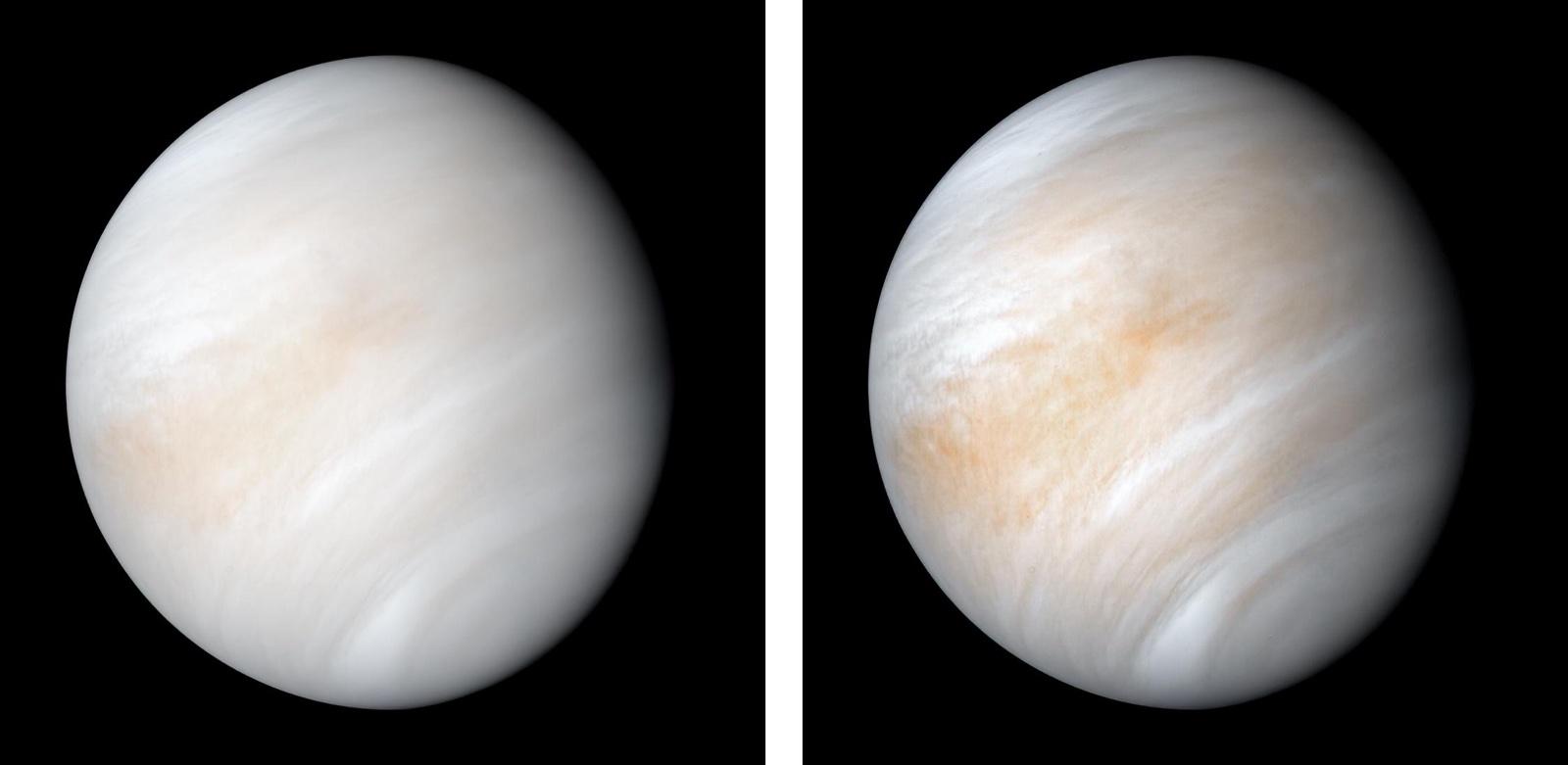
Two clocks run on Venus, and much of the confusion about its day comes from mixing them up. One is the sidereal day, the time the planet takes to turn once relative to the distant stars. The rotation model adopted by the International Astronomical Union's working group on cartographic coordinates, and distributed to mission software by NASA's NAIF team in its pck00011 constants file, writes the angle of the Venus prime meridian as 160.20 minus 1.4813688 degrees for every day counted from noon on 1 January 2000. That rate is one turn every 243.0185 days. The minus sign is the backward spin, since the angle shrinks with time. NAIF's file records that the Venus values were left unchanged in the working group's 2015 report, so the figure in force today is the one derived from Magellan in the early 1990s.
Backwards needs a reference. NAIF's documentation fixes the north pole of every planet on the north side of the solar system's invariable plane, "regardless of the body's spin direction". Seen from above that pole, Venus turns clockwise, opposite to Earth and opposite to its own path round the Sun. Pick the pole by the right-hand rule instead and the same axis points down, which is why NSSDCA's fact sheet gives Venus an obliquity to its orbit of 177.36 degrees and an inclination of the equator of 2.64 degrees. Both are correct: one tilt measured from opposite ends of the axis. Longitudes follow the IAU pole. The USGS gazetteer lists every Venus feature in planetocentric coordinates, east positive from 0 to 360, and zero longitude runs through the central peak of Ariadne, a crater 23.6 km across at 43.9 degrees north.
The other clock is the solar day, from one sunrise to the next at the same spot. On Earth the orbit makes the solar day a little longer than the sidereal one, 24 hours against 23 hours 56 minutes, because the planet must turn slightly further to face the Sun again. On Venus the orbit runs one way and the spin the other, so the two motions add and the solar day comes out far shorter than the turn: one divided by 116.75 equals one divided by 243.02 plus one divided by 224.70. NSSDCA gives the length of day as 2,802.0 hours, or 116.75 Earth days. The IAU rate and NSSDCA's orbital period of 224.701 days give 116.7505 days by that formula; JPL's Horizons sheet prints 116.7490, two minutes less, without saying why. JAXA's public summary rounds all three: a spin of 243 days, an orbit of 225 and a day of 117.
Here the famous line about a day longer than a year needs care. A turn of 243 days is longer than an orbit of 224.7 days, so Venus does rotate once in more than a year. The day anyone standing there would count, sunrise to sunrise, fits into the year 1.92 times, so noon and midnight each come round a little less than twice per Venus year. At the equator daylight lasts about 58.4 Earth days, half the solar day, and the night is as long. With the axis within 2.64 degrees of upright, day length hardly changes through the year, and JAXA's summary says plainly that Venus has no seasons. NSSDCA lists the day to night temperature range at the surface as roughly zero, so the long night is as hot as the day.
Because the ground turns westward, everything in the sky appears to travel the other way: stars and Sun rise in the west and set in the east. The point beneath the Sun slides eastward over the surface by about 3.08 degrees of longitude per Earth day, so by azmth's arithmetic the Sun needs nearly six Earth hours to move its own width across the sky, about 0.74 degrees as seen from Venus. Soviet landers measured the light at the ground, and NSSDCA's summary of the preliminary Venera 9 results compares it to the light at Earth's midlatitudes on a cloudy summer day. The direction of the Sun's daily motion, west to east, is geometry and holds whether or not its disc can be made out through the overcast.
Clock time at a place on Venus is kept the way Soviet and American teams kept it, as local solar time. The solar day is divided into 24 local hours, with noon when the Sun is overhead and six o'clock at the morning terminator, so each Venus hour lasts 116.75 Earth hours, just under five Earth days. Because the Sun moves east across the ground, a site east of the point beneath the Sun is still in its morning: local time is 12 hours plus the difference between the subsolar longitude and the site's longitude, divided by 15, in east longitudes. Ralph Lorenz worked with exactly that difference in a 2018 note added to the Planetary Data System archive of the Vega balloons, which drifted westward far faster than the Sun moved: the Vega 1 balloon started just after local midnight and Vega 2 at about 1 a.m., and both were last heard at about 8 a.m. local solar time, two Earth days later.
Mission records use the same clock. Venera 4 descended on the night side where, in Marov's account, the local solar time was 4:40 with the Sun 110 degrees from the zenith. Venera 8 landed at 6:24 local solar time with the Sun 84.5 degrees from the zenith, about five and a half degrees above the horizon, according to NSSDCA, which adds that its event times are spacecraft times, the Earth-received time minus 3 minutes 36 seconds of light travel. In the same account, Venera 9 touched down at 13:12 by Venus solar time with the Sun 33 degrees from the zenith. The four Pioneer Venus probes of 9 December 1978 reached the ground within 12 minutes of one another at local times from 0:07 to 7:38, because they were spread across the night and morning hemispheres. No source read for this page used a running count of Venus days like the Mars Sol Date: events are dated in Earth time and placed in the Venus day by local solar time.
Until radar, the clouds kept the length of the turn out of reach. Charles Boyer summed up the telescope record in the French journal L'Astronomie in 1965: every value from 24 hours to 225 days had been put forward and none confirmed, and the generally accepted opinion was that the planet always showed the same face to the Sun. Radar cut through. In Andrew Butrica's NASA history of planetary radar, JPL and MIT's Lincoln Laboratory at first concluded from their 1961 echoes that the day was about as long as the year, around 225 days, with one face always turned to Earth at closest approach. Between 1 October and 17 December 1962, near-daily observations at Goldstone let JPL's Roland Carpenter follow one irregularity in the echo spectrum that persisted from day to day and moved slowly. He took it for a rough region of ground carried round by the rotation and concluded that the sidereal period was 250 plus or minus 40 days, retrograde. He and fellow JPL radar astronomer Dick Goldstein published the result in Science on 8 March 1963.
Others came close. At Lincoln Laboratory, William Smith had seen in 1961 data that only retrograde motion explained how the echo bandwidth changed, but his supervisor Paul Green, wary after a false radar detection of Venus in 1958, had him tone the paper down, and its abstract spoke only of "a very slow or possibly retrograde rotation". Vladimir Kotelnikov's Soviet group first estimated about 11 days from its 1961 echoes and, after the 1962 approach, concluded 200 to 300 days, retrograde, by Butrica's account.
Meanwhile two French observers had found something moving much faster. Henri Camichel had been photographing Venus in ultraviolet light at the Pic du Midi observatory since 1953, and on his advice Charles Boyer, a magistrate who was president of the Court of Appeal in Brazzaville according to Dollfus's 1988 account, began in August 1957 with a 26 cm telescope and a Wratten 34 violet filter. A dark band seen on 28 August was back on 1 September. Boyer wrote that he immediately thought of a rotation in four days and told Camichel, who found the same recurrence in his 1953 plates. The joint summary of their 1961 paper in the Annales d'Astrophysique was cautious: the changing markings could be explained by a displacement in the retrograde direction, similar aspects returned roughly every four days, and this might be the rotation period of Venus, though they could not affirm it. Inside the paper, the authors parted ways. Boyer's section, timing a Y-shaped marking, concluded that Venus turned retrograde with a synodic period very close to 96 hours 33 minutes, a sidereal day of 97 hours 38 minutes, and took the dark masses for clouds that roughly followed features on the ground. Camichel's section placed the photographed details in the atmosphere of the planet rather than on its ground and allowed that they might be purely atmospheric.
Boyer kept measuring. In 1962 an international campaign organised through Dollfus, then president of IAU Commission 16, had eight observatories spread round the globe photograph Venus in ultraviolet through a whole evening elongation. By 1965 Boyer faced radar periods of about 250 days. Citing hour-to-hour motion of the markings, stereo measurements by France's IGN mapping agency and a 1964 Doppler measurement by Guinot of the Paris Observatory, he wrote that the problem could be considered solved and that the planet turned retrograde in about four days. The direction and the four days were right, but what turns in four days is the upper atmosphere.
JAXA describes it this way: the atmosphere of Venus turns in the direction of the spin, westward, and at the top of the cloud layer it circles the planet in only about four days, some 60 times faster than the ground. Analysis of Akatsuki images and temperatures by Takeshi Horinouchi's group, published in Science and announced by JAXA on 24 April 2020, found that thermal tides, waves driven by daytime heating, carry the angular momentum that keeps the fastest cloud-top flow going near the equator. NASA's caption for a reprocessed Mariner 10 view gives the clouds about four and a half days per circuit at about 100 m/s. Venus therefore keeps a third clock, the four-day sky described on the atmosphere page, and it was that clock Boyer and Camichel had been reading.
The number in today's model comes from Magellan's radar images. M. E. Davies and eight co-authors, E. L. Akim among them, followed hundreds of landmarks through Magellan's early mapping and published a period of 243.0185 plus or minus 0.0001 days in August 1992, an average over about 500 days in the description of a later team. The quoted precision, under nine seconds, described those 500 days and could not promise that the planet would keep that rate.
Evidence of drift came from Venus Express. Its VIRTIS spectrometer could make out surface features by peering through the clouds in the infrared, and when Nils Müller of the German Aerospace Center (DLR) lined its maps up with Magellan's, taken some 16 years earlier, features sat up to 20 km from where the Magellan rate put them. "When the two maps did not align, I first thought there was a mistake in my calculations," he told ESA in February 2012. Matching the maps required a day on average 6.5 minutes longer, 243.023 plus or minus 0.001 days in the paper he led in Icarus. ESA noted that this agreed with long-duration radar from Earth, and in 2019 Bruce Campbell and colleagues put 29 years of Earth-based radar images, 1988 to 2017, at 243.0212 plus or minus 0.0006 days. The team weighed short random swings, which should average out, against decades-long weather cycles, which might not; project scientist Håkan Svedhem added that choosing landing sites would need an accurate rate.
Jean-Luc Margot of UCLA and colleagues then measured the spin directly instead of mapping it. From 2006 to 2020 they sent a 3.5 cm radar signal of 200 to 400 kW to Venus from DSS-14, the 70 m antenna at Goldstone, and recorded the echoes there and at the 100 m Green Bank Telescope in West Virginia. The speckled echo from rough ground sweeps across Earth as the planet turns; when its track lines up with the two dishes, the same flicker reaches Green Bank about 20 seconds after Goldstone, and the lag gives the spin rate at that moment. Of 121 attempts, 21 succeeded. Published in Nature Astronomy on 29 April 2021, the results put the average sidereal day for 2006 to 2020 at 243.0226 plus or minus 0.0013 days, while single measurements ranged from 243.0159 to 243.0308 days, a spread of 61 parts per million or about 21 minutes. The team rejected a constant spin with high confidence and found the earlier averages at odds with most of their instantaneous values. That, Margot told UCLA, "probably explains why previous estimates didn't agree with one another".
The likely cause is planetary weather. The atmosphere of Venus carries an estimated angular momentum about 180 times Earth's, and its share of the whole planet's angular momentum is some 60,000 times larger than on Earth. Margot's team calculated that at least about 3.8 percent of it must be moving to and from the solid planet, and concluded that core torques and tides are far too weak to explain the changes. The length-of-day variations they measured are, in their words, three orders of magnitude larger than on Earth, where the day changes by milliseconds. What drives them in detail is open. The data hint at a forcing twice or once per Venus day that the team could not confirm, no long-term trend was detectable, and the atmospheric models available then predicted exchanges 30 to 300 times slower than observed.
For maps and clocks the differences are small in each turn and large over years. Margot's group calculated that the positions of equatorial landmarks predicted by their model and by the Magellan-based model in use drift apart by about 1 km per year, and that the random wandering alone adds 3.3 km of uncertainty over a decade; UCLA's release put the risk for a future landing at up to 30 km. By azmth's arithmetic the two rates have separated by about a quarter of a degree of longitude since the start of 2000, some 26 km at the equator. On a local solar clock a quarter of a degree is about one Venus minute, just under two Earth hours, so a sunrise computed with either rate falls at nearly the same moment. The maps are where it matters, as ESA and UCLA both said of future landers.
Why Venus spins backwards at all has no settled answer. Tides raised by the Sun in the solid planet would on their own lock its spin to its 225-day orbit, Margot's team noted, and Thomas Gold and Steven Soter proposed in 1969 that the Sun's pull on a heat-driven tide in the thick atmosphere pushes the other way, so that the spin settles where the two torques balance. Alexandre Correia and Jacques Laskar showed in Nature in 2001 that a planet with a dense atmosphere ends in one of only four rotation states, and that most starting conditions lead to Venus's present one by two routes: the axis flipping over, or a forward spin slowing and reversing while the tilt goes to zero. Giant impact simulations by Mirco Bussmann and colleagues (Astronomy and Astrophysics, 2025) found many collisions consistent with the present rotation, including head-on hits on a non-rotating Venus, which typically left small debris discs likely to fall back onto the planet instead of forming a lasting moon. In a study its authors list as accepted by The Astrophysical Journal (arXiv version of 21 September 2026), Stephen Kane and colleagues found that tides could both remove an early moon and slow a fast-spinning Venus, though only for a narrow range of starting spins and moon masses.
One near coincidence has tempted astronomers since the 1960s. Venus and Earth line up at inferior conjunction every 583.92 days, which is 5.0015 Venus solar days, so Venus turns almost the same face towards Earth at each close approach. The early radar teams read the pattern as a lock, and Peter Goldreich and Stanton Peale asked in Nature in 1966 whether the spin was resonant with Earth. An exact lock would need a period of about 243.16 days by azmth's arithmetic, against the 243.02 measured. Margot's team concluded that the atmospheric swings are so large that they likely prevent capture in such a resonance.
What we know
Sidereal rotation, official model
243.0185 Earth days, retrograde. The IAU model in NAIF's pck00011 file writes the prime meridian angle as W = 160.20 - 1.4813688 d degrees, d in days from J2000; 360 divided by 1.4813688 is 243.0185. NAIF notes the Venus values are unchanged in the IAU working group's 2015 report.
Which pole is north
NAIF's PCK documentation puts each body's north pole on the north side of the solar system's invariable plane, "regardless of the body's spin direction". Venus therefore turns clockwise seen from above its north pole, and W decreases with time.
Tilt, two conventions
NSSDCA: obliquity to orbit 177.36 degrees and inclination of the equator 2.64 degrees, the same axis measured from its two ends. Margot and colleagues (2021): 2.6392 plus or minus 0.0008 degrees.
Solar day
NSSDCA: length of day 2,802.0 hours, 116.75 Earth days. From 1/116.75 = 1/243.02 + 1/224.70 the IAU rate gives 116.7505 days (azmth arithmetic). JPL Horizons prints 116.7490 days beside a sidereal period of 243.018484 days that yields 116.7505; the two-minute difference is unexplained by either source.
Year against day
Sidereal orbital period 224.701 days (NSSDCA), so the sidereal turn is longer than the year, while the solar day fits into it 1.92 times. At the equator daylight lasts about 58.4 Earth days (half a solar day, azmth arithmetic).
NSSDCA's own rotation figure
The fact sheet (last updated 11 January 2024) lists the sidereal rotation period as -5,832.6 hours, the minus sign marking retrograde spin. That is 243.025 days, between the IAU value and the 2006 to 2020 radar average; the sheet does not say which measurement it follows.
Four measured periods
243.0185 plus or minus 0.0001 d (Magellan landmarks, about a 500-day average, early 1990s); 243.023 plus or minus 0.001 d (Venus Express against Magellan, about 16 years); 243.0212 plus or minus 0.0006 d (Earth-based radar images, 1988 to 2017); 243.0226 plus or minus 0.0013 d (radar speckles, 2006 to 2020). Each averages a different stretch of a spin that changes.
Spin of Venus: the 20-minute wander
Margot's 21 instantaneous measurements run from 243.01594 to 243.03075 days; the paper calls the excursion 61 ppm, a spin period change of 0.015 days or 21 minutes, and rejects a constant spin with high confidence (p much smaller than 10^-16).
Spin of Venus: why the day changes
Venus's atmospheric angular momentum is estimated at about 180 times Earth's, and its share of total planetary angular momentum about 60,000 times Earth's. The measured swings imply that at least about 3.8 percent of it passes to and from the solid planet; core torques and tides are judged too weak.
Spin of Venus: how it was measured
DSS-14 at Goldstone transmitted at 8,560 MHz (3.5 cm) with about 200 to 400 kW; echoes were recorded at DSS-14 and the 100 m Green Bank Telescope. 121 attempts between 2006 and 2020, 21 successes. Published in Nature Astronomy on 29 April 2021.
Venus Express finding (2012)
VIRTIS infrared maps placed surface features up to 20 km from where Magellan's 243.0185-day rate put them; ESA said they lined up only with a day on average 6.5 minutes longer. Lead author Nils Müller (DLR); ESA release of 10 February 2012; paper in Icarus 217, 474 to 483.
Boyer and Camichel: the four-day markings
Boyer photographed Venus at Brazzaville from August 1957 with a 26 cm telescope and a Wratten 34 violet filter; Camichel had ultraviolet plates from the Pic du Midi 60 cm reflector since 1953. Their 1961 paper in the Annales d'Astrophysique reported markings recurring about every four days with retrograde displacement. In his own section Boyer already concluded a retrograde rotation, synodic 96 h 33 min, sidereal 97 h 38 min, while Camichel's section put the markings in the atmosphere.
Boyer's 1965 conclusion
Facing radar periods of about 250 days, Boyer argued in L'Astronomie that the planet itself turned retrograde in about four days. The four-day retrograde motion is real and belongs to the cloud tops; the solid planet takes 243 days.
Retrograde spin found by radar
From Goldstone observations of 1 October to 17 December 1962, JPL's Roland Carpenter followed a persistent spectral feature and found a sidereal period of 250 plus or minus 40 days, retrograde, published with R. M. Goldstein in Science 139, 910 (8 March 1963).
Local solar time
Twenty-four local hours per solar day, so one Venus hour is 116.75 Earth hours. In east longitudes, local time = 12 h + (subsolar longitude - site longitude) / 15; six o'clock is the morning terminator. Lorenz's 2018 PDS note uses this difference for the Vega balloons, which began near midnight to 1 a.m. and ended about 8 a.m. local time.
Lander clocks
Venera 8 landed at 09:28:40 UT spacecraft time, 6:24 local Venus solar time, solar zenith angle 84.5 degrees (NSSDCA; spacecraft time is Earth-received time minus 3 min 36 s). The Pioneer Venus probes landed at local times of 7:38, 3:35, 6:46 and 0:07 (PDS).
Zero longitude
The USGS gazetteer: Ariadne, a 23.6 km crater centred at 43.9 N and listed at 360.00 E (the 0 meridian), adopted by the IAU in 1985; "Central peak in this crater defines zero degrees longitude." Venus coordinates are planetocentric, east positive, 0 to 360.
Cloud-top clock
JAXA: the atmosphere turns westward, with the spin, and near the cloud tops circles the planet in only about four days, about 60 times faster than the planet turns; Akatsuki data showed in 2020 that thermal tides maintain the flow at low latitudes.
The near lock with Earth
Synodic period 583.92 days divided by 116.75 is 5.0015 solar days, so Venus shows nearly the same face to Earth at each inferior conjunction; an exact lock would need about 243.16 days (azmth arithmetic). Margot's team: the atmospheric swings likely prevent capture in resonances with Earth.
How it got this way: open
Proposals for how Venus reached its slow retrograde spin include solar tides balanced by atmospheric thermal tides (Gold and Soter, 1969) and evolution to one of four final rotation states by an axis flip or a reversal of forward spin (Correia and Laskar, 2001). Giant impact simulations (Bussmann and colleagues, 2025) and a lost-moon tidal model (Kane and colleagues, 2026) address the slow spin and the missing moon. None is established.
What happened, and when
- Late Aug to early Oct 1953Henri Camichel photographs Venus in ultraviolet with the 60 cm Gentili reflector at the Pic du Midi. Years later he finds dark markings in this series returning at close to four days.
- 28 Aug to 1 Sep 1957At Brazzaville, Charles Boyer's violet-filter photographs show a dark band across the disc that reappears four days later; he writes to Camichel and to Texereau.
- 1961Boyer and Camichel publish their photographic observations in the Annales d'Astrophysique (24, 531 to 535): a retrograde displacement and a recurrence of about four days, offered as a possible rotation period.
- 1 Oct to 17 Dec 1962Near-daily radar observations of Venus at Goldstone at 2,388 MHz. Roland Carpenter follows a persistent feature in the echo spectra and finds the retrograde spin.
- 8 Mar 1963Goldstein and Carpenter, "Rotation of Venus: Period Estimated from Radar Measurements", appears in Science.
- 1965Boyer's article "Research on the rotation of Venus" in L'Astronomie argues for a four-day retrograde rotation of the planet against the radar's roughly 250 days.
- 22 Jul 1972Venera 8 lands on the day side at 6:24 local Venus solar time, with the Sun about 5.5 degrees above the horizon.
- 9 Dec 1978The four Pioneer Venus probes reach the surface within 12 minutes of one another, at local times from 0:07 to 7:38.
- 11 to 17 Jun 1985The two Vega balloons drift westward through the Venus night, starting just after local midnight and at about 1 a.m. and ending near 8 a.m. local solar time.
- 25 Aug 1992Davies and colleagues publish 243.0185 plus or minus 0.0001 days from landmarks in Magellan radar images, the value still in the IAU model.
- About 2007Venus Express VIRTIS images record surface features that are later matched against Magellan's maps.
- 2006 to 2020Goldstone and Green Bank make 121 attempts to catch Venus radar speckles; 21 succeed.
- 10 Feb 2012ESA announces that Venus Express found the Venus day on average 6.5 minutes longer than Magellan measured.
- Nov 2019Campbell and colleagues publish 243.0212 days from 29 years of Earth-based radar images (Icarus 332).
- 24 Apr 2020JAXA announces that Akatsuki data show thermal tides maintaining the four-day super-rotation of the cloud tops.
- 29 Apr 2021Margot and colleagues publish a mean sidereal day of 243.0226 days and variations of about 20 minutes in Nature Astronomy.
- 2025Bussmann and colleagues publish giant impact simulations consistent with Venus's present rotation (Astronomy and Astrophysics 702, A106).
- 21 Sep 2026Kane and colleagues post version 3 of their study of how tides could remove an early moon and slow Venus's spin, listed by the authors as accepted by The Astrophysical Journal.
In pictures
Tap a photo to enlarge.
Translated from the original sources
Passages from the French, Japanese and Russian sources this page draws on, in azmth's translation. Tap Show original to read the original wording.
C. Boyer and H. Camichel, Observations photographiques de la planète Vénus, Annales d'Astrophysique 24, 531
French · 4 passages
C. Boyer and H. Camichel, Observations photographiques de la planète Vénus, Annales d'Astrophysique 24, 531 (1961), ADS scan
Open the source“The change in the appearance of the markings can be explained by a displacement in the retrograde direction. Similar appearances return approximately every four days. This period could be that of the rotation of Venus, without it being possible, however, to affirm it.”
azmth's translation · Show originalHide original
French: «Le changement dans l’aspect des taches peut s’expliquer par un déplacement dans le sens rétrograde. Des apparences voisines reviennent approximativement tous les quatre jours. Cette période pourrait être celle de la rotation de Vénus sans qu’on puisse toutefois l’affirmer.»
“The photographed details are located in the atmosphere of the planet and not on its ground itself.”
Camichel's section, p. 534
azmth's translation · Show originalHide original
French: «Les détails photographiés se trouvent dans l’atmosphère de la planète et non sur son sol même.»
“Its rotation speed relative to the Earth-Sun direction is certainly close to 4 days. I think it is very close to 96 hours 33 minutes, which gives 97 hours 38 minutes for the length of the sidereal day.”
Boyer's section, p. 533
azmth's translation · Show originalHide original
French: «Sa vitesse de rotation par rapport à la direction Terre-Soleil est certainement voisine de 4 jours. Je pense qu’elle est très proche de 96 heures 33 minutes ; ce qui donne 97 heures 38 minutes pour la durée du jour sidéral.»
“But one may also think, given the variability of the phenomena observed, that they are purely atmospheric”
Camichel's section, p. 535
azmth's translation · Show originalHide original
French: «Mais on peut penser aussi, devant la variabilité des phénomènes observés, qu’ils sont purement atmosphériques»
C. Boyer, Recherches sur la rotation de Vénus, L'Astronomie 79, 223
French · 8 passages
C. Boyer, Recherches sur la rotation de Vénus, L'Astronomie 79, 223 (1965), ADS scan
Open the source“Research on the rotation of Venus”
the article's title, p. 223
azmth's translation · Show originalHide original
French: «Recherches sur la rotation de Vénus»
“Many astronomers nevertheless tried to deduce the rotation period from their drawings. Every value, from 24 hours to 225 days, was put forward without any of them being confirmed afterwards.”
azmth's translation · Show originalHide original
French: «De nombreux astronomes ont tenté néanmoins de déduire la période de rotation de leurs dessins. Toutes les valeurs, de 24 heures à 225 jours, ont été avancées sans qu’aucune d’entre elles se trouve confirmée par la suite.»
“It was finally deduced that the rotation must be very slow, at least of the order of a month, the generally accepted opinion being that the planet always showed the same face to the Sun.”
azmth's translation · Show originalHide original
French: «On en déduisit finalement que la rotation devait être très lente, au moins de l’ordre du mois, l’opinion généralement admise étant que la planète montrait toujours la même face au Soleil.»
“I began the photographs in August 1957 using a Wratten 34 violet filter. I obtained markings immediately.”
azmth's translation · Show originalHide original
French: «Je commençai les photos en août 1957 en utilisant un filtre violet Wratten 34. J’obtins immédiatement des taches.»
“I immediately thought of a rotation in 4 days and wrote to Messrs Camichel and Texereau to tell them of the phenomenon. Mr Camichel found the four-day period again on his plates of 1953.”
azmth's translation · Show originalHide original
French: «Je pensai immédiatement à une rotation en 4 jours et écrivis à MM. Camichel et Texereau pour leur faire part du phénomène. M. Camichel retrouvait la période de quatre jours sur ses clichés de 1953.»
“I obtained 96 h 33 min for the synodic rotation (Boyer's 1960 timing of the Y-shaped marking).”
azmth's translation · Show originalHide original
French: «J’obtins 96h33m pour la rotation synodique»
“Yet the radar echo measurements, while indicating a retrograde rotation, lead to an extremely long period of the order of 250 days.”
azmth's translation · Show originalHide original
French: «Or les mesures par écho radar, tout en indiquant une rotation rétrograde, conduisent à une période extrêmement longue de l’ordre de 250 jours.»
“I think the problem of the duration and direction of the rotation of Venus can be considered solved. The planet turns in the retrograde direction in about 4 days.”
azmth's translation · Show originalHide original
French: «Je pense qu’on peut considérer le problème de la durée et du sens de rotation de Vénus comme résolu. La planète tourne en sens rétrograde en 4 jours environ.»
Epizody kosmonavtiki, Venera-4 page, section attributed to Marov
Russian · 1 passage
Epizody kosmonavtiki, Venera-4 page, section attributed to Marov (Web Archive copy, May 2024)
Open the source“The local solar time in this region of Venus was 4:40, and the solar zenith angle was 110 degrees.”
Marov's account of Venera 4
azmth's translation · Show originalHide original
Russian: «Местное солнечное время в этом районе Венеры было 4:40 часов, а зенитный угол Солнца был равен 110°.»
Epizody kosmonavtiki, Venera-9 page, section attributed to Marov
Russian · 1 passage
Epizody kosmonavtiki, Venera-9 page, section attributed to Marov (Web Archive copy, May 2024)
Open the source“At this point the solar zenith angle was 33 degrees, which corresponded to 13:12 by Venusian solar time.”
Marov's account of the Venera 9 landing
azmth's translation · Show originalHide original
Russian: «В этой точке зенитный угол Солнца составлял 33°, что соответствовало 13:12 по венерианскому солнечному времени.»
JAXA press release on Akatsuki and super-rotation
Japanese · 4 passages
JAXA press release on Akatsuki and super-rotation (24 April 2020)
Open the source“Venus rotates very slowly, with a rotation period of 243 days in Earth time. Unlike Earth, its direction of rotation is opposite to its revolution (period 225 days in Earth time), and the length of one day is 117 days.”
azmth's translation · Show originalHide original
Japanese: 金星は自転周期が地球時間で243日と、非常にゆっくり自転しています。地球と違って自転の向きは公転(周期は地球時間で225日)と逆で、一日の長さは117日です。
“Its atmosphere rotates in the direction of the spin (that is, westward), at a speed far exceeding it.”
azmth's translation · Show originalHide original
Japanese: その大気は自転の向きに(つまり西向きに)、それをはるかに上回る速さで回転しています。
“There [near the top of the cloud layer], the atmosphere goes round the planet in only about 4 days, reaching a speed about 60 times that of the rotation.”
azmth's translation · Show originalHide original
Japanese: そこでは、大気が惑星を一周するのがわずか4日程度と、自転の60倍ほどの速さに達します。
“Because Venus's spin axis stands almost upright, there are no seasons.”
azmth's translation · Show originalHide original
Japanese: 金星は自転軸がほぼ正立しているため季節はありません。
Sources
- NSSDCA Venus Fact Sheet (D. R. Williams, last updated 11 January 2024)
- NAIF generic planetary constants kernel pck00011.tpc (IAU 2015 rotation elements, 27 December 2022)
- NAIF PCK Required Reading (body-fixed frame and pole conventions)
- JPL Horizons Venus physical data sheet (revised 12 April 2021)
- Margot, Campbell, Giorgini, Jao, Snedeker, Ghigo and Bonsall, Spin state and moment of inertia of Venus (arXiv 2103.01504, full text)
- Margot and colleagues, Nature Astronomy 5, 676 (published 29 April 2021)
- UCLA Newsroom, How long is a day on Venus? (29 April 2021)
- ESA, Could Venus be shifting gear? (10 February 2012)
- Mueller, Helbert, Erard, Piccioni and Drossart, Rotation period of Venus estimated from Venus Express VIRTIS images and Magellan altimetry, Icarus 217 (2012), Crossref record
- Campbell and colleagues, The mean rotation rate of Venus from 29 years of Earth-based radar observations, Icarus 332 (2019), Crossref record
- Davies and colleagues, The rotation period, direction of the North Pole, and geodetic control network of Venus, JGR 97 (1992), Crossref record
- C. Boyer and H. Camichel, Observations photographiques de la planète Vénus, Annales d'Astrophysique 24, 531 (1961), ADS scan · in French
- C. Boyer, Recherches sur la rotation de Vénus, L'Astronomie 79, 223 (1965), ADS scan · in French
- A. Dollfus, Charles Boyer and the Rotation of Venus, IAU Colloquium 98 (1988)
- A. J. Butrica, To See the Unseen: A History of Planetary Radar Astronomy, NASA SP-4218 (1996), chapter 2
- Goldstein and Carpenter, Rotation of Venus: Period Estimated from Radar Measurements, Science 139 (1963), Crossref record
- USGS Gazetteer of Planetary Nomenclature: Ariadne
- R. Lorenz, Note on Local Solar Time during the VEGA Missions at Venus, in PDS label vg1bl_rdr.lbl (2018)
- PDS Atmospheres Node, Summary of the Pioneer Venus Mission (entry and impact table)
- NSSDCA, Venera 8 descent craft record (Web Archive copy, August 2025)
- Epizody kosmonavtiki, Venera-4 page, section attributed to Marov (Web Archive copy, May 2024) · in Russian
- Epizody kosmonavtiki, Venera-9 page, section attributed to Marov (Web Archive copy, May 2024) · in Russian
- JAXA press release on Akatsuki and super-rotation (24 April 2020) · in Japanese
- NASA Science, Venus: Facts
- NASA Photojournal PIA23791, Venus from Mariner 10
- Correia and Laskar, The four final rotation states of Venus, Nature 411, 767 (2001)
- Gold and Soter, Atmospheric tides and the resonant rotation of Venus, Icarus 11 (1969), Crossref record
- Goldreich and Peale, Resonant Rotation for Venus?, Nature 209 (1966), Crossref record
- Bussmann and colleagues, The possibility of a giant impact on Venus, A&A 702, A106 (2025), arXiv
- Kane, Selsis, Leconte and Raymond, Tidal Demise: The Evolution and Fate of a Hypothetical Venus Moon (arXiv 2608.25036, v3 21 September 2026)
- NSSDCA, Venera 9 descent craft/lander record (Web Archive copy, December 2023)
- Horinouchi and colleagues, How waves and turbulence maintain the super-rotation of Venus' atmosphere, Science 368, 405 (2020), Crossref record
Checked on 26 September 2026. Where the science is unsettled this page says so rather than picking a winner.
azmth is independent and is not affiliated with or endorsed by NASA, Roscosmos, NPO Lavochkin, ESA, JAXA, ISRO, CNSA, or any other space agency or company named on this page.