Venera 4
Lavochkin design bureau · Soviet Union · Atmospheric probe · 1967 · Into the atmosphere Success
Ended on 18 October 1967, when the capsule's signal was lost after 93 minutes under its parachute, 24 to 28 km above the surface. Its twin, Kosmos 167, never left Earth orbit.
TL;DR· 17 min read
Venera 4 dropped a capsule into the night-side atmosphere of Venus on 18 October 1967 and radioed 93 minutes of readings, the first data from inside another planet's atmosphere. It found about 90 percent carbon dioxide and temperatures up to 262 °C, then went silent 24 to 28 km up. Moscow announced that it had landed, a claim built on a misleading altimeter reading and later disproved by Mariner 5 and by radar and microwave measurements from Earth. Its twin, Kosmos 167, never left Earth orbit.
What did Venera 4 discover on Venus?
Venera 4 was the first spacecraft to send back measurements from inside another planet's atmosphere. On 18 October 1967 its one-metre capsule hung under a parachute on the night side of Venus for 93 minutes, found the atmosphere to be about 90 percent carbon dioxide and recorded temperatures climbing to 262 °C, then fell silent 24 to 28 km above the ground. Moscow announced a landing; within two years Soviet and American scientists agreed the capsule had stopped high in the atmosphere. This page also covers its twin, Kosmos 167, stranded in Earth orbit in June 1967, and two of the men behind it: chief designer Georgy Babakin and Academy of Sciences president Mstislav Keldysh.
Facts as of 5 November 2026, from the sources listed below.
- 93 minutesof readings radioed from inside the atmosphere of Venus on 18 October 1967, one sample every 48 seconds at 1 bit per second
- about 90 % CO₂carbon dioxide found by the capsule's gas analysers, where nitrogen had been expected to be the main gas
- 24 to 28 kmaltitude at which the signal stopped, by reconstruction (Marov 24, NSSDCA 25, Lavochkin and Siddiqi 28; Mitchell's table of radii implies about 23); the capsule never transmitted from the ground
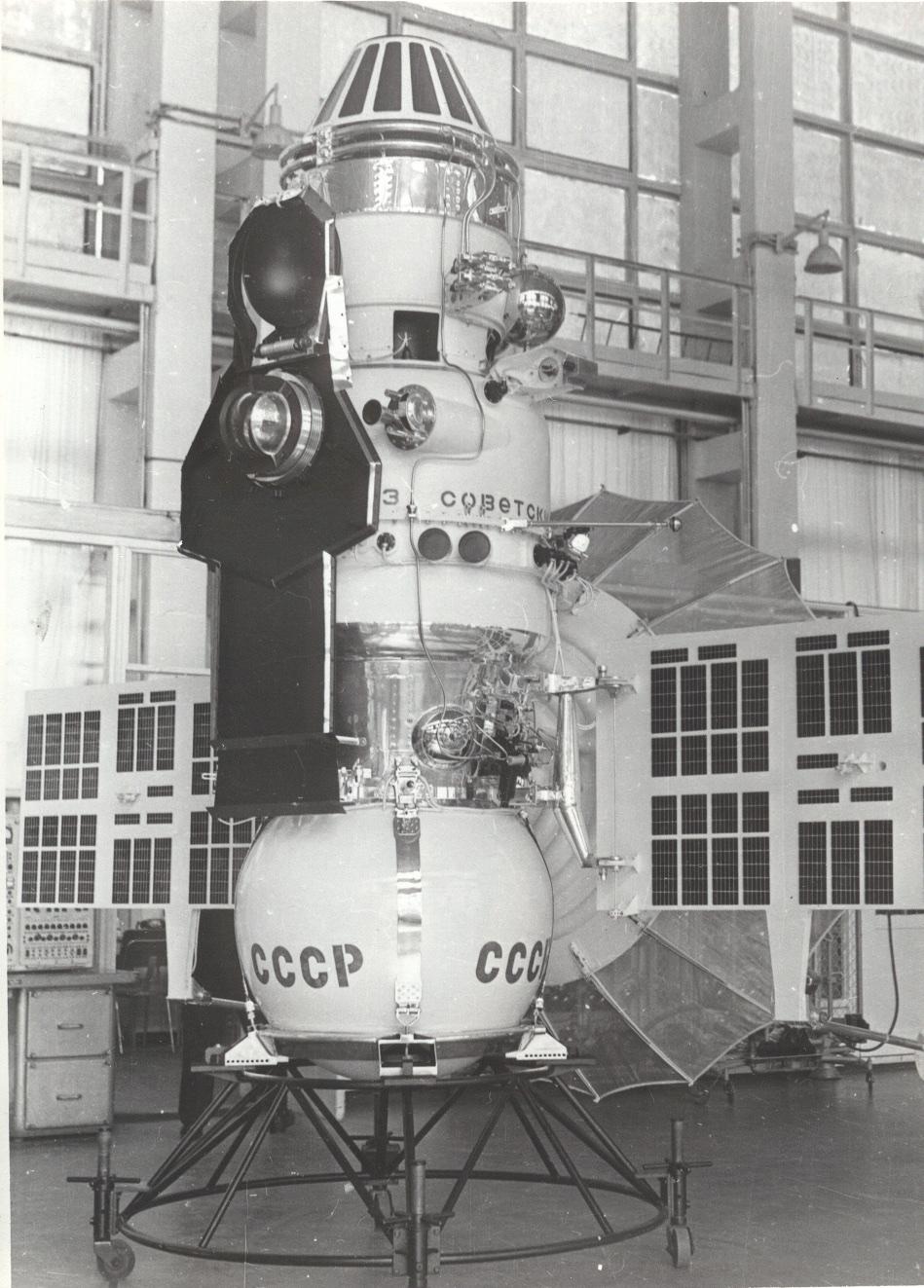
On 18 October 1967 a one-metre sphere under a parachute sent back 93 minutes of readings from inside the atmosphere of Venus. NASA's catalogue and Asif Siddiqi's NASA-published chronicle both record Venera 4 as the first spacecraft to transmit data from the atmosphere of another planet. What it returned was startling: a thermometer climbing from 33 to 262 °C, a barometer that ran off its scale, and about 90 percent carbon dioxide where nitrogen was assumed to be the main gas. The Soviet Union announced that the capsule had landed. It had stopped transmitting some 24 to 28 km above the ground, and scientists took nearly two years to agree on that.
Behind it lay a long run of failures. Pro Kosmos, a Russian space news site, counts eight failed Soviet attempts on Venus before 1965, and Venera 2 and 3, launched in November 1965, fell silent shortly before arrival because their equipment overheated, Lavochkin's own history records. The same year Sergei Korolev's OKB-1 handed its automatic lunar and planetary work to the Lavochkin plant and its new chief designer, Georgy Babakin, whose team, Lavochkin writes, built a craft with a single job: delivering a descent capsule into the atmosphere of Venus. Indexed V-67, it kept the basic 3MV layout inherited from OKB-1, in Siddiqi's words, though Lavochkin lists a new thermal control system, a substantially reworked power supply and a descent capsule designed anew.
The Academy of Sciences, led by Mstislav Keldysh since May 1961, set the requirements. Since Venera 3, Lavochkin records, it had raised its design values for the surface to 425 °C and 1 to 10 atmospheres; Shubin's chronology on the epizodsspace archive gives 475 °C, and neither quotes the document. The hull's rating is disputed. Mikhail Marov, who helped reduce the data, gives 10 bar with a design margin to 18 bar, and Pro Kosmos also says no more than 10 atmospheres. Don P. Mitchell's history gives 25 atmospheres, the figure Pro Kosmos attaches to the capsules Babakin ordered after Venera 4.
The capsule, close to a sphere 103 cm across, weighed 377 kg by Lavochkin's figure and 383 kg in NASA's catalogue, in Siddiqi and in the 1968 yearbook of the Great Soviet Encyclopaedia. It was built to float, in case of an ocean few believed in; Marov describes a sugar-based switch to signal a splashdown, which Shubin says was removed before flight. Its radio altimeter, Marov says, sent a single message when it sensed 26 km; Lavochkin describes it as built to mark five fixed heights, from 26 down to 2 km.
Babakin's team tested harder than OKB-1 had. Marov reports that a new centrifuge destroyed the capsule's internal components on its first run, at the 350 to 450 g expected for a steep entry; Shubin dates the centrifuge to the end of April 1967, says that first test broke the cable connectors, and has the capsule reworked from 1 May, six weeks before launch. At 1,106 kg, well above Venera 3's 960 kg, the craft needed the upgraded Molniya-M and its new Blok VL escape stage.
There were two of them. On 17 June 1967, five days after Venera 4, a second V-67 reached its parking orbit, where, Lavochkin says, the Blok VL failed; Siddiqi blames a turbopump that had not been chilled before ignition. Stranded, it became Kosmos 167 and re-entered on 25 June. In Pro Kosmos's words, 'Venera 4 flew alone.' NASA's Mariner 5 set off towards the same planet two days after Venera 4. Venera 4's one course correction, on 29 July, was oriented by the Sun alone and so accurate, Lavochkin says, that the planned second one was never needed.
Boris Chertok, of the bureau behind the earlier Veneras, watched the arrival with Keldysh at the tracking centre near Yevpatoria in the Crimea, and his memoir times it minute by minute. At 7:38 Moscow time came the separation command; the carrier's dish swung away from Earth and its signal vanished. At 7:44 the room heard the capsule. Allowing for the three hours between Moscow time and UT and the 4.3 light-minute delay that JPL's Horizons ephemeris gives, 7:38 matches Siddiqi's 04:34 UT release (NSSDCA attaches 04:34 to release and entry together). Marov gives the same 04:34 but places the separation 44,800 km above the night side; Lavochkin has it on entry.
Over the loudspeakers, as Chertok remembers it, came 28 km on the altimeter at 7:46; a pressure sensor off scale at 9.3 atmospheres at 8:53, to Keldysh's surprise; and silence at 9 h 14 min 09 s, above 280 degrees. Recalled decades later, several of these differ from the reduced data. The 1968 paper of the scientists who processed the data logs telemetry from 07:40:52 to 09:13:17 Moscow time, with the barometer off scale at 08:30:31. Lavochkin gives a barometer limit of 7.3 atmospheres, a final temperature of 262 °C and an altimeter mark of 26 km; Shubin, like Chertok, has 28 km, and silence at 9:13:31. The paper, Lavochkin, NSSDCA and Siddiqi say 93 minutes, though the paper's clock times span 92 minutes 25 seconds; Chertok's give about 90, and Pro Kosmos writes 1 hour 34 minutes.
The gas analysers delivered the result that has lasted: about 90 percent carbon dioxide (90 percent, with an error under 10 percent, in the yearbook; 90 to 95 in NSSDCA and Siddiqi) and very little water. The carbon dioxide came as a surprise, Marov writes, since the atmosphere had been expected to be at least half nitrogen; Mitchell records Carl Sagan arguing for 15 to 50 percent nitrogen and suggesting the instrument had malfunctioned. Later probes confirmed the Soviet figure, and the low water content, Marov writes, ended overnight the idea of Venus as a water planet (more on the atmosphere of Venus).
For months Moscow held that the capsule had reached the ground. The 1968 yearbook has Soviet pennants delivered to the surface for the second time, and a profile of readings that ends there at 270 °C and 20 atmospheres. Siddiqi quotes the official claim that the capsule 'continued transmitting until it actually touched the surface of the planet.' On the day, NASA Administrator James Webb called the landing 'an accomplishment any nation can be proud of', and in Science on 15 March 1968 D. E. Reese and P. R. Swan concluded that the data gave 'consistent and firm evidence' that Venera 4 had reached the surface.
An ambiguous instrument explains much of the error. The altimeter reported 26 km as soon as it switched on, which Lavochkin now says misled everyone; later estimates, it says, put the parachute's opening at 61 to 65 km, while Marov and NSSDCA have the instruments switching on near 55 km. A 26 km reading, Marov explains, could equally mean double that height, or zero, and Mitchell argues the radar worked but its ambiguity was resolved the wrong way. Much else seemed to fit: the final 262 °C and roughly 18 bar were close to what many then expected at the surface.
Evidence against the landing came from three directions. Microwave measurements from Earth implied a surface of at least 325 °C, Marov writes, and a reanalysis that Mitchell credits to the Soviet radio astronomer Arkady Kuz'min, using Venera 4's own composition, raised the estimate to about 427 °C. Earth-based radar put the solid surface well below the last reading. And on 19 October Mariner 5 sent its radio signal through the atmosphere as it flew past; its profile, Mitchell notes, matched Venera 4's once Venera 4's composition was used to convert refractivity to density.
The Venera 4 scientists held to the landing at first. In their July 1968 paper in the Journal of the Atmospheric Sciences, Avduevsky, Marov and Rozhdestvensky still took the loss of signal as touchdown, at 544 K (271 °C) and most probably 18.5 kg/cm², and called the 800 K and 130 kg/cm² that Mariner 5 implied with a 6,056 km radar radius 'unreasonably high'. At COSPAR in Tokyo that May, Kuz'min suggested the capsule might have landed on a high mountain; Sagan replied that the batteries had died first and that radar showed no such relief. Meetings over the next two years, Marov says, settled that it had stopped high above the ground, and Soviet news agencies then announced, Mitchell writes, that it had not reached the surface.
Where it stopped depends on the analysis. By Marov's account the same three scientists changed their reading in 1969: the capsule ceased to exist about 24 km up at 18 ± 2.5 bar, and extrapolating to the ground they predicted 442 °C and 90 bar, values Marov says later measurements confirmed brilliantly. Lavochkin recalculates 17 to 20 atmospheres at 262 °C and puts the altitude near 28 km, as does Siddiqi. NASA's catalogue has roughly 25 km, 22 bar and 277 °C; Pro Kosmos 25 km, 271 °C and 17 to 20 atmospheres; Mitchell about 23 km (from his table of radii), 271 °C and about 18.5 atmospheres. Chertok writes that Venera 5 and 6 in May 1969 supported a crush at 25 to 27 km. All are model results, since the height of the last reading was never measured.
Why it went silent is also unsettled. Marov and Pro Kosmos say the pressure exceeded the capsule's design, Siddiqi that pressure and temperature damaged it, and Chertok that it was crushed. Mitchell argues the more likely cause was the battery, rated for about 100 minutes and silent at 93, and calls popular accounts of a violent implosion 'probably melodramatic'. NASA's catalogue offers both, and Marov allows that the batteries may also have run down. Chertok adds a coda: at 9:30 a signal came back for a moment, clean, with no telemetry and no noise, and was gone. Then, Marov and Mitchell write, the parachute probably burned away and the sphere fell to the surface.
Three sources print 19° N, 38° E: NASA's catalogue as the point the probe was over, Marov as where it was first concluded to have landed, Mitchell as where it came down. Siddiqi prints 19° N, 36° E for the impact, about 200 km away. None gives a method, a longitude system or an error. Lavochkin and the 1968 yearbook describe only the entry: night side, near the equator, about 1,500 km from the terminator (the morning one, says Lavochkin), within 500 km. In JPL's Horizons ephemeris for 04:34 UT (today's IAU longitudes), both printed positions lie 108 to 111 degrees from the subsolar point, matching Marov's solar zenith angle of 110 degrees, while the verbal description, placed on the equator, lands near 0°, 30° E: about 2,100 km away, close to the centre of the Earth-facing disk where Marov and Mitchell say the capsule was aimed. No source reconciles the two, and azmth has found no re-determination of the site from Magellan-era maps.
Before it burned up, the carrier returned science of its own: a hydrogen corona extending about 10,000 km from the planet and a magnetic dipole moment no more than three ten-thousandths of Earth's. Cosmic-ray counts held steady down to 5,000 km and then fell as the planet blocked part of the sky, which the yearbook reads as evidence that Venus has no radiation belts.
Babakin, in Pro Kosmos's account, took from Venera 4 that the pressure was far above 10 atmospheres and ordered the next capsules built for 25; those flew as Venera 5 and 6 in 1969 and led to Venera 7, which landed in December 1970. When the signal died, Chertok recalls him telling the room that clearly they had not flown in vain. Chertok also recalls Babakin reporting to Keldysh's council on Venera 7 and the plans for Venera 8. Babakin died suddenly on 3 August 1971; Keldysh died on 24 June 1978.
Venera 4 measured the air of another planet from the inside and came within about 25 km of its surface. Its readings set the 25-atmosphere requirement for the next capsules, and its misread altimeter produced a landing claim that took two years to retire. The capsule and its pennants lie somewhere on the night side it fell towards in 1967, one of the objects on what we left at Venus.
Mission facts
Organisations
USSR: Lavochkin design bureau (chief designer Georgy Babakin), USSR Academy of Sciences
Venera 4: designations
V-67 in Lavochkin's own history; 1V (V-67) No. 310 in Siddiqi; 4V-1 No. 310 in Jonathan McDowell's catalogue; COSPAR 1967-058A.
Venera 4: launch
12 June 1967 at 02:39:45 UT from Baikonur (NIIP-5, Site 1/5) on a Molniya-M (8K78M), fired towards Venus from a parking orbit by the Blok VL escape stage, flying for the first time.
Venera 4: mass
1,106 kg in all. The descent capsule is 377 kg in Lavochkin's figure and 383 kg in NSSDCA, Siddiqi and the 1968 yearbook of the Great Soviet Encyclopaedia. Venera 3 had weighed 960 kg, so a heavier rocket was needed.
Capsule: construction
Near-spherical, 103 cm across, with a parachute compartment and an instrument compartment, both sealed; the instrument compartment was pressurised to 2 atm for stiffness. A subliming heat shield covered glass-textolite honeycomb insulation. Sterilised before launch.
Capsule: design limits
The Academy of Sciences specified 425 °C and 1 to 10 atm at the surface (Lavochkin; Shubin gives 475 °C). Marov gives a hull rating of 10 bar with margin to 18 bar and a parachute rated to 400 °C; Pro Kosmos gives no more than 10 atm; Mitchell gives 25 atm.
Capsule: power and radio
A 28 ampere-hour battery sized for about 100 minutes; two transmitters on 922.8 MHz sending 1 bit per second direct to Earth through a low-gain antenna, one set of readings every 48 seconds.
Capsule: instruments
Two resistance thermometers (270 to 600 K and 210 to 730 K), aneroid barometer, beta-ray density gauge, 11 gas-analyser cells in two units (G-8 and G-10) and the Vysota radio altimeter, which Lavochkin describes as built to mark five fixed heights (26, 14, 9, 4.5 and 2 km); Shubin says it sent only one. Lavochkin's list rates the pressure sensors at 0.13 to 6.8 atm; its text gives a 7.3 atm upper limit, and the 1968 paper of the scientists who reduced the data gives 0.13 to 7.3 kg/cm².
Bus: instruments
Siddiqi lists an SG-59M three-axis magnetometer, four ion traps, STS-5 and SBT-9 gas-discharge counters, radiation detectors, KS-18-2M cosmic-ray counters and an LA-2 spectrometer, which Lavochkin says measured hydrogen and oxygen. Lavochkin puts the magnetometer on a 3.5 m boom.
Parachutes
A 2.2 m² drogue (Marov describes it as 2.5 m) and a 55 m² main canopy. NSSDCA's spacecraft record calls the main a '55 meter' parachute; its descent-craft record gives the same number as square metres.
Arrival timing
Capsule released at 04:34 UT on 18 October 1967 (Siddiqi; NSSDCA gives 04:34 UT for release and entry together). Chertok, at the Yevpatoria tracking centre, logged the separation report at 7:38 Moscow time (04:38 UT) as received on Earth. JPL Horizons puts Venus 0.522 AU away that morning, 4.3 light-minutes.
Length of descent
93 minutes (Lavochkin, NSSDCA, Siddiqi, the 1968 yearbook, and Avduevsky, Marov and Rozhdestvensky in 1968, although their telemetry times, 07:40:52 to 09:13:17 Moscow time, span 92 minutes 25 seconds). Pro Kosmos writes 1 hour 34 minutes. Chertok's clock gives about 90 minutes, from first capsule signal at 7:44 to loss at 9:14:09 Moscow time; Shubin gives the loss as 9:13:31.
Last readings
262 °C with 17 to 20 atm recalculated (Lavochkin); 544 ± 10 K (271 °C) and a most probable 18.5 kg/cm², then read as surface values (Avduevsky, Marov and Rozhdestvensky, July 1968); 18 ± 2.5 bar (the same authors, 1969, as given by Marov); 271 °C and an estimated 18.5 atm (Mitchell); 271 °C and 17 to 20 atm at 25 km (Pro Kosmos); 277 °C and 22 bar (NSSDCA).
Altitude when silent
About 24 km (Avduevsky, Marov and Rozhdestvensky, 1969, per Marov), roughly 25 km (NSSDCA; Chertok; Pro Kosmos), 27 km (Novosti Kosmonavtiki, 1992), about 28 km (Lavochkin; Siddiqi). Mitchell's table puts the last transmission 6,075 km from the centre, about 23 km above the modern radius, and he says pressure may have breached the hull near 22 km. None was measured directly.
Atmosphere composition
Carbon dioxide 90 percent with an error under 10 percent (1968 yearbook) or 90 to 95 percent (NSSDCA, Siddiqi); nitrogen under 7 percent on one sensor and under 2.5 percent on the other (Shubin; the yearbook gives the first, Marov the second); oxygen 0.4 to about 1.5 percent; little water.
Bus: findings
A hydrogen corona reaching about 10,000 km and roughly 1,000 times thinner than Earth's upper-atmosphere hydrogen; no atomic oxygen; no radiation belts; a dipole moment under 3/10,000 of Earth's; fewer than 1,000 ions per cm³ above 100 km.
Where it came down
19° N, 38° E (NSSDCA, which puts the probe 'over the Eisila region' there; Marov; Mitchell) or 19° N, 36° E (Siddiqi), about 200 km apart. Lavochkin and the 1968 yearbook give only a verbal entry point: night side, near the equator, about 1,500 km from the terminator (the morning terminator, in Lavochkin).
Kosmos 167
The twin, V-67 No. 311, launched 17 June 1967 at 02:36:38 UT. The Blok VL did not fire (its turbopump had not been chilled before ignition, per Siddiqi); orbit 187 by 262 km at 51.8° (McDowell; epizodsspace lists 286/201 km and 89.2 min); re-entered 25 June 1967.
Site: 19°N, 38°E · Eisila region · position estimated (source)
Mission timeline
- 2 Mar 1965Georgy Babakin is appointed chief designer of the Lavochkin plant; in the same year Korolev's OKB-1 hands it all automatic lunar and planetary work.
- Jan to May 1967New test facilities: a thermal-vacuum chamber finished in January (Marov) and a centrifuge commissioned at the end of April (Shubin). The first centrifuge test damages the capsule's internals and forces a rework from 1 May.
- 12 Jun 1967Venera 4 (V-67 No. 310) leaves Baikonur at 02:39:45 UT on a Molniya-M, on the first flight of the Blok VL escape stage.
- 14 Jun 1967NASA launches Mariner 5 towards Venus at 06:01 UT, a flyby with no camera.
- 17 Jun 1967The twin, V-67 No. 311, launches at 02:36:38 UT. The first three stages work, the Blok VL does not, and the stranded craft is named Kosmos 167.
- 25 Jun 1967Kosmos 167 re-enters Earth's atmosphere, eight days after launch.
- 29 Jul 1967The only trajectory correction, 12 million km from Earth, oriented by the Sun alone. The planned second correction is never needed.
- 18 Oct 1967About two hours out and 45,000 km from Venus, the craft is turned on command from Earth to aim its dish at Earth. The capsule is released at 04:34 UT, enters at about 11 km/s and brakes at up to 300 g (Lavochkin) or 350 g (Marov); the bus transmits until it breaks up.
- 18 Oct 196793 minutes of parachute descent at 1 bit per second: the temperature climbs from 33 to 262 °C while the pressure gauge goes off scale at its 7.3 atmosphere limit, until contact is lost.
- 18 Oct 1967Moscow announces that the capsule reached the surface; NASA Administrator James Webb calls the landing an accomplishment any nation can be proud of.
- 19 Oct 1967Mariner 5 passes 4,094 km above Venus (10,151 km from the centre) at 17:34:56 UT; its radio occultation profile becomes part of the case that Venera 4 stopped high above the ground.
- 15 Mar 1968D. E. Reese and P. R. Swan argue in Science that the data give 'consistent and firm evidence' Venera 4 reached the surface.
- Mar to May 1968Soviet and American scientists compare results at the Kitt Peak conference in Arizona in March and at COSPAR in Tokyo in May, where Kuz'min proposes a landing on a mountain and Sagan rejects it.
- Jul 1968Avduevsky, Marov and Rozhdestvensky publish their Venera 4 atmosphere model in the Journal of the Atmospheric Sciences (received 18 March). They still treat the loss of signal as the end of the descent, with a surface of 544 K and a most probable 18.5 kg/cm².
- 1969By Marov's later account, Avduevsky, Marov and Rozhdestvensky now place the end of transmission about 24 km up at 18 ± 2.5 bar and extrapolate 442 °C and 90 bar at the surface.
- 16 to 17 May 1969The capsules of Venera 5 and 6 descend; Chertok writes that they confirmed Venera 4 had been crushed at 25 to 27 km.
- 3 Aug 1971Babakin dies suddenly; he is buried at Novodevichy cemetery in Moscow.
- 24 Jun 1978Keldysh dies, three years after stepping down as president of the Academy.
A filled dot marks something that physically happened. A hollow one marks an announcement, a naming or a target.
In pictures
Tap a photo to enlarge.
Translated from the original sources
Passages from the Russian sources this page draws on, in azmth's translation. Tap Show original to read the original wording.
NPO Lavochkin: Automatic interplanetary station Venera-4
Russian · 10 passages
NPO Lavochkin: Automatic interplanetary station Venera-4 (project page)
Open the source“Because, since the launch of Venera-3, the Academy of Sciences had revised its model of the atmosphere of Venus and in the technical specification for the craft set higher design values of temperature (425 °C against 330 to 350 °C for Venera-3) and pressure (1 to 10 atmospheres against 1.5 to 5) at the surface of the planet, the descent capsule had to be designed anew.”
azmth's translation · Show originalHide original
Russian: «В связи с тем, что с момента старта «Венеры-3» Академия наук пересмотрела модель атмосферы Венеры и в техническом задании на аппарат привела более высокие расчетные значения температуры (425°С против 330-350°С для «Венеры-3») и давления (1-10 атмосфер против 1,5-5) у поверхности планеты, пришлось заново проектировать спускаемый аппарат.»
“Because of the shortage of time (a little more than a year remained before the next launch 'window' of 1967 for a flight to Venus), it was decided to limit the work to building a craft only for delivering a descent capsule into the atmosphere of Venus.”
azmth's translation · Show originalHide original
Russian: «В связи с дефицитом времени (до очередного пускового «окна» 1967 года для полета к Венере оставалось чуть больше года) решено было ограничится созданием аппарата только для доставки спускаемого аппарата в атмосферу Венеры.»
“The station Venera-3 was taken as the basis for creating the V-67 automatic stations; however, following the results of its flight, some changes were made to the design.”
azmth's translation · Show originalHide original
Russian: «За основу при создании автоматических станций В-67 была взята станция «Венера-3», однако, по результатам ее полета в конструкцию были внесены некоторые изменения.»
“However, the station did not enter the interplanetary trajectory because of the failure of the VL upper stage. The craft, which received the name Kosmos-167, remained in Earth orbit.”
azmth's translation · Show originalHide original
Russian: «Однако на межпланетную траекторию станция не вышла вследствие отказа разгонного блока ВЛ. Аппарат, получивший название «Космос-167», остался на околоземной орбите.»
“During the flight, on 29 July 1967, at a distance of 12 million kilometres from Earth, a 'solar' trajectory correction (with orientation by the Sun alone) was carried out with the propulsion system, which removed the injection errors.”
azmth's translation · Show originalHide original
Russian: «В ходе перелета 29 июля 1967 года на расстоянии 12 миллионов километров от Земли с помощью двигательной установки была проведена «солнечная» (с ориентацией только по Солнцу) коррекция траектории, позволившая ликвидировать ошибки выведения.»
“On entering the atmosphere of Venus, which happened on the night side of the planet in the equatorial region 1,500 km from the morning terminator, the descent capsule experienced loads of 300 g.”
azmth's translation · Show originalHide original
Russian: «Спускаемый аппарат при входе в атмосферу Венеры, который произошел на ночной стороне планеты в районе экватора в 1500 км от утреннего терминатора, испытал перегрузки в 300 единиц.»
“Immediately on switch-on the radio altimeter gave the mark corresponding to 26 kilometres, which misled everyone. This fact gave grounds for claiming for some time that the descent capsule of Venera-4 had landed on the surface of the planet. In reality, by later estimates, the parachute opened at an altitude of 61 to 65 km.”
azmth's translation · Show originalHide original
Russian: «Сразу при включении радиовысотомер выдал метку соответствующую 26 километрам, что ввело всех в заблуждение. Этот факт дал повод некоторое время утверждать, что спускаемый аппарат станции «Венера-4» совершил посадку на поверхность планеты. На самом деле, по последующим оценкам, парашют раскрылся на высоте 61-65 км.»
“Pressure and density were measured until the instruments went off scale, since the upper limit of the manometer was 7.3 atmospheres. Only the temperature measurement continued throughout the parachute descent, for 93 minutes until contact was lost. Over this time the temperature changed from 33 to 262 °C. After recalculating the readings of pressure, density and temperature, a pressure of 17 to 20 atmospheres was obtained, corresponding to a temperature of 262 °C. In turn, such atmospheric parameters corresponded to an altitude of about 28 km.”
azmth's translation · Show originalHide original
Russian: «Давление и плотность измерялись вплоть до зашкаливания приборов, поскольку верхний предел манометра составлял 7,3 атмосферы. Только измерение температуры проводилось в течение всего спуска аппарата на парашюте в течение 93 минут до момента пропадания связи. За это время температура изменялась от 33 до 262°С. После пересчета показаний давления, плотности и температуры, было получено значение величины давления 17-20 атмосфер, соответствующее температуре 262°С. В свою очередь, такие параметры атмосферы соответствовали высоте ~28 км.»
“The gas analysers showed a predominant content of carbon dioxide in the atmosphere of Venus (about 90 percent) and a quite insignificant content of oxygen and water vapour.”
azmth's translation · Show originalHide original
Russian: «Газоанализаторы показали преимущественное содержание в атмосфере Венеры углекислого газа (~90%) и совсем незначительное содержание кислорода и водяного пара.»
“The scientific instruments of the orbital module of Venera-4 showed that Venus has no radiation belts, and the planet's magnetic field turned out to be 3,000 times weaker than Earth's. In addition, the solar ultraviolet indicator detected a hydrogen corona of Venus containing about 1,000 times less hydrogen than Earth's upper atmosphere. Atomic oxygen was not detected by the indicator.”
azmth's translation · Show originalHide original
Russian: «Научные приборы орбитального аппарата станции «Венера-4» показали отсутствие у Венеры радиационных поясов, а магнитное поле планеты оказалось в 3000 раз слабее магнитного поля Земли. Кроме того, с помощью индикатора УФ–излучения Солнца была обнаружена водородная корона Венеры, содержащая примерно в 1000 раз меньше водорода, чем верхняя атмосфера Земли. Атомарный же кислород индикатором обнаружен не был.»
epizodsspace: Venera-4 dossier
Russian · 17 passages
epizodsspace: Venera-4 dossier (1968 Great Soviet Encyclopaedia yearbook, Novosti Kosmonavtiki 1992, a section headed 'Marov' that appears to translate chapter 10 of Huntress and Marov's Soviet Robots in the Solar System, Shubin, and a Russian translation of Siddiqi), Web Archive copy of 27 May 2024
Open the source“[1968 yearbook of the Great Soviet Encyclopaedia] The station's descent capsule descended smoothly in the atmosphere of the planet. Pennants of the Soviet Union were delivered to the surface of the planet for the second time (fig. 6).”
azmth's translation · Show originalHide original
Russian: «Спускаемый аппарат станции плавно спустился в атмосфере планеты. На поверхность планеты второй раз были доставлены вымпелы Советского Союза (рис. 6).»
“[1968 yearbook] Radio measurements established that the station's deviation from the calculated trajectory at Venus would be 160,000 km.”
azmth's translation · Show originalHide original
Russian: «С помощью радиоизмерений было установлено, что отклонение станции от расчетной траектории у Венеры составит 160 тыс. км.»
“[1968 yearbook] The place where the station entered the atmosphere of the planet (to an accuracy of 500 km) is on the night side of Venus, near the equator, about 1,500 km from the terminator.”
azmth's translation · Show originalHide original
Russian: «Место входа станции в атмосферу планеты (с точностью до 500 км) находится на ночной стороне Венеры, вблизи экватора на расстоянии ок. 1500 км от терминатора.»
“[1968 yearbook] The temperature of the atmosphere from an altitude of 26 plus or minus 1.3 km to the surface changes linearly from 25 plus or minus 10 °C to 270 plus or minus 10 °C. The pressure at the same heights changes from 0.7 to 20 atmospheres.”
azmth's translation · Show originalHide original
Russian: «Температура атмосферы от высоты 26 ±1,3 км до поверхности изменяется линейно от 25°±10°С до 270°± 10°С. Давление на этих же высотах изменяется от 0,7 до 20 атмосфер.»
“[Novosti Kosmonavtiki, 1992, no. 21] 18 October 1992 marked 25 years since the first descent of a spacecraft in the atmosphere of another planet. It was the descent capsule of the Soviet interplanetary station Venera-4. As a result, the parameters of the atmosphere of Venus were measured directly down to an altitude of 27 km.”
azmth's translation · Show originalHide original
Russian: «18 октября 1992 г. исполнилось 25 лет первому спуску космического аппарата в атмосфере другой планеты. Им был спускаемый аппарат советской межпланетной станции "Венера-4". В результате удалось напрямую измерить параметры атмосферы Венеры до высоты 27 км.»
“[Marov] The descent capsule was designed for a pressure of 10 bar, although the upper bound (with the design margin) could reach 18 bar, and the maximum temperature for the parachute was 400 °C.”
azmth's translation · Show originalHide original
Russian: «Спускаемый аппарат был рассчитан на давление 10 бар, хотя верхняя граница (с учетом конструкторского запаса) могла достигать 18 бар, а максимальная температура для парашюта составляла 400°С.»
“[Marov] But, as usual, medallions with the coat of arms of the USSR and a bas-relief of Lenin were placed in the capsule.”
azmth's translation · Show originalHide original
Russian: «Но, как обычно, в капсулу были заложены медальоны с гербом СССР и барельефом Ленина.»
“[Marov] The Jodrell Bank radio observatory reported receiving signals from the surface of Venus, not understanding that the signals were sent during the descent through the atmosphere.”
azmth's translation · Show originalHide original
Russian: «Радиообсерватория Джодрелл Бэнк сообщила о получении сигналов с поверхности Венеры, не понимая, что сигналы были посланы во время спуска в атмосфере.»
“[Marov] The radio altimeter, based on an aviation radar altimeter, was intended to count the altitude during the descent, but a defect was built into its design, so that its reading at a height of 26 km could in fact correspond to a signal answering either to double the height, 52 km, or to 0 km.”
azmth's translation · Show originalHide original
Russian: «Радиовысотомер, основой которого послужил авиационный радиолокационный альтиметр, предназначался для отсчета высоты в процессе спуска аппарата, но в его конструкции был заложен дефект поэтому его показаниям на высоте 26 км мог фактически соответствовать сигнал, отвечающий как удвоенной высоте 52 км, так и 0 км.»
“[Marov] Soon afterwards, having reconsidered the whole body of data, the authors of the direct measurements, Avduevsky, Marov and Rozhdestvensky (1969), concluded that the descent capsule of Venera-4 ceased to exist at an altitude of about 24 km above the surface at an atmospheric pressure of 18 plus or minus 2.5 bar.”
azmth's translation · Show originalHide original
Russian: «Вскоре после этого, переосмыслив всю совокупность полученных данных, авторы прямых измерений Авдуевский, Маров и Рождественский (1969) пришли к выводу, что спускаемый аппарат «Венеры-4» прекратил существование на высоте около 24 км над поверхностью при давлении атмосферы 18±2,5 бар.»
“[Marov] Using the adiabatic model of the Venusian atmosphere as the most probable, they extrapolated these data to the surface corresponding to the radar radius of Venus and obtained 442 °C and 90 bar. These values were brilliantly confirmed by later measurements.”
azmth's translation · Show originalHide original
Russian: «Использовав, как наиболее вероятную, адиабатическую модель венерианской атмосферы, они экстраполировали эти данные к поверхности, отвечающей радиолокационному радиусу Венеры, и получили значения 442°С и 90 бар. Эти значения блестяще подтвердились результатами последующих измерений.»
“[Marov] Transmission from the descent capsule stopped when the atmospheric pressure (18 bar) proved to be its limit. It is possible, however, that by that moment, after 93 minutes of operation, the onboard batteries had discharged.”
azmth's translation · Show originalHide original
Russian: «Передача сигнала со спускаемого аппарата прекратилась, когда значение атмосферного давления (18 бар) оказалось для него предельным. Возможно, однако, что к этому моменту, после 93 минут работы, разрядились бортовые аккумуляторы.»
“[Marov] The station reached Venus on 18 October and at 04:34, at an altitude of 44,800 km above the night side of the planet, separated the descent capsule.”
azmth's translation · Show originalHide original
Russian: «Станция достигла Венеры 18 октября и в 04:34, находясь на высоте 44 800 км над ночной стороной планеты, отделила спускаемый аппарат»
“[Marov] It was concluded that the descent capsule had reached the surface at a point with coordinates 19 degrees north latitude and 38 degrees east longitude on the dark side of Venus near the morning terminator. Local solar time in this region of Venus was 4:40, and the solar zenith angle was 110 degrees.”
azmth's translation · Show originalHide original
Russian: «Был сделан вывод, что спускаемый аппарат достиг поверхности в точке с координатами 19° северной широты и 38° восточной долготы на темной стороне Венеры вблизи утреннего терминатора. Местное солнечное время в этом районе Венеры было 4:40 часов, а зенитный угол Солнца был равен 110°.»
“[Shubin] Parameters for Venus from the USSR Academy of Sciences: pressure 1 to 10 atm, temperature 475 degrees.”
azmth's translation · Show originalHide original
Russian: «Параметры на Венеру от АН СССР: давление 1-10 атм, температура 475°.»
“[Shubin] At the end of April 1967 a new centrifuge was put into service. At the very first test the connectors of the cable network were destroyed. From 1 May the descent capsule was being reworked.”
azmth's translation · Show originalHide original
Russian: «В конце апреля 1967 была сдана в эксплуатацию новая центрифуга. При первом же испытании разрушились разъёмы кабельной сети. 1 мая СА переделывали.»
“[Shubin] The signal from the descent capsule disappeared at 9:13.31; the pressure sensor had stopped, as it should, at 7 atm.”
azmth's translation · Show originalHide original
Russian: «Сигнал с СА пропал в 9:13.31 датчик давления остановился, как и положено на 7 атм.»
Boris Chertok, Rockets and People, vol. 3, chapter 'On the distant star Venus', on astronaut.ru
Russian · 7 passages
“[Chertok, quoting Vasily Mishin on 17 October 1967] Today Keldysh is flying to the Crimea with the minister. You must fly with them.”
azmth's translation · Show originalHide original
Russian: «Сегодня в Крым вылетает Келдьш с министром. Ты должен лететь с ними.»
“At 7 hours 38 minutes, the report [that the separation command had been given, the bus signal had vanished and separation had occurred].”
azmth's translation · Show originalHide original
Russian: «В 7 часов 38 минут доклад:»
“At 7 hours 44 minutes delighted shouts ring out [as the capsule's signal and telemetry are received].”
azmth's translation · Show originalHide original
Russian: «В 7 часов 44 минуты раздаются восторженные вопли:»
“[Keldysh, as recalled by Chertok] But our planetologists did not at all expect that the pressure could be so high. Now we will not learn the true value at the surface. We should have had another sensor with a larger range.”
azmth's translation · Show originalHide original
Russian: «А наши планетологи вовсе не ожидали, что давление может быть таким высоким. Теперь мы не узнаем истинной величины у поверхности. Надо было бы иметь и другой датчик на больший диапазон.»
“[Babakin, as recalled by Chertok] Now it is clear we did not fly in vain! Nobody will be planning expeditions to Venus!”
azmth's translation · Show originalHide original
Russian: «Теперь ясно, не зря летели! Экспедиции планировать на Венеру никто не станет!»
“9 hours 14 minutes 09 seconds [Moscow time]: the moment Chertok records the capsule's signal disappearing, with the temperature above 280 degrees.”
azmth's translation · Show originalHide original
Russian: «9 часов 14 минут 09 секунд»
“After careful processing of all the material it was proved that the descent capsule of Venera-4 had stopped some twenty-five kilometres short of the surface.”
azmth's translation · Show originalHide original
Russian: «После тщательной обработки всех материалов было доказано, что СА «Венеры-4» не дошел до поверхности километров двадцать пять.»
Boris Chertok, Rockets and People, vol. 3
Russian · 1 passage
Boris Chertok, Rockets and People, vol. 3 (Hot Days of the Cold War), contents page, on astronaut.ru
Open the source“Rockets and People. Hot Days of the Cold War. Book three”
Heading of astronaut.ru's contents page for the book, line breaks removed. The chapter cited on this page, 'On the distant star Venus...', sits in its chapter 6, 'From Venus to Earth'.
azmth's translation · Show originalHide original
Russian: «РАКЕТЫ И ЛЮДИ. ГОРЯЧИЕ ДНИ ХОЛОДНОЙ ВОЙНЫ Книга третья»
Pro Kosmos (prokosmos.ru): Igor Marinin, 'Conqueror of planets Georgy Babakin', 13 November 2024
Russian · 5 passages
“By order of the chairman of the State Committee for Aviation Technology of 2 March 1965, Georgy Nikolayevich was appointed chief designer, and the plant itself became an independent lead enterprise.”
azmth's translation · Show originalHide original
Russian: «Приказом председателя Госкомитета по авиационной технике от 2 марта 1965 года Георгий Николаевич был назначен главным конструктором, а сам завод стал самостоятельным головным предприятием.»
“The report from the descent capsule ran for 1 hour 34 minutes until it was destroyed, since it was designed for a pressure of no more than 10 atmospheres.”
azmth's translation · Show originalHide original
Russian: «Репортаж со спускаемого аппарата шел 1 час 34 минуты, пока он не разрушился, так как был рассчитан на давление не более 10 атмосфер.»
“Venera-4 flew alone. The twin station remained in Earth orbit.”
azmth's translation · Show originalHide original
Russian: ««Венера-4» летела в одиночестве. Станция-близнец осталась на околоземной орбите.»
“On the recommendation of the president of the USSR Academy of Sciences, Mstislav Keldysh, the Higher Attestation Commission awarded Babakin the degree of doctor of technical sciences without the defence of a dissertation.”
azmth's translation · Show originalHide original
Russian: «по представлению президента Академии наук СССР Мстислава Келдыша, решением Высшей аттестационной комиссии Бабакину была присуждена ученая степень доктора технических наук без защиты диссертации.»
“Having understood that on Venus the pressure was considerably higher than 10 atmospheres and the temperature above 270 degrees, Babakin gave instructions to bring the working capability of the descent capsules of the Venus stations up to 25 atmospheres.”
azmth's translation · Show originalHide original
Russian: «Поняв, что на Венере давление значительно выше 10 атмосфер, а температура выше 270 градусов, Бабакин дал поручение довести работоспособность спускаемых аппаратов венерианских станций до 25 атмосфер.»
Presidential Library: Georgy Nikolayevich Babakin
Russian · 2 passages
Presidential Library: Georgy Nikolayevich Babakin (1914 to 1971)
Open the source“In 1965 G. N. Babakin becomes chief designer of the lead rocket-building organisation NPO named after S. A. Lavochkin, where he sets about creating automatic interplanetary stations for flights to the Moon and the planets of the Solar System.”
azmth's translation · Show originalHide original
Russian: «В 1965 году Г. Н. Бабакин становится главным конструктором головной организации ракетостроения НПО имени С. А. Лавочкина, где он приступает к созданию автоматических межпланетных станций для полётов к Луне и планетам Солнечной системы.»
“On 3 August 1971 Georgy Nikolayevich died suddenly; he is buried at Novodevichy cemetery in Moscow.”
azmth's translation · Show originalHide original
Russian: «3 августа 1971 года Георгий Николаевич скоропостижно скончался, он похоронен на Новодевичьем кладбище в Москве.»
Keldysh Institute of Applied Mathematics: pages in memory of M. V. Keldysh
Russian · 4 passages
“19 May 1961 to 19 May 1975: President of the USSR Academy of Sciences.”
azmth's translation · Show originalHide original
Russian: «1961 г. (19 мая) – 1975 г. (19 мая) - Президент Академии наук СССР.»
“1956: appointed chairman of the Interdepartmental Scientific and Technical Council for Space Research (MNTS po KI).”
azmth's translation · Show originalHide original
Russian: «1956 г. - Назначен председателем МНТС по КИ.»
“Not for nothing did journalists dub him the 'Chief Theoretician of Cosmonautics'.”
azmth's translation · Show originalHide original
Russian: «Не зря журналисты окрестили его "Главным теоретиком космонавтики".»
“1978, 24 June: died suddenly.”
azmth's translation · Show originalHide original
Russian: «1978 г. - 24 июня скоропостижно скончался.»
epizodsspace: Kosmos-167 dossier, Web Archive copy of 16 January 2025
Russian · 1 passage
“Back-up of Venera-4, a craft of the same type, model 1V (V-67) No. 311. Upper-stage failure. Remained in Earth orbit and received the name Kosmos-167.”
azmth's translation · Show originalHide original
Russian: «Дублёр "Венеры-4", однотипный с ним КА модели 1В (В-67) №311. Отказ РБ. Остался на орбите ИСЗ, получил название "Космос-167".»
Sources
- NPO Lavochkin: Automatic interplanetary station Venera-4 (project page) · in Russian
- epizodsspace: Venera-4 dossier (1968 Great Soviet Encyclopaedia yearbook, Novosti Kosmonavtiki 1992, a section headed 'Marov' that appears to translate chapter 10 of Huntress and Marov's Soviet Robots in the Solar System, Shubin, and a Russian translation of Siddiqi), Web Archive copy of 27 May 2024 · in Russian
- epizodsspace: Kosmos-167 dossier, Web Archive copy of 16 January 2025 · in Russian
- Boris Chertok, Rockets and People, vol. 3, chapter 'On the distant star Venus', on astronaut.ru · in Russian
- Boris Chertok, Rockets and People, vol. 3 (Hot Days of the Cold War), contents page, on astronaut.ru · in Russian
- Pro Kosmos (prokosmos.ru): Igor Marinin, 'Conqueror of planets Georgy Babakin', 13 November 2024 · in Russian
- Presidential Library: Georgy Nikolayevich Babakin (1914 to 1971) · in Russian
- Keldysh Institute of Applied Mathematics: pages in memory of M. V. Keldysh · in Russian
- NSSDCA Master Catalog: Venera 4, 1967-058A (Web Archive copy of 14 August 2025; the live catalogue still returned an error page on 5 November 2026)
- NSSDCA Master Catalog: Venera 4 Descent Craft, 1967-058E (Web Archive copy of 15 August 2025)
- NSSDCA Master Catalog: Cosmos 167, 1967-063A (Web Archive copy of 13 August 2025)
- Asif A. Siddiqi, Beyond Earth: A Chronicle of Deep Space Exploration, 1958 to 2016 (NASA, 2018), entries 82 to 84
- Don P. Mitchell, 'Plumbing the Atmosphere of Venus' (mentallandscape.com)
- Jonathan McDowell, General Catalog of Artificial Space Objects (satcat), rows 1967-058A and 1967-063A
- JPL Horizons: Venus as seen from Earth, 18 October 1967 04:30 to 06:30 UT (DE441)
- Reese and Swan, 'Venera 4 Probes Atmosphere of Venus', Science 159 (1968), abstract via Crossref
- Avduevsky, Marov and Rozhdestvensky, 'Model of the Atmosphere of the Planet Venus Based on Results of Measurements made by the Soviet Automatic Interplanetary Station Venera 4', J. Atmos. Sci. 25, 537 to 545 (July 1968), doi 10.1175/1520-0469(1968)025<0537:MOTAOT>2.0.CO;2, read in the Web Archive copy of the AMS PDF (14 August 2024)
- W. T. Huntress and M. Ya. Marov, Soviet Robots in the Solar System (Springer-Praxis, 2011), chapter 10, 'Finally success at the Moon and Venus, but Mars eludes', pp. 143 to 180 (Crossref record; the English text was not read)
Facts on this page were verified on 5 November 2026. Where sources disagree, the disagreement is stated rather than resolved silently.
azmth is independent and is not affiliated with or endorsed by NASA, Roscosmos, NPO Lavochkin, ESA, JAXA, ISRO, CNSA, or any other space agency or company named on this page.