Venera 2 and Venera 3
OKB-1 (Korolev) · Soviet Union · Flyby · 1965 · The first attempts Partial
Ended in 1966. Venera 2 flew past Venus in silence on 27 February 1966 and went on into orbit around the Sun. Venera 3 crashed into Venus on 1 March 1966, two weeks after its radio failed. Kosmos 96 never left Earth orbit.
TL;DR· 20 min read
Three leftover Soviet Mars craft were sent toward Venus in November 1965. Kosmos 96 was stranded in Earth orbit when a rocket stage exploded. Venera 2 and Venera 3 escaped Earth, then overheated and lost contact in February 1966. Venera 2 flew past Venus at 23,950 km on 27 February, and Venera 3 crashed into the planet on 1 March, so neither sent back any data from Venus.
Did Venera 3 land on Venus?
Venera 3 did not land on Venus: it crashed into the planet on 1 March 1966, two weeks after overheating had silenced its radio, so it sent nothing back. Asif Siddiqi's NASA chronicle lists it as the first spacecraft to hit another planet. It was one of three leftover Soviet Mars craft launched toward Venus in November 1965. Its partner Venera 2, a flyby craft with a camera, failed the same way and passed Venus in silence at 23,950 km on 27 February 1966. The third, Kosmos 96, was stranded in Earth orbit when a rocket stage exploded. Venera 3's 90 cm entry capsule held a small metal globe with a medal inside, which a 1966 Soviet stamp hailed as the pennant and medal on Venus. The science that came home was about the solar wind on the way.
Facts as of 3 November 2026, from the sources listed below.
- 3 in 11 daysVenus launches from Baikonur, 12 to 23 November 1965; two left Earth orbit, Kosmos 96 did not
- 23,950 kmVenera 2's closest approach to Venus at 02:52 UT on 27 February 1966, 17 days after its link failed (NSSDCA, Marov)
- 06:56 UTVenera 3's computed arrival at Venus on 1 March 1966, 13 days after its last contact on 16 February
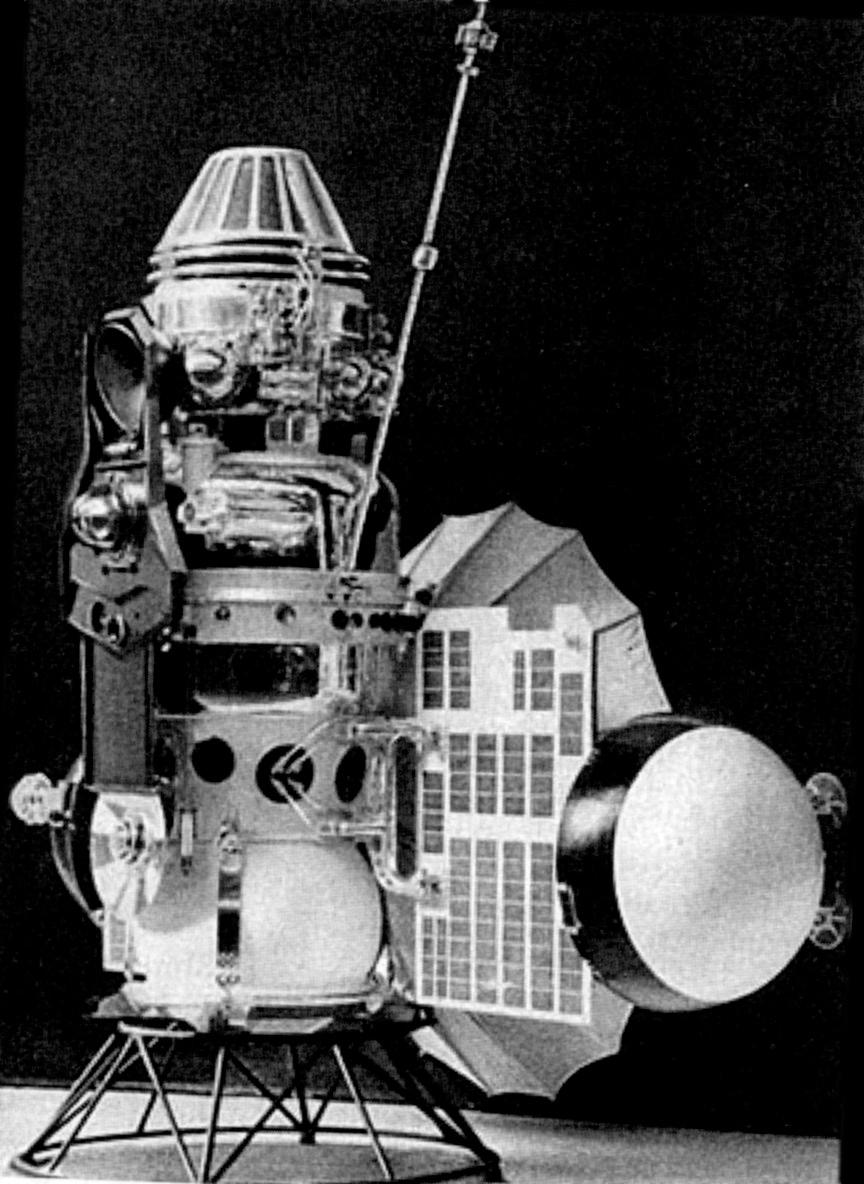
By Mikhail Marov's count, the Soviet Union had sent seven spacecraft toward Venus by the autumn of 1965, plus one test flight, and only two of the seven had survived their rockets. Those two, Venera 1 in 1961 and Zond 1 in 1964, had both gone silent months short of the planet. In November 1965 OKB-1, Sergei Korolev's design bureau, tried again with three spacecraft in eleven days. Venera 2 left on 12 November and Venera 3 on 16 November. The third, 3MV-4 No. 6, went up on 23 November, when a rocket stage exploded and stranded it in Earth orbit as Kosmos 96. The two that got away both reached Venus: Venera 2 passed the sunlit side at about 24,000 km on 27 February 1966, and Venera 3 struck the planet on 1 March. Neither returned a single measurement of Venus, because both had overheated and lost their radio links in February.
All three were built for Mars. They belonged to the 3MV family, the improved design that followed the 2MV craft of 1962, approved by the government on 21 March 1963 according to LePage. The November 1964 Mars window was meant for landers (the 3MV-3 variant) and photographic flyby craft (the 3MV-4), but only one craft flew in it, as Zond 2, and a second went past the Moon toward the orbit of Mars in July 1965 as Zond 3, a test the bureau's history says fulfilled its whole programme. That left three Mars craft: a lander carrier, 3MV-3 No. 1, and two flyby photographers, 3MV-4 No. 4 and No. 6. They were refitted for the Venus launch window of late 1965 and kept their Mars designations, which the bureau's history explains in one sentence: the Venus launches used the 'Martian' stock of stations with modifications, 'which explains their indices'. Even the name was inherited. Siddiqi writes that Zond 1 would probably have been called Venera 2 had it worked in 1964.
What the lander would meet was already in doubt. Marov writes that by launch time there were strong grounds to think the surface was hot, perhaps 400 °C, while the Venera 3 capsule was practically the one flown on Zond 1, designed for 77 °C and 5 bar. A 1996 article in Novosti Kosmonavtiki gives a different reading: capsule and sensors rated for up to 400 °C and 10 atmospheres, and a buoyancy test in case Venus had seas and oceans. Shubin's history says the radio astronomers Kuzmin and Clark, observing at the California Institute of Technology from May to July 1964, had shown that the heat came from the planet's disc, and that Mstislav Keldysh reported the heat as almost certain and the parachutes likely to burn at 130 °C, while allowing that the scientists might be wrong and that the capsule might transmit before it died. The decision, in Shubin's telling, was to launch. Marov says the team sent Venera 3 knowing its capsule might return atmospheric data and would not survive on the surface. The answer came four years later from Venera 7: its lander sent back temperatures down to the surface, from which the pressure was calculated, and its builder NPO Lavochkin still quotes the result as 90 plus or minus 15 atmospheres and 475 plus or minus 20 °C.
Venera 2 was the photographer. NSSDCA describes a cylindrical bus 1.1 m across and 3.3 m long with its flyby module, two solar wings spanning 4.4 m, a 1.7 m dish, a 2 kN KDU-414 engine for course corrections, and large hemispherical radiators on the tips of the solar panels. Its flyby module was a 60 cm sphere. Marov lists what the module held: a facsimile photo system with a 200 mm lens, the same as on Zond 2 and Zond 3, an ultraviolet spectrometer built into the camera for 285 to 355 nm (285 to 335 nm in LePage's account), a second one for ozone between 190 and 275 nm, and an infrared spectrometer covering 7 to 20 and 14 to 38 micrometres to measure the thermal emission of the atmosphere and clouds. LePage adds that the exposed film was to be developed on board and the negatives scanned for transmission. For the cruise the bus carried a fluxgate magnetometer, cosmic ray counters, charged particle traps, a micrometeorite detector, cosmic radio receivers and a Lyman-alpha hydrogen detector.
Venera 3 was the lander carrier, and its 'special compartment', in the words of the Soviet yearbook for 1967, was the descent capsule itself. The capsule was a sphere 90 cm across with a heat shield and a parachute, and NSSDCA says it carried two transmitters on the 32 cm band. Its mass is quoted three ways: 310 kg by Siddiqi and NSSDCA, 337 kg by Marov and 383 kg by LePage. Inside were sensors for temperature, pressure and density, instruments for the composition, acidity and electrical conductivity of the atmosphere, a gamma-ray detector for the ground, a cosmic ray detector, a tilt sensor that read the level of a pool of mercury, and a photometer for the airglow, the faint light the atmosphere gives off by itself, carried because the aim point was on the night side. The capsule was sterilised before launch, which Siddiqi says the Soviet press stressed after American and British scientists raised concerns. It also carried a metal globe of the Earth 70 mm across holding a medal with the Soviet coat of arms. The 1966 yearbook explained the pairing: two stations flying together raised the reliability of the experiment, let each check the other's data, and measured gradients between two points in space.
On 12 November 1965 Venera 2 lifted off from Site 31 at Baikonur on a Molniya-M. McDowell's catalogue logs 04:46:48 UT and Siddiqi 04:46; NSSDCA, LePage and Marov's Russian text give 05:02, which is 8:02 Moscow time. None of the sources consulted cites a range document that settles it. The Blok L upper stage fired from a parking orbit so accurately that no course correction was needed: the 1967 yearbook says the flyby conditions 'were achieved by the high accuracy of injection', and LePage writes that tracking put the craft within 40,000 km of the sunlit side. The first warning came early. Siddiqi records that contact was lost for a time about three hours after the craft left Earth orbit, and that communications stayed poor for the rest of the flight. Venera 3 followed on 16 November, at 04:13:35 UT in McDowell's list (04:13 in Siddiqi and NSSDCA, 04:19 in LePage), on a path that would have missed the planet without a correction.
The third launch, on 23 November 1965, failed on the way up. McDowell and Siddiqi time it at 03:14 UT, LePage and the epizodsspace compilers at 03:22. Late in the burn of the Blok I third stage, one of its four combustion chambers exploded after a fuel line cracked; the bureau's history puts the failure at 528 seconds, which matches LePage's 8 minutes 48 seconds. The stack still reached orbit, but tumbling, and the Blok L could not fire toward Venus. The OKB-1 engineer Boris Chertok wrote that 'the luck had run out' and that the failure 'turned the next Venera into a satellite of the Earth'. It was announced as Kosmos 96, the name series NSSDCA says was given to Soviet craft that stayed in Earth orbit whatever their destination; had it left, LePage writes, it would have been Venera 4. Its orbit is recorded as 227 by 310 km (Soviet 1966 yearbook), 209 by 262 km (McDowell) or 210 by 269 km (Novosti Kosmonavtiki), and it re-entered on 9 December 1965. Two sources tell the failure differently. Novosti Kosmonavtiki blames the Blok L engine, and NSSDCA describes an explosion, perhaps at ignition for the burn toward Venus, that threw off at least six fragments, and files the craft as an intended lander. Chertok, Marov, Siddiqi, McDowell and Novosti Kosmonavtiki itself all call it 3MV-4 No. 6, the flyby twin of Venera 2; the Energia history does not give its number.
Kosmos 96 has a second life in American folklore. Its re-entry has been linked to the fireball seen over Ontario and at least eight US states at 21:43 UT on 9 December 1965, and from there to the town of Kecksburg, Pennsylvania. NSSDCA's record rejects the link: the fireball's path was probably too steep for a craft falling from Earth orbit, US Air Force tracking indicates that Kosmos 96 decayed before 21:43 UT, and other analyses of the orbit 'definitively indicate it could not have been the Cosmos 96 spacecraft'.
A fourth attempt was planned. LePage writes that four spacecraft had been approved for the window and that the last was to fly on 26 November, but a rocket fault found in preparations could not be fixed in time. Marov also writes that one more station was left unlaunched when the window closed. The epizodsspace page on Kosmos 96 lists that date with a question mark, Siddiqi calls Kosmos 96 the third and last craft prepared, and McDowell's launch list has no Molniya launch between Kosmos 96 and Luna 8 on 3 December. NSSDCA reads it differently: its tentatively identified 'Venera 1965A' is an attempted flyby whose launcher it believes failed, dated 26 November in its list of tentative missions and 23 November in its Venus chronology. LePage and Marov describe a craft that was prepared and never launched, and McDowell's list records no launch that could be it; NSSDCA is alone among these sources in treating it as a launch, and Siddiqi's count of three leaves the fourth craft out altogether.
For a while the pair worked. On 26 December 1965, at 18:04 Moscow time according to Novosti Kosmonavtiki, Venera 3 made its course correction about 13 million km from Earth (12.9 million km and 19.7 m/s in LePage's account), which left it aimed 800 km from the centre of Venus, according to Marov and RIA Novosti. Controllers held 63 sessions with Venera 3 during the flight, Siddiqi records, and its charged particle trap returned solar wind spectra from 16 November to 7 January 1966, the date Shubin gives for its last scientific data. A week later, on 14 January, Korolev died during surgery. ProKosmos notes that he had helped prepare the launch and never learned how it ended.
Then the heat caught up with both craft. Venera 2's temperature jumped on 10 February, the date Marov gives for the last planned session before the flyby: the link degraded and the commands to start the flyby observations were never confirmed. NSSDCA and Shubin also end Venera 2's communications on 10 February. Venera 3 was last heard on 16 February according to Siddiqi, NSSDCA, Marov, RIA Novosti and Novosti Kosmonavtiki, or 18 February according to Shubin. The sources agree on the kind of fault and differ on its root. The Energia history speaks of the raised temperature of the radio receiver. Marov suspects the wrong coating on the hemispherical radiators. Siddiqi cites an investigation that found 40 radiator elements working improperly, which raised the gas temperature inside until parts of the receiving and decoding units failed and the solar panels overheated. Novosti Kosmonavtiki blames a wrong calculation of the thermal control parameters, made when nobody had accurate data on the heat flux near Venus. LePage reports degrading paint on the radiators and notes that Zond 3, flying away from the Sun, would have suffered less. The readings are compatible, and none of the sources quotes the investigation's own report.
Venera 2 kept its appointment in silence. Closest approach came at 02:52 UT on 27 February 1966 at 23,950 km, the figure in NSSDCA and Marov's Russian text; Siddiqi, the Energia history, Novosti Kosmonavtiki and the 1967 yearbook give 24,000 km, the yearbook measuring from the surface. It passed over the sunlit hemisphere, as the photography plan required. Siddiqi writes that the ground switched the instruments on beforehand; Novosti Kosmonavtiki says only that the commands to switch them on were sent. LePage adds that a last, poor session reportedly took place that day without confirming the commands. After the flyby, when the craft should have played back its observations, it never answered. Attempts continued for several days and ended on 4 March, and Venera 2 went on into orbit around the Sun. Marov thinks it likely that it did its work at the planet and simply could not report. LePage is more guarded: whether it made its observations is not known, he writes, and Venus's unbroken clouds would have made any photographs a nearly featureless disc.
Venera 3's arrival was worked out on paper. Novosti Kosmonavtiki put it plainly in 1996: all that remained was to state that, by ballistic calculations, the station entered the atmosphere of Venus at 9:56 Moscow time on 1 March 1966, which is 06:56 UT. Siddiqi gives 06:56:26 UT, four minutes earlier than planned. The region is quoted two ways. Siddiqi and Marov place it on the night side near the terminator between 20 degrees south and 20 degrees north and 60 to 80 degrees east; NSSDCA prints 20 degrees north to 30 degrees south over the same longitudes. Either box is thousands of kilometres across. No source states the longitude system, and none describes the method beyond ballistic calculation from tracking. Nor is it known whether the capsule separated: Siddiqi and NSSDCA say the bus released it automatically, but Marov writes only that it could have, and that no telemetry confirmed it. Shubin adds a postscript. In 1967, when the Soviets lost the signal from Venera 4 on approach, they rechecked the planetary positions, found a 700 km error in the theory of planetary motion then in use, and concluded from the new calculation that Venera 3 had indeed hit Venus.
The Energia history says the flight programme was fulfilled and that the station reached the surface and delivered the pennant of the USSR, 'the world's first flight of a spacecraft from the Earth to another planet'. Siddiqi's table of firsts lists Venera 3 as the first spacecraft to impact another planet. What physically arrived is another matter. Novosti Kosmonavtiki notes that later study of Venus showed the capsule could not in principle have reached the surface in working order, and LePage estimates that even after a good entry it would have been crushed at around 35 km. If the calculation is right, whatever reached the ground on 1 March 1966, bus, capsule or both, arrived as wreckage somewhere inside a region the size of a continent. It is listed with the other hardware on the planet at what we left at Venus.
The flight did return science, though none of it about Venus. K. I. Gringauz and colleagues used Venera 3's modulation trap to measure solar wind ion spectra from 0 to 3,600 eV. Set beside NASA's Pioneer 6 for the second half of December 1965, their numbers showed 'satisfactory agreement', and a second peak that appeared more than once in the Venera 3 spectra was read as doubly ionised helium. A companion paper by T. K. Breus and Gringauz estimated solar wind proton temperatures in fair agreement with Mariner 2, Explorer 10, IMP 2 and OGO 1. Both appeared in Kosmicheskiye Issledovaniya in 1967 and were translated for NASA. RIA Novosti adds that the large volume of trajectory measurements was valuable for the study of deep space communication and interplanetary flight. ProKosmos writes that Venera 2 also sent back data on interplanetary space during the cruise, but none of the sources consulted names a Venera 2 result or paper.
The pair were also the last planetary spacecraft built and launched by OKB-1, as Marov notes. The bureau's history credits the design of its automatic stations to the sector of G. Yu. Maksimov, with V. I. Petrov as lead designer, and is candid about the record: of 19 interplanetary launches, only two could be called successful. Planetary work passed to the Lavochkin bureau under Georgy Babakin, at the end of 1965 according to the Energia history and Marov, or in April 1965 according to LePage, who says the move freed OKB-1 for crewed ships. Lavochkin's engineers were already reassessing the 3MV while Venera 2 and 3 flew, LePage writes, and Lavochkin's own history begins its Venus story in 1967 with Venera 4, which Siddiqi lists as the first successful entry into the atmosphere of Venus.
The Soviet state did not wait for engineers to settle the details. A 6 kopek stamp issued in 1966 reads 'Pennant and medal on Venus, 1 March 1966', and the story has changed little since. RIA Novosti called Venera 3 the first spacecraft to reach another planet in 2020; Argumenty i Fakty in November 2025, and ProKosmos and RT on 1 March 2026, called it the first to reach the surface of one. The careful version is narrower and still remarkable. In Marov's words, Venera 2 and Venera 3 were the first of the planetary stations Korolev had been launching since 1960 to complete a successful interplanetary crossing. One passed within 24,000 km of Venus, the other struck it by the best calculation of its trajectory, and both went quiet in the heat of the inner solar system before they could say what they had found.
Mission facts
Organisations
OKB-1, Sergei Korolev's design bureau (today RKK Energia), USSR
Builder
OKB-1, Sergei Korolev's design bureau, the last planetary craft it built and launched (Marov). Planetary work then passed to the Lavochkin bureau under Georgy Babakin, at the end of 1965 according to the Energia history and Marov, or in April 1965 according to LePage.
Origin
Three 3MV craft left over from the November 1964 Mars window, refitted for Venus and flown under their Mars designations: 3MV-4 No. 4 (Venera 2), 3MV-3 No. 1 (Venera 3) and 3MV-4 No. 6 (Kosmos 96).
Venera 2: identity and mass
3MV-4 No. 4, COSPAR 1965-091A. 963 kg (Siddiqi, NSSDCA, Marov, McDowell); Novosti Kosmonavtiki (1996) prints 962 kg.
Venera 2: launch
12 November 1965 from Site 31, Baikonur, on a Molniya-M (8K78M) numbered U15000-42 by McDowell. Launch time 04:46:48 UT (McDowell; Siddiqi 04:46) or 05:02 UT (NSSDCA, LePage, Marov's Russian text), which is 8:02 Moscow time. Unresolved.
Venera 2: payload
Flyby module, a 60 cm sphere (NSSDCA), holding a facsimile camera with a 200 mm lens, two ultraviolet spectrometers (285 to 355 nm, or 285 to 335 nm in LePage, and 190 to 275 nm) and an infrared spectrometer (7 to 20 and 14 to 38 micrometres), per Marov. Cruise instruments on the bus included a fluxgate magnetometer, cosmic ray counters, ion traps and a micrometeorite detector.
Venera 2: flyby
Closest approach 02:52 UT on 27 February 1966 at 23,950 km (NSSDCA, Marov), about 24,000 km in Siddiqi and the Soviet 1967 yearbook, which measures it from the surface. Sunlit side, as planned. No data returned; declared lost on 4 March 1966.
Venera 2: loss of contact
Communications ended on 10 February 1966 (NSSDCA, Shubin), the date Marov gives for the last planned session, when the temperature jumped and flyby commands went unconfirmed. LePage reports a final poor-quality session on 27 February.
Venera 3: identity and mass
3MV-3 No. 1, COSPAR 1965-092A. 960 kg (NSSDCA summary, Soviet 1966 yearbook, RIA Novosti, LePage, McDowell's total), 958 kg (Marov, Novosti Kosmonavtiki), 969 kg (Siddiqi's entry header, against 960 kg in his own table), 963 kg (NSSDCA's descriptive text).
Venera 3: launch
16 November 1965 from Site 31, Baikonur. 04:13:35 UT (McDowell), 04:13 UT (Siddiqi, NSSDCA), 04:19 UT (LePage). Argumenty i Fakty (2025) prints 4:19 Moscow time, which matches neither.
Venera 3: entry capsule
A 90 cm sphere with heat shield and parachute. Mass 310 kg (Siddiqi, NSSDCA), 337 kg (Marov) or 383 kg (LePage). Design limits: 77 °C and 5 bar, as on Zond 1 (Marov; LePage gives the same figures), or up to 400 °C and 10 atm (Novosti Kosmonavtiki 1996). Tested for buoyancy in case of seas, and sterilised before launch.
Venera 3: capsule instruments
Temperature, pressure and density sensors; atmospheric composition, acidity and conductivity instruments; a gamma-ray detector for the ground; a cosmic ray detector; a photometer for the atmosphere's own glow (airglow), since the aim point was on the night side; and a mercury-level tilt sensor.
Venera 3: course correction
26 December 1965 at 18:04 Moscow time (Novosti Kosmonavtiki), about 13 million km from Earth (RIA Novosti; 12.9 million km in LePage), 19.7 m/s (LePage). Afterwards the aim point was 800 km from the centre of Venus (Marov, RIA Novosti).
Venera 3: last contact
16 February 1966 (Siddiqi, NSSDCA, Marov, RIA Novosti, Novosti Kosmonavtiki) or 18 February 1966 (Shubin). Marov and LePage call 16 February '17 days' before arrival; on the calendar it is 13. 63 sessions were held in all (Siddiqi, RIA Novosti).
Venera 3: arrival
1 March 1966 at 06:56:26 UT (Siddiqi), about 06:56 UT (NSSDCA), 9:56 Moscow time (Novosti Kosmonavtiki), four minutes earlier than planned (Siddiqi). Computed from the trajectory: nothing was received. Novosti Kosmonavtiki calls it entry into the atmosphere; Siddiqi and NSSDCA call it impact on the surface.
Venera 3: impact region
Night side near the terminator, 20 S to 20 N and 60 to 80 E (Siddiqi, Marov, LePage) or 20 N to 30 S and 60 to 80 E (NSSDCA). No source states the longitude system. Capsule separation was never confirmed by telemetry (Marov).
Venera 3: cargo
A metal globe of the Earth 70 mm across holding a medal with the Soviet coat of arms (ProKosmos, 2026); NSSDCA describes medallions bearing the coat of arms. A 1966 Soviet stamp calls them the 'pennant and medal on Venus'.
Kosmos 96: identity and launch
3MV-4 No. 6, COSPAR 1965-094A, about 950 kg (Siddiqi, Marov); McDowell's catalogue lists 963 kg. Launched 23 November 1965 at 03:14:10 UT (McDowell; Siddiqi 03:14) or 03:22 UT (LePage, epizodsspace) on rocket U15000-30, a Molniya-M (8K78M) in McDowell and LePage, an 8K78 Molniya in Siddiqi.
Kosmos 96: failure
A third-stage combustion chamber exploded near the end of its burn, at 528 s in the Energia history, after a fuel line cracked; the tumbling Blok L could not fire (Marov, Siddiqi, LePage). Chertok says only that the third-stage propulsion failed, and the Energia history calls it abnormal operation of the Blok I engine. Novosti Kosmonavtiki (1996) blames the Blok L engine; NSSDCA suggests an explosion perhaps at ignition for the burn toward Venus. McDowell annotates the flight 'BOZ failed'.
Kosmos 96: orbit and decay
About 51.9 degrees; 227 by 310 km (Soviet 1966 yearbook, LePage), 209 by 262 km (McDowell) or 210 by 269 km (Novosti Kosmonavtiki). Re-entered 9 December 1965. NSSDCA rules out a link to the Kecksburg fireball of the same day.
Fourth craft
A fourth launch planned for 26 November 1965 was abandoned after a rocket fault found in preparations (LePage); Marov says one more station was left unlaunched when the window closed. NSSDCA instead lists 'Venera 1965A' as an attempted flyby whose launcher it believes failed, dated 26 November in one list and 23 November in another. Siddiqi counts only three craft prepared.
Mission timeline
- 18 Jul 1965Zond 3, 3MV-4 No. 3, is launched past the Moon toward the orbit of Mars as a test of the flyby design; the Energia history says it fulfilled its whole programme.
- 12 Nov 1965Venera 2 (3MV-4 No. 4) launches from Baikonur at 04:46:48 UT by McDowell's list or 05:02 UT by NSSDCA and LePage. Injection is accurate enough that no course correction is needed.
- 16 Nov 1965Venera 3 (3MV-3 No. 1) launches at 04:13 UT carrying its 90 cm entry capsule. Its charged particle trap starts returning solar wind spectra.
- 23 Nov 19653MV-4 No. 6 launches; a third-stage chamber explodes near the end of the burn and the stack reaches Earth orbit tumbling. The Blok L cannot fire and the craft is announced as Kosmos 96.
- 26 Nov 1965A fourth Venus launch, planned for the close of the window, is abandoned after a rocket fault found during preparations (LePage; Marov also counts one station left unlaunched). NSSDCA lists it as a launch failure.
- 9 Dec 1965Kosmos 96 re-enters the Earth's atmosphere. NSSDCA rules out a link to that day's Great Lakes fireball and the Kecksburg story.
- 26 Dec 1965Venera 3 fires its engine for a course correction at 18:04 Moscow time (Novosti Kosmonavtiki), about 13 million km from Earth (RIA Novosti), putting it on a collision course with Venus.
- 7 Jan 1966Last scientific data from Venera 3 (Shubin); the ion-trap record used by Gringauz's group runs from 16 November to this date.
- 14 Jan 1966Sergei Korolev dies while both spacecraft are on their way to Venus.
- 10 Feb 1966Venera 2's temperature jumps during the last planned session; commands for the flyby go unconfirmed and communications fail.
- 16 Feb 1966Last contact with Venera 3 (18 February in Shubin), 13 days before arrival.
- 27 Feb 1966Venera 2 passes the sunlit side of Venus at 23,950 km at 02:52 UT. Nothing is received.
- 1 Mar 1966Venera 3 reaches Venus at 06:56 UT by ballistic calculation, on the night side between 20 S and 20 N (or 30 S and 20 N) and 60 to 80 E. No signal is received.
- 4 Mar 1966Attempts to contact Venera 2 are abandoned; it continues in orbit around the Sun.
- 1966The Soviet post issues a 6 kopek stamp, 'Pennant and medal on Venus, 1 March 1966'.
- 1967Shubin writes that when Venera 4's signal was lost on approach, ballisticians found a 700 km error in the theory of planetary motion and, recalculating, concluded that Venera 3 had hit Venus.
A filled dot marks something that physically happened. A hollow one marks an announcement, a naming or a target.
In pictures
Tap a photo to enlarge.
Translated from the original sources
Passages from the Russian sources this page draws on, in azmth's translation. Tap Show original to read the original wording.
RKK Energiya corporate history 1946 to 1996, chapter on automatic interplanetary stations
Russian · 6 passages
RKK Energiya corporate history 1946 to 1996, chapter on automatic interplanetary stations (Wayback copy of epizodsspace)
Open the source“For the launches of the stations Venera 2 and Venera 3 the 'Martian' stock of stations was used, with the appropriate modifications, which explains their indices.”
azmth's translation · Show originalHide original
Russian: «При пусках АМС "Венера-2" и "Венера-3" использовался "марсианский" задел по АМС с соответствующими доработками, чем и объясняются их индексы.»
“On 12 November 1965 the automatic interplanetary station 3MV-4 No. 4, which received the name Venera 2, was successfully launched toward Venus; however, poor passage of control commands was noted throughout the flight, which was explained by the raised temperature of the radio system's receiver.”
azmth's translation · Show originalHide original
Russian: «12 ноября 1965 года успешно стартовала в сторону Венеры АМС ЗМВ-4 № 4, получившая название "Венера-2", однако на всем протяжении полета отмечалось плохое прохождение управляющих команд, что объяснялось повышенной температурой приемника радиосистемы.»
“The flight programme was fulfilled; the station reached the surface of the planet, delivering the pennant of the USSR on 1 March 1966. This was the world's first flight of a spacecraft from the Earth to another planet.”
azmth's translation · Show originalHide original
Russian: «Программа полета была выполнена, станция достигла поверхности планеты, доставив 1 марта 1966 года вымпел СССР. Это был первый в мире перелет космического аппарата с Земли на другую планету.»
“In the launch of 23 November 1965 the station was put into the intermediate orbit in an unstabilised attitude as a result of a failure of the third stage.”
The sentence continues in parentheses: Blok I, abnormal operation of the propulsion unit in the final phase, 528 s. The quote stops before that parenthesis.
azmth's translation · Show originalHide original
Russian: «При пуске 23 ноября 1965 года на промежуточную орбиту АМС вывели в нестабилизированном положении вследствие аварии III ступени»
“Of the 19 launches of automatic interplanetary stations carried out, only two can be called successful.”
azmth's translation · Show originalHide original
Russian: «Из 19 проведенных запусков автоматических межпланетных станций только два можно назвать удачными.»
“At the end of 1965 the work on automatic interplanetary stations was handed over to the S. A. Lavochkin design bureau (chief designer G. N. Babakin), that is, at the moment when the developers were already approaching the goal, having travelled a thorny path of mistakes, learning and accumulating experience.”
azmth's translation · Show originalHide original
Russian: «В конце 1965 года работы по АМС были переданы в ОКБ им. С.А. Лавочкина (главный конструктор Г.Н. Бабакин), т. е. тогда, когда разработчики уже подходили к намеченной цели, пройдя тернистый путь ошибок, обучения и накопления опыта.»
epizodsspace compilation page on Kosmos 96
Russian · 2 passages
epizodsspace compilation page on Kosmos 96 (in Russian): Chertok, Marov, Siddiqi, Soviet 1966 yearbook (Wayback)
Open the source“On 23 November 1965, duplicating 3MV-4 No. 4, we launched 3MV-4 No. 6. But the luck had already run out. A failure of the third-stage propulsion unit turned the next Venera into a satellite of the Earth. It was named Kosmos 96.”
Boris Chertok, quoted on the compilation page; his text prints the second index transposed, as '3VM-4'.
azmth's translation · Show originalHide original
Russian: «23 ноября 1965 года, дублируя 3МВ-4 №4 , мы осуществили запуск 3ВМ-4 №6. Но везение уже прекратилось. Авария двигательной установки третьей ступени превратила очередную "Венеру" в спутник Земли. Он был назван "Космос-96"»
“23 November, Kosmos 96: 310 by 227 [km], 51°54' [inclination], 89.6 [minutes].”
Great Soviet Encyclopedia yearbook for 1966, launch table.
azmth's translation · Show originalHide original
Russian: «23 ноября «Космос-96» 310 х 227 51°54' 89,6»
epizodsspace compilation page on Venera 3
Russian · 12 passages
epizodsspace compilation page on Venera 3 (in Russian): K. Lantratov, Novosti Kosmonavtiki 1996 No. 5, Marov, Shubin (Wayback)
Open the source“The design of the descent craft and the measuring ranges of its pressure and density sensors were calculated for operation at temperatures up to 400 °C and pressures up to 10 atm. In case Venus had seas and oceans, the descent craft was tested for buoyancy.”
K. Lantratov, Novosti Kosmonavtiki, 1996 No. 5.
azmth's translation · Show originalHide original
Russian: «Конструкция СА и диапазоны измерений датчиков давления и плотности на нем были рассчитаны для работы при температуре до 400°С и давление до 10 атм. На случай наличия на Венере морей и океанов спускаемый аппарат испытывался на плавучесть.»
“This time, however, the Blok L propulsion unit failed. As a result the station remained in a low Earth orbit (51.9°, 269 by 210 km, 89.6 min), received the designation Kosmos 96 and was destroyed in the dense layers of the atmosphere on 9 December of the same year.”
Lantratov, Novosti Kosmonavtiki, 1996.
azmth's translation · Show originalHide original
Russian: «Однако на этот раз произошел отказ двигательной установки блока Л. В результате станция осталась на низкой околоземной орбите (51.9°, 269x210 км, 89.6 мин), получила обозначение "Космос-96" и разрушилась в плотных слоях атмосферы 9 декабря того же года.»
“Because of an incorrect calculation of the parameters of the thermal control system, the heat balance in the pressurised compartments of both stations was upset. There simply were no accurate data on the heat flux in the vicinity of Venus at the time.”
Lantratov, Novosti Kosmonavtiki, 1996.
azmth's translation · Show originalHide original
Russian: «Из-за неверного расчета параметров системы терморегулирования нарушился тепловой баланс в гермоотсеках обеих станций. Точных данных о тепловом потоке в районе Венеры тогда просто не было.»
“Despite this failure, on 26 December at 18:04 Moscow time a trajectory correction was carried out on commands from Earth.”
Lantratov, Novosti Kosmonavtiki, 1996.
azmth's translation · Show originalHide original
Russian: «Несмотря на этот отказ, 26 декабря в 18 часов 4 минуты по московскому времени по командам с Земли удалось провести коррекцию траектории.»
“All that remained was to state that, according to ballistic calculations, the station Venera 3 entered the atmosphere of Venus on 1 March 1966 at 9 hours 56 minutes, the first in the world to do so.”
Lantratov, Novosti Kosmonavtiki, 1996.
azmth's translation · Show originalHide original
Russian: «Пришлось лишь констатировать, что по баллистическим расчетам станция "Венера-3" 1 марта 1966 года в 9 часов 56 минут впервые в мире вошла в атмосферу Венеры.»
“Later studies of Venus showed that the descent craft could not in principle have reached the surface in working condition because of the excessive atmospheric pressure and temperature.”
Lantratov, Novosti Kosmonavtiki, 1996.
azmth's translation · Show originalHide original
Russian: «Дальнейшие же исследования Венеры показали, что СА в принципе не мог достигнуть поверхности в работоспособном состояние из-за слишком большого атмосферного давления и температуры.»
“The spacecraft could have separated the descent craft automatically on 1 March 1966 at 06:56 GMT, but this was not confirmed by telemetry data.”
Marov and Huntress, Russian edition.
azmth's translation · Show originalHide original
Russian: «Космическая станция могла автоматически отделить спускаемый аппарат 1 марта 1966 года в 06:56 по Гринвичу, но это не было подтверждено данными телеметрии.»
“It ended up on the night side of Venus near the terminator between 20° south and 20° north latitude, and between 60° and 80° east [longitude].”
Marov and Huntress, Russian edition.
azmth's translation · Show originalHide original
Russian: «Он оказался на ночной стороне Венеры вблизи терминатора между 20° южной и 20° северной широты, и между 60° и 80° восточной»
“Last transmission of scientific data: 7 January 1966. Last communication session: 18 February 1966.”
Shubin.
azmth's translation · Show originalHide original
Russian: «Последняя передача научных данных - 7 января 1966 г. Последний сеанс связи - 18 февраля 1966 года.»
“They rechecked the positions of the planets and found that the error in the existing theory of planetary motion was 700 km. At the same time they checked whether Venera 3 had actually hit Venus. They calculated that it had.”
Shubin, on the 1967 Venera 4 approach.
azmth's translation · Show originalHide original
Russian: «Заново проверили положение планет и выяснили, что ошибка в существующей теории движения планет - 700 км. Заодно выяснили - а попала ли "Венера-3" в Венеру. Посчитали, что попала.»
“Launching two automatic stations a short time apart, a kind of 'group flight' of stations, increases the overall reliability of the experiment to obtain new information.”
Great Soviet Encyclopedia yearbook for 1966.
azmth's translation · Show originalHide original
Russian: «Запуск через небольшой промежуток времени 2 автоматических станций, своего рода «групповой полет» АМС увеличивает общую надежность эксперимента по получению новой информации.»
“The station's mass was 958 kg.”
Lantratov, Novosti Kosmonavtiki, 1996, on Venera 3.
azmth's translation · Show originalHide original
Russian: «Вес станции составлял 958 кг.»
epizodsspace compilation page on Venera 2
Russian · 11 passages
epizodsspace compilation page on Venera 2 (in Russian): Soviet yearbooks 1966 and 1967, Marov and Huntress (Russian edition), Shubin, Siddiqi in Russian (Wayback)
Open the source“The required conditions for Venera 2's flyby of the planet Venus were achieved by the high accuracy of injection.”
Great Soviet Encyclopedia yearbook for 1967.
azmth's translation · Show originalHide original
Russian: «Требуемые условия пролета станции «Венера-2» у планеты Венера достигались путем высокой точности вывода.»
“Before launch the descent craft of Venera 3 was sterilised.”
Great Soviet Encyclopedia yearbook for 1967.
azmth's translation · Show originalHide original
Russian: «Перед стартом спускаемый аппарат станции «Венера-3» подвергался стерилизации.»
“The atmospheric pressure at the surface remained uncertain, but it was obvious that conditions on the planet differed substantially from those the probe had been designed for (77 °C, 5 bar).”
Marov and Huntress, Russian edition.
azmth's translation · Show originalHide original
Russian: «Давление атмосферы на поверхности оставалось неопределенным, но было очевидно, что условия на планете существенно отличались от тех, на которые был рассчитан зонд (77°С, 5 бар).»
“Venera 2 and Venera 3 became the last planetary spacecraft created and launched by OKB-1.”
Marov and Huntress, Russian edition.
azmth's translation · Show originalHide original
Russian: ««Венера-2» и «Венера-3» стали последними планетными космическими станциями, созданными и запущенными ОКБ-1.»
“Mass of the descent craft: 337 kg.”
Marov and Huntress, Russian edition, which in the preceding sentence gives launch masses of 963 kg for Venera 2, 958 kg for Venera 3 and 950 kg for Kosmos 96.
azmth's translation · Show originalHide original
Russian: «Масса спускаемого аппарата: 337 кг.»
“Presumably the cause lay in the wrong coating of the hemispherical radiators.”
Marov and Huntress, Russian edition.
azmth's translation · Show originalHide original
Russian: «Предположительно, причина крылась в неправильном покрытии радиационных полусферических радиаторов.»
“Keldysh reported that an inferno on Venus was almost certain and that the parachutes would burn at +130°, but allowed for a small error by the scientists, and for the descent craft managing to transmit information before being destroyed. Launch the craft!”
Shubin.
azmth's translation · Show originalHide original
Russian: «Келдыш доложил, что пекло на Венере почти наверняка и парашюты при +130° сгорят, но допустил и ошибочку учёных, а также то, что СА успеют передать информацию до гибели. Пускать аппараты!»
“Communication finally ceased on 10 February 1966.”
Shubin, on Venera 2.
azmth's translation · Show originalHide original
Russian: «Связь окончательно прекратилась 10 февраля 1966 года.»
“One more spacecraft remained unlaunched until the window closed.”
Marov and Huntress, Russian edition.
azmth's translation · Show originalHide original
Russian: «Еще одна космическая станция осталась незапущенной до закрытия окна.»
“Venera 2 and Venera 3 reached the planet and became the first craft to accomplish a successful interplanetary crossing since the moment Korolev began launching planetary stations in 1960.”
Marov and Huntress, Russian edition.
azmth's translation · Show originalHide original
Russian: ««Венера-2» и «Венера-3» достигли планеты и стали первыми аппаратами, осуществившими успешный межпланетный перелет с того момента, когда Королев начал запускать планетные станции в 1960 году.»
“The special compartment of the station Venera 3 was the descent craft, lowered by parachute, with transmitters in the decimetre band to send to Earth the results of direct measurements of temperature and pressure in the atmosphere and at the surface of Venus.”
Great Soviet Encyclopedia yearbook for 1967.
azmth's translation · Show originalHide original
Russian: «Специальным отсеком станции «Венера-3» являлся спускаемый на парашюте аппарат с передатчиками дециметрового диапазона для передачи на Землю результатов непосредственных измерений температуры и давления в атмосфере и на поверхности Венеры.»
RIA Novosti reference article, 'The automatic interplanetary station Venera 3', 16 November 2020
Russian · 2 passages
“However, on 16 February 1966, shortly before the encounter with Venus, contact with the station was lost.”
azmth's translation · Show originalHide original
Russian: «Однако 16 февраля 1966 года, незадолго до встречи с Венерой, контакт со станцией был утерян.»
“the station entered a collision trajectory with the planet at a distance of 800 kilometres from its centre. At that time Venera 3 was about 13 million kilometres from Earth.”
azmth's translation · Show originalHide original
Russian: «станция вышла на траекторию столкновения с планетой на расстоянии 800 километров от ее центра. В это время "Венера-3" находилась на расстоянии около 13 миллионов километров от Земли.»
Argumenty i Fakty, 'Hot stuff: Venera 3 delivered the coat of arms of the USSR to the scorching planet', 16 November 2025
Russian · 2 passages
“The descent module was structurally a sphere 90 centimetres in diameter. Inside were a small metal globe of the Earth and a pennant with the coat of arms of the Soviet Union.”
azmth's translation · Show originalHide original
Russian: «Спускаемый модуль конструктивно представлял собой сферу диаметром 90 сантиметров. Внутри находились небольшой металлический глобус Земли и вымпел с гербом Советского Союза.»
“In August 1962 the American probe Mariner 2 made a successful flyby of Venus.”
The date is wrong: Mariner 2 passed Venus on 14 December 1962.
azmth's translation · Show originalHide original
Russian: «В августе 1962 года американский зонд «Маринер-2» совершил успешный пролёт рядом с Венерой.»
ProKosmos, '1 March 1966: the Soviet Venera 3 became the first craft to reach the surface of another planet', 1 March 2026
Russian · 4 passages
“However, according to ballistic calculations, on 1 March 1966 at 9:56 Moscow time the station Venera 3 did enter the planet's atmosphere, after which it crashed into the surface, accomplishing its main ballistic task.”
azmth's translation · Show originalHide original
Russian: «Однако, по баллистическим расчетам, 1 марта 1966 года, в 9:56 по московскому времени станция «Венера-3» все же вошла в атмосферу планеты, после чего врезалась в поверхность, выполнив свою главную баллистическую задачу.»
“The descent craft held a pennant in the form of a metal globe of the Earth 70 mm in diameter, inside which was a medal with the coat of arms of the Soviet Union.”
azmth's translation · Show originalHide original
Russian: «В спускаемом аппарате размещался вымпел в виде металлического глобуса Земли диаметром 70 мм, внутри которого находилась медаль с изображением герба Советского Союза.»
“Sergei Pavlovich [Korolev] died on 14 January 1966, while the spacecraft was still on its way to its target.”
azmth's translation · Show originalHide original
Russian: «Сергей Павлович умер 14 января 1966 года, когда аппарат все еще находился на пути к своей цели.»
“It [Venera 2] was to photograph the planet from its flyby trajectory, but it also failed, limited to transmitting data on outer space along the way.”
azmth's translation · Show originalHide original
Russian: «Она должна была сфотографировать планету с пролетной траектории, но также вышла из строя, ограничившись передачей данных о космическом пространстве по пути.»
RT (Russian), photo feature on the 60th anniversary of Venera 3's arrival, 1 March 2026
Russian · 1 passage
“On 1 March 1966, after 105 days, Venera 3 delivered to the surface of the mysterious planet a pennant with the coat of arms of the Soviet Union.”
RT attributes the sentence to the designer Boris Chertok.
azmth's translation · Show originalHide original
Russian: «1 марта 1966 года, через 105 суток, «Венера-3» доставила на поверхность загадочной планеты вымпел с гербом Советского Союза»
Marka publishing centre
Russian · 1 passage
Marka publishing centre (Russian Post), postal card No. 283, 50 years of Venera 3, issued 1 March 2016
Open the source“The station consisted of an orbital compartment and a descent craft, which was a sphere 0.9 m in diameter and weighed 960 kg.”
The 960 kg is the mass of the whole station.
azmth's translation · Show originalHide original
Russian: «Станция состояла из орбитального отсека и спускаемого аппарата, который представлял собой сферу диаметром 0,9 м и весил 960 кг.»
NPO Lavochkin, company history: cosmonautics
Russian · 3 passages
“From 1967 the interplanetary stations Venera 4, Venera 5 and Venera 6, and Venera 7, created under the direction of the bureau's chief designer G. N. Babakin, were launched to Venus.”
azmth's translation · Show originalHide original
Russian: «Начиная с 1967 года к Венере стартовали космические межпланетные станции «Венера-4», «Венера-5» и «Венера-6», «Венера-7», созданные под руководством главного конструктора ОКБ Г.Н. Бабакина.»
“It turned out that the pressure at the surface is 90 ± 15 atmospheres and the temperature 475 ± 20 °C.”
On Venera 7: the preceding sentences say the lander transmitted temperatures during descent and at the surface, which allowed the pressure and density profile to be calculated.
azmth's translation · Show originalHide original
Russian: «Оказалось, что давление у поверхности составляет 90±15 атмосфер, а температура - 475°±20°С.»
“This made it possible to calculate the distribution of pressure and density in the atmosphere of Venus with height, down to the surface.”
On the Venera 7 temperature data.
azmth's translation · Show originalHide original
Russian: «Это позволило рассчитать распределение давления и плотности в атмосфере Венеры по высоте вплоть до поверхности.»
Wikimedia Commons: 1966 Soviet stamp CPA 3379, Venera 3 pennant and medal
Russian · 1 passage
“Pennant and medal on Venus, 1 March 1966.”
Text printed on the 1966 Soviet 6 kopek stamp, read from the scan; the Commons description repeats only the first words.
azmth's translation · Show originalHide original
Russian: «Вымпел и медаль на Венере 1. III. 1966»
Sources
- RKK Energiya corporate history 1946 to 1996, chapter on automatic interplanetary stations (Wayback copy of epizodsspace) · in Russian
- epizodsspace compilation page on Venera 2 (in Russian): Soviet yearbooks 1966 and 1967, Marov and Huntress (Russian edition), Shubin, Siddiqi in Russian (Wayback)
- epizodsspace compilation page on Venera 3 (in Russian): K. Lantratov, Novosti Kosmonavtiki 1996 No. 5, Marov, Shubin (Wayback)
- epizodsspace compilation page on Kosmos 96 (in Russian): Chertok, Marov, Siddiqi, Soviet 1966 yearbook (Wayback)
- RIA Novosti reference article, 'The automatic interplanetary station Venera 3', 16 November 2020 · in Russian
- Argumenty i Fakty, 'Hot stuff: Venera 3 delivered the coat of arms of the USSR to the scorching planet', 16 November 2025 · in Russian
- ProKosmos, '1 March 1966: the Soviet Venera 3 became the first craft to reach the surface of another planet', 1 March 2026 · in Russian
- RT (Russian), photo feature on the 60th anniversary of Venera 3's arrival, 1 March 2026 · in Russian
- Marka publishing centre (Russian Post), postal card No. 283, 50 years of Venera 3, issued 1 March 2016 · in Russian
- NPO Lavochkin, company history: cosmonautics · in Russian
- Asif Siddiqi, Beyond Earth: A Chronicle of Deep Space Exploration 1958 to 2016, NASA SP-2018-4041, entries 60 to 62
- NSSDCA Master Catalog: Venera 2 (1965-091A), archived 14 August 2025
- NSSDCA Master Catalog: Venera 3 (1965-092A), archived 14 December 2024
- NSSDCA Master Catalog: Cosmos 96 (1965-094A), archived 9 August 2025
- NSSDCA, Chronology of Venus Exploration (last updated 11 March 2024)
- NSSDCA, Tentatively Identified Missions and Launch Failures
- J. McDowell, GCAT launch list (updated 2 November 2026)
- J. McDowell, GCAT satellite catalogue
- Andrew LePage, Venera 2 and 3: Touching the Face of Venus, Drew Ex Machina, 1 March 2016
- K. I. Gringauz et al., comparison of solar wind measurements on Venera 3 and Pioneer 6, Kosmicheskiye Issledovaniya 5 (2), 1967, NASA translation
- T. K. Breus and K. I. Gringauz, proton temperature of the interplanetary plasma from Venera 3, Kosmicheskiye Issledovaniya 5 (6), 1967, NASA translation
- Wikimedia Commons: 1966 Soviet stamp CPA 3379, Venera 3 pennant and medal · in Russian
Facts on this page were verified on 3 November 2026. Where sources disagree, the disagreement is stated rather than resolved silently.
azmth is independent and is not affiliated with or endorsed by NASA, Roscosmos, NPO Lavochkin, ESA, JAXA, ISRO, CNSA, or any other space agency or company named on this page.