Venera 1 and Tyazhely Sputnik
OKB-1 (Korolev) · Soviet Union · Flyby · 1961 · The first attempts Failure
Both launches failed. The first probe never left Earth orbit and re-entered on 26 February 1961. Venera 1 has been silent since February 1961. It passed Venus unheard at about 100,000 km that May and went into orbit around the Sun.
TL;DR· 21 min read
In February 1961 the Soviet Union launched two probes built to hit Venus. The first was stranded in Earth orbit when its last rocket stage failed to fire, and Moscow announced it only as a heavy satellite. The second, Venera 1, became the first spacecraft to set off toward Venus on 12 February. It was heard from 1.9 million km away on 17 February, lost soon after, and passed Venus unheard at about 100,000 km in May.
What happened to Venera 1?
Venera 1 was the first spacecraft to set off toward Venus. The Soviet Union launched it on 12 February 1961; it fell silent later that month, drifted past the planet unheard at about 100,000 km in May 1961 and went into orbit around the Sun. A sister probe launched eight days earlier never left Earth orbit: its last rocket stage failed to fire, and Moscow announced the stranded craft only as a heavy satellite. Both were 1VA probes from Sergei Korolev's design bureau, OKB-1, built to strike Venus and leave a Soviet emblem on it. Venera 1's trouble began on launch day, when an overheating Sun sensor tipped it into a safe mode that also switched off its radio receivers, so the ground could not call it. It came back on its own timer five days later, 1.9 million km out, and was lost soon after. Behind both flights stood a more ambitious lander, the 1V, dropped in the autumn of 1960 because it could not be ready in time.
Facts as of 5 November 2026, from the sources listed below.
- 643.5 kgmass of Venera 1 (1VA No. 2) as published in the Soviet yearbook for 1961; McDowell's catalogue carries 620 kg
- 1.889 million kmdistance from Earth at 14:04 Moscow time on 17 February 1961, the last session on record with a time, a range and telemetry readings
- about 100,000 kmcalculated miss distance at Venus on 19 to 20 May 1961; the pass itself was never observed
Two small probes left Tyuratam eight days apart in February 1961, both built to hit Venus and put a Soviet emblem on it. Neither did. The first, 1VA No. 1, reached a low parking orbit on 4 February and stayed there, because the Blok L escape stage never ignited, and the Soviet press described the stranded stack only as a heavy satellite. The second, 1VA No. 2, fired out of orbit on 12 February and became the craft TASS and later histories call Venera 1. OKB-1's engineers heard it on launch day and again on 17 February; accounts of later contact disagree, and by early March it was lost for good. By their ballisticians' reckoning it drifted past Venus in May. This page covers both launches, the more ambitious 1V lander that OKB-1 dropped in the autumn of 1960 to make the window, and a third 1VA airframe that one catalogue lists and no other source consulted here mentions.
OKB-1's Venus work traces back to a government decree of 10 December 1959 on the development of space research. According to the RKK Energia corporate history, it started work on a rocket for flights to Mars and Venus and set February 1960 as the deadline for draft designs of the stations. G. Yu. Maksimov's sector in Department 9 spent that winter laying out the systems, down to a photo-television unit and instruments to look for signs of life. Korolev approved a schedule for the Venus station on 8 May 1960. What came out of it was called 1V, and it was a lander: by September 1960 the bureau had issued working drawings for a station that would deliver a descent vehicle shaped like a television tube to the surface of Venus, and Siddiqi's NASA chronology adds that it was to photograph the surface. By then, the Energia history says, it was plain that 1V could not be built before a window that ran from 15 January to 15 February 1961. So the decision, taken at the range, was to build the Venus station on the design parameters of the 1M Mars probe, then being readied for October, reusing most of its test campaign. The new station got the index 1VA, to set it apart from the 1V with its landing on Venus, and on 1 January 1961 it was sent to the range.
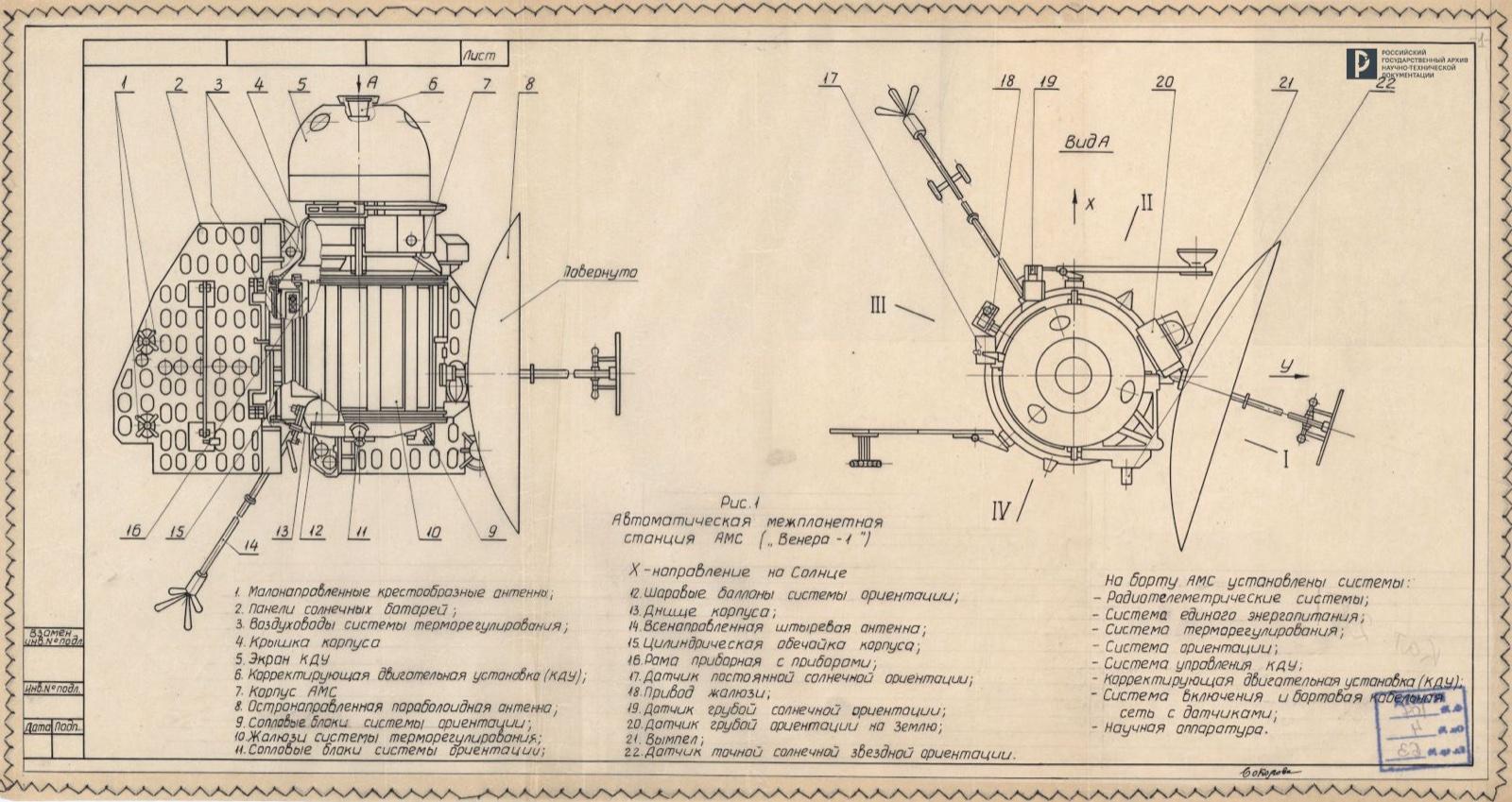
What flew was a pressurised cylinder with a dome on top. NSSDCA gives 2.035 m of height, 1.05 m of diameter and a fuelled mass of 643.5 kg, the figure in the Great Soviet Encyclopedia yearbook for 1961; McDowell's catalogue carries 620 kg. Two solar panels with about 2 square metres of cells stood out from the sides, a mesh dish more than 2 m across hung off one flank for the planned 8 and 32 cm links from Venus, and a 2.4 m omnidirectional rod was meant for the 1.6 m band; NSSDCA credits a separate T-shaped antenna with the 922.8 MHz downlink. A 1960 drawing now in the Russian State Archive of Scientific and Technical Documentation (RGANTD), from the papers of Korolev's colleague Arvid Pallo, labels 22 parts, among them the sensor for constant solar orientation, a fine Sun and star sensor, thermal-control louvres with their drive, spherical gas bottles for the attitude jets, a correction engine and an item marked simply 'pennant'. Here the sources part company. NSSDCA describes the dome as holding a sphere pressurised to 1.2 atmospheres that carried the pennant, and says the correction engine was not labelled in diagrams of the spacecraft; the archive drawing labels the dome as the engine's shield, item 5, and the engine itself as item 6. The science was modest: a three-axis fluxgate magnetometer by Sh. S. Dolginov of IZMIRAN on a 2 m boom, ion traps from K. I. Gringauz, micrometeorite detectors and cosmic-ray counters. Siddiqi's list adds infrared and ultraviolet spectrometers, which the archive's list leaves out.
Pride of place went to the pennant. The yearbook records a pennant bearing the State Emblem of the USSR; RGANTD says the designers fitted emblems in the hope they would reach the surface of a Venusian ocean, since many scientists then expected one (see Imagined Venus); NSSDCA says the sphere around them was designed to float; and a February 2026 anniversary piece on Pro Kosmos, prepared with RGANTD, calls the pennant titanium. A photograph in the Energia history, captioned as the pennants of Venera 1 and Venera 3, shows a disc dated 1961 with a diagram of planetary orbits, the Soviet coat of arms, and a small globe of the Earth. At breakfast after the launch, Chertok recalls, Korolev joked that only the pennant, which had heat protection, would ever reach the surface.
Just as new was the rocket. The 8K78, later called Molniya, stacked two new stages on the R-7: Blok I, adapted from the second stage of the R-9 missile with an engine from S. A. Kosberg's bureau, and Blok L, OKB-1's own escape stage. Blok L's S1.5400 engine was, the Energia history says, the first Soviet liquid engine to burn its turbine exhaust in the main chamber, giving about 7 tonnes of thrust and a vacuum specific impulse of 340 seconds from a titanium-alloy chamber. The hard part was timing. Blok L was built to light only after coasting in orbit, so it carried its own attitude control for the coast, a unit to ensure engine start in weightlessness (BOZ) and two small solid motors to give the stage an axial push. Starting Blok L in orbit, in weightlessness, was being tried for the first time, the history notes, and telemetry from the burn over the Gulf of Guinea reached the engineers only as late recordings from tracking ships, so some technical decisions were not quite correct and came late. The first two 8K78s, carrying 1M Mars probes on 10 and 14 October 1960, both failed in the third stage and never reached orbit.
Four days before launch the first 1VA nearly came to grief in the assembly building. Boris Chertok recalls that on 31 January, as the probe on its frame was being mated to the rocket, its attitude valves suddenly started firing and bleeding off nitrogen: the frame had flexed enough to trip the limit switches meant to start the first radio session after separation. Everyone on the erector jumped clear, because the probe's engine was already fuelled with nitric acid and kerosene. A fix, one switch blanked off and a wider stop and an electrical interlock on the other, was built overnight. On launch night it was minus 15 degrees, and tracking ships waited in the Gulf of Guinea, off Alexandria and in the Pacific. Launch came at 01:18:04 UT on 4 February (Siddiqi; McDowell's list has 01:18:03), which Kamanin's diary records as 4:18 Moscow time, two hours before sunrise. Three stages worked. Ussuriysk could not confirm that the fourth stage had separated, later reports were confused, and it soon became clear it would not leave for Venus.
Chertok chaired the inquiry, and it began as a quarrel between the rocket's control-system team, the power-supply designers and OKB-1's own engineers, whom Korolev had threatened to send back to Moscow along the railway sleepers if the fault was theirs. Telemetry plotted from the Kamchatka station settled it. At the end of the third-stage burn the PT-200, a rotating machine that converted current for Blok L's control system, had failed. Its designer, Iosifyan, learned it had been mounted on the truss between Blok I and Blok L, and protested that the machine was never rated for vacuum; its bearings or brushes had probably gone. Kamanin's diary gives the same verdict in a line, the fourth stage's converter had not been sealed, and records the only change made for the second launch: seal it. Sven Grahn's history of Jodrell Bank's tracking work describes the fault as a DC converter feeding the pyro timer, so that the start-support unit did not fire.
What to tell the world was argued two hours after the launch. Kamanin called the stranded stack 'the great mute', the largest satellite of the Earth at some 8 tonnes, unable to transmit because its antennas were still folded inside the fourth stage. Most of the commission, Kamanin included, wanted an immediate announcement, since foreign trackers would find the object anyway and might call it a spy satellite or, worse, a failed launch of a man; Korolev and others had doubts. Kamanin credits V. P. Glushko with the wording proposed: a new satellite put into orbit to rehearse the launch of a more powerful spacecraft. The Soviets gave its weight as 6,483 kg without separating probe from stage, and the papers called it Tyazhely sputnik, the heavy satellite. NSSDCA records that observers outside the USSR at first took it for a failed crewed flight. It circled at 212 by 318 km and re-entered on 26 February 1961. One more story about it rests on a single source: Andrew LePage writes that two years later a boy found debris from it, including the commemorative disc, near the River Baryusha in Siberia. None of the Russian accounts read for this page mentions that find.
At 7 a.m. on 11 February the second rocket rolled out, and the testers, Chertok writes, knocked on wood: it was the fourth 8K78, and surely the fourth would work. It lifted off at 00:34:36 UT on 12 February by McDowell's reckoning; Siddiqi has 00:34:38, and Kamanin's diary 3:34:25, which read as Moscow time is 00:34:25 UT. NSSDCA's trajectory page gives 02:09 UT and Chertok's memoir 7:04:35, and neither fits the others. This time, Chertok says, all four stages worked normally. The stack reached a parking orbit of about 229 by 282 km at 65.7 degrees (NSSDCA), rounded the Earth, and over equatorial Africa Blok L fired, which the Energia history calls the first departure toward Venus anywhere in the world. McDowell logs the start-support unit separating at 01:34 UT and the probe at 01:38 UT, and carries the spent Blok L in the same orbit around the Sun as the probe.
At 9:17 by Chertok's clock the NIP-16 station at Yevpatoria in Crimea reported the first deep-space session going normally, and a second at 16:23 confirmed the probe was really on its way to Venus. The ballistics centre said a correction would be needed and that, if it worked, the Soviet pennant would reach the planet. Then Yevpatoria reported trouble. Telemetry showed the constant solar orientation mode, which kept the panels on the Sun to charge the batteries, running unsteadily. On such a fault the station's logic turned it back to the Sun, spun it about its Sun-pointing axis for coarse gyroscopic stability and switched off every consumer except thermal control and the programme timer. Chertok calls the result a piece of stupidity committed at the design stage: the command receivers went off with everything else, so the ground could not call the probe, and the next session would come only from the onboard timer, five days later. TASS, unaware of this, announced the launch of the interplanetary station Venera-1, its bulletin closing with the claim that the flight laid the first interplanetary route to the planets. Chertok has TASS using the name at once; Siddiqi writes that it was applied retroactively many years later.
Despite a rush at the range to prepare a Vostok test flight with a dummy and dogs, Korolev and Keldysh flew to Yevpatoria with the whole Venus team for the session of 17 February. In the small hall at NIP-16, where field telephones were the main source of news, someone reported a signal; the room applauded until Korolev glared it quiet. The Soviet yearbook for 1961 puts the probe 1,889,000 km from Earth at 14:04 Moscow time that day, over the Indian Ocean and receding at 3,923 m/s, and says the solar orientation system worked steadily. Chertok's memoir contradicts that last point: the controllers risked testing the solar mode again during the session, and it failed again. According to NSSDCA the probe reported 29 degrees C and a pressure of 900 mm inside the dome, and the instruments returned data. A message from Alla Massevitch to Jodrell Bank timed the session at 14:04 to 15:35 Moscow time. The yearbook also places the probe 488,900 km out at noon on 13 February, which NSSDCA counts as a session, although Chertok describes five days without contact.
After that the accounts diverge. Chertok writes that the probe did not come up on 22 February. The yearbook says only that contact could not be made on 27 February. The Energia history says the station answered commands until 22 February and counts a two-way link with a station 1,400,000 km away as a world first. NSSDCA reports the bureau's claim of commands acknowledged at 3.2 million km on 22 February, 'fadeouts' on the 27th and a failed call at 7.5 million km on 4 March. The RGANTD article and the 2026 Pro Kosmos piece give 19 February as the last session. The dates measure different things: the last session with telemetry, a claimed command acknowledgement, or the day a scheduled call failed. After heated argument Pravda printed an unsigned description of the flight on 26 February, with a photograph of the spherical pennant and no word that contact had been lost.
A second inquiry under Chertok, with Raushenbakh, Khodarev and Ostashev among its members, found the orientation fault quickly. The optical sensor for constant solar orientation was not sealed, and the thermal engineers had checked only the average temperature of the whole instrument; calculations showed its sensing element could pass 80 degrees C, which, he writes, unambiguously caused the failure. The loss of contact took longer to argue and was put down to the programme timer, which had been built into the radio complex to save mass. Korolev rebuked Chertok sharply for that concession, and later stations carried timers of the bureau's own design, made at the Plastik plant. The lasting rule was simpler: never switch the command receivers off again. Siddiqi's account leans harder on heat, saying the probe shut its communications down because of higher-than-normal temperatures after its mechanical thermal shutters failed. The Energia history, in one sentence, links thermal-control disturbances to the orientation problems and says they forced every session through the omnidirectional antenna.
Moscow kept listening. According to Grahn's history, published by the observatory, Soviet trackers computed that the probe would pass closest to Venus on 17 May 1961 and asked Jodrell Bank to try for its telemetry then. The British telescope picked up unidentified signals on 922.8 MHz that day and sent them to Moscow; nothing came of them. Bernard Lovell invited Massevitch and Khodarev by telegram on 30 May, and they spent 9 to 16 June at the observatory trying again, without result. The last telegram of pointing data from Moscow that Grahn found in the observatory's Venus probe file is dated 20 June 1961.
Nobody saw the pass itself. NSSDCA and Siddiqi give 19 to 20 May 1961 and within or about 100,000 km, a figure the RGANTD article repeats; NSSDCA's trajectory table puts closest approach at 16.5 Venus radii, about 100,000 km at its 6,052 km radius, on 20 May. Chertok says the ballisticians reckoned about 100,000 km at the end of May, and the date given to Jodrell Bank at the time was 17 May. McDowell's heliocentric catalogue then carries the probe and its Blok L in an orbit of 0.718 by 1.019 astronomical units inclined 0.58 degrees, and dates the pass to 20 May with a query mark; NSSDCA gives 0.72 by 1.02 AU and a period of 311.1 days. A pass that distant marks no point on the planet, so Venera 1 has no globe pin.
Of the science that came back, little is in the published record. NSSDCA's entry for Dolginov's magnetometer, with a range of plus or minus 50 gammas per axis, says only limited results were obtained during a short transmission period en route and no flyby results have been presented in the literature. Siddiqi writes that the 17 February session returned data on interplanetary magnetic fields, cosmic rays and solar plasma, and that Venera 1 data helped detect plasma flow in deep space. RGANTD goes further, saying the flight confirmed the presence of solar-wind plasma and gave its parameters near the Earth and at about two million kilometres. No paper publishing Venera 1 values was located for this page, so how much the ion traps added cannot be judged here.
A third airframe appears in one place. Gunter's Space Page lists '1VA #3' as not launched. Siddiqi's chronology, McDowell's catalogue, NSSDCA and the Energia history know only two 1VA stations, and neither Chertok nor Kamanin, in the passages read for this page, mentions a third. It remains a lead until a document turns up.
Out of the failure came a new programme. In early February 1961, at the range, Korolev decided on a unified station for Mars and Venus; the initial data for the 2MV series were ready by 30 July, and by early 1962 working drawings for four versions, including a Venus lander and a Venus flyby craft, had gone to the factory. Blok L kept failing. Only in 1964, the Energia history says, was the root cause found: a design error meant power for the stage's attitude system was not switched over as intended 70 seconds before ignition, leaving the stage uncontrolled for those 70 seconds. When the disturbances stayed small the engine lit anyway, and the history names 1VA among the flights that got away with it. The error took 15 minutes to fix. Of 19 interplanetary launches OKB-1 made, the same history counts only two as successful, and at the end of 1965 the work passed to the Lavochkin bureau under G. N. Babakin. The road ran through Zond 1 and Venera 2 and 3 to Venera 4. The American attempts of 1962 are on Mariner 1 and 2.
Mission facts
Organisations
OKB-1 (S. P. Korolev), USSR
1VA No. 1: launch
4 February 1961 at 01:18:04 UT (Siddiqi; the epizodsspace header agrees) or 01:18:03 (McDowell's launch list), from Site 1/5 at Tyuratam on an 8K78 (Molniya) with a Blok L fourth stage. Kamanin's diary gives 4:18 Moscow time, which is the same instant. Launcher serial L1-7V in Siddiqi and McDowell; RussianSpaceWeb prints L1-6 for this flight.
1VA No. 1: what failed
The PT-200, a rotating converter that powered Blok L's control system, failed at the end of the third-stage burn. It sat on the truss between Blok I and Blok L and was not rated for vacuum (Chertok, via telemetry from Kamchatka). Kamanin's diary calls it the fourth stage's unsealed converter. Grahn's Jodrell Bank history describes it as a DC converter feeding the pyro timer, so that the start-support unit did not fire.
1VA No. 1: orbit and re-entry
The probe stayed attached to Blok L in a 212 by 318 km orbit inclined at 64.95 degrees with an 89.8 minute period (NSSDCA). The stack re-entered on 26 February 1961 after 22 days. McDowell's catalogue lists the separated start-support unit (BOZ) as its own object, down on 17 March 1961.
1VA No. 1: announced mass
6,483 kg for the whole stack, with no split between probe and stage (Siddiqi). NSSDCA's text says 6,483 kg but its summary box says 6,843 kg, the same digits in a different order. Kamanin's diary puts the satellite at 8 tonnes, well above the announced figure. The probe alone was about 645 kg (Siddiqi).
1VA No. 1: how it was announced
A commission met two hours after launch. Kamanin credits Glushko with the wording proposed: a new satellite put up to rehearse the launch of a more powerful spacecraft. The Soviet press usually called it Tyazhely sputnik, the heavy satellite (Siddiqi). Sputnik 7 is a Western label; LePage gives Tyazheliy Sputnik 4 as the Soviet designation, and NSSDCA lists that name for the launch platform.
Venera 1: launch
12 February 1961 at 00:34:36 UT (McDowell), 00:34:37 (epizodsspace header) or 00:34:38 (Siddiqi). Kamanin's diary has 3:34:25, which read as Moscow time is 00:34:25 UT. NSSDCA's trajectory page gives 02:09:00 UT and Chertok's memoir prints 7:04:35; neither matches the others. Launcher serial L1-6V in Siddiqi and McDowell; RussianSpaceWeb prints L1-7.
Venera 1: departure from Earth orbit
From a parking orbit of 229 by 282 km at 65.7 degrees (NSSDCA), Blok L fired over equatorial Africa at the end of the first orbit (Energia history, Kamanin). McDowell logs the start-support unit separating at 01:34 UT and the probe at 01:38 UT.
Venera 1: the spacecraft
A pressurised cylinder with a dome, 2.035 m tall and 1.05 m across, 643.5 kg fuelled, with two solar panels of about 2 square metres in all, a mesh dish over 2 m across and a 2.4 m omnidirectional rod (NSSDCA). OKB-1 built it on the design of the 1M Mars probe (Energia history); Siddiqi gives its main engine as the S5.14 of 200 kgf.
Venera 1: radio
Transmissions on 922.8 MHz on command from Earth (Soviet yearbook 1961). NSSDCA adds a 770 MHz uplink, a downlink rate of 1 bit per second and a T-shaped antenna for the 922.8 MHz link. The Energia history says orientation trouble forced every session through the omnidirectional antenna.
Venera 1: instruments
A three-axis fluxgate magnetometer on a 2 m boom (principal investigator Sh. S. Dolginov, IZMIRAN), ion traps (K. I. Gringauz), micrometeorite detectors and cosmic-ray counters (NSSDCA). RGANTD lists two ion traps, a micrometeorite detector, a Geiger counter and a radiation detector; Siddiqi also lists infrared and ultraviolet spectrometers.
Venera 1: published positions
126,300 km at 12:00 Moscow time on 12 February; 488,900 km at 12:00 on 13 February; the edge of Earth's sphere of influence at 23:00 on 14 February at about 4 km/s; 1,889,000 km at 14:04 on 17 February, over the Indian Ocean (Soviet yearbook 1961). NSSDCA reads the 12 and 13 February figures as two sessions; Chertok's memoir has the probe silent from 12 to 17 February.
Venera 1: last contact, five readings
17 February, with the 22 February session missed (Chertok, Siddiqi; Massevitch's message to Jodrell Bank also names 17 February); 19 February (RGANTD, Pro Kosmos 2026); answered commands until 22 February (Energia history); contact could not be made on 27 February (Soviet yearbook); commands reportedly acknowledged at 3.2 million km on 22 February, fadeouts on the 27th and a failed attempt at 7.5 million km on 4 March (NSSDCA).
Venera 1: why it fell silent
The optical sensor for constant solar orientation was unsealed and could exceed 80 degrees C; the safe mode it triggered switched off the command receivers, and loss of contact was put down to the programme timer built into the radio complex (Chertok's inquiry). Siddiqi attributes the overheating to failed thermal shutters.
Venera 1: the pass of Venus
19 to 20 May 1961 at within or about 100,000 km (NSSDCA, Siddiqi, RGANTD); 16.5 Venus radii on 20 May in NSSDCA's trajectory table; 20 May with a query mark in McDowell's heliocentric catalogue; the end of May (Chertok); 17 May was the date Soviet trackers gave Jodrell Bank (Grahn). Nobody observed it.
Venera 1: orbit around the Sun
0.718 by 1.019 AU, inclined 0.58 degrees, shared by the spent Blok L (McDowell's heliocentric catalogue). NSSDCA gives 0.72 by 1.02 AU and a period of 311.1 days.
Venera 1: stated aims
Testing methods of placing a spacecraft on an interplanetary path, very long-range radio communication and control, refining the scale of the solar system, and a number of physical studies in space (Soviet yearbook 1961).
Pennant
A pennant bearing the State Emblem of the USSR (Soviet yearbook 1961), sealed in a sphere meant to float on the ocean many then expected on Venus (NSSDCA, RGANTD). Pro Kosmos (2026) describes the pennant as titanium.
1V: the design that was dropped
Working drawings for station 1V, which was to deliver a descent vehicle shaped like a television tube to the surface, were issued by September 1960. It could not be built in time, and 1VA, based on the 1M Mars probe, replaced it; the 1VA station was sent to the range on 1 January 1961 (Energia history).
Mission timeline
- 10 Dec 1959A government decree on the development of space research starts work on a rocket for flights to Mars and Venus and sets February 1960 as the deadline for draft designs of the stations.
- 8 May 1960Korolev approves the development schedule for a Venus station, to fly in a window the Energia history gives as 15 January to 15 February 1961.
- Sep 1960Working drawings for the 1V lander are issued, and it becomes clear it cannot be built in time. The team at the range decides to build the Venus station on the 1M Mars design instead.
- 10 and 14 Oct 1960The first two 8K78 rockets, carrying 1M Mars probes, fail in the third stage and never reach orbit.
- 1 Jan 1961The station indexed 1VA, so named to set it apart from the landing 1V, is sent to the launch range.
- 4 Feb 19611VA No. 1 lifts off at 01:18 UT. Three stages work; the PT-200 converter fails and Blok L never ignites. Announced as a heavy satellite.
- 12 Feb 1961Venera 1 lifts off at 00:34 UT. Blok L fires over equatorial Africa and sends it toward Venus. Chertok times Yevpatoria's report of the first session at 9:17; telemetry then shows the solar orientation mode running unsteadily.
- 13 Feb 1961The Soviet yearbook places the probe 488,900 km from Earth at noon Moscow time. NSSDCA counts this as a second session; Chertok describes five days without contact from 12 to 17 February.
- 17 Feb 1961After five days of silence in Chertok's account, the probe comes up on its own timer at 1,889,000 km; the solar mode fails again. The last session on record with a time, a range and telemetry readings.
- 22 Feb 1961The next scheduled session fails (Chertok). The Energia history says the station answered commands until this date.
- 26 Feb 19611VA No. 1 and its stage re-enter. The same day Pravda prints an unsigned description of the Venus flight without mentioning the lost contact.
- 27 Feb to 4 Mar 1961Further calls fail: the Soviet yearbook records no contact on 27 February, and NSSDCA a failed attempt at 7.5 million km on 4 March.
- 17 May 1961At Moscow's request Jodrell Bank listens at the predicted closest approach and records unidentified signals on 922.8 MHz, sent to Moscow and never claimed as Venera 1.
- 19 to 20 May 1961By the ballistic calculations the silent probe passes Venus at about 100,000 km and continues into orbit around the Sun.
- 9 to 16 Jun 1961Alla Massevitch and Khodarev work at Jodrell Bank on a last attempt; the last Moscow telegram with pointing data that Grahn found in the file is dated 20 June.
- 30 Jul 1961Initial data for the unified 2MV Mars and Venus station are ready. Korolev had decided on it at the range in early February 1961, while the 1VA launches were being prepared.
A filled dot marks something that physically happened. A hollow one marks an announcement, a naming or a target.
In pictures
Tap a photo to enlarge.
Translated from the original sources
Passages from the Russian sources this page draws on, in azmth's translation. Tap Show original to read the original wording.
RKK Energia corporate history 1946 to 1996, chapter on automatic interplanetary stations
Russian · 12 passages
RKK Energia corporate history 1946 to 1996, chapter on automatic interplanetary stations (Wayback copy of the epizodsspace transcription)
Open the source“The world's first launch toward the planet Venus took place on 4 February 1961; the third stage worked normally, but Blok L did not start.”
azmth's translation · Show originalHide original
Russian: «Первый в мире старт к планете Венера был осуществлен 4 февраля 1961 года, III ступень отработала нормально, однако блок Л не запустился.»
“By September 1960 the working drawings for station 1V had been issued. But it was clear that a station delivering a descent vehicle in the form of a 'television tube' to the surface of Venus could not be built in the time remaining.”
azmth's translation · Show originalHide original
Russian: «К сентябрю 1960 года выпустили рабочие чертежи по станции 1В. Однако было ясно, что станцию с доставкой спускаемого аппарата в виде "телевизионной трубки" на поверхность Венеры в оставшиеся сроки создать невозможно.»
“On 1 January 1961 the station, which received the index 1VA to distinguish it from the previously developed station 1V with a landing on the surface of Venus, was sent to the range.”
azmth's translation · Show originalHide original
Russian: «1 января 1961 года станцию, которая получила индекс 1ВА, в отличие от ранее разрабатываемой станции 1В с посадкой на поверхность Венеры, отправили на полигон.»
“The astronomical launch period lay between 15 January and 15 February 1961.”
azmth's translation · Show originalHide original
Russian: «Астрономический срок старта находился между 15 января и 15 февраля 1961 года.»
“The station reached orbit with its Blok L escape stage, went round the Earth and, over equatorial Africa, set off toward Venus for the first time in the world.”
azmth's translation · Show originalHide original
Russian: «На орбиту вышла АМС с разгонным блоком Л, обогнула Землю и над Экваториальной Африкой впервые в мире стартовала в сторону Венеры.»
“At the very start of the flight (after separation), disturbances in the thermal control system caused deviations in the orientation system, so all communication sessions were held through the omnidirectional antenna.”
azmth's translation · Show originalHide original
Russian: «В самом начале полета (после отделения) на станции в связи с нарушениями в работе системы терморегулирования возникли отклонения в работе системы ориентации, поэтому все сеансы связи проводились через всенаправленную антенну.»
“The station answered commands until 22 February 1961, after which no signals could be obtained.”
azmth's translation · Show originalHide original
Russian: «Станция отвечала на команды до 22 февраля 1961 года, после чего получить сигналы не удалось.»
“for the first time in the world, two-way communication was achieved with an interplanetary station 1,400,000 km from the Earth.”
azmth's translation · Show originalHide original
Russian: «впервые в мире была осуществлена двусторонняя связь с АМС, удаленной от Земли на 1 400 000 км.»
“The decision to develop a unified station was taken by S. P. Korolev at the beginning of February 1961 at the range, while preparing to launch the 1V and 1VA stations.”
azmth's translation · Show originalHide original
Russian: «Решение о разработке унифицированной станции принято С.П. Королевым в начале февраля 1961 года на полигоне при подготовке к пуску станций 1В и 1ВА.»
“Starting the Blok L rocket stage in an intermediate orbit, in weightlessness, was being done for the first time.”
azmth's translation · Show originalHide original
Russian: «Запуск ракетного блока Л на промежуточной орбите в условиях невесомости проводился впервые.»
“Blok L could work successfully (1VA, 2MV-4) if angular disturbances of the fourth stage did not change its attitude by more than the permitted amount.”
azmth's translation · Show originalHide original
Russian: «Работа блока Л могла быть успешной (1ВА, 2МВ-4), если угловые возмущения IV ступени не изменяли ее положения больше допустимого»
“Of the 19 launches of automatic interplanetary stations carried out, only two can be called successful.”
azmth's translation · Show originalHide original
Russian: «Из 19 проведенных запусков автоматических межпланетных станций только два можно назвать удачными.»
epizodsspace compilation, 1VA No. 1: Chertok and Kamanin on the 4 February 1961 launch
Russian · 6 passages
epizodsspace compilation, 1VA No. 1: Chertok and Kamanin on the 4 February 1961 launch (Wayback copy)
Open the source“The cause was obvious: the failure, at the end of the third stage's burn, of the PT-200 rotary current converter.”
Chertok
azmth's translation · Show originalHide original
Russian: «Была очевидна причина - отказ в конце участка работы третьей ступени машинного преобразователя тока ПТ-200.»
“This electrical machine was not designed to work in a vacuum.”
Iosifyan, as quoted by Chertok
azmth's translation · Show originalHide original
Russian: «На работу в вакууме эта электрическая машина не рассчитана.»
“The first launch of a rocket to Venus took place at exactly 4:18 Moscow time.”
Kamanin's diary
azmth's translation · Show originalHide original
Russian: «Первый старт ракеты на Венеру состоялся точно в 4:18 по московскому времени.»
“A 'great mute' appeared in space: the largest satellite of the Earth (weighing 8 tonnes), but with no radio link.”
Kamanin's diary
azmth's translation · Show originalHide original
Russian: «В космосе появился "великий немой" - самый большой спутник Земли (весом в 8 тонн), но без радиосвязи.»
“'To work out the launch of a more powerful spacecraft, a new satellite has been put into orbit, with whose help all necessary telemetry measurements were obtained during the very first orbit.'”
Glushko's proposed wording, in Kamanin's diary
azmth's translation · Show originalHide original
Russian: «"С целью отработки запуска более мощного космического корабля выведен на орбиту новый спутник, с помощью которого в течение первого же витка получены все необходимые телеметрические измерения".»
“we considered it advisable to explain the appearance of a new large satellite without revealing the true purpose of the launch.”
Kamanin's diary
azmth's translation · Show originalHide original
Russian: «мы полагали целесообразным дать объяснение появления нового большого спутника, не раскрывая истинную цель запуска.»
epizodsspace compilation, Venera-1: Soviet yearbook 1961, Chertok's Rakety i lyudi, Kamanin's diary
Russian · 16 passages
epizodsspace compilation, Venera-1: Soviet yearbook 1961, Chertok's Rakety i lyudi, Kamanin's diary (Wayback copy)
Open the source“Mass of the station: 643.5 kg. Transmissions from the station were made at 922.8 MHz on command from Earth. The station carried a pennant bearing the State Emblem of the USSR.”
Great Soviet Encyclopedia yearbook, 1961
azmth's translation · Show originalHide original
Russian: «Вес АМС - 643,5 кг. Радиопередачи с AMС велись на частоте 922,8 мегагерца по командам с Земли. На АМС имелся вымпел с изображением Государственного герба СССР.»
“The main tasks of this launch were to test methods of placing a space object on an interplanetary path, to test very long-range radio communication and control of a space station, to refine the scale of the solar system and to carry out a number of physical studies in space.”
Yearbook, 1961
azmth's translation · Show originalHide original
Russian: «Основные задачи этого запуска-проверка методов вывода космического объекта на межпланетную трассу, проверка сверхдальней радиосвязи и управления космической станцией, уточнение масштаба солнечной системы и проведение ряда физических исследований в космосе.»
“At 14:04 on 17 February the station was 1,889,000 km from the Earth's surface, above the Indian Ocean.”
Yearbook, 1961
azmth's translation · Show originalHide original
Russian: «К 14 час. 04 мин. 17 февраля АМС находилась на расстоянии 1 млн. 889 тыс. км от поверхности Земли над Индийским ок.»
“The solar orientation system worked stably. On 27 February 1961 it was not possible to make contact with the station.”
Yearbook, 1961
azmth's translation · Show originalHide original
Russian: «Система солнечной ориентации работала устойчиво. 27 февраля 1961 г. войти в связь с АМС не удалось.»
“On 12 February at 7 h 04 min 35 s the fourth 8K78 launcher lifted off, the first on which all four stages worked normally.”
Chertok
azmth's translation · Show originalHide original
Russian: «12 февраля в 7 часов 04 минуты 35 секунд стартовала четвертая по счету ракета-носитель 8К78, на которой впервые нормально отработали все четыре ступени.»
“At 9:17 NIP-16 at Yevpatoria triumphantly reported that the first long-range communication session was going normally.”
Chertok
azmth's translation · Show originalHide original
Russian: «В 9 часов 17 минут НИП-16 из Евпатории торжествующе доложил, что первый сеанс дальней связи идет нормально.»
“Only the pennant, which has heat protection, will reach the surface of Venus.”
Korolev, as quoted by Chertok
azmth's translation · Show originalHide original
Russian: «До поверхности Венеры дойдет только вымпел, имеющий теплозащиту.»
“The stupidity we had committed in the design was discovered at once. Along with all the systems, the onboard receivers were switched off too, the ones that could accept commands from Earth to begin the next session.”
Chertok
azmth's translation · Show originalHide original
Russian: «Глупость, которую мы допустили при проектировании, тут же была обнаружена. Вместе со всеми системами выключались и бортовые приемники, которые могли принять с Земли управляющие команды о начале очередного сеанса.»
“Nevertheless, unaware of our doubts, TASS informed the world of the launch of the interplanetary station 'Venera-1'.”
Chertok
azmth's translation · Show originalHide original
Russian: «Тем не менее, не ведая о наших сомнениях, ТАСС оповестил мир о запуске межпланетной станции "Венера-1".»
“On 22 February 1VA did not come on the air. The session of the 17th, from a range of 1.9 million km, was the last.”
Chertok
azmth's translation · Show originalHide original
Russian: «22 февраля 1ВА на связь не вышла. Сеанс 17-го был последним с дальности 1,9 миллионов километров.»
“After heated arguments, on 26 February Pravda did publish, without any authors' signatures, a detailed article about the first flight to Venus, without mentioning that radio contact had ceased.”
Chertok
azmth's translation · Show originalHide original
Russian: «После горячих споров 26 февраля "Правда" все же опубликовала без подписей каких-либо авторов подробный материал о первом полете к Венере, не упоминая о прекращении радиосвязи.»
“The silent Venera-1, by the ballisticians' calculations, passed about 100,000 km from Venus at the end of May 1961.”
Chertok
azmth's translation · Show originalHide original
Russian: «Молчаливая "Венера-1", по расчетам баллистиков, прошла примерно в 100 000 км от Венеры в конце мая 1961 года.»
“Calculations showed that at the permitted average temperature, the maximum heating of the sensing element could exceed 80 degrees C.”
Chertok
azmth's translation · Show originalHide original
Russian: «Расчеты показали, что при допускаемой средней температуре максимальный разогрев чувствительного элемента может превысить 80°С.»
“But the main measure taken over this incident was the decision never again to switch off the command radio link receivers at all.”
Chertok
azmth's translation · Show originalHide original
Russian: «Но основным мероприятием по этому происшествию было решение - впредь приемники командной радиолинии вообще никогда не выключать.»
“It was established that in the 4 February launch the fourth stage's converter, which had not been sealed, failed. On this rocket the converter was sealed; no other changes were made.”
Kamanin's diary
azmth's translation · Show originalHide original
Russian: «Установлено, что при пуске 4 февраля отказал умформер 4-й ступени ракеты, который не был загерметизирован. На данной ракете умформер загерметизировали, других изменений не делали.»
“At 3:34:25, exactly at the calculated time, the rocket was launched, and this time too the launch went excellently.”
Kamanin's diary
azmth's translation · Show originalHide original
Russian: «В 3:34:25 точно в расчетное время состоялся старт ракеты, который и в этот раз прошел отлично.»
RGANTD (Russian State Archive of Scientific and Technical Documentation), S. Kh. Shamsutdinov: Venera-1, the first interplanetary station, with four archive drawings
Russian · 5 passages
“It included a magnetometer, two ion traps to measure the parameters of the solar wind, a micrometeorite detector, a Geiger counter and a detector to measure cosmic radiation.”
azmth's translation · Show originalHide original
Russian: «В ее состав входили: магнитометр, две ионные ловушки для измерения параметров солнечного ветра, детектор микрометеоритов, счетчик Гейгера и детектор для измерения космической радиации.»
“Nevertheless the station's designers fitted it with pennants bearing the coat of arms of the USSR, in the hope that they would still reach the surface of the Venusian ocean.”
azmth's translation · Show originalHide original
Russian: «Тем не менее разработчики межпланетной станции установили на ней вымпелы с изображением герба СССР в надежде, что они все же достигнут поверхности венерианского океана.»
“The presence of solar wind plasma was confirmed, and data were obtained on its parameters near the Earth and at a distance of about two million kilometres from it.”
azmth's translation · Show originalHide original
Russian: «Было подтверждено наличие плазмы солнечного ветра, а также получены данные о его параметрах в окрестностях Земли и на расстоянии около двух миллионов километров от нее.»
“Unfortunately, the last radio session with Venera-1 took place on 19 February 1961.”
azmth's translation · Show originalHide original
Russian: «К сожалению, последний сеанс радиосвязи с «Венерой-1» состоялся 19 февраля 1961 г.»
“According to ballistic calculations, on 19 to 20 May 1961 the station passed about 100 thousand km from Venus and entered orbit as a satellite of the Sun.”
azmth's translation · Show originalHide original
Russian: «По баллистическим расчётам, станция 19-20 мая 1961 г. прошла на расстоянии около 100 тысяч км от Венеры и вышла на орбиту спутника Солнца.»
Pro Kosmos, 12 February 2026: 65th anniversary article on Venera 1, prepared with RGANTD
Russian · 3 passages
“The station's sealed compartment held a titanium pennant with Soviet symbols, enclosed in a sphere designed to float in the supposed Venusian ocean.”
azmth's translation · Show originalHide original
Russian: «В герметичном отсеке автоматической станции размещался титановый вымпел с символикой СССР, заключенный в сферу, спроектированную так, чтобы плавать в предполагаемом венерианском океане.»
“It passed about 100 thousand km from the planet and entered its orbit.”
The second clause is an error: the probe went into orbit around the Sun.
azmth's translation · Show originalHide original
Russian: «Она прошла на расстоянии примерно 100 тыс. км от планеты и вышла на ее орбиту.»
“The last successful communication session took place on 19 February, after which the station never came on the air again and was declared lost.”
azmth's translation · Show originalHide original
Russian: «Последний успешный сеанс связи состоялся 19 февраля, после чего станция больше не выходила на связь и ее признали потерянной.»
RGANTD (Russian State Archive of Scientific and Technical Documentation): general-view drawing, Figure 1, automatic interplanetary station Venera-1, fond 107, inventory 4, file 63, sheet 1 (archive scan)
Russian · 1 passage
“5. Correction engine shield; 6. Correction engine unit (KDU); 17. Sensor for constant solar orientation; 21. Pennant.”
Selected items, not contiguous, from the legend of the general-view drawing that the archive dates to 1960, RGANTD f. 107, op. 4, d. 63, l. 1, read from the archive's scan
azmth's translation · Show originalHide original
Russian: «5. Экран КДУ; 6. Корректирующая двигательная установка (КДУ); 17. Датчик постоянной солнечной ориентации; 21. Вымпел;»
Sources
- RKK Energia corporate history 1946 to 1996, chapter on automatic interplanetary stations (Wayback copy of the epizodsspace transcription) · in Russian
- epizodsspace compilation, Venera-1: Soviet yearbook 1961, Chertok's Rakety i lyudi, Kamanin's diary (Wayback copy) · in Russian
- epizodsspace compilation, 1VA No. 1: Chertok and Kamanin on the 4 February 1961 launch (Wayback copy) · in Russian
- RGANTD (Russian State Archive of Scientific and Technical Documentation), S. Kh. Shamsutdinov: Venera-1, the first interplanetary station, with four archive drawings · in Russian
- RGANTD (Russian State Archive of Scientific and Technical Documentation): general-view drawing, Figure 1, automatic interplanetary station Venera-1, fond 107, inventory 4, file 63, sheet 1 (archive scan) · in Russian
- Pro Kosmos, 12 February 2026: 65th anniversary article on Venera 1, prepared with RGANTD · in Russian
- NSSDCA Master Catalog: Venera 1, 1961-003A (Wayback copy, August 2025; the live catalogue returned an error on 26 September and 5 November 2026)
- NSSDCA Master Catalog: Sputnik 7, 1961-002A (Wayback copy, December 2024)
- NSSDCA: Venera 1 trajectory details (Wayback copy)
- NSSDCA: Venera 1 triaxial fluxgate magnetometer, 1961-003A-01 (Wayback copy)
- NSSDCA: Venera 1 ion traps, 1961-003A-02 (Wayback copy)
- Asif A. Siddiqi, Beyond Earth: A Chronicle of Deep Space Exploration, 1958 to 2016, NASA SP-2018-4041, entries 21 and 22
- Sven Grahn, Jodrell Bank's role in early space tracking activities, part 2 (Jodrell Bank Centre for Astrophysics)
- Jonathan McDowell, General Catalog of Artificial Space Objects: launch list
- Jonathan McDowell, GCAT satellite catalogue (1961 Beta and Gamma objects)
- Jonathan McDowell, GCAT heliocentric catalogue (Venera 1 and its Blok L)
- Gunter's Space Page: Venera 1 (1VA)
- Anatoly Zak, RussianSpaceWeb: Venus probes launch list
- Andrew LePage, Drew Ex Machina: Venera 1, the first Venus mission attempt (2016)
Facts on this page were verified on 5 November 2026. Where sources disagree, the disagreement is stated rather than resolved silently.
azmth is independent and is not affiliated with or endorsed by NASA, Roscosmos, NPO Lavochkin, ESA, JAXA, ISRO, CNSA, or any other space agency or company named on this page.