The Venus we imagined
Swamps, a world ocean, seas of oil and pulp jungles: how Venus was imagined before spacecraft, and how radio, Mariner 2 and Venera 7 ended it.
TL;DR· 20 min read
Chinese astronomers once read omens in the daylight appearances of Venus, and its unbroken clouds later let people imagine almost anything beneath them. Svante Arrhenius pictured coal-age swamps in 1915, and in 1955 rival scientists proposed a world ocean or seas of oil. Radio telescopes from 1956 and Mariner 2 in 1962 showed that the heat comes from the surface itself, and Venera 7 measured about 475 °C on the ground in 1970. That retired the jungle and ocean Venus of pulp fiction and of Soviet stories such as the film Planet of Storms.
What did people think Venus was like before spacecraft?
Before spacecraft reached it, Venus was imagined as a warm, wet twin of Earth: a planet of swamps, of a single world ocean or even of oil, and in fiction a place of jungles, endless rain and prehistoric monsters. Radio astronomers found in 1956 that it glows in radio waves as if it were at roughly 300 °C, Mariner 2 showed in December 1962 that the heat comes from at or near the surface, and Venera 7 measured about 475 °C on the ground in 1970. This page follows the imagined planet from China's morning and evening stars through Svante Arrhenius's swamps, the rival ocean and oil theories of 1955 and the six-year argument over the radio heat, to the pulp stories, the Soviet novels and Pavel Klushantsev's film Planet of Storms (Planeta bur'), which Hollywood recut twice.
- 47 °CSvante Arrhenius's 1915 estimate of the average temperature of Venus, on which he built his planet of swamps
- 560 to 620 Kapparent temperature of Venus at 3.15 cm measured by the US Naval Research Laboratory in May and June 1956, against 235 to 240 K for the cloud tops in the infrared
- 464 °Cmean surface temperature of the real Venus (737 K), under 92 bar of mostly carbon dioxide (NSSDCA)
Long before anyone asked what the clouds of Venus hid, Chinese poets gave the planet two names. The ode Da Dong in the Book of Songs pairs them: 'In the east there is Qiming, in the west there is Changgeng.' Qiming is the opener of brightness at dawn, Changgeng the long-continuing star at dusk, and a 2016 Beijing Evening News column points out that both are Venus. The planet as a whole was Taibai, the great white, for its colour. The Chinese space account Our Space adds that in the Western Han Sima Qian matched its whiteness to metal in the five-phase scheme, which gave Jinxing, the metal star. With the other four planets known in ancient China, the Sun and the Moon it made up the seven luminaries, which still name the days of the week in Japan. The names outlived astronomy. Lu Xun's mother recalled that a monk gave the writer the Buddhist name Changgeng, while his brother Zhou Zuoren was called Qiming: 'the two stars never meet', she said, although, as the column notes, they are the same planet.
Venus never strays far from the Sun, whose glare hides it by day unless it stands well clear in transparent air. Li Xudai, an astronomer writing for the Chinese edition of National Geographic in 2024, calls such sightings normal, but explains that seeing Venus by day, 'Taibai seen by day', was a bad sign for the emperor: the Sun stood for the ruler, and a planet competing with its light suggested he might be replaced. 'Taibai crossing the sky', when Venus could be seen both before and after noon as it crossed the meridian, signalled the fall of a state. His example is the summer of 626. According to the historical record he summarises, Venus crossed the daytime sky on 29 June and 1 July, a court astronomer secretly told the emperor Li Yuan that the Prince of Qin would take the empire, and on 2 July that prince, Li Shimin, ambushed his two brothers at the Xuanwu Gate and killed them; three months later his father handed him the throne. The Beijing Evening News column adds that the Shiji had assigned Venus to Qin, the western land the prince took his title from.
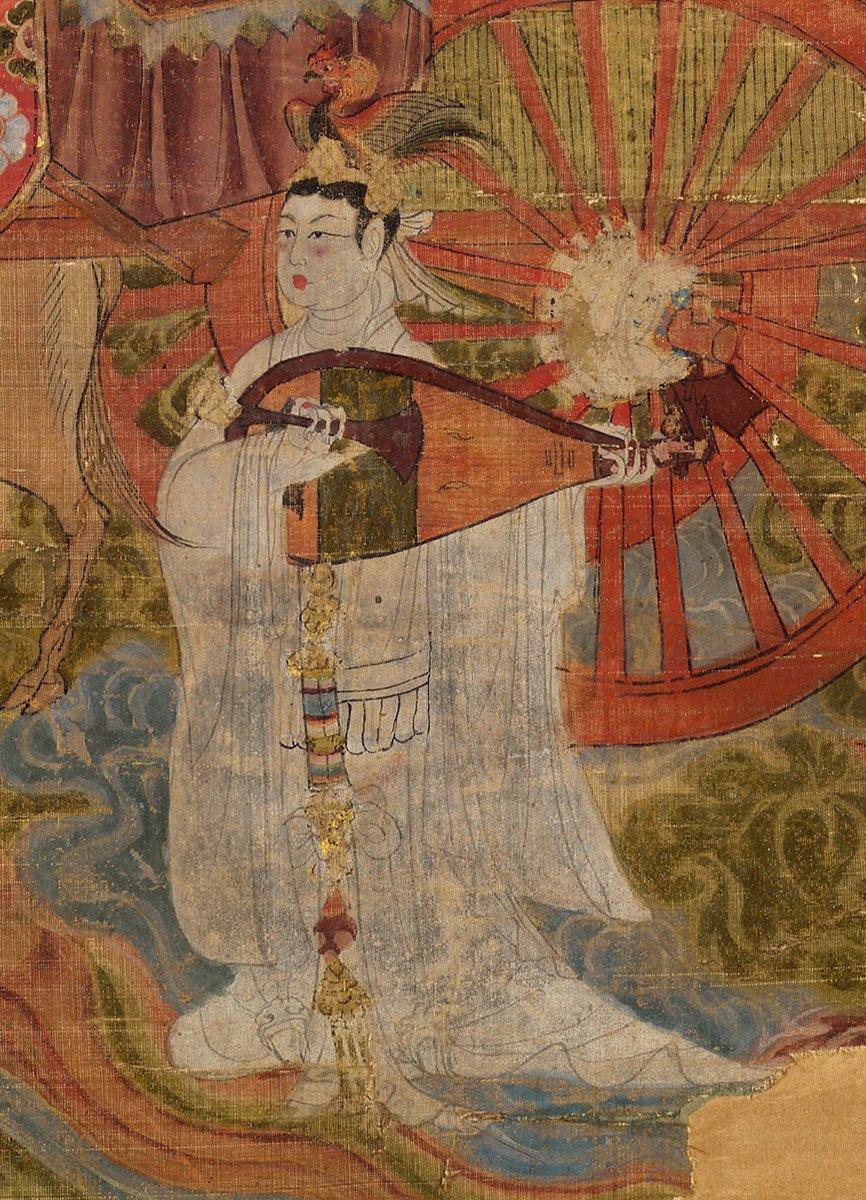
Astrology gave Venus a body. The same column cites a text on averting calamities of the seven luminaries for the earliest image of the Venus deity, a woman in a yellow skirt wearing a cockscomb crown and playing the pipa, who after the Ming became the white-bearded old man Taibai Jinxing of Journey to the West. A silk painting from Cave 17 at Dunhuang, dated by its inscription to 897 and now in the British Museum, shows the older figure: Venus in white with a bird on her head, playing the pipa beside the Buddha of Blazing Light and the other four planets. Those names have since been written onto Venus itself. Among the long channels that the International Astronomical Union has named on the planet are Tai-pe Valles, glossed in its gazetteer as the Chinese name for Venus, a 400 km system near 11 N, 156.5 E, with Kinsei Vallis for the Japanese name and Kūmsong Vallis for the Korean one, all three approved in 1997.
Western science reached its own warm, wet Venus by calculation. In Stjärnornas öden, published in Stockholm in 1915 and in English in 1918 as The Destinies of the Stars, the Swedish chemist Svante Arrhenius worked out an average temperature for Venus of about 47 °C and a humidity about six times the average on Earth. From that he concluded that everything on Venus must be dripping wet, and that the ground beneath its rain clouds lay almost windless. 'A very great part of the surface of Venus is no doubt covered with swamps,' runs the English edition, like those in which Earth's coal was laid down but some 30 degrees warmer. Life there, in his view, was luxuriant but low, mostly vegetable and much the same everywhere, while the slightly cooler poles would breed higher forms whose culture would spread toward the equator as the planet cooled. His account ends with a Venus that might one day be the Babylonians' queen of heaven as the dwelling place of the highest beings in the solar system.
By the 1950s the water picture was under siege. Donald Menzel and Fred Whipple of Harvard College Observatory opened their June 1955 paper, The Case for H2O Clouds on Venus, by conceding that the clouds were then almost universally blamed on something other than water. The objections were real: spectroscopy found almost no water vapour, radiometers put the cloud tops near 250 K, and H. C. Urey had argued that water would help rock lock carbon dioxide away as carbonate, so a planet so rich in carbon dioxide ought to be dry. Menzel and Whipple answered with B. Lyot's polarisation measurements, which among the substances Lyot knew only water droplets fitted well, and with a geological twist: if oceans covered the entire surface, a thin layer of carbonate on the sea floor would soon stop the reaction and leave the carbon dioxide in the air. They concluded that present-day oceans completely covering the planet could produce the observed clouds. The same year Fred Hoyle, in Frontiers of Astronomy, argued that Venus had begun with more hydrocarbons than water, that the oxygen freed from its water had been used up oxidising them, and that the excess might remain as oceans of oil under a perpetual smog of oil droplets. Venus, he wrote, 'is probably endowed beyond the dreams of the richest Texas oil-king.'
The measurement that upended the debate came from a radio dish in Washington. On 34 days between 2 May and 23 June 1956, around inferior conjunction, C. H. Mayer, T. P. McCullough and R. M. Sloanaker of the US Naval Research Laboratory aimed the laboratory's 50-foot reflector at Venus with a sensitive radiometer working at 3.15 cm. The apparent black-body temperature came out at about 620 ± 110 K in early May and 560 ± 73 K near conjunction. That was more than twice the 235 to 240 K that infrared radiometers found at the cloud tops, and well above the 408 K that Wildt had estimated in 1940 as the greatest surface temperature solar heating could produce. In the paper, received in July 1957 and published in January 1958, the three were careful. They declined to say where the radiation came from, allowed that at least part of it might come from the surface, and judged a hot ionosphere unlikely because it would need electron densities orders of magnitude above those in Earth's atmosphere.
For six years the heat had competing explanations. Summing up in 1964, the Mariner 2 radiometer team noted that ground observers had found a brightness temperature near 600 K at wavelengths of 3 cm and longer but only 350 to 400 K at 8 and 4 mm. Most theoretical discussions, the team wrote, assumed or tried to justify a hot surface, among them papers by A. H. Barrett and E. J. Öpik in 1961 and by Carl Sagan in 1962. D. E. Jones proposed in 1961 that the radio heat was thermal emission from the ionosphere; others blamed electrical discharges in the atmosphere (Tolbert and Straiton, 1962) or instabilities in the ionospheric plasma (Scharf, 1963). Sagan's case rested on the greenhouse effect. Owen Toon, who worked in his laboratory, credits him as one of the first to recognise that a massive greenhouse effect warms the surface of Venus, and traces his interest in the planets to childhood reading of Edgar Rice Burroughs.
The test was built into a spacecraft. In 1960 a microwave radiometer was proposed for Mariner A to settle where the emission came from; when the Atlas-Centaur rocket fell behind schedule the mission shrank to the 447 pound Mariner R, and the radiometer to two channels at 19 and 13.5 mm. The deciding evidence was at the edge of the disc. Near the limb a radiometer looks through a longer slant of atmosphere, so a hot surface under an absorbing atmosphere should fade toward the edge, while a hot layer high above should not. On 14 December 1962 Mariner 2 swept its beams across Venus three times, and the 19 mm channel showed the limbs cooler than the centre by far more than the beam geometry could explain. The team, which included Jones, concluded that the radiation originates at or near the surface.
Mariner 2 did not end every doubt at once. In 1967 J. B. Pollack and Carl Sagan were still publishing a critical test of the electrical discharge model of the microwave emission, and the design of Venera 4 still carried a trace of the ocean. One account in the epizodsspace record says its capsule would have stayed afloat if it came down in an ocean, which few believed in, and that a 'sugar head' device would then have signalled the splashdown. Shubin's chronicle in the same collection records that the Academy of Sciences gave the designers a surface pressure of 1 to 10 atmospheres and a temperature of 475 degrees, and that when the capsule was reworked in May 1967 the sugar lock came out while the buoyancy stayed; in Shubin's own reading, the buoyancy was by then meant for a fall on Earth. The answer from the ground came from Venera 7, which landed on the night side on 15 December 1970. A telemetry fault left only its temperature channel working. NPO Lavochkin gives 475 ± 20 °C at the surface, and a pressure of 90 ± 15 atmospheres calculated from that temperature record and earlier probes' data. The clouds once read as water turned out to be sulfuric acid; how that was established, starting from Lyot's polarisation curves, is on The Atmosphere of Venus.
Novelists and visionaries had been visiting Venus since the seventeenth century. The Encyclopedia of Science Fiction traces Venus through planetary tours by Athanasius Kircher (1656) and Emanuel Swedenborg (1758), whose inhabitants, in the manner of Fontenelle's, tended to be gentle and ethereal in keeping with the goddess of love, and it names Achille Eyraud's Voyage à Vénus, published in Paris by Michel Lévy in 1865, as the first novel concerned specifically with Venus. Eyraud's narrator brakes his fall with propulsion cones and lands in a meadow of tall grass under dazzling light. When a listener objects that Venus must be very hot, the narrator's answer is the scientists' logic in miniature: its atmosphere is far cloudier than ours, and a thick veil of white vapours sends the sunlight back into space, shields the ground from burning rays and brings abundant rain.
The pulp magazines turned the clouds into a stage set. Otis Adelbert Kline's The Planet of Peril ran in Argosy in 1929, and Edgar Rice Burroughs began his own Venus series with Pirates of Venus, serialised in Argosy in 1932. Robert A. Heinlein made Venus a fertile, sickly world of fungus-ridden swamps in 'The Green Hills of Earth' (1947) and two later novels. A second tradition made Venus an ocean. Olaf Stapledon's Last and First Men (1930) gave future humanity a winged life on its floating islands, C. S. Lewis set a new Eden on islands of floating vegetation in Perelandra (1943), Henry Kuttner and C. L. Moore housed the last humans in undersea keeps in 'Clash by Night' (1943) and Fury (1947), and Isaac Asimov, writing as Paul French, published Lucky Starr and the Oceans of Venus in 1954. Ray Bradbury's 'Death-by-Rain' (1950), retitled 'The Long Rain' in The Illustrated Man (1951), kept the jungle version under weather that never relents.
Writers in the socialist countries used the same clouds for different lessons. Stanisław Lem's Astronauci (The Astronauts, 1951), his first novel about interplanetary travel, sends an expedition to a Venus whose inhabitants had prepared to attack Earth but destroyed themselves beforehand in a fratricidal war. It was filmed as The Silent Star (Der schweigende Stern; 1960 in the Encyclopedia of Science Fiction, 1959 in The Guardian), though Lem later judged his first science fiction novels to be without value. Arkady and Boris Strugatsky's The Land of Crimson Clouds (Strana bagrovykh tuch), about a tragic expedition to a pitiless Venus, grew from an idea Arkady had around 1951, and a letter of 10 December 1952 shows the science seeping in: Boris had written that the water on Venus had vanished, and Arkady asked in reply what the cloud cover could be if there was no water, and whether the planet could then be inhabited even by burdocks and ants. The manuscript sat at the children's publisher Detgiz for two years before going to the typesetters in April 1959, while editors demanded that the brothers remove at least some of the corpses. Aleksandr Kazantsev's novella Planet of Storms, later reworked as Grandsons of Mars, sent a Soviet and American expedition to a Venus much like Earth in the Jurassic, and became the basis of a film.
Pavel Klushantsev, a popular science director at the Lennauchfilm studio in Leningrad, had a feature about a Moon expedition approved in 1959. After a bitter fight with the screenwriters, writes Evgeny Kharitonov in an essay on Klushantsev's career (printed in the magazine Esli in 2002), Kazantsev's novella became the basis and the heroes set off for Venus instead of the Moon. Planet of Storms was shot at Lennauchfilm in 1961, according to the Bryansk news agency RIA Strela, which on 12 April 2022 marked 60 years since its premiere in the region's cinemas, putting that premiere in 1962; Kharitonov writes that it reached the big screen in 1961. Its Venus is wet, volcanic and prehistoric, with a hovering car, a robot called John, a carnivorous flower, lizard-like natives, a dinosaur, a pterodactyl and an eruption, and a closing twist that suggests intelligent life after all. Kharitonov records that the culture minister Ekaterina Furtseva wanted to cut a scene in which the woman left in orbit weeps ('A Soviet woman cosmonaut cannot cry!'), and that critics savaged the film while audiences loved it; in a St Petersburg television report Klushantsev's production manager Aleksandr Kharkevich remembered queues at the Znanie cinema on Nevsky Prospekt for about half a year. Twenty-eight countries bought the distribution rights.
In the United States Roger Corman bought the film and cut it into two new pictures. Voyage to the Prehistoric Planet (1965), credited to John Sebastian, a pseudonym of Curtis Harrington, kept much of the Soviet footage, dubbed the cosmonauts, swapped the woman in orbit for Faith Domergue and added Basil Rathbone as a scientist in a transmission room, according to Douglas Buck's account in Offscreen. Voyage to the Planet of Prehistoric Women followed in 1968 under the name Derek Thomas. Its director, Peter Bogdanovich, told The A.V. Club in 2002 that Corman had dubbed the Russian film as Storm Clouds of Venus, that AIP would not buy it unless women were added, and that he shot for five days and directed about ten minutes of the result. The makers of the original went uncredited, and Georgy Zhzhenov appears in the American titles as Kurt Boden. By the first version's release, Mariner 2 had already flown past the real planet.
Once the surface was known to be hot and dry, writers lost interest, the Encyclopedia of Science Fiction notes, and the old Venus survived mainly as farewell. Larry Niven's 'Becalmed in Hell' (1965) showed the intimidating new world, while Roger Zelazny's 'The Doors of His Face, the Lamps of His Mouth', published the same year, took an ornate leave of the planet of the great ocean, and Brian Aldiss and Harry Harrison gathered the old stories in 1968 under the title Farewell, Fantastic Venus! Later novelists turned to remaking the planet, in Pamela Sargent's terraforming saga begun with Venus of Dreams (1986) and in Kim Stanley Robinson's 2312 (2012). In 2015 Gardner Dozois and George R. R. Martin edited Old Venus, an anthology of new stories set on the traditional Venus of science fiction and science fantasy, half a century after science had retired it.
Parts of the imagined Venus have returned as serious questions. Whether the planet held oceans early in its history is still argued: a modelling study posted in April 2026 concluded that its carbon dioxide atmosphere does not by itself show whether Venus had a temperate past. The question is covered on Did Venus Have Oceans?. Whether anything could live in the clouds, a possibility H. Morowitz and Carl Sagan raised in 1967, is on Life on Venus. The oldest names needed no correction: Qiming still rises ahead of the Sun and Changgeng still follows it down, and they are still the same planet.
What we know
Swamp Venus (Arrhenius, 1915)
In The Destinies of the Stars (Stockholm, 1915, in Swedish; English edition 1918) Svante Arrhenius computes a mean temperature near 47 °C and a humidity about six times Earth's average, concludes that everything on Venus is dripping wet and that much of the surface is swamp like Earth's coal-forming swamps but about 30 degrees warmer, and expects luxuriant but low, mostly plant life, with higher forms at the cooler poles.
Ocean Venus (Menzel and Whipple, 1955)
Donald Menzel and Fred Whipple (Harvard College Observatory, PASP 67, 161, June 1955) argue that the clouds are water and suggest that present-day oceans completely covering the surface would halt the carbonate reaction H. C. Urey had used to argue that Venus must be dry.
Oil Venus (Hoyle, 1955)
Fred Hoyle's Frontiers of Astronomy proposes that Venus began with more hydrocarbons than water, used up the oxygen from its water oxidising them, and may keep oceans of oil under a perpetual smog of oil droplets; tides in those oceans would explain its slow rotation.
Radio puzzle: the 1956 measurement
C. H. Mayer, T. P. McCullough and R. M. Sloanaker (US Naval Research Laboratory) observed Venus at 3.15 cm with the NRL 50-foot reflector on 34 days from 2 May to 23 June 1956 and derived an apparent black-body temperature of about 620 ± 110 K in early May and 560 ± 73 K near inferior conjunction (ApJ 127, 1, January 1958). Infrared readings of 235 to 240 K referred to the cloud tops, and Wildt's 1940 greenhouse estimate allowed at most 408 K at the surface.
Radio puzzle: the rival explanations
Hot surface (Barrett 1961, Öpik 1961, Sagan 1962); thermal emission from a dense ionosphere (Jones 1961); electrical discharges in the atmosphere (Tolbert and Straiton 1962); plasma instabilities in the ionosphere (Scharf 1963). Ground measurements gave about 600 K at 3 cm and longer but 350 to 400 K at 8 and 4 mm.
Radio puzzle: the verdict
Mariner 2's microwave radiometer scanned Venus three times on 14 December 1962. The 19 mm channel showed true limb darkening, which the team (Barath, Barrett, Copeland, Jones and Lilley) read as showing that the radiation originates at or near the surface; the 13.5 mm data were too noisy to show it clearly.
Surface as reached by Venera 7
Venera 7 landed on the night side on 15 December 1970. A failed telemetry commutator left only the temperature channel, which read 475 ± 20 °C at the surface; NPO Lavochkin gives the surface pressure as 90 ± 15 atmospheres, calculated from that temperature profile with hydrostatic equilibrium, the gas law and earlier probes' data.
Surface today
Mean temperature 737 K (464 °C), surface pressure 92 bar, atmosphere 96.5 percent carbon dioxide near the surface (NSSDCA Venus fact sheet, last updated 11 January 2024, checked 26 September 2026).
What the clouds are
Sulfuric acid particles about 60 km up, where pressure and temperature are Earth-like; NASA's caption for a reprocessed Mariner 10 view contrasts them with the water droplets and ice crystals of Earth's clouds.
Venus in fiction: the earliest novel
The Encyclopedia of Science Fiction names Achille Eyraud's Voyage à Vénus (Paris, Michel Lévy, 1865) as the first novel concerned specifically with Venus; earlier planetary tours by Kircher (1656) and Swedenborg (1758) gave it gentle, ethereal inhabitants.
Venus in fiction: jungle and rain
Kline's The Planet of Peril (Argosy, 1929); Burroughs's Pirates of Venus (Argosy, 17 September to 22 October 1932; book 1934); Weinbaum's 'Parasite Planet' (1935); Heinlein's fungal swamps in 'The Green Hills of Earth' (1947); Bradbury's 'Death-by-Rain' (1950), retitled 'The Long Rain' (1951).
Venus in fiction: the ocean planet
Stapledon's Last and First Men (1930), Lewis's Perelandra (1943; retitled Voyage to Venus in 1953), Kuttner and Moore's 'Clash by Night' (1943) and Fury (1947), and Asimov's Lucky Starr and the Oceans of Venus (1954, as Paul French).
Venus in fiction: after 1962
Niven's 'Becalmed in Hell' and Zelazny's 'The Doors of His Face, the Lamps of His Mouth' (both 1965); Aldiss and Harrison's anthology Farewell, Fantastic Venus! (1968); terraforming in Sargent's Venus of Dreams (1986) and Robinson's 2312 (2012); the retro anthology Old Venus (2015). Entry updated 10 August 2026.
Soviet and Polish Venus novels
Lem's The Astronauts (1951), in which Venus prepared to attack Earth and destroyed itself in a fratricidal war (Lem's official site); the Strugatskys' The Land of Crimson Clouds, conceived around 1951 and sent to the typesetters at the children's publisher Detgiz in April 1959 (Boris Strugatsky's commentary); Kazantsev's novella Planet of Storms, later reworked as Grandsons of Mars (Argumenty i Fakty, 2016).
Planet of Storms: how it was made
Pavel Klushantsev's Lennauchfilm feature began in 1959 as a Moon expedition; after a fight with the screenwriters Kazantsev's novella became the basis and the destination became Venus (Kharitonov, essay of 2001 printed in Esli, 2002). A St Petersburg television report puts the cost of the rover alone at 400,000 roubles.
Planet of Storms: when it came out
Two readings: shot at Lennauchfilm in 1961 and premiered in Bryansk region cinemas 60 years before 12 April 2022, so in 1962 (RIA Strela); released to the big screen in 1961 (Kharitonov, 2002). Alex Cox in The Guardian (2011) also dates it 1962. Twenty-eight countries bought distribution rights (Kharitonov; Argumenty i Fakty, 2016).
Planet of Storms: the American versions
Voyage to the Prehistoric Planet (1965), credited to John Sebastian (Curtis Harrington), with Basil Rathbone and Faith Domergue added; Voyage to the Planet of Prehistoric Women (1968), credited to Derek Thomas (Peter Bogdanovich), with new scenes of silent, telepathic women on a Venusian shore and a voice-over by Bogdanovich himself.
Chinese names
Qiming, the opener of brightness, for the morning apparition and Changgeng, the long-continuing star, for the evening one, paired in the Book of Songs ode Da Dong; Taibai, the great white, for the planet; Jinxing, the metal star, from the five-phase scheme; one of the 'five wefts', the planets known in ancient China, that with the Sun and Moon make the 'seven luminaries'.
Chinese omens
'Taibai seen by day', Venus seen in daylight, was a bad sign for the emperor; 'Taibai crossing the sky', Venus seen both before and after noon as it crossed the meridian, signalled the fall of a state. Venus crossed the daytime sky on 29 June and 1 July 626, days before the Xuanwu Gate coup of 2 July (Li Xudai, National Geographic Chinese edition, 16 July 2024).
What happened, and when
- 29 Jun to 2 Jul 626Venus crosses the daytime sky on 29 June and 1 July; a court astronomer tells Li Yuan the Prince of Qin will take the empire, and Li Shimin strikes at the Xuanwu Gate on 2 July.
- 897A donor named Zhang has a silk painting made of the Buddha of Blazing Light and the five planets, with Venus as a woman playing the pipa; it is later recovered from Cave 17 at Dunhuang.
- 1865Michel Lévy publishes Achille Eyraud's Voyage à Vénus in Paris, with a cloud-veiled, rainy Venus of meadows and people.
- 1915Svante Arrhenius's The Destinies of the Stars, published in Swedish in Stockholm, describes Venus as largely swamp, about 30 degrees warmer than Earth's coal-age swamps (English edition 1918).
- 17 Sep to 22 Oct 1932Edgar Rice Burroughs's Pirates of Venus runs in Argosy.
- 1943C. S. Lewis's Perelandra sets a new Eden on the floating islands of an ocean Venus.
- Jun 1955Menzel and Whipple make the case for water clouds over a planet-wide ocean; the same year Fred Hoyle proposes oceans of oil.
- 2 May to 23 Jun 1956The US Naval Research Laboratory's 50-foot reflector measures Venus at 3.15 cm on 34 days and finds an apparent temperature of 560 to 620 K.
- Apr 1959The Strugatsky brothers' Venus novel The Land of Crimson Clouds goes to the typesetters at the children's publisher Detgiz after two years there.
- 24 Mar 1961Carl Sagan's review 'The Planet Venus' appears in Science; D. E. Jones's hot-ionosphere explanation follows in Planetary and Space Science in June.
- 1961 to 1962Pavel Klushantsev shoots Planet of Storms at Lennauchfilm; RIA Strela, on 12 April 2022, marks 60 years since its premiere in Bryansk region cinemas, while Kharitonov dates its release to 1961.
- 14 Dec 1962Mariner 2's radiometer scans Venus three times and records limb darkening, placing the source of the radio heat at or near the surface.
- 1965Voyage to the Prehistoric Planet, cut from Planet of Storms by Curtis Harrington for Roger Corman, is released in the United States.
- May 1967Soviet engineers remove the sugar lock splashdown signal from the Venera 4 capsule but keep it buoyant, according to Shubin's chronicle, which reads the buoyancy as a provision for a fall on Earth.
- 1968Voyage to the Planet of Prehistoric Women, credited to Derek Thomas (Peter Bogdanovich), recuts the Soviet film a second time for American release.
- 15 Dec 1970Venera 7 lands on the night side and returns temperature readings from the surface, 475 ± 20 °C; NPO Lavochkin calculates a surface pressure of 90 ± 15 atmospheres from them.
- 1997The IAU adopts Tai-pe Valles, Kinsei Vallis and Kūmsong Vallis, named for the Chinese, Japanese and Korean names of the planet.
In pictures
Tap a photo to enlarge.
Translated from the original sources
Passages from the Russian, Chinese, Swedish, French and Polish sources this page draws on, in azmth's translation. Tap Show original to read the original wording.
Svante Arrhenius, The Destinies of the Stars
Swedish · 1 passage
Svante Arrhenius, The Destinies of the Stars (Stockholm: Hugo Geber, 1915), p. 150, Project Runeberg scan and transcription
Open the source“One can understand from this that on Venus everything must be dripping wet.”
Stjärnornas öden, 1915, p. 150
azmth's translation · Show originalHide original
Swedish: “Man kan därav förstå, att på Venus allt skall vara drypande vått.”
Svante Arrhenius, The Destinies of the Stars
Swedish · 1 passage
Svante Arrhenius, The Destinies of the Stars (Stockholm: Hugo Geber, 1915), p. 151, Project Runeberg scan and transcription
Open the source“A very great part of the surface of Venus is therefore no doubt covered by swamps, corresponding to those in which the formation of coal on Earth took place, but about 30 degrees hotter.”
p. 151
azmth's translation · Show originalHide original
Swedish: “En mycket stor del av Venus’ yta täckes därför utan tvivel av sumpmarker, motsvarande dem, i vilka stenkolsbildningen på jorden försiggått, men omkring 30 grader hetare.”
Svante Arrhenius, The Destinies of the Stars
Swedish · 1 passage
Svante Arrhenius, The Destinies of the Stars (Stockholm: Hugo Geber, 1915), title and contents page with the cover scan, Project Runeberg
Open the source“The Earth with the Moon, seen from Mercury (the caption printed above the illustration on the cover of Stjärnornas öden, 1915).”
azmth's translation · Show originalHide original
Swedish: “Jorden med månen sedda från Merkurius”
Achille Eyraud, Voyage à Vénus
French · 1 passage
Achille Eyraud, Voyage à Vénus (1865), Library of Congress copy, Internet Archive full text
Open the source“this thick veil of white vapours, which sends the Sun's rays back into space, thus often protects the ground from their burning blows, while also being a cause of abundant rain.”
Voyage à Vénus, 1865, p. 44
azmth's translation · Show originalHide original
French: «ce voile épais de blanches vapeurs, qui renvoie dans l'espace les rayons solaires, préserve ainsi fréquemment le sol de leurs brûlantes atteintes, en même temps qu'il est une cause de pluies abondantes.»
Gallica (BnF), Achille Eyraud, Voyage à Vénus (Paris: Michel Lévy, 1865), catalogue record
French · 1 passage
“Voyage to Venus, by Achille Eyraud (Gallica catalogue record: Paris, Michel Lévy, 1865).”
azmth's translation · Show originalHide original
French: «Voyage à Vénus, par Achille Eyraud»
He Xi, What Kind of Star Is Taibai Jinxing?, Beijing Evening News, reprinted by China News Service, 16 December 2016
Chinese · 6 passages
“The Book of Songs (Xiaoya, Da Dong): 'In the east there is Qiming, in the west there is Changgeng.' Both refer to Venus.”
azmth's translation · Show originalHide original
Chinese: 《诗·小雅·大东》:“东有启明,西有长庚。”说的都是金星
“(Lu Xun's mother:) Zhou Zuoren was called Qiming, also a star name, called 'the fifth-watch star' [in Shaoxing]; the two stars never meet.”
azmth's translation · Show originalHide original
Chinese: 周作人叫启明,也是星名,叫‘五更肖’,两星永远不相见。
“If Taibai Jinxing (Venus) is seen in daytime, this special phenomenon is called 'Taibai crossing the sky, seen by day', a sign of great disorder.”
azmth's translation · Show originalHide original
Chinese: 如果在白天见到太白金星,这种特殊的天文现象被称之为“太白经天昼见”,是大乱之相!
“The Qiyao rangzai fa describes its earliest image as a female deity in a yellow skirt, wearing a cockscomb, playing the pipa.”
azmth's translation · Show originalHide original
Chinese: 《七曜禳灾法》描述最初的形象是穿着黄色裙子,戴着鸡冠,演奏琵琶的女性神
“So the planets that could be observed in ancient China were named after the five phases, metal, wood, water, fire and earth, and called the 'five wefts', in contrast to the fixed stars (the 'warp stars'); the five wefts together with the Sun and Moon were called the 'seven luminaries'. Today in Japan the seven days of every week are all named after the seven luminaries.”
azmth's translation · Show originalHide original
Chinese: 因而中国古代所能观察到的行星,以金木水火土五行命名,称为“五纬”,与恒星(经星)相对,“五纬”与日月合称为“七曜”。现在日本每个星期七天都用七曜来称呼
“What kind of star is Taibai Jinxing?”
Title of the Beijing Evening News article.
azmth's translation · Show originalHide original
Chinese: 太白金星是颗什么星?
Li Xudai, The Daytime Venus That Changed the Fate of the Tang Dynasty, National Geographic Chinese edition, 16 July 2024
Chinese · 6 passages
“In ancient China Venus was called Taibai, and seeing Venus in daytime was called 'Taibai seen by day'.”
azmth's translation · Show originalHide original
Chinese: 古代中國,金星稱為太白,白天看見金星稱為「太白晝見」。
“On 29 June and 1 July 626 Venus crossed the sky in daytime (taibai jing tian).”
azmth's translation · Show originalHide original
Chinese: 公元626年6月29日與7月1日都發生太白經天
“Seeing Venus in the daytime is a normal phenomenon, but Venus appearing by day did set off a bloodbath and changed the history of the Tang dynasty.”
azmth's translation · Show originalHide original
Chinese: 白天看見金星是正常的現象,不過白天出現金星確實引發一場腥風血雨,改變了唐朝的歷史。
“'Taibai seen by day' was a bad omen for the emperor: the Sun stood for the emperor, and seeing Venus by day meant that Venus was competing with the Sun's brilliance and the emperor might be replaced, an unfavourable sign for him. There was also 'Taibai crossing the sky', when Venus could be seen both before and after noon, that is, when Venus crossed the meridian; this was a sign of the fall of a state.”
azmth's translation · Show originalHide original
Chinese: 太白晝見對皇帝來說是不好的徵兆,太陽代表皇帝,白天看見金星,表示金星與太陽爭輝,皇帝可能被替換,對皇帝是不利的象徵。另外還有「太白經天」,也就是金星從正午前和正午後都可以看見,也就是金星經過中天,這是亡國的象徵。
“About the author: Li Xudai, who runs The Astronomer on the Roof, holds a doctorate from the Institute of Astronomy at National Central University.”
azmth's translation · Show originalHide original
Chinese: 關於作者:李昫岱,屋頂上的天文學家主理人,中央大學天文所博士
“The daytime Venus that changed the fate of the Tang dynasty.”
Title of the article, whose daytime Venus is the omen called 'Taibai seen by day'.
azmth's translation · Show originalHide original
Chinese: 改變唐朝命運的晝見太白
Jin Shuxin, Stars and Poems | Venus: Qiming in the East, Changgeng in the West, Our Space account, The Paper, 7 August 2021
Chinese · 3 passages
“Not until the Western Han did Sima Qian, following five-phase theory, match its white colour to metal and formally give it the name Jinxing (metal star).”
azmth's translation · Show originalHide original
Chinese: 一直到了西汉,司马迁才依据“五行”学说,将其白色与金对应,正式给了它“金星”这个名字。
“Source: Our Space (account ID ourspace0424), the account that published the article.”
azmth's translation · Show originalHide original
Chinese: 来源 | 我们的太空(ID:ourspace0424)
“Stars and Poems | Venus: in the east there is Qiming, in the west there is Changgeng.”
Title of the article, before its series tag.
azmth's translation · Show originalHide original
Chinese: 繁星与诗 | 金星:东有启明,西有长庚
Boris Strugatsky, Kommentarii k proidennomu, chapter on Strana bagrovykh tuch, official Strugatsky site
Russian · 3 passages
“The idea of a story about a tragic expedition to the pitiless planet Venus came to Arkady Natanovich, apparently, in the second half of 1951.”
azmth's translation · Show originalHide original
Russian: «Идея повести о трагической экспедиции на беспощадную планету Венеру возникла у АН, видимо, во второй половине 1951 года.»
“(Arkady to Boris, 10 December 1952:) if there is no water on Venus, what then is the cloud cover that covers it?”
azmth's translation · Show originalHide original
Russian: «ежели нет на Венере воды, что же собой представляет облачный покров, ее (Венеру) покрывающий?»
“The manuscript lay at Detgiz for two years (sent to the typesetters in April 1959).”
azmth's translation · Show originalHide original
Russian: «Рукопись пролежала в Детгизе два года (сдана в набор в апреле 1959).»
Elena Yakovleva, Budushchee po Kazantsevu, Argumenty i Fakty, 2 September 2016
Russian · 1 passage
Elena Yakovleva, Budushchee po Kazantsevu, Argumenty i Fakty, 2 September 2016 (Web Archive copy)
Open the source“at first it was called 'Planet of Storms', then 'Grandsons of Mars' (of Kazantsev's novella).”
azmth's translation · Show originalHide original
Russian: «сперва она называлась «Планета Бурь», затем «Внуки Марса»»
Evgeny Kharitonov, Kosmicheskaya odisseya Pavla Klushantseva
Russian · 4 passages
Evgeny Kharitonov, Kosmicheskaya odisseya Pavla Klushantseva (2001; Esli, 2002; reprinted in Na ekrane - Chudo, 2003), fandom.ru (Web Archive copy)
Open the source“and the heroes of the film set off to explore Venus instead of the Moon.”
azmth's translation · Show originalHide original
Russian: «а герои картины вместо Луны отправились осваивать Венеру»
“'A Soviet woman cosmonaut cannot cry!'”
Ekaterina Furtseva's objection, as reported by Kharitonov
azmth's translation · Show originalHide original
Russian: «"Советская женщина-космонавт не может плакать!"»
“The film was bought by 28 countries.”
azmth's translation · Show originalHide original
Russian: «Фильм был закуплен 28 странами»
“The film Planeta bur' came out on the big screen in 1961 (Kharitonov).”
azmth's translation · Show originalHide original
Russian: «Фильм "Планета бурь" вышел на большой экран в 1961 году»
RIA Strela, 60 let nazad ... sostoyalas' prem'era fil'ma 'Planeta bur''
Russian · 1 passage
RIA Strela, 60 let nazad ... sostoyalas' prem'era fil'ma 'Planeta bur'' (12 April 2022)
Open the source“It was shot at the Lennauchfilm studio in 1961.”
azmth's translation · Show originalHide original
Russian: «Он был снят в киностудии «Леннаучфильм» в 1961 году.»
Telekanal Sankt-Peterburg, 'Planeta bur''. Istoriya shedevra
Russian · 3 passages
Telekanal Sankt-Peterburg, 'Planeta bur''. Istoriya shedevra (Web Archive copy)
Open the source“the rover alone cost 400,000 roubles”
azmth's translation · Show originalHide original
Russian: «один только планетоход обошелся в 400 тысяч рублей»
“Zhzhenov was even credited as a certain Kurt Boden.”
azmth's translation · Show originalHide original
Russian: «Жженов же и вовсе был указан как некий Курт Боден.»
“On Nevsky, at the Znanie cinema, this picture ran for about half a year and drew a queue every time (Aleksandr Kharkevich, production manager of Klushantsev's films).”
azmth's translation · Show originalHide original
Russian: «На Невском в кинотеатре "Знание" эта картина шла около полугода и собирала каждый раз очередь.»
epizodsspace, Venera-4 dossier
Russian · 4 passages
epizodsspace, Venera-4 dossier (Web Archive copy of 27 May 2024)
Open the source“Had the capsule come down in an ocean, which few believed in, it would have stayed afloat”
azmth's translation · Show originalHide original
Russian: «В случае попадания капсулы в океан, во что мало кто верил, она осталась бы на плаву»
“The sugar lock and level indicators were removed from the equipment, but buoyancy in case of landing in water was kept (Shubin, who adds his own view that this was no longer for Venus but for Earth, a way to save the descent module if it fell on Earth).”
azmth's translation · Show originalHide original
Russian: «Сахарный замок и индикаторы уровня из оборудования исключили, но плавучесть при попадания в воду оставили»
“Parameters for Venus from the USSR Academy of Sciences: pressure 1 to 10 atm, temperature 475° (Shubin; the unit of the temperature is not stated).”
azmth's translation · Show originalHide original
Russian: «Параметры на Венеру от АН СССР: давление 1-10 атм, температура 475°.»
“my opinion: this was no longer for Venus but for Earth, a way to keep the descent module intact if it fell on Earth (Shubin, on the buoyancy kept after the sugar lock was removed).”
azmth's translation · Show originalHide original
Russian: «моё мнение - это уже не для Венеры - для Земли - возможность сохранить СА при падении на Землю»
NPO Lavochkin, Venera-7 project page
Russian · 2 passages
“It turned out that the pressure at the surface of Venus is 90 ± 15 atmospheres (the same sentence goes on to give the temperature as 475 ± 20 °C; the page explains that, with only the temperature channel working, pressure and density were calculated from the temperature profile using hydrostatic equilibrium, the gas law and earlier stations' data).”
azmth's translation · Show originalHide original
Russian: «Оказалось, что давление у поверхности Венеры составляет 90±15 атмосфер»
“On the descent module's entry into the atmosphere the telemetry commutator failed, as a result of which only the ambient temperature was transmitted to Earth.”
azmth's translation · Show originalHide original
Russian: «При входе СА в атмосферу произошел отказ телеметрического коммутатора, в результате чего на Землю передавалась только температура окружающей среды»
Stanisław Lem official site, Astronauci
Polish · 2 passages
“The image of Venus, preparing to attack Earth but destroyed beforehand by a fratricidal war”
azmth's translation · Show originalHide original
Polish: „Obraz Wenus, gotującej się do ataku na Ziemię, ale zniszczonej wcześniej wskutek bratobójczej wojny”
“Yet this first novel of Lem's about interplanetary travel carries a charge of exceptional imagination.”
azmth's translation · Show originalHide original
Polish: „W tej pierwszej Lema powieści o podróży międzyplanetarnej jest jednak ładunek nieprzeciętnej wyobraźni”
Sources
- Svante Arrhenius, The Destinies of the Stars (Stockholm: Hugo Geber, 1915), title and contents page with the cover scan, Project Runeberg · in Swedish
- Svante Arrhenius, The Destinies of the Stars (Stockholm: Hugo Geber, 1915), p. 150, Project Runeberg scan and transcription · in Swedish
- Svante Arrhenius, The Destinies of the Stars (Stockholm: Hugo Geber, 1915), p. 151, Project Runeberg scan and transcription · in Swedish
- Svante Arrhenius, The Destinies of the Stars, trans. J. E. Fries (New York: Putnam, 1918), Internet Archive full text
- D. H. Menzel and F. L. Whipple, The Case for H2O Clouds on Venus, PASP 67, 161 (June 1955), ADS scan
- Fred Hoyle, Frontiers of Astronomy (1955), Internet Archive full text
- C. H. Mayer, T. P. McCullough and R. M. Sloanaker, Observations of Venus at 3.15-cm Wave Length, ApJ 127, 1 (January 1958), ADS scan
- F. T. Barath, A. H. Barrett, J. Copeland, D. E. Jones and A. E. Lilley, Mariner 2 Microwave Radiometer Experiment and Results, AJ 69, 49 (February 1964), ADS scan
- D. E. Jones, The microwave temperature of Venus, Planetary and Space Science 5, 166 (June 1961), DOI record
- C. Sagan, The Planet Venus, Science 133, 849 (24 March 1961), PubMed record
- O. B. Toon and E. P. Condon, Carl Sagan and the Exploration of Mars and Venus (1997), NTRS abstract
- J. B. Pollack and C. Sagan, A critical test of the electrical discharge model of the Venus microwave emission (1967), NTRS record
- H. Morowitz and C. Sagan, Life in the clouds of Venus? (1967), NTRS record
- NSSDCA, Venus Fact Sheet (last updated 11 January 2024)
- NASA, PIA23791: Venus from Mariner 10 (8 June 2020)
- NPO Lavochkin, Venera-7 project page · in Russian
- epizodsspace, Venera-4 dossier (Web Archive copy of 27 May 2024) · in Russian
- The Encyclopedia of Science Fiction, entry 'Venus' (updated 10 August 2026)
- Gallica (BnF), Achille Eyraud, Voyage à Vénus (Paris: Michel Lévy, 1865), catalogue record · in French
- Achille Eyraud, Voyage à Vénus (1865), Library of Congress copy, Internet Archive full text · in French
- Stanisław Lem official site, Astronauci · in Polish
- Stanisław Lem official site (English), Lem's Opinion on Astronauts
- Boris Strugatsky, Kommentarii k proidennomu, chapter on Strana bagrovykh tuch, official Strugatsky site · in Russian
- Elena Yakovleva, Budushchee po Kazantsevu, Argumenty i Fakty, 2 September 2016 (Web Archive copy) · in Russian
- Evgeny Kharitonov, Kosmicheskaya odisseya Pavla Klushantseva (2001; Esli, 2002; reprinted in Na ekrane - Chudo, 2003), fandom.ru (Web Archive copy) · in Russian
- RIA Strela, 60 let nazad ... sostoyalas' prem'era fil'ma 'Planeta bur'' (12 April 2022) · in Russian
- Telekanal Sankt-Peterburg, 'Planeta bur''. Istoriya shedevra (Web Archive copy) · in Russian
- Alex Cox, Rockets from Russia: great Eastern Bloc science-fiction films, The Guardian, 1 July 2011
- Douglas Buck, Voyage to the Prehistoric Planet / Voyage to the Planet of Prehistoric Women, Offscreen, 4 May 2020
- Nathan Rabin, interview with Peter Bogdanovich, The A.V. Club, 17 April 2002 (Web Archive copy)
- He Xi, What Kind of Star Is Taibai Jinxing?, Beijing Evening News, reprinted by China News Service, 16 December 2016 · in Chinese
- Li Xudai, The Daytime Venus That Changed the Fate of the Tang Dynasty, National Geographic Chinese edition, 16 July 2024 · in Chinese
- Jin Shuxin, Stars and Poems | Venus: Qiming in the East, Changgeng in the West, Our Space account, The Paper, 7 August 2021 · in Chinese
- British Museum, painting 1919,0101,0.31, Tejaprabha Buddha and the Five Planets (Web Archive copy of the 2018 record)
- IAU Gazetteer of Planetary Nomenclature: Tai-pe Valles
- IAU Gazetteer of Planetary Nomenclature: Kinsei Vallis
- IAU Gazetteer of Planetary Nomenclature: Kūmsong Vallis
- A. Constantinou, O. Shorttle and H. Nicholls, Equifinality of Venus-like CO2 Atmospheres (arXiv 2604.25810, 28 April 2026)
Checked on 26 September 2026. Where the science is unsettled this page says so rather than picking a winner.
azmth is independent and is not affiliated with or endorsed by NASA, Roscosmos, NPO Lavochkin, ESA, JAXA, ISRO, CNSA, or any other space agency or company named on this page.