Mariner 1 and Mariner 2
NASA and JPL · United States · Flyby · 1962 · The first attempts Success
Ended. Mariner 2 flew past Venus on 14 December 1962, was last heard from on 3 January 1963 and still circles the Sun. Mariner 1 was destroyed during launch on 22 July 1962. Mariner A, Mariner B and the 1959 Venus probes never went to Venus.
TL;DR· 20 min read
Mariner 2 flew past Venus on 14 December 1962, about 34,850 km above the surface, in the first successful flyby of another planet. Its radio scans pointed to a very hot lower atmosphere or surface, it found no magnetic field, and it detected the solar wind in every one of its readings across the cruise. Its twin, Mariner 1, was destroyed 293 seconds after launch on 22 July 1962, when a faulty beacon on its Atlas rocket and a missing symbol in the ground guidance program sent it off course. Of the 1959 Venus plans, one probe flew as Pioneer 5 into orbit around the Sun and the others were turned to the Moon; Mariner A and Mariner B never flew.
When did Mariner 2 fly past Venus?
Mariner 2 flew past Venus on 14 December 1962 and became the first spacecraft to make a successful visit to another planet, radioing home what it measured. Its twin, Mariner 1, had been destroyed less than five minutes after launch on 22 July, when a faulty beacon on the rocket and one missing symbol in the ground guidance program sent it off course. Both were built in under a year as a quick stand-in for the heavier Mariner A, cancelled when its Centaur rocket fell behind schedule. Earlier American plans had already missed Venus: larger probes meant for June 1959 were turned to the Moon, and a small craft flew in 1960 as Pioneer 5 into an orbit around the Sun. A later design, Mariner B, never flew. At Venus, Mariner 2's radio scans pointed to intense heat deep under the clouds, and it found no magnetic field. On the way, it showed that the solar wind, a stream of particles from the Sun, was there in every one of about 40,000 readings.
Facts as of 5 November 2026, from the sources listed below.
- 40,954 kmfrom the centre of Venus at closest approach, 19:59:28 GMT on 14 December 1962, which JPL's final report also gives as 34,854 km above the surface
- 293 sMariner 1's flight before the destruct command, sent 6 s before the Atlas and Agena would have separated
- 40,000solar plasma spectra from Mariner 2, with the solar wind present in every one, as JPL reported
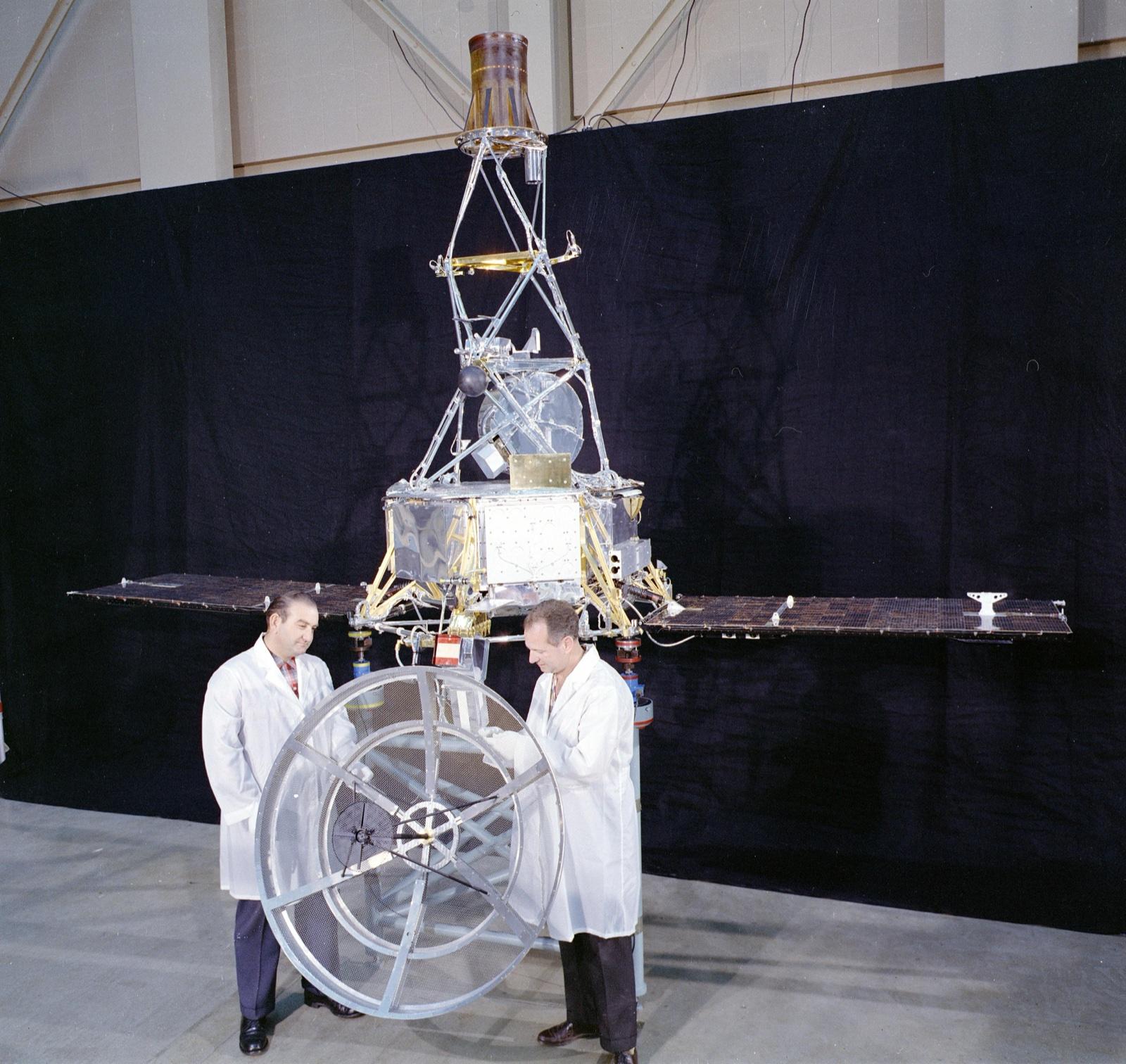
Mariner 2 was one of several American designs aimed at Venus between 1958 and 1962, and the only one of them to get there. NSSDCA's catalogue describes it as "the first spacecraft to successfully encounter another planet", and Asif Siddiqi's NASA chronicle calls it the first fully successful interplanetary mission by any nation. The rest of the line is less familiar: probes planned for the June 1959 window, the small craft that flew as Pioneer 5, the heavy Mariner A, Mariner 1, and the Mariner B capsule carrier that drifted from Venus to Mars.
The earliest of these plans belonged to the Air Force. In 1958 Space Technology Laboratories (STL) began studying, for the Advanced Research Projects Agency, a spin-stabilised "paddle-wheel" probe of about 170 kg that would ride an Atlas with Able upper stages and make a quick flyby of Venus in June 1959, according to Andrew LePage's history of the programme. NASA inherited the work when it opened in October 1958 and adopted the Venus goal that November. Within months the plan changed. LePage ties the switch to the Soviet Luna 1 flight of January 1959, tight funding and a short supply of Atlas rockets. Siddiqi writes that two of the three Atlas-Able craft "had originally been slated for Venus orbit (in June 1959)" and were redirected after Luna 3. The two accounts differ on whether the craft was to orbit or fly past, and on which Soviet success prompted the change. Don P. Mitchell's table of Venus launches lists 13 June 1959 as an unused Type I window. All three Atlas-Able craft ended up aimed at lunar orbit, and all three were lost in launch failures between November 1959 and December 1960.
A lighter fallback lasted longer. The Air Force already had a plan for a small Thor-Able Venus flyby probe, and NASA adopted it in the hope of still meeting the 1959 window; LePage gives its mass as 36 kg. It missed the window too. Renamed P-2, it flew as Pioneer 5 on 11 March 1960, at 13:00:07 UT in Siddiqi's chronicle and 08:00:06.99 EST in STL's own mission report, from Launch Complex 17A. That report lists as a primary objective a trajectory "to approach the orbital path of the planet Venus and become an artificial planet", and records the orbit achieved: 0.8061 by 0.9931 AU, with a period of 311.64 days. Its 43.2 kg carried Telebit, a digital telemetry system, and controllers heard it until 11:31 UT on 26 June 1960 at 36.4 million km, a distance Mariner 2 later exceeded. The sources disagree about its magnetometer: STL's May 1960 report credits it with measuring the interplanetary field, while Siddiqi, in an entry that also credits the probe with the first map of that field, writes that its data were unusable because of the instrument's position inside the craft.
Venus then passed to the Jet Propulsion Laboratory. At a briefing for NASA Administrator Glennan on 8 July 1960, JPL's Robert Parks said the late 1960 Mars and early 1961 Venus windows would have to be ignored, and proposed a modest Ranger-based craft for Venus in 1962, according to NASA's history of Mars exploration, SP-4212. Headquarters overruled the laboratory. Its planners proposed Mariner A, a Venus flyby on the new Atlas-Centaur in 1962, with a larger Mariner B to follow in 1964, and Glennan approved the Mariner projects on 15 July 1960. The 1961 window the Americans passed over was the one used by the Soviet Venera 1, which fell silent in February and drifted past Venus in May 1961.
On paper, Mariner A was a three-axis stabilised craft on a hexagonal frame, with solar panels giving 300 W at Earth, radiometers, an ultraviolet spectrometer, a boom-mounted magnetometer, plasma, radiation and micrometeoroid detectors, and no camera, passing Venus on the day side at 26,900 km (LePage). Its weight depends on the document. JPL's final project report, SP-59, places Mariner A and B in "the 1250-pound class"; NASA's 2022 history article speaks of two 1,250-pound craft; Siddiqi gives about 565 kg each; JPL's tracking report describes an 1,100-lb design; LePage gives 500 kg. JPL scheduled the two Venus missions, P-37 and P-38, on Centaurs 7 and 8 (SP-59). Then the Centaur slipped. A November 1960 engine test went wrong, the first test flight moved from June to December, and by the winter of 1961 the revised schedule seemed to rule out 1962 (SP-4212). By the second week of August 1961 it was generally accepted that no Centaur would be ready. JPL proposed the Ranger-derived Mariner R on 28 August, and on 30 August NASA's Office of Space Flight Development approved it and cancelled Mariner A. Mariner A reached design and a model; no flight hardware is recorded.
Its replacement, Mariner R (the R stood for Ranger), combined the Block I Ranger design with features of Mariner A. In the three weeks before 1 September 1961 JPL sketched a 447-lb craft, which left nine months to build it (JPL tracking report). It had a hexagonal base 1.04 m across, a pyramid mast reaching 3.66 m, two solar wings spanning 5.05 m with 9,800 cells, a 3 W transmitter and a dish antenna (NSSDCA; cell count from JPL's tracking report). JPL's proposal allowed 25 lb of instruments (about 11 kg in SP-4212), later raised to 40 lb (SP-59); for the flown payload NASA's 2022 article gives 46 lb and Siddiqi 9 kg. The payload was a microwave radiometer at 13.5 and 19 mm, an infrared radiometer at 8.4 and 10.4 micrometres, a fluxgate magnetometer, an ion chamber with Geiger counters, a detector tube from James Van Allen's group at the State University of Iowa, a cosmic dust detector and a solar plasma spectrometer; Carl Sagan was among the infrared experimenters. JPL built three. R-1 and R-2 were the flight craft, and a set of spares, assembled as R-3, was used for fault-finding at the Cape while R-1 stood ready for launch (SP-59).
Launch came first for Mariner 1 (spacecraft R-1, mission P-37), which lifted off from Launch Complex 12 at 4:21:23 a.m. EST on 22 July 1962 (09:21:23 UT). A first countdown had been scrubbed over a blown fuse in the range safety circuits, and the second was held for a noisy ground tracking component and for power fluctuations in the radio guidance system. The Atlas-Agena B flew normally until the range safety officer saw an unscheduled yaw-lift manoeuvre to the northeast. By 4:25 a.m. the vehicle looked likely to come down in the North Atlantic shipping lanes or on an inhabited area. At 4:26:16 a.m., 293 s into the flight and 6 s before the Atlas and Agena would separate, after which the stack could no longer be destroyed, the officer pressed the destruct button (SP-59). Mariner's transponder kept transmitting for 1 min 4 s, and JPL's tracking report says it signalled until it struck the Atlantic 357 s after liftoff. Siddiqi and NASA's mission page give the destruct time as T+294.5 s; NASA's release of August 1962 and SP-59's own management chapter say about 290 s. Had it flown, Siddiqi writes, Mariner 1 would have passed Venus at 29,000 km on 8 December 1962.
The Atlas was steered from the ground. A radar tracked two beacons on the rocket and a ground computer sent steering commands up to it (SP-59). NSSDCA's account, drawing on the Mariner 1 Post Flight Review Board, names two faults acting together. The airborne rate beacon dropped out four times, for 1.5 to 61 s, and during those gaps the ground program used raw instantaneous values where it should have used smoothed ones, because a superscript overbar had been left out when the handwritten equations were coded. The result was a string of needless steering corrections. NASA's mission page describes the missing symbol as an overbar on R, the symbol for radius; JPL's tracking report speaks of "the omission of a single symbol from the program equations of the ground-based computer". The fixes NASA announced in August 1962 were a more rigorous checkout of the Atlas rate beacon and a revised data-editing equation, which guards the ground guidance equipment against faulty data.
NASA took R-2 out of storage and launched it 36 days after Mariner 1. A first countdown on 25 August was cancelled for a stray voltage in the Agena destruct batteries. The second ended in liftoff at 06:53:14 UT on 27 August (NSSDCA and Siddiqi; JPL's tracking report gives 06:53:17 in its narrative and 06:53:13.927 in its event table). The flight nearly failed within minutes. Shortly before the booster engines cut off, control of one Atlas vernier engine was lost; the engine swung to its stop, and once the boosters dropped away the vehicle rolled, reaching about 360 degrees per second. Control returned after about a minute and the roll stopped after 35 revolutions. SP-59 says the cause "has never been fully resolved". The Agena then coasted in a parking orbit about 187 km up (115 miles in JPL's tracking report; NSSDCA prints 118 km), and injected Mariner 2 towards Venus 26 min 3 s after liftoff, over the South Atlantic.
Early tracking predicted a wide miss: 384,000 km from the centre of Venus in SP-59's first solution, 233,000 miles in NASA's October 1962 account. The midcourse manoeuvre, commanded at 22:49 UT on 4 September with the craft about 1.5 million miles out and completed at 02:45:25 UT on 5 September, included an engine burn of about 28 s shortly after midnight. It added 2 mph more than planned, so the predicted pass moved from the 9,000-mile aim point to about 20,900 miles. That was still inside the 5,000 to 40,000-mile band the planetary instruments were designed for. The cruise brought a run of faults. On 8 September attitude control was lost for three minutes, possibly after a collision with a small object. One solar panel faltered on 31 October and failed for good on 15 November, by which time the other wing could carry the load that close to the Sun. Temperatures kept climbing until, nine days before the encounter, some subsystems ran about 40 degrees F above prediction. On 12 December the central computer and sequencer stopped issuing its timing pulses, so on encounter day Goldstone sent a backup command, RTC-7, to switch Mariner 2 into encounter mode.
The radiometers were switched on and set scanning about six and a half hours before closest approach. The microwave instrument first found the disc at 18:59 GMT, spacecraft time, and swept across it three times, at mid-scan altitudes of about 40,200 km over the night side, 37,750 km across the terminator and 35,850 km over the day side (SP-59). The same report gives the scanning period as 35 minutes in its science chapter and 42 minutes in its trajectory chapter, where the sweeps run from 47,400 to 41,800 km from the planet's centre and end about 23 minutes before closest approach. JPL placed closest approach at 19:59:28 GMT on 14 December 1962, 40,954 km from the centre and 34,854 km (21,645 miles) above the surface, at 6.743 km/s relative to Venus. Encounter mode lasted about seven hours, and a ground command returned the craft to cruise at 20:40 GMT.
Published miss distances vary. NSSDCA gives 34,773 km without saying how it was measured. NASA's mission page gives 21,660 miles (34,854 km), JPL's figure rounded, and JPL's tracking report gives 21,648 miles in its synopsis and 21,645 in its tracking chapter. The clean comparison is from the centre of Venus. JPL's 40,954 km of 1965 and the 40,948 km of John D. Anderson's later reconstruction, which JPL Horizons now serves as spacecraft -2, differ by 6 km. The surface figures part company because different radii are subtracted: SP-59's centre and surface figures differ by 6,100 km, while Horizons' distance less the modern mean radius of 6,051.8 km gives about 34,897 km. The time is harder. Horizons puts closest approach at 19:55:19 coordinate time (about 19:54:45 UTC), with the signal reaching Earth at 19:57:57 UTC, while SP-59 and NSSDCA give 19:59:28. Neither source explains the gap of nearly five minutes.
SP-59 called the central radiometer result "unquestionable", though the numbers attached to it vary. The microwave sweeps found limb darkening: the disc was cooler towards its edge. That pattern fits heat rising from deep in the atmosphere or from the surface, and SP-59 judged that it appeared to rule out the rival explanation of the planet's strong radio emission, a dense ionosphere above a world with Earth-like temperatures (the older ideas are traced in imagined Venus). SP-59 gives preliminary peak brightness temperatures of 460 K on the dark side, 570 K near the terminator and 400 K on the day side, each uncertain by 15 percent, and found little difference between night and day. For the surface itself the two JPL documents of 1965 disagree: SP-59 prints about 400 K, the tracking report about 800 degrees F, roughly 700 K. Douglas Jones's 1966 technical report on the experiment fits the scans with a surface near 700 K under a cloud layer near 350 K, and caps the surface pressure at about 100 atmospheres for an atmosphere of 20 percent carbon dioxide. NASA's mission page quotes 216 degrees C (dark side) and 237 degrees C (day side), figures not found in the JPL reports read for this page. The modern average, from NSSDCA's fact sheet, is 737 K (464 degrees C) at 92 bar.
On the same mount, the infrared radiometer returned five pairs of readings on the night side, eight along the terminator and five on the day side (SP-59). Its two channels agreed, which to SP-59 meant thick cloud, little carbon dioxide above the tops and essentially no radiation from the surface. Central cloud temperatures were about 240 K, falling by about 20 K towards the limb. One cold patch near the southern end of the terminator sweep stood out, and JPL's tracking report wondered whether it lay above a high mountain. NASA's 1963 educational fact sheet also passed on speculation that the clouds might be condensed hydrocarbons like city smog; what the clouds are made of is covered on the atmosphere of Venus page.
Nothing marked the planet in the fields and particles data. The magnetometer, able to see a change of about 4 gamma, found no Venusian field anywhere on the pass, which SP-59 converts into a dipole moment below a tenth of Earth's, and the particle counters found no trapped radiation belt. Across the whole cruise, though, Mariner 2 helped settle an older question. The solar plasma spectrometer of M. Neugebauer and C. W. Snyder recorded about 40,000 spectra, and the solar wind was present in every one, blowing at 320 to 770 km/s with an average of 505 km/s. The dust detector registered two definite impacts in the whole flight. The ion chamber logged about 3 roentgens for the entire mission, of which the solar proton event of 23 and 24 October contributed about 0.25. Radio tracking gave a mass for Venus of 0.81485 Earth masses and, according to JPL's tracking report, a more accurate value of the astronomical unit than any before.
After the flyby Mariner 2 kept transmitting as it fell in towards perihelion, which NSSDCA dates to 27 December and SP-59 to 05:15 GMT on 28 December. A second computer fault on 30 December slowed the telemetry from 8.33 to about 7.59 bits per second. Johannesburg's last tracking pass ended at 07:00 GMT on 3 January 1963, at 86.677 million km from Earth, and later searches from Woomera and Goldstone heard nothing. It remains in solar orbit, with a period JPL gave as 345.9 days. A mission display board photographed at the time recorded the end of the mission as 11:00 p.m. PST on 2 January, the same instant in Pacific time, which may be why some accounts, the Smithsonian's record among them, end the flight on 2 January.
Success closed the Mariner R line. SP-59 records that, because Mariner 2 had returned so much good data, NASA decided in January 1963 to stop work on the Mariner R craft planned for the 1964 Venus window; SP-4212's list of mission numbers includes two such flights, P-40 and P-41. Mariner B had already drifted away from Venus. Conceived in 1960 as a Centaur-launched bus that would drop a capsule into Mars or Venus, it was directed in August 1961 towards a 1964 flight to either planet, then on 9 April 1962 postponed to the 1964 Mars window, with the 1964 Venus slot handed to Mariner R. By late summer 1962 NASA planned a Mariner B class craft for Venus on Atlas-Centaur in 1965 instead; in December JPL said that could not happen and proposed 1966 on Saturn-Agena (SP-4212). It got as far as a preliminary capsule design, begun at Ford's Aeronutronic Division in late 1961, and a list of eight bus and ten capsule experiments chosen from 64 proposals, before it was folded into the Mariner 1966 plans and the Voyager studies. SP-4212 describes Mariners E and F, approved in December 1963, as its replacement. Mitchell's table of Venus launches lists no American attempt between Mariner 2 and Mariner 5, which passed Venus in October 1967.
In the same 1962 window the Soviet Union had less luck. RKK Energia's corporate history records three 2MV launches towards Venus, on 25 August, 1 September and 12 September 1962, two landers and one flyby craft, all lost because the Blok L escape stage did not fire; Siddiqi differs on the first flight, writing that the stage ignited but cut off after 45 s. Their story is on the Zond 1 page. A full-scale Mariner 2, assembled by JPL engineers from spare and test parts, was on display in the Boeing Milestones of Flight Hall of the National Air and Space Museum in Washington according to the museum's record on 5 November 2026; it appears with other surviving hardware on what we left at Venus.
Mission facts
Organisations
NASA and the Jet Propulsion Laboratory (Mariner A, B, 1 and 2); NASA with the US Air Force and Space Technology Laboratories (the 1959 probes and Pioneer 5)
Mariner 1: launch
22 July 1962 at 4:21:23 a.m. EST (09:21:23 UT) from Launch Complex 12, Cape Canaveral, on an Atlas-Agena B, on the second countdown, after a scrub the night before. JPL's tracking report gives 09:21:20 GMT.
Mariner 1: destruct
4:26:16 a.m. EST, after 293 s of flight and 6 s before Atlas-Agena separation, when an unscheduled yaw-lift manoeuvre threatened the North Atlantic shipping lanes or an inhabited area. Siddiqi and NASA's mission page give T+294.5 s; NASA's August 1962 release, and SP-59's own management chapter, say about 290 s. The transponder kept transmitting for 64 s.
Mariner 1: cause
The Atlas rate beacon was inoperative four times, for 1.5 to 61 s, and a superscript overbar had been omitted when handwritten guidance equations were coded, so the ground computer used instantaneous values in place of smoothed ones during the gaps (Post Flight Review Board, as summarised by NSSDCA).
Mariner 1 and 2: mass
NSSDCA gives 202.8 kg for both. NASA's mission pages and Siddiqi give 202.8 kg (447 lb) for Mariner 1 and 203.6 kg (449 lb) for Mariner 2. NASA's 1962 releases say 447 lb; its 1963 fact sheet says 449 lb.
Mariner 1 and 2: spacecraft
Hexagonal base 1.04 m across, 3.66 m tall, solar wings spanning 5.05 m, a 3 W transmitter, a 1,000 Wh silver-zinc battery, a 225 N hydrazine engine for course correction and nitrogen jets for attitude control.
Mariner 1 and 2: instruments
Microwave radiometer (13.5 and 19 mm), infrared radiometer (8.4 and 10.4 micrometres), magnetometer, ion chamber with Geiger counters, an Iowa (Van Allen) detector tube, cosmic dust detector and solar plasma spectrometer.
Mariner 2: launch
27 August 1962 at 06:53:14 UT on Atlas-Agena B from Launch Complex 12, 36 days after Mariner 1. JPL's tracking report gives 06:53:13.927 GMT in its event table and 06:53:17 in its narrative.
Mariner 2: midcourse manoeuvre
Commanded at 22:49:00 UT on 4 September 1962 and completed at 02:45:25 UT on 5 September. SP-59 also says the whole manoeuvre took about 34 minutes, which fits a count from the roll turn that began an hour after the command; the engine burn, predicted at 28.3 s, came near 00:23 UT and could not be timed exactly from telemetry.
Mariner 2: closest approach (JPL, 1965)
19:59:28 GMT on 14 December 1962, 40,954 km from the centre of Venus and 34,854 km (21,645 miles) from the surface, at 6.743 km/s relative to the planet, 109.546 days after injection.
Mariner 2: closest approach (other readings)
NSSDCA: 34,773 km at 19:59:28 UT. NASA mission page: 21,660 miles (34,854 km). JPL Horizons (John D. Anderson's reconstruction): 40,948 km from the centre at 19:55:19 CT (about 19:54:45 UTC), received on Earth at 19:57:57 UTC.
Mariner 2: planet scans
Three microwave sweeps from 18:59 GMT: night side at about 40,200 km, near the terminator at 37,750 km and day side at 35,850 km. SP-59 gives the scanning time as 35 min in one chapter and 42 min in another.
Mariner 2: microwave temperatures
Preliminary peak brightness temperatures of 460 K (dark side), 570 K (near terminator) and 400 K (light side), each uncertain by 15 percent, with limb darkening and little day-night difference.
Mariner 2: surface temperature readings
About 400 K in SP-59; about 800 degrees F (about 700 K) in JPL's tracking report; a best-fit surface near 700 K in Jones's 1966 technical report; 216 to 237 degrees C on NASA's mission page. Modern average: 737 K (464 degrees C), from NSSDCA's Venus fact sheet.
Mariner 2: magnetic field
None detected anywhere on the pass; SP-59 says a change of about 4 gamma on any axis would have been seen, while JPL's tracking report gives a 5-gamma limit. SP-59 puts Venus's dipole moment below a tenth of Earth's from the field and plasma data, and below 18 percent from the particle data.
Mariner 2: solar wind
Present in every one of about 40,000 spectra, at 320 to 770 km/s with an average of 505 km/s.
Mariner 2: last signal
07:00 GMT on 3 January 1963 at Johannesburg, 86.677 million km from Earth; later searches from Woomera and Goldstone heard nothing.
Pioneer 5
Launched 11 March 1960 on a Thor-Able with the objective of approaching the orbital path of Venus; reached a 0.8061 by 0.9931 AU solar orbit of 311.64 days, inclined 3.351 degrees to the ecliptic.
1959 Venus window
Siddiqi: two of three Atlas-Able craft 'had originally been slated for Venus orbit (in June 1959)'. LePage describes a flyby probe of about 170 kg for the same window. Mitchell lists 13 June 1959 as an unused Type I window.
Mission timeline
- 13 Jun 1959Mitchell's table of Venus launches lists this date as an unused Type I window: nothing was launched towards Venus.
- 11 Mar 1960Pioneer 5, first planned as a Venus probe, is launched on a Thor-Able into a solar orbit reaching in towards the orbit of Venus.
- 26 Jun 1960Last contact with Pioneer 5, at 36.4 million km from Earth.
- 15 Jul 1960NASA approves the Mariner projects: Mariner A for Venus in 1962 on Atlas-Centaur, and a larger Mariner B for Mars and Venus in 1964.
- 30 Aug 1961Two days after JPL proposes the Ranger-derived Mariner R, NASA approves it and cancels Mariner A.
- 9 Apr 1962NASA postpones Mariner B to the 1964 Mars window and gives the 1964 Venus mission to another Mariner R.
- 22 Jul 1962Mariner 1 lifts off at 09:21:23 UT and is destroyed by the range safety officer after 293 s.
- 27 Aug 1962Mariner 2 is launched at 06:53:14 UT and injected towards Venus 26 min 3 s later.
- 4 to 5 Sep 1962Mariner 2 performs its midcourse manoeuvre: commanded at 22:49 UT on 4 September, an engine burn of roughly 28 s near 00:23 UT on 5 September, and completion at 02:45:25 UT.
- 23 to 24 Oct 1962Mariner 2's particle detectors record a solar proton event, the only clear detection of solar cosmic rays in JPL's tracking report; SP-59 counts two major flare-related excursions over the whole flight.
- 15 Nov 1962One solar panel fails for good after faltering on 31 October; the other wing carries the load.
- 12 Dec 1962The central computer and sequencer stops issuing its timing pulses, two days before encounter.
- 14 Dec 1962Goldstone commands encounter mode; three radiometer sweeps from 18:59 GMT; closest approach 19:59:28 GMT at 34,854 km from the surface.
- 3 Jan 1963Last signal from Mariner 2, received at Johannesburg at 07:00 GMT, 86.677 million km from Earth.
- Jan 1963NASA stops work on the Mariner R planned for the 1964 Venus window, citing the quality and amount of Mariner 2's data.
- Dec 1963Mariners E and F are approved for 1966, replacing the long-delayed Mariner B.
A filled dot marks something that physically happened. A hollow one marks an announcement, a naming or a target.
In pictures
Tap a photo to enlarge.
Sources
- JPL for NASA, Mariner-Venus 1962 Final Project Report, NASA SP-59 (1965), Wayback copy of the NASA History PDF
- JPL Technical Memorandum 33-212, Tracking and Data Acquisition Support for the Mariner Venus 1962 Mission (1965)
- D. E. Jones, The Mariner II Microwave Radiometer Experiment, JPL Technical Report 32-722 (1966)
- NASA news releases 62-182 (Mariner Spacecraft), Mariner flight report of 10 October 1962 and 62-234 (Mariner Passes Earth)
- NASA Facts NF B-4-63, Mariner II Reports (1963)
- NSSDCA Master Catalog: Mariner 1
- NSSDCA Master Catalog: Mariner 2
- NASA Science: Mariner 1
- NASA Science: Mariner 2
- NASA Science: Pioneer 5
- Asif A. Siddiqi, Beyond Earth: A Chronicle of Deep Space Exploration, 1958 to 2016, NASA SP-2018-4041
- Edward and Linda Ezell, On Mars: Exploration of the Red Planet 1958 to 1978, NASA SP-4212, chapter 2 (Wayback copy)
- NASA SP-4212, chapter 3 (Wayback copy)
- Space Technology Laboratories, Project Thor-Able 4 Final Mission Report (25 May 1960), scanned copy
- Andrew LePage, Vintage Micro: The First Interplanetary Probe, Drew Ex Machina (2015)
- Andrew LePage, The Future That Never Came: The Mariner A Mission to Venus, Drew Ex Machina (2021)
- NASA History, 60 Years Ago: Mariner 2 Launches to Explore Venus (2022)
- Don P. Mitchell, Missions to Venus (launch windows table)
- JPL Horizons, Mariner 2 (spacecraft -2) data sheet and vectors, trajectory m2_620827_621231_ja_v1
- NSSDCA Venus Fact Sheet
- Smithsonian National Air and Space Museum, Mariner 2 engineering model, A19760027000
- NSSDCA Master Catalog: Mariner 5
- RKK Energiya corporate history 1946 to 1996, chapter on automatic interplanetary stations (Wayback copy of the epizodsspace transcription) · in Russian
Facts on this page were verified on 5 November 2026. Where sources disagree, the disagreement is stated rather than resolved silently.
azmth is independent and is not affiliated with or endorsed by NASA, Roscosmos, NPO Lavochkin, ESA, JAXA, ISRO, CNSA, or any other space agency or company named on this page.