What we left at Venus
What humans left on Venus: landers, crushed probes, heat shields, balloons, fallen orbiters and the silent Akatsuki, and what is known of where each lies.
TL;DR· 20 min read
McDowell's catalogue lists 59 objects that ended on or in Venus between 1966 and 2015, from ten Soviet landers to heat-shield halves and the despin weights of the Pioneer probes, and seven more still in orbit, including Japan's silent Akatsuki. The best landing sites are known to within about 150 km. Nobody saw where the two Vega balloons or the three orbiters that sank into the atmosphere finally came down.
What have humans left on Venus?
Humans have left at least 59 objects on Venus or in its air since 1966, and seven more are still listed in orbit around it. Jonathan McDowell's catalogue of space objects counts ten Soviet landers that worked on the surface, probes that fell silent before or as they hit, carrier buses, sixteen heat-shield halves, two balloons and three orbiters that sank into the atmosphere, while the silent Japanese orbiter Akatsuki is among those still circling. Magellan's radar could not pick out anything so small, so every place is an estimate: the best-placed landers are known to within about 150 km, Venera 3 only to a box thousands of kilometres wide, and nobody saw where the three fallen orbiters went in. The list also takes in parachutes, lens caps, a flat backup antenna, Soviet pennants and about 260,000 names and messages printed on aluminium plates aboard Akatsuki.
- 59objects that ended on or in Venus between 1966 and 2015, in McDowell's catalogue (updated 2 November 2026)
- 7objects still listed in orbit around Venus, none working: five spacecraft, a spent motor and an instrument cap
- 150 kmradius of the error circle around the seven best-placed Soviet landing sites
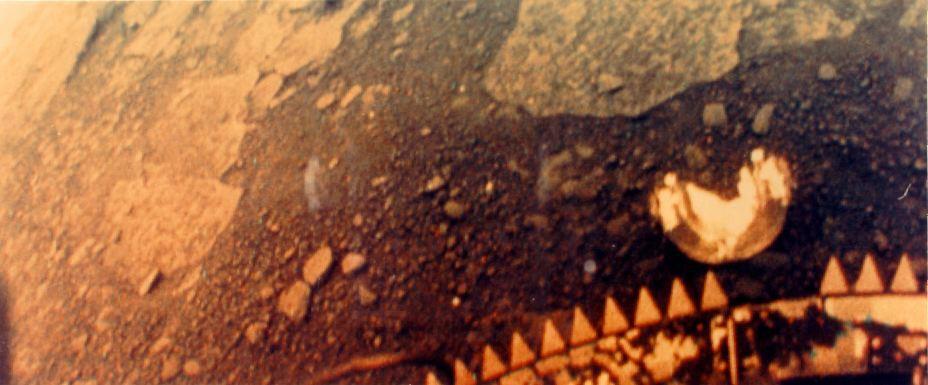
Whatever stopped at Venus instead of flying past is still there in some form: on the ground, scattered across it in pieces, burned into its air or circling it with a dead radio. Jonathan McDowell's General Catalog of Artificial Space Objects, updated on 2 November 2026, lists 59 objects that ended their flights on or in Venus between 1 March 1966 and 2015, and it carries seven more as still in orbit. The 59 are a mixed lot: ten Soviet landers, seven capsules and probes that were silent before or at impact, one American probe that kept talking after it hit, seven carrier buses, sixteen heat-shield halves, two capsule lids, a handful of small Pioneer Venus parts, two balloons, three orbiters and a spent motor still attached to one of them. Parachutes and camera covers are not in the catalogue at all. This page is the inventory behind the globe's pins.
Ten landers reached the surface and sent data from it, all of them Soviet: Venera 7 in December 1970, Venera 8, Venera 9 and 10, Venera 11 and 12, Venera 13 and 14 and the two Vega landers in June 1985. The Pioneer Venus Multiprobe added one more working object on the ground without meaning to. Its Day Probe came down without a parachute, yet it transmitted for 67 minutes 37 seconds after it hit (NSSDCA and Siddiqi; the times in the Planetary Data System's summary table give 67 minutes 35 seconds). Siddiqi counts the Night Probe, whose signal outlived its impact by two seconds, as a second survivor.
How precisely those places are known varies widely. Seven sites (Venera 8, 9, 10, 13 and 14 and both Vegas) have landing circles from Akim and Stepanyants (1993), which A. M. Abdrakhimov's 2001 geological mapping abstracts plot on Magellan mosaics, each with the same caveat: 'Radius of ellipse of probable error in the lander position is 150 km'. For Venera 7, 11 and 12 the published positions, as in NSSDCA's catalogue, are only whole degrees. Catalogues disagree too: for Vega 2, NSSDCA prints 8.5° S, 164.5° E, about 1,390 km from the Akim and Stepanyants centre of 7.14° S, 177.67° E, while McDowell's lander list gives 6.45° S, 181.08° E, some 365 km the other way. None of these positions has been checked against an image: Magellan, which mapped the surface at better than 300 m on average according to JPL, could not show an object the size of a Venera lander, whose braking disc is about 2 m across.
Four Soviet capsules never reached the ground working. Venera 3 fell silent on 16 February 1966 and struck the night side on 1 March, so its impact point is a computed box: 20° N to 30° S and 60° to 80° E in NSSDCA's catalogue, 20° S to 20° N over the same longitudes in Asif Siddiqi's NASA chronicle. NSSDCA calls Venera 3 the first spacecraft to reach the surface of another planet. Venera 4 sent data for 93 minutes on its parachute and went quiet high above the ground, at 28 km by Siddiqi's account and roughly 25 km by NSSDCA's. NSSDCA places it over 19° N, 38° E and Siddiqi at 19° N, 36° E, and the cause of the silence is argued: Siddiqi blames pressure and heat, while Don P. Mitchell thinks the 100-minute battery simply ran out, and NSSDCA allows either. Venera 5 and 6 were built to go deeper and were crushed at about 18 km, over 3° S, 18° E and 5° S, 23° E according to NSSDCA.
On 9 December 1978 the Pioneer Venus Multiprobe spread five objects across both hemispheres. The Planetary Data System's summary table gives impact points of 4.4° N, 304.0° E for the Large Probe, 59.3° N, 4.8° E for the North Probe, 31.3° S, 317.0° E for the Day Probe and 28.7° S, 56.7° E for the Night Probe, and it puts the bus, which carried no heat shield, at 37.9° S, 290.9° E when its signal stopped at about 110 km. The table gives no error bars, and Siddiqi rounds the small-probe sites to whole degrees.
From Venera 3 to Venera 8 the carriers did not fly past (Venera 1 and 2 had). Venera 3's bus struck the planet with its capsule, and from Venera 4 to Venera 8 each bus released its capsule and then followed it into the atmosphere, where McDowell's catalogue ends each of them. NPO Lavochkin says the Venera 4 bus kept sending telemetry and science for some time before it was destroyed, and NSSDCA says the Venera 8 bus sent data 'until entering the atmosphere and incinerating as planned'. How much of any bus reached the ground is unknown. The pattern changed in 1975, when the Venera 9 and 10 buses braked into orbit. The Venera 11 to 14 and Vega carriers flew past, relayed their landers' signals and went on round the Sun, the Vegas on to Halley's Comet.
Landing on Venus meant shedding a shell. The Venera 9 to 14 landers and both Vegas came down inside a spherical entry pod about 2.4 m across that split into two halves once the air had done the braking. Venera 9 and 10 dropped their parachutes at about 50 km and Venera 11 and 12 theirs at 49 km (Mitchell), Venera 14 at about 47 km (NPO Lavochkin). McDowell catalogues each of the sixteen shell halves as its own object at 485 kg, a figure he marks as uncertain. The smaller first-generation capsules dropped less: McDowell lists a 20 kg capsule lid for each of Venera 7 and 8, and NSSDCA describes Venera 8's top shell being jettisoned on entry to release its parachute. Venera 8 also carried a second antenna meant to lie beside it, a flat washer with four folding petals that NPO Lavochkin designed to be thrown out after landing and to rest on one face, so that a gravity switch could transmit from the side facing the sky. The sources describe the design; none says whether it deployed.
Then there are the lens caps. Each camera window on the Venera 9 to 14 landers sat under a cover that pyrotechnic charges were meant to blow off after touchdown. On Venera 9 and 10, Mitchell writes, one cover on each lander stuck, so each left one cover on the ground and kept the other. On Venera 11 and 12 every cover stayed on, held down by pressure after a seal formed, and neither lander returned a picture. NPO Lavochkin ran 78 tests of the release for the next pair, and this time it worked: on Venera 14 the telephotometer covers came off after the first four minutes on the ground. In the Venera 13 picture at the top of this page, the pale half-shell lying beside the toothed landing ring appears to be one of them, and Mitchell points out a pentagonal pennant fastened to the same ring.
The American probes shed hardware too. NSSDCA's record for the Pioneer Large Probe has its heat shield jettisoned at 67 km and its parachute at about 45 km, pieces McDowell catalogues as an aft cover with its chute (about 10 kg) and a deceleration module (about 90 kg). He adds six despin weights of about a kilogram each from the three small probes, and two mass-spectrometer caps, one from the Large Probe and one released by the bus a day before it entered.
Each Vega descent sphere also carried a balloon, and releasing it scattered a train of parts. In NPO Lavochkin's sequence, the upper half of the heat shield was pulled away on its own parachute with the balloon package inside. The package then dropped out under a stabilising parachute and a main one, and its ring-shaped container was cut apart so that the lower half-ring, which served as ballast, pulled the gondola, tether and envelope out behind it. Once filling was done, the parachute and helium system dropped off, and later the ballast. NSSDCA puts the whole stowed system at 120 kg and the floating balloon at 21.5 kg, so roughly 100 kg per Vega fell to the surface in pieces, by azmth's subtraction. NSSDCA's pages disagree on the altitude: 54 km for deployment in the Vega 2 lander record, 61 km for extraction and 54 km for inflation in the balloon records.
Once aloft, the Vega balloons floated for about 46.5 hours at 53 to 54 km until their batteries ran down, and where they ended up is not known. NSSDCA's Vega 1 balloon record says so: 'It is not known how much further the balloon travelled after the final communication.' Its Vega 2 lander record, by contrast, says the balloon entered the day side after two days and 'expanded and burst due to solar heating'. Two sets of end points circulate, from different kinds of measurement. The familiar positions, 8.1° N, 68.8° E and 7.5° S, 76.3° E at the last radio sessions at 00:38 UT on 13 and 17 June 1985, are NSSDCA's, from a solution in which each balloon drifts 'at nearly constant latitude'. The tracks measured by very long baseline interferometry, good to about 10 km according to Sagdeev and colleagues (1992) and archived in the Planetary Data System, end about four and a half hours earlier, at 9.09° N, 77.41° E and 3.22° S, 83.99° E. For Vega 2 the measured track had wandered about 4° north of NSSDCA's latitude.
Three orbiters ended in the atmosphere, and azmth found no published entry point for any of them. Pioneer Venus Orbiter ran out of fuel while its low point was sinking. R. J. Strangeway records that 'No telemetry was received from the spacecraft after periapsis on orbit 5056 (October 8, 1992)'. Its last measured low point, on orbit 5055 at 19:46 UT on 7 October 1992, was 131 km above 11.87° S, 89.2° E in the Planetary Data System's ephemeris (the file names no direction; its solar zenith angle fits east). McDowell dates the re-entry itself to 22 October 1992. Magellan was driven into the upper air on purpose on 11 October 1994 for a last aerodynamics experiment; contact ended at 10:02 UT the next day, and the project's final report expected it to 'land on Venus by 1:00 PM PDT Thursday, October 13, 1994'. Venus Express was declared ended in December 2014 and faded out. ESA last heard its signal on 19 January 2015, and its mission manager said at the time that the spacecraft 'may continue orbiting Venus but under conditions which do not allow us to receive a signal'. McDowell's catalogue enters its re-entry as '2015 Q2?'.
Seven objects may still be up there. McDowell's catalogue gives the status 'in orbit', with no end date, to the orbiters of Venera 9, 10, 15 and 16, to Akatsuki, to the spent Star 48B motor that braked Magellan into orbit and to a one-kilogram instrument cap from Pioneer Venus Orbiter. JPL's pre-launch guide gives the motor as 2,146 kg full, 2,014 kg of it propellant, which leaves a casing of about 130 kg by azmth's subtraction. The Venera 9 and 10 orbiters were built to work for three months; NPO Lavochkin says Venera 9's lasted until 27 April 1976. The radar mappers of Venera 15 and 16 fell silent in January and June 1985 when their attitude-control nitrogen was gone, Venera 16 after it obeyed a command meant for Vega 1. While they worked, the Sun's pull kept lifting their low points, and O. N. Rzhiga writes that the orbits had to be corrected with the engine. The catalogue's 'in orbit' means only that no end has been reported; azmth found no operator account of these orbits and no one tracking them.
Akatsuki, the latest arrival to stay, entered orbit in December 2015; McDowell's register lists no Venus orbit insertion since. JAXA lost contact at the end of April 2024, after a long spell in a control mode with poor attitude accuracy, and carried out the transmitter shutdown procedure from 09:00 JST on 18 September 2025. Because the link was already dead, there is no way to confirm the command was received. JPL's Horizons system, checked on 4 November 2026, fits its trajectory to tracking only up to 26 April 2024 and predicts no further than 24 August 2025. JAXA's closing release and its report of 13 July 2026 give only a summary orbit (about 1,000 km by 360,000 to 370,000 km, period about 11 days) and say nothing about its lifetime or an eventual entry, so azmth treats Akatsuki as presumed in orbit and untracked.
Aboard it are about 260,000 messages. Between 23 October 2009 and 10 January 2010 JAXA collected 260,214 entries, 57,378 of them through the Planetary Society. JAXA's report to the Space Activities Commission of 10 February 2010 says the data would be printed on 100 aluminium plates and fixed to the spacecraft as balance weights at three places; in an interview published by ITmedia the same month, JAXA staff said the count would probably come out at about 90 plates. JAXA set aside three plates for drawings of the virtual singer Hatsune Miku after 13,849 fans signed one group entry.
Soviet probes carried pennants as well. NSSDCA's record for Venera 3 lists 'medallions bearing the coat of arms of the U.S.S.R.', and a 2025 feature in Argumenty i Fakty describes a small metal globe of the Earth and a pennant with the Soviet coat of arms inside the 90 cm capsule. Venera 5 and 6 each took 'a medallion bearing the coat of arms of the U.S.S.R. and a bas-relief of V.I. Lenin' (NSSDCA), and the Russian State Archive of Scientific and Technical Documentation keeps photographs of the Lenin and coat-of-arms pennants mounted on the outside of the Venera 7 capsule. Mitchell writes that they were titanium with heat-resistant polysiloxane enamels, and that Venera 9 to 14 carried identical pennants apart from names and years. The emblems went wherever their capsules went: some to the surface, some crushed in the air.
Past Venus, rather than at it, went the rocket stages. McDowell's heliocentric catalogue follows fifteen spent upper stages into the planet's sphere of influence behind their payloads, from the Blok L that launched Venera 1 in 1961 to the Fregat of Venus Express in 2006. Each then passes back into orbit around the Sun, and most of the dates carry question marks.
Anyone who wants to see this hardware has to settle for its siblings on Earth. NPO Lavochkin's own museum at Khimki holds 26 spacecraft, which it describes as genuine craft and full-scale mockups built from test articles and spare flight parts. Ralph Lorenz's photographs there, released through the Planetary Data System, show a Vega lander with its brown entry shell cut away, and his 2017 captions place full-size mockups of a Vega balloon with its gondola, and of a Vega carrier, on display at the Smithsonian's Udvar-Hazy Center. In Washington the National Air and Space Museum shows the Mariner 10 flight spare, transferred from JPL in 1982, and a full-scale Mariner 2 that JPL engineers assembled from spares and test components; the museum's records, checked on 4 November 2026, list both on display. A RIA Novosti photograph in Argumenty i Fakty shows a Venera 3 exhibit in the Kosmos pavilion at VDNKh in Moscow.
Whether any of it survives is a newer question. On 28 April 2026 Geoarchaeology published 'Planetary Geoarchaeology of Venus' by Forassiepi, Holcomb, Pajola, Jorayev and Andrzejewski, which treats the landing and impact sites as archaeological contexts. Its abstract counts 'the remains of landers and probes from 15 space missions concentrated between 1965 and 1985', a number that fits Venera 3 to 14, the Pioneer Venus Multiprobe and the two Vegas, and it pushes back on the assumption that Venus quickly erases what lands there. Beryllium, Kapton and silicone parts are probably gone, the authors argue, but titanium, ceramic and aluminium structure is likely preserved, 'albeit oxidized, corroded, and potentially deformed', and they work through the Pioneer Day Probe as a case study. The article is closed access, so its site table could not be compared with this page.
Even the ground under the landers is being reread. In August 2026 the planetary geologist Alexander Basilevsky of the Vernadsky Institute told Moskovsky Komsomolets that the Venera landers of the 1970s most often came down on fine ejecta blown downwind from impact craters into radar-dark parabolas, and that no Soviet lander set down between such deposits; drilling a few decimetres, they sampled that blanket and never reached the older rock beneath. The paper appeared in Solar System Research in May 2026. The surface of Venus and landing on Venus pages take that further.
What we know
How many objects
59 in McDowell's lander and impact catalogue (update of 2 November 2026): 10 Soviet landers, 7 capsules and probes that were silent before or at impact, the Pioneer Venus Day Probe, 7 carrier buses, 16 heat-shield halves, 2 Venera capsule lids, 10 small Pioneer Venus parts, 2 balloons, 3 orbiters and the solid motor still attached to Pioneer Venus Orbiter. Parachutes and camera covers are not listed.
Still listed in orbit
Seven objects with status 'in orbit' and no end date: the Venera 9, 10, 15 and 16 orbiters, Akatsuki, Magellan's spent Star 48B motor and a 1 kg instrument cap from Pioneer Venus Orbiter (catalogue update of 2 November 2026). azmth found no published tracking of any of them later than Akatsuki's, which ends in April 2024.
Best-located landing sites
Venera 8, 9, 10, 13, 14 and Vega 1 and 2 have landing circles from Akim and Stepanyants (1993), plotted on Magellan mosaics, each with a 150 km radius of probable error; Venera 8's is 10.70° S, 335.25° E. Venera 7, 11 and 12 are published only to whole degrees.
Pioneer Venus probe sites
Large Probe 4.4° N, 304.0° E; North Probe 59.3° N, 4.8° E; Day Probe 31.3° S, 317.0° E; Night Probe 28.7° S, 56.7° E; bus signal lost over 37.9° S, 290.9° E at about 110 km. The PDS table gives no uncertainty.
Heat-shield halves and parachutes
Venera 9 to 14 and both Vegas descended inside a 2.4 m spherical pod that split in two; Venera 9 and 10 dropped their parachutes at about 50 km, Venera 11 and 12 their single descent chute at 49 km (Mitchell; NPO Lavochkin gives 46 km and the 1979 Soviet yearbook 40 km). McDowell lists each half at 485 kg, marked uncertain.
Camera covers
Venera 9 and 10 each had one camera cover stick; on Venera 11 and 12 every cover stayed on and no picture came back; Venera 13 and 14 blew theirs off after landing, so those covers lie beside the landers (Mitchell; NPO Lavochkin).
Venera 8 backup antenna
Venera 8 carried a second antenna shaped like a flat washer with four folding petals, designed to be thrown out after landing and to lie on one face so that a gravity switch could use the side facing up. The sources azmth read describe only the design and do not say whether it deployed; either way it lies at the landing site.
Vega balloon hardware
Each balloon system weighed 120 kg stowed, with parachutes, ballast, helium tanks and release devices; the balloon that floated weighed 21.5 kg. The rest, about 100 kg per Vega by azmth's subtraction, fell away during deployment.
Carrier buses, Venera 3 to 8
Venera 3's bus struck Venus with its capsule; from Venera 4 to 8 each bus followed its capsule into the atmosphere and was not built to survive entry (NSSDCA, Venera 4). McDowell lists the Venera 4 to 8 buses at 680 to 725 kg each and gives them their capsules' coordinates.
Balloon end points
NSSDCA's last-session positions are 8.1° N, 68.8° E (Vega 1) and 7.5° S, 76.3° E (Vega 2). The last VLBI fixes in the PDS archive, about 4.5 hours earlier and good to about 10 km (Sagdeev and colleagues, 1992), are 9.09° N, 77.41° E and 3.22° S, 83.99° E. Where either balloon came down is unknown.
Orbiters that fell
Pioneer Venus Orbiter sent no telemetry after periapsis on orbit 5056, 8 October 1992 (Strangeway); McDowell dates its re-entry 22 October 1992. Magellan went silent at 10:02 UT on 12 October 1994 (JPL) and Venus Express's carrier signal was last heard on 19 January 2015 (ESA). azmth found no published entry point for any of them.
Venera 9 and 10 orbiters
Built for three months as satellites of Venus; the Venera 9 orbiter worked until 27 April 1976 (NPO Lavochkin). NSSDCA says each transmitter failed after three months. McDowell's catalogue still lists both in orbit; azmth found no later observation or orbit-lifetime study.
Venera 15 and 16 orbiters
Venera 15 used up its attitude-control nitrogen on 30 December 1984 and missed its session on 7 January 1985; Venera 16 spent its last nitrogen on 13 June 1985 after obeying a command meant for Vega 1. McDowell's catalogue still lists both in orbit; azmth found no later observation or orbit-lifetime study.
Akatsuki
Contact lost at the end of April 2024; JAXA carried out the transmitter shutdown procedure from 09:00 JST on 18 September 2025, and its report of 13 July 2026 says nothing about the orbit's lifetime or an entry. JPL Horizons fits its reconstruction to tracking up to 26 April 2024 and carries an ISAS solution and prediction only to 24 August 2025 (checked 4 November 2026). Presumed in orbit, untracked; the JST Science Portal noted in February 2026 that no Venus probe is active.
Magellan's spent motor
The Star 48B solid motor (2,146 kg full, 2,014 kg of it propellant) was designed to be separated after the orbit-insertion burn (JPL's pre-launch guide); McDowell records the separation at 01:30 UT on 11 August 1990 and still lists the casing in a 294 by 8,472 km orbit.
Upper stages
McDowell follows 15 spent stages into Venus's sphere of influence and back into orbit around the Sun, from Venera 1's Blok L (1961) to the Fregat of Venus Express (2006); most dates carry question marks.
Pennants
Pennants with a bas-relief of Lenin and the Soviet coat of arms were fixed to the outside of the Venera 7 capsule (RGANTD); Venera 3 carried medallions with the coat of arms, and Venera 5 and 6 each a medallion with the coat of arms and a Lenin bas-relief (NSSDCA).
Akatsuki message plates
260,214 entries collected from 23 October 2009 to 10 January 2010, printed in black and white on 100 aluminium plates and fixed to the spacecraft as balance weights (JAXA's campaign page); JAXA's February 2010 report planned three mounting places. JAXA staff told ITmedia in February 2010 that it would probably be about 90 plates.
Stand-ins on Earth
The Mariner 10 flight spare, transferred from JPL in 1982, is in the National Air and Space Museum's Exploring the Planets gallery; a full-scale Mariner 2 built by JPL engineers from spares stands in the Milestones of Flight Hall (museum records, checked 4 November 2026). NPO Lavochkin's museum at Khimki lists 26 spacecraft in a collection of genuine craft and full-scale mockups.
The 2026 catalogue
Forassiepi, Holcomb, Pajola, Jorayev and Andrzejewski, 'Planetary Geoarchaeology of Venus', Geoarchaeology 41(2), e70056 (issue dated March 2026, published online 28 April 2026): remains of landers and probes from 15 missions, with titanium, ceramic and aluminium parts likely preserved.
Site: 7.55°S, 303.69°E · Venera 13 landing site, a representative point · position estimated, ±150 km (source)
What happened, and when
- 1 Mar 1966Venera 3 strikes the night side, silent since 16 February; its capsule carried medallions with the Soviet coat of arms. The impact point is only a computed box.
- 18 Oct 1967Venera 4's bus transmits until it breaks up in the atmosphere; the capsule falls silent on its parachute and comes down unheard.
- 16 and 17 May 1969Venera 5 and 6 capsules are crushed near 18 km, each carrying a medallion with the coat of arms and a bas-relief of Lenin.
- 15 Dec 1970Venera 7 lands with pennants fixed to the outside of its capsule.
- 22 Jul 1972Venera 8 lands on the day side with a flat backup antenna designed to be thrown out after touchdown; the bus incinerates as planned (NSSDCA).
- 22 and 25 Oct 1975Venera 9 and 10 landers drop their shell halves and parachutes; their buses brake into orbit as satellites of Venus.
- 27 Apr 1976The Venera 9 orbiter's working life ends, according to NPO Lavochkin; azmth found no published fate for it or for the Venera 10 orbiter.
- 9 Dec 1978Pioneer Venus Multiprobe: the Large Probe sheds its heat shield at 67 km and parachute at about 45 km, four probes hit the ground and the bus burns up.
- 21 and 25 Dec 1978Venera 12 and 11 land, but every camera cover stays on, so no pictures come back.
- 1 and 5 Mar 1982Venera 13 and 14 land and blow off their camera covers, which fall beside them.
- Jan and Jun 1985Venera 15 goes silent in January, its nitrogen gone since 30 December; Venera 16 spends its last nitrogen on 13 June after a command meant for Vega 1.
- 11 to 17 Jun 1985Vega 1 and 2 land and release balloons, shedding shell halves, parachutes, torus halves and helium tanks; the balloons fall silent about 46.5 hours after entry.
- 11 Aug 1990Magellan separates its spent Star 48B motor after entering orbit; McDowell still lists the casing in Venus orbit.
- 8 Oct 1992Last telemetry from Pioneer Venus Orbiter, after periapsis on orbit 5056.
- 12 Oct 1994Magellan goes silent at 10:02 UT during its final plunge; JPL expects it to reach the surface by 20:00 UT on 13 October.
- 19 Jan 2015ESA last detects Venus Express's carrier signal; the entry itself is never observed.
- Apr 2024JAXA loses contact with Akatsuki; it carries out the shutdown procedure blind on 18 September 2025.
- 28 Apr 2026Forassiepi and colleagues' catalogue of the landing and impact sites and their preservation appears online in Geoarchaeology (issue dated March 2026).
In pictures
Tap a photo to enlarge.
Translated from the original sources
Passages from the Russian and Japanese sources this page draws on, in azmth's translation. Tap Show original to read the original wording.
NPO Lavochkin, Venera 4 project page
Russian · 1 passage
“For some time the orbital craft still transmitted telemetry and scientific information, until it broke up.”
azmth's translation · Show originalHide original
Russian: «Какое–то время орбитальный аппарат еще передавал телеметрию и научную информацию, пока не разрушился.»
NPO Lavochkin, Venera 8 project page
Russian · 2 passages
“after landing an additional antenna was 'thrown out' of the descent craft.”
azmth's translation · Show originalHide original
Russian: «после посадки из спускаемого аппарата "выбрасывалась" дополнительная антенна.»
“The body of this antenna was made as a flat washer with four folding petals, so that it would lie on the surface of Venus on one of its flat sides.”
azmth's translation · Show originalHide original
Russian: «Корпус этой антенны был изготовлен в виде плоской шайбы с четырьмя складывающимися лепестками, так что одной из своих плоских сторон он должен лежать на поверхности Венеры.»
NPO Lavochkin, Venera 13 and 14 project page
Russian · 3 passages
“At a height of about 47 km the braking parachute was shot off, and the lander continued its descent on the aerodynamic braking shield.”
azmth's translation · Show originalHide original
Russian: «На высоте ~47 км произошел отстрел тормозного парашюта, и далее продолжался спуск ПА на тормозном аэродинамическом щитке.»
“Then the telephotometer covers were dropped, and the transmission of images began, interspersed with telemetry from other instruments.”
azmth's translation · Show originalHide original
Russian: «Затем были сброшены крышки телефотометров, и началась передача изображений с вкраплениями ТМ-информации с других приборов.»
“Had the engine failed completely during the diversion, the orbital craft would have entered the atmosphere after the descent craft.”
azmth's translation · Show originalHide original
Russian: «При полном отказе двигателя во время увода орбитальный аппарат вошёл бы в атмосферу вслед за спускаемым аппаратом»
NPO Lavochkin, Vega 1 and 2 project page
Russian · 3 passages
“After 3 minutes the balloon container is cut. The container, shaped like a torus, is cut along its outer and inner diameters. The lower half-torus, which serves as ballast, falls and pulls out the gondola, the suspension and the balloon envelope.”
azmth's translation · Show originalHide original
Russian: «Через 3 минуты производится резка аэростатного контейнера. Контейнер, имеющий форму тора, разрезается по наружному и внутреннему диаметрам. Нижний полутор, играющий роль балласта, падая вниз, вытягивает гондолу, подвеску и оболочку аэростата.»
“When filling is complete (after 430 seconds) the filling line is cut and sealed near the upper pole of the envelope, and the balloon deployment parachute with the filling system separates from the balloon probe.”
azmth's translation · Show originalHide original
Russian: «По окончании процесса наполнения (через 430 секунд) осуществляется резка и герметизация трубопровода наполнения вблизи верхнего полюса оболочки, и ПВА с системой наполнения отделяется от A3.»
“On a command from the threshold device of the pressure sensors (P = 0.9 atm) or temperature sensors (T = 60 °C) the ballast is dropped.”
azmth's translation · Show originalHide original
Russian: «По команде порогового устройства датчиков давления (Р=0,9 атм) или температуры (Т=60°С) сбрасывается балласт.»
NPO Lavochkin, 45 years since the launch of Venera 9 and 10
Russian · 1 passage
“The orbiters were designed to work as artificial satellites of Venus for three months, but they worked much longer. Venera 9 existed until 27 April 1976.”
azmth's translation · Show originalHide original
Russian: «Орбитальные аппараты были рассчитаны на функционирование в качестве искусственных спутников Венеры в течение трёх месяцев, однако они проработали намного дольше. «Венера-9» просуществовала до 27 апреля 1976 года.»
NPO Lavochkin, Venera 15 and 16 project page
Russian · 2 passages
“On 30 December the complete exhaustion of the working fluid (nitrogen) of the attitude-control system was recorded on Venera 15.”
azmth's translation · Show originalHide original
Russian: «30 декабря на «Венере-15» зафиксировано полное израсходование рабочего тела (азота) системы ориентации.»
“The command helped Vega 1 restore three-axis orientation, but Venera 16, trying to do the same, used up the last of its nitrogen.”
azmth's translation · Show originalHide original
Russian: ««Веге-1» переданная команда помогла восстановить трехосную ориентацию, а вот «Венера-16» при попытке также построить ПСЗО израсходовала последние остатки азота.»
O. N. Rzhiga, 'A new era in the study of Venus', chapter on the Venera 15 and 16 orbits
Russian · 1 passage
O. N. Rzhiga, 'A new era in the study of Venus', chapter on the Venera 15 and 16 orbits (astronaut.ru, Russian)
Open the source“Because of the Sun's gravitational pull on the spacecraft, the periapsis height gradually increased, and the orbits had to be corrected with the engine.”
azmth's translation · Show originalHide original
Russian: «За счет воздействия на аппараты солнечного притяжения высота в перицентре постепенно увеличивалась, и параметры орбит приходилось корректировать с помощью двигателя.»
NPO Lavochkin, museum page
Russian · 1 passage
“The museum's pride is its collection of genuine spacecraft developed by the firm and their full-scale mockups, made at the enterprise from technological test articles and parts left over from flight spacecraft.”
azmth's translation · Show originalHide original
Russian: «Украшением и гордостью музея по праву можно считать коллекцию подлинных космических аппаратов, разработанных фирмой, и их полномасштабных макетов, изготовленных на предприятии на основе технологических образцов и заделов штатных космических станций.»
RGANTD, Venera 7: first landing on the surface of a planet
Russian · 1 passage
“Pennants with a bas-relief of V. I. Lenin and the coat of arms of the USSR were placed on the outer surface of the descent craft.”
azmth's translation · Show originalHide original
Russian: «На внешней поверхности СА были размещены вымпелы с барельефом В.И. Ленина и гербом СССР.»
Argumenty i Fakty, Venera 3 delivered the Soviet coat of arms to the planet, 16 November 2025
Russian · 1 passage
“The descent module was a sphere 90 centimetres across. Inside were a small metal globe of the Earth and a pennant with the coat of arms of the Soviet Union.”
azmth's translation · Show originalHide original
Russian: «Спускаемый модуль конструктивно представлял собой сферу диаметром 90 сантиметров. Внутри находились небольшой металлический глобус Земли и вымпел с гербом Советского Союза.»
Rodina, 55 years ago two Soviet interplanetary stations found out what Venus breathes, 16 May 2024
Russian · 1 passage
“their task was to study the atmosphere of Venus and to deliver a special cargo to its surface: Soviet pennants with a bas-relief of Lenin and the coat of arms of the USSR.”
azmth's translation · Show originalHide original
Russian: «их задачей было изучить атмосферу Венеры, а также доставить на ее поверхность особый груз - вымпелы Советского Союза с барельефом Ленина и гербом СССР.»
Moskovsky Komsomolets via Rambler, Soviet craft landed on Venus in radar-dark places, 21 August 2026
Russian · 1 passage
“And it was on exactly this fine-grained material that the Venera series craft most often landed in the 1970s.”
azmth's translation · Show originalHide original
Russian: «И вот именно на этот тонкодисперсный материал чаще всего и садились аппараты серии «Венера» в 1970-х годах.»
JAXA press release: end of operations of the Venus probe Akatsuki
Japanese · 2 passages
JAXA press release: end of operations of the Venus probe Akatsuki (PLANET-C), 18 September 2025 (Japanese)
Open the source“From 09:00 on 18 September 2025 the transmitter shutdown work for the Venus probe Akatsuki (PLANET-C) was carried out, and operation of the probe was ended.”
azmth's translation · Show originalHide original
Japanese: 2025年9月18日午前9時より金星探査機「あかつき」(PLANET-C)の停波作業を実施し、同探査機の運用を終了しました。
“However, during operations at the end of April 2024, starting from a long spell in a control mode with poor attitude-keeping accuracy, communication could no longer be established.”
azmth's translation · Show originalHide original
Japanese: しかし、2024年4月末の運用において、姿勢維持の精度が高くない制御モードが長く続いたことを発端として通信を確立できなくなりました。
JAXA, messages sent to Akatsuki
Japanese · 1 passage
JAXA, messages sent to Akatsuki (F17 launch site)
Open the source“The message data were printed in black and white on 100 aluminium plates and, after baking and other treatment, fixed to the spacecraft as balance weights. They will be put into orbit around Venus together with Akatsuki.”
azmth's translation · Show originalHide original
Japanese: これらのメッセージのデータは100枚のアルミプレートに白黒で印刷し、ベーキングなどの処理を行ったのち、バランスウェイトとして機体に取り付けられました。今後あかつきとともに、金星周回軌道に投入されます。
JAXA, report to the Space Activities Commission on the Akatsuki message campaign, 10 February 2010
Japanese · 1 passage
“Total entries: 260,214 people.”
azmth's translation · Show originalHide original
Japanese: 応募総数 260,214名
ITmedia, 'We went to see Akatsuki, bound for Venus, and the Hatsune Miku panels', 23 February 2010, page 1
Japanese · 2 passages
ITmedia, 'We went to see Akatsuki, bound for Venus, and the Hatsune Miku panels', 23 February 2010, page 1 (Japanese)
Open the source“We had planned to carry 100 panels, but it will probably be about 90.”
azmth's translation · Show originalHide original
Japanese: 搭載するパネルは100枚を予定していましたが、おそらく90枚ほどになります。
“In the end it was decided that three panels with Miku illustrations could be carried on Akatsuki.”
azmth's translation · Show originalHide original
Japanese: 最終的には、ミクのイラスト入りパネル3枚をあかつきに載せられることが決定。
ITmedia, same article, page 2
Japanese · 1 passage
“The printing on the Miku panel, enlarged. It is printed in tiny characters of about 0.2 mm, but it can be read.”
azmth's translation · Show originalHide original
Japanese: ミクパネルの印刷を拡大。約0.2ミリと極小の文字で印刷されているが、読める
JAXA ISAS, results of the Venus probe Akatsuki, report to the Cabinet Office's subcommittee on space science and exploration, 13 July 2026
Japanese · 2 passages
JAXA ISAS, results of the Venus probe Akatsuki, report to the Cabinet Office's subcommittee on space science and exploration, 13 July 2026 (Japanese)
Open the source“On 18 September 2025 the transmitter shut-off operation for Akatsuki was carried out, and its operation ended.”
azmth's translation · Show originalHide original
Japanese: 2025年9月18日に「あかつき」の停波運用を実施し、運用終了となった。
“Orbit: elliptical orbit around Venus (altitude about 1,000 km to 370,000 km).”
azmth's translation · Show originalHide original
Japanese: 軌道:金星周回楕円軌道(高度約1千km~37万km)
JST Science Portal, 'Farewell Akatsuki: Venus's puzzles solved by persistence, and Solar System exploration goes on', 25 February 2026
Japanese · 1 passage
JST Science Portal, 'Farewell Akatsuki: Venus's puzzles solved by persistence, and Solar System exploration goes on', 25 February 2026 (Japanese)
Open the source“There is no active Venus probe, but there seems to be reason for hope in what comes next.”
azmth's translation · Show originalHide original
Japanese: 現役の金星探査機はないが、今後に期待が持てそうだ。
Sources
- J. McDowell, GCAT lander and impact catalogue (landercat), updated 2 November 2026
- J. McDowell, GCAT lunar and planetary register (lprcat), updated 2 November 2026
- J. McDowell, GCAT heliocentric register (hcocat), updated 2 November 2026
- J. McDowell, GCAT phases and status values
- Forassiepi et al., Planetary Geoarchaeology of Venus, Geoarchaeology 41(2), e70056 (2026), Crossref record with abstract
- Abdrakhimov, Geologic mapping of Venera 8 landing site region, LPSC XXXII abstract 1590 (2001)
- Abdrakhimov, Geologic mapping of Venera 9 landing site region, LPSC XXXII abstract 1601 (2001)
- Abdrakhimov, Geologic mapping of Venera 10 landing site region, LPSC XXXII abstract 1632 (2001)
- Abdrakhimov, Geologic mapping of Venera 13 landing site region, LPSC XXXII abstract 1653 (2001)
- Abdrakhimov, Geologic mapping of Venera 14 landing site region, LPSC XXXII abstract 1670 (2001)
- Abdrakhimov, Geologic mapping of Vega 1 landing site region, LPSC XXXII abstract 1700 (2001)
- Abdrakhimov, Geologic mapping of Vega 2 landing site region, LPSC XXXII abstract 1719 (2001)
- NASA PDS Atmospheres Node, Summary of the Pioneer Venus Mission
- NASA PDS Atmospheres Node, Vega 2 balloon data table vg2bl_rdr.dat
- NASA PDS Atmospheres Node, Vega 1 balloon data table vg1bl_rdr.dat
- NASA PDS Atmospheres Node, Vega extras and image captions (R. Lorenz)
- NASA PDS PPI Node, Pioneer Venus Orbiter ephemeris, orbit 5055
- NSSDCA, Venera 3 (archived)
- NSSDCA, Venera 4 (archived)
- NSSDCA, Venera 5 Descent Craft (archived)
- NSSDCA, Venera 8 Descent Craft (archived)
- NSSDCA, Pioneer Venus Large Probe
- NSSDCA, Pioneer Venus Orbiter
- NSSDCA, Vega 1 Balloon (archived)
- NSSDCA, Vega 2 Lander (archived)
- NSSDCA, Magellan (archived)
- NSSDCA, Venus photo gallery
- A. A. Siddiqi, Beyond Earth: A Chronicle of Deep Space Exploration, 1958 to 2016 (NASA, 2018)
- R. J. Strangeway, Pioneer Venus Orbiter entry phase (archived)
- JPL, Final reports from the Magellan project, October 1994
- JPL, Magellan: The Unveiling of Venus, chapter 4 (archived)
- ESA Rocket Science blog, Venus Express: the last shout, 23 January 2015
- JPL Horizons, Akatsuki (-5) object data
- D. P. Mitchell, Soviet spacecraft pennants
- D. P. Mitchell, Plumbing the atmosphere of Venus
- D. P. Mitchell, First pictures of the surface of Venus
- D. P. Mitchell, Drilling into the surface of Venus
- Smithsonian NASM, Mariner 10 flight spare, A19830006000
- Smithsonian NASM, Mariner 2 engineering model, A19760027000
- JAXA press release: end of operations of the Venus probe Akatsuki (PLANET-C), 18 September 2025 (Japanese) · in Japanese
- JAXA, report to the Space Activities Commission on the Akatsuki message campaign, 10 February 2010 · in Japanese
- JAXA, messages sent to Akatsuki (F17 launch site) · in Japanese
- ITmedia, 'We went to see Akatsuki, bound for Venus, and the Hatsune Miku panels', 23 February 2010, page 1 (Japanese) · in Japanese
- ITmedia, same article, page 2 · in Japanese
- NPO Lavochkin, Venera 4 project page · in Russian
- NPO Lavochkin, Venera 8 project page · in Russian
- NPO Lavochkin, Venera 13 and 14 project page · in Russian
- NPO Lavochkin, Venera 15 and 16 project page · in Russian
- NPO Lavochkin, Vega 1 and 2 project page · in Russian
- NPO Lavochkin, 45 years since the launch of Venera 9 and 10 · in Russian
- NPO Lavochkin, museum page · in Russian
- RGANTD, Venera 7: first landing on the surface of a planet · in Russian
- Argumenty i Fakty, Venera 3 delivered the Soviet coat of arms to the planet, 16 November 2025 · in Russian
- Rodina, 55 years ago two Soviet interplanetary stations found out what Venus breathes, 16 May 2024 · in Russian
- Moskovsky Komsomolets via Rambler, Soviet craft landed on Venus in radar-dark places, 21 August 2026 · in Russian
- O. N. Rzhiga, 'A new era in the study of Venus', chapter on the Venera 15 and 16 orbits (astronaut.ru, Russian) · in Russian
- NSSDCA, Pioneer Venus Small Probe (Day)
- NSSDCA, Vega 2 Balloon (archived)
- NSSDCA, Venera 9 (orbiter, archived)
- NASA PDS PPI Node, PVO ephemeris label (field definitions)
- JPL Horizons, Venus sub-solar point at 1992-10-07 19:46:27 UT
- NASA PDS Atmospheres Node, Vega 1 balloon data label vg1bl_rdr.lbl
- NSSDCA, Venera 10 (orbiter, archived)
- JAXA ISAS, results of the Venus probe Akatsuki, report to the Cabinet Office's subcommittee on space science and exploration, 13 July 2026 (Japanese) · in Japanese
- JST Science Portal, 'Farewell Akatsuki: Venus's puzzles solved by persistence, and Solar System exploration goes on', 25 February 2026 (Japanese) · in Japanese
- Sagdeev et al., Differential VLBI measurements of the Venus atmosphere dynamics by balloons: VEGA project, Astronomy and Astrophysics 254, 387 (1992)
- Basilevsky and Head, On the composition of the material of geological-morphological units on Venus, Solar System Research 60(3), published online 19 May 2026
Checked on 4 November 2026. Where the science is unsettled this page says so rather than picking a winner.
azmth is independent and is not affiliated with or endorsed by NASA, Roscosmos, NPO Lavochkin, ESA, JAXA, ISRO, CNSA, or any other space agency or company named on this page.