Venera 11 and Venera 12
NPO Lavochkin · Multinational · Lander · 1978 · The surface years Partial
Ended. Both landers sent data from the surface in December 1978, but no pictures or soil analysis. The carrier buses flew on around the Sun and were last heard from on 1 February 1980 (Venera 11) and 18 April 1980 (Venera 12).
TL;DR· 21 min read
Venera 12 and Venera 11, twin Soviet landers, touched down on Venus on 21 and 25 December 1978 and sent data from the surface for 110 and 95 minutes, after sampling the atmosphere on the way down. Their camera covers failed to come off and their soil samplers leaked, so no pictures or rock analyses came back. The carrier buses flew on for more than a year chasing cosmic gamma-ray bursts with Soviet and French detectors, and Venera 12 also took an ultraviolet spectrum of a comet.
When did Venera 11 and 12 land on Venus?
Venera 12 landed on Venus on 21 December 1978 and its twin Venera 11 on 25 December, and they sent data from the surface for 110 and 95 minutes. The two Soviet stations had been launched five days apart that September, each a carrier bus with a lander on top. In the 1978 launch window the craft would reach Venus so fast that braking into orbit needed more propellant than they could carry, so each bus dropped its lander two days out and relayed its signals while flying past. Both landers measured the chemistry of the atmosphere and recorded radio bursts read as lightning. On both, the camera covers stayed shut and the soil sampler leaked, so the colour panoramas and rock analyses that were the main goal never came. The buses then spent nearly all their remaining propellant stretching the distances between detectors in a Soviet and French hunt for gamma-ray bursts, and in March 1979 they recorded an extraordinary burst from a kind of object later named a soft gamma repeater.
Facts as of 8 October 2026, from the sources listed below.
- 110 and 95 minutesof transmission from the surface by the Venera 12 and Venera 11 landers, each ended when its flyby relay moved out of range
- 0 imagesreturned from the surface: on both landers the camera covers failed to come off
- 350 m/svelocity change each bus spent in February 1979, nearly all its remaining propellant, to widen the gamma-ray burst baseline
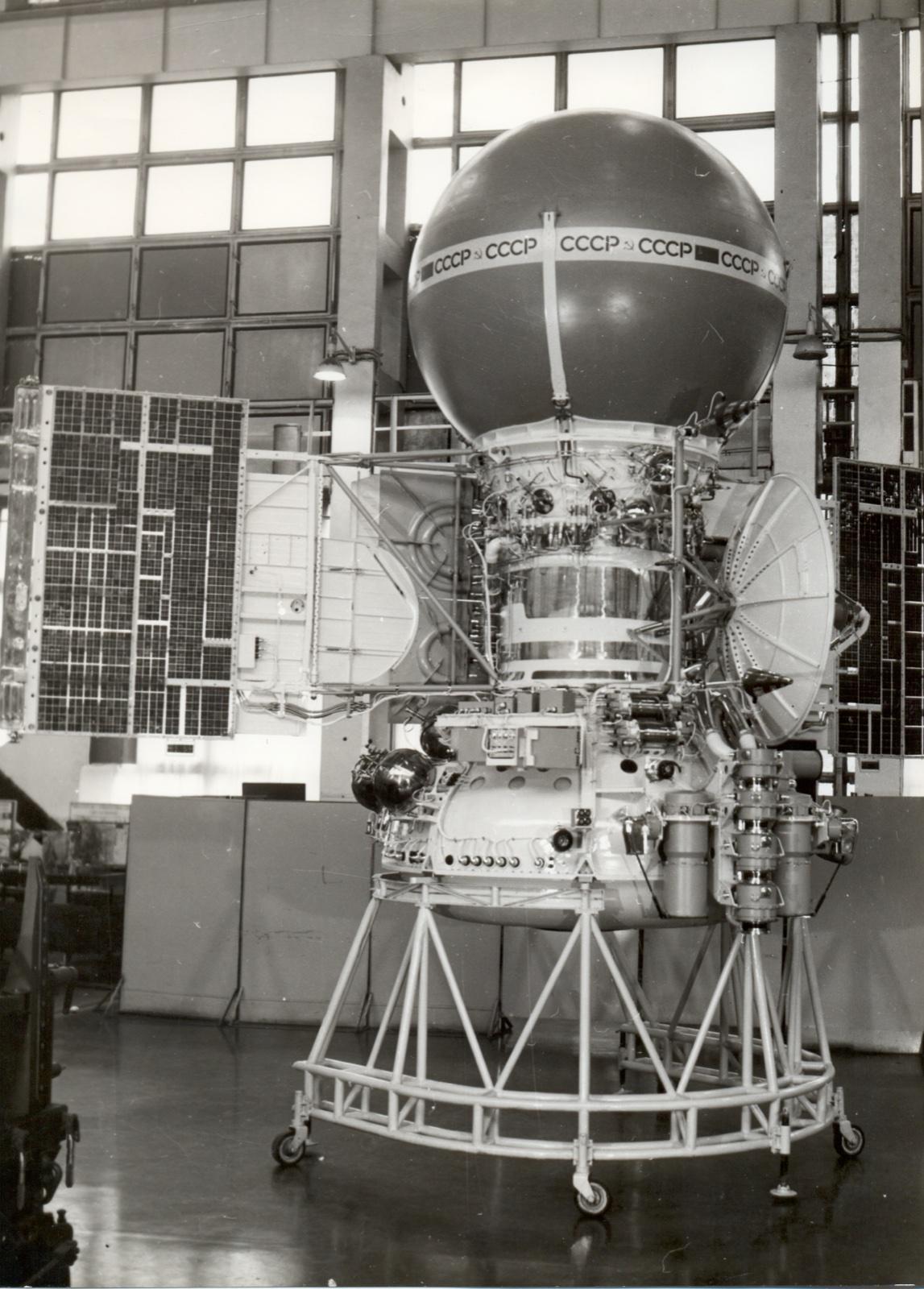
The 1978 launch window posed a harder problem than the one solved in 1975. According to NPO Lavochkin, changed ballistic conditions that year led the bureau to choose a flyby and landing scheme for the pair it calls series 4V1: each station would release its lander two days out and swing past the planet relaying the lander's signals, where Venera 9 and 10 had braked into orbit. NSSDCA explains the choice in terms of fuel: the craft would reach Venus much faster than in 1975, and the propellant needed to enter orbit was too great. Don P. Mitchell, whose history of the Soviet landers draws on Russian books and interviews, puts the arrival energy at three times that of the 1975 craft. Siddiqi's chronicle for NASA adds a second motive, that a passing carrier gave a lander more radio time.
The carriers changed little. NSSDCA describes the same 4V platform used for the 1975 orbiters: a 110 cm cylinder of propellant tanks, a pressurised ring of electronics and instruments, two solar wings spanning 6.7 m and a 1.6 m dish, with the entry sphere mounted on top. It gives Venera 12's bus a dry mass of 2,127 kg. At launch Venera 11 weighed 4,447.3 kg and Venera 12 4,457.9 kg, with 687.4 kg and 685.3 kg of propellant, and each carried a 1,645 kg descent craft whose lander would stand on the surface at 750 kg.
Below the clouds the new landers were meant to fall almost free. In NPO Lavochkin's description a 1.4 m² pilot chute and a 6 m² chute pulled away the top half of the heat shield, and a 24 m² braking chute lowered the lander through the clouds for nine or ten minutes before being cut loose at 46 to 48 km. The 180 m² three-canopy main parachute of Venera 9 and 10 was left off, which the bureau says shortened the descent by 15 minutes, and the lander finished the fall on its disc-shaped brake, designed to meet the ground at 7.3 to 8.5 m/s. The plan on the ground was for the soil sampler and both cameras to start 32 seconds after touchdown and keep going until radio contact was lost.
Siddiqi lists thirteen lander instruments: an imaging system, the Sigma gas chromatograph, a mass spectrometer, a gamma-ray spectrometer, the Groza lightning detector, temperature and pressure sensors, a nephelometer, an anemometer, an optical spectrophotometer, a remote soil collector, an X-ray fluorescence analyser for cloud particles, the Arakhis X-ray fluorescence spectrometer with its drill, and the PrOP-V penetrometer. Mitchell adds a scanning photometer fed by a rotating prism in the aerobrake and a microphone, and describes the mass spectrometer's metre-long intake, meant to avoid the contamination by cloud material that had affected Venera 9's. The two cameras were new colour telephotometers. In Mitchell's figures one would have sent 252 by 1,000 pixels of 10 bits in 14 minutes, over a lander link twelve times faster than in 1975, with the relays received by a new 70 m dish at Yevpatoria in Crimea.
The buses carried their own payload for the cruise and beyond. Siddiqi lists a plasma spectrometer, the Konus gamma-ray detector, the Signe-2MZ1 gamma and X-ray burst detector, the DUMS-1 ultraviolet spectrometer, a magnetometer, solar wind detectors and cosmic ray detectors. Konus was the experiment of E. P. Mazets and his colleagues at the Ioffe Institute; SIGNE 2 came out of the programme that CESR, the space radiation research centre in Toulouse, ran with the Soviet side under the French space agency CNES, according to the historian Philippe Varnoteaux. Mitchell describes an extreme-ultraviolet spectrometer on the bus as an extension of V. G. Kurt's work on atomic hydrogen, built with French colleagues to record the Lyman-alpha lines of hydrogen, helium, oxygen and other elements.
Venera 11 left Baikonur on 9 September 1978 and was in trouble almost at once. NPO Lavochkin records that its Sun-pointing attitude dropped out in the first communication session, as the antennas unfolded, and was quickly restored. The worse fault was that both the main and the reserve stage of the fan in the descent craft's cooling loop had failed, so the lander could not be chilled in the usual way. Controllers closed the shutter of the lander's radiative heater on 17 October, almost a month early, and tilted the station 40 degrees away from the Sun. Even so the lander was at 12 °C when it separated, where the norm was minus 10 to minus 15 °C.
Venera 12, launched on 14 September, had a smoother flight on a path of 98 days against Venera 11's 107, which let it arrive first. One of its telemetry tape recorders failed on the way, and a precision Sun sensor had to be swapped for its backup, but its cooling worked: the chill-down before release brought the lander to minus 12.3 °C, and it had warmed only to 5 °C by the time it entered the atmosphere.
On 19 December Venera 12 released its lander and fired its engine for 212.83 m/s to swing the bus onto a flyby path. Two days later the entry sphere hit the atmosphere at 11.2 km/s at an angle of minus 19 degrees, braked for 35 seconds, rode its parachute down to 46 km and then fell for 52 minutes 11 seconds on the disc brake alone. It landed on 21 December 1978 at 6 h 30 min Moscow time, which NSSDCA and Siddiqi give as 03:30 UT, after 61 minutes 53 seconds in the atmosphere, and it transmitted for 110 minutes through its bus, then passing about 34,000 km above the planet. Siddiqi calls it a record. NPO Lavochkin gives 470 °C and 90 atm at the site. Mitchell prints 468 °C and 93.6 atm, and writes that the landing raised a cloud of dust that darkened the sky for 20 to 30 seconds until winds of about 1 m/s cleared it.
Four days later it was Venera 11's turn. Its lander, released on 23 December, entered on 25 December at 11.2 km/s and minus 18 degrees, spent 52 minutes 58 seconds on the brake after the parachute let go at 46 km, and landed after 62 minutes 41 seconds, at 6 h 24 min Moscow time (03:24 UT). The bus passed 34,370 km from the surface and relayed for 95 minutes. The failed cooling showed: by the end the instrument container was above 70 °C, though NPO Lavochkin notes that the equipment was still working. Surface conditions were 462 °C and 92 atm according to the bureau, or 452 °C and 92.6 atm in Mitchell's figures. The Soviet yearbook for 1979 puts the site about 800 km from Venera 12's and Mitchell about 850 km. The whole-degree positions, 14° S, 299° E and 7° S, 294° E, are about 900 km apart on a sphere of Venus's size, a gap that rounding can account for.
NSSDCA's pages for both landers say they entered the nightside atmosphere, which is hard to square with the Soviet record. NPO Lavochkin lists a landing on the day side among the expedition's aims, the 1979 yearbook describes the spectrometer recording the daytime sky during descent, and V. I. Moroz and colleagues at IKI published those spectra in Nature in March 1980 as spectra of the Venus day sky. A JPL Horizons calculation for the published whole-degree sites, using the current IAU rotation model, puts the Sun about 73 degrees above the horizon at Venera 11's site at touchdown, a little after 11 in the morning local solar time, and about 69 degrees at Venera 12's. A 2018 JPL conference abstract gives Venera 11's entry at 11:10 local solar time, which fits that geometry, but also a solar zenith angle of 37 degrees, which does not. Every reading except NSSDCA's puts both landings in daylight.
Mitchell describes the moment in the control centre when the pictures should have arrived: there was a strong signal, but no modulation. The main scientific tasks were not accomplished, NPO Lavochkin says: no photo panoramas and nothing on the composition of the soil, because on each lander both telephotometer covers, redesigned after Venera 9 and 10, failed to jettison. On both landers the outside atmosphere also broke into the vacuum cavity of the VB01 soil sampler, so the sample never reached the detector, and the PrOP-V penetrometer returned nothing because its readings were to be judged from the pictures. Mitchell writes that a later study found a seal had formed that stopped the pressure equalising, so tons of atmospheric pressure held the covers down against their pyrotechnic charges. The bureau also lists smaller losses, including no data from the Sigma chromatograph and the IOAV optical instrument after Venera 11 touched down. The Soviet yearbook for 1979 told a different story: it names only the atmospheric instruments, says all of them worked to plan, and never mentions the cameras or the soil analyser.
Most of the descent science worked. According to the Soviet yearbook, the mass spectrometers switched on at about 24 km and ran to the ground, taking 22 gas samples and sending 220 spectra, and the two landers agreed completely; the gas chromatograph made nine analyses. NPO Lavochkin summarises the finding as a significant amount of nitrogen, about 5%, beside the main carbon dioxide, with traces of water vapour, chlorine, sulfur and their compounds, carbon isotopes roughly like Earth's, and isotopes of argon, neon and krypton. The yearbook adds that the isotopic make-up of Venus's argon shows a strong anomaly against Earth's, which NSSDCA records as a high ratio of argon-36 to argon-40. Mitchell's table shows how far the two methods could differ: nitrogen at 4.0 ± 0.3% by mass spectrometer and 2.5 ± 0.3% by chromatograph, argon at 110 against 40 on a row with no unit, where the yearbook gives about 0.01% (some 100 parts per million) from both instruments. In the clouds, Mitchell writes, the X-ray analyser found ten times more chlorine than sulfur, and according to NPO Lavochkin the nephelometer confirmed the cloud base at 48 to 49 km found by Venera 9 and 10.
Every 10 seconds, the yearbook says, the optical spectrometer recorded the sky spectrum from 450 to 1,200 nm and the angular spread of scattered light through four filters between 490 and 1,330 nm. Siddiqi reports that the Venera 11 spectrophotometer found only 3 to 6% of the sunlight reaching the surface. Mitchell draws the picture that emerged: the sky grows steadily more orange with depth, the deep atmosphere scatters so strongly that the surface would not be clearly visible from more than a few kilometres up, and an observer on the ground would see the rocks fade into a featureless orange haze.
The Groza receiver, designed by Leonid Ksanfomaliti of the Space Research Institute (IKI) around a 25 cm loop antenna, listened at kilohertz frequencies for electrical discharges. On 21 December 1978 it recorded many electromagnetic pulses on the Venera 12 lander, which Ksanfomaliti interpreted as electrical discharges, according to a 2025 Literaturnaya Gazeta piece on a manuscript biography of him; he reported them in Nature in March 1980 as frequent lightning discharges in the clouds. NPO Lavochkin places the discharges in the cloud layer, with energy roughly equal to terrestrial lightning and a rate of up to 30 a second. Mitchell differs twice over: he calls the bursts significantly more intense than terrestrial storms, with some evidence of a source far below the clouds, and he says Venera 11 heard intense activity while Venera 12 heard much less. The question never closed. A 2023 study of whistler waves seen by Parker Solar Probe calls Venus lightning debated for decades and shows that some whistlers need no lightning at all; the atmosphere page follows the argument.
The twins did not have Venus to themselves. NASA's Pioneer Venus orbiter had entered orbit on 4 December 1978, and on 9 December the four probes of the Pioneer Venus multiprobe had entered the atmosphere. Mitchell notes that the American probes returned only about 1% as much data as Venera 11 and 12, that their results largely agreed, and that all four suffered damage and odd readings at about 12.5 km, the height at which Venera 12 saw anomalous Groza readings and unusual phase shifts in its Doppler signal.
After the flybys both buses were reassigned. For the Soviet-French experiment on locating gamma-ray bursts, NPO Lavochkin writes, the two stations were used to give the largest possible measuring base: Venera 12 fired about 350 m/s on 5 February 1979 and Venera 11 did the same on 7 February, burning nearly all their remaining propellant. A burst reaches widely separated detectors at slightly different times, so a longer baseline gives a tighter position. HEASARC, NASA's high-energy archive, describes SIGNE 2 as two sodium iodide detectors on each craft covering the whole sky, which with a third set on Prognoz 7 in Earth orbit formed a three-point interplanetary triangulation network, and it credits the arrangement as the first time identical detectors had been used simultaneously for burst studies on spacecraft separated by interplanetary distances. Varnoteaux writes that the detectors on Prognoz 7, Venera 11 and Venera 12 together located several dozen gamma-ray sources and yielded a first catalogue of the phenomenon.
One burst stood apart from the rest. The Konus catalogue of soft gamma repeater activity, compiled at the Ioffe Institute from the Konus detectors on Venera 11 to 14 and later craft, lists an event on 5 March 1979 at 15:51:39 UT from the source SGR 0526-66: an initial pulse 0.25 seconds long followed by a pulsating tail lasting more than 64 seconds. Mazets and his colleagues reported in Nature in December 1979 that Konus on both Veneras had caught a very intense burst on 5 March and a much weaker one on 6 March from the same source, that several other spacecraft saw the first too, and that they could place the source on the sky. The catalogue lists sixteen more bursts from that source up to 1983. The Ioffe laboratory's memorial to its later head Rafail Aptekar says that soft gamma repeaters, objects it describes as having extremely strong magnetic fields, were discovered in the Konus experiments on the Venera stations at the turn of the 1980s.
Venera 12 had one more target. About a year and a half after launch, NPO Lavochkin writes, it could study the newly found comet Bradfield, catalogued by Siddiqi as C/1979 Y1. On 13 February 1980 the bus, then crossing Earth's orbit about 150 million km from the Sun, turned on its gyro platform toward the comet, which lay inside the orbit of Venus, and its DUMS-1 ultraviolet spectrometer, never meant for comets, recorded a spectrum; the session was repeated on 17 March. Venera 11 was already gone. As it moved away from the Sun its Sun sensors became unreliable and it fell back on gyroscopic spin, and after a last session on 1 February 1980 it did not answer on 8 February. One possible cause, the bureau says, was a poor spin of a craft unbalanced by the loss of its lander and nearly all its propellant, which left the solar array's current below the load until the battery ran down. Venera 12 met the same end in mid-April 1980, 174 million km from the Sun, and was last heard on 18 April.
SIGNE 2 belongs to a longer French thread. France and the Soviet Union signed a space cooperation agreement on 30 June 1966, Varnoteaux writes, and CESR, under CNES, proposed a first high-energy astronomy experiment to the Soviet side. SIGNE 1 flew on Prognoz 2 from 29 June 1972, and its more capable successor, SIGNE 2, went on Prognoz 6, 7 and 9 and on four Venus probes: Venera 11, 12, 13 and 14. HEASARC spells the version on Venera 13 and 14 SNEG-2MG and says those buses returned gamma-ray data until March 1983.
Other European instruments also reached Venus on other nations' spacecraft before ESA sent its own Venus Express. NSSDCA's page for the Venera 9 orbiter of 1975 (see Venera 9 and 10) lists a French ultraviolet photometer at 350 nm, and Jean-Loup Bertaux, Jacques Blamont, Vladimir Kurt and colleagues published Lyman-alpha observations of hydrogen around Venus from the same orbiters in 1978; the two descriptions may refer to one French instrument or to two. The Space Research Institute (IWF) in Graz says the first magnetometer built there flew on Venera 13 at the end of 1981, and that its instruments on Venera 13 and 14 gave new insight into the solar wind. The East German Academy of Sciences built an infrared Fourier spectrometer for Venera 15 and 16 as its first deep-space experiment, to map temperature and pressure above the clouds, according to a 2009 German history. NSSDCA states that the ultraviolet spectrometer, the mass spectrograph and the pressure and temperature instruments on the Vega landers of 1985 were developed jointly by French and Soviet investigators. On Pioneer Venus, Ulf von Zahn of the University of Bonn led the multiprobe bus's neutral mass spectrometer, and Jacques Blamont of the CNRS aeronomy laboratory shared the lead of the large probe's nephelometer with Boris Ragent of NASA Ames.
Both landers remain on the surface at positions known only to the nearest degree, and the halves of their entry spheres and their parachutes also came down on Venus, at unrecorded positions; the ledger of what reached Venus tracks them. The buses circle the Sun, silent since 1980. Some of their remote science was later revised: in 1996 S. A. Stern and colleagues reported that far-ultraviolet emissions the Venera 11 and 12 spectrophotometers had attributed to argon were not argon, removing a conflict with the argon measured in place. Mitchell writes that Venera 13 and 14, launched in 1981, would complete the missions attempted by Venera 11 and 12, and in March 1982 they did, with colour pictures and soil analyses from two new sites.
Mission facts
Organisations
NPO Lavochkin and the USSR Academy of Sciences (Soviet Union), with the French SIGNE 2 gamma-ray burst detectors from CESR Toulouse under CNES
Series and designations
NPO Lavochkin calls the pair its 4V1 series. Siddiqi lists them as 4V-1 no. 360 (Venera 11) and no. 361 (Venera 12). NSSDCA catalogues the buses as 1978-084A and 1978-086A and the landers as 1978-084D and 1978-086C.
Launches
Venera 11 on 9 September 1978 at 03:25:39 UT and Venera 12 on 14 September at 02:25:13 UT (Siddiqi; NPO Lavochkin prints 06:25:39.5 and 05:25:13, the same instants three hours ahead, in Moscow time), both on Proton-K rockets from Baikonur. Lavochkin gives parking orbits of 177 by 159.6 km and 185 by 163 km; NSSDCA gives 177 by 205 km for both. The cruise took 107 days for Venera 11 and 98 for Venera 12.
Upper stage
NPO Lavochkin writes that the second burn of a Blok DM stage sent each craft to Venus (3,887.42 m/s for Venera 11, 3,962.54 m/s for Venera 12). Siddiqi names the stage as a Blok D-1, 11S824M nos. 3L and 4L.
Mass
4,447.3 kg (Venera 11) and 4,457.9 kg (Venera 12) at launch according to NPO Lavochkin and Siddiqi, each with a 1,645 kg descent craft whose lander weighed 750 kg on the surface. NSSDCA prints 4,940 kg on both bus pages and 4,461 kg in the Venera 12 text.
Venera 12 lander
Touched down on 21 December 1978 and transmitted for 110 minutes (NPO Lavochkin); the Soviet yearbook for 1979 gives the time as 6 h 30 min Moscow time, and NSSDCA and Siddiqi as 03:30 UT. NPO Lavochkin reports 470 °C and 90 atm at the surface; Mitchell prints 468 °C and 93.6 atm.
Venera 11 lander
Touched down on 25 December 1978 and transmitted for 95 minutes (NPO Lavochkin); the Soviet yearbook for 1979 gives the time as 6 h 24 min, and NSSDCA and Siddiqi as 03:24 UT. NPO Lavochkin reports 462 °C and 92 atm; Mitchell prints 452 °C and 92.6 atm.
Landing sites
Venera 11 at 14° S, 299° E and Venera 12 at 7° S, 294° E, whole degrees only in NSSDCA, Siddiqi and Mitchell. The sites are quoted as about 800 km apart (Soviet yearbook, NPO Lavochkin, Siddiqi) or about 850 km (Mitchell); the whole-degree figures are about 900 km apart.
Flyby distance
NPO Lavochkin gives 34,370 km from the surface for Venera 11's bus and about 34,000 km for Venera 12's, and 35,000 km as the minimum distance in its general flight scheme. NSSDCA and the Soviet yearbook for 1979 give about 34,000 km for both, Siddiqi 35,000 km for both.
Descent timing
Braking parachute released at 46 km, then free fall on the disc brake for 52 min 58 s (Venera 11) and 52 min 11 s (Venera 12); total descent 62 min 41 s and 61 min 53 s (NPO Lavochkin). The Soviet yearbook for 1979 gives the parachute stage as ending at 40 km.
What failed
On both landers the telephotometer covers, redesigned after Venera 9 and 10, did not jettison, and the outside atmosphere broke into the vacuum cavity of the VB01 soil sampler so no soil reached the detector (NPO Lavochkin). The PrOP-V penetrometer returned nothing usable because its results were to be read from the pictures.
Atmospheric nitrogen
About 5% according to NPO Lavochkin and the Soviet yearbook, which credit the lander measurements in general and put the gas chromatograph's figure at several per cent. Mitchell's results table gives 4.0 ± 0.3% from the mass spectrometer and 2.5 ± 0.3% from the gas chromatograph.
Groza lightning detector
L. V. Ksanfomaliti's low-frequency radio receiver recorded discharges that NPO Lavochkin places in the cloud layer, with energy about equal to Earth's lightning and rates of up to 30 per second. Ksanfomaliti published them in Nature in March 1980 as frequent lightning discharges in the clouds.
Gamma-ray baseline
Venera 12 burned about 350 m/s on 5 February 1979 and Venera 11 on 7 February, nearly all their remaining propellant, to widen the baseline of the Soviet-French experiment for locating gamma-ray bursts (NPO Lavochkin).
SIGNE 2 detectors
Two per spacecraft, each a 4.5 by 3.7 cm sodium iodide crystal inside an 8 mm plastic anticoincidence jacket, arranged to see the whole sky; with Prognoz 7 they formed a three-point triangulation network (HEASARC). Konus used six crystals 80 mm across and 30 mm thick.
Comet Bradfield
On 13 February 1980 Venera 12 turned toward the comet using its gyro platform and took an ultraviolet spectrum of comet C/1979 Y1 (Bradfield) with its DUMS-1 spectrometer, repeating the session on 17 March 1980.
End of contact
Venera 11: last session 1 February 1980, no response on 8 February. Venera 12: lost three-axis attitude in mid-April 1980 at 174 million km from the Sun, last session 18 April 1980 (NPO Lavochkin).
Europe: the SIGNE programme
Proposed to the Soviet side by CESR Toulouse under CNES. SIGNE 1 flew on Prognoz 2 in 1972; SIGNE 2 flew on Prognoz 6, 7 and 9 and on Venera 11, 12, 13 and 14 (Philippe Varnoteaux, Air & Cosmos).
Europe: Venera 9 and 10
NSSDCA lists a French ultraviolet photometer at 350 nm on the Venera 9 orbiter; Bertaux, Blamont, Kurt and colleagues published Lyman-alpha hydrogen observations from both orbiters in 1978.
Site: 14°S, 299°E · Venera 11 lander · position estimated (source)
Mission timeline
- 9 Sep 1978Venera 11 lifts off from Baikonur at 03:25:39 UT on a Proton-K. In the very first session the Sun-pointing attitude drops out as the antennas deploy, and is restored.
- 14 Sep 1978Venera 12 follows at 02:25:13 UT on a shorter, 98-day path that will bring it to Venus first.
- 17 Oct 1978With the cooling fan of its descent craft dead since launch (main and reserve stages both failed), Venera 11's controllers close the lander's heater shutter almost a month early; as a second measure, on a date the builder does not give, they tilt the craft 40 degrees away from the Sun.
- 19 Dec 1978Venera 12 releases its lander, chilled to minus 12.3 °C, and diverts its bus onto a flyby path with a 212.83 m/s burn.
- 21 Dec 1978The Venera 12 lander touches down at 03:30 UT after a 61 min 53 s descent and transmits from the surface for 110 minutes, with no pictures.
- 23 Dec 1978Venera 11 releases its lander and diverts its bus with a burn of about 213 m/s.
- 25 Dec 1978The Venera 11 lander touches down at 03:24 UT, about 800 km from its twin by Soviet figures, and transmits for 95 minutes while its interior climbs above 70 °C.
- 5 and 7 Feb 1979Venera 12 and then Venera 11 each burn about 350 m/s, nearly all their remaining propellant, to stretch the baseline of the Soviet-French gamma-ray burst experiment.
- 5 Mar 1979Konus on both buses records an intense burst at 15:51:39 UT from the source now catalogued as SGR 0526-66, a 0.25 s spike followed by a pulsating tail of more than 64 s; a weaker burst from the same source follows on 6 March.
- Dec 1979E. P. Mazets and colleagues at the Ioffe Institute publish the Konus observations in Nature as a flaring X-ray pulsar in Dorado.
- 1 Feb 1980Last session with Venera 11. After losing reliable Sun sensing it had been spinning on its gyroscopes; on 8 February it does not answer.
- 13 Feb 1980Venera 12, crossing Earth's orbit about 150 million km from the Sun, turns toward the comet on its gyro platform and records an ultraviolet spectrum of comet Bradfield.
- 17 Mar 1980Venera 12 repeats its comet session.
- 20 Mar 1980Nature prints two IKI papers from the landers on consecutive pages: V. I. Moroz and colleagues on the spectrum of the Venus day sky, and L. V. Ksanfomaliti on frequent lightning discharges in the clouds.
- 18 Apr 1980Last session with Venera 12, after its three-axis attitude failed in mid-April at 174 million km from the Sun.
- 30 Oct and 4 Nov 1981Venera 13 and 14 leave for Venus with updated SIGNE and Konus detectors, and with landers that will retry the pictures and soil analyses Venera 11 and 12 lost.
- Jul 1996Stern and colleagues report in Icarus that the far-ultraviolet emissions the Venera 11 and 12 spectrophotometers attributed to argon are not argon, from a sounding rocket flown on 15 August 1994.
A filled dot marks something that physically happened. A hollow one marks an announcement, a naming or a target.
In pictures
Tap a photo to enlarge.
Translated from the original sources
Passages from the Russian, French and German sources this page draws on, in azmth's translation. Tap Show original to read the original wording.
NPO Lavochkin, project page Venera-11, Venera-12
Russian · 13 passages
NPO Lavochkin, project page Venera-11, Venera-12 (mission account, failures and results)
Open the source“Because of the changed ballistic conditions for the flight to Venus in 1978, a flyby and landing scheme was chosen.”
azmth's translation · Show originalHide original
Russian: «В связи с изменением баллистических условий для полёта к Венере в 1978 году была выбрана пролётно-десантная схема.»
“landing of the lander on the surface of the planet, on its day side”
listed among the aims of the expedition
azmth's translation · Show originalHide original
Russian: «осуществление посадки ПА на поверхность планеты, на ее дневную сторону»
“Because the three-canopy main parachute with an area of 180 m² was removed from the parachute system, the total descent time in the atmosphere was reduced by 15 minutes compared with Venera-9 and 10.”
azmth's translation · Show originalHide original
Russian: «Поскольку из состава парашютной системы исключен трехкупольный основной парашют площадью 180 м2, общее время спуска аппарата в атмосфере уменьшилось по сравнению с «Венерой-9, 10» на 15 минут.»
“On 21 December 1978 the descent craft of Venera-12 made a soft landing and for 110 minutes transmitted scientific information from the surface of the planet, which was relayed to Earth by the Venera-12 orbital craft (OA), then flying past at a height of about 34,000 km.”
azmth's translation · Show originalHide original
Russian: «21 декабря 1978 года спускаемый аппарат «Венеры-12» совершил мягкую посадку и в течение 110 минут передавал с поверхности планеты научную информацию, которая ретранслировалась на Землю ОА «Венера-12», совершавшим в это время пролет на высоте ~ 34 000 км.»
“By the time reception of data from the Venera-11 lander ended, the temperature in the instrument container had exceeded 70 °C, but the equipment kept working.”
azmth's translation · Show originalHide original
Russian: «К моменту окончания приема информации с посадочного аппарата «Венеры-11» температура в приборном контейнере превысила величину 70°С, однако аппаратура продолжала работать.»
“both covers of the telephotometers, which had been modified after the flight of Venera-9 and Venera-10, failed to jettison on each of the landers.”
azmth's translation · Show originalHide original
Russian: «не отстрелились обе крышки телефотометров, которые были доработаны после полета «Венеры-9» и «Венеры-10», на каждом из посадочных аппаратов.»
“In addition, also on both craft, the outside atmosphere broke into the vacuum cavity of the VB01 soil sampling device, as a result of which the soil was not delivered to the detector unit.”
azmth's translation · Show originalHide original
Russian: «Кроме того, также на обоих аппаратах, произошел прорыв внешней атмосферы в вакуумную полость грунтозаборного устройства ВБ01, в результате чего грунт не был подан к блоку детектирования.»
“Measurements with the scientific instruments established that besides the main constituent CO2 the atmosphere of Venus contains a significant amount of nitrogen (about 5%).”
azmth's translation · Show originalHide original
Russian: «Измерениями с помощью научных приборов было установлено, что наряду с основной составляющей CO2 в атмосфере Венеры имеется значительное количество азота (около 5%).»
“electrical discharges occur in the cloud layer; their energy is roughly the same as that of lightning in the Earth's atmosphere, but the rate of discharges is much higher and reaches 30 per second.”
azmth's translation · Show originalHide original
Russian: «электрические разряды происходят в облачном слое; их энергия примерно такая же, как у молний в атмосфере Земли, но частота следования разрядов намного выше и достигает 30 раз в секунду.»
“Practically all the propellant reserves were used up; the impulse of each correction was about 350 m/s.”
azmth's translation · Show originalHide original
Russian: «Были израсходованы практически все запасы топлива; импульс каждой коррекции составил ~350 м/с.»
“Although the scientific payload was not intended for studying comets, the DUMS-1 ultraviolet spectrometer made it possible to obtain a spectrum of comet Bradfield.”
azmth's translation · Show originalHide original
Russian: «Хотя комплекс научной аппаратуры не был предназначен для изучения комет, ультрафиолетовый спектрометр ДУМС-1 позволил получить спектр кометы Брэдфилда.»
“On 1 February 1980 the last communication session was held with it, and on 8 February the craft did not respond to commands from Earth.”
azmth's translation · Show originalHide original
Russian: «1 февраля 1980 года с ней был проведен последний сеанс связи, а 8 февраля аппарат на команды с Земли не откликнулся.»
“after the session held on 18 April 1980 it was no longer possible to make contact with Venera-12.”
azmth's translation · Show originalHide original
Russian: «после сеанса, проведенного 18 апреля 1980 года, войти в связь с «Венерой-12» больше не удалось.»
Epizody kosmonavtiki, Venera-11 page reproducing the Great Soviet Encyclopedia yearbook for 1979 and a Russian translation of Siddiqi
Russian · 5 passages
Epizody kosmonavtiki, Venera-11 page reproducing the Great Soviet Encyclopedia yearbook for 1979 and a Russian translation of Siddiqi (Web Archive copy, May 2024)
Open the source“On the descent craft, after the parachute opened, the optical spectrometer recorded the spectrum of the daytime sky of Venus every 10 seconds (Great Soviet Encyclopedia yearbook, 1979).”
azmth's translation · Show originalHide original
Russian: «На СА после раскрытия парашюта с помощью оптического спектрометра каждые 10 сек регистрировался спектр дневного неба Венеры»
“On 25 December at 6 h 24 min the descent craft of the station Venera-11 made a soft landing on the surface of the planet about 800 km from the landing place of the descent craft of Venera-12.”
azmth's translation · Show originalHide original
Russian: «25 декабря в 6 час 24 мин СА станции «Венера-11» совершил мягкую посадку на поверхность планеты на расстоянии ок. 800 км от места посадки СА станции «Венера-12».»
“The mass spectrometers were switched on at a height of about 24 km and worked right up to landing. During the descent 22 gas samples were taken and 220 mass spectra sent to Earth. Comparing them shows that the results from both descent craft are fully identical.”
azmth's translation · Show originalHide original
Russian: «Масс-спектрометры были включены на высоте ~ 24 км и функционировали вплоть до самой посадки. За время спуска было взято 22 пробы газа, передано на Землю 220 масс-спектров. Их сопоставление показывает полное тождество результатов с обоих СА.»
“The isotopic composition of argon in the atmosphere of Venus shows a strong anomaly compared with the isotopic composition of argon in the Earth's atmosphere.”
azmth's translation · Show originalHide original
Russian: «Изотопный состав аргона атмосферы Венеры обнаруживает сильную аномалию по сравнению с изотопным составом аргона атмосферы Земли.»
“All the instruments of the descent craft worked in accordance with the programme (Great Soviet Encyclopedia yearbook, 1979, whose list of instruments names no cameras or soil analyser).”
azmth's translation · Show originalHide original
Russian: «Все приборы СА работали в соответствии с программой.»
Epizody kosmonavtiki, Venera-12 page
Russian · 1 passage
Epizody kosmonavtiki, Venera-12 page (Web Archive copy, January 2025)
Open the source“On 21 December at 6 h 30 min Moscow time the descent craft of the station Venera-12 made a soft landing and for 110 minutes transmitted scientific information from the surface of the planet.”
azmth's translation · Show originalHide original
Russian: «21 декабря в 6 час 30 мин московского времени СА станции «Венера-12» совершил мягкую посадку и в течение 110 мин передавал научную информацию с поверхности планеты»
Literaturnaya Gazeta, Leonid Ksanfomaliti. Zhizn na Venere
Russian · 1 passage
Literaturnaya Gazeta, Leonid Ksanfomaliti. Zhizn na Venere (21 February 2025), presenting Sergei Korostelev's manuscript biography of Ksanfomaliti
Open the source“On 21 December 1978 the long and very long wave radio receiver and spectrum analyser Groza that he designed, on the Venera-12 descent craft, recorded numerous electromagnetic pulses, which Ksanfomaliti interpreted as electrical discharges.”
azmth's translation · Show originalHide original
Russian: «21 декабря 1978 года разработанный им радиоприемник-спектроанализатор длинных и сверхдлинных волн «Гроза» на спускаемом аппарате «Венера-12» зарегистрировал многочисленные электромагнитные импульсы, интерпретированные Ксанфомалити как электрические разряды.»
Ioffe Institute, Laboratory for Experimental Astrophysics: In memory of R. L. Aptekar
Russian · 1 passage
“in the Konus experiments on the interplanetary stations of the Venera series, soft gamma repeaters were discovered”
azmth's translation · Show originalHide original
Russian: «в экспериментах «Конус» на межпланетных станциях серии «Венера» были открыты «мягкие гамма-репитеры»»
Philippe Varnoteaux, Il y a 40 ans, SIGNE-3 et l'astronomie gamma, Air & Cosmos
French · 3 passages
Philippe Varnoteaux, Il y a 40 ans, SIGNE-3 et l'astronomie gamma, Air & Cosmos (26 June 2017; Web Archive copy)
Open the source“The Centre d'étude spatiale des rayonnements (CESR) in Toulouse, under the direction of CNES, proposed to the Soviets a first high-energy astronomy experiment.”
azmth's translation · Show originalHide original
French: «Le Centre d’étude spatiale des rayonnements (CESR) de Toulouse, sous la conduite du CNES, propose aux Soviétiques une première expérience d’astronomie haute énergie.»
“More ambitious, the new version of the SIGNE programme consisted of carrying better gamma-ray detectors on Prognoz-6 (22/09/1977), Prognoz-7 (30/10/1978) and Prognoz-9 (01/07/1983), but also on probes bound for Venus: Venera-11 (09/09/1978), Venera-12 (14/09/1978), Venera-13 (30/10/1981) and Venera-14 (04/11/1981).”
azmth's translation · Show originalHide original
French: «Plus ambitieuse, la nouvelle mouture du programme SIGNE consiste à embarquer des détecteurs de rayons gamma plus performants sur Prognoz-6 (22/09/1977), Prognoz-7 (30/10/1978) et Prognoz-9 (01/07/1983), mais aussi sur des sondes en partance pour Vénus : Venera-11 (09/09/1978), Venera-12 (14/09/1978), Venera-13 (30/10/1981) et Venera-14 (04/11/1981).»
“It should be stressed that with Prognoz-7, Venera-11 and 12, the various Soviet and French gamma-ray burst detectors located, by triangulation, several dozen sources of gamma rays, making it possible to compile a first catalogue of this type of phenomenon.”
azmth's translation · Show originalHide original
French: «Soulignons qu’avec les Prognoz-7, Venera-11 et 12, les différents détecteurs de sursaut gamma soviétiques et français ont, par une méthode de triangulation, localisé plusieurs dizaines de sources de rayons gamma, permettant de constituer un premier catalogue référençant ce type de phénomène.»
IWF Graz, Weltraummagnetometer research group page
German · 1 passage
IWF Graz, Weltraummagnetometer research group page (Web Archive copy, November 2025)
Open the source“The first launch of a magnetometer built in Graz took place at the end of 1981 on board the Russian mission Venera-13 to Venus.”
azmth's translation · Show originalHide original
German: „Der erste Start eines in Graz gebauten Magnetometers erfolgte Ende 1981 an Bord der russischen Mission VENERA-13 zur Venus.“
Funkzentrum, Hammer und Zirkel im All: Zur Geschichte der Raumfahrt in der DDR
German · 1 passage
Funkzentrum, Hammer und Zirkel im All: Zur Geschichte der Raumfahrt in der DDR (17 June 2009)
Open the source“For its first deep-space experiment the Academy developed an infrared Fourier spectrometer that was used in 1983 on the Soviet probes Venera 15 and 16.”
azmth's translation · Show originalHide original
German: „Für das erste Tiefraumexperiment entwickelte die Akademie ein Infrarot-Fourier-Spektrometer, das 1983 auf den sowjetischen Sonden Venera 15 und 16 eingesetzt wurde.“
Sources
- NPO Lavochkin, project page Venera-11, Venera-12 (mission account, failures and results) · in Russian
- Epizody kosmonavtiki, Venera-11 page reproducing the Great Soviet Encyclopedia yearbook for 1979 and a Russian translation of Siddiqi (Web Archive copy, May 2024) · in Russian
- Epizody kosmonavtiki, Venera-12 page (Web Archive copy, January 2025) · in Russian
- NSSDCA, Venera 11 flight platform, 1978-084A (Web Archive copy, December 2023; the live catalogue returned an error on 26 September 2026)
- NSSDCA, Venera 11 descent craft, 1978-084D (Web Archive copy, November 2023)
- NSSDCA, Venera 12 flight platform, 1978-086A (Web Archive copy, December 2024)
- NSSDCA, Venera 12 descent craft, 1978-086C (Web Archive copy, December 2024)
- Asif A. Siddiqi, Beyond Earth: A Chronicle of Deep Space Exploration, 1958 to 2016 (NASA SP-2018-4041), entries 160 and 161
- Don P. Mitchell, Drilling into the Surface of Venus (Venera 11 and 12, Pioneer Venus, Venera 13 and 14)
- HEASARC, Venera 11 and 12 (SIGNE 2 and Konus gamma-ray instruments)
- HEASARC, Venera 13 and 14 (SNEG-2MG and Konus)
- E. P. Mazets and others, Observations of a flaring X-ray pulsar in Dorado, Nature 282, 587 (December 1979)
- Ioffe Institute, Laboratory for Experimental Astrophysics: Konus catalogue of SGR activity, SGR 0526-66
- Ioffe Institute, Laboratory for Experimental Astrophysics: In memory of R. L. Aptekar · in Russian
- Literaturnaya Gazeta, Leonid Ksanfomaliti. Zhizn na Venere (21 February 2025), presenting Sergei Korostelev's manuscript biography of Ksanfomaliti · in Russian
- Philippe Varnoteaux, Il y a 40 ans, SIGNE-3 et l'astronomie gamma, Air & Cosmos (26 June 2017; Web Archive copy) · in French
- S. A. Stern and others, The 825-1110 angstrom EUV spectrum of Venus, Icarus 122 (1996), NTRS record
- C. George and others, Non-lightning-generated whistler waves in near-Venus space, Geophysical Research Letters (2023), DOI 10.1029/2023GL105426, Crossref record with abstract
- JPL Horizons API: position of the Sun seen from the Venera 11 site, 25 December 1978
- JPL Horizons API: position of the Sun seen from the Venera 12 site, 21 December 1978
- NSSDCA, Venera 9 orbiter, 1975-050A (Web Archive copy, December 2024)
- J.-L. Bertaux and others, Lyman-alpha observations of Venera-9 and 10 I, Planetary and Space Science 26, 817 (1978), DOI 10.1016/0032-0633(78)90105-8, Crossref record
- IWF Graz, The IWF mourns the loss of Konrad Schwingenschuh (4 July 2024; Web Archive copy)
- IWF Graz, Weltraummagnetometer research group page (Web Archive copy, November 2025) · in German
- Funkzentrum, Hammer und Zirkel im All: Zur Geschichte der Raumfahrt in der DDR (17 June 2009) · in German
- NSSDCA, Vega 1, 1984-125A (Web Archive copy, November 2023)
- NSSDCA, Pioneer Venus bus neutral mass spectrometer, 1978-078A-03 (Web Archive copy, January 2025)
- NSSDCA, Pioneer Venus large probe nephelometer, 1978-078D-02 (Web Archive copy, December 2024)
- V. I. Moroz and others, Spectrum of the Venus day sky, Nature 284, 243 (20 March 1980)
- L. V. Ksanfomaliti, Discovery of frequent lightning discharges in clouds on Venus, Nature 284, 244 (20 March 1980)
- J. Grandidier and others, Solar spectrum and intensity analysis under Venus atmosphere conditions for photovoltaics operation, 16th VEXAG meeting abstract 8003 (2018)
- JPL Horizons API: sub-solar point on Venus at the two touchdown times
- Ioffe Institute, Konus catalog of SGR activity: 1978 to 2000 (instruments on Venera 11 to 14, Wind and Kosmos-2326)
- Don P. Mitchell, About Copyright (his research method and the rights in images on his site)
Facts on this page were verified on 8 October 2026. Where sources disagree, the disagreement is stated rather than resolved silently.
azmth is independent and is not affiliated with or endorsed by NASA, Roscosmos, NPO Lavochkin, ESA, JAXA, ISRO, CNSA, or any other space agency or company named on this page.