Pictures from the surface of Venus
Every picture ever taken on the surface of Venus: how the Venera 9, 10, 13 and 14 cameras worked, what they show, the lost lens caps and the missing sound.
TL;DR· 19 min read
Four Soviet landers have returned pictures from the surface of Venus: Venera 9 and 10 in black and white in 1975, and Venera 13 and 14 in colour in 1982. The cameras built each panorama one line at a time, looking out through a quartz window, and covers left on those windows cost Venera 9 and 10 half their views and Venera 11 and 12 all of theirs. The orange in the colour views is the light: with it removed, the rock looks dark and nearly colourless. No sound recording exists: the Groza-2 microphone reported only a noise level, which its team turned into a wind speed of about half a metre per second.
Which spacecraft have taken pictures on the surface of Venus?
Four spacecraft have sent pictures from the surface of Venus, all of them Soviet landers: Venera 9 and Venera 10 in October 1975, and Venera 13 and Venera 14 in March 1982. They show broken rock, flat slabs and dark soil under orange light, seen from about 90 cm up, and each lander sent data from the ground for between 53 and 127 minutes. Nothing with a camera has landed since, and no sound recording from the surface exists. This page explains how the cameras worked, what the colours really mean, how covers left on the camera windows cost half the 1975 views and all of the 1978 ones, and why one of the instrument builders came to see living things in the pictures.
- 4landers that sent pictures from the surface: Venera 9, 10, 13 and 14
- 127 minutesVenera 13's transmission time from the surface, against a planned 32 minutes
- 0sound recordings from the surface: Groza-2 sent a noise level
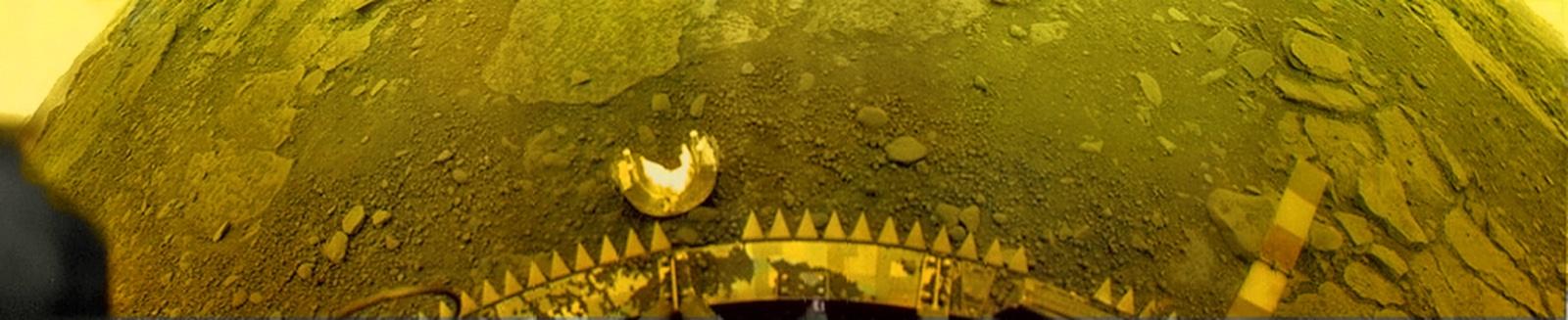
The Planetary Society, which publishes Ted Stryk's reconstructions of every view ever sent from the ground on Venus, puts the total at four, all of them landers built by NPO Lavochkin: Venera 9 and Venera 10 on 22 and 25 October 1975, and Venera 13 and Venera 14 on 1 and 5 March 1982. The Venera 11 and 12 landers of December 1978 transmitted for 95 and 110 minutes, NPO Lavochkin records, but returned no pictures, because their camera covers never came off. The Vega landers of June 1985 took no pictures at Venus and came down on the night side, according to Don P. Mitchell's catalogue of Soviet space images. NASA describes its planned DAVINCI probe as the first spacecraft to descend through the atmosphere since Vega 2. Everything anyone has seen of Venus from ground level comes from a few hours of scanning in 1975 and 1982.
The Venera imagers worked on a different principle from a film or television camera. NPO Lavochkin calls the Venera 9 imager a telephotometer, 'a system whose operating principle resembles mechanical television', and the history pages of the Space Research Institute (IKI RAN) add that official papers of the time called the devices surface contrast meters and never used the word image. Inside each, a small mirror rocked to sweep one vertical line of the scene across a photomultiplier tube, which measured the brightness of a single point at a time; the mirror then turned a step about the panorama axis and swept the next line (IKI). Each lander carried two such cameras on opposite sides, looking through quartz windows, with the scanning axis tilted 50 degrees down, so that the middle of each panorama looks at the ground beside the lander while its two ends reach out to the horizon. That geometry gives every Venera panorama its look: sky in the upper corners, the lander's ring bulging into the foreground, and ground that curves away like the inside of a bowl. Mitchell notes that the panoramas are spherical projections that can be remapped into ordinary perspective views.
Tight limits governed the 1975 cameras. By IKI's figures, a panorama held 517 lines of 115 picture elements at 64 levels of brightness. Mitchell gives the camera's telemetry rate as 256 bits per second, so at one line every 3.5 seconds a panorama took about half an hour, a pace he ties to that rate and to an expected minimum lander life of 30 minutes. The camera housings were packed with lithium nitrate trihydrate, a salt that melts near 30 °C and soaks up heat as it does (IKI). Nobody knew how dark the ground would be, since Venera 8 had measured dim light near the morning terminator, so halogen floodlights were fitted outside: two small unprotected ones according to IKI, four according to Mitchell, who writes that both landers found them unnecessary in the near-noon light and that later landers left them behind.
Touchdown for Venera 9 came on 22 October 1975, on the sunlit side of the planet out of sight of Earth, with its orbiter overhead as a relay. NPO Lavochkin's project page says the panorama began two minutes after landing; the bureau's 2020 anniversary article says the telephotometers switched on 30 seconds after the landing signal. At the receiving end the picture arrived on wet paper. Mikhail Marov, scientific leader of the Soviet Venus missions, told Gazeta.Ru how he and Arnold Selivanov, who had built the cameras, stood beside a primitive recorder that suddenly began to buzz and push out damp paper with vague outlines, until they realised it was the landscape of Venus and Selivanov nudged him to say that nobody else in the world had seen it yet. NPO Lavochkin, NSSDCA and The Planetary Society all call it the first picture sent from the surface of another planet. That description leaves aside the Mars 3 lander's 1971 fragment from Mars, 15 to 20 seconds of video that Mitchell says was reported to be featureless.
What the first picture shows is a slope strewn with angular, sharp-edged blocks, most of them 0.3 to 1 metre across according to NSSDCA's photo gallery caption, although NSSDCA's own Venera 9 spacecraft page describes a variety of rocks 30 to 40 cm across. NPO Lavochkin read the fresh, broken rock as a young surface, a million to ten million years old, and so as a sign that Venus is geologically active. Venera 10, which came down about 2,200 km away three days later, saw broad flat slabs with darker material between them, and IKI sums up both sites as a stony desert with traces of physical and chemical weathering. The light surprised people too: the landers found that 5 to 10 per cent of the Sun's energy reaches the ground, scattered by the clouds, and NSSDCA compares the level to a cloudy summer day at Earth's middle latitudes.
Half of each 1975 panorama was lost before it started. The windows were protected by covers for the whole flight, to be fired off after landing (IKI), and on each lander one of the two covers stayed put. NSSDCA says the Venera 9 imaging system could take only a 180 degree image instead of the planned 360 degree panorama because one cover failed to release; Mitchell blames atmospheric pressure for holding it in place. The working Venera 9 camera scanned a complete 174 degree view, reversed, and covered 124 degrees of a second pass before the orbiter drew out of radio range after 53 minutes, with the lander still working and, NPO Lavochkin adds, no hotter than 60 °C inside. Venera 10's working camera sent a 63 degree forward sweep, 184 degrees in reverse and 17 degrees more in its 65 minutes (Mitchell).
December 1978 went worse still. NPO Lavochkin records that on both Venera 11 and Venera 12 neither telephotometer cover ejected, although the covers had been reworked after Venera 9 and 10, so no panorama came back at all. Mitchell quotes the news given to the waiting scientists in the control centre: 'There is a strong signal, but no modulation.' The failure analysis on IKI's history pages names the likely causes as covers jamming in their thermal insulation because the gap was too small, too little gas pressure when one pyrotechnic unit misfired, and failure of both pyro cartridges; Mitchell's account is that a seal formed and outside pressure held the caps down. The release was completely redesigned: NPO Lavochkin says 78 tests were carried out on the covers alone, each time heating the descent craft to 450 °C and dropping it from a height before firing.
On 1 March 1982 the covers came off, and Venera 13 sent what NPO Lavochkin calls the first colour panoramas of the surface. The principle was unchanged, but the radio link to the carrier was 12 times faster and a line took 0.82 seconds (Mitchell), and IKI gives 13 minutes 10 seconds for a full panorama in clear light. Red, green and blue filters then swung in over part of the view, one camera repeating a 60 degree sector through each and the other a 165 degree sector according to IKI (Mitchell describes the second camera's colour scans as covering a full 180 degrees), so that some colour would reach Earth even if the lander died early. Venera 13 lasted 127 minutes against a planned 32, and reception ended on a command from Earth. Venera 14 had 57 minutes on 5 March, because its carrier passed Venus about 10,000 km closer than full reception needed. Counts of what came back vary with what is counted: Selivanov's team reported 11 panoramas of about 170 degrees and 10 fragments of 60 degrees from Venera 13, while Asif Siddiqi's NASA chronicle says eight, and Ksanfomaliti wrote in 2012 that the 1982 cameras sent 33 panoramas or fragments, without splitting that figure by lander.
Because Venera 13 lasted so long, its pictures show Venus changing. In July 1982 Selivanov, Yuri Gektin and colleagues compared views of the landing ring taken 6, 20, 33, 60 and 74 minutes into photography and found that soil thrown onto the ring at touchdown did not stay put, most likely because of the wind (Ksanfomaliti's companion paper adds that the amount on the ring steadily diminished, mainly the finest grains); a cloud of dust raised by the landing itself was detected for about 40 seconds. The contrast of some features changed over time, perhaps as moving clouds varied the light, and the lander itself may have shifted slightly around the 50th minute. NPO Lavochkin's summary lists blowing soil, changing colour tints and fluctuations in average brightness, and says the last two have still not been explained.
The orange of the familiar colour views needs a warning label. NPO Lavochkin puts the tint down to the thick atmosphere absorbing the blue part of sunlight. To let scientists correct for it, each lander set painted colour charts on the ground in view of the cameras, and IKI adds that a two-coloured disc on the arm of the PrOP soil probe was meant to help fix the true colour. In 1986 an American and Soviet team including Selivanov, Gektin and A. S. Panfilov removed the orange incident light from the Venera 13 frames and reported in Science that at visible wavelengths the surface appears dark and without significant colour. Mitchell remains cautious: the colour balance of the Venera 13 and 14 images, he writes, has never been calculated with complete satisfaction, partly because the cameras' radiometric response is uncertain, and the precise colours of Venus are still unknown. A caption calling the orange views true colour claims more than the data support.
A camera cover also stars in a well-known Venera 14 story. The PrOP soil probe, a ladder-like arm that swung out to push a cone into the ground, turn it and measure the ground's strength and electrical resistance, came down where an ejected cap was lying. Siddiqi writes that the probe simply tested the material of the lens cap. Mitchell writes that it landed inside the cap but may still have pushed through to the rock. Neither NPO Lavochkin's nor IKI's pages mention the episode, and the probe team's own report was not found for this page, so both readings stand. The caps were substantial: by Ksanfomaliti's caption, one seen in a Venera 13 panorama is 20 cm across and 16 cm tall.
No sound recording exists from the surface of Venus. Ksanfomaliti's Groza-2 package on Venera 13 and 14 did include a microphone, mounted about 250 mm above the landing ring. It listened between 400 and 2,500 Hz, but what reached Earth was the loudness of that noise as a voltage: continuously for 240 seconds after landing, then in 8-second samples every 200 or 392 seconds, according to the team's July 1982 paper. The trace shows the charges that threw off the camera caps, the drill at work, and then a steady signal that the team, after testing the microphone in a wind tunnel, read as a wind of 0.35 to 0.57 m/s. NPO Lavochkin gives 0.3 to 0.6 m/s, refined against soil drifting on the ring. The files shared online as the sound of Venus cannot come from that telemetry. One on the Internet Archive, uploaded anonymously in July 2023 and dated 1981, runs 240.02 seconds, the length of the continuous stretch in the published figure, and cites only Wikipedia. Even IKI's Venera-D page credits Venera 13 with the 'first recording of sound on the surface', which the instrument paper shows was a recorded noise level.
Behind the pictures stood one team. Arnold Sergeyevich Selivanov (1935 to 2019) worked from 1960 at the institute now called Russian Space Systems. Its obituary credits work under his leadership with imaging the far side of the Moon, the first pictures of the lunar surface, colour pictures of Mars from orbit and the first black and white and colour pictures of the surface of Venus; he won the Lenin Prize in 1966. His Venus cameras descended from the one on Luna 9, which returned three lunar panoramas in 1966 (Mitchell). The 1982 Venera 13 imaging paper is signed by Selivanov, Yu. M. Gektin and three colleagues, and Ksanfomaliti calls Gektin one of the two principal authors of the Venera television experiment. Mitchell thanks Selivanov and Gektin for helping him find the surface images he later rebuilt.
Leonid Vasilyevich Ksanfomaliti (1932 to 2019) ran IKI's laboratory of photometry and infrared radiometry for many years, according to Literaturnaya Gazeta. In January 2012 he published in the Academy journal Astronomicheskii Vestnik, explicitly for discussion, an analysis of nine Venera 13 panoramas describing objects from a decimetre to half a metre across that appeared, changed or vanished between frames: a 'disc', a 'black rag' and a 17 cm 'scorpion' that emerged about 90 minutes after the cameras started and was gone 26 minutes later. He proposed that some had the properties of living beings. Within a week RIA Novosti reported that Mitchell found the 'scorpion' only in the version of the image sent by time-pulse modulation, that IKI's Oleg Korablev said such speculation belonged in popular-science magazines and called it 'a kind of wishful thinking', and that the journal's editor, Mikhail Marov, very strongly doubted it while saying there were no firm grounds to reject it out of hand. Ksanfomaliti replied that whatever the modulation, a dot stays a dot, and later quoted Gektin as saying the camera team disliked the life reading but could find no other explanation. A 2019 review in Uspekhi Fizicheskikh Nauk, co-signed by Lev Zelenyi of IKI and two researchers from the Boreskov Institute of Catalysis in Novosibirsk, counted up to 18 hypothetically living objects. Siddiqi concludes that all such claims could be explained by the technical limits of transmitting the images. Ksanfomaliti defended the idea until his death on 7 September 2019; the wider question is at life on Venus.
Every version of these views online goes back to a handful of sources. The Soviet side issued processed prints, and NSSDCA still serves scans of them with the note that they 'are not necessarily in the public domain'. None of the Venera data is archived in NASA's Planetary Data System. Mitchell rebuilt the complete transmissions: Venera 9 partly from raw digital data found on tapes exchanged between the Soviet Union and Brown University, both 1975 landers partly from prints in the Soviet volume First Panoramas of the Surface of Venus, and Venera 13 and 14 by merging repeated transmissions of the same signal. In his final processed Venera 9 panorama he filled the missing regions with an inpainting algorithm. Ted Stryk's 2021 set for The Planetary Society was made from Russian Academy of Sciences data; at 4,104 by 840 pixels for a Venera 13 view it is about four times the size of the transmitted frame (azmth's measurement against Mitchell's 1,000 by 211), so it is larger and smoother but holds no more detail. IKI's Solar System section offers 14 raw Venera 13 and 14 sequences as 10-bit files with 512 brightness levels per point.
Since 1982 the surface has been pictured only from above, by radar and by its own heat; the radar maps are the subject of mapping Venus. From July 2020 NASA's Parker Solar Probe used its WISPR camera on Venus flybys to record the night side glowing between 470 and 800 nanometres, the rock hot enough to shine 'like a piece of iron pulled from a forge', as the study's lead author Brian Wood put it in NASA's 2022 release. Pictures from lower down remain plans. NASA says the DAVINCI probe will carry VenDI, an infrared camera behind a sapphire window, to take close-up images of Alpha Regio as it descends, and IKI lists for the Venera-D lander one landing camera, one microscopic camera and five panoramic cameras. Neither has flown as of 26 September 2026: NASA reported on 24 September 2026 that an engineering model of the DAVINCI descent probe had passed a furnace test run from 28 August to 10 September, and IKI's director Anatoly Petrukovich told TASS on 13 September 2026 that Venera-D's draft design runs from 2026 to 2028, with launch planned for 2036. Each mission's page tracks the details.
What we know
Landers that returned pictures
Four: Venera 9 (22 October 1975), Venera 10 (25 October 1975), Venera 13 (1 March 1982) and Venera 14 (5 March 1982). Venera 11 and 12 (December 1978) returned none.
What the cameras were
Optical-mechanical telephotometers: a rocking mirror swept one line at a time onto a photomultiplier. Official papers called them surface contrast meters and did not use the word image (IKI).
Venera 9 and 10 cameras
Two per lander, 40 by 180 degrees each, 115 elements per line, 517 lines, 64 brightness levels, FEU-114 photomultiplier, axis tilted 50 degrees down (IKI). About 30 minutes per panorama at one line every 3.5 s and a camera telemetry rate of 256 bit/s (Mitchell).
Venera 9 and 10 floodlights
Two small halogen floodlights working unprotected outside the lander (IKI), or four halogen lamps around the landing pad (Mitchell). Mitchell writes that both landers found them unnecessary.
Venera 9 and 10: lost covers
One of two window covers failed to release on each lander, so each sent about half the planned 360 degrees. Venera 9: a 174 degree view and 124 degrees of a return pass in 53 minutes; Venera 10: 63, 184 and 17 degree sweeps in 65 minutes (NSSDCA, Mitchell).
Venera 11 and 12: lost covers
Neither cover ejected on either lander, so no pictures came back. Likely causes: covers jammed in their insulation by a small gap, low gas pressure after a pyro unit misfired, or both pyro cartridges failing (IKI).
Venera 13 and 14: cover tests
39 kinds of test planned and 78 run on the cover release alone, heating the descent craft to 450 °C and dropping it before each firing; working margin 20.5 against a design figure of about 7.5 (NPO Lavochkin).
Venera 13 and 14 cameras
252 pixels per line including 41 of calibration, 9 bits plus parity, one line every 0.82 s (Mitchell). 13 min 10 s per clear panorama, then red, green and blue passes over a 60 or 165 degree sector (IKI).
Venera 13: what came back
11 panoramas of about 170 degrees and 10 fragments of 60 degrees in 127 minutes (Selivanov and others, 1982). Siddiqi counts eight panoramas; IKI's raw archive holds six Venera 13 sequences and eight from Venera 14.
Size of a camera cover
The white half-cylinder in the Venera 13 view is 20 cm across and 16 cm tall; the teeth on the landing ring are 5 cm apart (Ksanfomaliti, Nauka i Zhizn, 2012).
Venera 14: cover and soil probe
Siddiqi: an ejected cap fell where the PrOP probe worked, so the probe tested the cap. Mitchell: the probe landed inside the cap but may still have reached the rock.
True colour
Reprocessed to remove the orange incident light, Venera 13 frames show a surface that is dark and without significant colour at visible wavelengths (Pieters and others, Science, 1986). Mitchell: the colour balance has never been calculated with complete satisfaction.
Light at the surface
3 kilolux at the Venera 13 site and 10 kilolux at the Venera 14 site (NPO Lavochkin).
Venera 9 slope
The slope was about 30 degrees (NSSDCA gallery) or 20 degrees (Mitchell); the Venera 9 and 10 page also lists 15 to 20 degrees (Marov and Huntress) and 20 to 30 degrees (Buslaev and colleagues at NPO Lavochkin). Gazeta.Ru (2025) gives 10 degrees as the tilt of the lander itself on that slope. NSSDCA, Mitchell and Gazeta.Ru do not explain their figures.
Groza-2 microphone
Electromagnetic microphone, 400 to 2,500 Hz, peak near 1,700 Hz; two level channels, 55 to 82 dB and 95 to 120 dB; continuous for 240 s after landing, then 8 s samples every 200 or 392 s. It returned a noise level, with no waveform. Mitchell's annotated trace is labelled Venera 13, but the paper prints a trace of that shape as Venera 14.
Wind from the microphone
0.35 to 0.39 m/s at Venera 14; 0.57 m/s or more, falling to 0.51 m/s, at Venera 13 (1982 paper). NPO Lavochkin gives 0.3 to 0.6 m/s; Ksanfomaliti wrote 0.3 to 0.48 m/s in 2012.
Online 'recordings'
An Internet Archive upload of July 2023, dated 1981 and credited to the Soviet Academy of Sciences, runs 240.02 s with no provenance; its length matches the continuous part of the published level trace.
Arnold Selivanov
1935 to 2019. At Russian Space Systems (NII-885, NIIP, RNII KP) from 1960; Lenin Prize 1966; led the work behind the first lunar surface pictures and the first black and white and colour pictures of the surface of Venus.
What happened, and when
- 1966Luna 9's camera, designed by Selivanov's team on the same scanning principle later used at Venus, returns three panoramas from the Moon.
- 22 Oct 1975The Venera 9 lander touches down and, during 53 minutes on the surface, sends the first picture from the surface of Venus from its one working camera.
- 25 Oct 1975Venera 10 lands about 2,200 km away by the Soviet figure and sends its own half panorama during 65 minutes on the surface.
- 21 and 25 Dec 1978Venera 12 and Venera 11 land, but none of their four camera covers ejects and no picture returns.
- 1 Mar 1982Venera 13 sends the first colour panoramas from the surface over 127 minutes, and its Groza-2 microphone reports the noise level of the site.
- 5 Mar 1982Venera 14 lands roughly 900 to 1,000 km from Venera 13 and completes its camera programme in 57 minutes.
- Jul 1982Selivanov's team describes soil shifting on Venera 13's landing ring, most likely moved by the wind, and Ksanfomaliti's team turns the microphone level into a wind speed, in the July 1982 issue of Pis'ma v Astronomicheskii Zhurnal (Soviet Astronomy Letters).
- 12 Dec 1986Pieters and colleagues, with Selivanov's team, report in Science that the Venera 13 surface is dark and without significant colour once the orange light is removed.
- 20 Jan 2012RIA Novosti reports Ksanfomaliti's paper claiming that objects appearing and vanishing in the Venera 13 panoramas may have properties of living beings.
- 26 Jan 2012Mitchell traces the 'scorpion' to one of the two ways the picture was encoded; IKI's Oleg Korablev and the journal's editor Mikhail Marov voice doubt.
- 9 Oct 2012At an IKI symposium Ksanfomaliti proposes that a future lander carry sound-recording equipment to test his idea.
- 3 Mar 2019Arnold Selivanov, head of the team that built the Venera cameras, dies.
- Apr 2019Uspekhi Fizicheskikh Nauk publishes Ksanfomaliti, Zelenyi, Parmon and Snytnikov's review claiming up to 18 hypothetically living objects in the panoramas.
- 7 Sep 2019Leonid Ksanfomaliti dies, still defending his hypothesis.
- Jul 2020Parker Solar Probe's WISPR camera images the glow of the hot night-side surface from space during a Venus flyby.
- 15 Mar 2021The Planetary Society publishes Ted Stryk's reconstructions of all six Venera 9, 10, 13 and 14 camera views.
- 22 Oct 2025For the 50th anniversary Gazeta.Ru publishes Mikhail Marov's account of the first Venus landscape emerging on wet paper beside Selivanov.
In pictures
Tap a photo to enlarge.
Translated from the original sources
Passages from the Russian sources this page draws on, in azmth's translation. Tap Show original to read the original wording.
NPO Lavochkin, project page Venera-9, Venera-10
Russian · 3 passages
“Two minutes after landing the transmission of the television panorama began. These were the world's first photographs sent from the surface of another planet.”
azmth's translation · Show originalHide original
Russian: «Спустя 2 минуты после посадки начиналась передача телевизионной панорамы. Это были первые в мире фотографии, переданные с поверхности другой планеты.»
“The image was obtained in visible light by means of a telephotometer, a system whose operating principle resembles mechanical television.”
azmth's translation · Show originalHide original
Russian: «Изображение получалось в видимых лучах с помощью телефотометра - системы, по принципу действия напоминающей механическое телевидение.»
“A surface of this type cannot be old (10^6 to 10^7 years), and therefore Venus is a geologically active planet.”
The page prints the exponents as plain digits.
azmth's translation · Show originalHide original
Russian: «Возраст поверхности такого типа не может быть большим (106-107 лет) и, следовательно, Венера является геологически активной планетой.»
NPO Lavochkin, '45 years since the launch of Venera 9 and 10'
Russian · 1 passage
NPO Lavochkin, '45 years since the launch of Venera 9 and 10' (8 June 2020)
Open the source“Thirty seconds after the information about the landing on the surface of Venus was received, the telephotometers switched on, and reception began on Earth of the image of the first black and white television panorama of the surface of Venus in history.”
azmth's translation · Show originalHide original
Russian: «Через 30 секунд после получения информации о посадке на поверхность Венеры включились телефотометры, и на Земле начался приём изображения первой в истории черно-белые телепанорамы поверхности Венеры.»
IKI RAN Solar System section, history page 'Venera-9 and Venera-10'
Russian · 4 passages
IKI RAN Solar System section, history page 'Venera-9 and Venera-10' (2010)
Open the source“although officially they were called surface contrast meters (contrastometers), and the word 'image' was not mentioned anywhere.”
azmth's translation · Show originalHide original
Russian: «хотя официально они были названы измерителями контраста поверхности (контрастомерами), а слово «изображение» нигде не упоминалось.»
“Each of the two telephotometers has a field of view of 40 by 180 degrees, with 115 elements in a line and 517 lines in the whole panorama. Each picture element could take 64 levels of brightness.”
azmth's translation · Show originalHide original
Russian: «Каждый из двух телефотометров имеет угол обзора 40×180º, при этом число элементов в строке составляет 115, а всего в панораме содержится 517 строк. Каждый элемент изображения мог иметь 64 степени яркости.»
“The telephotometer windows are made of quartz glass. Throughout the flight and up to landing the windows are protected by covers, which are to be jettisoned after contact with the surface.”
azmth's translation · Show originalHide original
Russian: «Окна телефотометров сделаны из кварцевого стекла. В ходе всего перелета и вплоть до посадки окна защищены крышками, сброс которых предусмотрен после контакта с поверхностью.»
“two small floodlights with halogen incandescent lamps, working without any protection.”
azmth's translation · Show originalHide original
Russian: «два небольших прожектора на галогенных лампах накаливания, работавших без какой-либо защиты.»
NPO Lavochkin, project page Venera-11, Venera-12
Russian · 1 passage
“both telephotometer covers, which had been reworked after the flight of Venera 9 and Venera 10, failed to eject on each of the landers.”
azmth's translation · Show originalHide original
Russian: «не отстрелились обе крышки телефотометров, которые были доработаны после полета «Венеры-9» и «Венеры-10», на каждом из посадочных аппаратов.»
IKI RAN Solar System section, history page 'Venera-13 and Venera-14'
Russian · 3 passages
IKI RAN Solar System section, history page 'Venera-13 and Venera-14' (2010)
Open the source“The most probable causes of the failure were judged to be jamming of the covers in the thermal insulation owing to a small gap, a reduction in the pressure energy of the working gases for opening the cover caused by one of the pyro units not firing, and failure of both pyro cartridges in the cover separation units.”
azmth's translation · Show originalHide original
Russian: «Наиболее вероятными причинами отказа были признаны заклинивание крышек теплоизоляции ввиду малого зазора, уменьшение энергии давления рабочих газов для открытия крышки, вызванное несрабатыванием одного из пироузлов, а также отказ обоих пиропатронов в пироузлах отделения крышки.»
“In addition, to determine (on Earth) the true colour of the surface of Venus, colour test charts are used, 'carried out' from the lander onto the surface after landing.”
azmth's translation · Show originalHide original
Russian: «Кроме того, для определения (на Земле) истинного цвета поверхности Венеры используются цветные тесты, «выносимые» из ПА на поверхность после посадки.»
“When the transmission of the black and white panorama ends, the red filter is moved into place and the telephotometer mirror begins its return stroke.”
azmth's translation · Show originalHide original
Russian: «После окончания передачи черно-белой панорамы подставляется красный светофильтр, и начинается обратный ход зеркала телефотометра.»
NPO Lavochkin, project page Venera-13, Venera-14
Russian · 4 passages
“For checking the telephotometer cover jettison alone, 39 kinds of test were planned. In reality 78 were carried out.”
azmth's translation · Show originalHide original
Russian: «Только для проверки операции сброса крышек телефотометров запланировано 39 видов испытаний. В реальности проведено 78.»
“Colour panoramas of the surface of Venus with all-round coverage were obtained for the first time. Comparing a number of panoramas received over the whole session revealed dynamic phenomena: a layer of soil that had fallen on the landing platform being blown off, changes in colour tints and fluctuations of average illumination. The last phenomena have still not been explained.”
azmth's translation · Show originalHide original
Russian: «Впервые получены цветные панорамы поверхности Венеры с круговым обзором. Причем при сравнении между собой ряда панорам, полученных за весь сеанс передачи, обнаружены динамические явления: сдувание слоя грунта, попавшего на посадочную платформу, изменение цветовых оттенков и колебания средней освещенности. Последние явления до сих пор не объяснены.»
“the result of the influence of the thick, dense Venusian atmosphere, which absorbs the blue part of the spectrum of solar radiation.”
azmth's translation · Show originalHide original
Russian: «результат влияния мощной и плотной венерианской атмосферы, поглощающей синюю часть спектра солнечного излучения.»
“Careful analysis of the television images made it possible to refine the direction and magnitude of the wind speed determined from the acoustic measurements.”
azmth's translation · Show originalHide original
Russian: «Тщательный анализ телевизионных изображений позволил уточнить направление и величину скорости ветра, определяемую по акустическим измерениям.»
L. V. Ksanfomaliti, 'Life, it seems, has been found. But not where it was sought', Nauka i Zhizn no. 5, 2012
Russian · 5 passages
“Its diameter is 20 cm and its height 16 cm. The distance between the teeth is 5 cm.”
Caption of a Venera 13 panorama, describing the ejected camera window cover.
azmth's translation · Show originalHide original
Russian: «Её диаметр 20 см, высота 16 см. Расстояние между зубцами 5 см.»
“It caught my interest on 22 October 1975, as soon as the strip with the panorama crawled out of the bulky phototelegraph machine at the Yevpatoria Centre for Deep Space Communications.”
azmth's translation · Show originalHide original
Russian: «Меня он заинтересовал 22 октября 1975 года, сразу как только лента с панорамой выползла из громоздкого фототелеграфного аппарата в евпаторийском Центре дальней космической связи.»
“During their operation the cameras sent 33 panoramas or fragments of them, which makes it possible to follow the development of some interesting phenomena on the planet.”
azmth's translation · Show originalHide original
Russian: «За время работы камеры передали 33 панорамы или их фрагмента, что позволяет проследить развитие некоторых интересных явлений на планете.»
“we do not like the interpretation of the results as signs of life on the planet. But we cannot find another explanation for what we see in the panoramas of the surface of Venus.”
Attributed by Ksanfomaliti to Yu. M. Gektin.
azmth's translation · Show originalHide original
Russian: «нам не нравится интерпретация полученных результатов как признаков жизни на планете. Однако мы не можем найти другого объяснения тому, что видим на панорамах поверхности Венеры»
“The wind speed v was measured in many experiments: from the Doppler shift of the transmitted signal, from the movement of dust and from the acoustic noise in the on-board microphone (the sentence continues: and estimated at 0.3 to 0.48 m/s).”
azmth's translation · Show originalHide original
Russian: «Скорость ветра v измеряли во многих экспериментах: по доплеровскому смещению частоты передаваемого сигнала; по перемещению пыли и по акустическому шуму в микрофоне на борту»
Gazeta.Ru, 'What Venus looks like: photos from the surface and how Soviet scientists obtained them'
Russian · 2 passages
Gazeta.Ru, 'What Venus looks like: photos from the surface and how Soviet scientists obtained them' (22 October 2025), archived March 2026
Open the source“The recorder, a very primitive device even for those days, suddenly starts to buzz, and out of it crawls damp paper with some vague outlines.”
Mikhail Marov, recalling Venera 9.
azmth's translation · Show originalHide original
Russian: «Самописец, очень примитивный даже по тем временам прибор, вдруг начинает жужжать, и из него выползает влажная бумага с какими-то неясными очертаниями.»
“Arnold nudges me and says: 'Misha, do you realise that apart from you and me nobody in the world has seen this yet?'”
azmth's translation · Show originalHide original
Russian: «Арнольд толкает меня и говорит: «Миш, а ты понимаешь, что кроме нас с тобой этого никто в мире пока еще не видел?»»
AEX.RU relay of the Roscosmos note '45 years ago Venera 9 obtained a panorama of the surface of Venus'
Russian · 1 passage
AEX.RU relay of the Roscosmos note '45 years ago Venera 9 obtained a panorama of the surface of Venus' (22 October 2020)
Open the source“For the first time, in the atmosphere of the planet Venus at a pressure 90 times that on Earth and a temperature of 485 degrees Celsius, a unique image of the surface of Venus at the landing site has been obtained.”
TASS communique of October 1975, quoted by Roscosmos in 2020.
azmth's translation · Show originalHide original
Russian: «Впервые в условиях атмосферы планеты Венера при давлении в 90 раз больше, чем на Земле, и температуре 485 градусов по Цельсию получено уникальное изображение поверхности Венеры на месте посадки»
RIA Novosti, 'Soviet probes may have filmed living creatures on Venus'
Russian · 2 passages
RIA Novosti, 'Soviet probes may have filmed living creatures on Venus' (20 January 2012)
Open the source“Objects of noticeable size, from a decimetre to half a metre, have been found that appear, change or disappear, and whose images are hard to explain as arising at random from noise.”
Ksanfomaliti's 2012 paper, as quoted by RIA Novosti.
azmth's translation · Show originalHide original
Russian: «Обнаружены появляющиеся, изменяющиеся или исчезающие объекты заметных размеров, от дециметра до полуметра, случайное возникновение изображений которых благодаря шуму трудно объяснить»
“In particular, the 'scorpion' appeared at about the 90th minute after the cameras were switched on, and 26 minutes later it had vanished, leaving a groove in the soil in its place.”
azmth's translation · Show originalHide original
Russian: «В частности, "скорпион" появился около 90-й минуты с момента включения камер, а через 26 минут он исчез, а на его месте осталась канавка в грунте.»
RIA Novosti, ''Life' on Venus was produced by the signal coding of Soviet probes'
Russian · 3 passages
RIA Novosti, ''Life' on Venus was produced by the signal coding of Soviet probes' (26 January 2012)
Open the source“On the same image transmitted using time-pulse modulation, that very 'scorpion' appears on the panorama.”
Reporting Don Mitchell's comparison with the pulse-code version, which shows no such object.
azmth's translation · Show originalHide original
Russian: «На том же изображении, переданном с использованием время-импульсной модуляции на панораме появляется тот самый "скорпион".»
“'This is not pseudoscience, it is a kind of wishful thinking,' he added.”
Oleg Korablev, IKI.
azmth's translation · Show originalHide original
Russian: «"Это не псевдонаука, это некое wishful thinking", - добавил он.»
“Whatever modulation you use, a dot remains a dot.”
Ksanfomaliti's reply.
azmth's translation · Show originalHide original
Russian: «Какую модуляцию ни используй, точка остается точкой»
RIA Novosti, 'Recording sounds from Venus will help check whether it has life'
Russian · 1 passage
RIA Novosti, 'Recording sounds from Venus will help check whether it has life' (9 October 2012)
Open the source“these conclusions could be checked if a new automatic station equipped with sound-recording devices were sent to Venus.”
azmth's translation · Show originalHide original
Russian: «эти выводы можно было бы проверить, если к Венере была бы направлена новая автоматическая станция, оснащенная звукозаписывающими устройствами.»
Ksanfomaliti, Zelenyi, Parmon and Snytnikov, 'Hypothetical signs of life on Venus: revising results of 1975 to 1982 TV experiments', Uspekhi Fizicheskikh Nauk 189
Russian · 1 passage
Ksanfomaliti, Zelenyi, Parmon and Snytnikov, 'Hypothetical signs of life on Venus: revising results of 1975 to 1982 TV experiments', Uspekhi Fizicheskikh Nauk 189 (2019) 403
Open the source“As a result of a new analysis of the TV images obtained by the Venera missions, up to 18 hypothetically living objects have been found.”
azmth's translation · Show originalHide original
Russian: «В результате нового анализа ТВ-изображений, полученных в миссиях "Венера", обнаружено до 18 гипотетически живых объектов.»
Literaturnaya Gazeta, 'Leonid Ksanfomaliti. Life on Venus'
Russian · 2 passages
“Ksanfomaliti, however, proudly defended this hypothesis to the end of his days (he died on 7 September 2019).”
azmth's translation · Show originalHide original
Russian: «Ксанфомалити, однако, гордо отстаивал эту гипотезу до конца своих дней (он ушел из жизни 7 сентября 2019 года).»
“On 21 December 1978 the long and very long wave radio receiver and spectrum analyser 'Groza' that he developed, on the Venera 12 descent craft, registered numerous electromagnetic pulses, which Ksanfomaliti interpreted as electrical discharges.”
azmth's translation · Show originalHide original
Russian: «21 декабря 1978 года разработанный им радиоприемник-спектроанализатор длинных и сверхдлинных волн «Гроза» на спускаемом аппарате «Венера-12» зарегистрировал многочисленные электромагнитные импульсы, интерпретированные Ксанфомалити как электрические разряды.»
Russian Space Systems, obituary of Arnold Selivanov
Russian · 1 passage
Russian Space Systems, obituary of Arnold Selivanov (5 March 2019), archived
Open the source“Under his leadership and with his direct participation, developments were carried out that secured such priority achievements of national science and technology as imaging the far side of the Moon and obtaining the first pictures of the lunar surface, colour imaging of the surface of Mars from orbit, obtaining the first black and white and colour pictures of the surface of Venus, and thermal imaging of the surface of Mars.”
azmth's translation · Show originalHide original
Russian: «Под его руководством и при непосредственном участии были выполнены разработки, обеспечившие такие приоритетные достижения отечественной науки и техники, как съемка обратной стороны Луны и получение первых снимков поверхности Луны, цветная съемка поверхности Марса с орбиты его искусственного спутника, получение первых черно-белых и цветных снимков поверхности Венеры, а также проведение тепловой съемки поверхности Марса.»
IKI RAN, Venera-D mission page
Russian · 2 passages
“Soft landing of the module. First recording of sound on the surface and first transmission of a colour panoramic image.”
IKI's table entry for Venera 13.
azmth's translation · Show originalHide original
Russian: «Мягкая посадка модуля. Первая запись звука на поверхности и первая передача цветного панорамного изображения»
“Camera complex: landing (1), microscopic (1) and panoramic (5), to characterise the surface in the landing area.”
Planned Venera-D lander.
azmth's translation · Show originalHide original
Russian: «Комплекс камер: посадочная (1), микроскопическая (1) и панорамные (5) для характеризации поверхности в районе посадки»
IKI RAN, archive of raw unprocessed Venera 13 and 14 panoramas
Russian · 1 passage
IKI RAN, archive of raw unprocessed Venera 13 and 14 panoramas (zip, 13 MB)
Open the source“Original 10-bit files (512 brightness levels at each point).”
Note inside IKI's archive of raw Venera 13 and 14 panoramas.
azmth's translation · Show originalHide original
Russian: «Исходные 10-ти разрядные файлы (512 градаций яркости в каждой точке).»
TASS via Rambler, 'IKI RAN: draft design of the Russian mission to Venus will end in 2028'
Russian · 2 passages
TASS via Rambler, 'IKI RAN: draft design of the Russian mission to Venus will end in 2028' (13 September 2026)
Open the source“The draft design of the Venera-D mission will last from 2026 to 2028.”
TASS, 13 September 2026, relayed by Rambler.
azmth's translation · Show originalHide original
Russian: «Эскизное проектирование миссии "Венера-Д" продлится с 2026 года по 2028 год.»
“with a planned launch date in 2036 (of Venera-D, within the federal project Space Science).”
azmth's translation · Show originalHide original
Russian: «с предполагаемой датой старта в 2036 году»
Sources
- The Planetary Society, Ted Stryk, 'Every picture from Venus' surface, ever' (15 March 2021)
- Don P. Mitchell, Soviet Venus Images (image catalogue)
- Don P. Mitchell, Soviet Space Cameras
- Don P. Mitchell, Venera 9 and 10 mission page
- Don P. Mitchell, Venera 11 to 14 mission page
- Don P. Mitchell, Remote Scientific Sensors (penetrometers)
- Don P. Mitchell, About Copyright
- NPO Lavochkin, project page Venera-9, Venera-10 · in Russian
- NPO Lavochkin, project page Venera-11, Venera-12 · in Russian
- NPO Lavochkin, project page Venera-13, Venera-14 · in Russian
- NPO Lavochkin, '45 years since the launch of Venera 9 and 10' (8 June 2020) · in Russian
- IKI RAN Solar System section, history page 'Venera-9 and Venera-10' (2010) · in Russian
- IKI RAN Solar System section, history page 'Venera-13 and Venera-14' (2010) · in Russian
- IKI RAN, archive of raw unprocessed Venera 13 and 14 panoramas (zip, 13 MB) · in Russian
- IKI RAN, Venera-D mission page · in Russian
- Selivanov, Gektin, Naraeva, Panfilov and Fokin, 'Evolution of the Venera 13 imagery', Sov. Astron. Lett. 8 (1982) 235
- Ksanfomaliti and others, 'Acoustic measurements of the wind velocity at the Venera 13 and Venera 14 landing sites', Sov. Astron. Lett. 8 (1982) 227
- Pieters and others, 'The color of the surface of Venus', Science 234 (1986) 1379 (PubMed abstract)
- Asif A. Siddiqi, Beyond Earth: A Chronicle of Deep Space Exploration, 1958-2016 (NASA, 2018), entries 162 and 163
- NSSDCA, Venera 9 descent craft (1975-050D), archived June 2024
- NSSDCA Photo Gallery, Venus
- PDS Geosciences Node, Venera missions page
- RIA Novosti, 'Soviet probes may have filmed living creatures on Venus' (20 January 2012) · in Russian
- RIA Novosti, ''Life' on Venus was produced by the signal coding of Soviet probes' (26 January 2012) · in Russian
- RIA Novosti, 'Recording sounds from Venus will help check whether it has life' (9 October 2012) · in Russian
- L. V. Ksanfomaliti, 'Life, it seems, has been found. But not where it was sought', Nauka i Zhizn no. 5, 2012 · in Russian
- Ksanfomaliti, Zelenyi, Parmon and Snytnikov, 'Hypothetical signs of life on Venus: revising results of 1975 to 1982 TV experiments', Uspekhi Fizicheskikh Nauk 189 (2019) 403 · in Russian
- L. V. Ksanfomality, 'Venus as a natural laboratory for search of life in high temperature conditions: events on the planet on March 1, 1982', Solar System Research 46 (2012) 41 (DOI)
- Gazeta.Ru, 'What Venus looks like: photos from the surface and how Soviet scientists obtained them' (22 October 2025), archived March 2026 · in Russian
- Russian Space Systems, obituary of Arnold Selivanov (5 March 2019), archived · in Russian
- Literaturnaya Gazeta, 'Leonid Ksanfomaliti. Life on Venus' · in Russian
- AEX.RU relay of the Roscosmos note '45 years ago Venera 9 obtained a panorama of the surface of Venus' (22 October 2020) · in Russian
- Internet Archive, item 'Venera 14' (anonymous upload, 2023)
- NASA, DAVINCI science and instruments (modified 3 March 2026)
- NASA, 'Parker Solar Probe captures its first images of Venus' surface in visible light, confirmed' (9 February 2022)
- NASA DAVINCI blog, 'NASA's DAVINCI beats heat in preparation for blistering Venus descent' (24 September 2026)
- TASS via Rambler, 'IKI RAN: draft design of the Russian mission to Venus will end in 2028' (13 September 2026) · in Russian
Checked on 26 September 2026. Where the science is unsettled this page says so rather than picking a winner.
azmth is independent and is not affiliated with or endorsed by NASA, Roscosmos, NPO Lavochkin, ESA, JAXA, ISRO, CNSA, or any other space agency or company named on this page.