Life on Venus
Is there life on Venus? None has been found. The phosphine dispute, the ammonia signal and what the acid clouds allow, checked 4 November 2026.
TL;DR· 22 min read
No life has been detected on Venus. The debate is about the cloud layer 48 to 60 km up, which is mild but thought to be made of concentrated sulfuric acid. A 2020 report of phosphine gas has been challenged and defended ever since, a 2024 ammonia signal has yet to appear in a journal, and laboratory studies disagree on whether the acid could host the chemistry of life. The discoverers want measurements from inside the clouds, and no probe built for that has launched.
Is there life on Venus?
No one has found life on Venus. The question is about its clouds, 48 to 60 km up, where the temperature and pressure resemble Earth's surface but the droplets are thought to be concentrated sulfuric acid. Telescopes have picked up hints of two gases that on Earth come mainly from living things or industry: phosphine in 2020 and, more tentatively, ammonia in 2024. Independent teams found no clear phosphine signal, while its discoverers keep finding it in new data. Laboratory work is split as well: some of life's building blocks survive in the acid, but one study finds the droplets far too dry for any known organism. This page sets out each strand of evidence, what it measures, and what would settle the question.
- 20 ppbphosphine inferred from the JCMT spectrum in September 2020; the recalibrated ALMA data later gave the claim authors about 1 to 4 ppb planet-wide
- 0.004upper bound on the water activity of the cloud droplets (Hallsworth et al. 2021), against 0.585 for the hardiest known life
- 4JCMT-Venus monitoring campaigns completed as of the team's abstract of 2 July 2026, with a fifth approved for that month
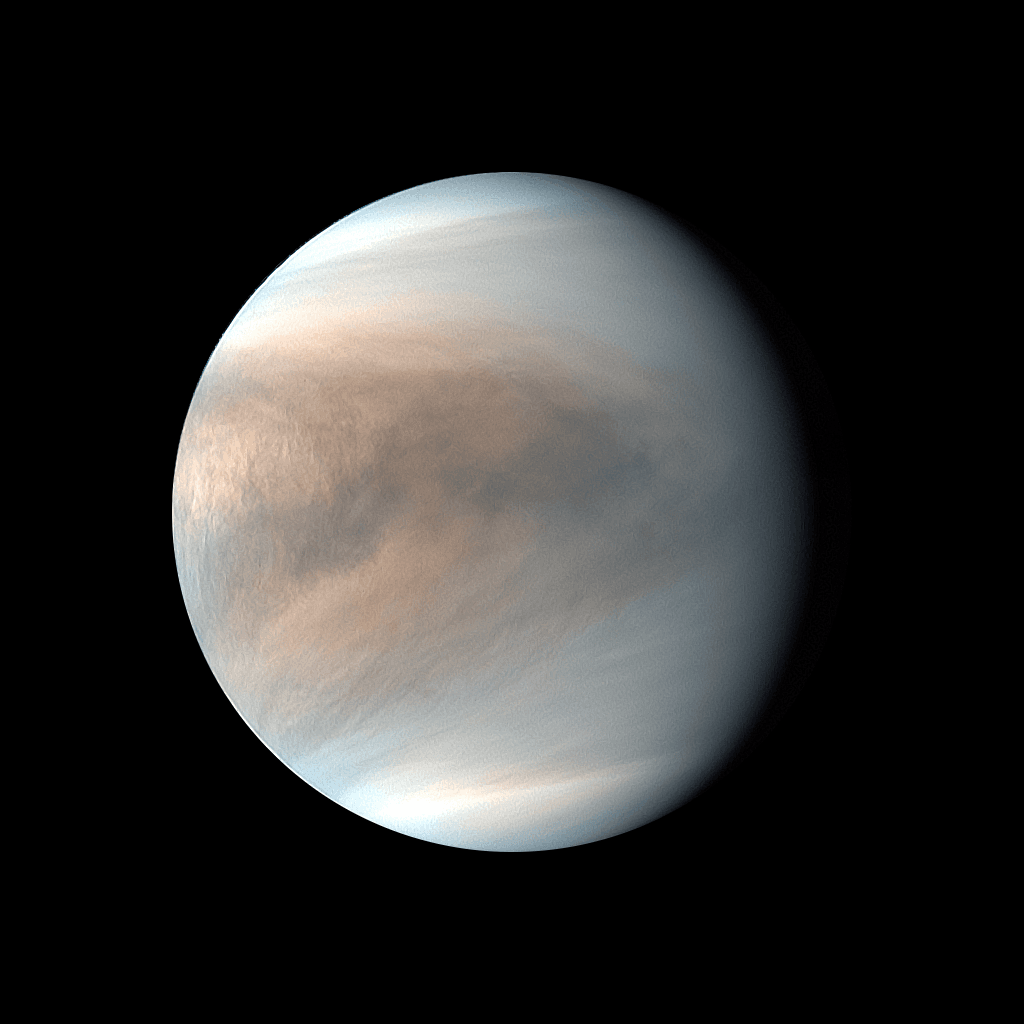
The surface is out of the question for life: David Clements of Imperial College London, who leads the phosphine follow-up, describes it as above 450 °C under nearly a hundred times Earth's sea-level pressure. The whole argument is about the clouds. Sanjay Limaye and colleagues put the lower cloud layer at 47.5 to 50.5 km, near 60 °C and one atmosphere, and Sara Seager's group describes the layers between 48 and 60 km as holding the main requirements for life: temperatures suited to covalent chemistry, sunlight for energy, and a liquid. The droplets are sulfuric acid, which laboratory teams model at 81 to 98 percent by weight, and on Earth, as Clara Sousa-Silva of the 2020 phosphine team pointed out, some microbes cope with up to about 5 percent acid.
The idea predates any knowledge of that acid. In September 1967 Harold Morowitz and Carl Sagan asked in Nature whether there could be life in the clouds, where water, carbon dioxide and sunlight seemed plentiful. They took the cloud tops to be ice crystals and the bottoms probably water droplets, and noted an ultraviolet darkening that pure ice could not explain. In 1973 Young asked in Icarus whether the clouds were sulfuric acid, and every side of today's debate treats the droplets that way. Venera 8 had already carried a small chemical test for ammonia down through the atmosphere in July 1972. It changed colour at two heights, and Mikhail Marov's account, quoted in Russian on the epizodsspace archive, says the reading was later traced to sulfuric acid, which turns the same indicator.
What keeps the question alive is a list of unexplained cloud features. William Bains, Janusz Petkowski, Paul Rimmer and Seager set several out in 2021: about 10 parts per million of oxygen in the cloud layers, large particles of unknown composition in the lower clouds, and vertical profiles of sulfur dioxide and water that models struggle to match. Another is the ultraviolet absorber, the unidentified substance that darkens the dayside clouds near 365 nm. Limaye's team argued in 2018 that particles in the lower clouds could hold enough mass to harbour microorganisms, potentially enough to be detected by optical methods. In June 2026 Polish and Czech researchers measured the spores of three acid-loving fungi and found absorption peaks between 243 and 323 nm that partly overlap the absorber's range. An August 2026 preprint by Mogul, Limaye and colleagues proposes a non-biological answer: aromatic hydrocarbons and iron compounds from altered cometary dust, which match the absorber's spectra. Each of these is a gap in the chemistry, and biology is one of several candidates for filling it.
Phosphine turned the speculation into headlines. On 14 September 2020 a team led by Jane Greaves of Cardiff University reported in Nature Astronomy a single absorption line at 266.94 GHz, the J=1-0 rotational line of phosphine (PH3), in spectra taken with the James Clerk Maxwell Telescope (JCMT) in Hawaii in June 2017 and with ALMA in Chile in March 2019, and from the JCMT spectrum inferred about 20 parts per billion. Phosphine is a reduced gas that should not persist in an oxidising atmosphere. On Earth, the Royal Astronomical Society's release said, it is made only industrially or by microbes living without oxygen; Jupiter and Saturn have it too, but there it forms deep in hot, high-pressure hydrogen atmospheres, chemistry the team's modeller did not expect on a rocky planet. William Bains led the team's search for other sources, from sunlight and lightning to volcanoes and meteorites, and found they could supply at most a ten-thousandth of the amount seen. The paper named unknown photochemistry or geochemistry as possible origins, or, by analogy with Earth, life. Greaves had expected only to rule out extreme scenarios, and called the first hints of the line a shock.
Hideo Sagawa of Kyoto Sangyo University, the team's atmospheric modeller, gave a cautious account. He told the Japanese edition of Nature Digest that he joined the international team only after the telescope observations were over, and that his radiative transfer model placed the absorbing gas at about 50 to 60 km or higher, at roughly 20 molecules in every billion. His own view, he said, was that chemical explanations should be tested and ruled out before life is discussed; the paper had ended by saying life could not be excluded, and to his surprise that was the phrase the press picked up. Going back through older infrared data from other telescopes, he found no phosphine line; he called the situation full of contradictions and said testing a result from many viewpoints is how science should proceed.
Within weeks other groups had the data open. A team led by T. Encrenaz, with Sagawa, Greaves and Sousa-Silva as co-authors, searched infrared spectra taken at NASA's Infrared Telescope Facility in March 2015 and set a 3-sigma upper limit of 5 ppb at the cloud top, four times below the millimetre value. Snellen and colleagues reprocessed the ALMA data with the published scripts and showed that the 12th-order polynomial used to flatten the spectrum could produce other strong lines out of noise; their own analysis left a feature of about 2 sigma. M. A. Thompson reached the same verdict on the JCMT spectrum with bootstrap statistics. Geronimo Villanueva's group pointed to a sulfur dioxide line only 1.3 km/s from the phosphine line, too close to separate at the resolution used. Trompet and colleagues searched solar occultation spectra from the SOIR instrument on Venus Express and reported upper limits almost two orders of magnitude below 20 ppb. In Moscow, IKI deputy director Oleg Korablev told RIA Novosti in January 2021 that his colleagues, having first allowed that phosphine might be present, ran a standard atmospheric model and were left with the impression that sulfur dioxide alone explained the data; he called the episode a good reason to explore Venus with more sensitive methods.
Then the ALMA data themselves changed. ALMA staff found an issue in the data used to confirm the detection, and on 17 November 2020 ESO added a note to its release saying they had been recalibrated and re-released. Greaves's team reprocessed them and still recovered the line, now at a planet-averaged 1 to 4 ppb with local peaks of 5 to 10 ppb, arguing that the higher JCMT figure could be reconciled if the gas varies over time; an April 2021 follow-up put the whole-planet ALMA signal at 5.4 sigma. In January 2021 Andrew Lincowski, Victoria Meadows and colleagues modelled the line and concluded that it forms above 80 km, where phosphine would be destroyed quickly, and that ordinary sulfur dioxide fits the JCMT feature. The discoverers answered with sulfur dioxide measurements taken at nearly the same time and put the contamination at about 10 percent of the JCMT line and about 2 percent of the ALMA line. Behind the chemistry sits a dispute about height. Sagawa's model placed the absorption near 50 to 60 km, Lincowski's above 80 km, and that choice decides whether the gas would be in the cloud layer where life is proposed or far above it.
An airborne observatory made a separate test. In November 2021 M. A. Cordiner and colleagues used three flights of SOFIA, a modified Boeing 747SP in service from 2014 to 2022, with the GREAT spectrometer tuned to phosphine lines near 533 and 1,067 GHz, higher in frequency than the line seen from the ground. They found no phosphine and set a disk-averaged upper limit of 0.8 ppb between 75 and 110 km, which they called more stringent than previous ground-based studies. Greaves's group then reprocessed the same spectra, bypassing calibration-load signals they judged non-essential, and reported in Geophysical Research Letters in 2023 a 5.7-sigma candidate suggesting about 3 ppb above the clouds. The instrument and the planet were the same, so the two results measure the effect of two processing choices on one data set. The discoverers also proposed a pattern: detections come from air moving from night into day, upper limits from air long in sunlight, as expected if sunlight destroys the gas.
If the gas is there, something has to keep making it. Truong and Lunine proposed in PNAS in 2021 that phosphides brought up by deep-mantle volcanism could supply it. Bains and colleagues replied that sustaining even 1 ppb this way would take at least 21,600 cubic kilometres of eruption a year, more than any historical rate on Earth, and a 2024 review by the claim team found that no gas reaction, surface or subsurface geochemistry, or photochemistry comes near the observed amount. The review names unknown geochemistry or photochemistry, which would mean the consensus on Venus's chemistry is significantly incomplete, and, as a more extreme possibility, an aerial biosphere. A finding of no known process marks the limits of today's models and laboratory data, and leaves unknown non-biological routes open.
Old spacecraft data were drawn in too. Within two weeks of the announcement, Rakesh Mogul, Limaye and colleagues reinterpreted mass spectra recorded at 51.3 km by the Pioneer Venus Large Probe in 1978 and assigned peaks to phosphine, hydrogen sulfide, nitrous and nitric acid and other species, with ammonia as a possible assignment. The claim team counts this as independent support. In 2025 the same group returned to the probe's data and concluded that its instruments had inadvertently swallowed cloud droplets, whose decomposition points to aerosols of roughly 20 percent ferric sulfate, 20 percent sulfuric acid and 60 percent water by weight. If that holds, the droplets are far wetter than the pure-acid picture assumes. It rests on one reinterpretation of instruments that were built to measure gases.
More data has been the discoverers' main answer. JCMT-Venus, the monitoring programme Clements leads with Greaves, was awarded 200 hours on the JCMT and uses a wider-band receiver called ʻŪʻū, which records phosphine, water (through HDO) and sulfur dioxide at once. Clements wrote that the first campaign alone, in February 2022, produced 140 times as much information as the discovery data, and that Venus is so bright at these wavelengths that reflections from the telescope and its dome create ripples larger than the absorption lines. With a Fourier method to remove them, the team recovered narrow phosphine and HDO lines, and an experimental technique revealed broad line wings that, in a preliminary analysis, imply about 0.3 parts per million near 55 km, a level he compared with the Pioneer Venus reanalysis. At the UK National Astronomy Meeting in July 2025 the team's slides concluded that phosphine was 'still found, but possibly variable in both time and across face of Venus', and asked whether there was tension with other limits. The same slides placed the narrow line high in the atmosphere, near 80 km, and looked for gas nearer the clouds in the pressure-broadened wings. By July 2026 four campaigns were complete and a fifth had been approved for that month. This page found no refereed JCMT-Venus phosphine paper by 4 November 2026, and Clements himself wrote that acceptance of the result is still far from universal.
The ammonia case began as a hypothesis: in December 2021 Bains, Petkowski, Rimmer and Seager proposed in PNAS that ammonia dissolving in some droplets would neutralise them into semi-solid salt slurries with a pH near 1, and that, if the source were biological, the most energy-efficient reaction for making ammonia would also release oxygen, accounting for the oxygen in the clouds. On 17 July 2024, at the National Astronomy Meeting in Hull, Greaves presented a tentative ammonia signal in Green Bank Telescope data, and Clements told CNN it was 'arguably more significant than the discovery of phosphine', because a microbe would have a reason to make it. Greaves cautioned that even both gases together would not show life without direct measurements. In July 2025 the Royal Astronomical Society quoted her saying the team's latest data had found more evidence of ammonia, and said papers were expected later that year; this page found no refereed ammonia paper by 4 November 2026. At IKI in Moscow, planetary physicist Dmitry Gorinov said in May 2025 that ammonia on Venus is extremely scarce or absent. A December 2025 Peking University laboratory study proposed a non-biological source: sunlit sulfur turning nitrate into ammonia in acid.
Even if one or both gases are real, a biology needs somewhere to live. In June 2021 John Hallsworth and colleagues computed water activity, a measure of how available water is to organisms, from observed temperatures and water vapour, and found 0.004 or less for the sulfuric acid droplets, two orders of magnitude below 0.585, the limit for known extremophiles. In 2024 Charles Cockell, Hallsworth and colleagues described the Venus cloud deck as temperate but incompatible with known life, and used it to separate habitability for known organisms from habitability for any possible life. Supporters of cloud life have two replies: ammonia could neutralise some droplets, and the 2025 Pioneer Venus reanalysis suggests the aerosols hold far more water than pure acid would. Both rest on models or on reinterpreted 1978 data.
The MIT-led group has asked what survives in the acid itself. In 2023 Seager, Petkowski and colleagues reported in PNAS that the five nucleic acid bases of DNA and RNA are stable across the cloud range of temperature and acid strength. In July 2024 the same group tested 20 dipeptides, pairs of amino acids joined by a peptide bond, found that most broke down within weeks, that none was stable at both 81 and 98 percent acid, and concluded that Venus life would likely need a substitute for the peptide bond. In March 2025 they reported that short chains of peptide nucleic acid (PNA), a candidate genetic-like polymer, lost between 0.4 and 28.6 percent in 14 days in 98 percent acid at about 25 °C. In September 2026 a PNAS paper by Jia Yi Zhang, Aurelio Dregni, Petkowski, Seager and Mei Hong reported, from NMR spectroscopy and structural modelling, that three peptides fold into omega-loop structures in concentrated acid, where scarce water spares the peptide bonds from hydrolysis; Petkowski's Wrocław university quoted him saying they stayed fully stable in 98 percent acid for at least two weeks. Martin Rahm of Chalmers University, who was not involved, told Eos he was 'less sure' the structures are omega loops, and Eos noted that the modelling software was not designed for sulfuric acid. Whether a molecule holds its shape is a separate question from whether the droplets can support life, and the water activity objection still applies.
The discoverers call for measurements from inside the clouds, and by early November 2026 no instrument built for the purpose had flown. One candidate is Rocket Lab's small entry probe carrying an autofluorescence nephelometer, the first of what Seager calls the Morning Star Missions; she told Space.com, in an article of 3 September 2026, that Rocket Lab had moved it to the Neutron rocket and the team was 'awaiting Neutron readiness' (see Venus Life Finder); on 14 October 2026 Rocket Lab put Neutron's first launch in 2027. In July 2025 Greaves's team presented VERVE, a mission concept for a CubeSat-sized probe budgeted at 50 million euros that would ride with ESA's EnVision and map phosphine and ammonia. In Moscow, Russian Academy of Sciences president Gennady Krasnikov told President Putin on 9 December 2025 that Venera-D would look for markers of life, and vice-president Sergey Chernyshev said in April 2026 that traces of ancient life, such as complex organic compounds, might be found by the mission planned for 2036. One chance has gone by: in 2021 the Max Planck Institute for Solar System Research expected the submillimetre instrument on ESA's JUICE to detect phosphine at concentrations a thousand times lower, but JUICE passed Venus on 31 August 2025 with its high-gain antenna as a sunshield, and ESA said its remote sensing instruments could not be active.
Three separate questions tend to be flattened into one headline. Is there a real absorption feature? Independent reanalyses found none that is statistically significant, the discoverers keep recovering one, and the answer depends on how the spectrum of a very bright planet is cleaned. Is it phosphine? The discoverers put sulfur dioxide's share at a tenth or less; Lincowski's team found ordinary sulfur dioxide enough to explain the line, and infrared and spacecraft limits above the clouds sit well below the millimetre claims, which the discoverers attribute to altitude, time of day and sunlight. Is it biological? Clements wrote in 2024 that the discovery papers were explicit that they did not constitute evidence for life, only of phosphine. In a July 2026 preprint chapter, Daliah Bibas and Clément Vidal set the phosphine claim beside the 1976 Viking life-detection experiments on Mars as two high-uncertainty claims, and argued that such claims need transparent routes to verification.
What we know
Status, 4 November 2026
No detection of life on Venus has been confirmed. Phosphine is still reported by the team that announced it in 2020, now monitoring Venus as JCMT-Venus: an abstract for the Europlanet Science Congress (The Hague, 7 to 11 September 2026) announced a talk on 'the re-detection of PH3' and its robustness. Searches of arXiv, Crossref and the news on 4 November 2026 found no refereed JCMT-Venus phosphine paper, and no new phosphine measurement from any team since September 2026.
Phosphine: the 2020 claim
Greaves et al., Nature Astronomy, announced 14 September 2020: a single absorption line at 266.94 GHz (the J=1-0 rotational line of phosphine, PH3) in JCMT spectra of June 2017 and ALMA spectra of March 2019; a model fitted to the JCMT spectrum gave about 20 ppb. The authors found no known abiotic route and named unknown photochemistry or geochemistry, or life, as possible sources.
Phosphine: the readings side by side
About 20 ppb (JCMT, 2020 paper); 7+ ppb (first ALMA processing); about 1 to 4 ppb planet average with local peaks of 5 to 10 ppb (recalibrated ALMA, claim authors, November 2020); under 0.8 ppb at 75 to 110 km (SOFIA, Cordiner et al.); about 3 ppb above the clouds (same SOFIA data reprocessed by the claim authors); about 0.3 ppm near 55 km (JCMT-Venus line wings, preliminary). The figures refer to different altitudes, dates and parts of the disc.
Phosphine: infrared and spacecraft limits
Infrared spectra from NASA's IRTF (March 2015) give a 3-sigma upper limit of 5 ppb at the cloud top, four times below the millimetre value (Encrenaz et al. 2020). Venus Express SOIR solar occultations give limits almost two orders of magnitude below 20 ppb, which the authors called the lowest known upper limits for Venus (Trompet et al. 2020).
Phosphine: the statistics dispute
Snellen et al. reproduced the ALMA reduction and found that the 12th-order polynomial used to flatten the spectrum could produce five other lines above 10 sigma within 60 km/s; their own analysis left a feature of about 2 sigma. M. A. Thompson's bootstrap reanalysis of the JCMT spectrum likewise found no significant line.
Phosphine: the sulfur dioxide dispute
A sulfur dioxide line at 266.943 GHz lies 1.3 km/s from the phosphine line (Villanueva et al., Nature Astronomy 2021). Lincowski et al. (2021) concluded the feature forms above 80 km and fits ordinary mesospheric SO2. The claim authors measured SO2 contamination at about 10 percent of the JCMT line and about 2 percent of the ALMA line (MNRAS 2022).
SOFIA search (November 2021)
Three flights of NASA's SOFIA airborne observatory in November 2021, with the GREAT spectrometer tuned to phosphine lines near 533 and 1,067 GHz. Cordiner et al. (GRL 2022) found no phosphine and set a disk-averaged upper limit of 0.8 ppb for 75 to 110 km, which they described as more stringent than previous ground-based studies.
SOFIA: same data, second reading
Greaves et al. (GRL 2023) bypassed calibration-load signals they judged non-essential and reported a 5.7-sigma candidate, about 3 ppb above the clouds. They proposed that sunlight destroys phosphine, so views of air moving from night into day show it and views of air long in sunlight do not.
Phosphine: non-biological sources tested
Truong and Lunine (PNAS 2021) proposed volcanically erupted phosphides. Bains et al. (Universe 2022) calculated that at least 21,600 cubic km of eruption per year would be needed for 1 ppb, more than any historical terrestrial rate. A 2024 review by the claim team found no gas, surface, subsurface or photochemical pathway sufficient.
Pioneer Venus Large Probe, reanalysed
Mogul et al. (2020 preprint, GRL 2021) assigned peaks in the 1978 Large Probe mass spectra at 51.3 km to phosphine and other reduced species, 'potentially ammonia' among them. Mogul et al. (JGR Planets 2025) argued the instruments swallowed cloud droplets and inferred aerosols of about 20 percent ferric sulfate, 20 percent sulfuric acid and 60 percent water by weight.
JCMT-Venus
Long-term monitoring led by David Clements (Imperial College London) with the ʻŪʻū receiver: 200 hours awarded, campaigns in February 2022, July 2023 and September 2023 (given as August to September 2023 in the team's 2026 abstract), and a fourth from 21 April to 1 May 2025. The first campaign alone gave 140 times the information of the discovery data; reflections from the telescope, its dome and the receiver cabin make ripples larger than the lines sought.
Ammonia: Venera 8 (1972)
The IAV-72 colour-change analyser read 0.01 to 0.1 percent ammonia at about 46 and 33 km (1973 Soviet yearbook text) or 44 to 32 km (Mikhail Marov's account, as quoted on epizodsspace). Marov attributes the reading to sulfuric acid, which also turns the indicator.
Ammonia: the 2021 hypothesis
Bains, Petkowski, Rimmer and Seager (PNAS, December 2021) proposed that ammonia dissolving in some droplets neutralises them into semi-solid salt slurries of pH about 1, and that, if the ammonia is biological, the most energy-efficient reaction making it would also release the oxygen seen in the clouds.
Ammonia: a non-biological route (2025)
Li et al. (Peking University, Nature Communications, published 5 December 2025) showed with experiments and quantum chemical calculations that elemental sulfur, under acidic and ultraviolet-lit conditions like those in the clouds, can reduce nitrate to ammonia, converting up to 20 percent of it within six hours. They proposed this as an abiotic source of ammonia in the 48 to 70 km cloud layer.
Ammonia: the 2024 signal, status 4 November 2026
The claim team announced a tentative ammonia detection at the National Astronomy Meeting in Hull in July 2024. In July 2025 the Royal Astronomical Society quoted Greaves ('Our latest data has found more evidence of ammonia') and said papers were expected later that year. This page found no refereed ammonia paper on arXiv or Crossref by 4 November 2026.
Life in the clouds: conditions
Lower cloud layer 47.5 to 50.5 km at about 60 °C and 1 atm (Limaye et al. 2018). Laboratory analogues use 81 to 98 percent sulfuric acid by weight, the range usually assumed for the droplets (Petkowski et al. 2024); a 2025 reanalysis of Pioneer Venus data argues for much wetter aerosols. Some Earth microbes cope with up to about 5 percent acid (Sousa-Silva, 2020).
Life in the clouds: water activity
Hallsworth et al. (Nature Astronomy, 28 June 2021) computed water activity of 0.004 or less for the sulfuric acid droplets, two orders of magnitude below the 0.585 limit for known extremophiles; by the same method the Martian atmosphere is slightly too dry (0.537 or less) and Jupiter's clouds are permissive on water activity alone.
Peptides and other molecules in sulfuric acid
Nucleic acid bases stable in cloud-range acid (PNAS 2023). Most of 20 dipeptides break down within weeks, none stable at both 81 and 98 percent (Scientific Reports 2024). Peptide nucleic acid hexamers lose 0.4 to 28.6 percent in 14 days at about 25 °C (Science Advances 2025). Three peptides reported to fold into stable omega loops in concentrated acid (PNAS, September 2026); an outside chemist told Eos he was less sure of the loop identification.
The ultraviolet absorber
An unidentified substance darkens the dayside clouds near 365 nm. Limaye et al. (2018) argued lower-cloud particles could hold enough mass to harbour microorganisms, potentially enough biomass to detect optically. Olewicz, Słowik and Kolařík (Scientific Reports, June 2026) found absorption peaks of acid-loving fungal spores at 243 to 323 nm that partly overlap the absorber's range. A preprint by Mogul, Zolotov, Way and Limaye (August 2026, under review) matches the absorber's spectra with aromatic hydrocarbons and iron compounds from altered cometary dust, a non-biological explanation.
Probes that could test it (4 November 2026)
Sara Seager says Rocket Lab's entry probe for the MIT-led Morning Star Missions waits for the Neutron rocket: 'we are awaiting Neutron readiness' (Space.com, 3 September 2026). On 14 October 2026 Rocket Lab said Neutron's inaugural launch 'is now expected to occur in 2027'; that update does not mention the Venus probe. VERVE, a CubeSat-sized probe budgeted at 50 million euros to ride with ESA's EnVision, was presented as a mission concept in July 2025.
Venera-D and markers of life
Russian Academy of Sciences president Gennady Krasnikov told President Putin on 9 December 2025 that the future Russian Venus mission would look for markers of life. Academy vice-president Sergey Chernyshev said in April 2026 that traces of ancient life, such as complex organic compounds, might be found by Venera-D in 2036; the ancient-life premise is a hypothesis.
What happened, and when
- Sep 1967Harold Morowitz and Carl Sagan ask in Nature whether life could exist in the clouds of Venus, then thought to be ice crystals above and water droplets below.
- 22 Jul 1972Venera 8 descends with the IAV-72 ammonia test, which changes colour in the lower atmosphere; the reading is later attributed to sulfuric acid.
- 1978The Pioneer Venus Large Probe's mass spectrometer and gas chromatograph sample the atmosphere during its descent; the mass spectra are reinterpreted in 2020, and both instruments' data in 2025.
- Jun 2017The James Clerk Maxwell Telescope on Maunakea records the 266.94 GHz spectrum later read as phosphine.
- Mar 2019ALMA in Chile records the same line.
- 14 Sep 2020Greaves et al. report about 20 ppb of phosphine in Nature Astronomy; the Royal Astronomical Society and ESO issue releases.
- Oct 2020Encrenaz et al. (infrared limit), Snellen et al. (ALMA statistics), Villanueva et al. (SO2) and Thompson (JCMT statistics) post a new infrared search and reanalyses, none finding significant phosphine.
- 17 Nov 2020ESO notes that ALMA staff found an issue in the data and recalibrated them; the claim team's reprocessing gives about 1 to 4 ppb planet-wide.
- 28 Jun 2021Hallsworth et al. publish water activity of 0.004 or less for the cloud droplets, under a title calling the clouds uninhabitable.
- Nov 2021SOFIA flies three times with the GREAT spectrometer. Cordiner's team finds no phosphine and sets an upper limit of 0.8 ppb at 75 to 110 km; the claim team later reported about 3 ppb from the same data.
- Dec 2021Bains, Petkowski, Rimmer and Seager publish the ammonia hypothesis in PNAS.
- Feb 2022JCMT-Venus observes its first monitoring campaign with the wide-band ʻŪʻū receiver.
- 17 Jul 2024At the National Astronomy Meeting in Hull, new JCMT phosphine recoveries and a tentative Green Bank Telescope ammonia signal are presented.
- 21 Apr to 1 May 2025JCMT-Venus observes its fourth campaign, coordinated with radio observations at Effelsberg and elsewhere.
- 9 Jul 2025Greaves's team presents VERVE, a concept for a 50 million euro probe to ride with ESA's EnVision, at the National Astronomy Meeting in Durham.
- 31 Aug 2025JUICE passes Venus using its high-gain antenna as a sunshield. ESA said its remote sensing instruments could not be active, so its submillimetre instrument did not look for phosphine.
- 5 Dec 2025A Peking University team reports in Nature Communications that sunlit sulfur can turn nitrate into ammonia in Venus-like acid, and proposes it as a non-biological source of the gas.
- 12 Aug 2026Mogul, Zolotov, Way and Limaye post a preprint proposing that aromatic hydrocarbons and iron compounds from altered cometary dust are the ultraviolet absorbers.
- Sep 2026PNAS publishes Zhang, Dregni, Petkowski, Seager and Hong, who report that three peptides fold into omega loops in concentrated sulfuric acid.
- 7 to 11 Sep 2026Europlanet Science Congress abstract: four JCMT-Venus campaigns complete, a fifth approved for July 2026, and a talk on the re-detection of phosphine.
- 14 Oct 2026Rocket Lab says Neutron's first launch is now expected in 2027. Seager has said the Morning Star entry probe waits for this rocket; Rocket Lab's update does not mention Venus.
In pictures
Tap a photo to enlarge.
Translated from the original sources
Passages from the Russian, Japanese, German and Polish sources this page draws on, in azmth's translation. Tap Show original to read the original wording.
Nature Digest
Japanese · 6 passages
Nature Digest (Japanese edition), interview with Hideo Sagawa, 'Kinsei taiki ni hosufin ka?' (Vol. 17 No. 12, 2020)
Open the source“In fact, I joined this international research team only after the telescope observations had finished.”
Hideo Sagawa, Kyoto Sangyo University
azmth's translation · Show originalHide original
Japanese: 実は、私がこの国際研究チームに加わったのは、望遠鏡での観測が終わってからのことです。
“Jupiter and Saturn are gas planets with atmospheres of hydrogen and helium and almost no oxygen. Phosphine is thought to be synthesised chemically in the hot, high-pressure deep atmosphere and carried to the upper layers by atmospheric circulation. On rocky Venus, by contrast, phosphine is not thought to be made by the same chemical reactions as on Saturn and Jupiter.”
Hideo Sagawa, Kyoto Sangyo University
azmth's translation · Show originalHide original
Japanese: 木星と土星は、水素とヘリウムからなる大気を持つガス惑星で、酸素はほとんどありません。ホスフィンは高温高圧の深部大気で化学合成され、大気循環によって上層部に運ばれていると考えられています。一方、岩石からなる金星では、土星や木星と同じ化学反応でホスフィンが作られることはないと思われます。
“And I established that radio waves around 1.123 mm wavelength come from around 50 to 60 km altitude in the Venus atmosphere. The sulfuric acid clouds lie in this altitude range, and phosphine is thought to be at this altitude or above it. My estimate also gave phosphine at about 20 in every billion molecules of the Venus atmosphere.”
azmth's translation · Show originalHide original
Japanese: そして、波長1.123mm前後の電波が、金星大気の高度50~60km周辺に由来することを突き止めました。この高度域には硫酸の雲が存在しており、ホスフィンも、この高度域かそれよりも上空に存在していると考えられます。また、試算により、ホスフィンが金星大気分子10億個のうち約20個を占めるとする結果も得ました。
“Personally, I think we should examine possibilities such as chemical synthesis, and discuss the existence of life only if those are ruled out.”
azmth's translation · Show originalHide original
Japanese: 私個人は、化学合成などの可能性を検討し、それらが否定された場合に生命存在について議論すべきではないかと考えています。
“The paper, too, discussed the possibility of chemical synthesis and wrote at the end that 'the possibility of life cannot be ruled out', but unexpectedly it was the 'possibility of life' part that was highlighted in the reporting.”
azmth's translation · Show originalHide original
Japanese: 論文でも、化学合成の可能性について言及し、最後に「生命存在の可能性も捨て切れない」と書いたのですが、思いがけず、「生命存在の可能性」の部分がクローズアップされて報道される事態となりました。
“I myself re-examined past Venus data from other infrared telescopes, but found no infrared absorption line of phosphine. I have to call the situation full of contradictions, but I think testing a result from many different viewpoints like this is the proper path of scientific research.”
azmth's translation · Show originalHide original
Japanese: 私自身も、他の赤外線望遠鏡による過去の金星データを見直したのですが、ホスフィンの赤外線の吸収線は見当たりませんでした。矛盾に満ちた状況と言わざるを得ませんが、このように多様な視点で検証していくのが科学研究の正しい道筋だと思っています。
Max-Planck-Gesellschaft, 'Kein Phosphin in Venuswolken'
German · 3 passages
Max-Planck-Gesellschaft, 'Kein Phosphin in Venuswolken' (16 July 2021)
Open the source“'For radio astronomy, Venus is a very bright and therefore difficult object,' says the Max Planck researcher (Paul Hartogh, co-author of the Villanueva reanalysis).”
azmth's translation · Show originalHide original
German: „„Für die Radioastronomie ist Venus ein sehr helles und somit schwieriges Objekt“, so der Max-Planck-Forscher.“
“The British researchers have meanwhile corrected their initial value of 20 parts of phosphine per billion (20 ppm) downwards, but hold to the detection of the gas.”
The bracketed 'ppm' is the release's own slip for ppb.
azmth's translation · Show originalHide original
German: „Die britischen Forscher haben ihren zunächst gefundenen Wert von 20 Teilen Phosphin pro Milliarden (20 ppm) in der Zwischenzeit nach unten korrigiert, halten am Fund des Gases aber fest.“
“As model calculations show, the JUICE instrument SWI (Submillimeter Wave Instrument), developed and built under the leadership of the Göttingen Max Planck Institute, will be able to detect phosphine concentrations a thousand times lower.”
azmth's translation · Show originalHide original
German: „Wie Modellrechnungen zeigen, wird das JUICE-Instrument SWI (Submillimeter Wave Instrument), das unter Leitung des Göttinger Max-Planck-Instituts entwickelt und gebaut wurde, in der Lage sein, tausendfach geringere Phosphinkonzentrationen zu detektieren.“
RIA Novosti, 'V RAN ob'yasnili obnaruzhenie priznakov zhizni na Venere'
Russian · 3 passages
RIA Novosti, 'V RAN ob'yasnili obnaruzhenie priznakov zhizni na Venere' (29 January 2021)
Open the source“Russian scientists who analysed foreign colleagues' data on the presence in the Venus atmosphere of a possible sign of life, phosphine, concluded that it had been confused with sulfur dioxide, IKI RAN deputy director Oleg Korablev told RIA Novosti.”
azmth's translation · Show originalHide original
Russian: «Российские ученые, проанализировавшие данные зарубежных коллег о наличии в атмосфере Венеры возможного признака жизни - фосфина, пришли к выводу, что его спутали с сернистым газом, рассказал РИА Новости заместитель директора Института космических исследований РАН Олег Кораблев.»
“'But then we more carefully put in a model of the atmosphere, its vertical profile, in line with the generally accepted picture of Venus, and on the whole we have a similar impression: that nothing besides sulfur dioxide is needed in this region to explain these data.'”
Oleg Korablev, IKI deputy director, January 2021; RIA's lead sentence renders this as a conclusion that phosphine was confused with sulfur dioxide.
azmth's translation · Show originalHide original
Russian: «"Но потом более внимательно подставили модель атмосферы, в соответствии с общепринятыми представлениями о Венере, вертикальный ее разрез, и, в общем, у нас сходное впечатление, что кроме диоксида серы в этом районе ничего не нужно для того, чтобы объяснить эти данные"»
“On the contrary, this is a very good example of why we need to keep exploring Venus and use more sensitive methods.”
Oleg Korablev, January 2021
azmth's translation · Show originalHide original
Russian: «Это, наоборот, очень хороший пример того, что надо нам исследовать Венеру дальше, использовать более чувствительные методы»
IKI RAN, 'Kto zhivet na Venere'
Russian · 1 passage
IKI RAN, 'Kto zhivet na Venere' (summary of Rossiya-24 'Vopros nauki', 4 October 2020)
Open the source“Phosphine is a biomarker; its presence in a planet's atmosphere indicates the presence of living beings.”
IKI's summary of a Rossiya-24 science programme with Ludmila Zasova, 4 October 2020; quoted here as an example of how the claim was framed.
azmth's translation · Show originalHide original
Russian: «Фосфин – биомаркер, его наличие в атмосфере планеты указывает на присутствие живых существ.»
IKI RAN, 'Venera Probe Is Back, Long Live Venus'
Russian · 1 passage
IKI RAN, 'Venera Probe Is Back, Long Live Venus' (11 May 2025, text in Russian)
Open the source“The presence on board [Venera 8] of an instrument to look for ammonia shows how poorly the composition of the Venus atmosphere was understood then. Ammonia is widespread in the Solar System, but on Venus in particular there is extremely little of it, or none at all.”
Dmitry Gorinov, IKI planetary physics department, May 2025
azmth's translation · Show originalHide original
Russian: «По наличию на борту прибора для поиска аммиака видно, насколько плохо тогда представляли и состав венерианской атмосферы. Аммиак распространён в Солнечной системе, но именно на Венере его крайне мало, или нет вовсе.»
epizodsspace, 'Venera-8'
Russian · 2 passages
epizodsspace, 'Venera-8' (archived 22 March 2025): 1973 Soviet yearbook text and an account by Mikhail Marov
Open the source“Although the ammonia test gave a positive result of 0.1% to 0.01% at altitudes from 44 to 32 km, this result, as it later turned out, was caused by sulfuric acid, which also reacted positively with the indicator used.”
Mikhail Marov's account, as quoted on the epizodsspace page
azmth's translation · Show originalHide original
Russian: «Хотя тест на аммиак дал положительный результат от 0,1 % до 0,01 % на высотах от 44 до 32 км, этот результат, как выяснилось в дальнейшем, был обусловлен серной кислотой, которая тоже давала положительную реакцию на использованный индикатор.»
“Measurements made at altitudes of about 46 and 33 km established that the volume content of ammonia lies within 0.01 to 0.1%.”
1973 Soviet yearbook text
azmth's translation · Show originalHide original
Russian: «В результате измерений, выполненных на высотах около 46 и 33 км, было установлено, что объемное содержание аммиака находится в пределах 0,01-0,1%.»
RIA Novosti, 'Glava RAN nazval tsel' rossiyskoy missii na Veneru'
Russian · 1 passage
RIA Novosti, 'Glava RAN nazval tsel' rossiyskoy missii na Veneru' (9 December 2025)
Open the source“The future Russian mission to Venus will look for markers of life on the planet, RAS president Gennady Krasnikov said at a meeting with Russian President Vladimir Putin (9 December 2025).”
azmth's translation · Show originalHide original
Russian: «Будущая российская миссия на Венеру будет искать маркеры жизни на этой планете, сообщил президент РАН Геннадий Красников на встрече с президентом РФ Владимиром Путиным.»
iXBT, Chernyshev on Venera-D and traces of life
Russian · 1 passage
iXBT, Chernyshev on Venera-D and traces of life (7 April 2026)
Open the source“Scientific data allow us to suppose that about 3 billion years ago there was water on the surface of Venus and life even had time to appear. That is not the case now, but some traces of that life, complex organic compounds, may be found.”
RAS vice-president Sergey Chernyshev, April 2026; a hypothesis, stated as such
azmth's translation · Show originalHide original
Russian: «Научные данные позволяют предположить, что примерно 3 млрд лет назад на поверхности Венеры была вода и даже успела появиться жизнь. В настоящее время этого нет, но могут быть обнаружены какие-то следы этой жизни, сложные органические соединения.»
Politechnika Wrocławska, 'Zagadka chmur Wenus. Czy kwas siarkowy może chronić budulce życia?'
Polish · 2 passages
Politechnika Wrocławska, 'Zagadka chmur Wenus. Czy kwas siarkowy może chronić budulce życia?' (2 September 2026)
Open the source“The research showed that the peptides are fully stable in 98% sulfuric acid for at least two weeks.”
Janusz Pętkowski, Wrocław University of Science and Technology
azmth's translation · Show originalHide original
Polish: „Badania wykazały, że peptydy wykazują pełną stabilność w 98% kwasie siarkowym przez co najmniej dwa tygodnie.”
“Paradoxically, the absence of water protects these molecules from the destructive action of hydronium ions, which in aqueous solutions lead to rapid hydrolysis.”
Janusz Pętkowski
azmth's translation · Show originalHide original
Polish: „Paradoksalnie brak wody chroni te cząsteczki przed destrukcyjnym działaniem jonów hydroniowych, które w roztworach wodnych prowadzą do szybkiej hydrolizy”
Sources
- Greaves et al., 'Phosphine Gas in the Cloud Decks of Venus', Nature Astronomy (2020), arXiv 2009.06593
- Royal Astronomical Society, 'Hints of life on Venus' (14 September 2020)
- ESO release eso2015, with the edit of 17 November 2020 on the ALMA recalibration
- Bains et al., 'Phosphine on Venus Cannot be Explained by Conventional Processes', Astrobiology (2021), arXiv 2009.06499
- Encrenaz et al., 'A stringent upper limit of the PH3 abundance at the cloud top of Venus', A&A (2020), arXiv 2010.07817
- Snellen et al., 'Re-analysis of the 267-GHz ALMA observations of Venus', A&A 644, L2 (2020), arXiv 2010.09761
- Villanueva et al., 'No evidence of phosphine in the atmosphere of Venus by independent analyses' (journal title: 'from independent analyses'), Nature Astronomy 5, 631 (2021), arXiv 2010.14305
- Thompson, 'The statistical reliability of 267 GHz JCMT observations of Venus', MNRAS (2021), arXiv 2010.15188
- Trompet et al., 'Phosphine in Venus' atmosphere: detection attempts and upper limits above the cloud top assessed from the SOIR/VEx spectra', A&A 645, L4 (2020)
- Greaves et al., 'Re-analysis of Phosphine in Venus' Clouds', Nature Astronomy 5, 636 (2021), arXiv 2011.08176
- Greaves et al., 'Recovery of Spectra of Phosphine in Venus' Clouds', arXiv 2104.09285
- Lincowski et al., 'Claimed detection of PH3 in the clouds of Venus is consistent with mesospheric SO2', ApJL 908, L44 (2021), arXiv 2101.09837
- Greaves et al., 'Low levels of sulphur dioxide contamination of Venusian phosphine spectra', MNRAS (2022), arXiv 2108.08393
- Cordiner et al., 'Phosphine in the Venusian Atmosphere: A Strict Upper Limit from SOFIA GREAT Observations', GRL (2022), arXiv 2210.13519
- Greaves et al., 'Recovering Phosphine in Venus' Atmosphere from SOFIA Observations', GRL 50, e2023GL103539 (2023), arXiv 2211.09852
- NASA Science, SOFIA mission page (dates 2014 to 2022)
- Truong and Lunine, 'Volcanically extruded phosphides as an abiotic source of Venusian phosphine', PNAS 118 (2021)
- Bains et al., 'Constraints on the production of phosphine by Venusian volcanoes', Universe 8, 54 (2022), arXiv 2112.00140
- Bains et al., 'Source of phosphine on Venus: an unsolved problem', Frontiers in Astronomy and Space Sciences 11 (2024)
- Mogul et al., 'Venus' Mass Spectra Show Signs of Disequilibria in the Middle Clouds', GRL (2021), arXiv 2009.12758
- Mogul et al., 'Re-Analysis of Pioneer Venus Data: Water, Iron Sulfate, and Sulfuric Acid are Major Components in Venus' Aerosols', JGR Planets 130 (2025)
- Clements, 'Venus Phosphine: Updates and lessons learned', Proceedings IAU Symposium 387, arXiv 2409.13438
- Clements, Greaves, Tang and the JCMT-Venus team, 'Phosphine in Venus' Clouds', slides, National Astronomy Meeting 2025, Durham
- Tang et al., 'JCMT-Venus: Long-term Monitoring of Chemical Variability in Venus' Upper Mesosphere', EPSC2026-1119 (updated 2 July 2026)
- Bains, Petkowski, Rimmer and Seager, 'Production of Ammonia Makes Venusian Clouds Habitable and Explains Observed Cloud-Level Chemical Anomalies', PNAS 118 (52), 2021, arXiv 2112.10850
- Li et al., 'Photoactive elemental sulfur allotropes promote extensive ammonia synthesis in Venus-like atmosphere', Nature Communications 17, 287 (published 5 December 2025)
- CNN, 'The discovery of a possible sign of life in Venus' clouds sparked controversy. Now, scientists say they have more proof' (29 July 2024)
- Royal Astronomical Society, 'Life on Venus? UK probe could reveal the answer' (9 July 2025)
- Morowitz and Sagan, 'Life in the Clouds of Venus?', Nature 215, 1259 (1967)
- Young, 'Are the clouds of Venus sulfuric acid?', Icarus 18, 564 (1973), DOI record
- Limaye et al., 'Venus' Spectral Signatures and the Potential for Life in the Clouds', Astrobiology 18, 1181 (2018), Europe PMC
- Hallsworth et al., 'Water activity in Venus's uninhabitable clouds and other planetary atmospheres', Nature Astronomy 5, 665 (2021)
- Cockell, Hallsworth et al., 'The Concept of Life on Venus Informs the Concept of Habitability', Astrobiology 24, 628 (2024)
- Seager et al., 'Stability of nucleic acid bases in concentrated sulfuric acid', PNAS 120 (2023)
- Petkowski et al., 'General instability of dipeptides in concentrated sulfuric acid as relevant for the Venus cloud habitability', Scientific Reports 14 (2024)
- Petkowski et al., 'Astrobiological implications of the stability and reactivity of peptide nucleic acid (PNA) in concentrated sulfuric acid', Science Advances 11 (2025)
- Zhang, Dregni, Petkowski, Seager and Hong, 'Peptides adopt stable omega-loop structures in concentrated sulfuric acid', PNAS 123 (2026)
- Eos, 'Venusian Sulfur Clouds Might Not Be So Inhospitable After All' (18 September 2026)
- Olewicz, Słowik and Kolařík, 'Acidophilic fungi as possible candidates for living forms in the Venus clouds', Scientific Reports 16 (2026)
- Mogul, Zolotov, Way and Limaye, 'Altered Cosmic Organics as Venus' Ultraviolet Absorbers', arXiv 2608.11696 (12 August 2026, under review)
- Space.com, 'Rocket issues delay 1st-ever private mission to Venus' (3 September 2026)
- Rocket Lab, 'Rocket Lab Provides Update on Neutron Development and Adjusts Target Launch Timing' (14 October 2026), SEC filing exhibit 99.1
- SSC Space, 'Juice's Venus: assisting a successful flyby' (5 September 2025)
- Bibas and Vidal, 'Managing Uncertainty in Life Detection: Venus and Mars Claims Compared', arXiv 2607.17217 (July 2026)
- Nature Digest (Japanese edition), interview with Hideo Sagawa, 'Kinsei taiki ni hosufin ka?' (Vol. 17 No. 12, 2020) · in Japanese
- Max-Planck-Gesellschaft, 'Kein Phosphin in Venuswolken' (16 July 2021) · in German
- RIA Novosti, 'V RAN ob'yasnili obnaruzhenie priznakov zhizni na Venere' (29 January 2021) · in Russian
- IKI RAN, 'Kto zhivet na Venere' (summary of Rossiya-24 'Vopros nauki', 4 October 2020) · in Russian
- IKI RAN, 'Venera Probe Is Back, Long Live Venus' (11 May 2025, text in Russian)
- RIA Novosti, 'Glava RAN nazval tsel' rossiyskoy missii na Veneru' (9 December 2025) · in Russian
- iXBT, Chernyshev on Venera-D and traces of life (7 April 2026) · in Russian
- Politechnika Wrocławska, 'Zagadka chmur Wenus. Czy kwas siarkowy może chronić budulce życia?' (2 September 2026) · in Polish
- epizodsspace, 'Venera-8' (archived 22 March 2025): 1973 Soviet yearbook text and an account by Mikhail Marov · in Russian
- ESA, 'Juice team resolves anomaly on approach to Venus' (25 August 2025, updated 1 September 2025)
Checked on 4 November 2026. Where the science is unsettled this page says so rather than picking a winner.
azmth is independent and is not affiliated with or endorsed by NASA, Roscosmos, NPO Lavochkin, ESA, JAXA, ISRO, CNSA, or any other space agency or company named on this page.