Pioneer Venus Multiprobe
NASA Ames · United States · Atmospheric probe · 1978 · The surface years Success
Ended on arrival, 9 December 1978. All four probes sent data down to the surface, and the Day Probe kept transmitting from the ground for 67 minutes. The carrier bus burned up high in the atmosphere.
TL;DR· 16 min read
NASA's Pioneer Venus Multiprobe, launched on 8 August 1978, released one large and three small probes that plunged into Venus on 9 December 1978 at four sites far apart, two in daylight and two at night. All four radioed data down to the surface, the Day Probe kept transmitting for 67 minutes after impact, and the carrier bus burned up about 110 km above the ground. They found a deep atmosphere almost equally hot at all four sites, layered clouds of sulfuric acid, steady westward winds and far more primordial argon than Earth has.
What did the Pioneer Venus probes discover about Venus?
NASA's Pioneer Venus Multiprobe dropped four probes into Venus on 9 December 1978, and they found the deep atmosphere almost equally hot by day and night and from the equator to the far north, under layered clouds of sulfuric acid and steady westward winds. They also found far more primordial argon (gas left from the birth of the planets) than Earth has, and a cloud droplet caught in one instrument gave a ratio of heavy to ordinary hydrogen about 100 times Earth's, read as a sign that Venus lost water. A carrier bus had released the probes weeks earlier, and they radioed measurements all the way to the ground from four widely separated points. None was built to survive landing, yet the Day Probe kept transmitting from the surface for 67 minutes, while the bus burned up about 110 km above the ground. It flew as the partner of Pioneer Venus Orbiter.
Facts as of 5 November 2026, from the sources listed below.
- 67:37 min:sDay Probe transmitting from the surface after an impact it was not designed to survive
- 97 minutesfrom the Large Probe's entry at 18:45:32 UT to the bus falling silent at 20:22:55 UT on 9 December 1978 (SP-461 gives 1 hr 38 min)
- 12.5 kmheight below which external sensors on all four probes failed; traced in the 1990s to failing wire insulation
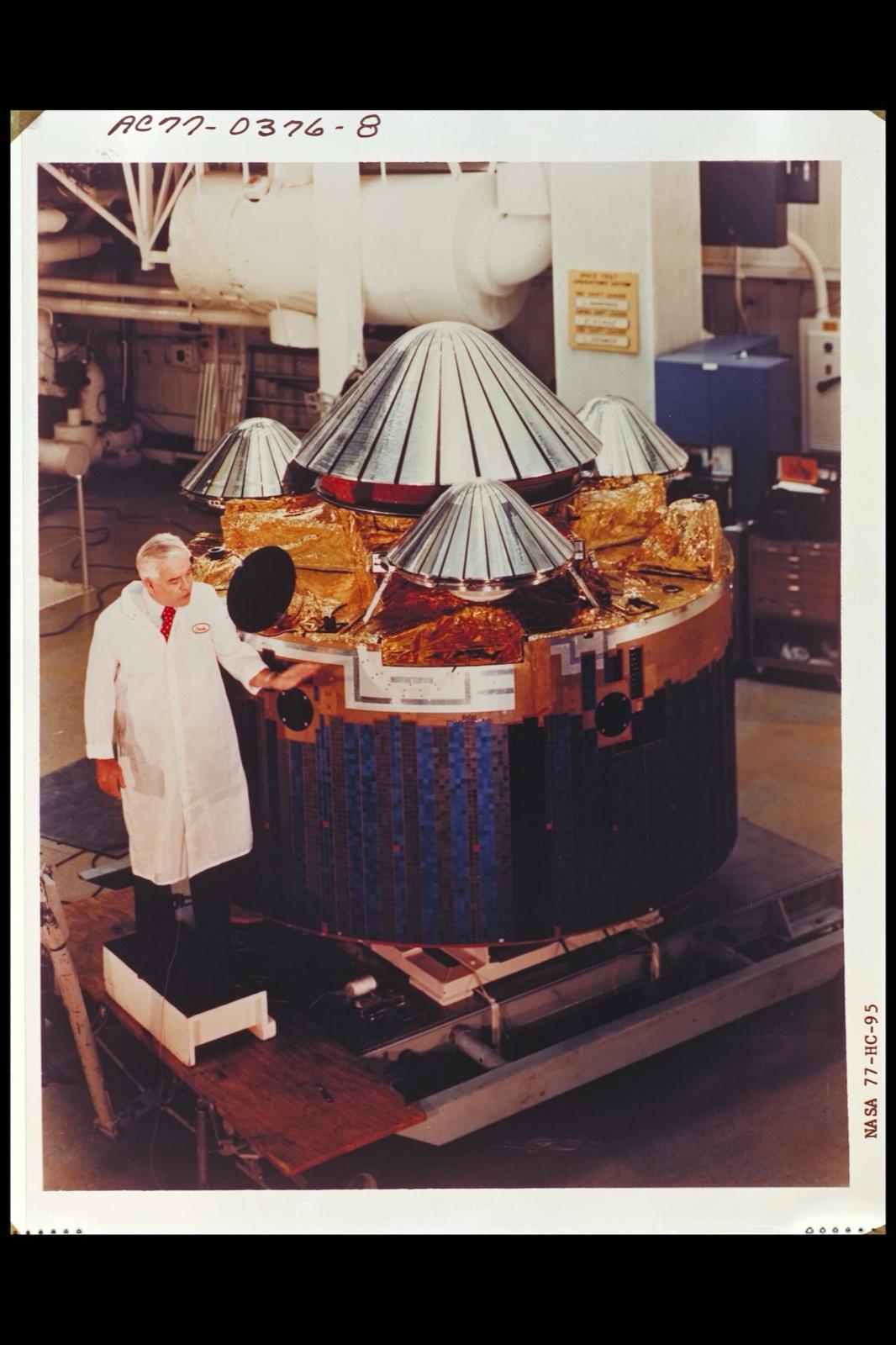
On the morning of 9 December 1978, California time, a 1.5 m ball of titanium and heat shield falling toward Venus switched on its radio (10:29 in the project's table of entry events; 10:24 in the narrative of NASA's 1983 history, SP-461). Within minutes the Goldstone and Canberra stations had locked on to three smaller probes too. NASA's Pioneer Venus Multiprobe had split into five spacecraft: the Large Probe, the North, Day and Night small probes, and the bus that had carried them from Earth. Between 18:45 and 20:22 UT all five entered the atmosphere. Nothing had been built to survive the landing, yet the Day Probe kept transmitting from the surface for 67 minutes 37 seconds.
Planning began with questions a single capsule could not answer. Soviet Venera probes had measured the basic properties of the lower atmosphere, but a National Academy of Sciences study found many problems those flights had not addressed. In 1970 a group of scientists wrote Venus: Strategy for Exploration, the Purple Book, proposing low-cost spacecraft and two multiprobe missions for 1975; a Science Steering Group later listed 24 key questions, 23 of which NASA's 2018 retrospective counts as addressed. Money set the dates. SP-461 tells the August 1972 cut to two flights twice, once with the Multiprobe still due in 1977 and once with both launches slipped to 1978 because Congress had not authorised a fiscal 1974 start. In June 1975 the House voted to cut 48 million dollars tied to the mission; scientists and the national press rallied, and the money was restored.
The carrier bus was a drum 2.5 m across spinning at about 48 rpm, with the Large Probe on top and the three small probes around it. NSSDCA gives the launch mass as 875 kg, of which 290 kg was the bus itself; other NASA figures differ. The bus had no heat shield or parachute. Its own science came from a neutral mass spectrometer led by U. von Zahn of the University of Bonn and an ion mass spectrometer led by H. Taylor.
Also called the Sounder, the Large Probe was 1.5 m across and weighed about 315 kg. Inside its heat shield sat a nitrogen-filled titanium sphere 73.2 cm across. It carried seven experiments, and its infrared radiometer looked out through a 13.5-carat diamond window. The three small probes were identical: 0.8 m across, about 90 kg each, a xenon-filled titanium sphere (xenon conducts only about a fifth as much heat as air) fixed inside a 45-degree cone, with no parachute. Each carried Seiff's atmospheric structure sensors, a nephelometer and Suomi's net flux radiometer. Five minutes before entry, weighted cables unwound to slow each probe's spin from 48 to 15 rpm (17 rpm in another SP-461 chapter), so that the air could swing the cone into line with its flight path.
Launched on 8 August 1978, the Multiprobe reached Venus five days after its partner orbiter, and splitting it was the delicate part. The probes could not take commands, so each timer had to be loaded beforehand with the seconds until the probe should wake. When the bus was turned for the Large Probe's release, tracking showed velocity changes nobody could account for. Project manager Charles Hall held the release, scheduled for 6 p.m. on 15 November, and recalled about 12 hours of work in an all-night session; the team chose a timer setting that straddled the uncertainty, and navigators later traced the likely cause to sunlight pressing on the spacecraft from an unfamiliar angle. NSSDCA times the release at 02:37:13 UT on 16 November, 6:37 p.m. on 15 November in California, so sources print both dates; none of the sources read here reconciles that time with Hall's account of the hold. The small probes followed on 20 November, freed within about a millisecond of one another.
First in, the Large Probe crossed 200 km at 18:45:32 UT (spacecraft time) at about 41,800 km/h, near the equator on the day side, where it was early morning. A parachute opened and the heat shield fell away near 67 km. At 19:03:28, near 45 km, the probe cast off its parachute deliberately, since a slower fall would have overheated it before it reached the deep atmosphere. It then sank like a metal ball in the sea and struck the ground at about 32 km/h at 19:39:53, at 4.4 N, 304.0 E. The signal stopped at impact, as planned.
Next came the North Probe, on a steep path of about 68.6 degrees below the horizontal, reconstructed from its accelerometers. It entered on the night side at 18:49:40 UT, where it was 3:35 in the morning, and reached the surface at 59.3 N, 4.8 E at 19:42:40. At 60 km it measured temperatures 25 K colder than the lower-latitude sites, and it fell silent at impact.
Over the southern hemisphere, where it was 6:46 in the morning, the Day Probe entered at 18:52:18 UT and hit the ground at 31.3 S, 317.0 E at 19:47:59, at about 8 m/s according to its atmospheric structure tables (SP-461 gives 36 km/h, about 10 m/s, for all three small probes). Then it kept talking. Its nephelometer saw the impact raise a dust cloud, of particles 10 to 100 micrometres across by Ragent and Blamont's estimate, that took several minutes to settle. Inside, the temperature climbed to 126 °C while the pressure rose only as a sealed bottle warming up would, with no sign that Venus air had leaked in. After 67 minutes 37 seconds by the project's table the signal stopped; SP-461 says the battery ran down, and NASA's mission page adds the heat and pressure.
Near local midnight the Night Probe entered at 18:56:13 UT and landed at 28.7 S, 56.7 E at 19:52:05, then transmitted for 2 seconds more. NASA's 2018 anniversary article says it likely tipped over; the mission reports read for this page do not establish why it stopped. The two night-side probes also saw a thin particle layer near 6 km altitude, which the 1995 anomaly review said had not been explained, and a faint glow in the lower atmosphere whose source the 1980 nephelometer paper called 'as yet uncertain'.
A Soviet yearbook noted in 1979 that the day-side small probe worked on the surface for 67 minutes although none had been designed to, and a yearbook for 1980, reproduced by the Russian archive site Episodes of Cosmonautics, reported that the two night-side probes registered a glow from 13 km, growing toward the surface, that might come from sulfur 'fires' at or near the ground. The 1995 workshop report explained light seen below 15 km as thermal emission from the hot atmosphere leaking through the detector filters, with no unusual variations pointing to burning, but it credits that signal to the two dayside probes, so the two accounts may describe different signals.
Last of the five, the bus crossed 200 km at 20:21:52 UT and fell silent at 20:22:55, about 110 km up; NASA's mission page says 120 km, and SP-461's narrative gives 115 km as the design level. In that minute it sampled air the probes had crossed too fast to measure. Von Zahn's team reported helium nearly as abundant as carbon dioxide at 150 km and an exospheric temperature of 285 K. On argon the bus results disagree in print: the February 1979 paper gave argon-36 and argon-40 at roughly 80 parts per million each at 135 km, while SP-461 says the instrument could not detect argon at 130 km, which by extrapolation would mean less than 10 ppm in the lower atmosphere.
Deep in the atmosphere all four probes ran into the same trouble at the same height. From about 12 or 13 km above the surface, the external temperature sensors on every probe gave false readings and the small probes reported their deployed booms as stowed, which was mechanically impossible. After a workshop at Ames in September 1993 pointed at the external wiring, tests at Hughes found an unqualified material: Kynar shrink tubing over harness joints decomposed above about 600 K, and insulation resistance collapsed for two or three minutes before partly recovering, much as the Venus data had done. The 1995 report says all the anomalies appear to be explained, while adding that more research is needed to document the processes.
Below about 45 km, four sites thousands of kilometres apart differed by only a few kelvin. The clouds came in three layers above about 49 km; concentrated sulfuric acid made up most of the particles, though the largest ones in the lowest layer defied identification. Tomasko's radiometer measured about 15 watts per square metre absorbed at the ground at the Large Probe's site, implying that about 2 percent of the sunlight reaching Venus is absorbed at the surface. The probes drifted within a few degrees of due west above the lowest few kilometres, in winds of about 100 m/s near 65 km and 1 m/s or less near the ground. A preliminary report in July 1979, from the Day and North probes, gave more than 200 m/s in the densest middle cloud layer, a figure absent from the summary of the 1980 four-probe analysis. More is on the atmosphere of Venus.
Noble gases brought a surprise. Hoffman's mass spectrometer found about 40 ppm of argon-36 and 50 ppm of argon-40, uncertain by roughly a factor of two. On Earth the radiogenic argon-40 dominates; on Venus the two came out about equal, which SP-461 translates into about 75 times as much primordial argon-36 as in Earth's atmosphere. The Soviet landers of Venera 11 and 12, arriving that same month, found the same pattern, undermining models in which Venus, Earth and Mars drew their gases from one common stock. Some early numbers did not last: in 1980 Oyama's team reported two misidentified gas chromatograph peaks, revised argon to 67 ppm and carbon monoxide to 20 ppm, and said no estimate for oxygen could yet be made.
A droplet produced a result still debated. As the Large Probe passed through the dense cloud layer, its mass spectrometer inlet clogged with what looked like liquid, and gases from the evaporating droplet showed up once the probe descended into hotter air. Donahue, Hoffman and colleagues used those readings in 1982 to measure the ratio of deuterium to hydrogen at (1.6 ± 0.2) × 10⁻², a hundredfold enrichment over Earth's, and argued that Venus had outgassed at least 0.3 percent of an Earth ocean, and perhaps far more. In 1987 Grinspoon proposed that a steady supply of hydrogen, most likely from comets, could explain the same ratio with no early excess of water. How wet young Venus was remains open, followed on oceans and the greenhouse.
Nearly half a century on, the data are being read again. In 2024 and 2025 NASA's Planetary Data System restored the descent tables and the interferometry wind data from old NSSDCA tapes. Rakesh Mogul and colleagues have re-read the Large Probe's mass spectra: a 2021 paper assigned trace species at 51.3 km including phosphine, with some assignments described as potential or tentative (see life on Venus); a 2025 paper argued the instruments had inadvertently swallowed cloud droplets, implying aerosols rich in water and iron sulfate; and a November 2025 paper found nitrogen unevenly mixed, about 5.2 percent by volume in the clouds against 2.5 percent below 15 km.
The hardware's resting places come from the 1978 trajectory reconstructions. A study in the March 2026 issue of Geoarchaeology took the Day Probe as its case study and argued that titanium, ceramic and aluminium parts are likely to have survived, oxidised and perhaps deformed, while beryllium, Kapton and silicone parts have probably degraded. The full list of what reached the planet is on what we left at Venus.
Mission facts
Organisations
NASA (Ames Research Center; spacecraft built by Hughes Aircraft Company)
Designations
Pioneer Venus Multiprobe, also Pioneer Venus 2 and Pioneer 13. COSPAR IDs: bus 1978-078A, Large Probe 1978-078D, North Probe 1978-078E, Night Probe 1978-078F, Day Probe 1978-078G.
Managed and built by
NASA Ames Research Center (project manager Charles F. Hall); spacecraft built by Hughes Aircraft Company in El Segundo, California. NSSDCA lists Lawrence Colin as project scientist.
Launch
8 August 1978 at 07:33 UT on Atlas-Centaur AC-51 (Atlas no. 5031D) from Launch Complex 36A, Cape Canaveral.
Launch mass (two readings)
875 kg in the NSSDCA description (585 kg of probes, 32 kg of hydrazine, 290 kg of bus); 904 kg on NASA's mission page. The NSSDCA summary box gives the bus alone as 380 kg.
Bus
2.5 m cylinder, 2.9 m tall with probes attached, spin-stabilised at about 48 rpm, no heat shield or parachute. Carried a neutral mass spectrometer and an ion mass spectrometer (principal investigators U. von Zahn of the University of Bonn and H. Taylor, per SP-461).
Large Probe
1.5 m across; 315 kg (NSSDCA text), 316.5 kg (NASA mission page) or 300 kg (NSSDCA summary box). Titanium pressure vessel 73.2 cm across (NSSDCA project page, SP-461), nitrogen-filled, seven experiments, parachute. NSSDCA counts 14 pressure-vessel penetrations; SP-461 gives 14 in one chapter and 19 in another.
Small probes (North, Day, Night)
Identical, 0.8 m across (76 cm on NASA's mission page), 90 kg (NSSDCA text) or 75 kg (summary box), xenon-filled titanium sphere in a fixed 45-degree cone, no parachute. Each carried atmospheric structure sensors, a nephelometer and a net flux radiometer.
Diamond window (Large Probe)
The infrared radiometer's window was a 13.5-carat diamond about 1.9 cm across, cut in the Netherlands from a 205-carat industrial rough diamond from South Africa.
Releases
Large Probe 02:37:13 UT on 16 November 1978 (15 November in California); small probes 13:06:29 UT on 20 November (NSSDCA). The PDS summary prints 15 and 19 November. Release distances about 11.1 and 9.3 million km (NASA mission page).
Entry (all four probes)
About 41,800 to 42,000 km/h at entry (SP-461); 11.58 to 11.60 km/s near 120 to 137 km in the PDS entry tables. Reconstructed flight path angles at entry: Day Probe 24.6, Night Probe 41.1, North Probe 68.6 degrees below horizontal. SP-461 gives small-probe peak decelerations of about 223 g on the shallowest entry to 458 g on the steepest.
Entry to impact (spacecraft time, 9 Dec 1978)
Large 18:45:32 to 19:39:53 (54 min 21 s); North 18:49:40 to 19:42:40 (53 min 00 s); Day 18:52:18 to 19:47:59 (55 min 41 s); Night 18:56:13 to 19:52:05 (55 min 52 s). NSSDCA gives the Large Probe impact as 19:39:55.
Large Probe parachute
Deployed about 18:46:21 UT, heat shield off near 67 km, parachute jettisoned at 19:03:28 UT near 45 km after 17 min 07 s. The PDS description gives 45.4 km at 19:06.3 ground-received time.
Surface transmission
Day Probe 67 min 37 s after impact (SP-461 table; the printed times 19:47:59 and 20:55:34 give 67 min 35 s); Night Probe 2 s; Large and North probes none.
Bus entry and burn-up
Crossed 200 km at 20:21:52 UT over 37.9 S, 290.9 E; signal lost at 20:22:55 UT at about 110 km (NSSDCA, PDS). NASA's mission page says 120 km; SP-461's narrative gives 115 km as the design level.
Surface readings at touchdown (PDS tables)
Large 92.2 bar; Day 92.7 bar (0.10 km below the Large Probe site); Night 95.8 bar (0.65 km below); North 86.6 bar (0.98 km above). The small-probe tables mark temperatures below 12.4 km (Day, North) and 14.4 km (Night) as extrapolated; the Large Probe table notes its sensor breakdown at 13.1 km.
Winds
About 1 m/s or less near the surface and about 100 m/s near 65 km at all four sites, directed within a few degrees of due west except within a few km of the surface; equatorward flow of 1 to 7 m/s between 50 and 55 km (Counselman and colleagues, 1980).
Argon and deuterium
Argon-36 about 40 ppm and argon-40 about 50 ppm, uncertain by about a factor of two (Hoffman and colleagues, 1979). D/H (1.6 ± 0.2) × 10⁻², about 100 times Earth's (Donahue and colleagues, 1982).
12.5 km anomaly
External sensors on all four probes failed starting between 12 and 13 km. Traced after a 1993 workshop to insulation breakdown in the external harness, where Kynar shrink tubing decomposed above about 600 K (NASA CP-3303, 1995).
Site: 4.4°N, 304°E · Large Probe, day side near the equator · position estimated (source)
Mission timeline
- 1970Space Science Board and Lunar and Planetary Missions Board scientists publish Venus: Strategy for Exploration (the Purple Book), recommending multiprobe missions for 1975.
- Aug 1972NASA restricts the programme to two flights. SP-461 tells it twice: once with the Multiprobe still due in 1977, once with both launches slipped to the 1978 window because Congress had not authorised a fiscal 1974 start.
- Feb to Nov 1974Hughes Aircraft is selected in February; Congress approves a new start for fiscal 1975 in August; the full hardware contract follows in November.
- Jun 1975The House votes to cut 48 million dollars tied to the Venus mission; after lobbying by scientists and the press the funds are restored.
- 8 Aug 1978Launch at 07:33 UT on Atlas-Centaur AC-51 from Cape Canaveral, 80 days after Pioneer Venus Orbiter.
- 16 Aug 1978Course correction adds 2.25 m/s; without it the spacecraft would have missed Venus by about 14,000 km.
- 16 Nov 1978Large Probe released at 02:37:13 UT (15 November in California), after the release was held over unexplained tracking data.
- 20 Nov 1978North, Day and Night probes released together at 13:06:29 UT; the bus then slows slightly to arrive after them.
- 9 Dec 1978, 18:45 to 18:56 UTThe four probes enter the atmosphere at 200 km, Large Probe first; all instruments on all probes report working.
- 9 Dec 1978, 19:03 UTLarge Probe jettisons its parachute near 45 km and free-falls the rest of the way.
- 9 Dec 1978, 19:39 to 19:52 UTImpacts: Large 19:39:53, North 19:42:40, Day 19:47:59, Night 19:52:05. The Night Probe transmits 2 more seconds.
- 9 Dec 1978, 20:21 to 20:22 UTThe bus enters at 200 km over 37.9 S, 290.9 E and burns up, signal lost near 110 km.
- 9 Dec 1978, 20:55 UTThe Day Probe's signal ends at 20:55:34 UT, 67 minutes 35 seconds after the printed impact time; the project's table gives 67 minutes 37 seconds on the surface.
- 21 and 25 Dec 1978The Soviet Venera 12 and 11 landers reach the surface, giving a second set of measurements the same month.
- 23 Feb 1979Science publishes an initial collection of Pioneer Venus results, including the argon excess and the four temperature profiles.
- 7 May 1982Donahue and colleagues report a deuterium to hydrogen ratio about 100 times Earth's in Science, under the title Venus was wet.
- 28 to 29 Sep 1993Ames workshop on the 12.5 km anomaly; later tests trace it to failing insulation on the probes' external harness.
- 2024 to 2025The Planetary Data System restores the descent and wind data from NSSDCA tapes; separately, Mogul and colleagues publish further re-analyses of the Large Probe mass spectra in September and November 2025.
A filled dot marks something that physically happened. A hollow one marks an announcement, a naming or a target.
In pictures
Tap a photo to enlarge.
Sources
- NSSDCA Master Catalog: Pioneer Venus Probe Bus (1978-078A)
- NSSDCA Master Catalog: Pioneer Venus Large Probe (1978-078D)
- NSSDCA Master Catalog: Pioneer Venus Small Probe (North) (1978-078E)
- NSSDCA Master Catalog: Pioneer Venus Small Probe (Night) (1978-078F)
- NSSDCA Master Catalog: Pioneer Venus Small Probe (Day) (1978-078G)
- NSSDCA: Pioneer Venus Project Information
- PDS Atmospheres Node: Summary of the Pioneer Venus Mission (entry and impact table)
- PDS Atmospheres Node: Pioneer Venus Special Events Data bundle (2024), descent and entry tables
- PDS Atmospheres Node: Pioneer Venus Multiprobe DLBI wind bundle (2025)
- Fimmel, Colin and Burgess, Pioneer Venus, NASA SP-461 (1983), NTRS 19830022069
- Seiff and colleagues, Pioneer Venus 12.5 km Anomaly Workshop Report, NASA CP-3303 (1995), NTRS 19950023637
- NASA Science: Pioneer Venus 2 (after Siddiqi, Beyond Earth)
- NASA: 40 Years Ago, Pioneers Encounter Venus (John Uri, 10 December 2018)
- Counselman and colleagues, Zonal and meridional circulation of the lower atmosphere of Venus determined by radio interferometry, JGR 85 (1980)
- Seiff and colleagues, Measurements of thermal structure and thermal contrasts in the atmosphere of Venus, JGR 85 (1980)
- Ragent and Blamont, The structure of the clouds of Venus: results of the Pioneer Venus nephelometer experiment, JGR 85 (1980)
- Seiff and colleagues, Thermal contrast in the atmosphere of Venus, Science 205 (1979)
- Hoffman and colleagues, Composition and structure of the Venus atmosphere, Science 205 (1979)
- Hoffman and colleagues, Venus lower atmospheric composition: preliminary results, Science 203 (1979)
- von Zahn and colleagues, Venus thermosphere: in situ composition measurements, Science 203 (1979)
- Taylor and colleagues, Ionosphere of Venus: first observations of the dayside ion composition near dawn and dusk, Science 203 (1979)
- Tomasko and colleagues, Preliminary results of the solar flux radiometer experiment, Science 203 (1979)
- Knollenberg and Hunten, Clouds of Venus: particle size distribution measurements, Science 203 (1979)
- Counselman and colleagues, Venus winds are zonal and retrograde below the clouds, Science 205 (1979)
- Apt and Goody, Infrared image of Venus at the time of Pioneer Venus probe encounter, Science 203 (1979)
- Oyama and colleagues, Corrections in the Pioneer Venus sounder probe gas chromatographic analysis, Science 208 (1980)
- Donahue and colleagues, Venus was wet: a measurement of the ratio of deuterium to hydrogen, Science 216 (1982)
- Grinspoon, Was Venus wet? Deuterium reconsidered, Science 238 (1987)
- Mogul and colleagues, Venus' mass spectra show signs of disequilibria in the middle clouds, GRL (2021)
- Mogul and colleagues, Re-analysis of Pioneer Venus data: water, iron sulfate, and sulfuric acid are major components in Venus' aerosols, JGR Planets (2025)
- Mogul and colleagues, Altitude profile and isotopic composition for N2 from Pioneer Venus mass spectra, GRL (2025)
- Lorenz and Allen, Parachute deployment on Venus: recovery of 'lost' Pioneer Venus large probe entry accelerometer data, Advances in Space Research (2023)
- Cabrera and West, Pioneer Venus Large Probe stagnation point entry heating with coupled ablation, Journal of Spacecraft and Rockets (2026)
- Forassiepi and colleagues, Planetary geoarchaeology of Venus: assessing the preservation conditions of the Venus space probes, Geoarchaeology 41(2) (2026)
- Episodes of Cosmonautics: Pioneer Venus 2 (Soviet yearbook excerpts, archived 3 July 2025) · in Russian
- Spektrum der Wissenschaft: Venus, von Pioneer enthüllt (June 1994) · in German
Facts on this page were verified on 5 November 2026. Where sources disagree, the disagreement is stated rather than resolved silently.
azmth is independent and is not affiliated with or endorsed by NASA, Roscosmos, NPO Lavochkin, ESA, JAXA, ISRO, CNSA, or any other space agency or company named on this page.