Soviet Venus missions that never flew
NPO Lavochkin · Multinational · Programme · 1976 · Never flew Cancelled
Never flown. The Russian Venus mission in development is Venera-D, an orbiter and lander whose draft design runs from 2026 to 2028 (checked 26 September 2026).
TL;DR· 20 min read
From the mid-1970s the Soviet Union worked on at least six Venus projects that never flew. DZhVS, a lander meant to last a month, got as far as prototype parts tested at 500 °C. 4V-3 and 6V never got past proposals. Venera-84, shared with France, became Vega when Halley's comet was added, and Vesta lost its Venus leg in 1987. VNIITransmash built wind-powered rover mock-ups for tests on Earth in 1984 and 1986, and Lavochkin engineers proposed a new rover on paper in 2019.
What Soviet Venus missions never flew?
After the Venera 9 and 10 landings of 1975, the Soviet Union worked on at least six Venus projects that never flew. They were DZhVS, a lander meant to listen for venusquakes for a month or more; 4V-3, a repeat of the Venera 13 and 14 landers; 6V, a craft with balloons and seismometers; Venera-84 and Vesta, both shared with France; and a wind-powered rover. Venera-84 turned into Vega when Halley's comet was added, and its large French balloon was dropped. Vesta lost its Venus leg in 1987. DZhVS got as far as prototype parts, including a receiver mock-up that ran for months at 500 °C, and VNIITransmash built rover mock-ups for tests on Earth in 1984 and 1986. In 2019 NPO Lavochkin engineers proposed a new rover on paper.
Facts as of 26 September 2026, from the sources listed below.
- 30 dayssurface life the scientists asked of DZhVS, against 53 and 65 minutes for Venera 9 and 10
- 9 to 10 mdiameter of the French EOS balloon planned for Venera-84 (French and Russian accounts differ); the Vega balloons that flew instead were 3.4 m
- 24 Feb 1982Minister Afanasyev approves the Vega technical assignment that replaced Venera-84
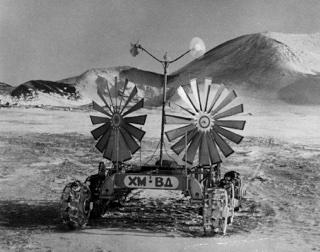
Between the landings of Venera 9 and 10 in 1975 and the break-up of the Soviet Union, the Lavochkin design bureau and its partners drew up more Venus missions than they launched. Two never got past a bureau index and a proposal: 4V-3, a repeat of the soil-sampling landers of Venera 13 and 14 planned for December 1984, and 6V, a Venus craft on the universal UMVL platform pencilled in for 1983, then 1990, 1996 and 2000. Two reached real hardware on the ground: DZhVS, a long-lived seismic station whose 500 °C components were built and tested in research set for 1977 to 1980, and the six-wheeled, wind-powered KhM-VD rover mock-ups that VNIITransmash built in 1984 and 1986. Two more were joint projects with France. Venera-84, called 5V Venera-EOS in Russian sources, was meant to float a large French balloon in the clouds and was reshaped into Vega once Halley's comet came within reach. Vesta, studied by CNES from October 1984 and discussed with the Soviet side into 1986, would have paired Soviet Venus landers with a French asteroid probe. In 2019 NPO Lavochkin engineers took up the rover idea again on paper. None of these flew in the form described here.
The sources disagree on when the bureau's leadership changed. Georgy Babakin, who led the bureau from Venera 4 to Venera 7, died on 3 August 1971. NPO Lavochkin's own history says S. S. Kryukov took over from the end of 1971 and that Vyacheslav Kovtunenko became chief designer in 1977; the same page dates Kovtunenko's rise to general designer to 1986 in one paragraph and 1987 in another. V. G. Perminov, the bureau's leading designer for Mars and Venus spacecraft, tells it differently in the memoir NASA published in 1999: Kryukov, once a deputy of Sergei Korolev, resigned after Minister S. A. Afanasyev cancelled the Mars soil return project in 1978, and only then was Kovtunenko brought in from the Yuzhnoye bureau in Dnepropetrovsk. Perminov writes that Kovtunenko kept the Venus spacecraft Kryukov had started and in 1979 began UMVL, a universal design for Mars, Venus and the Moon. The first-hand account of DZhVS used here, in Novosti Kosmonavtiki in 2001, is signed V. Perminov and N. Morozov, who write as members of the design team.
DZhVS grew out of a gap in the Venera 9 and 10 programme. Perminov and Morozov write that the flight programme of neither lander included seismic activity or the crust, experiments they call of the first importance for understanding the planet, so at the scientists' request the designers looked at doing them on later flights. Their first idea was active sounding: set off a charge some distance from a seismograph and record the waves that come back from deeper layers. On Venus an ordinary charge would have needed heavy insulation to survive the descent and then 10 to 15 minutes at 500 °C while the ringing from the lander's own impact died away, and throwing it far enough through the dense air was hard. So the designers considered sending a nuclear charge on a second descent craft, built from a first-generation station, and detonating it far from the first. The article says this could not be done because international agreements prohibit putting nuclear charges into space. What remained was passive seismology, waiting for venusquakes, and for that the scientists wanted a lander that would work on the surface for at least a month. Venera 9 and 10 had lasted 53 and 65 minutes.
The first approach was to keep ordinary electronics cool for longer. The pressure hull would be a Dewar flask, an inner sphere hung inside an outer one on thin titanium rods working in tension, because the joints had to carry up to 175 tonnes when a 500 kg instrument compartment decelerated at up to 350 g in the atmosphere. Radiant heat still leaked through, so the gap was to be packed with tiny shiny evacuated glass beads, and the inside of the inner sphere lined with lithium nitrate trihydrate, a salt that soaks up heat as it melts. After a long search the design reached five days on the surface. The bureau then brought in NIITP, the thermal processes institute of the Ministry of General Machine Building, and NPO Energiya of the Ministry of Medium Machine Building to reach the 30 days the scientists wanted; both later sent reports listing measures that would make 30 days possible with ordinary equipment.
About the same time the designers learned that the Minsk Institute of Radioelectronics had microcircuits that worked at up to 250 °C in instruments lowered into deep boreholes. That pushed them toward a bolder station whose instruments would themselves withstand 500 °C. IKI director Roald Sagdeev liked the idea and put his institute to work on the science programme, and Academician B. Ye. Paton, president of the Ukrainian Academy of Sciences, brought in Ukrainian institutes. In 1976 and 1977 NPO Lavochkin and IKI drew up and approved the Basic principles for an automatic station for long-duration research on the surface of Venus. DZhVS would have two compartments. The upper one, sealed and insulated, held ordinary instruments kept below 50 °C for two hours to measure the weather, soil, radiation and light and to take a panorama. It would then be switched off, and the 500 °C instruments would be switched over to the lower compartment, which carried sensitive seismographs, kept an internal pressure of 0.1 to 0.3 MPa and ran on a radioisotope thermoelectric generator of about 30 W. Data would go to Earth directly and through the orbiter. The article's text rates the lower compartment's equipment for about a year at 500 °C; its drawing of the 30-day station labels the same section 'at least one month'.
Research on elements, materials and equipment was set for 1977 to 1980, to be followed by a design project if the results were good, and they were encouraging. A cable bureau in Mytishchi and the Ukrainian Institute of Materials Science produced heat-resistant wire; Elekon in Kazan made a prototype sealed connector in a titanium body; the Institute of Solid State Physics built a diamond-crystal radiation detector able to work at 500 °C; scientists from the Institute of Physics of the Earth worked on heat-resistant seismic sensors; and VNIIRTI reported that a silicon-germanium radioisotope generator could be made at 3 kg per watt, or 2 kg with a new process from its Sukhumi branch. The Minsk institute supplied prototype chips for a receiver mock-up, which ran for several months in an IKI thermal chamber held at 500 °C. Yet the bureau never reached the step of analysing the results and choosing a variant. Perminov and Morozov blame the workload: the radar mappers that flew as Venera 15 and 16, due to launch in June 1983, and then Vega, due in December 1984. The DZhVS teams were moved to other work and could not be brought back years later, and funding for space projects began to fall at the end of the 1980s. No cancellation decree is cited. Some of the work lived on, the article says: a Mashinoapparat motor for the drill that bored even basalt on Venus, heat-resistant wire later used in aviation, and heat-resistant chips and radiant-heat shielding methods reused in a study for a probe to pass 10 solar radii from the Sun's surface.
4V-3 was the bureau's plan for the 1984 launch window, indexed V-84. V. Karfidov's 2021 catalogue of Soviet probe projects describes it as a probe to continue the study of Venus by repeating the sampling and analysis of soil with a landing in a new region, using a landing module like that of 4V-1M, the series that flew as Venera 13 and 14. Two were proposed for launch in December 1984. The entry closes with one line: the 4V-3 project was not carried out and was replaced by project 5V. No second source for 4V-3 was found for this page, and Karfidov gives no date for the switch.
The authors of the 1986 overview of the Vega balloon experiment in the Soviet journal Pis'ma v Astronomicheskiy Zhurnal, among them Sagdeev, V. M. Linkin, Jacques Blamont and R. Preston of JPL, write that Blamont first proposed balloons for studying the dynamics of the Venus atmosphere as early as 1967. The EOS name was in use by April 1974, when a Soviet-French symposium in Moscow on the EOS-Venera project heard a proposal to follow transmitting balloons with ground radio interferometers, the method Vega would use. Between 1974 and 1980, under a joint programme of the Interkosmos Council of the Soviet Academy of Sciences and the French space agency CNES, a comprehensive balloon station was developed in both countries, sending its measurements to Earth through an orbiter, and the scheme needed a separate carrier for each balloon station and each orbiter. Karfidov names two craft in the family, 5VS and 5VP, but no source read for this page says which role each had. IKI calls the programme 5V Venera-EOS. Igor Marinin, writing on the Russian space news site Pro Kosmos in June 2025, calls it Venera-84 and says the launch of two stations was set for 1984 and officially timed to the 200th anniversary of the Montgolfier brothers' balloon, which is why it was nicknamed Montgolfier to Venus. In his account the Soviet side would supply an orbiter and a lander with a balloon deployment system, and French engineers in Toulouse the balloon and its gondola.
Sources disagree on the balloon's size and mass. Marinin gives the whole floating station about 220 kg, made up of a Teflon envelope 10 m across and a gondola of science equipment of about 50 kg, expected to work for five Earth days, with its data stored on the orbiter's tape recorder for relay to Earth. A 2020 tribute to Blamont by Pierre-François Mouriaux and Philippe Varnoteaux for the Société astronomique de France describes the French EOS balloon as 9 m in diameter with a gondola of 220 kg. The two may be measuring different things, the whole station in one case and the gondola in the other, or different stages of the design; neither says. Marinin also dates the start of work on Venera-84 to the early 1980s, which does not fit the 1974 to 1980 development in the 1986 balloon paper; Thérèse Encrenaz of the Paris Observatory, writing in 2026, places the project under study at the end of the 1970s.
Halley's comet ended the plan. IKI's history of Vega says development of the V-85 5VK station began under a party and government decree of 8 May 1980, and that ballistic analysis then showed the carrier could be sent past Halley after the Venus flyby. Largely on Sagdeev's initiative the comet was added, and in IKI's words the preceding project was in effect wound up. Encrenaz dates the proposal to the Franco-Soviet meetings in Ajaccio in September 1980, where it was suggested that the Venera-84 orbiter drop the lander and balloon into the atmosphere and then head for the comet. Karfidov says the compromise was found in 1981: work on 5VS stopped, 5VP was reworked to widen the Halley studies, and the balloon station was made smaller and lighter and would send its data straight to Earth with no relay. The 1986 balloon paper credits that step to Sagdeev and Linkin: a low-power transmitter heard directly by sensitive stations on Earth, which would also track the balloon by very long baseline interferometry. The technical assignment for the new complex, 8K82K-5VK, was drawn up and approved by its developers between May and September 1981 and finally approved by Minister Afanasyev on 24 February 1982, according to the Russian State Archive of Scientific and Technical Documentation (RGANTD), which holds it.
French and Russian accounts tell the end of the French balloon differently. Karfidov says the French side declined to develop a lightened balloon station and Marinin that it declined to build one for Vega, so the task fell to Soviet engineers, and the Vega balloons that flew in June 1985, 3.4 m across, were designed and built in the Soviet Union. The Blamont tribute puts it the other way round: in the end the Soviets preferred to replace the French EOS balloon with two smaller ones. A French popular history on Clubic says the mass budget forced a choice between Halley and the big balloon. France stayed in the experiment in other roles. The 1986 paper lists Blamont as co-leader, with Linkin, of the balloon's meteorological and nephelometer experiments, and at the Interkosmos Council's request CNES organised and coordinated the international radio telescope network that tracked the balloons alongside a Soviet one, with Blamont and Preston as its scientific leaders. No source read for this page says how far the French balloon hardware got before the change.
6V, first designated 183V, was the bureau's next Venus design. Karfidov lists what it was to do: photograph the surface during the last 10 km of descent, deploy a series of balloons for different altitudes, run an active and a passive seismic experiment, and study Venus from orbit. It was to be built like 1F, the craft that flew to Mars as Phobos, with a spherical descent craft in place of the science compartment. The 1978 programme set two launches for 1983. The space research programme for 1986 to 2000 that NPO Lavochkin drew up in 1984 moved two launches to 1990, followed by paired launches of modified 6V-1 and 6V-2 craft in 1996 and 2000. Karfidov's verdict is that work on 6V did not get beyond technical proposals. Perminov's memoir does not mention 6V, but it describes the slow progress of the UMVL platform behind 1F: begun in 1979, it produced the Phobos craft only about ten years later.
Vesta, a contraction of Venera and asteroids in Karfidov's reading, was discussed in 1985 and 1986 as a Soviet-French mission of two launches, each carrying a Soviet 5V-type Venera probe and a French Vesta probe. The Soviet craft would drop landers, and possibly balloons, to image the surface during descent, look for volcanic activity and study the circulation and clouds; the French craft would swing past Venus toward an asteroid or a comet. The CNES Phase 0 report of 1985, which NASA published in English in 1986, fills in the plan: about 5 tonnes on each Proton in December 1992 or January 1993, two identical launches a few days apart, a descent module entering the atmosphere at 11.6 km/s in mid-1993 with a planetary probe, a floating probe and a landing probe, a landing at Aphrodite, and a Soviet bus going on past an Apollo-Amor asteroid such as Anteros. The presidents of CNES and Intercosmos approved a joint report recommending Phase A in September 1985; the mission analysis assumed a mid-1991 launch, and the report notes that a decision to postpone was made during the study.
Venus dropped out in 1987, when, Karfidov writes, the project was re-aimed at Mars because Soviet Mars probes were being worked out at the time. The Mars version kept the pairing, with two Proton launches in 1994, and was then split into separate French launches in September and December 1994. As the M1, M2 and M3 Mars programme built up, Vesta was not worked out in more detail.
Leningrad's VNIITransmash, the institute behind the Lunokhod chassis and the PrOP-V penetrometer that measured Venus soil, did the rover work. Its own chronology of space work, as archived in 2018, has two Venus rover entries: in 1984, a six-wheeled running mock-up, KhM-VD, for long-duration work on Venus using the energy of wind flows; and in 1986, a running mock-up KhM-VD2 with one turning wind turbine to recharge the battery, the main energy source for its motor-wheels. Both were test vehicles for use on Earth. The Roscosmos television studio lists a 14-minute film of KhM-VD-2 trials in its Venera collection. Where and when the trials ran is less settled. The Spanish space writer Daniel Marín describes two 160 kg six-wheeled prototypes, which he calls VM-KhD, tested between 1984 and 1987 on the Kamchatka peninsula alongside Mars rover models, with solid lubricants rated to 600 to 800 °C and no radioisotope generator, which he says was ruled out as too heavy. KamchatkaMedia, a regional news agency, wrote in April 2026 that a 1986 expedition to the Tolbachik and Shiveluch volcanoes studied wind fields for a wind-powered Venus rover, and it dates the Mars and Venus rover trials there to 1986 to 1989. None of the Russian sources read for this page gives the 160 kg mass, the lubricants or the name VM-KhD.
The idea came back in February 2019. Speaking at the Korolev Readings, an unnamed representative of NPO Lavochkin quoted by TASS on 1 February described a rover that would move across Venus the way Curiosity moves across Mars and work at 500 °C. With its entry, descent and landing systems it would weigh 872 kg, or 1,059 kg with margin, and it would need high-temperature batteries, motors, drives and electronics. It would travel inside a descent craft, drive autonomously and communicate through an orbiter or a lander. The speaker said no formal research work (NIR) was under way and the study was being done on an initiative basis, that the next step would be a technical proposal, that he hoped the rover would enter the federal space programme after 2025, and that it would not be part of Venera-D.
On 26 September 2026 the Russian Venus mission in development was Venera-D. IKI director Anatoly Petrukovich said, according to TASS as relayed by Lenta.ru on 14 September 2026, that its draft design should run from 2026 to 2028; the same report recalls that in April 2026 Sergei Chernyshev, a vice-president of the Russian Academy of Sciences, described it as an orbiter and a lander planned for launch in 2036. The report mentions no rover. Later lander, rover and balloon ideas are collected under Venus proposals and Venus concepts.
Mission facts
Organisations
NPO Lavochkin with IKI AN SSSR and VNIITransmash; the French space agency CNES on Venera-84 and Vesta
DZhVS: what it was
A long-lived Venus station by NPO Lavochkin and IKI: an upper compartment of ordinary instruments for two hours, then 500 °C instruments, including sensitive seismographs, in a lower compartment powered by a radioisotope generator of about 30 W, relaying through the orbiter and direct to Earth.
DZhVS: stage reached
Basic principles approved by NPO Lavochkin and IKI in 1976 and 1977; component research planned for 1977 to 1980, with prototype wire, a titanium sealed connector, a diamond radiation detector and a receiver mock-up that ran for months at 500 °C. The bureau never moved on to a design project.
DZhVS: planned lifetime
Scientists wanted at least a month. An interim insulated design reached five days. The article's text rates the equipment of the hot lower compartment for about a year; its drawing labels it at least one month.
DZhVS: why it stopped
Workload on the Venera 15 and 16 radar mappers (launch June 1983) and Vega (December 1984), teams reassigned, then falling space funding at the end of the 1980s. No cancellation decree is cited.
Nuclear seismic sounding
Considered before DZhVS: a nuclear charge on a second descent craft, detonated far from a seismograph lander, to sound the deep crust. Ruled out because international agreements prohibit putting nuclear charges into space.
4V-3 (V-84)
A pair of probes proposed for December 1984 to repeat soil sampling and analysis at a new landing region with a 4V-1M-type lander. Not carried out; replaced by project 5V. Single source (Karfidov, 2021).
Venera-84: names
5V Venera-EOS (IKI); Venera-84 and Montgolfier to Venus (Pro Kosmos); craft 5VS and 5VP (Karfidov); the French balloon is EOS in French sources.
Venera-84: the balloon
Pro Kosmos: a floating station of about 220 kg, a 10 m Teflon envelope and a gondola of about 50 kg, five days of work. Société astronomique de France: a 9 m balloon with a 220 kg gondola.
Venera-84: origins
Blamont first proposed Venus balloons in 1967; from 1974 to 1980 Interkosmos and CNES developed a balloon station relayed by an orbiter, each needing its own carrier (Sagdeev and co-authors, 1986).
Venera-84: how it became Vega
Decree of 8 May 1980 (IKI); Halley proposal at Ajaccio, September 1980 (Encrenaz); compromise in 1981, 5VS dropped and 5VP reworked (Karfidov); technical assignment for 8K82K-5VK drawn up and approved by its developers May to September 1981 and given final approval 24 February 1982 (RGANTD).
6V (183V)
A UMVL-platform craft built like the Phobos 1F probe with a spherical descent craft, descent imaging below 10 km, balloons at several heights, active and passive seismology and an orbiter. Two launches set for 1983, then 1990, then 6V-1 and 6V-2 pairs in 1996 and 2000. Never beyond technical proposals.
Vesta: the Venus plan
Two Proton launches (December 1992 or January 1993 in the CNES Phase 0 report), each a Soviet craft dropping a descent module with probe, floating probe and lander at Venus in mid-1993 (landing site Aphrodite) and a French craft going on to the asteroids.
Vesta: how far it got
Phase A recommended in a joint report approved by the presidents of CNES and Intercosmos in September 1985 (CNES Phase 0 report); re-aimed at Mars in 1987; not worked out further once the M1, M2 and M3 Mars programme took over.
KhM-VD and KhM-VD2
VNIITransmash running mock-ups: a six-wheeled KhM-VD in 1984 for long-duration work on Venus on wind energy, and KhM-VD2 in 1986 with one turning wind turbine charging the battery for its motor-wheels. Earth test vehicles only.
Lavochkin rover (2019)
Presented at the Korolev Readings: 872 kg with entry, descent and landing systems, 1,059 kg with margin, built to work at 500 °C. An initiative study with no formal research work (NIR) under way; the speaker said it would stay outside Venera-D.
Mission timeline
- 1967Jacques Blamont first proposes balloons for studying the dynamics of the Venus atmosphere.
- 1974 to 1980A Soviet-French symposium on the EOS-Venera project in Moscow in April 1974 hears the proposal to track balloons by radio interferometry; under a joint Interkosmos and CNES programme a balloon station relayed by an orbiter is developed in the USSR and France.
- 1976 to 1977NPO Lavochkin and IKI approve the basic principles of a station for long-duration work on the surface of Venus (DZhVS).
- 1977 to 1980Planned period of DZhVS component research. Among its results, a receiver mock-up with Minsk microcircuits runs for several months in an IKI thermal chamber held at 500 °C.
- 1978A 1978 programme sets two launches of 183V (later 6V) for 1983.
- 8 May 1980Party and government decree under which, per IKI, development of the V-85 5VK station begins; the Halley flyby is added after ballistic analysis.
- Sep 1980At Franco-Soviet meetings in Ajaccio it is proposed that the Venera-84 carrier drop its lander and balloon and go on to Halley's comet.
- 1981Compromise: work on 5VS stops, 5VP is reworked into 5VK (Vega), the balloon shrinks and transmits direct to Earth; France declines to build the lighter balloon.
- 24 Feb 1982Minister S. A. Afanasyev approves the technical assignment for 8K82K-5VK, drawn up and approved by its developers from May to September 1981.
- 1984VNIITransmash builds KhM-VD, a six-wheeled running mock-up of a wind-powered Venus rover.
- 1984NPO Lavochkin's space research programme for 1986 to 2000 moves the 6V pair to 1990, with 6V-1 and 6V-2 pairs to follow in 1996 and 2000.
- 15 and 21 Dec 1984Vega 1 and 2 launch in the window once planned for the 4V-3 pair and Venera-84.
- 9 and 13 Jun 1985Vega 1 and 2 release their descent craft, which land two days later; during the descent each drops a 3.4 m Soviet-built balloon, the design that replaced the French one.
- Sep 1985The presidents of CNES and Intercosmos approve a joint report recommending that Vesta enter Phase A.
- 1986VNIITransmash builds KhM-VD2, with one turning wind turbine to charge its battery; film of its trials survives.
- 1987Vesta is re-aimed from Venus to Mars.
- 1 Feb 2019TASS reports that an NPO Lavochkin representative has presented a 500 °C Venus rover study, 872 kg with its landing systems, at the Korolev Readings.
- 13 Sep 2026IKI's director tells TASS (relayed by Lenta.ru on 14 September) that Venera-D's draft design will run from 2026 to 2028; no rover is mentioned.
A filled dot marks something that physically happened. A hollow one marks an announcement, a naming or a target.
In pictures
Tap a photo to enlarge.
Translated from the original sources
Passages from the Russian, French and Spanish sources this page draws on, in azmth's translation. Tap Show original to read the original wording.
V. Perminov and N. Morozov, The long-lived Venus station project, Novosti Kosmonavtiki No. 8
Russian · 8 passages
V. Perminov and N. Morozov, The long-lived Venus station project, Novosti Kosmonavtiki No. 8 (223), 2001, pp. 72-73 (Wayback copy of the full-issue PDF)
Open the source“The problem could have been solved by delivering a nuclear charge on a second descent craft (using a first-generation station for this) and detonating it far from the first descent craft, which would have given information on the deep layers of the crust of Venus.”
azmth's translation · Show originalHide original
Russian: «Проблема могла быть решена путем доставки вторым СА (при использовании для этого станции первого поколения) ядерного заряда и подрыва его на большом удалении от первого СА, что позволило бы получить сведения о глубинных слоях коры Венеры.»
“But this option could not be carried out, since international agreements prohibit putting nuclear charges into space.”
azmth's translation · Show originalHide original
Russian: «Но этот вариант не мог быть реализован, так как международными соглашениями запрещается выводить в космос ядерные заряды.»
“After a long search, unconventional solutions made it possible to bring the descent craft's working time on the surface of Venus up to 5 days (fig. 1).”
azmth's translation · Show originalHide original
Russian: «После длительных поисков за счет неординарных решений удалось довести время функционирования СА на поверхности Венеры до 5 суток (рис.1).»
“On the basis of these studies, in 1976 to 1977 NPO Lavochkin and IKI drew up and approved the 'Basic principles for building an automatic station for long-duration research on the surface of Venus'.”
azmth's translation · Show originalHide original
Russian: «На основании этих проработок в 1976–1977 гг. НПО им. С.А.Лавочкина и ИКИ были разработаны и утверждены «Основные принципы построения автоматической станции для длительных исследований на поверхности Венеры».»
“The lower compartment was to be fitted with equipment, including high-sensitivity seismographs, able to work for a long time, about a year, at 500 °C with a pressure inside the compartment of 0.1 to 0.3 MPa.”
azmth's translation · Show originalHide original
Russian: «Нижний отсек планировалось укомплектовать аппаратурой, в т.ч. высокочувствительными сейсмографами, способной длительное время, около года, функционировать при 500°С и давлении в отсеке 0.1...0.3 МПа.»
“Power for the science instruments and onboard systems of the lower compartment was to come from a radioisotope thermoelectric generator of about 30 W.”
azmth's translation · Show originalHide original
Russian: «Питание научной аппаратуры и бортовых систем нижнего отсека должно было обеспечиваться радиоизотопным термоэлектрическим генератором мощностью около 30 Вт.»
“The mock-up worked for several months in the thermal chamber of IKI of the USSR Academy of Sciences, in which a temperature of 500 °C was constantly maintained.”
azmth's translation · Show originalHide original
Russian: «Макет несколько месяцев работал в термокамере ИКИ АН СССР, в которой постоянно поддерживалась температура 500°С.»
“The teams working on DZhVS were redirected to other work, and it was impossible to bring them back to the earlier development several years later.”
azmth's translation · Show originalHide original
Russian: «Коллективы, занимающиеся разработкой ДЖВС, были перенацелены на другие работы, и вернуть их через несколько лет к прежним разработкам было невозможно.»
V. Karfidov, Projects of Soviet interplanetary probes 1981 to 1990
Russian · 5 passages
V. Karfidov, Projects of Soviet interplanetary probes 1981 to 1990 (Kosmonavtika, 2021), Wayback copy of epizodsspace
Open the source“It was proposed to launch two 4V-3 probes in December 1984. The 4V-3 project was not carried out and was replaced by project 5V.”
azmth's translation · Show originalHide original
Russian: «Предлагалось запустить две АМС 4В-3 в декабре 1984 года. Проект 4В-3 не реализовывался и был заменен проектом 5В.»
“A compromise was found in 1981. It was decided to stop work on the 5VS probe and to rework the 5VP probe to widen the possibilities for studying Halley's comet.”
azmth's translation · Show originalHide original
Russian: «Компромиссное решение было найдено в 1981 году. Работы над АМС 5ВС было решено прекратить, а АМС 5ВП доработать для расширения возможностей исследования кометы Галлея.»
“In this situation the French side declined to develop the floating balloon station in a lightened version, and the task of creating the balloon station fell entirely to Soviet specialists.”
azmth's translation · Show originalHide original
Russian: «Французская сторона в этой ситуации отказалась от разработки ПАС в облегченном варианте, и задача создания аэростатной станции осталась целиком за советскими специалистами.»
“Work on the 6V project did not advance beyond the technical proposals stage.”
azmth's translation · Show originalHide original
Russian: «Работы по проекту 6В не продвинулись дальше этапа технических предложений.»
“In 1987 the Vesta project was re-aimed from Venus to Mars, since projects to send probes to Mars were being worked out in the USSR at that time.”
azmth's translation · Show originalHide original
Russian: «В 1987 году проект «Vesta» был перенацелен с Венеры на Марс, т.к. в это время в СССР прорабатывались проекты отправки АМС к Марсу.»
IKI RAN, VEGA mission page
Russian · 2 passages
“The VEGA project was based on the earlier programme 5V 'Venera-EOS' for studying Venus with a balloon, which the USSR was developing jointly with France.”
azmth's translation · Show originalHide original
Russian: «Проект ВЕГА базировался на более ранней программе 5В «Венера-ЭОС» по исследованию Венеры с помощью аэростата, которую СССР разрабатывал совместно с Францией.»
“Development of the V-85 5VK probe began under the decree of the CPSU Central Committee and the USSR Council of Ministers of 8 May 1980.”
azmth's translation · Show originalHide original
Russian: «Разработка АМС В-85 5ВК началась по постановлению ЦК КПСС и Совета Министров СССР от 8 мая 1980 г.»
I. Marinin, On the way to Halley's comet: the history of the first and only balloons on Venus
Russian · 2 passages
I. Marinin, On the way to Halley's comet: the history of the first and only balloons on Venus (Pro Kosmos, 11 June 2025)
Open the source“Under this project the floating balloon station had a mass of about 220 kg and consisted of a Teflon envelope 10 m in diameter and a gondola of science equipment of about 50 kg.”
azmth's translation · Show originalHide original
Russian: «По этому проекту ПАС имела массу около 220 кг и состояла из тефлонового баллона диаметром 10 м и гондолы с научным оборудованием массой около 50 кг.»
“The launch of two stations was planned for 1984 and officially timed to the 200th anniversary of the Montgolfier brothers' invention of the balloon, so the project was called 'Montgolfier to Venus'.”
azmth's translation · Show originalHide original
Russian: «Запуск двух станций был запланирован на 1984 год и официально был приурочен к 200-летию изобретения братьями Монгольфье воздушного шара, поэтому проект назвали «Монгольфьер на Венеру».»
RGANTD, Vega 1 and 2: balloons on Venus and Halley's comet, with scans of the 8K82K-5VK technical assignment
Russian · 1 passage
“The document was drawn up and approved by the main developers and contractors of the Venera-Halley project, Vega for short, in May to September 1981. The Minister of General Machine Building, S. A. Afanasyev, gave the project final approval on 24 February 1982.”
azmth's translation · Show originalHide original
Russian: «Документ был составлен и утвержден основными разработчиками и исполнителями проекта «Венера-Галлей», сокращенно «Вега», в мае-сентябре 1981 г. Министр общего машиностроения С.А. Афанасьев окончательно одобрил проект 24 февраля 1982 г.»
NPO Lavochkin, company history: cosmonautics
Russian · 1 passage
“In 1977 V. M. Kovtunenko was appointed chief designer, and in 1987 general designer and general director of NPO Lavochkin.”
azmth's translation · Show originalHide original
Russian: «В 1977 году главным конструктором, а в 1987 году Генеральным конструктором и генеральным директором НПО им. С.А. Лавочкина был назначен В.М. Ковтуненко.»
VNIITransmash, chronology of space work
Russian · 2 passages
VNIITransmash, chronology of space work (Wayback copy, December 2018)
Open the source“The six-wheeled running mock-up KhM-VD was created for long-duration work on Venus using the energy of wind flows.”
Entry for 1984.
azmth's translation · Show originalHide original
Russian: «Создан 6-колесный ходовой макет ХМ-ВД для долговременной работы на Венере с использованием энергии ветровых потоков.»
“The running mock-up KhM-VD2 was created with one turning wind turbine to recharge the battery, the main source of energy for the motor-wheels.”
Entry for 1986.
azmth's translation · Show originalHide original
Russian: «Создан ходовой макет ХМ-ВД2 с одним поворотным ветродвигателем для подзарядки аккумулятора – основного источника энергии для мотор-колёс.»
Roscosmos TV film library: Venus rover KhM-VD-2
Russian · 1 passage
“Trials of a transport robot of increased cross-country ability intended for work in the space environment.”
Description of the 14-minute film 'Venus rover KhM-VD-2'.
azmth's translation · Show originalHide original
Russian: «Испытания транспортного робота повышенной проходимости, предназначенного для работы в космической среде.»
TASS, 1 February 2019: a Venus rover for 500 °C may be built in Russia
Russian · 1 passage
TASS, 1 February 2019: a Venus rover for 500 °C may be built in Russia (Wayback copy)
Open the source“The NPO representative told a TASS correspondent that no research work (NIR) is being done on this project at present; for now it is done on an initiative basis.”
azmth's translation · Show originalHide original
Russian: «Представитель НПО сообщил в беседе с корреспондентом ТАСС, что сейчас по этому проекту не проводятся научно- исследовательские работы (НИР), пока это делается в инициативном порядке.»
Lenta.ru, 14 September 2026: Venera-D draft design in two years
Russian · 1 passage
Lenta.ru, 14 September 2026: Venera-D draft design in two years (citing TASS)
Open the source“The draft design of the Russian automatic interplanetary station Venera-D will be produced in two years.”
azmth's translation · Show originalHide original
Russian: «Эскизный проект российской автоматической межпланетной станции (АМС) «Венера-Д» создадут через два года.»
P.-F. Mouriaux and P. Varnoteaux, Hommage au professeur Blamont
French · 1 passage
P.-F. Mouriaux and P. Varnoteaux, Hommage au professeur Blamont (Société astronomique de France, 2020)
Open the source“In the end, however, the Soviets preferred to replace the French EOS balloon (9 m in diameter with a 220 kg gondola) with two smaller ones.”
azmth's translation · Show originalHide original
French: «Toutefois, au final, les Soviétiques ont préféré remplacer le ballon français EOS (de 9 m de diamètre avec une nacelle de 220 kg) par deux plus petits.»
T. Encrenaz, Il y a quarante ans, le passage de la comète de Halley
French · 1 passage
T. Encrenaz, Il y a quarante ans, le passage de la comète de Halley (L'Astronomie Afrique, 1 April 2026)
Open the source“In September 1980, at the Franco-Soviet days held in Ajaccio, it was proposed to use the Venera-84 orbiter to drop the lander with the balloon into the atmosphere of Venus and then to redirect it toward Halley's comet.”
azmth's translation · Show originalHide original
French: «En septembre 1980, lors des journées franco-soviétiques qui se tiennent à Ajaccio, il est proposé d’utiliser l’orbiteur de Venera-84 pour larguer l’atterrisseur avec le ballon dans l’atmosphère de Vénus, puis de se rediriger vers la comète de Halley.»
E. Bottlaender, Vega, dernier acte sur Vénus
French · 1 passage
E. Bottlaender, Vega, dernier acte sur Vénus (Clubic, 2020)
Open the source“Unfortunately, for lack of mass, a choice had to be made between Halley's comet and the Venus balloon: the big French balloon was replaced by a helium-filled atmospheric balloon prepared by the Soviets.”
azmth's translation · Show originalHide original
French: «Malheureusement, faute de masse, il a fallu choisir entre la comète de Halley et l'aérostat vénusien : le gros ballon français est remplacé par un ballon atmosphérique gonflé à l'hélium préparé par les soviétiques.»
D. Marín, Construyendo una nave capaz de sobrevivir en la superficie de Venus
Spanish · 2 passages
D. Marín, Construyendo una nave capaz de sobrevivir en la superficie de Venus (Eureka, 4 September 2011)
Open the source“The Venerokhod project team did not stop at theoretical calculations: two 160 kg six-wheeled prototypes called VM-KhD were actually built.”
azmth's translation · Show originalHide original
Spanish: “El equipo del proyecto Venerojod no se limitó a llevar a cabo cálculos teóricos, sino que se llegaron a construir dos prototipos de 160 kg y seis ruedas denominados VM-KhD (ВМ-ХД).”
“These vehicles would be tested between 1984 and 1987 on the Kamchatka peninsula alongside other planetary rover models, including several versions of Mars rovers.”
azmth's translation · Show originalHide original
Spanish: “Estos vehículos se probarían entre 1984 y 1987 en la península de Kamchatka junto a otros modelos de rovers planetarios, incluyendo varias versiones de Marsojods.”
KamchatkaMedia, 12 April 2026: how Kamchatka helped Gagarin fly and tested planetary rovers
Russian · 2 passages
“In 1986 the task was the study of wind fields: the Venus rover ran on wind energy.”
azmth's translation · Show originalHide original
Russian: «В 1986 году задачей было исследование ветровых полей: венероход питался за счет ветровой энергии.»
“The work was done on the cinder fields of Tolbachik and Shiveluch.”
azmth's translation · Show originalHide original
Russian: «Работу вели на шлаковых полях Толбачика и Шивелуча.»
Sources
- V. Karfidov, Projects of Soviet interplanetary probes 1981 to 1990 (Kosmonavtika, 2021), Wayback copy of epizodsspace · in Russian
- V. Perminov and N. Morozov, The long-lived Venus station project, Novosti Kosmonavtiki No. 8 (223), 2001, pp. 72-73 (Wayback copy of the full-issue PDF) · in Russian
- IKI RAN, VEGA mission page · in Russian
- I. Marinin, On the way to Halley's comet: the history of the first and only balloons on Venus (Pro Kosmos, 11 June 2025) · in Russian
- RGANTD, Vega 1 and 2: balloons on Venus and Halley's comet, with scans of the 8K82K-5VK technical assignment · in Russian
- NPO Lavochkin, company history: cosmonautics · in Russian
- V. G. Perminov, The Difficult Road to Mars, NASA Monographs in Aerospace History No. 15, 1999
- R. Z. Sagdeev et al., Overview of the Soviet Vega balloon experiment, NASA TM-88516 (translation of Pis'ma v Astronomicheskiy Zhurnal 12(1), 1986)
- A. Perret et al., VESTA Project: Phase 0 report (CNES), NASA TM-88515, 1986
- VNIITransmash, chronology of space work (Wayback copy, December 2018) · in Russian
- Roscosmos TV film library: Venus rover KhM-VD-2 · in Russian
- TASS, 1 February 2019: a Venus rover for 500 °C may be built in Russia (Wayback copy) · in Russian
- P.-F. Mouriaux and P. Varnoteaux, Hommage au professeur Blamont (Société astronomique de France, 2020) · in French
- T. Encrenaz, Il y a quarante ans, le passage de la comète de Halley (L'Astronomie Afrique, 1 April 2026) · in French
- E. Bottlaender, Vega, dernier acte sur Vénus (Clubic, 2020) · in French
- D. Marín, Construyendo una nave capaz de sobrevivir en la superficie de Venus (Eureka, 4 September 2011) · in Spanish
- Lenta.ru, 14 September 2026: Venera-D draft design in two years (citing TASS) · in Russian
- R. Z. Sagdeyev et al., Differential VLBI measurements of the Venus atmosphere dynamics by balloons: VEGA project, Astronomy and Astrophysics 254, 387-392 (1992)
- 19FortyFive, 2 July 2026: article on the Vega balloons (cited for a claim this page corrects)
- KamchatkaMedia, 12 April 2026: how Kamchatka helped Gagarin fly and tested planetary rovers · in Russian
Facts on this page were verified on 26 September 2026. Where sources disagree, the disagreement is stated rather than resolved silently.
azmth is independent and is not affiliated with or endorsed by NASA, Roscosmos, NPO Lavochkin, ESA, JAXA, ISRO, CNSA, or any other space agency or company named on this page.