Landers, balloons and rovers on the drawing board
NASA, ESA and others · Multinational · Programme · 2009 · Never flew Cancelled
Never flown. No design on this page is funded to fly, though a few, such as the CANVAS rover, are still being studied. The hardware built so far has been tested only on Earth. NASA's 2027 budget request would close the small fund that develops Venus hardware; Congress has not yet decided.
TL;DR· 20 min read
Since 1998 NASA, ESA and others have studied Venus landers, balloons, aircraft, rovers and sample returns, and none has flown or is funded to fly. NASA's 2009 and 2020 flagship studies and three smaller studies for the 2011 decadal survey were never started, and NASA's NIAC programme for long-shot ideas has paid for studies from the Zephyr landsailer and the AREE rover to CANVAS, a rolling rover chosen in 2026. NASA Glenn's LLISSE lander technology has run through 60-day tests at Venus conditions, and JPL's altitude-changing balloon flew as a prototype in Nevada in 2022.
Is NASA sending a rover to Venus?
NASA has no rover, balloon or long-lived lander headed for Venus: none of the designs that it, ESA and a handful of others have drawn up since the late 1990s has flown there, and none is funded to fly. Their ideas, more than twenty in all, include a rocket launched from under a balloon to bring rock home, a lander that floats between two sites on a metal bellows, a wind-driven landsailer, a clockwork rover, an inflatable aircraft and a weather station built to last two months on ground at about 465 °C. Two flagship studies, in 2009 and 2020, gathered many of them into campaigns costing roughly 3 to 4 billion dollars, and neither decadal survey chose them. The hardware built so far has been tested on Earth: LLISSE electronics and sensors that ran for 60 days in a chamber that recreates the Venus surface, and a one-third scale JPL balloon that flew twice over Nevada in July 2022.
Facts as of 4 November 2026, from the sources listed below.
- 60 dayssurface life NASA Glenn designed LLISSE for, against about two hours for every Venus lander so far
- 3.7 billion dollarsestimated cost of the 2020 Venus Flagship Mission, in 2025 dollars; the decadal survey chose other flagships
- 2test flights of JPL's one-third scale aerobot prototype over Nevada's Black Rock Desert, July 2022
Every spacecraft that has reached the surface of Venus stopped working within about two hours, a limit NASA Glenn engineers still quote in 2025. Almost every idea on this page is a way around that number: survive longer on the ground, move across it, or stay in the clouds where the air is mild and let the wind do the travelling. The ideas come from NASA centres and the universities NASA funds, the European Space Agency, a French engineering society and one aerospace company, and they run from 1998 to 2026. None has flown. What they have produced is paper, weeks of furnace time in a chamber that recreates Venus, and one silver balloon that flew twice over Nevada. Proposals that lost a NASA or ESA competition have their own page, the Venus missions that lost the competition. This page holds the rest: agency design studies, technology projects and the long-shot concepts NASA pays for through its Innovative Advanced Concepts programme (NIAC).
Bringing rock back from Venus runs into the same two walls in every study that has tried it. Venus has a gravity well close to Earth's, and a rocket fired from the ground would start at about 92 times Earth's surface pressure and about 465 °C. The Jet Propulsion Laboratory study titled Venus Surface Sample Return: A Weighty High-Pressure Challenge, written by Ted Sweetser, Jim Cutts and colleagues with JPL's Team X (revisions to 24 February 1999), answered with a single launch in the Delta IV class. An inflatable drag device would capture the spacecraft into orbit, a lander would spend about 90 minutes on the ground, and an ultrasonic corer would take an intact rock of about one cubic centimetre plus a sample of the lower atmosphere. A balloon inflated from helium tanks on the lander would then lift a three-stage solid-fuel Venus ascent vehicle to about 66 km, the height that minimised the combined size of balloon and rocket. From there the rocket would put the sample into orbit, the orbiter would chase it down, and solar electric propulsion would bring it home in about two and a half years in total. The team thought advanced technology could shrink the job to one launch where earlier studies had needed two.
One of those earlier studies was European. ESA's Venus Sample Return Assessment Study Report, SCI(98)3, by G.E.N. Scoon and J.-P. Lebreton, is dated June 1998 at Noordwijk. It is known here only from the reference lists of the JPL paper and a 2019 white paper; the report itself was not found. That white paper, Venus sample return mission revisited, was written by Dominique Valentian, Christophe Koppel, Philippe Mairet and Loup Mairet of the EOS commission of the Association Aéronautique et Astronautique de France for ESA's Voyage 2050 consultation. It reread the JPL design, as published by David Rodgers and colleagues in 2000, and listed its weak points: solid motors that might buckle under about 9 MPa of outside pressure, propellant warming during a four-hour balloon climb, and a balloon that must swell almost a thousandfold between the surface and its float height. Its own answer used several landers built as vertical take-off drones that would fly their samples up to a rocket hanging under a balloon at about 55 km, needing two or three Ariane 64 launches. The authors wrote that it "may be ranked" in ESA's large (L) mission class. In 2024 Geoffrey Landis of NASA Glenn presented a NIAC variant in which a high-temperature solar aircraft carries the sample above the clouds to a balloon platform that makes carbon monoxide and oxygen propellant from the atmosphere, removing the need to ship about three tonnes of propellant to Venus. Two years earlier Sara Seager's NIAC team at MIT had studied returning cloud particles and gas instead of rock. The Russian sample return idea appears on the Venera-D page, China's atmosphere sample return on China and Venus, and the MIT group's flight plans on Venus Life Finder.
ESA's Venus Entry Probe, completed in 2005, belonged to a series called Technology Reference Studies: model missions outside the science programme, drawn up to show which technologies Europe would need. It paired two small orbiters. The Venus Polar Orbiter (905 kg fuelled) would watch the atmosphere; the Venus Elliptical Orbiter (558 kg) would carry a ground-penetrating radar, deliver a 91 kg entry probe and relay its data. Inside the probe was a balloon meant to settle at 55 km, circle the planet at least twice (about 14 Earth days) and drop fifteen small ballast probes to measure pressure, temperature, light and wind in the lower atmosphere. The whole stack came to 1,508 kg on a Soyuz-Fregat 2-1b from Kourou, with a reference launch in November 2013 that was never more than a planning date.
NASA's Venus Flagship Mission study began when NASA commissioned a Science and Technology Definition Team in January 2008, and the team's final report was out by May 2009. The team, with members from the United States, Russia, France, Germany, the Netherlands and Japan, worked to NASA guidelines of a launch between 2020 and 2025 and a cost cap of 3 to 4 billion dollars. Its Design Reference Mission had an orbiter, two balloons in the clouds and two landers built to last five hours on different terrain. It needed two Atlas V 551 rockets. The carrier, with two entry vehicles each holding a balloon and a lander, would launch in late April 2021 and arrive in July 2022; the orbiter would launch six months later on a faster path and get there three months earlier. The landers were aimed at the tessera of Alpha Regio (27° S, 3° E) and at lava flow fields at 47.4° S, 6.5° E. The balloons would circle Venus up to seven times, and the orbiter would then aerobrake to a 230 km circular orbit for two years of radar mapping. The preliminary cost came to 2.7 to 3.8 billion dollars in 2009 money.
For the planetary decadal survey covering 2013 to 2022, the National Research Council's Inner Planets Panel had NASA's Goddard Space Flight Center, working with Ames and (for two of them) JPL, run three quicker studies. The Venus Mobile Explorer (report dated 18 December 2009, science champion Lori Glaze) would land in the highlands, analyse the ground, then fill a metal bellows with helium and float about 3 km above the surface for roughly 220 minutes, imaging an 8 to 16 km traverse before dropping the bellows and falling to a second site. Its whole science mission lasted six hours, five of them near the surface. The Venus Intrepid Tessera Lander, VITaL (March 2010, co-champions Martha Gilmore and Lori Glaze), was a low ring-shaped lander designed to stay upright on steep, blocky tessera, with Ovda Regio as the study site, two hours of surface work and a Raman and laser-induced breakdown spectrometer to read rock chemistry and mineralogy. The Venus Climate Mission (June 2010, science champion David Grinspoon) would put a balloon at 55.5 km for a 21-day campaign drifting toward the south pole, releasing a mini-probe and two drop sondes. All three came out at or above the top of the New Frontiers range: 1.1 to 1.7 billion dollars for VME and 740 million to 1.1 billion for VITaL in 2015 dollars without the rocket, and 1,145 to 1,577 million for VCM with it.
The survey, published in 2011 as Vision and Voyages, recommended none of them for a start. Its programme carried three flagships: MAX-C at Mars, the Jupiter Europa Orbiter and the Uranus Orbiter and Probe. Only if budgets turned out better than assumed did it list additions, in order: more Discovery money, another New Frontiers mission, and then either the Enceladus Orbiter or the Venus Climate Mission. A Venus In Situ Explorer stayed on the list of New Frontiers candidates. The next survey, Origins, Worlds, and Life (released in April 2022), chose the Uranus Orbiter and Probe and an Enceladus Orbilander as its new flagships and again kept the Venus In Situ Explorer as a New Frontiers theme. In early 2023 NASA dropped that theme from its draft call for the fifth New Frontiers mission, for programmatic balance after DAVINCI, VERITAS and EnVision; a 2025 National Academies review agreed but ranked it high for later calls. NASA's 2027 budget request schedules the call for fiscal year 2027.
Surface mobility has produced three NIAC rovers. Zephyr, a landsailer drawn up by Geoffrey Landis and Glenn's COMPASS design team for a NIAC Phase I study and published as a NASA technical memorandum in December 2019, was a wheeled craft of about 250 kg with an 8 m tall rigid sail of 12 square metres that also carried its solar cells. It would carry 25 kg of instruments, return 2 gigabits over a 30-day mission and cover more than 30 km, sailing in 2025 on the plains near the Venera 10 site, where Soviet landers had measured winds of 80 to 120 cm/s. At JPL, Jonathan Sauder proposed the Automaton Rover for Extreme Environments, AREE, in 2015, inspired by mechanical computers: wind turbines inside the body for power, tank-style treads, and radar targets that an orbiter could ping to read data out like Morse code. "With a fully mechanical rover, you might be able to survive as long as a year," he told JPL in August 2017. The Phase I result was more sober. A purely mechanical rover was feasible but impractical, an all-electronic one impossible with current technology, and a hybrid with a small core of heat-proof electronics "extremely compelling"; NIAC funded a Phase II in 2017. The third, CANVAS, picked in July 2026 for a nine-month study led by David Bugby at JPL, is a radioisotope-powered ball that would roll, with no exposed mechanisms, by blowing compressed Venus air out of opposite sides and, its study page says, could outlast several Earth years.
NIAC's smaller Venus studies explored power more than mobility. ALIVE (2012), from Glenn's COMPASS team and Penn State's Applied Research Laboratory, would burn lithium in the carbon dioxide air to drive a Stirling engine that powered and cooled a lander for five days. Ratnakumar Bugga's VIP-INSPR at JPL (a NIAC Phase I, then a Phase II selected in 2017) would top up hydrogen and oxygen brought from Earth by splitting sulfuric acid and water from the clouds, feeding a fuel cell and a balloon that cycles between about 65 and 15 km. Erik Brandon's 2019 study would charge a balloon's batteries in the sunlit upper air, bring the balloon down, and beam the energy by radio or microwave to a lander's batteries, since cloud blocks lasers. Jeffrey Balcerski's LEAVES (2018) would scatter a hundred or more sensors of 120 g each that descend for about nine hours. BREEZE, from Javid Bayandor at the University at Buffalo (2019), was an inflatable ray-shaped flier that flaps its fins, dipping to about 50 km for data and climbing above 60 km to recharge. A NIAC Phase I study by L. Lemke and colleagues, filed in January 2024, sketched an aircraft that would fly between about 5 and 30 km with 25 kg of instruments, drawing power from heat carried between the hot lower air and cooler heights.
One aircraft concept came from industry. Northrop Grumman and the inflatable-structures firm L'Garde designed the Venus Atmospheric Maneuverable Platform, VAMP, an inflatable flying wing that would enter the atmosphere with no aeroshell and then fly semi-buoyant on solar power in the upper and middle cloud layers for up to a year, carrying about 100 pounds of instruments. In May 2015 SpaceNews, which described a years-long cruise, reported the company gearing up to enter it in NASA's next New Frontiers competition. No record was found of NASA selecting or funding it; Northrop Grumman still hosts a page describing it.
In March 2017 NASA's Planetary Science Deep Space SmallSat Studies, PSDS3, announced ten concept studies worth 3.6 million dollars in total, for craft under 180 kg. Two were for Venus. Cupid's Arrow, led by Christophe Sotin at JPL, was a 30 kg probe that would skim into the upper atmosphere, take in a gas sample, climb back out and measure noble gases and their isotopes; it began as a technology demonstration riding with the VERITAS proposal in NASA's 2014 Discovery round. CUVE, led by Valeria Cottini of the University of Maryland with Goddard, was a 12-unit CubeSat that would spend about six months in polar orbit reading the planet in ultraviolet and visible light (190 to 570 nm) to identify the unknown ultraviolet absorber in the clouds. A Glenn abstract of November 2017 counts nineteen studies against the release's ten; the Venus work also covered VAMOS, a JPL orbiter that would look for venusquakes as ripples in the airglow high above them, and SAEVe. Early the same year NASA's science chief put a question to the leaders of the Venus Exploration Analysis Group: "What can you do for $200M?" The answer, the Venus Bridge report of 20 April 2018, paired an orbiter with an in-situ element. Glenn's V-BOSS, a small orbiter carrying a lander meant to last a full Venus solar day of 117 days, was priced at 201 million dollars before launch and operations.
Behind V-BOSS and SAEVe sat real hardware. LLISSE, the Long-Lived In-Situ Solar System Explorer, is NASA Glenn's attempt at a lander built from electronics and sensors that work at the surface temperature. Its 2017 fact sheet describes a cube of about 20 cm and 10 kg, running on a high-temperature battery for about 60 Earth days and reporting wind, temperature, pressure, sunlight and gas chemistry to an orbiter at intervals, using silicon carbide circuits that tolerate the surface heat. In November 2018 the MIPT magazine Za nauku described the plan for Russian readers: a long-lived NASA station working at least 60 days, and one to four more, some lasting 120. Two months later the Russian-American science team for Venera-D wrote LLISSE into its baseline, attached to the Russian lander. SAEVe, the smallsat study of 2017 to 2018 built on LLISSE, costed two such stations placed 300 to 800 km apart for 120 days, with seismometers. By August 2021 LLISSE electronics had run through a 60-day test in the Glenn Extreme Environment Rig at Venus temperature and pressure, and a NASA Glenn review of August 2025 shows four chemical sensors (sulfur dioxide, carbon monoxide, carbonyl sulfide and hydrogen fluoride) working through a 60-day test in the same chamber, its sulfur dioxide record running from late August to late October 2017. A May 2025 summary offered a 15 to 50 kg lander to ride along on someone else's Venus orbiter, and reported an independent assessment that it could reach TRL 6 (a prototype demonstrated in a relevant environment) within four years given the budget profile presented to NASA. No carrier for it, and no LLISSE report newer than August 2025, appears in any source consulted up to November 2026.
The 2020 Venus Flagship Mission study, led by Martha Gilmore of Wesleyan University with Patricia Beauchamp of JPL and delivered on 8 August 2020 for the 2023 to 2032 decadal survey, folded several of these threads into one design. A single expendable Falcon Heavy would launch in June 2031 with five platforms: an orbiter, a lander bound for the tessera of western Ovda Regio, a variable-altitude aerobot, and two small satellites that study atmospheric loss and help track the aerobot. The lander would carry a LLISSE, released on the surface to work for 60 days while the main lander lasted six to eight hours. The aerobot would cycle between 52 and 62 km for a nominal 60 days, circling Venus about every five days. The estimated cost was 3.7 billion dollars in 2025 money.
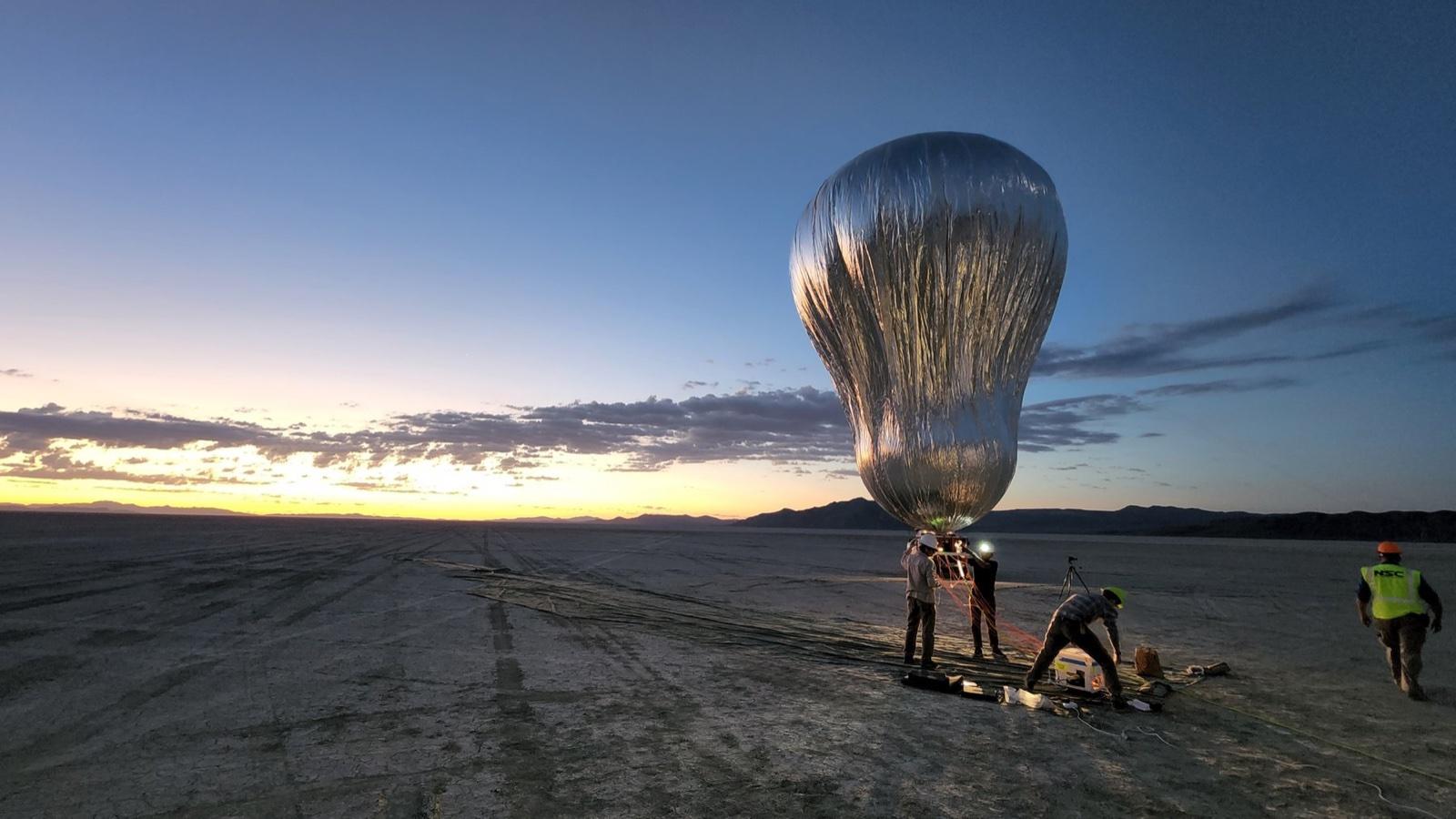
JPL's aerobot has flown, on Earth. JPL and Near Space Corporation built a two-part balloon: an inner helium reservoir and an outer envelope, with helium pumped between them to change buoyancy and so altitude, and a Teflon skin to resist sulfuric acid. A one-third scale prototype, about 4 m across, flew twice over the Black Rock Desert in Nevada in July 2022, climbing more than 1 km to air whose temperature and density resemble the Venus cloud layer around 55 km. The full-size version would be 12 m across and carry about 100 kg for 100 days or more. The idea continues on paper: at the March 2026 Lunar and Planetary Science Conference, an MIT-led team that included JPL engineers modelled a 12.5 m super-pressure aerobot that would replace leaking helium with carbon monoxide and oxygen split from the carbon dioxide air, giving a nominal design life of ten years against four months for a helium-only reference balloon.
Nothing on this page has a ride yet. NASA's budget request of April 2026 for fiscal year 2027 would cancel DAVINCI and VERITAS and the American part of EnVision, and would also remove the Venus Technology line, the small account that proves out hardware for future Venus missions, according to The Planetary Society, which identified most of the request's proposed terminations from line items missing from it and said NASA had not answered requests to confirm them. Congress had not settled that budget by early November 2026; a stopgap law holds 2026 spending levels until 11 December. The concepts remain a library to borrow from: the 2020 flagship design reused the variable-altitude balloon and LLISSE, and LLISSE's electronics resurfaced in the 2025 ride-along offer.
Mission facts
Organisations
NASA (JPL, Goddard, Glenn, Ames and the NIAC programme), ESA, the Association Aéronautique et Astronautique de France and Northrop Grumman
Sample return: JPL study (1999)
One Delta IV class launch, inflatable drag device for capture, about 90 minutes on the surface, a balloon lifting a three-stage solid rocket to about 66 km, and solar electric propulsion home in about two and a half years in total.
Sample return: ESA (1998) and AAAF (2019)
ESA's assessment by G.E.N. Scoon and J.-P. Lebreton, report SCI(98)3 of June 1998, is cited in the JPL and AAAF papers, but the report itself was not found. The AAAF white paper for ESA's Voyage 2050 call has drone landers fly samples to a balloon-borne rocket at about 55 km, on two or three Ariane 64 launches; its authors say it "may be ranked" in ESA's large (L) class.
Venus Entry Probe (ESA, 2005)
Two small orbiters (905 kg and 558 kg fuelled), a 91 kg entry probe, a balloon at 55 km for about 14 days dropping 15 microprobes; 1,508 kg on Soyuz-Fregat from Kourou; reference launch November 2013.
Venus Flagship study (2009)
Orbiter, two cloud balloons and two five-hour landers (Alpha Regio, 27° S 3° E; lava flows, 47.4° S 6.5° E) on two Atlas V 551 launches in 2021; cost estimate 2.7 to 3.8 billion dollars (FY2009).
VME, Venus Mobile Explorer (Dec 2009)
Helium-filled metal bellows lifts the gondola about 3 km for roughly 220 minutes across an 8 to 16 km traverse; six hours in all; 1.1 to 1.7 billion dollars (FY2015, no rocket).
VITaL, Venus Intrepid Tessera Lander (Mar 2010)
Ring-shaped lander for rough tessera, Ovda Regio as study site, two hours on the surface; 740 million to 1.1 billion dollars (FY2015, no rocket).
VCM, Venus Climate Mission (Jun 2010)
Balloon at 55.5 km for 21 days, a mini-probe and two drop sondes, 3,948 kg on an Atlas V 551; 1,145 to 1,577 million dollars (FY2015, with rocket).
Decadal verdict (2011)
VCM appears only as an extra if budgets improved, after more Discovery money and another New Frontiers mission, and as an alternative to an Enceladus Orbiter.
Venus In Situ Explorer and New Frontiers 5
Recommended as a New Frontiers mission in all three planetary decadal surveys. NASA removed it from the draft New Frontiers 5 call in early 2023 for programmatic balance, after DAVINCI, VERITAS and EnVision; a 2025 National Academies review found its absence warranted (Finding 7) and called it a high priority for later calls.
Zephyr landsailer (NIAC)
About 250 kg, 8 m rigid sail of 12 m², 25 kg of instruments, 30-day mission over more than 30 km near the Venera 10 site; NASA/TM-2019-220004.
AREE rover (NIAC, JPL)
Proposed by Jonathan Sauder in 2015; Phase I found a purely mechanical rover impractical and a hybrid with high-temperature electronics compelling; Phase II 2017.
VAMP (Northrop Grumman)
Inflatable flying wing with L'Garde: no aeroshell, solar powered, flying in the upper and middle cloud layers for up to a year with about 100 lb of instruments. SpaceNews reported in May 2015 that Northrop Grumman was gearing up to enter it in New Frontiers.
Other NIAC Venus studies
ALIVE (2012), VIP-INSPR (Phase II 2017), LEAVES (2018), BREEZE and power beaming (2019), cloud sample return (2022), a heat-exchange aircraft (report 2024), sample return with Venus-made propellant (2024).
PSDS3 smallsats (Mar 2017)
Ten studies announced, 3.6 million dollars in all, for craft under 180 kg; the Venus pair were Cupid's Arrow (30 kg atmosphere skimmer) and CUVE (12-unit ultraviolet CubeSat).
Venus Bridge (Apr 2018)
Answer to "What can you do for $200M?": Glenn's V-BOSS orbiter and 117-day lander priced at 201 million dollars; JPL ran eight architecture studies.
SAEVe (2017 to 2018)
Two LLISSE-based stations 300 to 800 km apart, 120 days each, with seismometers; presented at a Venera-D meeting in Moscow in October 2018 as a potential Venera-D element.
LLISSE (NASA Glenn)
About 10 kg and 20 cm, silicon carbide electronics, high-temperature battery, about 60 Earth days; independent review (May 2025): TRL 6 possible within four years on the budget presented.
Venus Flagship study (2020)
Orbiter, tessera lander with LLISSE, 60-day aerobot at 52 to 62 km and two smallsats on one Falcon Heavy in June 2031; 3.7 billion dollars (2025).
JPL aerobot
Two-part helium balloon that changes altitude; one-third scale prototype flew twice in July 2022; full size 12 m across, meant to circle Venus for at least 100 days.
Status (as of 4 Nov 2026)
None funded for flight. NASA's FY2027 request (3 April 2026) names no Venus mission and no Venus technology line, which The Planetary Society's analysis of 23 April 2026 reads as ending DAVINCI, VERITAS, the US part of EnVision and the Venus Technology line; the same request schedules the fifth New Frontiers call for FY2027 and its selection for FY2029. No FY2027 NASA appropriation had passed by 4 November 2026; a continuing resolution holds FY2026 rates to 11 December 2026.
Mission timeline
- June 1998ESA's Venus Sample Return Assessment Study Report, SCI(98)3, by Scoon and Lebreton.
- February 1999JPL and Team X describe a single-launch Venus surface sample return with a balloon-lifted rocket.
- 2005ESA completes the Venus Entry Probe technology reference study.
- By May 2009The Venus Science and Technology Definition Team, commissioned in January 2008, completes its Venus Flagship Design Reference Mission report (the archived file is dated 1 May 2009).
- 18 Dec 2009 to June 2010Decadal survey studies of VME, VITaL and the Venus Climate Mission are completed.
- 2011Vision and Voyages recommends three flagships elsewhere; VCM is listed only as a possible addition if budgets improve.
- 11 May 2015SpaceNews reports Northrop Grumman readying VAMP for NASA's next New Frontiers competition.
- 23 March 2017NASA selects PSDS3 smallsat studies, among them Cupid's Arrow and CUVE for Venus.
- 25 August 2017JPL profiles AREE, the clockwork-inspired rover that NIAC funded for study (NIAC lists it among its 2017 Phase I and Phase II selections).
- Late August to late October 2017Four LLISSE chemical sensors (sulfur dioxide, carbon monoxide, carbonyl sulfide, hydrogen fluoride) run through a 60-day test in NASA Glenn's GEER chamber at Venus conditions; the dates come from the test record in a 2025 Glenn review.
- 20 April 2018VEXAG's Venus Bridge report answers the 200 million dollar question.
- 31 January 2019The Venera-D joint science team's Phase II report baselines a NASA LLISSE on the Russian lander.
- 8 August 2020The 2020 Venus Flagship Mission study is delivered to the decadal survey.
- By August 2021LLISSE electronics run through a 60-day test at Venus surface conditions in NASA Glenn's GEER chamber.
- 19 April 2022Origins, Worlds, and Life, the decadal survey for 2023 to 2032, picks the Uranus Orbiter and Probe and an Enceladus Orbilander as new flagships, keeping a Venus In Situ Explorer as a New Frontiers theme.
- July 2022JPL and Near Space Corporation fly the one-third scale aerobot prototype twice over the Black Rock Desert, Nevada.
- Early 2023NASA leaves the Venus In Situ Explorer out of its draft call for the fifth New Frontiers mission, for programmatic balance after DAVINCI, VERITAS and EnVision; a National Academies review agrees in 2025.
- May 2025NASA Glenn offers a 15 to 50 kg long-lived lander as a ride-along; an independent team judges TRL 6 reachable in four years given the budget profile presented to NASA.
- 3 April 2026NASA's FY2027 budget request is released; The Planetary Society's analysis of 23 April finds it would remove the Venus Technology line along with DAVINCI, VERITAS and the US part of EnVision.
- July 2026NIAC selects CANVAS, a rolling Venus rover concept led by David Bugby at JPL, for a nine-month Phase I study.
A filled dot marks something that physically happened. A hollow one marks an announcement, a naming or a target.
In pictures
Tap a photo to enlarge.
Sources
- Sweetser et al., Venus Surface Sample Return: A Weighty High-Pressure Challenge (JPL, 1999), NTRS
- Valentian, Koppel, Mairet and Mairet, Venus sample return mission revisited (AAAF white paper for ESA Voyage 2050, 2019)
- Landis, Oleson and Colozza, A Conceptual Architecture for Venus Surface Sample Return (ASCEND 2024), NTRS
- Seager et al., Venus Atmosphere and Cloud Particle Sample Return for Astrobiology, NIAC Phase I final report, NTRS
- ESA Science and Technology, Venus Entry Probe technology reference study
- Venus Flagship Mission Study, final report of the Venus STDT (April 2009), archived copy
- Balint et al., Summary of NASA's Flagship Class Venus Mission Study (EGU 2009)
- Venus Mobile Explorer, mission concept study report to the NRC decadal survey (December 2009)
- Venus Intrepid Tessera Lander, mission concept study report (March 2010)
- Venus Climate Mission, mission concept study report (June 2010)
- National Research Council, Vision and Voyages for Planetary Science 2013-2022, executive summary
- National Academies, Origins, Worlds, and Life, summary
- National Academies, Report Identifies Priority Planetary Science Missions, Planetary Defense Efforts, and Strategic Investments for the Next Decade (news release, 19 April 2022)
- NASA 2018 Autonomy Workshop, Venus Design Reference Mission reports
- Landis et al., NIAC Phase 1 Final Report: Venus Landsailer Zephyr, NASA/TM-2019-220004
- NASA NIAC, Automaton Rover for Extreme Environments (AREE)
- JPL, A Clockwork Rover for Venus (25 August 2017)
- Paul et al., Advanced Lithium Ion Venus Explorer (ALIVE), COMPASS/NIAC, NTRS
- NASA NIAC, Venus Interior Probe Using In-situ Power and Propulsion (VIP-INSPR)
- Balcerski et al., LEAVES: Lofted Environmental and Atmospheric Venus Sensors, NTRS
- NASA NIAC, BREEZE
- NASA NIAC, Power Beaming for Long Life Venus Surface Missions
- Lemke et al., Heat-Exchange Driven Aircraft for Low Altitude and Surface Exploration of Venus, Phase 1 final report, NTRS
- Landis, Venus Sample Return Using In-situ Propellant (NIAC, 2024), NTRS
- Northrop Grumman, Venus Atmospheric Maneuverable Platform (VAMP)
- SpaceNews, Venus Plane Pushed for Next NASA New Frontiers Mission (11 May 2015)
- JPL, NASA Selects CubeSat, SmallSat Mission Concept Studies (23 March 2017)
- NASA, NASA Studies CubeSat Mission to Solve Venusian Mystery (15 August 2017)
- Bienstock et al., Cupid's Arrow: An Innovative Nanosat to Sample Venus' Upper Atmosphere, NTRS
- Wallace et al., VAMOS: A SmallSat Mission Concept for Remote Sensing of Venusian Seismic Activity from Orbit, NTRS
- Kremic et al., SAEVe (VEXAG 2017 abstract), NTRS
- Kremic et al., SAEVe: A Long-Lived Lander Concept for Venus (VEXAG 2018), NTRS
- VEXAG, Venus Bridge Summary Report (20 April 2018)
- NASA Glenn, LLISSE fact sheet (November 2017)
- Kremic, LLISSE Accomplishments (August 2021), NTRS
- Kremic, High-Temperature Lander Systems and Payloads Capability Summary (May 2025), NTRS
- Hunter et al., Sensor System Development for Long-Lived Venus Surface Lander Applications (IPM-6, August 2025), NTRS
- Venera-D Joint Science Definition Team, Phase II Final Report (31 January 2019), IKI
- MIPT Za nauku, Venera-D: the first long-lived mission to Venus (8 November 2018) · in Russian
- Gilmore, Beauchamp et al., Venus Flagship Mission Decadal Study Final Report (8 August 2020)
- JPL, JPL's Venus Aerial Robotic Balloon Prototype Aces Test Flights (10 October 2022)
- Turner, Izraelevitz et al., Prototype Development of a Variable Altitude Venus Aerobot (2021), NTRS
- Horn et al., Science Opportunities for Long-Lived Venus Aerial Robotic Platforms Enabled by ISRU (LPSC 2026, abstract 1291)
- The Planetary Society, Analyzing the FY 2027 NASA budget request (23 April 2026)
- Venus In-Situ Cloud Explorer Mission Concept (JPL white paper written after the June 2021 VERITAS, DAVINCI and EnVision selections, NASA-hosted)
- van den Berg, Falkner et al., ESA Venus Entry Probe Study (2nd International Planetary Probe Workshop, 2005), NTRS
- Kremic, A Potential Venera-D Element: SAEVe (Venera-D meeting, Moscow, 5 October 2018), NTRS
- National Academies, Proposed Science Themes for NASA's Fifth New Frontiers Mission (2025), chapter 3
- NASA, FY 2027 President's Budget Request, full budget estimates (April 2026)
- NASA NIAC, Combinatory Architecture offering Neomobility, on-Venus Adaptability, and Survivability (CANVAS), 2026 Phase I
- JPL, NASA Awards 2026 Innovative Technology Concepts (29 July 2026)
- Public Law 119-103, Continuing Appropriations and Extensions Act, 2027 (2 September 2026)
Facts on this page were verified on 4 November 2026. Where sources disagree, the disagreement is stated rather than resolved silently.
azmth is independent and is not affiliated with or endorsed by NASA, Roscosmos, NPO Lavochkin, ESA, JAXA, ISRO, CNSA, or any other space agency or company named on this page.