China and Venus
CNSA and the Chinese Academy of Sciences · China · Programme · 2030 · Announced Planned
No Chinese spacecraft has gone to Venus yet. China's 2024 space science plan names a Venus atmosphere sample return for 2028 to 2035, and route studies for Tianwen-4, its Jupiter mission, pass Venus in April 2030.
TL;DR· 20 min read
China has sent no spacecraft to Venus. Its 2024 national space science plan names a Venus atmosphere sample return for 2028 to 2035, and a 2025 roadmap slide puts the launch around 2033. Published route studies take Tianwen-4 past Venus in April 2030 on its way to Jupiter. VOICE, a small Venus orbiter proposed by the Chinese Academy of Sciences, was reviewed in 2022 for a 2026 launch and did not fly.
Has China sent a spacecraft to Venus?
China has not sent a spacecraft to Venus yet, and it has announced no approved mission to Venus. Its national space science plan of October 2024 names a Venus atmosphere sample return for the years 2028 to 2035, and a 2025 roadmap slide gives that mission a launch around 2033. Tianwen-4, China's Jupiter mission, passes Venus in April 2030 in two published route studies. An earlier proposal for a small Venus radar orbiter, VOICE, was reviewed in 2022 for a 2026 launch and did not fly. This page follows each of them, with the statements, research funding and ground observations around them.
Facts as of 4 November 2026, from the sources listed below.
- 0Chinese spacecraft sent to Venus as of 4 November 2026 (McDowell's catalogues, updated 2 November 2026)
- 2028 to 2035plan phase naming a Venus atmosphere sample return; a March 2025 roadmap slide gives launch around 2033
- April 2030Venus flyby in two published Tianwen-4 trajectory studies (4 April or 11 April); no official date or distance
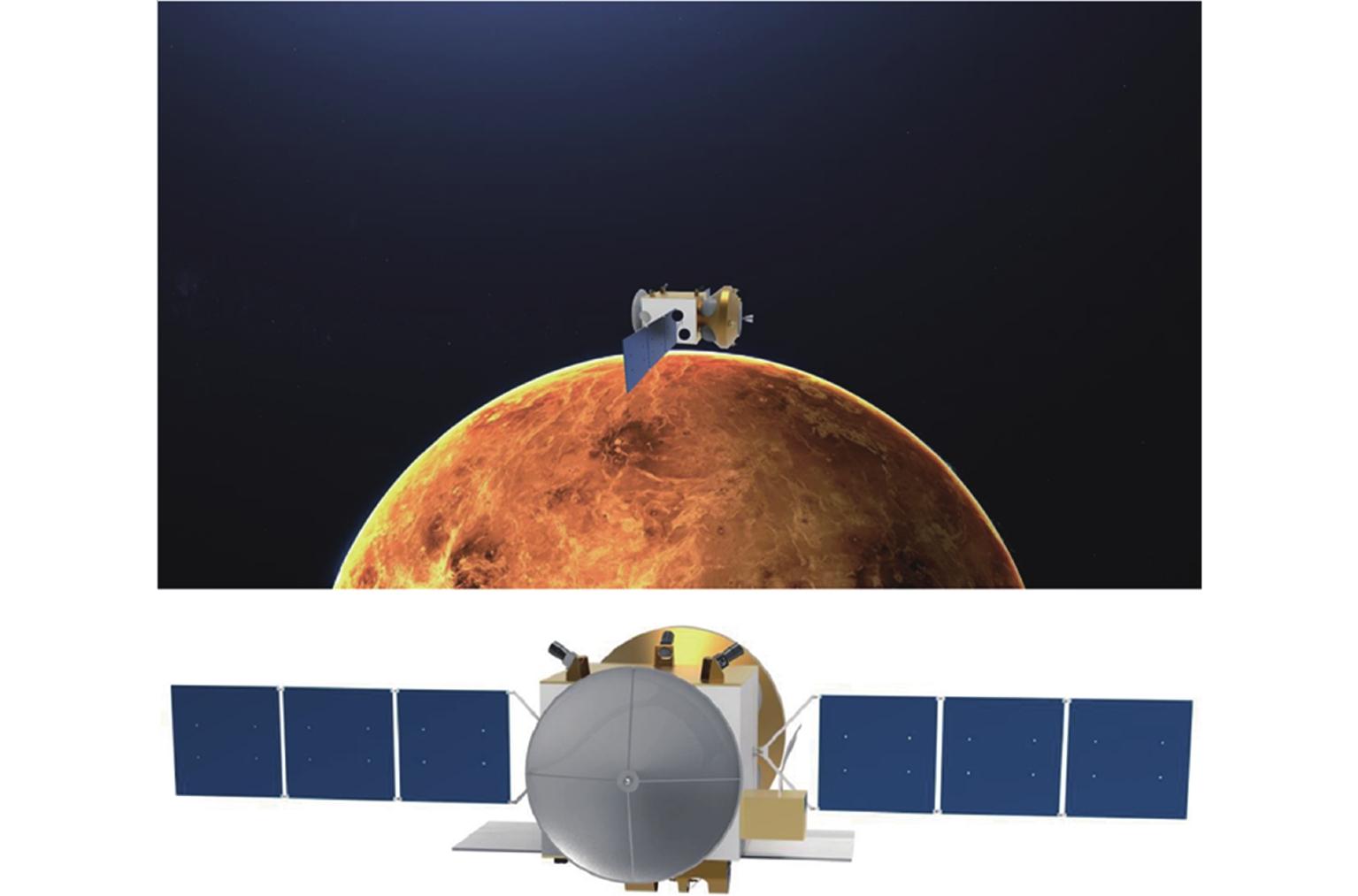
No Chinese spacecraft has yet been sent to Venus. Jonathan McDowell's catalogues of deep-space and heliocentric objects, both regenerated on 2 November 2026, list the Chinese payloads that have left Earth orbit: lunar craft (the Chang'e and Queqiao series among them), Chang'e-2, which went on to the asteroid Toutatis, the Chang'e-5 orbiter, now in solar orbit, Tianwen-1 at Mars and Tianwen-2, sent to a near-Earth asteroid. None has Venus as its destination. China's connection with Venus lives on paper and on the ground: an orbiter proposal that competed for funding in 2022 and was not taken forward, a sample return written into the national space science plan, a Jupiter mission whose published trajectories swing past Venus, statements by senior engineers, some research money, and radio telescopes that followed a European spacecraft behind the planet.
English reporting tends to blur the steps of Chinese planning language. Argumentation is studying and justifying a mission; project approval is the decision that turns a study into a funded project; implementation follows. China's 2024 national plan asks for five to eight science missions to be 'argued and approved' by 2027. For 2028 to 2035 it names five programmes to be 'argued and implemented', Venus atmosphere sample return among them, separately from about fifteen science satellite missions. No Venus item on this page has been reported as reaching project approval.
Talk of a Chinese Venus mission is older than any Chinese hardware beyond the Moon. On 16 September 2010, at the 2010 Space Engineering Breeding Forum, the academician Ye Peijian, adviser to the chief designer and chief commander of the Chang'e-2 lunar orbiter, sketched what Science and Technology Daily called the deep space timetable 'in his own eyes': Mars in 2013, Venus in 2015 and a crewed Moon landing in 2025. He proposed exploring Venus in parallel with Mars and listed a Venus orbiter among the goals for 2020. It was a personal proposal and was not adopted on that schedule; China's Mars mission Tianwen-1 left Earth on 23 July 2020.
Engineers kept the idea alive in print. In 2015 the National Defense Industry Press published Deep Space Exploration: Venus Exploration, a book by Hou Jianwen, Yang Guang, Feng Jianjun and colleagues. After chapters on the Soviet, American, European and Japanese missions, it devotes a chapter each to a Venus orbiter (with a section on a Chinese Venus concept), a mission floating in the atmosphere and a surface and roving mission, then sets out key technologies. The catalogue pages consulted do not give the authors' institution, and no agency is recorded adopting these concepts.
Official remarks grew more specific a decade later without becoming commitments. In March 2022 Wu Weiren, chief designer of China's lunar exploration programme, said that China was preparing to explore other planets 'for example Venus', adding that 'some missions have already been included in planning and argumentation'. At the Tiandu International Conference on Deep Space Exploration on 25 April 2023, Wu Yanhua, chief designer of the deep space exploration major project, said China 'will argue Venus and Mercury missions'. The same conference gave the Queqiao relay constellation a Venus role in two readings: Beijing Daily's account of Wu Yanhua's talk puts Mars and Venus coverage in its third phase, before 2050, while The Paper's account of Wu Weiren's lunar research station keynote has it built by 2040 to serve exploration of Mars, Venus and beyond.
Russia offered a partnership. In late February 2022, after new American sanctions, Roscosmos head Dmitry Rogozin declared US participation in Venera-D impossible and said Russia would carry out the mission alone or bring China in; according to the TASS report carried by Naked Science on 27 February, he had instructed on 25 February that talks with Beijing begin, covering Venus and other deep space projects. No Chinese statement taking up the offer was found, nor any later joint Venus project.
VOICE, the Venus Volcano Imaging and Climate Explorer, was a proposal for a small Venus orbiter led by Dong Xiaolong, a researcher at the National Space Science Center (NSSC) of the Chinese Academy of Sciences, with the CAS Aerospace Information Research Institute, the CAS Institute of Geochemistry and the CAS Innovation Academy for Microsatellites. It sat outside CNSA's Tianwen programme and grew out of concept studies funded by CAS's Strategic Priority Program on Space Science, which by November 2025 had launched eight science satellites, among them the Wukong dark matter explorer and the Kuafu-1 solar observatory.
On 9 July 2022 NSSC convened an expert consultation on the proposal's science goals and payload. Eight academicians and nearly twenty specialists took part, from universities including Peking University and National Central University in Taiwan, the national science foundation and CAS institutes. Their written conclusion called the science objectives clear and the design internationally competitive, and 'recommended approving and implementing the project as soon as possible, to seize the opportunity in international competition'. They also suggested broadening the search for signs of life, extending radio occultation and using orbit tracking to measure Venus's gravity. NSSC's report of the meeting gave the schedule as launch in 2026 and entry into Venus orbit in 2027.
Three instruments were proposed. An S-band polarimetric synthetic aperture radar would image the whole surface at about 30 m and selected areas at metre scale, which NSSC described as the first metre-resolution radar imaging of Venus. A microwave sounder looking both down and at the limb, from microwave to terahertz bands, would measure temperature and composition below and within the clouds, including a search for phosphine and ammonia. An ultraviolet to near-infrared imager would track the clouds, see the surface through near-infrared windows and watch for lightning. Paul Byrne of Washington University in St. Louis told the Planetary Society that none of Magellan, VERITAS or EnVision carries a fully polarimetric radar. The science themes were volcanism and thermal history, past water and plate motion, the runaway greenhouse and possible habitable conditions in the clouds (see Life on Venus).
Orbit and timeline come in two versions. The journal paper by Dong Xiaolong and ten co-authors, published online on 1 December 2022, gives a polar circular orbit of about 350 km. The Planetary Society's account of Dong's talk at the Europlanet Science Congress in September 2022 has launch in June 2026, arrival in Venus orbit in December 2026, aerobraking down to a circular 300 km orbit, science from April 2027 and a primary mission of three to four years; NSSC's 'Venus orbit in 2027' may count the start of science. Mass and launcher appear in one unofficial place, a Weibo post by the account China Spaceflight on 8 March 2023: about three months of aerobraking to 350 km, saving 450 kg of propellant, a total mass of 2,081 kg and a Long March 3B launch. No NSSC or CAS source found confirms those figures.
VOICE was one of 13 candidates for the third phase of the Strategic Priority Program, for implementation from 2025 to 2030. Three rivals shared its planetary and Earth science group, and a panel was to choose five to seven missions across all groups. In December 2022 the journal paper still described VOICE as 'taking part in selection'. Then the record goes quiet: the national plan of October 2024 lists the mission directions for its first stage, and none is at Venus. On 24 November 2025 NSSC said that in the 15th Five-Year Plan period (2026 to 2030) it would carry out a science satellite programme 'including' Hongmeng, Kuafu-2, the Earth 2.0 exoplanet survey and the eXTP X-ray observatory. Earth 2.0 had been one of VOICE's fellow candidates in 2022; VOICE is not named. No Chinese source found says it was selected, rejected or cancelled, or why, although English Wikipedia files it under cancelled missions. June 2026, its launch month, passed without a Chinese launch toward Venus. This page records VOICE as proposed and not taken forward, with no stated reason.
The Venus goal still in the national plan is larger and further away. On 15 October 2024 the Chinese Academy of Sciences, the China National Space Administration and the China Manned Space Engineering Office jointly released the National Medium and Long Term Development Plan for Space Science (2024 to 2050). Venus appears once in its text. In the second stage, 2028 to 2035, China is to operate its space station and 'argue and implement' science missions including crewed lunar exploration, the lunar research station, exploration of the edge of the solar system, exploration of the giant planet systems and Venus atmosphere sample return. The plan gives no launch year, no architecture and no implementing organisation. A year later, NSSC director Wang Chi's anniversary article of 16 October 2025 repeated the list with no Venus progress, and no source found up to 4 November 2026 names an implementing institute, chief designer or hardware.
Hou Zengqian, a CAS academician and chief scientist of China's planetary exploration programme and of the Tianwen-3 Mars sample return, spelled out the scientific case. Speaking in Wuhan on 17 November 2024, he proposed searching for life in three settings: the land of Mars, the atmosphere of Venus and the oceans of the icy moons. His roadmap, as Jimu News reported it, proposed a ground simulator of planetary habitable environments at the very start of the 2030s, a Venus atmosphere sample return in the early 2030s, the first Mars research station mission after the mid-2030s and a Neptune and Triton mission in the late 2030s. Jimu News reported his aim as providing a reference for the top-level design of planetary missions after 2030; each step is worded as a suggestion.
Two photographed slides show what the concept looks like. On 26 and 28 March 2025 Andrew Jones posted them on Bluesky; the roadmap carries the logo of the Deep Space Exploration Laboratory, and IEEE Spectrum described the material as a presentation shared on Chinese social media. The roadmap, headed 'Habitability and the search for extraterrestrial life: leading the future development of China's planetary exploration', and subtitled as a reference for follow-on planetary missions, shows Tianwen-3 launching around 2028 and Tianwen-4 around 2029, each marked 'approved by the central government'. After them, inside a dashed box and without that note, come a large ground facility simulating planetary habitable environments, to be built around 2030, 'sampling and return of potential microbes in the Venus atmosphere' launching around 2033, a Mars research station around 2038 and a Triton mission around 2039, the same order as Hou Zengqian's Wuhan roadmap, whose stated aim the subtitle echoes. The concept slide is titled 'Venus orbit, land and return integrated exploration', borrowing the formula of China's lunar programme, yet none of its ten numbered steps reaches the surface: launch, transfer, orbital observation, release, sampling the atmosphere at several points, floating in it, rendezvous in Venus orbit to hand over the sample, departure, cruise home and re-entry. It draws the sampling probe as a winged aircraft above the clouds and the return craft as an orbiter and returner stack, module names that McDowell's catalogue also records for Chang'e-5. It names the goals (possible traces of life, the evolution of the Venus environment, the unknown ultraviolet absorber in the clouds) and the main payloads, an atmosphere collection device and in situ gas analysers.
Readings of the date differ, and they measure different things. The national plan gives a phase, 2028 to 2035, and the verb pair 'argue and implement', which records no project approval. Hou Zengqian proposes 'the early 2030s'. The roadmap slide gives a launch 'around 2033'. EarthSky's May 2025 summary that China wants samples on Earth 'by 2033' reads the launch year as the return year. IEEE Spectrum set out the engineering problems in May 2025 with researchers from MIT, where Sara Seager's team studied a Venus atmosphere sample return for NASA in 2022; the magazine says NASA did not select the mission proposal (see Venus Life Finder): the clouds are mostly droplets of sulfuric acid, a craft inside them sees neither stars nor surface to fix its position, and an ascent rocket must climb out of unknown, possibly windy conditions to meet an orbiter. MIT's design called for 22 tons of spacecraft to return 10 grams of atmosphere, and no mission has yet brought material back from Venus.
Tianwen-4 is the Jupiter mission of CNSA's planetary exploration programme. At the International Astronautical Congress in Paris on 21 September 2022, Wang Qiong of CNSA's Lunar Exploration and Space Engineering Center described it as a launch around 2030 on a Long March 5, carrying a main probe for Jupiter and a sub-probe for a Uranus flyby; the 2018 trajectory study and a 2025 roadmap slide both include an orbit around Callisto. Its status has firmed since. CNSA deputy administrator Bian Zhigang said, as People's Daily's overseas edition reported on 3 March 2025, that Tianwen-3 and Tianwen-4 were intensifying work on key technologies and refining their study and implementation plans; the roadmap slide marks Tianwen-4 as approved by the central government; Wang Chi's article of October 2025 lists it among missions being advanced; on China Space Day, 24 April 2026, Guan Feng, director of the China Lunar Exploration and Space Center, said Tianwen-4 'is also within the plan' and will explore Jupiter and its moons; and at the 2026 congress in Antalya, as CNSA reported on 9 October, its chief engineer Li Guoping named 'Tianwen-4 Jupiter system exploration' among missions offering international partners room for payloads. None of these statements mentions Venus.
The Venus leg comes from engineers. At the 2022 Paris congress Wang Jilian of the China Academy of Space Technology said the probe would fly past Venus once and Earth twice and use the gravitational slingshot to reach Jupiter. Two published trajectories, optimised by separate teams for different launch dates, put numbers on it. Zhang Lei and four colleagues at the Beijing Institute of Spacecraft System Engineering, writing in Spacecraft Engineering in 2018, compared gravity-assist sequences for launches from 2029 to 2033 and chose Venus, Earth, Earth. Their optimum launches on 25 September 2029, passes Venus on 4 April 2030 at a flyby altitude of 6,011.35 km, passes Earth in February 2031 and May 2033, and reaches Jupiter on 23 December 2035. The 'Gan De' science study by Michel Blanc, Wang Chi and colleagues from Chinese and French institutes, shown at the European Geosciences Union meeting in May 2020, launches on 2 October 2029, passes Venus on 11 April 2030 at 12,716 km and arrives at Jupiter on 15 August 2035. Neither is a CNSA baseline, and no 2025 or 2026 official source confirms the flyby, its date or its distance.
If the flyby is kept, Chinese hardware will pass Venus about three years before the launch year the 2025 roadmap slide gives the sample return. A December 2023 paper by Zou Xin and colleagues at the Beijing Institute of Spacecraft System Engineering, in Chinese Space Science and Technology, proposes, in a preliminary concept for the mission, measuring the solar wind and magnetic field in interplanetary space from Venus to Earth to Jupiter and on to Uranus. Other spacecraft that used Venus this way are on the Venus flybys page.
Research money for Venus preparation has been offered at a small scale. On 14 September 2024 the National Natural Science Foundation of China published a special call, 'Lunar and deep space exploration science research (II)', with eleven research topics. Topic 9 compares atmospheric escape at Venus and Mars 'to provide a basis for the argumentation and planning of future Venus and Mars exploration science missions'. Topic 11 asks for a spaceborne microwave to terahertz radiometer design aimed at the habitable zone and biosignature gases of the Venus clouds and at Jupiter, 'to provide technical support for China's future Venus and Jupiter exploration'. VOICE proposed the same kind of instrument; the call does not mention it. The call planned about eight medium projects across all eleven topics, averaging no more than 3 million yuan (about €400,000) in direct costs each and running from 2025 to 2028; the funded teams were not identified.
Chinese researchers have also argued in print that the country should move. Han Lin and colleagues at the CAS Institutes of Science and Development, reviewing foreign Venus programmes in 2024, concluded that China should seize the moment and start deploying Venus missions as soon as possible. Zhang Xiwen and Li Qi of the Institute of Geophysics of the China Earthquake Administration, in a 2025 review, proposed a phased national strategy: orbiters with small descent probes within ten years, aerial platforms around 2040, and landing, roving and a study of sample return from 2040 to 2050, calling the decade to 2030 the key period for China to begin. Both are academic recommendations, and the second misdescribes some foreign missions (it calls VERITAS a surface probe), so it is cited here for its proposal alone.
Ground antennas in China have already helped sound Venus's atmosphere through someone else's spacecraft. Radio telescopes of CAS's Shanghai and Xinjiang observatories took part in the PRIDE sessions that recorded the carrier signal of ESA's Venus Express as it passed behind Venus. The 2019 analysis in Astronomy and Astrophysics lists Sheshan (25 m), Nanshan near Urumqi (25 m) and the 65 m Tianma near Shanghai among the stations, and reports that in the session of 23 March 2014 Tianma held the signal through a complete occultation, including the time when the planet's disk fully hid the spacecraft, because the thick atmosphere bent the signal so strongly.
What would change this page is any of three announcements: project approval for the Venus sample return, or the naming of its institute and chief designer; an official Tianwen-4 trajectory, which would settle whether the April 2030 flyby is in the flight plan; and a word from CAS on what happened to VOICE. None had appeared by 4 November 2026 in CNSA's news index (latest item 26 October), NSSC's news pages or McDowell's catalogues of 2 November.
Mission facts
Organisations
China: CAS National Space Science Center (VOICE proposal); CAS, CNSA and the China Manned Space Engineering Office (national space science plan naming a Venus atmosphere sample return); CNSA planetary exploration programme (Tianwen-4); Deep Space Exploration Laboratory (roadmap slides)
Status (as of 4 Nov 2026)
No Chinese spacecraft has been sent to Venus: McDowell's heliocentric catalogue, updated 2 November 2026, lists the Chinese payloads that have flown in solar orbit (Chang'e-2, the Chang'e-5 orbiter, Tianwen-1 and Tianwen-2), none with Venus as its destination. No dedicated Chinese Venus mission has been reported as approved.
National plan
National Medium and Long Term Development Plan for Space Science (2024 to 2050), released 15 October 2024 jointly by CAS, CNSA and the China Manned Space Engineering Office. Venus appears once in its text.
Sample return: plan wording
Second stage, 2028 to 2035: 'argue and implement' science missions including a Venus atmosphere sample return. No launch year, architecture or implementing body is given.
Sample return: date readings
Plan: phase 2028 to 2035. Hou Zengqian (17 Nov 2024): proposed for the early 2030s. Deep Space Exploration Laboratory roadmap slide (posted 26 Mar 2025): launch around 2033.
Sample return: concept
A photographed presentation slide shows a winged sampling probe that samples the atmosphere at several points and floats in it, and an orbiter and returner stack that meets the sample in Venus orbit and brings it to Earth. Payloads: an atmosphere collection device and in situ gas analysers.
Sample return: science goals
Possible traces of life, the evolution of the Venus environment, material and energy cycles in the atmosphere, and the cause of the unknown ultraviolet absorber in the clouds (concept slide).
VOICE: proposer
CAS National Space Science Center, project lead Dong Xiaolong, with the CAS Aerospace Information Research Institute, Institute of Geochemistry and Innovation Academy for Microsatellites. A candidate for phase III of the CAS Strategic Priority Program on Space Science.
VOICE: payloads
S-band polarimetric SAR (global imaging at about 30 m, metre scale in selected areas); nadir and limb microwave to terahertz sounder (below-cloud structure, phosphine and ammonia); ultraviolet to near-infrared multispectral imager (clouds, surface windows, lightning).
VOICE: orbit
Polar circular orbit of about 350 km (journal paper, 2022). The Planetary Society's account of the EPSC 2022 talk gives aerobraking down to a circular 300 km orbit.
VOICE: schedule proposed
NSSC (July 2022): launch 2026, Venus orbit 2027. EPSC 2022 talk as reported: launch June 2026, orbit insertion December 2026, science from April 2027, primary mission three to four years.
VOICE: mass and launcher (unofficial)
2,081 kg on a Long March 3B, with about three months of aerobraking saving 450 kg of propellant, per an unofficial Weibo post of 8 March 2023. Not confirmed by any NSSC or CAS source found.
VOICE: outcome
One of 13 SPP-III candidates in 2022. Not named in NSSC's list of 24 November 2025 for 2026 to 2030 (Hongmeng, Kuafu-2, Earth 2.0, eXTP). No Chinese source found says it was selected or cancelled. No launch in June 2026.
Tianwen-4: status
Jupiter and Callisto mission of CNSA's planetary programme. Marked 'approved by the central government' on a laboratory slide posted in March 2025. On 24 April 2026 Guan Feng said it 'is also within the plan' and will explore Jupiter and its moons; on 9 October 2026 CNSA reported its chief engineer Li Guoping naming 'Tianwen-4 Jupiter system exploration' among missions offering international partners room for payloads. Neither mentions Venus.
Tianwen-4: Venus flyby, 2018 study
Beijing Institute of Spacecraft System Engineering study (Zhang Lei et al., Spacecraft Engineering 2018): launch 25 Sep 2029, Venus flyby 4 Apr 2030 at 6,011.35 km altitude, Earth flybys 18 Feb 2031 and 26 May 2033, Jupiter 23 Dec 2035.
Tianwen-4: Venus flyby, 2020 study
'Gan De' study (Blanc, Wang Chi et al.): launch 2 Oct 2029, Venus flyby 11 Apr 2030 at 12,716 km altitude, Earth flybys 15 Feb 2031 and 23 May 2033, Jupiter 15 Aug 2035.
Tianwen-4: proposed cruise science
A preliminary concept proposes measuring the solar wind and interplanetary magnetic field from Venus to Earth to Jupiter and on to Uranus (Zou Xin et al., Beijing Institute of Spacecraft System Engineering, Chinese Space Science and Technology, December 2023).
Research funding call
An NSFC call of 14 September 2024 offers funding for a Venus and Mars atmospheric escape study and a spaceborne terahertz radiometer for the Venus clouds, projects to run 2025 to 2028; which teams won was not found.
Relay coverage
The Queqiao relay and navigation constellation is to cover Mars and Venus in its third phase, before 2050 (Wu Yanhua, 25 April 2023); The Paper's account of the lunar station plan puts the constellation, serving Mars and Venus, by 2040.
Mission timeline
- 16 Sep 2010Academician Ye Peijian proposes, as his own timetable, Venus exploration in 2015 alongside Mars. It is not adopted.
- 23 Mar 2014The 65 m Tianma radio telescope records ESA's Venus Express through a complete occultation behind Venus, in a PRIDE session.
- 2015The book Deep Space Exploration: Venus Exploration sets out orbiter, floating and surface mission concepts.
- 2018A Beijing Institute of Spacecraft System Engineering trajectory study for China's Jupiter mission picks a Venus, Earth, Earth route with a Venus flyby on 4 April 2030.
- May 2020The 'Gan De' Jupiter study shown at EGU 2020 has a Venus flyby on 11 April 2030 at 12,716 km.
- 24 Mar 2022Science and Technology Daily reports Wu Weiren saying China is preparing to explore planets 'for example Venus' and that some missions are in planning and argumentation.
- 9 Jul 2022NSSC expert review of VOICE recommends approving it as soon as possible; launch planned for 2026.
- 21 Sep 2022At the IAC in Paris, CAST's Wang Jilian says Tianwen-4 will fly past Venus once and Earth twice.
- 1 Dec 2022The VOICE paper is published, describing the mission as a candidate still in selection.
- 25 Apr 2023Wu Yanhua says China will argue Venus and Mercury missions; Queqiao relay coverage of Venus is planned before 2050.
- 14 Sep 2024NSFC call offers funding for Venus terahertz sounder technology and a Venus and Mars escape study, for 2025 to 2028.
- 15 Oct 2024The national space science plan names a Venus atmosphere sample return for its 2028 to 2035 stage.
- 17 Nov 2024Hou Zengqian proposes the Venus atmosphere sample return for the early 2030s.
- 26 to 28 Mar 2025Photographs of a Deep Space Exploration Laboratory roadmap slide, posted on Bluesky, give the Venus sample return a launch around 2033; a second slide shows its concept.
- 24 Nov 2025NSSC names its science satellite programme for 2026 to 2030; no Venus mission is on it.
- 24 Apr 2026Guan Feng says Tianwen-4 is within the plan and will explore Jupiter and its moons; Venus is not mentioned.
- June 2026VOICE's proposed launch month passes with no Chinese launch toward Venus (McDowell's catalogues to 2 November 2026).
- 9 Oct 2026CNSA reports that at the International Astronautical Congress in Antalya its chief engineer Li Guoping named Tianwen-4 Jupiter system exploration among missions offering international partners room for payloads; Venus is not mentioned.
- April 2030 (study)Target date of Tianwen-4's Venus flyby in both published trajectory studies; not confirmed by CNSA.
A filled dot marks something that physically happened. A hollow one marks an announcement, a naming or a target.
In pictures
Tap a photo to enlarge.
Translated from the original sources
Passages from the Chinese and Russian sources this page draws on, in azmth's translation. Tap Show original to read the original wording.
NSSC news, 12 Jul 2022: VOICE expert consultation held in Beijing
Chinese · 4 passages
“The VOICE mission builds on a series of mission concept and design studies supported by the Strategic Priority Program on Space Science. Using payload technology of fairly high maturity, it is an original small space science satellite mission with strong Chinese characteristics, planned to launch in 2026 and to enter Venus orbit in 2027 for scientific exploration.”
azmth's translation · Show originalHide original
Chinese: VOICE任务以空间科学先导专项支持开展的系列任务概念和方案研究为基础,通过采用成熟度较高的有效载荷技术,是原创性的极富中国特色的小型空间科学卫星任务,计划2026年发射,2027年进入金星轨道开展科学探测。
“The advisory expert group recommended approving and implementing the project as soon as possible, to seize the opportunity in international competition and for major scientific results.”
azmth's translation · Show originalHide original
Chinese: 咨询专家组建议尽快立项实施,抢占国际竞争和取得重大科学成果的机遇。
“using surface radar imaging at metre-class resolution, achieved for the first time (NSSC's description of the proposed radar).”
azmth's translation · Show originalHide original
Chinese: 利用首次实现的米级分辨率的表面雷达成像
“The Venus volcano and climate exploration mission (VOICE) addresses major frontier scientific questions of Venus geology and climate; its science objectives are clear and of great scientific significance.”
Conclusion of the July 2022 expert consultation, as NSSC reported it.
azmth's translation · Show originalHide original
Chinese: 金星火山和气候探测任务(VOICE)面向金星地质和气候的重大前沿科学问题,凝练的科学目标明确,科学意义重大
Same paper, PDF on SciEngine
Chinese · 1 passage
Same paper, PDF on SciEngine (text searched)
Open the source“It is currently taking part in selection as a candidate space science satellite mission of the CAS Strategic Priority Program on Space Science.”
Text reassembled from the paper's two-column PDF.
azmth's translation · Show originalHide original
Chinese: 目前作为中国科学院空间科学战略性先导专项的候选空间科学卫星工程任务参加遴选。
Dong Xiaolong et al., 'Venus Volcano Imaging and Climate Explorer Mission', Chinese Journal of Space Science 42(6), 2022
Chinese · 2 passages
“to observe the global surface and atmosphere of Venus jointly from a 350 km circular orbit.”
azmth's translation · Show originalHide original
Chinese: 在350 km圆轨道上对金星全球表面和大气联合探测。
“Venus volcano and climate exploration mission.”
Chinese title of the 2022 journal paper, whose English title is 'Venus Volcano Imaging and Climate Explorer Mission'.
azmth's translation · Show originalHide original
Chinese: 金星火山与气候探测任务
CAS, 24 Nov 2025: NSSC results briefing and 2026 to 2030 science satellite programme
Chinese · 1 passage
“During the 15th Five-Year Plan period, NSSC will organise and implement a science satellite programme including the Hongmeng project, Kuafu-2, the exo-Earth survey and the enhanced X-ray Timing and Polarimetry observatory.”
azmth's translation · Show originalHide original
Chinese: “十五五”期间,空间中心将组织实施包含鸿蒙计划、夸父二号、系外地球巡天、增强型X射线时变与偏振空间天文台在内的太空探源科学卫星计划。
CNSA: National Medium and Long Term Development Plan for Space Science
Chinese · 2 passages
CNSA: National Medium and Long Term Development Plan for Space Science (2024 to 2050), 15 Oct 2024
Open the source“Operate the China Space Station, and argue and implement science missions including crewed lunar exploration, the lunar research station, exploration of the edge of the solar system, exploration of the giant planet systems and Venus atmosphere sample return.”
Second stage, 2028 to 2035.
azmth's translation · Show originalHide original
Chinese: 运营中国空间站,论证实施载人月球探测、月球科研站、太阳系边际探测、巨行星系统探测、金星大气采样返回等科学任务。
“Argue and implement a batch of space science missions: at science frontiers including dark matter and the extreme universe, gravitational waves, protostellar clouds, exoplanets, solar activity, and solar system and Earth system exploration, argue and approve 5 to 8 space science missions, among them 2 to 3 large missions expected to produce landmark results.”
First stage, to 2027.
azmth's translation · Show originalHide original
Chinese: 论证实施一批空间科学任务,在暗物质与极端宇宙、引力波、原恒星云、系外行星、太阳活动、太阳系和地球系统探测等科学前沿,论证立项5~8项空间科学任务,其中包括有望产出标志性重大成果的大型任务2~3项。
CAS, 16 Oct 2025: Wang Chi, one year of the national space science plan
Chinese · 1 passage
CAS, 16 Oct 2025: Wang Chi, one year of the national space science plan (from Guangming Daily)
Open the source“Planetary exploration is also steadily advancing deep space missions such as the Tianwen-3 Mars sample return and Tianwen-4 Jupiter system exploration.”
Wang Chi, October 2025.
azmth's translation · Show originalHide original
Chinese: 行星探测也在有序推进天问三号火星采样返回任务、天问四号木星系探测等深空探测任务。
Jimu News, 17 Nov 2024: Hou Zengqian in Wuhan on planetary exploration after 2030
Chinese · 2 passages
“At the meeting Hou Zengqian also set out a roadmap for China's search for extraterrestrial life and habitable environments: at the start of the 2030s, it is suggested to build the basic version of a ground simulator of planetary habitable environments; in the early 2030s, it is suggested to carry out the Venus atmosphere sample return mission;”
azmth's translation · Show originalHide original
Chinese: 会上,侯增谦还提出了我国开展地外生命探寻与宜居环境研究的发展路线图:2030年代初期,建议建成行星宜居环境地面模拟装置基本型;2030年代前期,建议实施金星大气采样返回任务;
“He discussed the development path of future planetary exploration, hoping to provide a reference for the top-level design of follow-on planetary exploration missions after 2030.”
Hou Zengqian, as Jimu News reported his talk.
azmth's translation · Show originalHide original
Chinese: 探讨了未来行星探测工程的发展路径,希望为2030年后行星探测工程接续任务的顶层设计提供借鉴。
Andrew Jones on Bluesky, 26 Mar 2025: photographed Deep Space Exploration Laboratory roadmap slide
Chinese · 4 passages
“Launch around 2033. Venus exploration: sampling and return of potential microbes in the Venus atmosphere.”
Text on the photographed Deep Space Exploration Laboratory roadmap slide.
azmth's translation · Show originalHide original
Chinese: 2033年前后发射 金星探测 金星大气潜在微生物采样返回
“Launch around 2029. Tianwen-4 (approved by the central government).”
Same slide.
azmth's translation · Show originalHide original
Chinese: 2029年前后发射 天问四号(中央已批复)
“Development roadmap: with the search for extraterrestrial life and planetary habitability as its main line, to serve as a reference for follow-on missions of the planetary exploration programme.”
Subtitle of the photographed roadmap slide.
azmth's translation · Show originalHide original
Chinese: 发展路线图:以地外生命探寻与行星宜居性研究为主线,为行星探测工程接续任务提供借鉴
“Deep Space Exploration Laboratory.”
Logo on the photographed roadmap slide, which gives the name in English and Chinese.
azmth's translation · Show originalHide original
Chinese: DSEL DEEP SPACE EXPLORATION LAB 深空探测实验室
Andrew Jones on Bluesky, 28 Mar 2025: photographed Venus atmosphere sample return concept slide
Chinese · 3 passages
“Concept: Venus orbit, land and return integrated exploration.”
Title of the photographed concept slide.
azmth's translation · Show originalHide original
Chinese: 设想:金星绕-落-回综合探测
“Main payloads: a Venus atmosphere collection device, in situ gas composition analysers and others.”
azmth's translation · Show originalHide original
Chinese: 主要载荷:金星大气采集装置、原位气体成分分析装置等。
“Returner; orbiter and returner stack; orbiter.”
Labels on the spacecraft drawing of the photographed concept slide.
azmth's translation · Show originalHide original
Chinese: 返回器 轨返组合体 轨道器
Guancha, 28 Sep 2022: Tianwen-4 to Jupiter and Uranus
Chinese · 2 passages
Guancha, 28 Sep 2022: Tianwen-4 to Jupiter and Uranus (IAC 2022 talks)
Open the source“On the technical details of this deep space mission, Wang Jilian said the probe will fly past Venus once and past Earth twice, using the gravitational slingshot effect to head for Jupiter.”
azmth's translation · Show originalHide original
Chinese: 对于这项深空探测任务的技术细节,王冀莲则介绍说,探测器将分别掠过金星一次、掠过地球两次,从而借助引力弹弓效应飞向木星。
“In December 2020 the Chang'e-5 lunar probe returned to Earth with lunar samples, and the 'orbit, land, return' three-step strategy of China's lunar exploration programme was completed successfully.”
azmth's translation · Show originalHide original
Chinese: 2020年12月,嫦娥五号月球探测器成功携带月球样品返回地球,中国探月工程的“绕、落、回”三步走战略取得圆满成功。
Zhang Lei et al., 'Research on Jovian System Tour Trajectory Design', Spacecraft Engineering 2018 No. 1
Chinese · 1 passage
Zhang Lei et al., 'Research on Jovian System Tour Trajectory Design', Spacecraft Engineering 2018 No. 1 (archived text copy; Table 2 read from its image)
Open the source“The Venus, Earth, Earth (VEE) gravity-assist sequence gives a better result than Venus-Earth, Venus-Venus-Earth and other sequences in the launch windows considered.”
azmth's translation · Show originalHide original
Chinese: 得到金星-地球-地球(VEE)借力序列在所考虑发射窗口下比金星-地球、金星-金星-地球等序列借力效果更佳。
Beijing Daily
Chinese · 2 passages
Beijing Daily (from the People's Daily app), 24 Apr 2026: Guan Feng on Tianwen-3 and Tianwen-4
Open the source“He also disclosed that the Tianwen-4 mission is also within the plan and will explore Jupiter and its moons.”
Guan Feng, 24 April 2026.
azmth's translation · Show originalHide original
Chinese: 他同时透露,天问四号任务也已在计划之内,将对木星及其卫星进行探测。
“On 24 April 2026, at the opening ceremony of the main event of the 11th China Space Day, Guan Feng, director of the China lunar exploration and space centre, said that the Tianwen-3 mission of China's planetary exploration programme is planned to launch around 2028 and to bring Mars samples back to Earth around 2031.”
azmth's translation · Show originalHide original
Chinese: 2026年4月24日,在第十一个“中国航天日”主场活动启动仪式上,中国探月与航天中心主任关锋介绍,中国行星探测工程天问三号任务计划于2028年前后实施发射,并将于2031年前后携带火星样品返回地球。
People's Daily overseas edition, 3 Mar 2025: China's deep space expedition
Chinese · 1 passage
“CNSA deputy administrator Bian Zhigang said earlier that the Tianwen-3 and Tianwen-4 missions are intensifying work on key technologies and refining their study (argumentation) and implementation plans.”
azmth's translation · Show originalHide original
Chinese: 国家航天局副局长卞志刚此前表示,天问三号和天问四号任务正在加紧关键技术的攻关,细化论证实施方案。
China News (Science and Technology Daily), 19 Sep 2010: Ye Peijian's deep space timetable
Chinese · 1 passage
“At the '2010 Space Engineering Breeding Forum' held on the 16th, academician Ye Peijian, adviser to the chief designer and chief commander of China's Chang'e-2 satellite, sketched the deep space timetable as he saw it: explore Mars in 2013, explore Venus in 2015, and achieve the first crewed Moon landing in 2025.”
azmth's translation · Show originalHide original
Chinese: 在16日召开的“2010年航天工程育种论坛”上,我国“嫦娥二号”卫星总师、总指挥顾问叶培建院士向大家勾画了自己眼中的深空探测时间表:2013年探测火星,2015年探测金星,2025年实现首次载人登月。
Xinhuanet (Science and Technology Daily), 24 Mar 2022: Wu Weiren on China's deep space plans
Chinese · 1 passage
“He also said China is preparing to explore other planets of the solar system, for example Venus, and near-Earth asteroids that threaten Earth, for warning, defence and disposal. 'Some of these missions have already been included in planning and argumentation.'”
Wu Weiren.
azmth's translation · Show originalHide original
Chinese: 他同时表示,未来我国还准备进行太阳系其他行星的探测。比如对金星进行探测;对威胁地球的近地小行星进行探测,实现对其预警、防御、处置等。“有的任务已被纳入规划和论证”。
Beijing Daily via Sina, 25 Apr 2023: Wu Yanhua's deep space timetable, Venus and Mercury
Chinese · 2 passages
“Wu Yanhua also disclosed the long-range vision for planetary exploration: China will argue Venus and Mercury missions, as well as missions to the ice giants, main belt asteroids and Centaurs.”
azmth's translation · Show originalHide original
Chinese: 吴艳华还透露了行星探测的远期设想,我国将论证金星、水星探测任务,以及冰巨星、主带小行星、半人马族小天体等探测任务。
“Phase three will achieve communication and navigation coverage of Mars and Venus before 2050, serving exploration of Mars, Venus, the giant planets and the edge of the solar system.”
azmth's translation · Show originalHide original
Chinese: 三期将在2050年前实现火星、金星通信导航覆盖,服务火星、金星、巨行星探测和太阳系边界探测等。
The Paper, 26 Apr 2023: lunar research station and Queqiao constellation
Chinese · 1 passage
“By 2040 build the improved version [of the lunar research station], carry out Sun, Earth and Moon space environment observation and science experiments, and build the Queqiao communication, navigation and remote sensing constellation, serving crewed lunar landing and deep space exploration of Mars, Venus and others.”
azmth's translation · Show originalHide original
Chinese: 2040年前建成完善型,开展日地月空间环境探测及科学试验,并建成鹊桥通导遥综合星座,服务载人登月和火星、金星等深空探测
NSFC, 14 Sep 2024: special call, Lunar and deep space exploration science research
Chinese · 2 passages
NSFC, 14 Sep 2024: special call, Lunar and deep space exploration science research (II)
Open the source“Analyse the effect of atmospheric escape on planetary space and surface environments, to provide a basis for the argumentation and planning of future Venus and Mars exploration science missions.”
azmth's translation · Show originalHide original
Chinese: 分析大气逃逸对行星空间、表面环境的影响,为未来金星和火星探测科学任务的论证规划提供依据。
“carry out related terahertz sounding simulation and verification, to provide technical support for China's future Venus and Jupiter exploration.”
azmth's translation · Show originalHide original
Chinese: 开展相关太赫兹探测仿真研究与验证,为未来我国金星与木星探测提供技术支撑。
China Spaceflight on Weibo, 8 Mar 2023
Chinese · 1 passage
China Spaceflight on Weibo, 8 Mar 2023 (archived): VOICE mass and launch plan
Open the source“The probe's total mass is 2,081 kg; launching on a Long March 3B would save 300 million [yuan] in funding.”
Unofficial Weibo account China Spaceflight, 8 March 2023.
azmth's translation · Show originalHide original
Chinese: 探测器总重2081kg,采用三乙发射可节省3亿经费。
Douban Books: 'Deep Space Exploration: Venus Exploration'
Chinese · 2 passages
Douban Books: 'Deep Space Exploration: Venus Exploration' (2015), ISBN 978-7-118-09519-7
Open the source“It then introduces future Venus exploration planning, mainly a Venus orbiting mission, a Venus atmosphere floating mission and a Venus surface and roving mission.”
Publisher's description of the 2015 book, line breaks removed.
azmth's translation · Show originalHide original
Chinese: 然后介绍了未来金星探测规划,主要包括金星环绕探测任务、金星大气漂浮探测任务以及金星表面和巡视探测任务。
“Deep Space Exploration: Venus Exploration first gives an overview of Venus and describes its environment from the angle of the science goals of Venus exploration.”
Opening of the publisher's description, which gives the book's title this way; line breaks removed.
azmth's translation · Show originalHide original
Chinese: 《深空探测 --金星探测》首先对金星进行了概要介绍,以金星探测的科学目标为角度介绍了金星环境
Han Lin et al., foreign Venus exploration trends and strategy, Chinese Journal of Space Science 2024 No. 5
Chinese · 1 passage
Han Lin et al., foreign Venus exploration trends and strategy, Chinese Journal of Space Science 2024 No. 5 (abstract)
Open the source“it is proposed that China should seize the opportunity and start deploying Venus exploration missions as soon as possible”
azmth's translation · Show originalHide original
Chinese: 提出中国应把握时机尽快启动部署金星探测任务
Zhang Xiwen and Li Qi, 'Progress and prospects of the Venus exploration programme', Seismological and Geomagnetic Observation and Research 46(2), 2025
Chinese · 1 passage
“The next 10 years (to 2030) will be the key period for China to begin Venus exploration.”
azmth's translation · Show originalHide original
Chinese: 未来10年(至2030年)将是中国展开金星探测的关键时期。
Naked Science, 27 Feb 2022: Rogozin on Venera-D and China
Russian · 1 passage
“The head of Roscosmos also stressed that our country [Russia] will carry out these plans on its own or bring China into them.”
azmth's translation · Show originalHide original
Russian: «Глава «Роскосмоса» также подчеркнул, что наша страна будет самостоятельно реализовывать эти планы или привлечет к ним Китай.»
Zou Xin, Peng Jing, Miao Yuanming, 'Research and prospect of scientific exploration for Jovian system', Chinese Space Science and Technology 43(6), 2023
Chinese · 1 passage
“Measure the solar wind and magnetic field in interplanetary space from Venus to Earth to Jupiter and on to Uranus, and study the structure of the solar wind and the variation of the interplanetary magnetic field in space and time.”
Objective 5 of the paper's preliminary concept for China's Jupiter mission; text extracted from the article PDF, typesetting spaces removed.
azmth's translation · Show originalHide original
Chinese: 探测金星-地球-木星及至天王星行星际空间的太阳风和磁场,研究太阳风结构和行星际磁场的时空变化。
CNSA, 9 Oct 2026: CNSA at the 77th International Astronautical Congress
Chinese · 1 passage
CNSA, 9 Oct 2026: CNSA at the 77th International Astronautical Congress (Li Guoping on Tianwen-4)
Open the source“China will continue to offer international partners opportunities to fly payloads on coming missions such as the Xihe-2 solar exploration, the Tianwen-3 Mars sample return and the Tianwen-4 Jupiter system exploration, working with friends from all countries for a better future for spaceflight.”
Li Guoping, CNSA chief engineer, at the 77th International Astronautical Congress in Antalya, as CNSA reported on 9 October 2026.
azmth's translation · Show originalHide original
Chinese: 中国将在后续羲和二号太阳探测、天问三号火星采样返回、天问四号木星系探测等任务中,继续为国际伙伴提供搭载机遇,与各国朋友携手努力,共创航天事业美好未来。
Sources
- NSSC news, 12 Jul 2022: VOICE expert consultation held in Beijing · in Chinese
- Dong Xiaolong et al., 'Venus Volcano Imaging and Climate Explorer Mission', Chinese Journal of Space Science 42(6), 2022 · in Chinese
- Same paper, PDF on SciEngine (text searched) · in Chinese
- CNSA: National Medium and Long Term Development Plan for Space Science (2024 to 2050), 15 Oct 2024 · in Chinese
- CAS, 16 Oct 2025: Wang Chi, one year of the national space science plan (from Guangming Daily) · in Chinese
- CAS, 24 Nov 2025: NSSC results briefing and 2026 to 2030 science satellite programme · in Chinese
- Jimu News, 17 Nov 2024: Hou Zengqian in Wuhan on planetary exploration after 2030 · in Chinese
- Andrew Jones on Bluesky, 26 Mar 2025: photographed Deep Space Exploration Laboratory roadmap slide
- Andrew Jones on Bluesky, 28 Mar 2025: photographed Venus atmosphere sample return concept slide
- The Planetary Society, 8 Nov 2022 (Andrew Jones): VOICE, will this Chinese candidate mission to Venus fly?
- Space.com, 14 Jul 2022 (Andrew Jones): China reveals more details about proposed mission to Venus
- IEEE Spectrum, 5 May 2025 (Andrew Jones): China Plans to Bring Back Samples of Venusian Clouds
- EarthSky, 13 May 2025: Venus clouds sample return mission (China)
- Zhang Lei et al., 'Research on Jovian System Tour Trajectory Design', Spacecraft Engineering 2018 No. 1 (archived text copy; Table 2 read from its image) · in Chinese
- Blanc, Wang Chi et al., 'Gan De: Science Objectives and Mission Scenarios for China's Mission to the Jupiter System', EGU 2020
- Guancha, 28 Sep 2022: Tianwen-4 to Jupiter and Uranus (IAC 2022 talks) · in Chinese
- Beijing Daily (from the People's Daily app), 24 Apr 2026: Guan Feng on Tianwen-3 and Tianwen-4 · in Chinese
- CNSA, 9 Oct 2026: CNSA at the 77th International Astronautical Congress (Li Guoping on Tianwen-4) · in Chinese
- People's Daily overseas edition, 3 Mar 2025: China's deep space expedition · in Chinese
- China News (Science and Technology Daily), 19 Sep 2010: Ye Peijian's deep space timetable · in Chinese
- Xinhuanet (Science and Technology Daily), 24 Mar 2022: Wu Weiren on China's deep space plans · in Chinese
- Beijing Daily via Sina, 25 Apr 2023: Wu Yanhua's deep space timetable, Venus and Mercury · in Chinese
- The Paper, 26 Apr 2023: lunar research station and Queqiao constellation · in Chinese
- NSFC, 14 Sep 2024: special call, Lunar and deep space exploration science research (II) · in Chinese
- Zhang Xiwen and Li Qi, 'Progress and prospects of the Venus exploration programme', Seismological and Geomagnetic Observation and Research 46(2), 2025 · in Chinese
- Han Lin et al., foreign Venus exploration trends and strategy, Chinese Journal of Space Science 2024 No. 5 (abstract) · in Chinese
- Douban Books: 'Deep Space Exploration: Venus Exploration' (2015), ISBN 978-7-118-09519-7 · in Chinese
- China Spaceflight on Weibo, 8 Mar 2023 (archived): VOICE mass and launch plan · in Chinese
- Bocanegra-Bahamon et al., 'Venus Express radio occultation observed by PRIDE', A&A 2019 (arXiv)
- J. McDowell, GCAT heliocentric catalogue hcocat.tsv, updated 2 Nov 2026
- Naked Science, 27 Feb 2022: Rogozin on Venera-D and China · in Russian
- Zou Xin, Peng Jing, Miao Yuanming, 'Research and prospect of scientific exploration for Jovian system', Chinese Space Science and Technology 43(6), 2023 · in Chinese
- J. McDowell, GCAT deep space catalogue deepcat.tsv, updated 2 Nov 2026 (Chang'e-5 Guidao Qi and Fanhui Qi)
Facts on this page were verified on 4 November 2026. Where sources disagree, the disagreement is stated rather than resolved silently.
azmth is independent and is not affiliated with or endorsed by NASA, Roscosmos, NPO Lavochkin, ESA, JAXA, ISRO, CNSA, or any other space agency or company named on this page.