VERITAS
NASA and JPL · Multinational · Orbiter · 2032 · Announced In development
In development. VERITAS now aims to launch in November 2032 and reach Venus in mid-2033, its team said in October 2026. It has 24.0 million dollars for the 2026 budget year, and Congress has not yet decided its money for 2027 (checked 4 November 2026).
TL;DR· 16 min read
VERITAS is NASA's planned Venus orbiter, led by JPL with German, Italian and French hardware, to map the planet by radar and infrared light. Selected in June 2021 for launch around 2028 to 2030, it was delayed in 2022 to no earlier than 2031, nearly defunded in 2023 and restored in 2024. The budget requests for 2026 and 2027 dropped it, but it has 24.0 million dollars for the 2026 budget year, and in October 2026 its team gave a launch date of November 2032. Congress has not yet decided its money for 2027.
When will VERITAS launch to Venus?
VERITAS is NASA's planned Venus orbiter, and its team now aims to launch it in November 2032 and reach Venus in mid-2033. It would remap the whole planet with a radar that measures its shape and looks for ground moving today, read rock types through gaps in the clouds with an infrared mapper from Germany, and probe the interior through its radio signal. NASA selected it on 2 June 2021 alongside DAVINCI for a launch between 2028 and 2030, then in November 2022 delayed it at least three years to free staff at the Jet Propulsion Laboratory for missions further along. Its money was nearly cut to nothing in 2023 and restored in March 2024. The President's budget requests for 2026 and 2027 dropped it again, but Congress kept it going for 2026, and Italy, Germany and France supply parts of it.
Facts as of 4 November 2026, from the sources listed below.
- 30 mplanned global radar image resolution from VISAR, with 15 m over part of the planet
- 24.0 million US$for VERITAS in NASA's FY2026 spending plan (July 2026), against at least 36.1 million in the Senate report
- Nov 2032launch date the deputy project scientist gave in October 2026; NASA's overview still says no earlier than 2031 and JPL lists TBD (checked 4 Nov 2026)
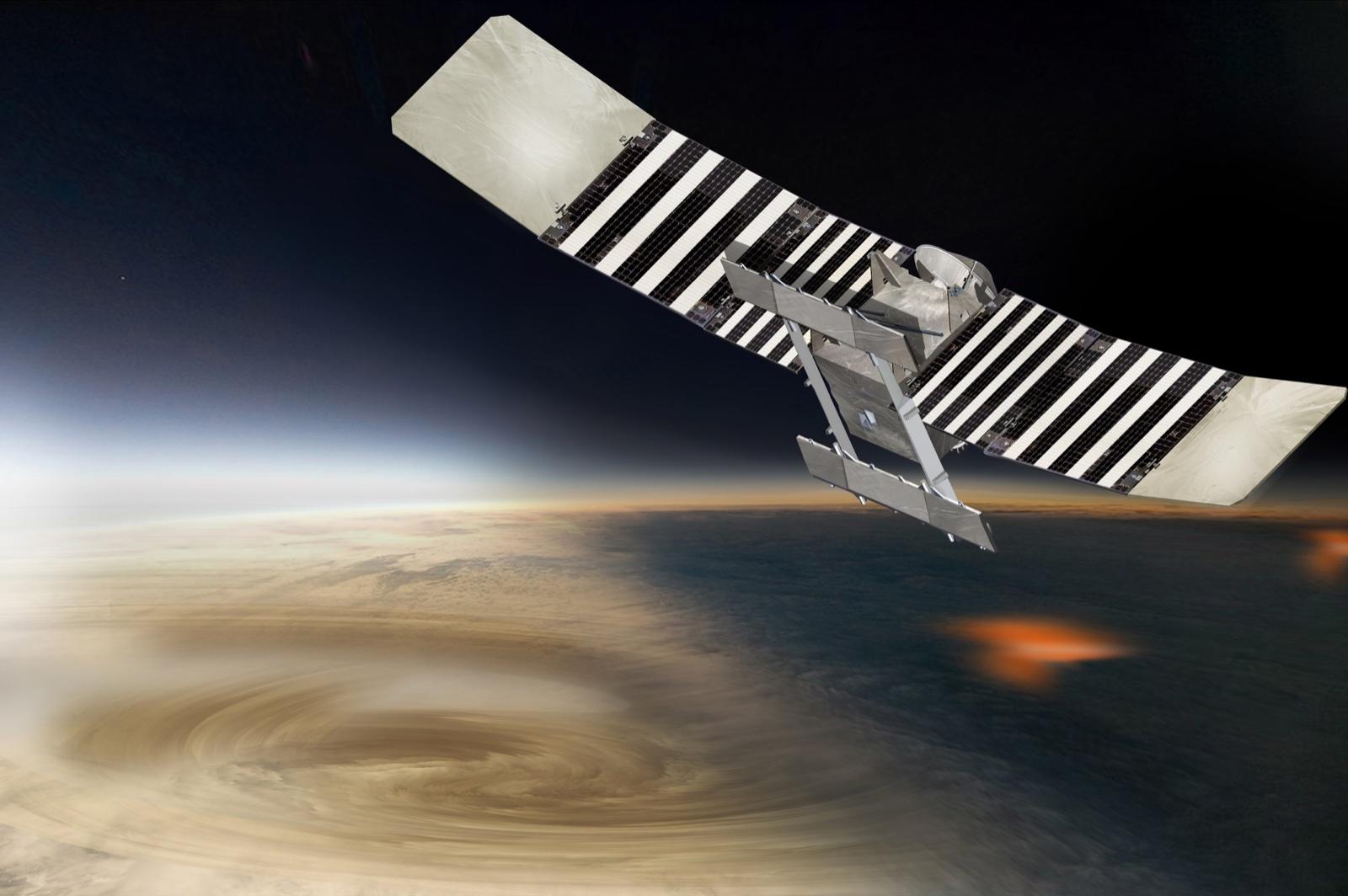
Selected in 2021 and still unbuilt, VERITAS depends on each year's budget. In early October 2026 its deputy project scientist, Dan Nunes of JPL, told the Venus Exploration Analysis Group that VERITAS was funded with a launch date of November 2032 and would reach Venus in mid-2033, Ars Technica reported. On 4 November 2026 JPL still listed the launch as 'TBD', NASA's overview and reference catalogue said no earlier than 2031, and the German Aerospace Center (DLR) said 2031 was planned. NASA's FY2026 spending plan allots it 24.0 million dollars; the President's FY2027 request does not mention it. A stopgap signed on 2 September holds NASA at its 2026 level until 11 December, and by 1 November no FY2027 spending bill had cleared Congress.
The name spells out Venus Emissivity, Radio science, InSAR, Topography, And Spectroscopy and is also the Latin for truth. The orbiter would map the whole planet with a radar much sharper than the one Magellan flew in the early 1990s, look for ground that is moving today, read rock types through infrared gaps in the clouds, and probe the interior through its own radio signal. NASA's questions include whether Venus's volcanism is steady or catastrophic, whether subduction is active, and whether the high plateaus called tesserae are like Earth's continents (which would point to a wetter past).
The proposal is older than its selection. NASA says the team, together for nearly a decade, proposed it three times, twice to Discovery and once to New Frontiers. A Discovery finalist in 2015, it lost to Lucy and Psyche in January 2017, returned as a finalist in 2020, and on 2 June 2021 was selected alongside DAVINCI, each with about 500 million dollars for development and launches expected in 2028 to 2030. NASA's FY2025 budget document puts the Discovery 2019 cost cap at 500 million dollars in FY2019 terms, excluding launch vehicle and operations, and a separate preliminary life-cycle cost range, estimated at selection, at 1.2 to 1.6 billion dollars. The 2021 announcement also assigned it JPL's Deep Space Atomic Clock-2 as a technology passenger, which NASA's current VERITAS pages do not mention.
Lockheed Martin is the contractor for the spacecraft, its integration and testing, and launch and mission operations, according to the FY2025 budget document, which lists the launch vehicle as TBD, to be chosen competitively. The design is based on NASA's MAVEN Mars orbiter, with two solar wings of about 28 square metres in all; one side of the outermost panel on each wing doubles as a drag flap. JPL manages the mission, operations and navigation.
Reaching the mapping orbit takes longer than the flight to Venus. NASA's overview describes about six months of cruise, capture into a 120-hour orbit and a burn down to 10 hours, then aerobraking: repeated shallow dips into the upper atmosphere, about 2,635 of them in a 2025 plan by engineers at NASA Langley and JPL, let drag on the solar arrays shrink the orbit. Figures for the final orbit differ. That 2025 plan ends aerobraking at 219 by 400 kilometres with a 1.6-hour period, matching the high point and period in NASA's overview. A 2021 study led from Sapienza University of Rome describes a final, nearly circular polar orbit of 180 by 255 kilometres; NASA's VISAR table gives an altitude of 180 to 250 kilometres and NSSDCA below 250 kilometres. Both NASA's overview and the 2021 study have aerobraking end in the final orbit, so the figures probably belong to different versions of the plan; no source says so.
Science would then run for four rotations of Venus: more than 2.5 Earth years and about 28 terabits of data, says NASA, against about three and a half Earth years and more than 19 terabits in DLR's account and three years in the FY2025 budget document. A typical day would bring 16 hours of VEM and VISAR observing, then an eight-hour Deep Space Network session with the high-gain antenna turned to Earth, when the gravity data are gathered.
VISAR, the Venus Interferometric Synthetic Aperture Radar, is JPL's instrument. It works at X-band with two antennas set 3.1 metres apart, so each pass records an image and, from the slight difference between the antennas' views, the height of the ground. Processing on board cuts the data to be sent home by two to three orders of magnitude, which NASA says is what makes global coverage possible. The targets are images at 30 metres resolution globally and 15 metres over part of the planet, and heights on a 250-metre grid. NASA's science page gives the 15-metre coverage as about 25 per cent of the surface and the height accuracy as 5 metres; NSSDCA gives about 20 per cent, and the FY2025 budget document 6 metres.
Change over time is the newer measurement. By flying over the same 200 by 200 kilometre patch twice, VISAR can compare the two radar images and pick out ground that has moved in between (repeat-pass interferometry). NASA plans 12 to 18 such sites and quotes an expected accuracy of 1.5 centimetres, allowing for changes in atmospheric sulfur dioxide between passes; NSSDCA quotes 2 millimetres of precision without saying what it includes. While VERITAS waited, the Italian space agency ASI reported in May 2024 that a new analysis of Magellan images, co-authored by VERITAS co-investigator Marco Mastrogiuseppe, found new lava flows at Sif Mons and Niobe Planitia. The wider story is in Volcanoes on Venus.
VEM, the Venus Emissivity Mapper, is Germany's instrument, led by the DLR Institute of Space Research in Berlin. A few narrow windows in the clouds near one micrometre let through heat glowing from rocks at more than 460 degrees Celsius, and VEM looks through them on the night side only, because reflected sunlight would swamp the signal by day. DLR describes a multispectral pushbroom imager with six bands in five atmospheric windows for the surface and eight more for calibration and near-surface water vapour. NASA and DLR credit the VIRTIS instrument on Venus Express with pioneering the technique.
Builder and sponsor quote VEM's performance differently. DLR states a goal of an instrument signal-to-noise ratio well above 1,000 and a relative emissivity error below one per cent, provided better topography is available, which VISAR is meant to supply. NASA lists a signal-to-noise ratio above 15 as enough to tell iron-rich (mafic) from silica-rich (felsic) rock, a 4 per cent relative uncertainty in emissivity and a resolution of about 100 kilometres. The two appear to measure different things: DLR's is the instrument's own signal-to-noise ratio, NASA's is tied to telling rock types apart at the surface.
Gravity science needs no instrument of its own. By tracking tiny frequency shifts in the spacecraft's X-band and Ka-band radio links, the team maps how the planet's pull varies and how Venus wobbles as it turns, which constrain the size and state of the core and the thickness of the crust. The FY2025 budget document names Goddard as provider, with ASI and the University of Rome as cost-share partner. A 2021 simulation led by Gael Cascioli at Sapienza found that VERITAS could pin down the moment of inertia factor, a measure of how mass is spread inside a planet, to 0.3 per cent (3-sigma); a recent ground-based measurement then carried a 7 per cent uncertainty. Stated resolutions vary: NASA gives 200 kilometres with 7 milligal accuracy, NSSDCA 160 kilometres and 3 milligals.
JPL's page, checked on 4 November 2026, credits ASI with the integrated deep space transponders, the high-gain antenna and the star trackers; DLR with VEM and algorithms for processing VISAR data; and the French space agency CNES with two Ka-band travelling-wave tube amplifiers and a telecom repair kit. ASI's own announcements of June 2021 and May 2024 list the transponder, the high-gain antenna and the radio-frequency part of VISAR, with no star trackers, and the FY2025 budget document agrees that ASI shares in VISAR. France has a second share that JPL's page leaves out: DLR says the VEM optics, including the spectral filter assembly, come from CNES and LESIA, the space instrumentation laboratory of the Paris Observatory.
The setback of 2022 had nothing to do with Venus. That year JPL's Psyche asteroid mission missed its launch window, and an independent review board found that a significant factor was an imbalance between the laboratory's workload and its available workforce. On 4 November 2022 NASA said it anticipated delaying VERITAS by at least three years so that experienced JPL staff could finish flagship missions further along, freeing money for Psyche and other planetary needs. JPL would stand down its VERITAS management and engineering teams while funding continued for the science team, and the launch, expected in December 2027, moved to no earlier than 2031.
Worse followed in March 2023, when the FY2024 budget request gave VERITAS 1.5 million dollars against about 124 million previously projected, a cut Gizmodo and Universe Today both called a soft cancellation; NASA's FY2025 document describes FY2024 as a directed stand-down. In August 2023 about twenty VERITAS scientists used the Holuhraun lava flow and the still-hot Litli-Hrútur eruption in Iceland as stand-ins for Venus (NASA's account counts 18 scientists and engineers over 15 days). DLR's F-SAR airborne radar made measurements similar to those planned from orbit, and a ground team used a VEM emulator with six Venus-like filters.
Reinstatement came in March 2024. At the Lunar and Planetary Science Conference, principal investigator Suzanne Smrekar announced that VERITAS was back in NASA's budget, and the FY2025 request gave it 36.1 million dollars. It also scheduled a Mission System Review, dated early FY2026 in one passage, December 2026 in another and no later than 2027 in the schedule table. In November 2024 Smrekar said the working target was June 2031 but that NASA might prefer November 2032, the date her team gave in October 2026. That slip, she warned, could see partner instruments delivered long before VERITAS reached preliminary design, bring it to Venus within weeks of EnVision in 2033, and cost scientists the chance to study sites that missions such as DAVINCI will target (reported by Jeff Foust in SpaceNews and summarised by Universe Magazine).
In May 2025 NASA's technical supplement to the FY2026 request stated that 'in order to achieve cost savings, the DAVINCI, VERITAS, and EnVision missions are eliminated'. Senate Report 119-44 of 17 July 2025 directed NASA to continue formulating both Discovery Venus missions and provided not less than 99 million dollars for DAVINCI and 36.1 million for VERITAS. The full-year act approved on 23 January 2026 (Public Law 119-74) binds NASA to minimum amounts in its explanatory statement's table, which lists DAVINCI at 99 million and has no VERITAS line; the statement gives Senate report language the same weight unless it says otherwise. In March 2026 Louise Prockter, NASA's planetary science director, said work on VERITAS was 'ramping up slowly' and that 'it's going to be a challenge getting all three Venus missions to continue'. The July 2026 spending plan then set VERITAS at 24.0 million dollars.
Fiscal year 2027 reopened the fight by silence. NASA's request of April 2026 never names VERITAS, DAVINCI or EnVision; Casey Dreier of the Planetary Society read it as eliminating NASA's entire Venus portfolio. The House Appropriations Committee's bill of 13 May 2026 leaves the Venus missions out of its report's mission-specific language, an omission the Planetary Society called a real challenge for advocates. Ars Technica reported in October that ending NASA's EnVision role and Mars Sample Return freed money for DAVINCI and VERITAS.
If it flies, VERITAS is meant to share the decade with DAVINCI, which would drop a probe through the atmosphere, and Europe's EnVision, which would carry a radar and a spectrometer, VenSpec-M, that DLR says is technically based on VEM. For now the public record shows preliminary design reviews for Italian components and for VEM's filters, detector radiation tests and a representative mock-up of VEM at DLR. No public source checked says whether the Mission System Review has happened.
Mission facts
Organisations
NASA Discovery Program, led by the Jet Propulsion Laboratory (principal investigator Suzanne Smrekar), spacecraft by Lockheed Martin; Germany (DLR) supplies the VEM instrument, Italy (ASI) telecom and radar hardware, France (CNES) Ka-band amplifiers and, with LESIA, VEM optics
Name
Venus Emissivity, Radio science, InSAR, Topography, And Spectroscopy. NASA notes that veritas means truth in Latin.
Status (as of 4 Nov 2026)
JPL's mission page lists Launch Date 'TBD' and Status 'Future'. NASA's overview (last updated 2 November 2024) and NSSDCA say launch no earlier than 2031. DLR's VEM page, last changed on 19 August 2026, says launch is planned for 2031. At a VEXAG meeting in early October 2026, deputy project scientist Dan Nunes of JPL said VERITAS was funded with a launch date of November 2032 and would arrive close to mid-2033 (Ars Technica, 14 Oct 2026).
Selection
Chosen on 2 June 2021 from the Discovery 2019 competition, with about 500 million dollars per mission for development and launch expected in 2028 to 2030.
Cost (two measures)
The Discovery 2019 cost cap was 500 million dollars in FY2019 terms, excluding launch vehicle and operations. NASA's FY2025 budget document gives a preliminary life-cycle cost range, estimated at selection in 2021, printed as '1.2 - 1.6' under a $M heading, which only makes sense as 1.2 to 1.6 billion dollars.
Launch dates over time
Launch readiness date originally December 2027; after November 2022 no earlier than 2031; the FY2025 request targets 'an available Venus opportunity in 2031-2032' with launch no later than 2032; in October 2026 the deputy project scientist gave November 2032 (Ars Technica).
Spacecraft
Solar-powered orbiter based on NASA's MAVEN Mars orbiter. Two solar wings of three panels, about 28 square metres, giving about 3,400 W near Earth and 5,900 W at Venus; one side of each outermost panel doubles as an aerobraking drag flap.
Orbit (sources differ)
Near-polar. Cascioli and others (2021): final orbit 180 by 255 km, about 85.4 degrees, period about 1.5 h. Langley and JPL (2025): aerobraking ends at 219 by 400 km, 1.6 h (another slide of the same presentation gives 1.5 h); NASA's overview likewise gives a 400 km apoapsis and 1.6 h, and says VERITAS is in its final science orbit once aerobraking ends. NASA VISAR table: altitude 180 to 250 km; NSSDCA: final orbit below 250 km.
Getting there
NASA: about six months of cruise, capture by the six main engines into a 120-hour orbit, a burn down to 10 hours, then two aerobraking phases of about five months each with a VEM-only science pause. A 2025 Langley and JPL presentation gives 166 and 135 days, about 2,635 passes and a pause at a 4.6-hour orbit.
Science phase
Four rotations of Venus: NASA says more than 2.5 Earth years and about 28 terabits. DLR says about three and a half Earth years and over 19 terabits; the FY2025 request says a three-year science mission.
VISAR radar (JPL)
X-band (3.8 cm, 7.9 GHz) single-pass interferometer, two 3.9 by 0.6 m antennas on a 3.1 m baseline. Images at 30 m globally and 15 m over about 25 per cent (NASA) or about 20 per cent (NSSDCA); heights on a 250 m grid to 5 m (NASA) or 6 m (FY2025 request).
Surface change
Repeat-pass interferometry of 12 to 18 sites of 200 by 200 km. NASA expects 1.5 cm accuracy including atmospheric SO2 changes; NSSDCA quotes 2 mm precision without saying what it includes.
VEM infrared mapper (DLR)
Multispectral pushbroom imager, night side only: six surface bands in five atmospheric windows near 1 micrometre plus eight bands for calibration and near-surface water vapour; InGaAs detector of 1280 by 768 pixels with a thermoelectric cooler, 0.8 to 1.6 micrometres.
VEM performance (two measures)
DLR: instrument signal-to-noise ratio well above 1,000 and relative emissivity error below 1 per cent, given better topography. NASA: signal-to-noise above 15 to separate mafic from felsic rock, 4 per cent emissivity uncertainty, about 100 km resolution.
Gravity science
Two-way X- and Ka-band Doppler tracking. NASA: near-uniform field at 200 km and 7 mGal; NSSDCA: 160 km and 3 mGal. A 2021 simulation gives the moment of inertia factor to 0.3 per cent (3-sigma). NASA's FY2025 document names Goddard as provider, with ASI and the University of Rome as cost-share partner.
Italy (ASI)
JPL: integrated deep space transponders, high-gain antenna and star trackers. ASI's own releases (June 2021, May 2024): the IDST transponder, the high-gain antenna and the radio-frequency part of VISAR, with no star trackers.
France (CNES)
JPL: two flight-model Ka-band travelling-wave tube amplifiers and a repair kit for the telecom system. DLR: CNES and LESIA also supply the VEM optics, including the spectral filter assembly.
Germany (DLR)
VEM, led by the DLR Institute of Space Research in Berlin, plus algorithms for VISAR ground and onboard processing (per JPL). In June 2021 DLR said its Microwaves and Radar Institute and Remote Sensing Technology Institute were developing the VISAR end-to-end simulator, performance models and processing algorithms.
Budget to FY2025
FY2023 operating plan 9.5 million dollars; FY2024 a directed stand-down (the request gave a reported 1.5 million); FY2025 request 36.1 million, projected to reach 267.2 million in FY2029.
Budget from FY2026
FY2026 request: eliminated. Senate Report 119-44: not less than 36.1 million dollars. NASA's FY2026 spending plan (July 2026): 24.0 million. FY2027 request (April 2026): not named. None of the 12 FY2027 spending bills had cleared Congress by 1 Nov 2026; a stopgap holds NASA at its FY2026 level until 11 Dec 2026.
Mission timeline
- 30 Sep 2015VERITAS is one of five Discovery finalists, each given 3 million dollars for a concept study.
- 4 Jan 2017NASA selects Lucy and Psyche; VERITAS is not chosen.
- 13 Feb 2020Named again as one of four Discovery 2019 finalists for nine-month concept studies.
- 2 Jun 2021Selected with DAVINCI, about 500 million dollars each, launch expected 2028 to 2030.
- 16 Jul 2021ASI opens a market survey for Phase B industrial work on its VERITAS hardware.
- 4 Nov 2022After the Psyche review, NASA says it anticipates delaying VERITAS at least three years, from December 2027 to no earlier than 2031, and that JPL will stand down its management and engineering teams.
- Mar 2023The FY2024 budget request gives VERITAS a reported 1.5 million dollars; NASA later calls FY2024 a directed stand-down.
- Aug 2023About twenty team scientists test radar and infrared methods on Icelandic lava fields with DLR's airborne F-SAR radar.
- Mar 2024The FY2025 request restores VERITAS: 36.1 million dollars for FY2025 and a launch in 2031 or 2032.
- Nov 2024Smrekar reports a June 2031 target and warns NASA may move it to November 2032.
- May 2025NASA's technical supplement to the FY2026 request says VERITAS, DAVINCI and EnVision are eliminated to achieve cost savings.
- 17 Jul 2025Senate Report 119-44 directs continued formulation and provides not less than 36.1 million dollars.
- 16 Mar 2026Planetary science director Louise Prockter says work on VERITAS is 'ramping up slowly'.
- Apr 2026The FY2027 request omits VERITAS and the rest of NASA's Venus programme.
- 13 May 2026The House Appropriations Committee advances its FY2027 bill; the report leaves the Venus missions out of its mission-specific language.
- Jul 2026NASA's FY2026 spending plan allots VERITAS 24.0 million dollars.
- 19 Aug 2026DLR publishes new VERITAS and VEM pages; the VEM page states that launch is planned for 2031.
- 2 Sep 2026A continuing resolution is signed that holds NASA at its FY2026 level from 1 October to 11 December 2026.
- Oct 2026At a Venus Exploration Analysis Group meeting, deputy project scientist Dan Nunes says VERITAS is funded with a launch date of November 2032 and will reach Venus close to mid-2033, Ars Technica reports on 14 October.
A filled dot marks something that physically happened. A hollow one marks an announcement, a naming or a target.
In pictures
Tap a photo to enlarge.
Translated from the original sources
Passages from the German, Italian and French sources this page draws on, in azmth's translation. Tap Show original to read the original wording.
DLR: Venus Emissivity Mapper
German · 6 passages
DLR: Venus Emissivity Mapper (VEM) für VERITAS (19 Aug 2026)
Open the source“The launch of VERITAS is planned for the year 2031.”
DLR project page published 19 August 2026.
azmth's translation · Show originalHide original
German: „Der Start von VERITAS ist für das Jahr 2031 geplant.“
“Development of VEM is led by the DLR Institute of Space Research in Berlin.”
azmth's translation · Show originalHide original
German: „Die Entwicklung des VEM wird vom DLR-Institut für Weltraumforschung in Berlin geleitet.“
“A French contribution, namely the optics including the spectral filter assembly, is provided by the Centre National d'Etudes Spatiales (CNES) and the Laboratoire d'études spatiales et d'instrumentation en astrophysique (LESIA).”
azmth's translation · Show originalHide original
German: „Ein französischer Beitrag, nämlich die Optik einschließlich der Spektralfilterbaugruppe, wird vom Centre National d’Etudes Spatiales (CNES) und dem Laboratoire d’études spatiales et d’instrumentation en astrophysique (LESIA) bereitgestellt.“
“VEM is designed as a multispectral pushbroom imager to map surface emissivity using six spectral bands in five atmospheric windows, plus eight spectral bands for calibration and for detecting water vapour near the ground.”
azmth's translation · Show originalHide original
German: „Der VEM ist als multispektraler Push-Broom-Imager konzipiert, um die Oberflächenemissivität mithilfe von sechs Spektralbändern in fünf atmosphärischen Fenstern sowie acht Spektralbändern zur Kalibrierung und Erkennung von Wasserdampf in Bodennähe zu kartieren.“
“Using a highly integrated InGaAs detector of 1280 by 768 pixels, including a thermoelectric cooler (TEC), removes the need for cryogenic cooling.”
azmth's translation · Show originalHide original
German: „Durch den Einsatz eines hochintegrierten InGaAs-Detektors mit 1280 × 768 Pixeln, einschließlich eines thermoelektrischen Kühlers (TEC), entfällt die Notwendigkeit einer kryogenen Kühlung.“
“A rotatable window protects the optical entrance from contamination during the aerobraking phase, when VERITAS enters the atmosphere of Venus.”
'Aerobreaking' is spelled so on DLR's page.
azmth's translation · Show originalHide original
German: „Ein drehbares Fenster schützt den optischen Eingang vor Verunreinigungen während der Aerobreaking-Phase, wenn VERITAS in die Atmosphäre der Venus eintritt.“
DLR: VERITAS project page
German · 2 passages
DLR: VERITAS project page (19 Aug 2026)
Open the source“Over a period of about three and a half Earth years the probe will produce six synergistic datasets of unprecedented coverage, resolution and accuracy, totalling more than 19 Tb.”
azmth's translation · Show originalHide original
German: „In einem Zeitraum von etwa dreieinhalb Erdenjahren wird die Sonde sechs synergetische Datensätze mit noch nie dagewesener Abdeckung, Auflösung und Genauigkeit und einem Gesamtumfang von über 19 Tb erzeugen.“
“Its main goal is an instrument signal-to-noise ratio (SNR) well above 1000 and a predicted error in determining relative emissivity of less than 1 %, provided improved topography data for Venus are available.”
azmth's translation · Show originalHide original
German: „Sein Hauptziel ist es, ein Signal-Rausch-Verhältnis (SNR) des Instruments von deutlich über 1000 zu erreichen sowie einen prognostizierten Fehler bei der Bestimmung der relativen Emissivität von weniger als 1 % zu erzielen, vorausgesetzt, es liegen verbesserte Topografiedaten der Venus vor.“
DLR Weekly: an interferometric radar for Venus
German · 1 passage
DLR Weekly: an interferometric radar for Venus (14 Jun 2021)
Open the source“The radar end-to-end simulator, the instrument performance models and the processing algorithms for the innovative VISAR are being developed at the DLR Microwaves and Radar Institute (HR) and the DLR Remote Sensing Technology Institute (MF).”
14 June 2021
azmth's translation · Show originalHide original
German: „Der Radar-End-zu-End-Simulator, die Instrument-Performance-Modelle und Prozessierungsalgorithmen für das innovative VISAR werden am DLR Institut für Hochfrequenztechnik und Radarsysteme (HR) und am DLR Institut für Methodik der Fernerkundung (MF) entwickelt.“
DLR: EnVision project page
German · 1 passage
DLR: EnVision project page (VenSpec-M based on VEM; 19 Aug 2026)
Open the source“Technically, the VenSpec-M instrument is based on the design of the VEM instrument for NASA's VERITAS mission.”
DLR EnVision page, 19 August 2026.
azmth's translation · Show originalHide original
German: „Technisch basiert das VenSpec-M instrument auf dem Design des VEM Instruments für die NASA-Mission VERITAS“
DLRmagazin 174: Kleine Venus in der Mitte des Atlantiks
German · 1 passage
DLRmagazin 174: Kleine Venus in der Mitte des Atlantiks (Iceland campaign, 12 Mar 2024)
Open the source“Nearly twenty VERITAS scientists from the USA, Italy and Germany targeted two volcanic areas.”
DLRmagazin 174, on the August 2023 Iceland campaign.
azmth's translation · Show originalHide original
German: „Knapp zwanzig VERITAS-Wissenschaftlerinnen und -Wissenschaftler aus den USA, Italien und Deutschland nahmen sich zwei Vulkangebiete zum Ziel“
ASI: Con la missione VERITAS, anche l'Italia vola su Venere
Italian · 2 passages
ASI: Con la missione VERITAS, anche l'Italia vola su Venere (3 Jun 2021)
Open the source“Italy takes part in VERITAS through a partnership between the Italian Space Agency and the Jet Propulsion Laboratory, which gave our country responsibility for developing and building three onboard units: the IDST transponder (Integrated Deep Space Transponder), needed for communications and for the radio science experiments that help understand the planet's gravity; the radio-frequency part of VISAR, useful for studying the planet's morphology and volcanism; and the HGA (high-gain antenna).”
3 June 2021
azmth's translation · Show originalHide original
Italian: “L’Italia partecipa alla missione VERITAS attraverso una collaborazione di partnership tra Agenzia Spaziale Italiana e Jet Propulsion Laboratory, che ha assegnato al nostro Paese la responsabilità per lo sviluppo e la realizzazione di tre strumenti di bordo: il trasponditore IDST (Integrated Deep Space Transponder), necessario per garantire le comunicazioni e per eseguire gli esperimenti di radio scienza utili alla comprensione della gravità del pianeta, la parte a radiofrequenza del VISAR (Venus Interferometric Synthetic Aperture Radar), utile allo studio della morfologia del pianeta e dei fenomeni di vulcanismo, e l’antenna HGA (High-Gain Antenna).”
“By 2030 NASA's VERITAS mission will leave for Venus to reveal the inner workings of Earth's mysterious twin planet.”
ASI's expectation on 3 June 2021, since overtaken.
azmth's translation · Show originalHide original
Italian: “Entro il 2030 la missione VERITAS (Venus Emissivity, Radio Science, InSAR, Topography, and Spectroscopy) della NASA partirà alla volta di Venere per svelare il funzionamento interno del misterioso pianeta gemello della Terra.”
ASI: Venere, un pianeta ancora attivo
Italian · 1 passage
ASI: Venere, un pianeta ancora attivo (27 May 2024)
Open the source“In particular, Italy takes part in VERITAS through a collaboration between the Italian Space Agency and NASA's Jet Propulsion Laboratory, in which our country is responsible for developing and building three onboard units.”
27 May 2024; the list that follows again names the IDST transponder, the radio-frequency part of VISAR and the HGA.
azmth's translation · Show originalHide original
Italian: “In particolare, l’Italia partecipa alla missione VERITAS attraverso una collaborazione tra Agenzia Spaziale Italiana e il Jet Propulsion Laboratory della NASA, dove il nostro Paese ha la responsabilità dello sviluppo e la realizzazione di tre strumenti di bordo”
ASI: market survey for VERITAS Phase B industrial activities
Italian · 1 passage
ASI: market survey for VERITAS Phase B industrial activities (16 Jul 2021)
Open the source“Procedure, conducted under article 158 and article 4 of Legislative Decree 50/2016 as amended, for the 'Phase B industrial activities of the VERITAS mission'.”
Page metadata gives publication on 16 July 2021.
azmth's translation · Show originalHide original
Italian: “Procedura, esperita ai sensi di quanto previsto dall’art. 158 e dall’art. 4 del D. Lgs. n. 50/2016 e ss.mm.ii., per le 'Attività industriali di fase B della missione VERITAS'.”
Observatoire de Paris: La mission EnVision approuvée par l'ESA
French · 1 passage
Observatoire de Paris: La mission EnVision approuvée par l'ESA (1 Feb 2024)
Open the source“On VERITAS, the Paris Observatory (PSL) is heavily involved in the study and supply of subsystems of the VEM instrument.”
1 February 2024
azmth's translation · Show originalHide original
French: «Sur VERITAS, l’Observatoire de Paris - PSL est fortement impliqué pour l’étude et la fourniture de sous-systèmes de l’instrument VEM.»
CNES: EnVision en détails
French · 1 passage
“Together with NASA's upcoming DAVINCI+ and VERITAS missions, the trio of new spacecraft will provide the most complete study of Venus ever made.”
CNES EnVision page, which names VERITAS only as a companion mission; the superlative is CNES's own.
azmth's translation · Show originalHide original
French: «En collaboration avec les prochaines missions DAVINCI+ (Deep Atmosphere Venus Investigation of Noble gases, Chemistry, and Imaging) et VERITAS (Venus Emissivity, Radio Science, InSAR, Topography, and Spectroscopy) de la NASA, le trio de nouveaux engins spatiaux fournira l’étude la plus complète jamais réalisée sur Vénus.»
Sources
- JPL: VERITAS mission page (status, partner contributions; checked 4 Nov 2026)
- NASA Science: VERITAS home page (last updated 14 Jul 2026)
- NASA Science: VERITAS mission overview (spacecraft, orbit, phases; last updated 2 Nov 2024)
- NASA Science: VERITAS science and instruments (last updated 28 Apr 2025)
- NASA Science: VERITAS team (last updated 5 Jan 2026)
- NSSDCA: VERITAS spacecraft entry
- NASA release 15-196: Discovery finalists (30 Sep 2015)
- NASA release: Lucy and Psyche selected (4 Jan 2017)
- NASA release 20-016: four Discovery finalists (13 Feb 2020)
- NASA release 21-073: DAVINCI+ and VERITAS selected (2 Jun 2021)
- JPL: NASA responds to the Psyche independent review, VERITAS delayed (4 Nov 2022)
- NASA FY2025 budget request, congressional justification (VERITAS project pages)
- NASA FY2026 budget request, technical supplement (May 2025)
- Senate Report 119-44 (17 Jul 2025)
- Public Law 119-74, approved 23 Jan 2026 (govinfo)
- FY2026 Commerce, Justice, Science joint explanatory statement (Jan 2026)
- NASA FY2026 spending plan for P.L. 119-74 (July 2026)
- NASA FY2027 full budget request (April 2026)
- Planetary Society, Casey Dreier: the FY2027 NASA budget request (23 Apr 2026)
- Planetary Society, Jack Kiraly: House appropriators advance NASA bill (14 May 2026)
- Planetary Society: VERITAS mission page
- SpacePolicyOnline: House clears FY2027 CR (1 Sep 2026, updated 3 Sep)
- SpacePolicyOnline: what's happening in space policy, 1 to 8 Nov 2026 (FY2027 bills unfinished)
- Ars Technica, Stephen Clark: things are finally looking up for NASA's first missions to Venus in a generation (VEXAG meeting report, 14 Oct 2026)
- Space.com, Sharmila Kuthunur: LPSC town hall on the Venus missions (27 Mar 2026)
- SpaceNews, Jeff Foust: VERITAS Venus mission seeks to avoid further delays (27 Nov 2024; registration required)
- Universe Magazine: VERITAS may face new delays (29 Nov 2024, summarising SpaceNews)
- Gizmodo: NASA revives VERITAS (14 Mar 2024)
- Universe Today: VERITAS breathes new life (25 Mar 2024)
- Cascioli et al.: rotational state and interior of Venus with VERITAS (2021, NTRS)
- Deshmukh et al.: VERITAS aerobraking and engineering science investigation (IPPW, June 2025, NTRS)
- DLR: Venus Emissivity Mapper (VEM) für VERITAS (19 Aug 2026) · in German
- DLR: VERITAS project page (19 Aug 2026) · in German
- DLR Weekly: an interferometric radar for Venus (14 Jun 2021) · in German
- DLR: EnVision project page (VenSpec-M based on VEM; 19 Aug 2026) · in German
- DLRmagazin 174: Kleine Venus in der Mitte des Atlantiks (Iceland campaign, 12 Mar 2024) · in German
- ASI: Con la missione VERITAS, anche l'Italia vola su Venere (3 Jun 2021) · in Italian
- ASI: Venere, un pianeta ancora attivo (27 May 2024) · in Italian
- ASI: market survey for VERITAS Phase B industrial activities (16 Jul 2021) · in Italian
- Observatoire de Paris: La mission EnVision approuvée par l'ESA (1 Feb 2024) · in French
- CNES: EnVision en détails · in French
Facts on this page were verified on 4 November 2026. Where sources disagree, the disagreement is stated rather than resolved silently.
azmth is independent and is not affiliated with or endorsed by NASA, Roscosmos, NPO Lavochkin, ESA, JAXA, ISRO, CNSA, or any other space agency or company named on this page.