Did Venus have oceans?
Did Venus ever have oceans? What its heavy hydrogen, rival climate models and 2026 research say, plus terraforming and Venus-like exoplanets.
TL;DR· 20 min read
Nobody knows whether Venus had oceans. Its air is rich in heavy hydrogen (deuterium), about 100 to 240 times Earth's proportion, which shows the planet lost a great deal of water but not whether that water was ever liquid. Published models split: NASA's 2016 modelling suggests a shallow ocean could have lasted up to 2 billion years, while a 2021 Geneva model finds the steam never condensed. NASA's DAVINCI probe, aiming to launch in late December 2030, is designed to test the question. Terraforming schemes remain paper studies, and Venus is now the reference for Venus-like planets around other stars.
Nobody knows yet whether Venus had oceans. The planet has clearly lost a huge amount of water, but published climate models disagree on whether any of it ever lay on the surface as liquid. The heavy hydrogen in Venus's air, measured by Pioneer Venus in 1978 and confirmed from Earth and by Venus Express, records the loss but not the water's form. NASA's 2016 climate modelling suggests a shallow ocean could have stayed habitable for up to 2 billion years; a 2021 model from Geneva finds the steam never condensed; and a 2024 chemistry study argues the interior is too dry for Venus ever to have been habitable. Papers published in 2026 still leave both histories possible, and NASA's DAVINCI probe is designed to help decide. This page follows that argument, the idea of giving Venus oceans back by terraforming, and why Venus has become the benchmark for rocky planets around other stars.
- 100 to 240 times Earthdeuterium enrichment of Venus's water, depending on altitude and instrument (Pioneer Venus 1978 to Venus Express 2006 to 2007)
- 3 cmdepth of all the water in Venus's atmosphere spread as a global layer, against about 3 km for an Earth-like start (Chaffin et al. 2024)
- Dec 2030DAVINCI launch target reported in October 2026, a year earlier than the late 2031 in a NASA abstract of May 2026; its descent probe is designed partly to test whether Venus was ever wet
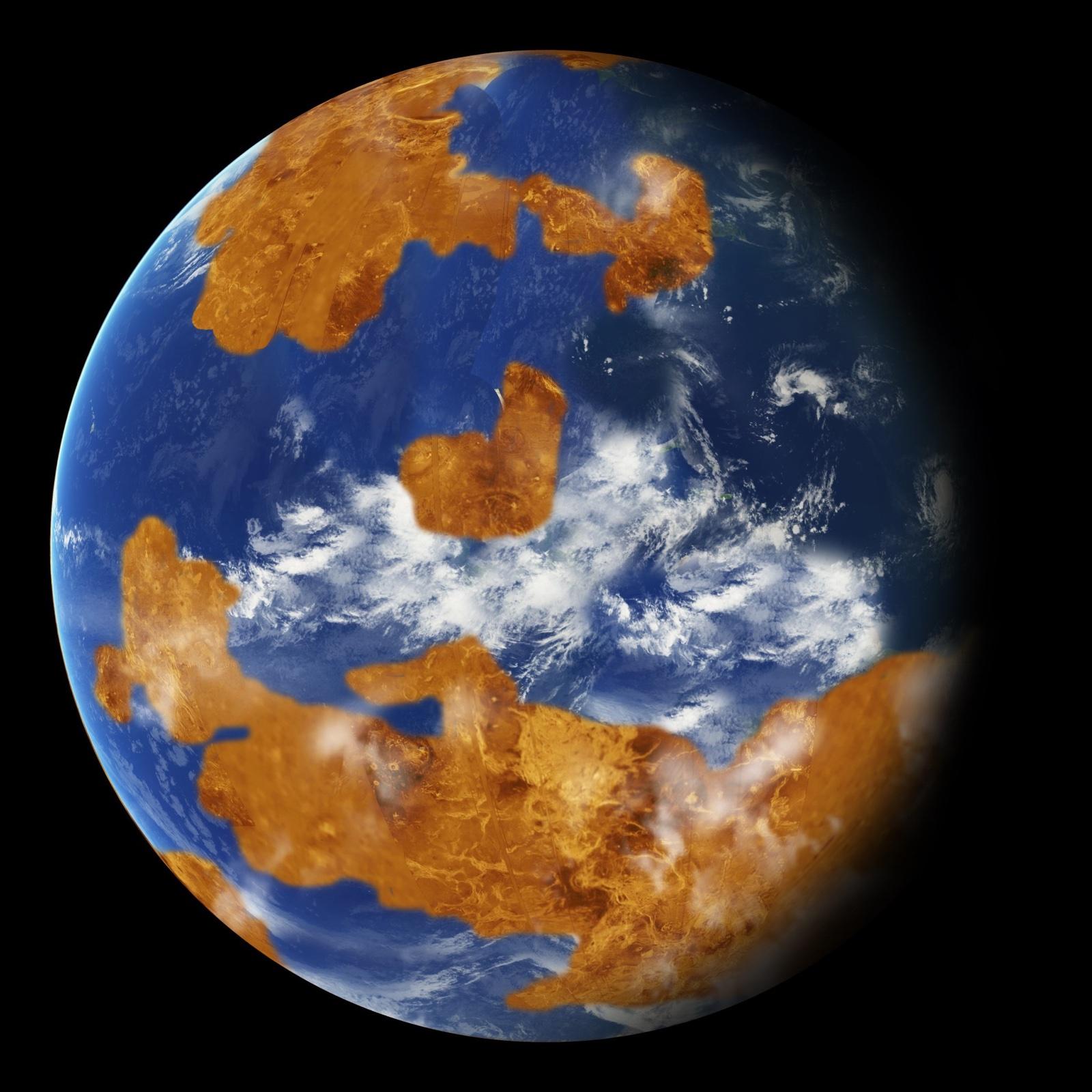
Venus, in the words of a 2024 Nature paper, is extremely dry. All the water vapour in its atmosphere, condensed and spread evenly over the planet, would make a layer about 3 centimetres deep; M. S. Chaffin and colleagues at the University of Colorado set that against the roughly 3 kilometre layer an Earth-like start would have supplied. NASA's planetary fact sheet lists 20 parts per million of water near the surface, in an atmosphere of 96.5 per cent carbon dioxide pressing at 92 bars on ground averaging 464 °C. Its hydrogen isotopes say it once held far more. What remains open is the form the water took: whether it ever fell as rain and gathered into seas, or stayed aloft as steam until sunlight split it and the hydrogen leaked away to space.
Soviet engineers were allowing for seas in 1965. When Venera 3 left for Venus on 16 November that year, its descent craft had been tested for buoyancy in case the planet had seas and oceans, as K. Lantratov recorded in Novosti Kosmonavtiki in 1996. On 18 October 1967 the gas analysers of Venera 4 sampled the air on the way down and, in NPO Lavochkin's summary, found about 90 per cent carbon dioxide with 'a quite insignificant content of oxygen and water vapour'. Ingersoll's 1969 paper was titled 'The Runaway Greenhouse: A History of Water on Venus', and in 1970 Rasool and de Bergh argued in Nature that Earth would be as hostile as Venus if it were only 6 to 10 million miles closer to the Sun. Older imaginings of swamps and seas are on the imagined Venus page.
Warm a wet planet and its air fills with water vapour, itself a greenhouse gas. Past a certain point, Colin Goldblatt and colleagues explained in 2013, only the upper atmosphere can radiate heat to space, which caps what the planet can shed at about 282 watts per square metre; absorb more sunlight than that and it heats uncontrollably until the entire ocean has evaporated. Venus receives 1.91 times the sunlight Earth does. Once steam reaches high altitude, ultraviolet light breaks the molecules apart and the hydrogen escapes, as NASA summarised the standard account in 2016. Without liquid water, carbon dioxide stays in the atmosphere. Earth keeps much of its carbon in crustal carbonates; Venus holds a comparable inventory almost entirely as gas, and the processes that built Earth's store (biology, liquid water and plate tectonics) are all absent there today, Tereza Constantinou, Oliver Shorttle and Harrison Nicholls noted in 2026.
Evidence that Venus lost water came down with the Pioneer Venus Large Probe on 9 December 1978. Its neutral mass spectrometer made the key measurement while its inlets were coated with sulfuric acid from the clouds, and in May 1982 Donahue, Hoffman, Hodges and Watson published the result in Science as 'Venus Was Wet': a deuterium to hydrogen ratio of (1.6 ± 0.2) × 10⁻², a hundredfold enrichment over Earth. Deuterium is hydrogen with an added neutron. Ordinary hydrogen is lighter and escapes more readily, so water that has been losing hydrogen for a long time grows richer in the heavy form. The team concluded that at least 0.3 per cent of a terrestrial ocean had been outgassed on Venus, a floor the paper calls 'consistent with a much greater production'.
Later measurements agree that the water is strongly enriched but not on how strongly, and each samples a different height. In 1991 de Bergh and colleagues used night-side spectra taken from Earth, which sound 32 to 42 kilometres above the surface, and found 120 ± 40 times the terrestrial ratio. Venus Express measured water and its deuterated form, HDO, 70 to 95 km up between April 2006 and August 2007; Fedorova and colleagues reported 240 ± 25 times terrestrial over the northern polar region, about 1.5 times the 157 ± 30 they quote for the lower atmosphere, and suggested that HDO is split less readily, or deuterium escapes more slowly, at those altitudes. For the bulk atmosphere Chaffin's 2024 paper uses about 120 times Earth, and Constantinou's 2024 paper 150 ± 30. The same spacecraft found hydrogen and oxygen ions leaving in a ratio of 1.9 to 1, which with the estimated escape of neutral atoms is close to the two-to-one of water (Barabash and colleagues, Nature, 2007).
What the ratio cannot do is say how much water there was, or whether it was ever liquid. Everything above Donahue's 0.3 per cent floor depends on escape rates that are still being revised. In 2024 Chaffin's group showed that a process missing from the standard account, the recombination of HCO⁺ ions with electrons, nearly doubles the present rate of hydrogen escape. That doubles the water that volcanoes or infalling impactors must supply to hold the atmosphere steady, and would let a late ocean, if one existed, dry out faster.
Climate models from NASA's Goddard Institute for Space Studies carry the case for oceans. In August 2016 Michael Way and colleagues took the topography mapped by Magellan, filled the lowlands with a shallow ocean, gave the planet an Earth-like atmosphere and its present slow rotation, and dimmed the Sun by up to 30 per cent to match its youth. The slow spin, Anthony Del Genio explained, exposes the day side for almost two months at a time and raises a thick umbrella of rain cloud. With rotation slower than about 16 Earth days, the Geophysical Research Letters paper found moderate temperatures despite 46 to 70 per cent more sunlight than Earth receives. Its two public summaries differ: NASA's release said the ocean could have lasted 'for up to 2 billion years of its early history'; the abstract says that at its current rotation Venus 'could have remained habitable until at least 0.715 Gya', 715 million years ago. One is a duration, the other a latest date for one case. In 2020 Way and Del Genio speculated that vast lava outpourings and the global resurfacing hundreds of millions of years ago ended the clement period. Whether anything lived there is on the life on Venus page.
Arguments against oceans reach further back, to the molten aftermath of formation. In 2013 Keiko Hamano, Yutaka Abe and Hidenori Genda of the University of Tokyo argued in Nature that rocky planets split into two types as their magma oceans freeze. A type I planet, beyond a critical distance from its star, solidifies within several million years and keeps most of its water, which forms the earliest oceans. A type II planet, inside that distance, can stay molten for as long as 100 million years while escaping hydrogen dries it out. Earth is type I. Venus formed close to the boundary, so the authors could not assign it with certainty, but its dry surface and mantle are what type II predicts.
Martin Turbet and colleagues at the University of Geneva asked whether steam from that molten phase could ever have rained out. Their 2021 Nature paper ran three-dimensional climate models of the young Earth and Venus with the water still airborne, and found that water clouds form preferentially on the night side, where they have a strong net warming effect. That warming blocked condensation even at sunlight down to 0.95 times what Earth receives today, and the paper concludes that water never condensed on Venus and oceans never formed. The same models say Earth kept its water because the young Sun was faint, which Emeline Bolmont called 'an unhoped-for opportunity' for a very hot young Earth. David Ehrenreich added a caveat: 'we will not be able to answer this question definitively on our computers'.
Way's and Turbet's models also ask different questions. Way's begin with an ocean already on the surface and ask whether it could stay stable. Turbet's begin with a hot planet whose water is all steam and ask whether it could condense at all. If Turbet's night-side clouds are right, Way's starting point was never reached; if they warm less than modelled, an ocean could have formed and then lasted as Way describes. Both depend on how clouds behaved on the young planet, which no instrument can observe now.
Chemistry offers a second line of attack, and it too points both ways. Water that is split and loses its hydrogen leaves oxygen behind, and Venus's air holds very little. In 2021 Krissansen-Totton, Fortney and Nimmo modelled interior, atmosphere and climate together from the magma ocean onward and found that both a habitable past and a never-wet past reproduce the atmosphere's composition, the inferred heat flow and the measured argon-40 and helium-4, even allowing a global ocean about 100 metres deep as late as a billion years ago. Warren and Kite, following the oxygen in PNAS in 2023, reproduced the modern atmosphere in fewer than 0.4 per cent of their runs, a narrow range favouring habitable eras that ended before 3 billion years ago. In December 2024 Constantinou, Shorttle and Paul Rimmer of the University of Cambridge worked backwards from today's air: the water, carbon dioxide and carbonyl sulfide that chemistry destroys must be restored by volcanism, and on their accounting those volcanic gases carry at most 6 per cent water. A dry interior, they argued in Nature Astronomy, means Venus 'has never been liquid-water habitable'. The argument depends on today's atmosphere being held in balance by volcanic resupply.
Work published in 2026 keeps both histories alive. Haskelle White-Gianella and Joshua Krissansen-Totton reported in the Planetary Science Journal that a rocky planet needs at least 20 to 50 per cent of Earth's ocean mass to keep its carbon cycle balanced over 4.5 billion years, and that limited surface water could have tipped Venus from temperate to uninhabitable. Constantinou, Shorttle and Nicholls found in Monthly Notices of the Royal Astronomical Society that a habitable Venus could have stored about 20 bar of carbon dioxide in carbonate rock and released it over tens of millions of years once the runaway began, but that magma ocean outgassing and some volcanic histories can build the same atmosphere with no temperate phase, so it 'does not uniquely diagnose a temperate past'. The CHILI intercomparison (a June 2026 preprint benchmarking interior and atmosphere codes, with Hamano among its authors) found that Venus's magma ocean can last 50 million years in some scenarios, with substantial disagreement between codes.
Rocks may hold a clue, although global resurfacing, as Turbet's paper notes, has obscured most of the planet's history. Tesserae, deformed highland terrains, are the exception: NASA calls one of them, Alpha Regio, possibly among the oldest surfaces on Venus. In 2008 Hashimoto and colleagues read night-side infrared emission recorded by Galileo during its Venus flyby and found that most highlands seem to emit less efficiently than most lowlands. One interpretation, they wrote, is felsic rock, the family that includes granite, and since large bodies of granitic magma need water to form, such terrain would imply that Venus may have had an ocean and a way to recycle water into the mantle. They noted the uncertainty from poorly known atmospheric parameters. Germany's DLR, whose Venus Emissivity Mapper is the infrared instrument planned for VERITAS, goes further on its project page: Venus Express data suggest the great highland plateaus are comparable to continents, so water may have been present when they formed, and Venus 'could hide more water in its interior than Earth'. That reading sits directly against the Cambridge dry-interior result, and DLR says VERITAS will test it, although NASA's fiscal 2027 request leaves it out; its team now aims to launch in November 2032.
Nothing that has flown can settle the question. NASA's DAVINCI probe is designed to try: its descent sphere should deliver, in the words of the 2022 mission paper, 'definitive chemical and isotopic composition' of the atmosphere above Alpha Regio, including key stable isotopes and oxygen fugacity, plus near-infrared images of a tessera from below the clouds. NASA says the aim is to help determine whether Venus was once wet and habitable. The 2022 paper planned a 2029 launch and a NASA abstract of May 2026 gave late 2031; in October 2026 Ars Technica reported a new target a year earlier, late December 2030, and probe release on 3 October 2032. The fiscal 2027 request does not mention DAVINCI either, but Congress funded it for fiscal 2026, and on 24 September 2026 NASA's DAVINCI blog reported a probe engineering model surviving Venus-like heat and the mission working toward approval for final design and fabrication. ESA's EnVision is to carry a comparable near-infrared mapper, VenSpec-M, designed to map rock types from orbit. None of the three has launched.
If Venus once had seas, could people give them back? In a 1961 review for Science, before the planet's extreme surface conditions were known, Carl Sagan suggested seeding the clouds with photosynthetic algae to break carbon dioxide down into oxygen and organic material. Alex Howe of NASA Goddard, reviewing the proposals in 2022, explains why that fails: Venus is too dry and its atmosphere too thick for chemistry alone, and splitting all the carbon dioxide would leave tens of bars of oxygen. Adelman proposed in 1982 that asteroid impacts strip the atmosphere, which would need impactors heavier than the roughly 5 × 10²⁰ kg of air itself. Birch's 1991 plan, which he argued could take as little as 200 years, spends most of that time behind a sunshade while the atmosphere cools, condenses and freezes, and brings in an ocean by breaking up Saturn's moon Enceladus. Bullock and Grinspoon, in 1996 work not aimed at terraforming, noted that calcium minerals on the surface could lock carbon dioxide away, over a natural timescale of 10 to 100 million years.
Numbers explain why every proposal remains a paper study. Howe's inventory puts about 1,027 tonnes of carbon dioxide above each square metre of the surface, against 8.6 kilograms of water. His own scheme leaves the surface alone: a shell of interlocking tiles at about 50 km, built largely from carbon extracted from the air, floated on the atmosphere's nitrogen and watered from Mars. He estimates about 200 years and calls that an extreme best case, since the materials exist in laboratories and nowhere on an industrial scale. Geoffrey Landis judged in 2011 that settling the cloud layer, where temperature and pressure resemble Earth's, is much more feasible; those plans are on the crewed Venus page.
Beyond the Solar System, Venus's water matters for a third reason. Transit surveys such as Kepler measure a planet's size, and at 95 per cent of Earth's radius Venus could not be told from Earth on size alone, as Stephen Kane and colleagues pointed out in 2014. They defined a Venus Zone around other stars, between the runaway greenhouse limit and about 25 times the sunlight Earth receives, where a planet is likely either to be in a runaway greenhouse or to be losing its atmosphere, and identified 43 potential Venus analogues among Kepler's planet candidates. The sunward edge of the habitable zone depends on the model: in 2013 Kopparapu and colleagues put the Solar System's water-loss limit at 0.99 astronomical units and an optimistic 'recent Venus' limit at 0.75 AU, an empirical edge resting on the inference that Venus has had no surface liquid water for at least the last billion years. Venus orbits at 0.723 AU, inside both.
Webb has begun to test the idea on real planets. TRAPPIST-1 c is 'basically a Venus twin', Laura Kreidberg of the Max Planck Institute for Astronomy said in NASA's June 2023 release: about the size of Venus, and receiving a similar amount of radiation from its small red star. The telescope measured a day side of 380 ± 31 K, and Sebastian Zieba's team found that this disfavours a thick carbon dioxide atmosphere, disfavours a Venus-like atmosphere with sulfuric acid clouds at 2.6 sigma, and points to a planet that formed with less than about 9.5 Earth oceans of water. In 2025 Daisy Turner's team weighed what their paper calls 'the exo-Venus Gliese 12 b': about Earth's size and mass, around a quiet M dwarf.
Because it can be visited, Venus is the reference for all of these worlds. A team led by Kane wrote in August 2026 that Venus provides the only accessible analogue for rocky exoplanets with thick carbon dioxide atmospheres, and calculated that DAVINCI's atmospheric profile would narrow the spread in a modelled Venus-like spectrum by factors of about 4 to 5 in transmission and 5 to 15 in thermal emission. A second 2026 paper from the group expects ESA's PLATO telescope to find about 170 to 280 terrestrial planets in Venus Zones during a four-year mission, 40 to 80 of them close to Earth's size.
What we know
Oceans: the short answer
Still unknown in November 2026. A paper published in MNRAS on 30 April 2026 finds that a habitable past with carbonates released later, and routes with no temperate phase at all, can each build Venus's massive CO2 atmosphere (how much magma-ocean CO2 survived early escape is uncertain), which therefore 'does not uniquely diagnose a temperate past'.
Oceans: water left today
About a 3 cm global equivalent layer, against the roughly 3 km layer an Earth-like start would give. Hydrodynamic escape probably removed most of it but shuts down below about 10 to 100 m, so escape processes still working today are needed to finish the job.
Oceans: water near the surface
20 parts per million by volume, in an atmosphere of 96.5 per cent carbon dioxide and 3.5 per cent nitrogen at 92 bar and an average 737 K (464 °C).
Oceans: deuterium, Pioneer Venus
D/H of (1.6 ± 0.2) × 10⁻², a hundredfold enrichment, measured by the Large Probe's mass spectrometer while its inlets were coated with sulfuric acid from the clouds. At least 0.3 per cent of a terrestrial ocean was outgassed, 'consistent with a much greater production' (Donahue, Hoffman, Hodges and Watson, Science, 7 May 1982).
Oceans: deuterium, from Earth
120 ± 40 times the terrestrial ratio, from HDO and H2O lines in a night-side spectrum at 2.34 to 2.43 micrometres, which sounds 32 to 42 km altitude (de Bergh and colleagues, Science, 1991).
Oceans: deuterium, Venus Express
HDO/H2O of 240 ± 25 times terrestrial at 70 to 95 km, from SOIR solar occultations over the northern polar region between April 2006 and August 2007, about 1.5 times the 157 ± 30 quoted for the lower atmosphere. The authors suggest weaker photodissociation of HDO or slower escape of deuterium at altitude.
Oceans: loss still under way
Venus Express measured escaping ions in the ratio H⁺ to O⁺ of 1.9, which with the estimated neutral escape is near the two-to-one ratio of water.
Oceans: escape rate revised
HCO⁺ dissociative recombination, missing from the older consensus, nearly doubles the present hydrogen escape rate and so doubles the volcanic outgassing or impactor water needed to hold the atmosphere steady (Chaffin and colleagues, Nature, 6 May 2024).
Oceans: the wet model
3D climate simulations with Magellan topography, an Earth-like atmosphere and a shallow ocean give moderate temperatures for rotation slower than about 16 Earth days. The paper says habitable 'until at least 0.715 Gya' at the current rotation; NASA's release said 'for up to 2 billion years'.
Oceans: the never-condensed model
Night-side water clouds warm the young planet enough to prevent surface condensation at sunlight down to 325 W/m², 0.95 times Earth's solar constant; the paper concludes 'oceans never formed on the surface of Venus' (Turbet and colleagues, Nature, 2021).
Oceans: the dry interior argument
Volcanic gases resupplying the atmosphere carry at most 6 per cent water, so the interior is dry and Venus 'has never been liquid-water habitable' (Constantinou, Shorttle and Rimmer, Nature Astronomy, online 2 December 2024).
Oceans: the oxygen test
Following oxygen from the end of a hypothetical habitable era, the modern atmosphere is reproduced in fewer than 0.4 per cent of runs, favouring habitable eras that ended before 3 billion years ago (Warren and Kite, PNAS, 2023).
Oceans: two types of planet
Type I planets solidify in several million years and keep their water; type II planets, inside a critical distance, can stay molten up to 100 million years and dry out. Venus is near the boundary and its dryness fits type II (Hamano, Abe and Genda, Nature, 2013).
Greenhouse: where the carbon went
Earth locks much of its carbon in crustal carbonates; Venus holds a comparable inventory almost entirely as atmospheric CO2. A past habitable Venus could have stored about 20 bar of CO2 as carbonates and released it over tens of millions of years after the runaway began.
Greenhouse: the runaway limit
A wet planet cannot radiate more than about 282 W/m²; absorbing more drives a runaway in which the ocean evaporates. The authors judge that anthropogenic emissions are probably insufficient to trigger one on Earth (Goldblatt and colleagues, Nature Geoscience, 2013).
Terraforming: what would have to change
Remove or lock away about 90 bar of CO2, create a breathable nitrogen-oxygen atmosphere, cool the surface from about 735 K, replace the lost water and possibly speed up the 117-day solar day. About 1,027 tonnes of CO2 sit above each square metre, against 8.6 kg of water.
Terraforming: the proposals
Algae in the clouds (Sagan, 1961); asteroid impacts to strip the air (Adelman, 1982); a sunshade to freeze the atmosphere plus water from Enceladus, the whole programme taking as little as 200 years (Birch, 1991); calcium minerals to bind CO2 (Bullock and Grinspoon, 1996, in work not aimed at terraforming); cloud-level settlement (Landis, 2011); a floating artificial surface at about 50 km (Howe, 2022). All are paper studies.
Exo-Venus: the Venus Zone
Defined in 2014 between the runaway greenhouse limit and about 25 times Earth's incident flux; 43 potential Venus analogues among Kepler candidates, with occurrence rates of 0.32 (M dwarfs) and 0.45 (G and K dwarfs).
What happened, and when
- 16 Nov 1965Venera 3 leaves for Venus. Its descent craft had been tested for buoyancy in case the planet had seas and oceans.
- 18 Oct 1967Venera 4's gas analysers sample the atmosphere during descent: about 90 per cent carbon dioxide, with a quite insignificant content of oxygen and water vapour.
- Nov 1969Ingersoll publishes 'The Runaway Greenhouse: A History of Water on Venus' in the Journal of the Atmospheric Sciences.
- Jun 1970Rasool and de Bergh argue in Nature that Earth would be as hostile as Venus if it were only 6 to 10 million miles closer to the Sun.
- 9 Dec 1978The Pioneer Venus Large Probe enters the atmosphere and reaches the surface about 54 minutes later; the deuterium result published in 1982 comes from its mass spectrometer's measurements during this descent.
- 7 May 1982Donahue and colleagues publish 'Venus Was Wet' in Science: D/H about 100 times Earth's, and at least 0.3 per cent of a terrestrial ocean outgassed.
- Feb 1991de Bergh and colleagues confirm the enrichment from Earth-based night-side spectra: 120 ± 40 times terrestrial at 32 to 42 km.
- Apr 2006 to Aug 2007Venus Express's SOIR spectrometer measures H2O and HDO in the mesosphere; the ratio at 70 to 95 km comes out at 240 ± 25 times terrestrial.
- May 2013Hamano, Abe and Genda propose type I and type II rocky planets in Nature, with Venus possibly type II: dried out while still molten.
- Sep 2014Kane, Kopparapu and Domagal-Goldman define the Venus Zone and count 43 potential Venus analogues in Kepler data.
- 11 Aug 2016NASA announces its Goddard Institute for Space Studies team's model (Way and colleagues) of a shallow, habitable early ocean.
- 13 Oct 2021Turbet and colleagues publish in Nature that night-side clouds kept Venus's steam from ever condensing.
- 19 Jun 2023NASA reports Webb's result that the Venus-sized TRAPPIST-1 c has no thick carbon dioxide atmosphere.
- 6 May 2024Chaffin and colleagues report that HCO⁺ recombination nearly doubles Venus's present hydrogen escape.
- 2 Dec 2024Constantinou, Shorttle and Rimmer argue from volcanic gas chemistry that Venus's interior is dry and it was never liquid-water habitable.
- Apr 2026NASA's FY2027 budget estimates, 384 pages, mention neither DAVINCI nor VERITAS.
- Apr to Jun 2026Three modelling papers appear: carbon cycles on arid planets (Planetary Science Journal), the 'equifinality' of Venus-like CO2 atmospheres (MNRAS) and the CHILI magma ocean intercomparison (preprint).
- Dec 2030 (target)DAVINCI launch, a year earlier than the late 2031 in a NASA abstract of May 2026, as Ars Technica reported from a Venus Exploration Analysis Group meeting in October 2026; the probe is to be released on 3 October 2032 after a flyby earlier that year.
In pictures
Tap a photo to enlarge.
Translated from the original sources
Passages from the French, Russian and German sources this page draws on, in azmth's translation. Tap Show original to read the original wording.
DLR, VERITAS project page
German · 2 passages
DLR, VERITAS project page (Venus Emissivity Mapper)
Open the source“Data from ESA's Venus Express mission, however, suggest that the large highland plateaus of Venus are comparable to continents, from which it can be inferred that water may have been present when they formed.”
azmth's translation · Show originalHide original
German: „Daten der ESA-Mission Venus Express ( VEX ) deuten jedoch darauf hin, dass die großen Hochebenen der Venus mit Kontinenten vergleichbar sind, woraus sich schließen lässt, dass bei deren Entstehung Wasser vorhanden gewesen sein könnte.“
“Indeed, Venus could hide more water in its interior than Earth. This fundamental idea about the formation of the Solar System and the planets will be tested with VERITAS.”
azmth's translation · Show originalHide original
German: „In der Tat könnte die Venus im Inneren mehr Wasser verbergen als die Erde. Diese grundlegende Idee über die Entstehung des Sonnensystems und der Planeten wird mit VERITAS überprüft werden.“
Université de Genève, Y a-t-il eu des océans sur Vénus, la soeur jumelle de la Terre?
French · 4 passages
Université de Genève, Y a-t-il eu des océans sur Vénus, la soeur jumelle de la Terre? (13 October 2021)
Open the source“"Thanks to our simulations, we have shown that the climatic conditions did not allow the water vapour in Venus's atmosphere to condense," says Martin Turbet.”
azmth's translation · Show originalHide original
French: ««Grâce à nos simulations, nous avons montré que les conditions climatiques n’ont pas permis la condensation de la vapeur d’eau de l’atmosphère de Vénus», déclare Martin Turbet.»
“"One of the main reasons for this is the clouds that form preferentially on the night side of the planet. These clouds cause a very strong greenhouse warming that prevented Venus from cooling as quickly as previously thought," the Geneva researcher continues.”
azmth's translation · Show originalHide original
French: «« L’une des principales raisons de ce phénomène sont les nuages qui se forment préférentiellement du côté nuit de la planète. Ces nuages provoquent un très puissant réchauffement par effet de serre qui a empêché Vénus de se refroidir aussi rapidement qu’on le pensait auparavant», poursuit le chercheur genevois.»
“"But we will not be able to answer this question definitively on our computers. Observations by the three Venus missions will be essential to confirm, or refute, our work."”
David Ehrenreich
azmth's translation · Show originalHide original
French: ««Mais nous ne pourrons pas répondre de manière définitive à cette question sur nos ordinateurs. Les observations des trois missions vénusiennes seront indispensables pour confirmer – ou infirmer – nos travaux.»»
“"But it turns out that for the very hot young Earth, this faint Sun was in fact an unhoped-for opportunity!" the researcher (Emeline Bolmont) continues.”
azmth's translation · Show originalHide original
French: ««Mais il s’avère que pour la jeune Terre très chaude, ce Soleil faible a en fait été une opportunité inespérée !», poursuit la chercheuse.»
Université de Genève, Le Journal: Il n'y a probablement jamais eu d'océan à la surface de Vénus
French · 1 passage
Université de Genève, Le Journal: Il n'y a probablement jamais eu d'océan à la surface de Vénus (14 October 2021)
Open the source“The study's authors, who also include Emeline Bolmont and David Ehrenreich, assistant professor and associate professor in the Department of Astronomy (Faculty of Science), stress however that their results rest on theoretical models that cannot settle the question of oceans on Venus definitively.”
azmth's translation · Show originalHide original
French: «Les auteur-es de l’étude, dont font également partie Émeline Bolmont et David Ehrenreich, professeure assistante et professeur associé au Département d’astronomie (Faculté des sciences), précisent toutefois que leurs résultats sont basés sur des modèles théoriques qui ne permettent pas de trancher la question des océans sur Vénus de manière définitive.»
K. Lantratov, Novosti Kosmonavtiki 1996 No. 5, reproduced on epizodsspace
Russian · 2 passages
K. Lantratov, Novosti Kosmonavtiki 1996 No. 5, reproduced on epizodsspace (Venera 3 page, archived)
Open the source“In case Venus had seas and oceans, the descent craft was tested for buoyancy.”
K. Lantratov, Novosti Kosmonavtiki 1996 No. 5, on Venera 3
azmth's translation · Show originalHide original
Russian: «На случай наличия на Венере морей и океанов спускаемый аппарат испытывался на плавучесть.»
“On 16 November [1965] Venera 3 successfully departed on its interplanetary trajectory.”
azmth's translation · Show originalHide original
Russian: «16 ноября на межпланетную трассу успешно вышла "Венера-3".»
NPO Lavochkin, Venera-4 project page
Russian · 2 passages
“The gas analysers showed a predominant content of carbon dioxide in the atmosphere of Venus (about 90 per cent) and a quite insignificant content of oxygen and water vapour.”
azmth's translation · Show originalHide original
Russian: «Газоанализаторы показали преимущественное содержание в атмосфере Венеры углекислого газа (~90%) и совсем незначительное содержание кислорода и водяного пара.»
“128 days after launch, on 18 October 1967, the Venera-4 station approached the planet.”
azmth's translation · Show originalHide original
Russian: «Спустя 128 суток после старта, 18 октября 1967 года, станция «Венера-4» сблизилась с планетой.»
Sources
- Chaffin et al. 2024, Venus water loss is dominated by HCO+ dissociative recombination, Nature 629
- NSSDCA Venus fact sheet
- Donahue, Hoffman, Hodges and Watson 1982, Venus Was Wet, Science 216
- NASA NSSDCA, Pioneer Venus Probe (Large Probe) catalogue entry 1978-078D
- de Bergh et al. 1991, Deuterium on Venus: Observations From Earth, Science 251
- Fedorova et al. 2008, HDO and H2O in the Venus mesosphere by SOIR on Venus Express, JGR Planets 113
- Barabash et al. 2007, The loss of ions from Venus through the plasma wake, Nature 450
- NASA GISS, NASA Climate Modeling Suggests Venus May Have Been Habitable (11 August 2016)
- Way et al. 2016, Was Venus the first habitable world of our solar system?, GRL 43
- Way and Del Genio 2020, Venusian Habitable Climate Scenarios, JGR Planets 125
- Hamano, Abe and Genda 2013, Emergence of two types of terrestrial planet on solidification of magma ocean, Nature 497
- Turbet et al. 2021, Day-night cloud asymmetry prevents early oceans on Venus but not on Earth, Nature 598
- Université de Genève, Y a-t-il eu des océans sur Vénus, la soeur jumelle de la Terre? (13 October 2021) · in French
- Université de Genève, Le Journal: Il n'y a probablement jamais eu d'océan à la surface de Vénus (14 October 2021) · in French
- Krissansen-Totton, Fortney and Nimmo 2021, Was Venus Ever Habitable?, Planetary Science Journal 2
- Warren and Kite 2023, Narrow range of early habitable Venus scenarios, PNAS 120
- Constantinou, Shorttle and Rimmer 2024, A dry Venusian interior constrained by atmospheric chemistry, Nature Astronomy 9
- White-Gianella and Krissansen-Totton 2026, Carbon Cycle Imbalances on Arid Terrestrial Planets, PSJ 7
- Constantinou, Shorttle and Nicholls 2026, Equifinality of Venus-like CO2 Atmospheres, MNRAS 548 (arXiv version)
- Nicholls et al. 2026, CHILI I: Primordial Magma Oceans of Earth and Venus (preprint)
- Hashimoto et al. 2008, Felsic highland crust on Venus suggested by Galileo NIMS data, JGR Planets 113
- Goldblatt, Robinson, Zahnle and Crisp 2013, Low simulated radiation limit for runaway greenhouse climates, Nature Geoscience 6
- Rasool and de Bergh 1970, The Runaway Greenhouse and the Accumulation of CO2 in the Venus Atmosphere, Nature 226
- Ingersoll 1969, The Runaway Greenhouse: A History of Water on Venus, J. Atmos. Sci. 26 (bibliographic record)
- NASA, DAVINCI mission page
- NASA DAVINCI blog, NASA's DAVINCI Beats Heat in Preparation for Blistering Venus Descent (24 September 2026)
- NASA NTRS 20260004755, Modeling the Big Plunge: DAVINCI Entry, Descent, and Landing (submitted May 2026)
- Ars Technica, Stephen Clark: things are finally looking up for NASA's first missions to Venus in a generation (14 Oct 2026)
- Garvin et al. 2022, Revealing the Mysteries of Venus: The DAVINCI Mission, PSJ 3
- NASA FY2027 Budget Estimates (April 2026; no mention of DAVINCI or VERITAS)
- Howe 2022, Cloud Continents: Terraforming Venus Efficiently by Means of a Floating Artificial Surface, JBIS 75 (arXiv version)
- Sagan 1961, The Planet Venus, Science 133 (bibliographic record)
- Kane, Kopparapu and Domagal-Goldman 2014, On the Frequency of Potential Venus Analogs from Kepler Data
- Kopparapu et al. 2013, Habitable Zones Around Main-Sequence Stars: New Estimates
- Kane et al. 2019, Venus as a Laboratory for Exoplanetary Science
- Zieba et al. 2023, No thick carbon dioxide atmosphere on the rocky exoplanet TRAPPIST-1 c
- NASA, Webb Rules Out Thick Carbon Dioxide Atmosphere for Rocky Exoplanet (19 June 2023)
- Turner et al. 2025, The mass of the exo-Venus Gliese 12 b
- Kane et al. 2026, The Expected Yield of Venus Zone Terrestrial Planets from PLATO (accepted by PASP; arXiv)
- Kane et al. 2026, The Venus Benchmark: Resolving Degeneracies in Terrestrial Exoplanet Spectra with DAVINCI (accepted by AJ; arXiv)
- NASA, Venus: Facts
- DLR, VERITAS project page (Venus Emissivity Mapper) · in German
- ESA, EnVision VenSpec suite page
- K. Lantratov, Novosti Kosmonavtiki 1996 No. 5, reproduced on epizodsspace (Venera 3 page, archived) · in Russian
- NPO Lavochkin, Venera-4 project page · in Russian
Checked on 4 November 2026. Where the science is unsettled this page says so rather than picking a winner.
azmth is independent and is not affiliated with or endorsed by NASA, Roscosmos, NPO Lavochkin, ESA, JAXA, ISRO, CNSA, or any other space agency or company named on this page.