Passing visitors: every gravity-assist flyby of Venus
NASA, ESA, JAXA and others · Multinational · Flyby · 1990 · Radar, and the return Success
Solar Orbiter is the next spacecraft due at Venus, passing about 948 km above the surface at 22:58 UTC on 24 December 2026. The next newcomer is the UAE's MBR Explorer, due to launch in early 2028 and swing past Venus on its way to the asteroid belt.
TL;DR· 22 min read
Spacecraft bound elsewhere have flown past Venus 22 times since Mariner 10 in 1974, from the Soviet Vega carriers heading for Halley's Comet to JUICE in 2025. Some passes produced real Venus science, among them Galileo's infrared maps and Parker Solar Probe's pictures of the glowing night-side surface; others took none. The next visitor is Solar Orbiter on 24 December 2026, and the UAE's MBR Explorer is due to follow in 2028.
Which spacecraft have flown past Venus?
Mariner 10, Galileo, Cassini, MESSENGER, Parker Solar Probe, BepiColombo, Solar Orbiter, JUICE and the two Soviet Vega carriers have all flown past Venus on the way somewhere else, making 22 passes between 1974 and 2025. Each one used the planet's gravity to change speed or tilt its orbit. Several turned their instruments on Venus as they went by: Galileo mapped the night-side clouds in infrared, Parker Solar Probe saw the hot surface glowing through them and BepiColombo caught carbon escaping to space. This page gathers every pass, the Soviet carriers that relayed their landers while flying by, and the next visitor, Solar Orbiter, on 24 December 2026.
Facts as of 4 November 2026, from the sources listed below.
- 22Venus passes by spacecraft bound elsewhere, February 1974 to August 2025 (azmth's count from the sources on this page)
- 948 kmpredicted height of Solar Orbiter's next Venus flyby, 24 December 2026 at 22:58 UTC (JPL Horizons, queried 4 November 2026)
- 6,033 dayswithout a launch to Venus between Magellan (May 1989) and Venus Express (November 2005); the gap since Akatsuki left on 20 May 2010 equals it on 25 November 2026, counted by calendar date
For a spacecraft heading in toward the Sun, or out toward Jupiter and Saturn, Venus is a lever that costs no fuel. Between February 1974 and August 2025, spacecraft whose destinations lay elsewhere made 22 passes of the planet: one by Mariner 10, two by the Soviet Vega carriers, one by Galileo, two by Cassini, two by MESSENGER, seven by Parker Solar Probe, two by BepiColombo, four by Solar Orbiter and one by JUICE (azmth's count). Four Soviet landing missions added relay passes by their carriers, and two small Japanese craft drifted by in 2010.
A gravity assist borrows some of a planet's motion around the Sun. A spacecraft passing behind Venus leaves with more speed around the Sun, one passing in front leaves with less, and one crossing high over a pole has its orbital plane tilted. Parker Solar Probe's project scientist at the Johns Hopkins Applied Physics Laboratory (APL), Nour Raouafi, put its purpose plainly: flying by Venus slows the spacecraft so that it can dive closer to the Sun (NASA, 2021); Solar Orbiter used its early passes to shrink its orbit and uses the later ones to climb out of the plane of the planets (ESA). The price is precision: for the passes of August 2021, ESA says the approach paths were accurate to within a few kilometres at 187.7 million km from Earth.
Mariner 10 opened the list on 5 February 1974. NSSDCA records a closest range of 5,768 km at 17:01 UT and describes it as the first spacecraft to use the gravitational pull of one planet to reach another; Asif Siddiqi's NASA chronicle Beyond Earth calls it the first to use a gravity assist to change its interplanetary trajectory. The pass bent its path in toward Mercury, which it then flew past three times, and NSSDCA also credits it with the first close-up images of Venus.
The Soviet landers of 1978 and 1982 arrived on carriers that never stopped. NPO Lavochkin, their builder, calls the design a 'flyby and landing scheme' and each carrier an 'orbital craft', although none of them orbited anything but the Sun. Two days out, each carrier released its lander, swerved onto a miss trajectory and relayed the lander's signals as it passed; the design figure for the 1978 pair was 35,000 km. The Venera 11 and 12 carriers passed at 34,370 km on 25 December 1978 and about 34,000 km on 21 December, relaying 95 and 110 minutes from the surface; Siddiqi gives 35,000 km for both. For Venera 13 and 14 Siddiqi gives 36,000 km for each carrier. Lavochkin differs for Venera 14: after the lander separated on 3 March 1982 the divert burn gave 171.4 m/s instead of 227.8 m/s, and the carrier passed 26,050 km from Venus, which Lavochkin says was 10,000 km closer than needed to receive all the lander's data. Siddiqi reports the same shortfall and a pass much closer than planned, but at 36,000 km. Lavochkin's figure plus its 10,000 km comes to about 36,000 km; no source found explains the difference, so both stand. The guaranteed relay window shrank to 17 minutes after landing (Lavochkin).
Carriers also served as test beds. By 1980, Lavochkin writes, the next expedition (1984) was to go to Venus and then Halley's Comet, and the Venera 13 carrier was picked to rehearse the course corrections: after its pass it fired its engine on 10 June 1982 (192 m/s) to imitate aiming at a comet encounter, and again on 14 October (69.08 m/s), after which no propellant remained for the third burn in the plan. Siddiqi gives the same dates and adds a trajectory change by the Venera 14 carrier on 14 November 1982. Earlier, on 7 February 1979, the Venera 11 carrier had burned about 350 m/s (Siddiqi) for the Soviet and French Signe-2MZ1 gamma-ray burst experiment.
Halley's turn came in June 1985. Having released their landers and balloons, the Vega 1 and 2 carriers passed Venus on 11 and 15 June and swung toward Halley. Siddiqi gives 39,000 km for Vega 1 and no figure for Vega 2. The 1986 yearbook of the Great Soviet Encyclopedia, as reproduced in the Epizody kosmonavtiki archive, gives 39,000 km and 24,500 km from the surface for the two carriers, the only Soviet-era source found for the Vega 2 number. Lavochkin records corrections on 25 and 29 June 1985 that set the carriers on course for the comet, which they passed in March 1986.
Galileo, bound for Jupiter on a route that needed one pass of Venus and two of Earth, came by on 10 February 1990. JPL announced closest approach at one minute before 1 a.m. Eastern time (05:59 UTC), about 10,000 miles above the surface and 41 degrees south of the equator. Siddiqi gives 05:58:48 UT and 16,106 km, and the JPL Horizons trajectory gives 16,123 km above a sphere of 6,051.8 km. Venus added almost 5,000 mph to Galileo's speed, JPL said. Results published in Science in September 1991 included night-side maps from the Near Infrared Mapping Spectrometer showing opacity variations in the lower clouds near 50 km, plasma waves recorded near the bow shock and nine radio bursts between 100 kHz and 5.6 MHz, for which, Gurnett and colleagues wrote, lightning is the only known source.
Cassini, bound for Saturn with ESA's Huygens probe aboard, needed two passes. The first, at 13:44:41 UTC on 26 April 1998 by the Horizons trajectory (NASA's timeline says 25 April), came within about 284 km of the surface and added about 7 km/s (NASA). The second, on 24 June 1999 at 20:29:55 UTC, passed 602.6 km up, two seconds earlier and four kilometres higher than targeted, according to the project's weekly report. For the second pass several orbiter instruments were briefly switched on while Huygens stayed off (ESA). Both times the radio and plasma wave instrument listened for the high-frequency signals of terrestrial lightning and heard none, though it heard Earth's lightning easily on the Earth flyby of 18 August 1999. Gurnett's team concluded in Nature (2001) that any Venus lightning is either extremely rare or very different from Earth's. Set beside Galileo's bursts, the question remains open; see Atmosphere of Venus.
MESSENGER, bound for Mercury, used its two passes in opposite ways. On 24 October 2006 it passed 2,987 km above Venus at 08:34 UTC with the Sun lying between the spacecraft and Earth, and its principal investigator, Sean Solomon, said the team was not making any scientific observations, saving them for the next pass. On 5 June 2007 it returned at 338 km (23:08:19 UTC) with all seven instruments running as a rehearsal for Mercury. APL gives the effective velocity change as 5.523 km/s for the first pass and 6.937 km/s for the second. ESA's Venus Express was in orbit at the time, and APL's Ralph McNutt described the joint campaign as the first opportunity to measure interplanetary conditions and conditions at Venus simultaneously.
Two passengers of 2010 belong in the record, though neither sought a gravity assist. JAXA's solar sail IKAROS and the student-built Shin'en (UNITEC-1) left Earth with Akatsuki on 20 May 2010. The IKAROS team reported a pass about 80,800 km from Venus at 16:39 Japan time on 8 December (07:39 UTC). Shin'en's last communication came on 21 May 2010, with a beacon tracked until 31 May, and Siddiqi says only that the inert craft flew past sometime in December 2010.
Parker Solar Probe left Earth on 12 August 2018 and was at Venus 52 days later, on 3 October. Seven flybys between 2018 and 2024 shrank its orbit until perihelion reached about 6.1 million km from the Sun's surface (APL). NASA gave the distances at the time as about 1,500 miles (3 October 2018), about 1,870 miles (26 December 2019), 833 km (11 July 2020), 2,385 km (20 February 2021, a day-before figure that Horizons matches) and 3,814 km (16 October 2021); for the sixth pass, on 21 August 2023, the Horizons trajectory gives 4,006 km. The seventh, on 6 November 2024 at 18:43 UTC, was the closest. NASA put the aim point at about 240 miles (380 km) and APL says the craft flew precisely through it; Horizons gives 376 km, and APL's release converts the same 240 miles to about 387 km.
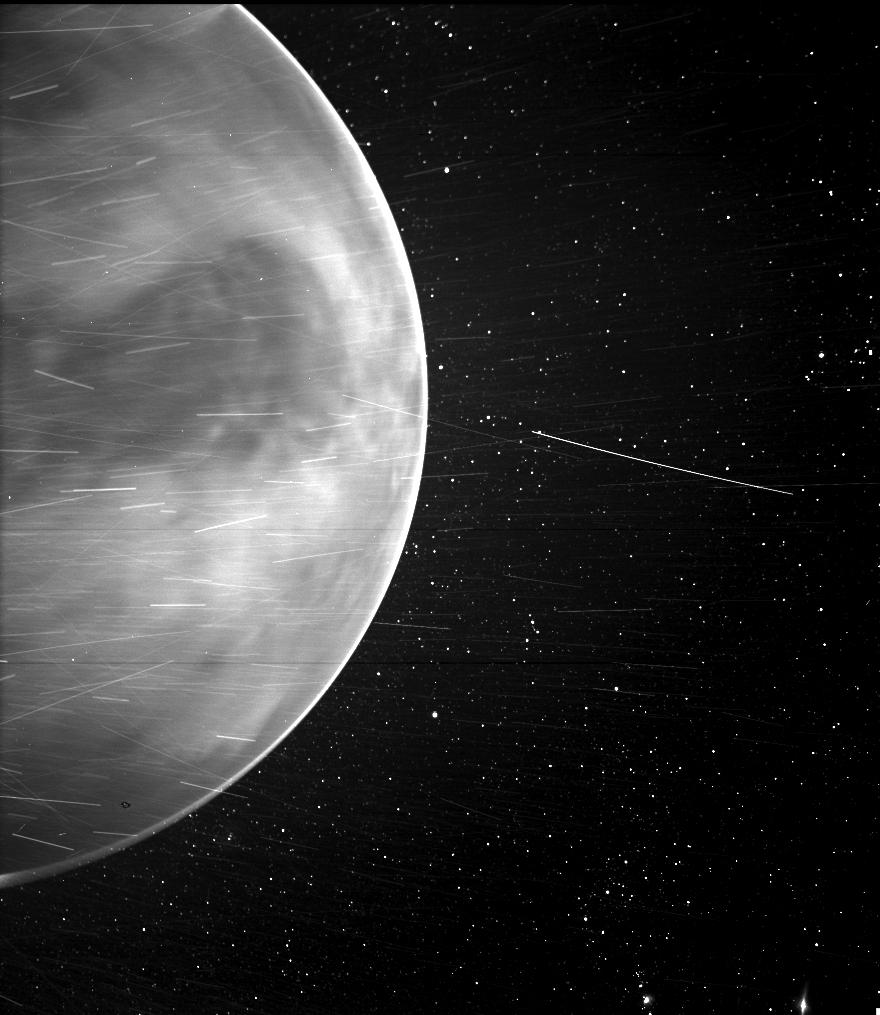
APL says Parker's early plans included no planetary science, but on 11 July 2020 the team turned WISPR, a camera built to image the solar wind, toward Venus in the hope of tracking the clouds. It saw through them: the night-side surface, at about 460 degrees C, glows faintly at the red edge of the visible spectrum, and WISPR's 470 to 800 nm band caught that glow, with the cooler highland Aphrodite Terra showing as a dark patch. The February 2021 pass lined up to image the whole night side, and Brian Wood's analysis appeared in Geophysical Research Letters on 9 February 2022. NASA calls these the first visible-light images of the surface taken from space; the first pictures from the ground came from the Venera 9 lander in 1975. The same July 2020 pass skimmed the upper atmosphere, where the FIELDS instrument recorded a natural radio emission for seven minutes. Glyn Collinson's team used it to measure the ionosphere, which had last been sampled directly by Pioneer Venus Orbiter in 1992, and found it much thinner near solar minimum.
BepiColombo, the European and Japanese mission to Mercury, passed Venus as a stack of two orbiters on a transfer module: ESA's Mercury Planetary Orbiter and JAXA's Mio. Its first Venus pass, on 15 October 2020 at 03:58:31 UTC, came 10,720.5 km above the surface by ESA's figure and 10,721.6 km by JAXA's, and slowed the stack by about 3.25 km/s. Most in situ instruments ran, with the MERTIS and PHEBUS spectrometers. JAXA coordinated the pass with Akatsuki, then in orbit around Venus, and with the Hisaki ultraviolet telescope in Earth orbit, and described the result as the first simultaneous planetary observation by three Japanese spacecraft missions. With the phosphine claim of September 2020 in the news, JAXA's Institute of Space and Astronautical Science (ISAS) noted that MERTIS covered wavelengths where phosphine absorbs; see Life on Venus.
August 2021 brought two visitors in 33 hours. Solar Orbiter passed 7,995 km from Venus at 04:42 UTC on 9 August, on the morning side; BepiColombo followed at 13:51:54 UTC on 10 August, only 552 km up, approaching over the night side. Neither could take high-resolution images with its science cameras, ESA said, but Solar Orbiter's SoloHI imager watched the planet in the days before and BepiColombo's monitoring cameras took black-and-white frames through closest approach. Each craft served as the other's solar wind monitor: BepiColombo sat upstream during Solar Orbiter's pass (ESA), and Solar Orbiter, between Venus and the Sun, did the same for BepiColombo's (ISAS). A team including ISAS reported in Nature Communications on 15 December 2022 that, at solar minimum, the solar wind was held off higher than models predicted, suggesting it does not inject energy straight into the ionosphere. Mio's Mass Spectrum Analyzer also caught cold oxygen and carbon ions about six Venus radii out in the flank of the induced magnetosphere, a region never sampled before, according to Hadid and colleagues in Nature Astronomy (12 April 2024).
Solar Orbiter, run by ESA with NASA, flies an orbit in resonance with Venus so that it comes back to the planet every few circuits of the Sun. Its first pass, on 27 December 2020 at 12:39 UTC, was about 7,500 km from the cloud tops. No images were possible because the spacecraft must keep facing the Sun, ESA explained, so only the magnetometer, the radio and plasma wave instrument and some particle sensors recorded. The third, on 4 September 2022 at 01:26 UTC, came 12,500 km from the planet's centre, shortly after a coronal mass ejection launched from the Sun on 30 August had swept over both the spacecraft and the planet (ESA). The fourth, on 18 February 2025, came within 379 km at 21:48 CET (20:48 UTC) and tilted the orbit from about 7.7 to about 17 degrees (angles that ESA's graphic and the Horizons notes measure from the Sun's equator), the step that gave ESA its first clear views of the Sun's south pole in June 2025.
ESA's Jupiter Icy Moons Explorer, JUICE, made its only Venus pass on 31 August 2025 at 07:28 CEST (05:28 UTC), after a communications anomaly in July had been cleared. SSC Space, whose engineers helped plan the flyby within ESA's control team, gives the distance as 5,088 km, which the Horizons trajectory matches. The spacecraft is built for the cold of the Jupiter system, so near Venus it kept its high-gain antenna pointed at the Sun as a heat shield, and SSC says no science observations were made. The JUICE data sheet in JPL Horizons (revised 27 September 2026) still gives a last Earth flyby in January 2029 and arrival at Jupiter in July 2031, and lists no further Venus pass.
The next spacecraft due at Venus is Solar Orbiter again, on 24 December 2026. ESA's flyby table says the pass will raise the inclination to 24 degrees and mark the start of the high-latitude mission. JPL's Horizons system, carrying ESA's trajectory fitted to tracking up to 17 September 2026, predicts closest approach at 22:57:48 UTC, about 948 km above the surface, at 20.8 km/s (queried 4 November 2026). Three more are scheduled in ESA's table, which adds that dates are subject to change: 18 March 2028, 10 June 2029 and 2 September 2030. ESA's planned trajectory in Horizons puts the first two at exactly 350.0 km, round figures that look like planning aim points, and the last at 02:58 UTC on 3 September 2030, 2,618 km up, one calendar day after ESA's date. No other past visitor is due back: APL called Parker's 2024 pass its final one, and the Horizons trajectories of Parker (queried to 2030), BepiColombo (to April 2027) and JUICE (to July 2031) show no later approach within 1.5 million km.
An Emirati spacecraft is the next new flyby visitor on the calendar. The mission was announced in 2021 as the 'Emirates mission to explore Venus and the asteroid belt', and the government portal still says it will explore the planet Venus. When the UAE Space Agency set out the full plan on 29 May 2023, the spacecraft was named MBR Explorer and Venus had become one of three gravity assists, with Earth and Mars, on a five-billion-kilometre tour of seven asteroids ending at (269) Justitia. An H3 launch was contracted from Mitsubishi Heavy Industries on 9 October 2024; Al Bayan (17 February 2026), The National (27 April 2026, with assembly and testing under way) and the news agency WAM (4 October 2026) give the first quarter of 2028, and Khaleej Times (4 September 2026) says March 2028. The National dated the Venus pass to July 2028 in its report of the 2023 briefing; no 2026 or Arabic source found restates the month or gives an altitude, so July 2028 remains the 2023 plan.
A 2020 study by NSSC and European partners for a Chinese mission to the Jupiter system, presented under the name Gan De, drew a Venus flyby on 11 April 2030 at 12,716 km after a launch on 2 October 2029. China's Jupiter mission is now Tianwen-4, and no official source found says whether it keeps that route: in April 2026 Guan Feng, director of the China Lunar Exploration and Space Center, said only that Tianwen-4 is within the plan and will explore Jupiter and its moons, with no date. NASA's DAVINCI, with a December 2031 launch baseline (its team now works toward December 2030), plans flybys before its probe descends, but it is bound for Venus itself. Russia's Interhelioprobe, a solar probe that was to use repeated Venus gravity assists, grew out of the Russian and German Interhelios project of the late 1990s and never flew. In February 2016 the IKI director Lev Zelenyi said budget cuts had pushed its launch beyond 2025; in February 2019 Vladimir Kuznetsov, director of IZMIRAN, said funding for 2019 to 2021 had been cut so sharply that the manufacturing contract would be re-let and the formal 2026 date would not hold. No later status was found.
Planetary geometry sets every launch and flyby date. Earth and Venus return to the same relative positions every 583.92 days, and each return opens a launch window for a direct flight (Don P. Mitchell's table of Venus missions). In 1978 two American and two Soviet launches put ten separate craft at Venus between 4 and 25 December: the Pioneer Venus orbiter, the multiprobe bus and its four probes, and two landers with their two flyby carriers. Mitchell marks the Type I windows of 1977, 1980, 1986 and 1988 as unused; Siddiqi says the Challenger accident delayed Magellan by at least a year, and it left on 4 May 1989 on a path one and a half times around the Sun. Mitchell lists 1991, 1993, 1994 and 1996 as unused too.
Two long gaps frame the gravity-assist era. After Magellan's launch on 4 May 1989, no mission whose destination was Venus left Earth until Venus Express on 9 November 2005, a gap of 6,033 days counted by calendar date, with only Galileo and Cassini passing by in between. Since Akatsuki and its passengers left on 20 May 2010, no mission to Venus has been launched. On 4 November 2026 that gap stood at 6,012 days, and it equals the earlier one on 25 November 2026. The next launch aimed at Venus on the schedule is India's Venus Orbiter Mission, targeted for March 2028 by the Indian government (June 2026); the Rocket Lab and MIT probe of the Venus Life Finder effort has no date and awaits Rocket Lab's unflown Neutron rocket. Announced plans for VERITAS, DAVINCI, EnVision and Venera-D all point to the 2030s; their own pages carry their current dates.
Mission facts
Organisations
NASA, ESA, JAXA, the Soviet Union (NPO Lavochkin) and the UAE Space Agency, among others
Mariner 10 (bound for Mercury)
Passed Venus on 5 February 1974 at a closest range of 5,768 km at 17:01 UT. NSSDCA calls it the first spacecraft to use the gravitational pull of one planet (Venus) to reach another; Siddiqi calls it the first to use a gravity assist to change its interplanetary trajectory. Science: yes, including the first close-up images of Venus.
Venera 11 and 12 carriers (1978)
Relay flybys at 34,370 km (Venera 11, 25 December) and about 34,000 km (Venera 12, 21 December) from the surface, per NPO Lavochkin, which planned 35,000 km; Siddiqi gives 35,000 km for both. Lavochkin calls each carrier an 'orbital craft', though it went into solar orbit.
Venera 13 and 14 carriers (1982)
Siddiqi gives 36,000 km for both and calls Venera 14's pass 'much closer than originally planned'. For Venera 14, NPO Lavochkin gives 26,050 km after a divert burn 56.4 m/s short (171.4 m/s instead of 227.8 m/s), 10,000 km closer than needed for full reception. The Venera 13 carrier then rehearsed the Halley trajectory with burns on 10 June and 14 October 1982.
Vega 1 and 2 carriers (1985, bound for Halley)
Passed Venus on 11 and 15 June 1985 at 39,000 km and 24,500 km from the surface (1986 Soviet encyclopedia yearbook); Siddiqi gives 39,000 km for Vega 1 and no Vega 2 figure. Science: lander relay. Course corrections toward the comet on 25 and 29 June 1985 (NPO Lavochkin).
Galileo (bound for Jupiter)
10 February 1990 at 05:58:48 UT: 16,106 km (Siddiqi), 'about 10,000 miles above the surface' (JPL), 16,123 km (Horizons). Science: yes, imaging, infrared night-side maps, fields and particles, and a search for lightning that found nine possible events.
Cassini-Huygens (bound for Saturn)
26 April 1998 (ESA; NASA's timeline says 25 April) at about 284 km, adding about 7 km/s (NASA); 24 June 1999 at 20:29:55 UTC and 602.6 km (Cassini weekly report). Science: a lightning search on both passes found no high-frequency signals; several orbiter instruments ran on the second pass, Huygens stayed off (ESA).
MESSENGER (bound for Mercury)
24 October 2006, 08:34:00 UTC, 2,987.3 km, no science (Sun between spacecraft and Earth); 5 June 2007, 23:08:19 UTC, 338.3 km, all seven instruments on and joint observations with Venus Express. Effective velocity changes 5.523 and 6.937 km/s (APL).
IKAROS and Shin'en (2010)
Launched with Akatsuki on 20 May 2010 (21 May, Japan time). IKAROS passed about 80,800 km from Venus at 16:39 JST on 8 December 2010 (JAXA IKAROS blog); Shin'en, with no communication after 21 May 2010 (a beacon was tracked to 31 May), passed sometime in December 2010 (Siddiqi). No Venus science.
Parker Solar Probe (bound for the Sun): seven passes
3 Oct 2018 about 1,500 miles; 26 Dec 2019 about 1,870 miles; 11 Jul 2020 833 km; 20 Feb 2021 2,385 km (announced the day before, matched by Horizons); 16 Oct 2021 3,814 km (NASA); 21 Aug 2023 4,006 km (Horizons); 6 Nov 2024 376 km (Horizons), through an aim point NASA gave as about 240 miles (380 km); APL's release converts the 240 miles to about 387 km. Launch to first flyby took 52 days.
Parker Solar Probe: Venus science
WISPR imaged the night-side surface glowing at 470 to 800 nm on the July 2020 and February 2021 passes (published 9 February 2022); FIELDS recorded a natural radio emission for seven minutes in July 2020 and measured a thinner ionosphere near solar minimum.
BepiColombo (bound for Mercury)
15 October 2020 at 03:58:31 UTC, 10,720.5 km (ESA) or 10,721.6 km (JAXA), braking about 3.25 km/s; 10 August 2021 at 13:51:54 UTC (ESA image release; the Cosmos page gives 13:51), 552 km. Science: yes, spectrometers, magnetometers and plasma sensors on both passes; Mio results published in 2022 and 2024.
Solar Orbiter, flown (bound for an inclined solar orbit)
27 Dec 2020, 12:39 UTC, about 7,500 km from the cloud tops; 9 Aug 2021, 04:42 UTC, 7,995 km; 4 Sep 2022, 01:26 UTC, 12,500 km from the centre; 18 Feb 2025, 20:48 UTC, 379 km, tilting the orbit from about 7.7 to 17 degrees (ESA flyby table). Science: in situ fields and particles only; the cameras face the Sun.
JUICE (bound for Jupiter)
31 August 2025 at 07:28 CEST (05:28 UTC; ESA's time, Horizons gives 05:28:51), 5,088 km (SSC and Horizons). No science observations: the high-gain antenna was turned to the Sun as a heat shield.
Next visitor: Solar Orbiter, 24 December 2026
ESA lists the date and a rise in inclination to 24 degrees. JPL Horizons (data sheet revised 30 September 2026, trajectory fitted to tracking up to 17 September 2026) predicts closest approach at 22:57:48 UTC, about 948 km above the surface, at 20.8 km/s (queried 4 November 2026).
Solar Orbiter, scheduled after 2026
18 March 2028, 10 June 2029 and 2 September 2030 in ESA's table ('Dates subject to change'). ESA's planned trajectory, as carried by Horizons (queried 4 November 2026), gives 350 km, 350 km (design values) and 2,618 km, and puts the last at 02:58 UTC on 3 September 2030.
MBR Explorer (UAE, bound for the asteroid belt)
Launch in the first quarter of 2028 (UAE Space Agency via Al Bayan, 17 February 2026), restated with a launch from Japan when its lander was unveiled on 4 October 2026 (WAM, via Annahar; Khaleej Times). Venus is one of three gravity assists with Earth and Mars, as Khaleej Times repeated that day. The 2023 reports dated its Venus pass to July 2028; no 2026 source found restates the month, and no altitude is published.
Tianwen-4 (China, study)
A 2020 study for a Chinese Jupiter-system mission (Gan De, EGU 2020, NSSC and partners) placed a Venus flyby on 11 April 2030 at 12,716 km after a 2 October 2029 launch; an earlier trajectory study from the Beijing Institute of Spacecraft System Engineering (2018) passed Venus on 4 April 2030 at about 6,011 km (China and Venus). People's Daily (overseas edition, 3 March 2025) gave a Tianwen-4 launch around 2030. On 24 April 2026 the director of the China Lunar Exploration and Space Center said only that Tianwen-4 is within the plan and will explore Jupiter and its moons (People's Daily via Beijing Daily); no 2026 source gives its trajectory or confirms the flyby.
Interhelioprobe (Russia, never flew)
Solar probe designed around repeated Venus gravity assists, from the Russian and German Interhelios of the late 1990s. Launch moved beyond 2025 after 2016 budget cuts (IKI, via RIA Novosti); in February 2019 IZMIRAN said the 2026 date would not hold and the contract would be re-let.
Launch windows
Earth and Venus return to the same relative positions every 583.92 days (Mitchell). Mitchell marks the Type I windows of 1959, 1977, 1980, 1986, 1988, 1991, 1993, 1994 and 1996 as unused.
The current gap (as of 4 November 2026)
No mission to Venus has launched since Akatsuki on 20 May 2010 (NSSDCA's chronology, updated March 2024, lists no Venus-bound launch after it, only the flyby users Parker, BepiColombo and Solar Orbiter; the MIT and Rocket Lab probe's page still reads 'Coming soon', and its science lead told Space.com on 3 September 2026 that it awaits the Neutron rocket, whose debut Rocket Lab has since moved to 2027): 6,012 days by calendar date on 4 November 2026. It equals the 6,033-day gap from Magellan (4 May 1989) to Venus Express (9 November 2005) on 25 November 2026 and is longer from 26 November.
Mission timeline
- 5 Feb 1974Mariner 10 passes Venus at 5,768 km on its way to Mercury.
- 21 and 25 Dec 1978The Venera 12 and Venera 11 carriers relay their landers while flying past at about 34,000 km.
- 1 and 5 Mar 1982The Venera 13 and 14 carriers relay their landers; the Venera 14 carrier passes at 26,050 km after a weak divert burn (NPO Lavochkin).
- 11 and 15 Jun 1985The Vega 1 and 2 carriers pass Venus and swing toward Halley's Comet.
- 10 Feb 1990Galileo passes about 16,000 km above Venus on its way to Jupiter.
- 26 Apr 1998Cassini-Huygens passes about 284 km above the surface; a second pass follows on 24 June 1999.
- 5 Jun 2007MESSENGER passes within about 200 miles (338 km in APL's flyby data) with all seven instruments on, in concert with Venus Express.
- 8 Dec 2010JAXA's solar sail IKAROS passes about 80,800 km from Venus.
- 14 Feb 2019IZMIRAN's director says Interhelioprobe funding has been cut and its 2026 launch will not happen.
- 11 Jul 2020Parker Solar Probe's WISPR camera sees the night-side surface through the clouds; FIELDS samples the ionosphere.
- 15 Oct 2020BepiColombo's first Venus pass, 10,720 km up, coordinated with Akatsuki and Hisaki.
- 9 and 10 Aug 2021Solar Orbiter (7,995 km) and BepiColombo (552 km) pass Venus 33 hours apart.
- 6 Nov 2024Parker Solar Probe makes its seventh and final Venus flyby, aimed at about 380 km above the surface.
- 18 Feb 2025Solar Orbiter passes 379 km from Venus and its orbit tilts to about 17 degrees.
- 31 Aug 2025JUICE passes 5,088 km from Venus with its instruments off.
- 24 Dec 2026 (predicted)Solar Orbiter's fifth Venus flyby, about 948 km up at 22:58 UTC by the Horizons prediction (trajectory fitted to 17 September 2026, queried 4 November 2026).
- Q1 2028 (planned)Target launch of the UAE's MBR Explorer, restated when its lander was unveiled on 4 October 2026; the 2023 plan put its Venus gravity assist in July 2028.
A filled dot marks something that physically happened. A hollow one marks an announcement, a naming or a target.
Every pass, flown and scheduled
Every pass of Venus by a spacecraft whose destination lay elsewhere, flown and scheduled, as of 4 November 2026. Heights are above the surface unless marked. 'Horizons' means azmth's reading of JPL Horizons vectors (Venus radius 6,051.8 km). Section B lists relay carriers and passengers of Venus missions for completeness; they are not counted in the 22.
Flown (22)
Scheduled (6)
Relay carriers and passengers (6)
Carriers and passengers of Venus missions, listed for completeness and not counted among the flybys above.
In pictures
Tap a photo to enlarge.
Translated from the original sources
Passages from the Russian, Arabic, Japanese and Chinese sources this page draws on, in azmth's translation. Tap Show original to read the original wording.
NPO Lavochkin: Venera 11 and Venera 12
Russian · 5 passages
“Because the ballistic conditions for the flight to Venus changed in 1978, a flyby and landing scheme was chosen.”
azmth's translation · Show originalHide original
Russian: «В связи с изменением баллистических условий для полёта к Венере в 1978 году была выбрана пролётно-десантная схема.»
“Two days before arrival at the planet the orbital craft and the descent craft separate, after which the 11D425A engine is fired to divert the orbital craft onto a flyby trajectory.”
azmth's translation · Show originalHide original
Russian: «За двое суток до подлета к планете производится разделение орбитального и спускаемого аппаратов, после чего включается двигатель 11Д425А для увода орбитального аппарата на пролётную траекторию.»
“At the moment of landing the orbital craft (OA) makes a partial flyby of Venus, during which it receives information from the descent vehicle; the minimum distance from the surface of Venus is 35 thousand km.”
azmth's translation · Show originalHide original
Russian: «В момент посадки ОА совершает частичный облёт Венеры, в ходе которого идет прием информации с СА, при этом минимальное расстояние от поверхности Венеры составляет 35 тысяч км.»
“Information from the landing site was transmitted for 95 minutes to the flyby craft, whose minimum distance from the surface of the planet was 34,370 km.”
Venera 11; the source's '¬' line-break hyphenation marks removed from the quote.
azmth's translation · Show originalHide original
Russian: «Информация с места посадки в течение 95 минут передавалась на пролетный аппарат, минимальное расстояние от которого до поверхности планеты составило 34370 км.»
“On 21 December 1978 the Venera 12 descent vehicle made a soft landing and for 110 minutes transmitted science data from the surface, which was relayed to Earth by the Venera 12 orbital craft, flying past at that time at a height of about 34,000 km.”
azmth's translation · Show originalHide original
Russian: «21 декабря 1978 года спускаемый аппарат «Венеры-12» совершил мягкую посадку и в течение 110 минут передавал с поверхности планеты научную информацию, которая ретранслировалась на Землю ОА «Венера-12», совершавшим в это время пролет на высоте ~ 34 000 км.»
NPO Lavochkin: Venera 13 and Venera 14
Russian · 3 passages
“However, the impulse the engine delivered was enough for the orbital craft not to 'crash' into Venus, and it passed at a distance of 26,050 km from it. That is 10,000 km closer to the surface of Venus than needed to receive the full information from the lander.”
Venera 14.
azmth's translation · Show originalHide original
Russian: «Однако отработанного двигателем импульса хватило, чтобы ОА не «врезался» в Венеру, а прошел от неё на расстоянии 26050 км. Это на 10000 км ближе к поверхности Венеры, чем необходимо для приёма в полном объёме информации с посадочного аппарата.»
“Already in 1980 a decision was taken for the next expedition (1984) to make successive approaches of the spacecraft to two space objects, Venus and Halley's Comet.”
azmth's translation · Show originalHide original
Russian: «Уже в 1980 году появилось решение о проведении в последующей экспедиции (1984 г.) последовательного сближения КА с двумя космическими объектами - Венерой и кометой Галлея.»
“The first of these corrections, which imitated aiming at the point of encounter with the comet, took place on 10 June 1982.”
Venera 13 carrier.
azmth's translation · Show originalHide original
Russian: «Первая из таких коррекций, которая имитировала прицеливание в точку встречи с кометой, состоялась 10 июня 1982 года.»
NPO Lavochkin: 40 years since the launch of Vega 1 and Vega 2
Russian · 1 passage
NPO Lavochkin: 40 years since the launch of Vega 1 and Vega 2 (2024)
Open the source“Soon after the automatic stations Vega 1 and Vega 2 flew past Venus, trajectory corrections of the (flyby) spacecraft were carried out on 25 and 29 June 1985 respectively, which sent them toward Halley's Comet.”
azmth's translation · Show originalHide original
Russian: «Вскоре после пролёта Венеры автоматическими станциями «Вега-1» и «Вега-2» 25 и 29 июня 1985 года соответственно были проведены коррекции траектории космических (пролётных) аппаратов, с помощью которых они были направлены к комете Галлея.»
Epizody kosmonavtiki: Vega 1, with Great Soviet Encyclopedia yearbook texts
Russian · 1 passage
Epizody kosmonavtiki: Vega 1, with Great Soviet Encyclopedia yearbook texts (Wayback copy)
Open the source“After separating the descent vehicles, the stations passed at distances of 39 thousand km (Vega 1) and 24.5 thousand km (Vega 2) from the surface of the planet Venus and continued their flight to Halley's Comet.”
Great Soviet Encyclopedia yearbook for 1986, as reproduced.
azmth's translation · Show originalHide original
Russian: «После отделения спускаемых аппаратов станции прошли на расстоянии 39 тыс. км («Вега-1») и 24,5 тыс. км («Вега-2») от поверхности планеты Венера и продолжили полет к комете Галлея.»
Epizody kosmonavtiki: Karfidov, projects of 1991 to 2000
Russian · 2 passages
Epizody kosmonavtiki: Karfidov, projects of 1991 to 2000 (Wayback copy)
Open the source“The Russian and German project Interhelios was developed in the late 1990s and by 2005 had turned into the purely Russian project Interhelioprobe.”
azmth's translation · Show originalHide original
Russian: «Российско-германский проект «Interhelios» разрабатывался в конце 1990-х годов и к 2005 году трансформировался в чисто российский проект «Интергелиозонд».»
“Using four gravity-assist manoeuvres on successive flybys of Venus, the probe reaches a working orbit with a perihelion radius of 20 million km and an inclination to the ecliptic of 40 degrees.”
In the source this sentence belongs to RKK Energiya's 1999 Solar Platform project, not to Interhelios.
azmth's translation · Show originalHide original
Russian: «Используя четыре гравитационных маневра при последовательных пролетах около Венеры, АМС выходит на рабочую орбиту с радиусом перигелия 20 млн. км и наклонением к плоскости эклиптики 40 град.»
RIA Novosti: Interhelioprobe and Millimetron launches postponed
Russian · 1 passage
RIA Novosti: Interhelioprobe and Millimetron launches postponed (4 February 2016, Wayback copy)
Open the source“Not a single project has been closed, but some projects have been postponed.”
IKI director Lev Zelenyi, 4 February 2016, on Interhelioprobe and Millimetron.
azmth's translation · Show originalHide original
Russian: «Ни один проект не закрыт, но некоторые проекты перенесены.»
RIA Novosti: Russia will not launch a Sun probe in 2026
Russian · 1 passage
RIA Novosti: Russia will not launch a Sun probe in 2026 (14 February 2019, Wayback copy)
Open the source“Formally the date is now 2026, and in reality we know that it will not happen.”
IZMIRAN director Vladimir Kuznetsov, 14 February 2019.
azmth's translation · Show originalHide original
Russian: «Формально сейчас стоит 2026 год и реально мы знаем, что этого не будет.»
ISAS/JAXA: result of Mio's first Venus swing-by
Japanese · 3 passages
ISAS/JAXA: result of Mio's first Venus swing-by (2020)
Open the source“It is a large Japanese and European mission that will study Mercury comprehensively with two orbiters: the Mercury Magnetospheric Orbiter Mio (MMO), JAXA's responsibility, and the Mercury Planetary Orbiter (MPO), ESA's responsibility.”
Footnote on BepiColombo.
azmth's translation · Show originalHide original
Japanese: 宇宙航空研究開発機構(JAXA)担当の水星磁気圏探査機「みお」(MMO:Mercury Magnetospheric Orbiter)と欧州宇宙機関(ESA)担当の水星表面探査機(MPO:Mercury Planetary Orbiter)の2つの周回探査機で水星の総合的な観測を行う日欧協力の大型ミッションです。
“BepiColombo carried out its first Venus swing-by, making its closest approach to Venus at 12:58:31 Japan time on Thursday 15 October 2020 and passing at an altitude of 10,721.6 km (Fig. 1, right). The swing-by used the gravity of Venus to slow the craft by about 3.25 km/s, achieving the target value.”
azmth's translation · Show originalHide original
Japanese: 「ベピコロンボ」は、1度目の金星スイングバイを実施し、2020年10月15日(木)12時58分31秒(日本時間)に金星に最接近、高度10,721.6kmを通過しました(図1右)。金星スイングバイでは金星の重力を利用して約3.25km/sの減速を行い、目標としていた数値を達成しました。
“This is the first time a simultaneous planetary observation has been achieved jointly by three Japanese spacecraft missions.”
azmth's translation · Show originalHide original
Japanese: 日本の宇宙機3ミッション共同による惑星同時観測の実現は初めてとなります。
ISAS/JAXA: the solar wind cannot enter the Venus atmosphere, Mio swing-by result
Japanese · 1 passage
ISAS/JAXA: the solar wind cannot enter the Venus atmosphere, Mio swing-by result (26 January 2023)
Open the source“However, these observations show that the solar wind is dammed up at a higher altitude than previously expected, suggesting observationally that energy is not injected into the Venus ionosphere by collision with solar wind plasma.”
azmth's translation · Show originalHide original
Japanese: しかし今回の観測結果はこれまでの予想よりも高高度で太陽風が堰き止められることを示しており、太陽風プラズマとの衝突による金星電離圏へのエネルギー注入は起こらないことが観測的に示唆されました。
ISAS/JAXA: plans for the first BepiColombo Venus swing-by and joint campaign
Japanese · 1 passage
ISAS/JAXA: plans for the first BepiColombo Venus swing-by and joint campaign (October 2020)
Open the source“Phosphine (PH3), whose detection at Venus was recently announced and is much discussed, also has absorption lines in the MERTIS wavelength range, so the instrument team is studying hard whether it can be observed.”
azmth's translation · Show originalHide original
Japanese: また最近金星での検出が発表され話題となっているリン化水素(フォスフィン、PH3)もMERTISの波長範囲に吸収線をもつため、その観測可能性について機器チームが鋭意検討中です。
JAXA IKAROS blog: daily report, 10 December 2010
Japanese · 1 passage
“IKAROS passed at a distance of about 80,800 km from Venus at 16:39 Japan Standard Time on 8 December.”
azmth's translation · Show originalHide original
Japanese: IKAROSは12月8日日本標準時16:39に,金星距離約80800kmを通過しました.
UAE government portal: Emirates mission to explore Venus and the asteroid belt 2028
Arabic · 2 passages
“Emirates mission to explore Venus and the asteroid belt 2028 (the portal page's heading).”
azmth's translation · Show originalHide original
Arabic: “مهمة الإمارات لاستكشاف الزهرة وحزام الكويكبات 2028”
“The Emirates project to explore the planet Venus and the asteroid belt is the first Arab space mission of its kind: it will explore the planet Venus and gather unprecedented scientific data on 7 asteroids in the asteroid belt of the solar system, with the spacecraft landing on the last of the seven.”
2021 wording, still on the portal on 4 November 2026.
azmth's translation · Show originalHide original
Arabic: “ويعد مشروع الإمارات لاستكشاف كوكب الزهرة وحزام الكويكبات أول مهمة فضائية عربية من نوعها، إذ سوف يستكشف كوكب الزهرة، بالإضافة إلى جمع بيانات علمية غير مسبوقة عن 7 كويكبات ضمن حزام الكويكبات داخل المجموعة الشمسية، على أن تهبط المركبة على آخر كويكب من الكويكبات السبعة.”
Government of Dubai Media Office: MBR Explorer announcement
Arabic · 1 passage
Government of Dubai Media Office: MBR Explorer announcement (29 May 2023)
Open the source“The spacecraft will travel 5 billion kilometres on an orbital journey of 6 flybys ending at the seventh asteroid, Justitia, including 3 gravity-assist manoeuvres at Venus, Earth and Mars to increase the spacecraft's speed.”
azmth's translation · Show originalHide original
Arabic: “وستقطع المركبة الفضائية، مسافة 5 مليار كيلومتر، في رحلة مدارية مكونة من 6 تحليقات وصولاً إلى الكويكب السابع «جوستيشيا»، تتضمن 3 مناورات بمساعدة قوة الجاذبية لكوكب الزهرة والأرض والمريخ لزيادة سرعة المركبة الفضائية”
Al Bayan (WAM): H3 launch agreement signed (9 October 2024)
Arabic · 1 passage
“the signing of an agreement between the UAE Space Agency and Mitsubishi Heavy Industries to provide launch services using the H3 carrier rocket in 2028 for the spacecraft 'Mohammed bin Rashid Explorer'”
azmth's translation · Show originalHide original
Arabic: “توقيع اتفاقية بين وكالة الإمارات للفضاء وشركة ميتسوبيشي للصناعات الثقيلة، لتوفير خدمات الإطلاق باستخدام الصاروخ الحامل H3 عام 2028 للمركبة "المستكشف محمد بن راشد"”
Al Bayan: ground segment design review completed
Arabic · 2 passages
Al Bayan: ground segment design review completed (17 February 2026)
Open the source“The Emirates Mission to the Asteroid Belt is scheduled for launch during the first quarter of 2028 within the set launch window.”
azmth's translation · Show originalHide original
Arabic: “ومن المقرر إطلاق مهمة الإمارات لاستكشاف حزام الكويكبات خلال الربع الأول من عام 2028 ضمن نافذة الإطلاق المحددة.”
“Once launched, the spacecraft will cover nearly five billion kilometres, performing gravity-assist manoeuvres with the help of the planets Venus, Earth and Mars to speed its journey toward the main asteroid belt.”
azmth's translation · Show originalHide original
Arabic: “وبمجرد إطلاقها، ستقطع المركبة مسافة تقارب خمسة مليارات كيلومتر عبر إجراء مناورات جاذبية بمساعدة كواكب الزهرة والأرض والمريخ لتسريع رحلتها نحو الحزام الرئيسي للكويكبات.”
Annahar, citing WAM: the UAE unveils the MBR Explorer lander, launch in 2028
Arabic · 1 passage
Annahar, citing WAM: the UAE unveils the MBR Explorer lander, launch in 2028 (4 October 2026)
Open the source“The mission is scheduled to launch from Japan during the first quarter of 2028, after the lander is integrated with the 'Mohammed bin Rashid Explorer' at the Laboratory for Atmospheric and Space Physics of the University of Colorado Boulder in the United States.”
Annahar, citing WAM, 4 October 2026.
azmth's translation · Show originalHide original
Arabic: “من المقرر إطلاق المهمة من اليابان خلال الربع الأول من عام 2028، بعد دمج مركبة الهبوط مع "المستكشف محمد بن راشد" في مختبر فيزياء الغلاف الجوي والفضاء بجامعة كولورادو بولدر الأميركية.”
Beijing Daily: High hopes for Tianwen-3's Mars samples, and Tianwen-4 is going to Jupiter
Chinese · 2 passages
Beijing Daily: High hopes for Tianwen-3's Mars samples, and Tianwen-4 is going to Jupiter (24 April 2026)
Open the source“On 24 April 2026, at the opening ceremony of the main event of the eleventh China Space Day, Guan Feng, director of the China Lunar Exploration and Space Center, said that the Tianwen-3 mission of China's planetary exploration programme is planned for launch around 2028 and will bring Mars samples back to Earth around 2031.”
azmth's translation · Show originalHide original
Chinese: 2026年4月24日,在第十一个“中国航天日”主场活动启动仪式上,中国探月与航天中心主任关锋介绍,中国行星探测工程天问三号任务计划于2028年前后实施发射,并将于2031年前后携带火星样品返回地球。
“He also revealed that the Tianwen-4 mission is already within the plan and will explore Jupiter and its moons.”
Guan Feng, director of the China Lunar Exploration and Space Center, 24 April 2026.
azmth's translation · Show originalHide original
Chinese: 他同时透露,天问四号任务也已在计划之内,将对木星及其卫星进行探测。
People's Daily Overseas Edition: China's new deep-space expedition
Chinese · 1 passage
People's Daily Overseas Edition: China's new deep-space expedition (3 March 2025)
Open the source“According to the plan, after launching Tianwen-2 this year, China will go on to launch Tianwen-3 and Tianwen-4 around 2028 and around 2030.”
People's Daily overseas edition, 3 March 2025.
azmth's translation · Show originalHide original
Chinese: 根据计划,在今年发射天问二号之后,中国还将在2028年前后及2030年前后陆续发射天问三号和天问四号。
NetEase self-published post: China to launch Tianwen-4 in 2029, focusing on Callisto
Chinese · 1 passage
NetEase self-published post: China to launch Tianwen-4 in 2029, focusing on Callisto (26 December 2023)
Open the source“On 11 April 2030 the probe flies past Venus at a flyby altitude of 12,716 km.”
Self-published NetEase article, 26 December 2023, presenting the 2020 Gan De study route as Tianwen-4's plan.
azmth's translation · Show originalHide original
Chinese: 2030 年 4 月 11 日,探测器飞掠金星,飞掠高度 12,716 公里。
Sources
- JPL Horizons: Solar Orbiter (-144) Venus-centred vectors for 24 December 2026 (data sheet revised 30 September 2026, fit to tracking up to 17 September 2026, queried 4 November 2026)
- ESA: Solar Orbiter perihelia and flybys (undated table)
- ESA: Solar Orbiter ready for close encounter with Venus (18 February 2025)
- ESA: Solar Orbiter prepares for festive Venus flyby (17 December 2020)
- ESA: Coronal mass ejection hits Solar Orbiter before Venus flyby (September 2022)
- ESA: Sights and sounds of a Venus flyby (August 2021)
- ESA Cosmos: BepiColombo Venus flybys
- ISAS/JAXA: result of Mio's first Venus swing-by (2020) · in Japanese
- ISAS/JAXA: the solar wind cannot enter the Venus atmosphere, Mio swing-by result (26 January 2023) · in Japanese
- ISAS/JAXA: plans for the first BepiColombo Venus swing-by and joint campaign (October 2020) · in Japanese
- Hadid et al., Nature Astronomy, 12 April 2024 (Crossref record with abstract)
- ESA: Juice team resolves anomaly on approach to Venus (update 1 September 2025)
- SSC: Juice's Venus flyby a success (2025)
- JPL Horizons: Parker Solar Probe (-96) Venus-centred vectors, sixth flyby, 21 August 2023 (data sheet revised 30 September 2026, re-queried 4 November 2026)
- NASA Parker Solar Probe blog: lines up for final Venus flyby, aim point about 240 miles (6 September 2024)
- JHU APL: Parker Solar Probe swings through final Venus flyby (8 November 2024)
- JPL Horizons: Parker Solar Probe (-96) Venus-centred vectors, seventh flyby, 6 November 2024 (data sheet revised 30 September 2026)
- NASA: Parker Solar Probe offers stunning view of Venus (24 February 2021)
- NASA: Parker Solar Probe captures its first images of Venus' surface in visible light, confirmed (9 February 2022)
- NASA: Parker Solar Probe discovers natural radio emission in Venus' atmosphere (3 May 2021)
- NASA Parker Solar Probe blog: completes its fifth Venus flyby (19 October 2021)
- JHU APL MESSENGER: flyby information
- APL release: MESSENGER completes Venus flyby (24 October 2006, NSSDCA mirror)
- APL release: MESSENGER completes second flyby of Venus (5 June 2007, NSSDCA mirror)
- NASA Science: Cassini timeline
- NASA Science: Cassini significant event report, week ending 30 June 1999
- ESA: Cassini-Huygens Venus flyby successfully completed (1999)
- Gurnett et al., Nature 409 (2001), non-detection of lightning signals at Venus (NTRS record)
- JPL: Galileo swings by Venus (10 February 1990)
- Carlson et al., Science 1991, Galileo infrared imaging spectroscopy at Venus (Europe PMC)
- Gurnett et al., Science 1991, lightning and plasma wave observations from the Galileo flyby (Europe PMC)
- A. Siddiqi, Beyond Earth: A Chronicle of Deep Space Exploration, 1958 to 2016 (NASA SP-2018-4041)
- NSSDCA: Mariner 10
- NSSDCA: Venera 14 bus (Wayback copy, 31 July 2025)
- NSSDCA: Chronology of Venus exploration (updated 11 March 2024)
- NPO Lavochkin: Venera 11 and Venera 12 · in Russian
- NPO Lavochkin: Venera 13 and Venera 14 · in Russian
- NPO Lavochkin: 40 years since the launch of Vega 1 and Vega 2 (2024) · in Russian
- Epizody kosmonavtiki: Vega 1, with Great Soviet Encyclopedia yearbook texts (Wayback copy) · in Russian
- Epizody kosmonavtiki: Karfidov, projects of 1991 to 2000 (Wayback copy) · in Russian
- RIA Novosti: Interhelioprobe and Millimetron launches postponed (4 February 2016, Wayback copy) · in Russian
- RIA Novosti: Russia will not launch a Sun probe in 2026 (14 February 2019, Wayback copy) · in Russian
- JAXA IKAROS blog: daily report, 10 December 2010 · in Japanese
- UAE government portal: Emirates mission to explore Venus and the asteroid belt 2028 · in Arabic
- Government of Dubai Media Office: MBR Explorer announcement (29 May 2023) · in Arabic
- Al Bayan (WAM): H3 launch agreement signed (9 October 2024) · in Arabic
- Al Bayan: ground segment design review completed (17 February 2026) · in Arabic
- The National: UAE unveils details of its mission to the main asteroid belt (29 May 2023)
- The National: MBR Explorer on track for 2028 launch as tests begin (27 April 2026)
- Khaleej Times: MBR Explorer, five billion km asteroid mission (4 September 2026)
- Annahar, citing WAM: the UAE unveils the MBR Explorer lander, launch in 2028 (4 October 2026) · in Arabic
- Khaleej Times: UAE asteroid mission probe achieves flight readiness in less than 2 years (4 October 2026)
- Blanc et al., Gan De: science objectives and mission scenarios for China's mission to the Jupiter system, EGU 2020
- Beijing Daily: High hopes for Tianwen-3's Mars samples, and Tianwen-4 is going to Jupiter (24 April 2026) · in Chinese
- LPSC 2026 abstract 1685: DAVINCI science update 2026
- Don P. Mitchell: Missions to Venus, with unused windows (2003 to 2004)
- Press Information Bureau, Government of India: Venus Orbiter Mission targeted for March 2028 (21 June 2026)
- Morningstar Missions (MIT): Rocket Lab mission to Venus, target launch date
- Space.com (Leonard David): Rocket issues delay 1st-ever private mission to Venus, 'we are awaiting Neutron readiness' (3 September 2026)
- Space.com (Mike Wall): Rocket Lab pushes 1st launch of next-gen Neutron rocket to 2027 (16 October 2026)
- JPL Horizons: JUICE (-28) data sheet (revised 27 September 2026; flyby list unchanged when re-read on 4 November 2026)
- ESA: Why Solar Orbiter is angling towards the Sun's poles (June 2025)
- NASA Parker Solar Probe blog: first Venus flyby (3 October 2018)
- NASA Parker Solar Probe blog: completes second Venus flyby (26 December 2019)
- NASA Parker Solar Probe blog: primed for fourth Venus flyby (19 February 2021)
- ESA: BepiColombo's second Venus flyby in images (13 August 2021)
- People's Daily Overseas Edition: China's new deep-space expedition (3 March 2025) · in Chinese
- NetEase self-published post: China to launch Tianwen-4 in 2029, focusing on Callisto (26 December 2023) · in Chinese
Facts on this page were verified on 4 November 2026. Where sources disagree, the disagreement is stated rather than resolved silently.
azmth is independent and is not affiliated with or endorsed by NASA, Roscosmos, NPO Lavochkin, ESA, JAXA, ISRO, CNSA, or any other space agency or company named on this page.