ISRO Venus Orbiter Mission (Shukrayaan)
ISRO · Multinational · Orbiter · 2028 · Announced In development
In development: the design review is complete, and launch is planned for March 2028 on ISRO's LVM3 rocket.
TL;DR· 17 min read
India's Venus Orbiter Mission, also called Shukrayaan, is an ISRO orbiter planned to launch in March 2028 on an LVM3 rocket. Approved in September 2024 at Rs 1,236 crore (about €117 million), it will carry 19 instruments, including a radar to map the surface, a Swedish instrument that studies how Venus loses its air and a Russian infrared spectrometer. It will use the atmosphere as a brake to reach a low polar orbit, 200 by 600 km up, and its design review is complete.
When will India's Venus mission launch?
India's Venus Orbiter Mission (VOM), often called Shukrayaan, is planned to launch in March 2028 on ISRO's LVM3 rocket. It is India's first mission to Venus: an orbiter with 19 instruments, led by a radar that will map the surface and look for active volcanoes. After arriving it will skim the upper atmosphere for several months to lower itself into a low polar orbit, then study the planet for five years. The Indian government approved the mission in September 2024 at Rs 1,236 crore (about €117 million), and by April 2026 ISRO had completed its design review and set up its science team. Sweden is building an instrument to study how Venus loses its air to space, and Russia a spectrometer to measure the gases, temperatures and winds in and above the clouds. The idea dates from 2012, and earlier targets of 2023, 2024 and 2025 passed while the mission waited for approval.
Facts as of 4 November 2026, from the sources listed below.
- March 2028launch target set by the Government of India in 2024 and restated in June 2026; ISRO's withdrawn 2024 table gave 29 March as the Earth departure date
- 19instruments: 16 Indian, 2 Indian with foreign partners, 1 foreign (ISRO's list)
- 1,236 crore rupeesapproved cost in September 2024 (about €117 million), of which Rs 824 crore (about €77.7 million) is for the spacecraft; Rs 5.12 crore (about €483,000) had been spent by 31 January 2026
Two years after approval, India's Venus Orbiter Mission is a reviewed design with a budget, a science team and a launch month. The Department of Space Annual Report 2025-26, dated 29 April 2026, records that the Preliminary Design Review has been completed, that a Science Working Group has been constituted and that the mission's Principal Scientist has been declared. The Press Information Bureau (PIB) repeated the target in a government backgrounder of 21 June 2026: the mission is 'targeted for launch in March 2028'. No source found up to 4 November 2026 reports a slip, and none reports flight hardware being assembled or tested.
ISRO's mission page sets out the flight plan. LVM3, ISRO's candidate launch vehicle, is to leave the spacecraft in an elliptical Earth parking orbit of 170 by 36,000 km, so the spacecraft's own engine must finish the departure toward Venus. After Venus Orbit Injection into a loose orbit of 500 by 60,000 km, six to eight months of aerobraking, dipping into the upper atmosphere at each close pass, are to lower it to a science orbit of about 200 by 600 km inclined around 90 degrees, where the instruments are to work for five years. According to the government's 2026 backgrounder, ISRO is undertaking aerobraking and thermal management at Venus for the first time. ISRO's page says the near-polar orbit would give uniform coverage, where earlier Venus missions covered either the south polar region or the equatorial belt.
Two exact dates circulate. Official texts now give only March 2028, or 'by 2028' in the Annual Report, but the days come from ISRO itself. According to Internet Archive captures of 1 October 2024, the earliest archived version of the mission page carried a table of the 'targeted launch window for the VOM': Earth departure on 29 March 2028 and arrival at Venus on 19 July 2028. The table was still online on 1 December 2024 and gone by 6 January 2025; no explanation for the change was found. India Today, the Times of India and, on 19 May 2026, The Week called 29 March the launch date, while The Hindu, on 9 September 2026, used ISRO's own label, 'Earth departure date'. Because the rocket leaves the craft in an Earth parking orbit, lift-off can come before departure from Earth, and ISRO has published no lift-off day. IKI, the Russian partner, gave the launch as 'after 2028' in an overview of 3 October 2025. This page uses March 2028 as the official target.
Work on the idea began long before approval. According to The Hindu, it was born in 2012, and ISRO began preliminary studies after the Department of Space received a 23 percent rise in its 2017-18 budget, seeking payload proposals from research institutes in April 2017. On 30 September 2020 the French space agency CNES announced that France would take part in ISRO's Venus mission, 'scheduled to launch in 2025', a year that none of the ISRO statements found gives. In November 2020 an ISRO official told PTI that 20 instrument proposals had been shortlisted, with collaborative contributions from Russia, France, Sweden and Germany, and that a June 2023 target was under review because of the pandemic. On 9 January 2023 P. Sreekumar, adviser to ISRO's space science programme, said the mission, by then aimed at December 2024, was still 'waiting for formal approval and money', and that 'right now the 2031 window is very good'.
The go-ahead came twenty months later. On 18 September 2024 the Union Cabinet approved the mission for the March 2028 opportunity at Rs 1,236 crore (about €117 million), of which Rs 824 crore (about €77.7 million) is for the spacecraft. ISRO is to develop and launch the spacecraft, which News9 reported in 2025 is to be assembled at the U R Rao Satellite Centre in Bengaluru.
Spending has been slow, and Parliament has said so. In its 410th Report, laid on 25 March 2026, the Standing Committee on Science and Technology, Environment, Forests and Climate Change found that the mission's 2024-25 allocation went unspent, and that the 2025-26 allocation was cut from Rs 50 crore (about €4.7 million) to Rs 29.50 crore (about €2.78 million), of which Rs 5.12 crore (about €483,000) had been spent by 31 January 2026. At that pace, the committee wrote of this mission and the two Chandrayaan missions reviewed with it, their timely accomplishment 'as per the proposed timelines may become challenging'. It also agreed with the department that such missions are iterative, and judged that their cash needs would rise substantially as they moved from initiation to execution. According to Rediff's reading of the full report, the Department of Space told the committee that the spacecraft configuration had been finalised, that the preliminary design review of the payloads and mainframe systems was complete, and that the 2025-26 money was tied to agreements with institutes building instruments. That places the design review before March 2026; The Week and the Times of India later dated its completion to April 2026.
Radar comes first in ISRO's payload list. VSAR, the S-band synthetic aperture radar presented by ISRO's Space Applications Centre, is meant to search for recent and active volcanism, characterise impact craters and map Venus at 20 to 30 m, which ISRO's page calls an order of magnitude better than Magellan. The two official descriptions differ on frequency. ISRO's 2024 page gives 2.5 GHz; the instrument's science lead, Sriram Saran Bhiravarasu, gave 2.385 GHz at the meeting of NASA's Venus Exploration Analysis Group on 6 November 2025, chosen so that VSAR's 12.6 cm wavelength exactly matches Magellan's. That match, with similar viewing geometry, allows one-to-one comparison with Magellan images of the volcanic provinces, about 38 years apart, to look for volcanic activity. The same deck labels the 200 to 600 km orbit 'Phase-B', a design-stage figure.
VARTISS, the second radar, is a low-frequency sounder. In its ionosphere mode it measures the density and height of the topside ionosphere; in its subsurface mode, 9 to 25 MHz in the 2025 deck, it works as an orbital ground-penetrating radar able to detect buried interfaces down to about 1 km, depending on the material. Around the two radars ISRO lists fourteen more Indian instruments, from VSEAM, an imaging spectrometer for hot volcanic spots, clouds and water, to cameras, a lightning receiver, a mass spectrometer, plasma, radiation and dust detectors and a solar soft X-ray spectrometer.
The Swedish contribution comes from a long family of instruments. The Venusian Neutrals Analyzer (VNA), built by the Swedish Institute of Space Physics (IRF), forms one half of the collaborative package VISWAS, beside a Plasma Analyser from the Space Physics Laboratory of ISRO's Vikram Sarabhai Space Centre. VNA is to measure neutral particles around Venus to study how the solar wind interacts with the atmosphere and how Venus loses its upper atmosphere to space. Its principal investigator, Yoshifumi Futaana, was also responsible for ASPERA-4 on Venus Express, and IRF describes VNA as the ninth generation of its miniature ion and neutral atom instruments.
Accounts of the paperwork behind VNA differ. ISRO's Annual Report says approval to formalise an MoU with IRF came in April 2025, and lists among the year's signed documents an agreement between ISRO and a 'Space Physics Laboratory, Sweden' for a payload on the Venus mission. At the Sweden and India summit in Gothenburg on 17 May 2026, the prime ministers' joint statement, published by the Swedish government, 'welcomed the collaboration' between ISRO and IRF on the mission. India Today and The Week reported a memorandum signed during the visit by ISRO and the Swedish National Space Agency, and the Times of India an agreement signed by Sweden. Neither the joint statement nor the six outcomes of the visit listed by India's Ministry of External Affairs, as reported by IANS, mention such a signing, and at the ministry's briefing that day the Secretary (West), Sibi George, said only that Sweden would be involved. IRF's release of 19 May speaks of deepened collaboration, so the parties and dates of the agreement or agreements are not confirmed from a primary text.
Russia's instrument is VIRAL, the Venus InfraRed Atmospheric gases Linker, from the Space Research Institute of the Russian Academy of Sciences (IKI RAN). This solar occultation spectrometer reads sunlight filtered through the planet's limb to profile temperature, gases and haze in and above the clouds and to measure winds between 65 and 140 km. In August 2025 Oleg Korablev of IKI told TASS, as retold by Ridus, that ISRO expected the final unit by March 2027. ISRO's Annual Report says approval to start an implementation arrangement with Roscosmos for VIRAL came in April 2025 and that technical discussions continue; no source found says that arrangement has been signed. IKI's October 2025 overview still says only that the spectrometer is expected to be installed. On 11 September 2026 the head of Roscosmos, Dmitry Bakanov, told the Vesti news service that VIRAL is 'our joint equipment' to be placed in orbit around Venus.
France's part in VIRAL is the open question on this page. CNES's release of 30 September 2020 said VIRAL, co-developed with Roscosmos and the CNRS laboratory LATMOS, had been selected by ISRO, and that CNES would coordinate the French part; PTI carried the statement that day and repeated it in November 2020. ISRO's 2024 page says VIRAL 'will be developed by IKI, RUSSIA', ISRO's 2026 report names only IKI and Roscosmos, and Roscosmos in 2026 speaks of a Russian and Indian project. A search of the LATMOS website on 4 November 2026 returned no page for VIRAL. No source found says whether a French contribution continues.
RAVI (Radio Anatomy of Venus Ionosphere), the second collaborative payload, needs no instrument box of its own: as the spacecraft's normal radio signal to Earth passes behind the limb, the bending of its path through the atmosphere and ionosphere gives profiles of electron density, temperature, pressure and number density. ISRO says only that RAVI 'will have a science collaboration with a Germany team'; no German institution has been named in any source found.
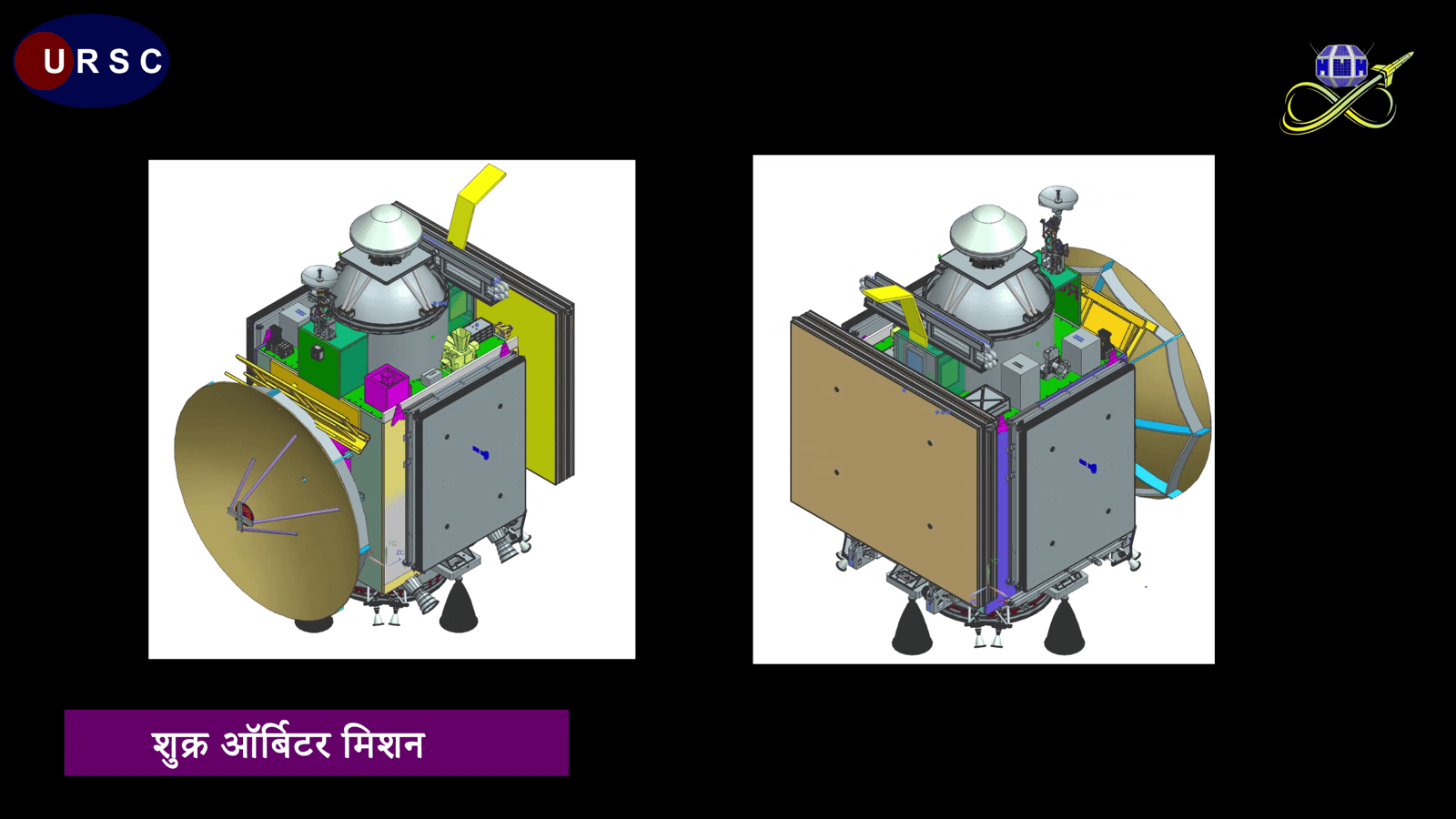
An atmospheric probe hangs over the mission without being part of its official plan. The idea is old: in May 2015 former ISRO chairman U. R. Rao told the Deccan Chronicle that the French scientist Jacques Blamont had handed him a report on using large balloons of his design to study the atmosphere of Venus, and that India lacked the expertise to make them. ISRO's 2024 payload list, the cabinet release and the 2025-26 Annual Report name no probe or balloon. In November 2025, however, renders shown by the U R Rao Satellite Centre depicted a domed object on top of the orbiter, which News9 read as an atmospheric probe; the same report said ISRO chairman V. Narayanan had indicated that a probe was still an option, and that Union minister Ashwini Vaishnaw had indicated the mission would carry one. This page has not traced either remark to a primary record. No mass, instruments, entry design or builder have been published; News9 repeated on 29 April 2026 that ISRO plans a probe, citing no official text. Until ISRO adds it to the payload list, this page treats it as an option under discussion; other unflown Venus ideas are gathered under Venus proposals.
Data are to come home through the DSN32 antenna of the Indian Deep Space Network, and the Indian Space Science Data Centre is to archive them in the PDS4 standard. ISRO has also been building a user community before launch: a national science meet at ISRO Headquarters in Bengaluru on 29 and 30 October 2025 drew about 150 participants, more than 70 of them from outside the Department of Space.
Other agencies are watching the schedule. On 9 September 2026 an ESA director told The Hindu that ESA's Venus science coordination group was speaking to ISRO 'to make sure that the missions complement each other'. The Space Applications Centre's comparison table of November 2025 set VOM's launch year of 2028 against 2031 for NASA's VERITAS and 2032 for the European EnVision, which ESA's own pages put in November 2031. For the orbiters that came before it, see mapping Venus and Akatsuki.
Mission facts
Organisations
Indian Space Research Organisation (ISRO), Department of Space, Government of India; foreign instruments from the Swedish Institute of Space Physics (IRF) and the Space Research Institute of the Russian Academy of Sciences (IKI RAN)
Name
Venus Orbiter Mission (VOM). The Hindi cabinet release of 2024 writes the English name in Devanagari letters; the Hindi committee release of 2026 calls it both Shukra Orbiter Mission and Shukra Parikrama Mission ('Venus orbit mission'), Shukra being the Hindi name for Venus. Shukrayaan ('Venus craft') is a popular name used in the press; it does not appear in the cabinet release or on ISRO's mission page.
Status (as of 4 Nov 2026)
Preliminary Design Review completed, Science Working Group constituted and Principal Scientist declared (Department of Space Annual Report 2025-26, dated 29 April 2026). The report does not mention integration of flight hardware, and no later official statement found reports a slip.
Launch target
March 2028 ('the opportunity available during March 2028' in the 2024 cabinet release; 'targeted for launch in March 2028' in a PIB backgrounder of 21 June 2026; 'planned to be launched in March 2028' on ISRO's mission page, read on 4 November 2026). The page's earliest archived version (1 October 2024) gave 29 March 2028 as the 'Earth Departure Date' in a table since removed; no lift-off day has been published.
Launcher and parking orbit
LVM3, which ISRO names as the candidate launch vehicle, to place the spacecraft in an elliptical Earth parking orbit of 170 km by 36,000 km (inclined 21.5 degrees, with an argument of perigee of 178 degrees, in the page's earliest archived version, 1 October 2024).
Earth departure and arrival (withdrawn ISRO table)
Earth departure 29 March 2028, a 112-day transfer, arrival at Venus 19 July 2028 and a total delta-v of 2,953 m/s with LVM3, in a table on ISRO's mission page as captured on 1 October 2024. The table was removed between 1 December 2024 and 6 January 2025; the press still repeats the dates (The Hindu, 9 Sep 2026).
Orbits
Venus Orbit Injection into 500 km by 60,000 km, then 6 to 8 months of aerobraking down to a science orbit of 200 km by 600 km inclined around 90 degrees, for 5 years of science.
Approved cost
Rs 1,236 crore (about €117 million), of which Rs 824.00 crore (about €77.7 million) for the spacecraft; the total includes payloads, global ground station support and the launch vehicle (cabinet approval, 18 Sep 2024). Euro amounts on this page are converted at the European Central Bank rates of 5 November 2026 (106.0395 rupees and 0.83393 pounds to the euro).
Spending to date
2024-25: Rs 1 crore (about €94,000) budgeted, revised to Rs 2.10 crore (about €198,000), nothing spent. 2025-26: Rs 50 crore (about €4.7 million) cut to Rs 29.50 crore (about €2.78 million), Rs 5.12 crore (about €483,000) spent by 31 January 2026 (410th Report of the Standing Committee, 25 March 2026).
Payloads
19 recommended by an Experts Review Committee: 16 Indian, 2 Indian and international collaborative (VISWAS, RAVI) and 1 international (VIRAL).
VSAR (radar)
S-band polarimetric synthetic aperture radar for volcanism, craters and mapping (30 m in the deck, 20 to 30 m on ISRO's page). ISRO's 2024 page gives 2.5 GHz; the Space Applications Centre deck of 6 Nov 2025 gives 2.385 GHz, matching Magellan's 12.6 cm wavelength, a 7.2 m by 2 m reflectarray antenna, 400 W and coverage from 70 degrees N to 70 degrees S.
VARTISS (sounder)
Low-frequency radar with an ionosphere mode (0.1 to 10 MHz on ISRO's page, 1 to 10 MHz in the 2025 deck) and a subsurface mode at 9 to 25 MHz that the deck says can detect interfaces down to about 1 km, depending on the material.
VNA (Sweden)
Venusian Neutrals Analyzer, built by IRF, principal investigator Yoshifumi Futaana, to fly as part of a larger Indian instrument package (VISWAS, whose Plasma Analyser comes from the Space Physics Laboratory of VSSC, per ISRO). IRF calls it the ninth generation of its miniature ion and neutral atom instruments, after SARA on Chandrayaan-1.
VIRAL (Russia)
Venus InfraRed Atmospheric gases Linker, 'developed by IKI, RUSSIA' in ISRO's words: a solar occultation spectrometer, 2.3 to 4.3 micrometres, profiling temperature and CO2 (65 to 180 km), CO, H2O, HDO and SO2, and measuring winds from 65 to 140 km through the Doppler shift of CO2 lines.
VIRAL's French share
In a press release of 30 September 2020, CNES said France would take part in the mission and that VIRAL, co-developed with Roscosmos and the CNRS laboratory LATMOS, had been selected by ISRO, with CNES coordinating the French part. ISRO's 2024 page and 2026 report name only IKI and Roscosmos; no source found confirms a French role after 2020.
RAVI (Germany)
Radio occultation experiment using the spacecraft's normal radio link, with 'a science collaboration with a Germany team'. No German institution is named.
Radar software (UK)
The UK Space Agency awarded Royal Holloway, University of London, £306,000 (about €367,000) in February 2024 for a project with ISRO named 'Chandrayaan-2 and Shukrayaan': processing multi-band radar data and developing analysis software, including to map the surface of Venus. ISRO's payload list names no British partner.
Technology goals
Aerobraking and thermal management at Venus, which the government says ISRO is undertaking for the first time.
Ground segment and data
DSN32 antenna of the Indian Deep Space Network, with support from external agencies such as NASA; data archived at the Indian Space Science Data Centre in the PDS4 standard.
Atmospheric probe
A domed object on top of the orbiter in U R Rao Satellite Centre renders reported in November 2025, read by News9 as an atmospheric probe. No probe is in ISRO's payload list, the cabinet release or the 2025-26 Annual Report. News9 repeated on 29 April 2026 that ISRO plans to deploy one, without citing an official text.
Mission timeline
- 2012The idea of an Indian Venus mission is born, according to The Hindu's 2023 account.
- 20 May 2015Former ISRO chairman U. R. Rao says a Venus craft could be ready in about two and a half years on a PSLV; Jacques Blamont offers ISRO a report on balloons for Venus.
- Apr 2017ISRO seeks Venus payload proposals from research institutes. The Hindu ties the start of preliminary studies to a 23 percent rise in the Department of Space's 2017-18 budget.
- 30 Sep 2020CNES announces that France will take part in ISRO's Venus mission, 'scheduled to launch in 2025', and that ISRO has selected VIRAL.
- Nov 2020ISRO shortlists 20 instrument proposals, including collaborative ones from Russia, France, Sweden and Germany; an ISRO official says the June 2023 target is under review. SpaceNews separately reports an ISRO scientist telling a NASA planning committee the aim is now late 2024.
- 9 Jan 2023P. Sreekumar says the mission, then aimed at December 2024, is 'waiting for formal approval and money' and that the 2031 window is very good.
- 18 Sep 2024Union Cabinet approves VOM at Rs 1,236 crore (about €117 million) for the March 2028 opportunity.
- 1 Oct 2024ISRO's mission page tabulates the targeted window: Earth departure 29 March 2028, a 112-day transfer, arrival at Venus 19 July 2028. Press reports call 29 March the launch date. The table is gone from the page by January 2025.
- Apr 2025ISRO obtains approval to start an implementation arrangement with Roscosmos for VIRAL and to formalise an MoU with IRF for VNA.
- 16 Aug 2025IKI's Oleg Korablev tells TASS that ISRO expects the final VIRAL unit by March 2027.
- 29 to 30 Oct 2025National science meet on VOM at ISRO Headquarters, Bengaluru, with about 150 participants; ISRO also describes an Announcement of Opportunity for analysing archival Venus data.
- 6 Nov 2025The Space Applications Centre presents VSAR and VARTISS to NASA's Venus Exploration Analysis Group, with launch given as 2028.
- 16 Nov 2025 (reported)U R Rao Satellite Centre renders show a domed object on top of the orbiter, read by News9 as an atmospheric probe.
- 25 Mar 2026Parliament's Standing Committee reports Rs 5.12 crore (about €483,000) spent by 31 January 2026 and warns the proposed timelines may become challenging.
- 29 Apr 2026Department of Space Annual Report 2025-26 records the Preliminary Design Review as completed.
- 17 May 2026Sweden and India summit in Gothenburg: the prime ministers welcome the ISRO and IRF collaboration on the mission.
- 11 Sep 2026Roscosmos head Dmitry Bakanov calls VIRAL 'our joint equipment' for orbit around Venus.
- Mar 2028 (target)Planned launch on LVM3, with Earth departure on 29 March 2028 in ISRO's withdrawn table; no lift-off day published; not yet happened.
A filled dot marks something that physically happened. A hollow one marks an announcement, a naming or a target.
In pictures
Tap a photo to enlarge.
Translated from the original sources
Passages from the Hindi, Russian, French and Swedish sources this page draws on, in azmth's translation. Tap Show original to read the original wording.
PIB, 18 Sep 2024: cabinet release in Hindi
Hindi · 3 passages
“The Union Cabinet chaired by Prime Minister Shri Narendra Modi has approved the development of the Venus Orbiter Mission (VOM).”
PIB, 18 September 2024; note the transliterated name.
azmth's translation · Show originalHide original
Hindi: “प्रधानमंत्री श्री नरेन्द्र मोदी की अध्यक्षता में केंद्रीय मंत्रिमंडल ने वीनस ऑर्बिटर मिशन (वीओएम) के विकास को मंजूरी प्रदान की है”
“The mission is expected to be accomplished at the opportunity available during March 2028.”
azmth's translation · Show originalHide original
Hindi: “इस मिशन के मार्च 2028 के दौरान उपलब्ध अवसर पर पूरा होने की संभावना है।”
“The total fund approved for the Venus Orbiter Mission (VOM) is Rs 1,236 crore, of which Rs 824.00 crore will be spent on the spacecraft.”
azmth's translation · Show originalHide original
Hindi: “वीनस ऑर्बिटर मिशन’ (वीओएम) के लिए स्वीकृत कुल निधि 1236 करोड़ रुपये है, जिसमें से 824.00 करोड़ रुपये अंतरिक्ष यान पर खर्च किए जाएंगे।”
PIB, 25 Mar 2026: the same committee release in Hindi
Hindi · 3 passages
“The Committee notes the significance of India's forthcoming space missions, in particular Chandrayaan-4, Chandrayaan-5 and the Venus orbit mission (Shukra Parikrama Mission).”
Hindi release of the 410th Report, 25 March 2026.
azmth's translation · Show originalHide original
Hindi: “समिति भारत के आगामी अंतरिक्ष मिशन, विशेष रूप से चंद्रयान-4, चंद्रयान-5 और शुक्र परिक्रमा मिशन के महत्व को नोट करती है”
“Completing these missions on time according to the proposed timelines may become challenging.”
azmth's translation · Show originalHide original
Hindi: “प्रस्तावित समय-सीमा के अनुसार इन मिशनों को समय पर पूरा करना चुनौतीपूर्ण हो सकता है”
“Regarding the Shukra (Venus) Orbiter Mission, the Committee found that for the financial year 2024-25 the allocation of Rs 1 crore at the initial planning stage was raised to Rs 2.10 crore at the revised stage, but no expenditure was made that year.”
Hindi release of the 410th Report, 25 March 2026; note the second Hindi name.
azmth's translation · Show originalHide original
Hindi: “शुक्र ऑर्बिटर मिशन के संबंध में, समिति ने पाया कि वित्तीय वर्ष 2024-25 के लिए, प्रारंभिक योजना के तहत ₹1 करोड़ का आवंटन पुनर्परिभाषित योजना चरण में बढ़ाकर ₹2.10 करोड़ कर दिया गया था, लेकिन उस वर्ष कोई व्यय नहीं हुआ।”
IRF, 19 May 2026: Together towards Venus
Swedish · 2 passages
IRF, 19 May 2026: Together towards Venus (Swedish version)
Open the source“For the mission, IRF is developing the Venusian Neutrals Analyzer (VNA) instrument as part of the joint Swedish and Indian instrument package VISWAS.”
azmth's translation · Show originalHide original
Swedish: “För missionen utvecklar IRF instrumentet Venusian Neutrals Analyzer (VNA) som en del av det gemensamma svensk-indiska instrumentpaketet VISWAS.”
“The mission will be IRF's second exploration of Venus.”
azmth's translation · Show originalHide original
Swedish: “Missionen blir IRF:s andra utforskning av Venus.”
IRF, 25 May 2026: Dagens Nyheter on IRF's part in the Venus Orbiter Mission
Swedish · 1 passage
IRF, 25 May 2026: Dagens Nyheter on IRF's part in the Venus Orbiter Mission (Swedish)
Open the source“the Indian space probe Venus Orbiter Mission (VOM), with a planned launch in 2028 (IRF note of 25 May 2026 on a Dagens Nyheter article of 23 May).”
azmth's translation · Show originalHide original
Swedish: “den indiska rymdsonden Venus Orbiter Mission (VOM) med planerad uppskjutning 2028”
Interfax, 11 Sep 2026: Russia and India plan a joint Venus project
Russian · 2 passages
Interfax, 11 Sep 2026: Russia and India plan a joint Venus project (Bakanov on VIRAL)
Open the source“our joint equipment, which will be put into orbit around Venus (Roscosmos head Dmitry Bakanov on VIRAL, 11 September 2026).”
azmth's translation · Show originalHide original
Russian: «наше совместное оборудование, которое будет запущено на орбиту Венеры»
“It is planned to be launched with the Indian Shukrayaan mission in 2028.”
Interfax's own sentence, citing official information.
azmth's translation · Show originalHide original
Russian: «Его планируется запустить в ходе индийской миссии "Шукраян" в 2028 году.»
IKI RAN, 3 Oct 2025: Space Science Days for the institute's 60th anniversary
Russian · 1 passage
IKI RAN, 3 Oct 2025: Space Science Days for the institute's 60th anniversary (programme overview)
Open the source“Launch after 2028. The installation on board of the VIRAL spectrometer, being built at IKI RAN, is envisaged.”
IKI programme overview, 3 October 2025.
azmth's translation · Show originalHide original
Russian: «Запуск после 2028 г. Предполагается установка на борту станции спектрометра VIRAL, создаваемого в ИКИ РАН»
IKI RAN media digest, 18 to 25 Aug 2025
Russian · 1 passage
IKI RAN media digest, 18 to 25 Aug 2025 (Korablev interview on VIRAL)
Open the source“[the VIRAL instrument, part of the science payload] of the Indian spacecraft Venus Orbiter Mission (formerly 'Shukrayaan'), is planned for launch in 2028 (IKI's summary of Korablev's TASS interview of 16 August 2025).”
azmth's translation · Show originalHide original
Russian: «индийского аппарата Venus Orbiter Mission (ранее «Шукраян») планируется к запуску в 2028 г.»
Ridus, 17 Aug 2025: IKI RAN will build the Venus atmosphere instrument by 2027
Russian · 1 passage
Ridus, 17 Aug 2025: IKI RAN will build the Venus atmosphere instrument by 2027 (retelling TASS)
Open the source“[the partners at ISRO] expect to receive the final unit as early as March 2027.”
azmth's translation · Show originalHide original
Russian: «рассчитывают получить окончательный образец уже к марту 2027 года»
Aaj Tak, 18 May 2026: Swedish instrument to fly on India's Shukrayaan
Hindi · 1 passage
Aaj Tak, 18 May 2026: Swedish instrument to fly on India's Shukrayaan (Hindi)
Open the source“Shukrayaan-1 is India's first Venus mission, with launch proposed for March 2028.”
Aaj Tak, 18 May 2026; shows the press name in Hindi.
azmth's translation · Show originalHide original
Hindi: “शुक्रयान-1 भारत का पहला शुक्र मिशन है, जिसकी लॉन्चिंग मार्च 2028 में प्रस्तावित है.”
U R Rao Satellite Centre
Hindi · 1 passage
U R Rao Satellite Centre (ISRO): slide with design views of the Venus Orbiter Mission spacecraft (image published by News9, 16 Nov 2025)
Open the source“Shukra (Venus) Orbiter Mission: the Hindi caption on the U R Rao Satellite Centre render slide of November 2025.”
azmth's translation · Show originalHide original
Hindi: “शुक्र ऑर्बिटर मिशन”
LATMOS website search for 'VIRAL'
French · 1 passage
LATMOS website search for 'VIRAL' (no results on 26 Sep and 4 Nov 2026)
Open the source“No publication was found.”
LATMOS website search for 'VIRAL', 26 September and 4 November 2026.
azmth's translation · Show originalHide original
French: «Aucune publication n’a été trouvée.»
CNES, 30 Sep 2020: France and India space cooperation, with a strong focus on climate and exploration
French · 3 passages
CNES, 30 Sep 2020: France and India space cooperation, with a strong focus on climate and exploration (French version; Internet Archive capture of 26 Jan 2021)
Open the source“In the field of exploration, France will take part in ISRO's Venus mission, whose launch is planned for 2025.”
CNES press release, 30 September 2020.
azmth's translation · Show originalHide original
French: «Dans le domaine de l’exploration, la France participera à la mission vénusienne de l’ISRO, dont le lancement est prévu en 2025.»
“The VIRAL instrument (Venus Infrared Atmospheric Gases Linker), co-developed with Roscosmos and the CNRS laboratory LATMOS, has been selected by ISRO through a call for proposals.”
azmth's translation · Show originalHide original
French: «L’instrument VIRAL (Venus Infrared Atmospheric Gases Linker) co-développé avec ROSCOSMOS et le laboratoire LATMOS du CNRS a été retenu par l’ISRO sur appel d’offre.»
“It will be the first French payload carried on an Indian exploration mission.”
azmth's translation · Show originalHide original
French: «Il s’agira de la première charge utile française embarquée sur une mission d’exploration indienne.»
Sources
- PIB, 18 Sep 2024: cabinet approves the Venus Orbiter Mission (English)
- PIB, 18 Sep 2024: cabinet release in Hindi
- ISRO: Mission to the Venus, and to the Moon: configuration and scientific objectives (payload list, orbits, launch plan; read 4 Nov 2026)
- Department of Space Annual Report 2025-26 (PDF, file dated 29 Apr 2026)
- PIB, 25 Mar 2026: 410th Report of the Standing Committee on the Department of Space (para 53)
- PIB, 25 Mar 2026: the same committee release in Hindi
- PIB backgrounder, 21 Jun 2026: India's space journey (Venus Orbiter Mission section)
- PIB, 13 Aug 2026: Rajya Sabha answer on ISRO's upcoming missions
- S. S. Bhiravarasu (SAC, ISRO): VSAR and VARTISS on board ISRO's Venus Orbiter Mission, VEXAG, 6 Nov 2025 (PDF)
- ISRO: national science meet on the Venus Orbiter Mission, 29 to 30 Oct 2025
- IRF, 19 May 2026: Together towards Venus (English)
- IRF, 19 May 2026: Together towards Venus (Swedish version) · in Swedish
- IRF: Swedish Institute of Space Physics return to Venus on Indian space mission (dated 1 Jul 2020; current text gives March 2028)
- IRF, 25 May 2026: Dagens Nyheter on IRF's part in the Venus Orbiter Mission (Swedish) · in Swedish
- Government of Sweden: joint statement on the India and Sweden summit, Gothenburg, 17 May 2026
- Interfax, 11 Sep 2026: Russia and India plan a joint Venus project (Bakanov on VIRAL) · in Russian
- IKI RAN, 3 Oct 2025: Space Science Days for the institute's 60th anniversary (programme overview) · in Russian
- IKI RAN media digest, 18 to 25 Aug 2025 (Korablev interview on VIRAL) · in Russian
- Ridus, 17 Aug 2025: IKI RAN will build the Venus atmosphere instrument by 2027 (retelling TASS) · in Russian
- The Hindu, 9 Sep 2026: ESA to explore cooperation with ISRO in human spaceflight, lunar and Venus missions
- The Hindu, 22 Sep 2026: ISRO and ESA broaden their cooperation agreement
- UK Space Agency, 14 Feb 2024: New funding supports UK role in global exploration to the Moon, Mars and Venus (Royal Holloway and ISRO project)
- The Hindu, 16 Jan 2023: ISRO pushing Venus mission Shukrayaan to 2031?
- Financial Express (PTI), 23 Nov 2020: Shukrayaan attracts international payload proposals
- SpaceNews, 19 Nov 2020: Shukrayaan launches in 2024 (Jatan Mehta; paywalled after the first paragraph)
- India Today, 1 Oct 2024: ISRO announces launch date of Venus Orbiter Mission
- Times of India, 1 Oct 2024: Venus orbiter to carry 19 payloads, launch on March 29, 2028
- The Week, 19 May 2026: Shukrayaan, India and Sweden join hands (read via Internet Archive capture of 11 Jul 2026)
- India Today, 18 May 2026: Sweden joins India's Shukrayaan mission
- Times of India, 20 May 2026: Sweden joins India's Venus mission
- Rediff, 15 Apr 2026: India's space plans hit funding snag (summary of the 410th Report)
- News9, 16 Nov 2025: new render shows atmospheric probe on ISRO's Venus mission
- U R Rao Satellite Centre (ISRO): slide with design views of the Venus Orbiter Mission spacecraft (image published by News9, 16 Nov 2025) · in Hindi
- News9, 29 Apr 2026: ISRO completes preliminary design review of Venus Orbiter Mission (repeats the probe plan without an official source)
- Deccan Chronicle, 20 May 2015: After Mars, ISRO plans Venus odyssey
- ET Education, 25 Sep 2026: ISRO chief's IIT Delhi lecture on the road map to 2040
- Telangana Today (IANS), 23 Aug 2026: Gaganyaan to Venus mission
- Aaj Tak, 18 May 2026: Swedish instrument to fly on India's Shukrayaan (Hindi) · in Hindi
- Economic Times (PTI), 30 Sep 2020: ISRO to launch its Venus mission in 2025, France to take part, says CNES
- LATMOS website search for 'VIRAL' (no results on 26 Sep and 4 Nov 2026) · in French
- ISRO mission page, earliest archived version: Internet Archive capture of 1 Oct 2024 (Table 1, targeted launch window)
- CNES, 30 Sep 2020: France and India space cooperation, with a strong focus on climate and exploration (French version; Internet Archive capture of 26 Jan 2021) · in French
- CNES, 30 Sep 2020: France-India space cooperation, focus on climate science and space exploration (English; Internet Archive capture of 25 Oct 2020)
- MEA special briefing on the Prime Minister's visit to Sweden, 17 May 2026 (transcript; the mea.gov.in page is script-rendered and was read through this GlobalSecurity.org copy)
- IANS, 18 May 2026: MEA lists six major outcomes of the Prime Minister's Sweden visit
- European Central Bank: euro reference rate for the Indian rupee (5 Nov 2026: 106.0395 rupees to the euro), used for the euro amounts on this page
Facts on this page were verified on 4 November 2026. Where sources disagree, the disagreement is stated rather than resolved silently.
azmth is independent and is not affiliated with or endorsed by NASA, Roscosmos, NPO Lavochkin, ESA, JAXA, ISRO, CNSA, or any other space agency or company named on this page.