Mariner 10 at Venus
NASA and JPL · United States · Flyby · 1974 · The surface years Success
Ended 24 March 1975, when the nitrogen for its pointing jets ran out. The Venus flyby of 5 February 1974 worked as planned: it returned 4,165 pictures and bent the spacecraft's path toward Mercury, which it passed three times.
TL;DR· 14 min read
Mariner 10 flew past Venus on 5 February 1974 and used the planet's gravity to reach Mercury, the first spacecraft to use one planet's pull to reach another. Its ultraviolet pictures turned a blank white disc into cloud bands that circle Venus in about four days, and its other instruments mapped the cloud layers, the upper atmosphere and the wake Venus leaves in the solar wind.
When did Mariner 10 fly past Venus?
Mariner 10 flew past Venus on 5 February 1974, passing about 5,800 km above the surface at 17:01 UT on its way to Mercury. Venus's gravity slowed the spacecraft and swung it inward, making Mariner 10 the first spacecraft to use one planet's pull to reach another. In ordinary light the close-up pictures showed a featureless haze, but through ultraviolet filters the cameras caught dark Y and C shaped cloud bands racing around the planet at about 100 m/s (360 km/h). Radio signals grazing the atmosphere as the spacecraft slipped behind Venus mapped cloud layers and the ionosphere, while other instruments traced the wake Venus leaves in the solar wind. It did all this despite heater, power, antenna and pointing faults on the way.
Facts as of 5 November 2026, from the sources listed below.
- 4,165pictures of Venus taken from 5 to 13 February 1974 (SP-424, NASA Science), the first close-ups of the planet (NSSDCA)
- 5,768 kmclosest range at 17:01 UT per NSSDCA; SP-424 and JPL's 1976 final report give about 5,790 to 5,800 km above the surface
- 16,090 km/hcut from the spacecraft's speed around the Sun by Venus's gravity ('nearly 10,000 mph', JPL final report, 1976)
Mercury is hard to reach: a spacecraft leaving Earth has to shed a great deal of orbital speed before it can fall that far toward the Sun. A direct flight with a useful payload would have needed a Titan IIIC with a Centaur upper stage, according to NASA's official history of the mission, The Voyage of Mariner 10 (NASA SP-424, 1978). Computer searches at the Jet Propulsion Laboratory (JPL) found Earth to Venus to Mercury opportunities in 1970 and 1973: a spacecraft that swung past Venus from its night side to its sunlit side would be slowed by the planet's gravity and drop inward to cross Mercury's orbit, and the smaller Atlas-Centaur could launch it. The price was precision. SP-424 says the Venus flyby had to be controlled to within 400 km or no Mercury encounter could take place, and JPL's 1976 final report puts it more starkly: a 1 km miss at Venus became a 1,000 km miss at Mercury.
NASA approved the mission in 1969, and in July 1971 Boeing was contracted to build two spacecraft, one to fly and one for testing. Money shaped the design. SP-424 gives the rule for the science teams as maximum science for minimum new development, and a 1994 NASA management paper by John Biggs and Walter Downhower says the project kept within its original goals for schedule, performance and cost. NSSDCA puts the total cost of the mission at roughly $100 million.
An Italian mathematician changed what the Venus flyby would buy. Giuseppe Colombo of Padua, at a meeting on the mission, noticed that after passing Mercury the spacecraft would circle the Sun in very nearly twice Mercury's orbital period, so a well-chosen first encounter could bring it back to the planet six months later. The Treccani biographical dictionary dates the meeting to February 1970 at Caltech and credits Colombo with turning a single planned encounter into three.
Mariner 10 is often called the first spacecraft to use a gravity assist, and the claim needs its qualifier. In October 1959 the Soviet Luna 3 was deliberately flown under the Moon so that lunar gravity would swing it back toward Earth, where Soviet stations could receive its far-side pictures. V. V. Ivashkin of the Keldysh Institute of Applied Mathematics, whose predecessor department designed that trajectory, writes that the Luna 3 flight was also the first time a gravity manoeuvre was carried out. NSSDCA credits Mariner 10 with something narrower: the first use of one planet's gravitational pull to reach another. Asif Siddiqi's NASA chronicle, Beyond Earth, qualifies the claim in its table of firsts (to change an interplanetary trajectory) but not in its Mariner 10 entry.
The Boeing-built spacecraft kept the Mariner family's eight-sided frame and added what a trip toward the Sun demanded: a folding sunshade, and two solar panels that could be rotated to stay at a safe temperature as sunlight grew to four and a half times its strength at Earth. NSSDCA gives a launch mass of 502.9 kg. Seven experiments shared 79.4 kg, among them two television cameras whose filter wheels included ultraviolet, blue and yellow filters. The trajectory did not carry the spacecraft through the planet's shadow, so one experiment, the ultraviolet occultation spectrometer, which watched the Sun set behind a planet, could not be used at Venus.
Atlas-Centaur AC-34 lifted off from Cape Canaveral at 05:45 UT on 3 November 1973, still the evening of 2 November in Pasadena. From a parking orbit the Centaur fired again, pointed backwards along Earth's path around the Sun, so that the spacecraft would lose speed and fall inward toward Venus. Problems soon followed. Heaters meant to keep the camera optics warm never switched on, so controllers left the vidicons running through the cruise for warmth, trading camera life for safety. On 13 November a 7.8 m/s correction fixed an aim that would have passed Venus some 55,000 km off target. Straight afterwards the star tracker locked onto a bright particle (a flake of paint, according to NSSDCA; SP-424 also allows a meteor) and lost its guide star Canopus, a problem NSSDCA says recurred throughout the mission.
The winter brought more. From Christmas Day a fault in the high-gain antenna feed, possibly a joint cracked by temperature changes, weakened the signal on and off until sunlight warmed the feed on 3 January. On 8 January 1974 the spacecraft switched itself, irreversibly, from its main power chain to the standby one. The ultraviolet spectrometer then watched Comet Kohoutek and, from outside Earth's glow of hydrogen, traced the comet's hydrogen to 17 degrees from the nucleus. The camera heaters came back on by themselves on 17 January, the fault having been a short in another heater, and after a small correction on 21 January, ten days of tracking placed the Venus flyby point within 27 km of its aim.
A week before Venus, controllers feared they were losing the spacecraft. On 28 January, during roll calibration turns, the attitude control system began to oscillate and fire its nitrogen jets at a ruinous rate. By the time guidance analyst W. I. Purdy commanded the gyros off, about an hour later, some 16 percent of the gas had gone. Nobody yet knew the cause, and switching the gyros back on risked an uncontrollable spin, so the project flew past Venus holding attitude on the Sun and Canopus alone, accepting the danger that glare from Venus might pull the star tracker off its star and swing the cameras away at the critical moment.
The approach came from the dark side of the planet. The first picture, showing the lit cusp at the north pole, reached the monitors at JPL about 12 minutes before closest approach, which came at 17:01 UT on 5 February 1974, within a minute of the time planned before launch. How close depends on the source. NSSDCA, NASA Science and Siddiqi give a closest range of 5,768 km; SP-424 gives about 5,790 km above the surface (5,794 km in another passage); JPL's 1976 final report gives 5,800 km altitude. With Venus's mean radius at 6,051.8 km, the NSSDCA figure cannot be a distance from the planet's centre, and it sits within about 30 km of JPL's altitudes; no source read for this page explains the difference. JPL's final report adds that Venus's gravity cut the spacecraft's speed relative to the Sun by nearly 16,090 km/h and bent its course toward Mercury.
Around 17:07 UT the spacecraft passed behind Venus as seen from Earth. Its high-gain antenna was programmed to swivel so that radio waves bent by the atmosphere would still reach Earth, and on both S-band and X-band the signal faded over several minutes instead of cutting off at once. Real-time data was lost from 17:12 until 17:36 UT, but the spacecraft kept photographing and taped its pictures and other data, and the star tracker held Canopus throughout.
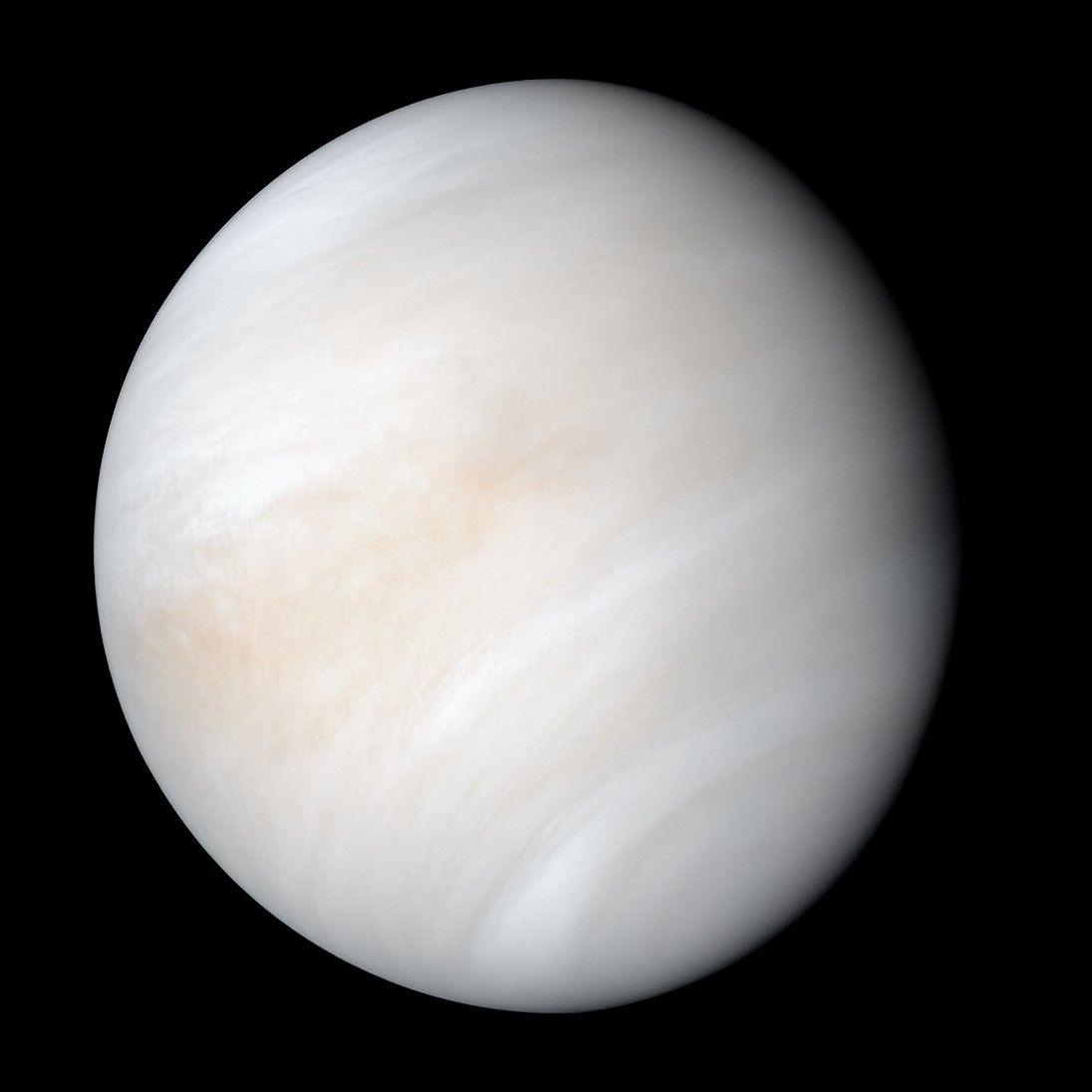
In blue and yellow light the close-range pictures showed no cloud detail down to about 100 m. The early reward was at the limb, where enhanced frames showed thin haze layers stacked above the main cloud deck, the haze about 6 km thick. Once the spacecraft was outbound the cameras switched to ultraviolet filters, and the planet changed character. Dark markings that Earth-based ultraviolet photographs had shown only as vague Y and C shapes resolved into spiral streaks, equatorial bands, bow-shaped waves and bright polar hoods. Near the point where the Sun stood overhead the images showed polygonal cells of rising air, and Verner Suomi of the television team described cellular structures in the clouds 200 to 300 km across. The cameras worked for eight days, and the last Venus frame, on 13 February, brought the total to 4,165.
Following features from frame to frame, Bruce Murray and colleagues on the television team measured east to west winds of about 100 m/s at the equator, with the angular speed increasing toward higher latitudes and the flow looking symmetrical between the hemispheres. That fitted the four-day retrograde rotation of the cloud tops inferred from Earth: Emmanuel Davoust's biography of Henri Camichel of the Pic du Midi Observatory credits him and Charles Boyer with finding it in 1961, a result space probes later confirmed. Beneath those clouds the planet turns once in 243 days, and why the air outruns the ground was left open. SP-424 called it a major question, weighed two extreme readings of the cloud patterns and looked to the coming Pioneer Venus mission to help decide. The question outlived that mission too. In 2020 a group led by Takeshi Horinouchi of Hokkaido University reported in Science, from Akatsuki images and temperature data, that thermal tides, raised as the air heats by day and cools by night, carry the angular momentum that maintains the rotation peak near the cloud tops at low latitudes, while other waves and turbulence push the other way; for mid-latitudes their abstract offers only a suggestion.
The other instruments filled in the layers above and below the clouds. The infrared radiometer found no day to night difference in cloud-top temperature; SP-424 gives about 250 K, the radiometer team's paper a brightness temperature of 255 K at 45 micrometres. The ultraviolet airglow spectrometer found about ten times as much atomic oxygen high in the atmosphere as at Mars, a sign that the upper atmosphere does not mix freely with the layers below. Radio occultation revealed four temperature inversions, at 56, 58, 61 and 63 km in the radio team's first paper (SP-424 prints 56, 61, 63 and 81 km). The X-band signal vanished at about 52 km, read as the top of the lower cloud deck (S-band reached 45 km in JPL's quick-look data). Doppler tracking measured the planet's mass and showed it to be a hundred times closer to a perfect sphere than Earth, in SP-424's phrasing.
Venus turned out to have no magnetic shield worth the name. The magnetometer found a field below one twentieth of one percent of Earth's, if any, yet Mariner 10 still crossed a detached bow shock where the supersonic solar wind piled up in front of the planet, confirming what Mariner 5 and Venera 4 had found in 1967. Ness and colleagues could not yet say what obstacle deflected the wind. Downstream the plasma and magnetic instruments picked up a disturbed wake, which the plasma team described as a comet-like tail hundreds of scale lengths long.
One conclusion of the 1978 history has not survived. SP-424 reported that Mariner 10 found hydrogen but no deuterium, and concluded that the hydrogen came from the solar wind and would be replenished as long as the wind blew. Mass spectrometer data from the Pioneer Venus large probe, published by Thomas Donahue's team in 1982, gave a deuterium to hydrogen ratio of about 1.6 percent, a hundredfold enrichment, which the team read as evidence that Venus was once wet: at least 0.3 percent of an Earth ocean's worth of water outgassed, a lower limit their abstract says is consistent with much more. Because the solar-wind conclusion rested on finding no deuterium, it lost its footing, and the argument moved on to how wet Venus once was.
Venus was the stepping stone and Mercury the prize. Following Colombo's resonance, Mariner 10 passed Mercury at about 704 km on 29 March 1974 (703 km in Siddiqi), at 48,069 km on 21 September 1974 and at 327 km on 16 March 1975. Last contact came at 12:21 UT on 24 March 1975, after the attitude-control nitrogen ran out. Its flight spare is on display at the National Air and Space Museum in Washington (museum record, November 2026), and in 2020 JPL engineer Kevin M. Gill reprocessed Venus frames from 7 and 8 February 1974 into the false-colour globe NASA published as PIA23791.
Mission facts
Organisations
NASA and the Jet Propulsion Laboratory (spacecraft built by Boeing)
Launch
3 November 1973, 05:45:00 UT, Atlas-Centaur AC-34 (Atlas 3D no. 5014D, Centaur D-1A) from Launch Complex 36B, Cape Canaveral
Builder and managers
Built by Boeing (Kent, Washington) under a July 1971 contract for a flight spacecraft and a test spacecraft; project run by JPL under Walker E. Giberson
Launch mass
502.9 kg including 29 kg of propellant and attitude-control gas (NSSDCA text); NSSDCA's summary box gives 473.9 kg; SP-424 gives 533.6 kg including a 30 kg launch-vehicle adapter
Science payload
79.4 kg of instruments (NSSDCA; SP-424 gives 78 kg): two TV cameras, infrared radiometer, ultraviolet airglow and occultation spectrometers, magnetometers, plasma analyser and charged particle telescope, with the radio system used for occultation and gravity science
Closest approach
17:01 UT on 5 February 1974 (10:01 a.m. Pacific Daylight Time), within one minute of the pre-launch schedule
Flyby distance
5,768 km closest range (NSSDCA, NASA Science, Siddiqi); about 5,790 km above the surface, and 5,794 km in another passage (SP-424); 5,800 km altitude in one section and about 5,631.5 km (3,500 miles) from the surface in another (JPL final report, 1976)
Gravity assist
Venus's gravity slowed the spacecraft relative to the Sun by nearly 16,090 km/h (10,000 mph) and turned it toward Mercury
Imaging coverage
Visible and near-ultraviolet imaging for eight days at resolutions from 100 m to 130 km
Cloud-top winds
About 100 m/s east to west at the equator, consistent with the four-day retrograde rotation; angular velocity increases with latitude
Cloud-top temperature
255 K brightness temperature at 45 micrometres (radiometer team, 1974); SP-424 gives about 250 K with no day-night difference
Radio occultation
Temperature inversions at 56, 58, 61 and 63 km; X-band lost at 52 km; night ionosphere layers at 120 and 140 km; day peak at 145 km
Upper atmosphere
Hydrogen, helium, carbon and oxygen atoms detected in ultraviolet airglow; exospheric temperature about 400 K
Mission timeline
- Jun 1968The Space Science Board of the National Academy of Sciences endorses a Mercury mission by way of Venus for the 1973 launch opportunity.
- Feb 1970Giuseppe Colombo, at a meeting on the mission, points out that the post-Mercury orbit could bring the spacecraft back for repeat Mercury flybys.
- Jul 1971Boeing is contracted to build a flight spacecraft and a test spacecraft.
- 3 Nov 1973Launch at 05:45 UT on Atlas-Centaur AC-34 from Cape Canaveral; the second Centaur burn sends the spacecraft inward toward Venus.
- 3 Nov 1973Calibration pictures of Earth and the Moon begin; the camera heaters fail to switch on, so the vidicons are left running.
- 13 Nov 1973First course correction, 19.9 s and about 7.8 m/s; the star tracker then loses Canopus to a bright particle.
- 8 Jan 1974The spacecraft switches irreversibly from its main to its standby power chain.
- 9 Jan to late Jan 1974Ultraviolet observations of Comet Kohoutek, passive from 9 January and with active scans late in the month, trace its hydrogen to 17 degrees from the nucleus.
- 21 Jan 1974Second course correction, 3.8 s and about 1.3 m/s, puts the Venus flyby point within 27 km of the aim.
- 28 Jan 1974A roll oscillation vents about 16 percent of the attitude-control nitrogen; the gyros are switched off and the flyby is flown on Sun and Canopus references.
- 5 Feb 1974, about 16:50 UTThe first picture of Venus, the lit cusp at the north pole taken from about 8,000 km, reaches the JPL monitors about 12 minutes before closest approach.
- 5 Feb 1974, 17:01 UTClosest approach: 5,768 km per NSSDCA, about 5,800 km altitude per JPL.
- 5 Feb 1974, 17:07 to 17:36 UTRadio occultation behind Venus; real-time data lost from 17:12 to 17:36 UT while pictures and other data are taped.
- 6 Feb 1974Ultraviolet frames, including a 36-frame full-disc mosaic from about 725,000 km, show the cloud markings in detail.
- 13 Feb 1974Last picture of Venus; the total reaches 4,165.
- 29 Mar 1974First Mercury flyby at about 704 km, made possible by the Venus gravity assist.
- 24 Mar 1975Last contact at 12:21 UT after the attitude-control gas is exhausted.
- 8 Jun 2020NASA publishes PIA23791, a reprocessed false-colour view of Venus made from Mariner 10 frames of 7 and 8 February 1974.
A filled dot marks something that physically happened. A hollow one marks an announcement, a naming or a target.
In pictures
Tap a photo to enlarge.
Sources
- NSSDCA Master Catalog: Mariner 10 (1973-085A)
- NASA Science: Mariner 10 mission page
- J. A. Dunne and E. Burgess, The Voyage of Mariner 10 (NASA SP-424, 1978), ch. 2, Mariner Venus-Mercury Mission (archived NASA History copy)
- NASA SP-424, ch. 3, Mariner's Payload
- NASA SP-424, ch. 4, Spacecraft, Scientists, and Schedules
- NASA SP-424, ch. 5, Venus Bound: Success and Near Failure
- NASA SP-424, ch. 6, Best Seen in Black Light
- JPL Technical Memorandum 33-734, Mariner Venus-Mercury 1973 Project Final Report, Vol. 1: Venus and Mercury 1 Encounters (1976)
- A. A. Siddiqi, Beyond Earth: A Chronicle of Deep Space Exploration, 1958 to 2016 (NASA SP-2018-4041), entry 144
- J. A. Dunne, Mariner 10 Venus encounter, Science 183 (1974) 1289
- B. C. Murray et al., Venus: atmospheric motion and structure from Mariner 10 pictures, Science 183 (1974) 1307
- H. T. Howard et al., Venus: mass, gravity field, atmosphere, and ionosphere as measured by the Mariner 10 dual-frequency radio system, Science 183 (1974) 1297
- A. L. Broadfoot et al., Ultraviolet observations of Venus from Mariner 10, Science 183 (1974) 1315
- N. F. Ness et al., Magnetic field observations near Venus: preliminary results from Mariner 10, Science 183 (1974) 1301
- H. S. Bridge et al., Observations at Venus encounter by the plasma science experiment on Mariner 10, Science 183 (1974) 1293
- S. C. Chase et al., Preliminary infrared radiometry of Venus from Mariner 10, Science 183 (1974) 1291
- T. M. Donahue et al., Venus was wet: a measurement of the ratio of deuterium to hydrogen, Science 216 (1982) 630
- J. R. Biggs and W. J. Downhower, A strategy of cost control for Mariner Venus/Mercury 1973 (NASA, 1994)
- Smithsonian National Air and Space Museum: Mariner 10 flight spare
- NASA Photojournal PIA23791: Venus from Mariner 10 (2020)
- NSSDCA Chronology of Venus Exploration (last updated 11 March 2024)
- NSSDCA Venus Fact Sheet
- V. V. Ivashkin, Lunar trajectories of spacecraft: pioneering work at the Keldysh Institute of Applied Mathematics (in Russian)
- Dizionario Biografico degli Italiani (Treccani): Colombo, Giuseppe (in Italian)
- E. Davoust, Biographie de l'astronome Henri Camichel, HAL hal-04102970 (2022, in French)
- JAXA press release, 24 April 2020: Akatsuki result on super-rotation published in Science (in Japanese)
- T. Horinouchi et al., How waves and turbulence maintain the super-rotation of Venus' atmosphere, Science 368 (2020) 405
Facts on this page were verified on 5 November 2026. Where sources disagree, the disagreement is stated rather than resolved silently.
azmth is independent and is not affiliated with or endorsed by NASA, Roscosmos, NPO Lavochkin, ESA, JAXA, ISRO, CNSA, or any other space agency or company named on this page.