Mariner 5
NASA and JPL · United States · Flyby · 1967 · Into the atmosphere Success
Ended. Mariner 5 sent its last data on 4 December 1967, and NASA closed the project on 5 November 1968. The spacecraft is still in orbit around the Sun.
TL;DR· 16 min read
Mariner 5 was the spare of NASA's Mars probe Mariner 4, converted for Venus and launched on 14 June 1967. On 19 October 1967, a day after Venera 4, it passed 4,094 km above Venus and sent its radio signal through the atmosphere, tracing temperature and pressure down to about 35 km above the surface. It had no camera. Its readings showed a thick carbon dioxide atmosphere and helped overturn the Soviet claim that Venera 4 had reached the ground.
What did Mariner 5 discover about Venus?
Mariner 5 flew past Venus on 19 October 1967 and probed its atmosphere by radio, finding thick, hot air made mostly of carbon dioxide. It also detected no magnetic field, found a shock wave in the solar wind in front of the planet, and measured the mass of Venus more accurately than ever before. The spacecraft was the spare of NASA's Mars probe Mariner 4, rebuilt for Venus in about 18 months, and it carried no camera. As it passed behind the planet, its signal sank through the air, and the way the air bent it traced temperature and pressure down to about 35 km above the surface. Set beside radar measurements of the planet's size, its readings helped show that the Soviet Venera 4 capsule, which arrived a day earlier, had fallen silent high above the ground.
Facts as of 5 November 2026, from the sources listed below.
- 4,094 kmclosest approach altitude on 19 October 1967, measured above the 6,056 km radius accepted at the time; 10,151 km from the centre of Venus
- 16,000 Hzpeak shift in the S-band radio frequency as the atmosphere bent the beam, reached, in JPL's words, at the moment of occultation; Mariner 4's signal at Mars had shifted about 5 Hz
- 0 camerasamong seven experiments: NASA chose Stanford's dual-frequency radio receiver over a television camera in February 1966
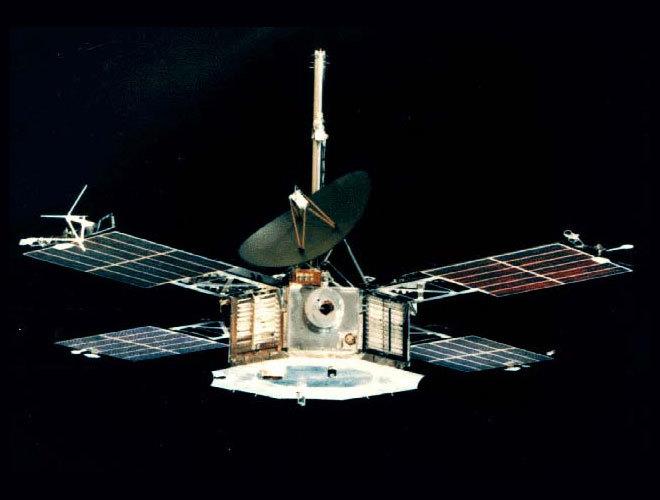
At 17:34:56 GMT on 19 October 1967, spacecraft time, Mariner 5 made its closest pass of Venus, 10,151 km from the planet's centre. About three minutes earlier its radio signal, still aimed at Earth, had begun to graze the night-side atmosphere. As the gas bent the beam its frequency drifted, by about 16,000 Hz at what JPL called the moment of occultation; Mariner 4's signal at Mars in 1965 had shifted by about 5 Hz. Goldstone caught the signal again 20.6 minutes after closest approach, climbing out of the sunlit side. Siddiqi's chronicle names this radio-occultation experiment as the mission's primary goal; it let a spacecraft with no camera change what people thought Venus was like.
The spacecraft was left over from Mars. Mariner 4 had flown past Mars on 15 July 1965, and its flight spares were in storage. NASA authorized the Mariner Venus 67 project late in December 1965, about 18 months before the June 1967 launch window, and on 30 December NASA's H. E. Newell told the Mariner 4 investigators by teletype that NASA planned to send the spare, MC-4, to Venus. The aim was to extend what Mariner 2 had found in 1962; the 1969 project report notes that Mariner 5 was the only spacecraft NASA scheduled for the 1967 opportunity.
Choosing the payload took about five weeks. On 8 January 1966 about 30 people met at Caltech and agreed that the most useful measurement would be the pressure or density at the surface, best made by dropping a probe, which did not appear feasible this time. The near-unanimous view was that an S-band occultation experiment mattered most and that television pictures of the clouds were highly desirable. Budget studies then forced a choice between a camera and Stanford University's dual-frequency radio experiment. JPL told NASA on 2 February that it preferred the camera; NASA's steering committee chose the radio experiment, and on 4 February Newell approved seven investigations without a camera, asking JPL to add television if data storage and power allowed. JPL's director replied on 15 February that, with 14½ months to launch, it could not be done without seriously jeopardizing the mission.
Converting a Mars craft for Venus meant turning it over. To point its antennas at Earth, the spacecraft had to fly the other way up, so the side that had stayed in shade on the way to Mars now faced the Sun. Closer to the Sun less panel was needed, and the solar-cell area fell from 70.4 to 43.6 square feet (about 6.5 to 4.1 m²). A sunshade unfolded with the panels, and JPL reckoned it kept the bus about 30 °F (17 °C) cooler at Venus.
Two of the seven experiments needed no instrument of their own: the S-band occultation used the ordinary telemetry transmitter, and celestial mechanics used range and Doppler tracking. The dual-frequency experiment ran the other way. Stanford's 150-foot dish transmitted at 49.8 and 423.3 MHz, and a new receiver on the spacecraft measured how the two signals changed. The magnetometer, plasma probe and trapped radiation detector were Mariner 4 instruments, and the ultraviolet photometer, from hardware built for Mariner 4 but never flown on it, looked for sunlight scattered by hydrogen and atomic oxygen.
Mariner 5 left Cape Kennedy at 06:01:00 UT on 14 June 1967 on an Atlas-Agena D, two days after Venera 4 had left Baikonur. JPL's target was a pass 8,165 km from the centre of the planet, but the launch was aimed 75,000 km wide so that neither the unsterilized spacecraft nor the Agena could strike Venus, with a correction planned from the outset. The motor fired on 19 June at 23:08:03 GMT in one section of JPL's 1969 report and 23:08:06 in another (SP-190's 23:08:28 is the report's time for the burn's end). It imparted 15.41 m/s against 16.13 m/s planned, and the flyby would come no closer than 10,000 km from the centre; the report suggests the shortfall may explain the wider pass, although its trajectory chapter describes the target as about 10,200 km from the centre. The primary objectives were still met, and the optional second burn was never used.
The encounter sequence began at 02:49:00 GMT on 19 October, commanded through the Deep Space Station at Woomera in Australia. Mariner 5 approached the night side from north of the planet's orbit and stayed more than 2,400 km clear of Venus's shadow, which mattered because losing the Sun would have cost it attitude control. The radio ray met the atmosphere at about 37° N on the night side and emerged at about 32° S in daylight.
Turning a frequency shift into a weather report needs an assumption about what the air is made of. The signal first felt the neutral atmosphere about 6,140 km from the centre, roughly 85 km up, where the pressure was about a thousandth of Earth's. The rate at which density fell off there implied 69 to 87 percent carbon dioxide if the rest was nitrogen. Assuming 90 percent, the 1969 report finds about 241 K above a tropopause near 6,114 km, then a steady rise to about 477 K (204 °C) at 6,085 km, where the signal gave out. Kliore's team blamed heavy defocusing as the beam neared critical refraction, the level at which the air bends a horizontal ray as sharply as the planet curves. NASA's 1971 report puts that level at about 32 km in one chapter and near 35 km in its summary, and Fjeldbo and Eshleman wrote in 1969 that the neutral atmosphere had been probed to within 35 km of the surface. Today's picture is on the atmosphere of Venus.
A day earlier Venera 4 had lowered its capsule into the same atmosphere, and Moscow said it had measured all the way down to the ground. The two data sets agreed where they overlapped; the dispute was about where the ground was. Izvestia reported 15 to 22 atmospheres and about 550 K at the end of the capsule's descent. Extending Mariner 5's profiles to those values put them about 6,078 km from the centre, give or take 10 km, while radar put the surface at 6,056 km; a footnote in the 1969 report concedes that Mariner 5's own altitudes were quoted from 6,056 km for convenience, although their validity was questionable. In March 1968 Reese and Swan still argued in Science that Venera 4 had reached the surface. That same month, Siddiqi writes, scientists compared both missions at Kitt Peak National Observatory and concluded that neither had been entirely successful in reporting conditions at the surface. The July 1968 Journal of the Atmospheric Sciences printed the Soviet Venera 4 papers beside two papers on the radius: Kliore and Cain's left two readings open (a plateau radar had missed, or measurements that stopped short of the ground), and 'The Case for the Radar Radius of Venus' set the combined 6,085 ± 10 km against radar's 6,050 ± 5 km.
NASA's final report, published in 1971, found the two sets of profiles in excellent agreement, with Venera 4 sampling the air between 6,078 and 6,105 km from the centre, 25 to 52 km above the surface. The only tenable assumption, it said, was that the capsule's radio altimeter had failed or been misread, perhaps taking a signal at twice 26 km as meaning 26 km; a landing on a high mountain was dismissed, since radar showed nothing unusual where the capsule came down. The Russian account that epizodsspace prints under the heading 'Marov' tells the same story from the other side: Mariner 5's data and radar measurements of the radius showed the capsule had not reached the ground, and meetings of Soviet and American scientists over the next two years concluded it 'ceased to exist while still high above the surface'. As late as February 1970 Eshleman's review in Radio Science said the lowest regions of the atmosphere had yet to be probed; Venera 7 reached the surface that December.
What Mariner 5 could not reach it could extrapolate, and there the numbers drift. SP-190 draws its profiles down to a radar radius it now gave as 6,053 ± 3 km and arrives at about 75 bar and 760 K. The text beside the figure cites 60 to 120 bar and 650 to 800 K from various authors, the summary settles on about 700 K and 100 bar until measurements came from the surface itself, and Reiff's foreword to the same volume says about 600 K. Siddiqi's chronicle, repeated on NASA's mission page, gives 527 °C and 75 to 100 atmospheres. NASA's fact sheet now gives 92 bar and 737 K (464 °C) at the surface.
Higher up, the ultraviolet photometer found hydrogen glowing at the Lyman-alpha wavelength and no trace of atomic oxygen. Its fall-off with height pointed to a cold upper atmosphere: SP-190 gives about 650 K for the exosphere of Venus against about 1,500 K for Earth's. The Stanford experiment picked up a weak night-side ionosphere, and both radio experiments profiled the much stronger daytime one, which ended abruptly near 500 km, pressed down by the solar wind. How much denser the daytime peak was depends on the paper: about two orders of magnitude in the Stanford group's 1967 report, about 50 times in JPL's 1969 summary and 30 times in Fjeldbo and Eshleman's 1969 analysis.
Mariner 5 spent about two hours inside the region where Venus disturbs the solar wind. Its magnetometer and plasma probe saw a bow shock, like Earth's but much smaller, and no field belonging to the planet. The trapped radiation detector found no energetic electrons or protons down to 10,150 km from the centre, from which Van Allen's group concluded the planet's magnetic dipole moment was almost certainly below a hundredth of Earth's and probably below a thousandth; Bridge's group put its upper limit within a factor of two of a thousandth. The obstacle to the wind, the teams argued, was the electrically conducting ionosphere. The Stanford group saw in this a third kind of interaction, unlike Earth, whose magnetic field holds the wind off, or the Moon, which has neither field nor ionosphere.
Tracking weighed the planet. The 1969 report gives the gravitational parameter of Venus as 324,859.61 ± 0.49 km³/s², and Anderson's team wrote that Mariner 5 had yielded masses for the Moon and Venus more accurate than any previously reported. The value JPL lists today, from its DE440 ephemeris, is 324,858.592 km³/s², about 1 km³/s² lower, roughly twice the 1969 uncertainty.
Venus also flung Mariner 5 inwards, lowering its closest point to the Sun from 107.1 to 86.7 million km, and SP-190 notes that no man-made object had been so close to the Sun before. On 21 November 1967 controllers switched to the low-gain antenna to prepare for a long cruise and a planned reunion in 1968. One more pass came on 4 December, when a digital demodulation technique pulled 42 minutes of usable data out of a four-hour track at Goldstone's DSS 14, with attitude, power and Canopus lock all normal; JPL's 1969 volume lists it as the last tracking of Mariner 5. An extension project hoped to regain telemetry from about 22 July 1968 and use the spacecraft until January 1969 to map uncharted parts of the sky at short wavelengths and sample the solar wind close to the Sun.
Searches began on 26 April 1968, and five that assumed a healthy spacecraft found nothing. On 14 October 1968 DSS 14 locked onto a signal about 30 kHz below the predicted frequency, and on 20 October the station achieved two-way lock, but the signal carried no telemetry and commands drew no response. On 5 November 1968 the project was declared complete, its extension objectives unmet. Program manager Glenn A. Reiff's foreword to the final report says the mission cost 10 percent less than anticipated, helped by hardware already bought. Mariner 5 itself is still circling the Sun, untracked: asked for 'mariner', JPL's Horizons system returns only Mariner 2.
Mission facts
Organisations
NASA / Jet Propulsion Laboratory
Designations
Mariner V; project name Mariner Venus 67 (Mariner-Venus 1967 in NASA SP-190); flight spacecraft M67-2, with the twin M67-1 kept as flight-support spacecraft; Mariner-67E / Mariner-E in Siddiqi; COSPAR 1967-060A.
Origin
Built from the Mariner Mars 1964 flight spares. NASA's teletype of 30 December 1965 called it 'the spare Mariner spacecraft (MC-4)'; Mariner 4 itself was MC-3.
Authorized
Late in December 1965, leaving about 18 months before the June 1967 launch window. JPL managed the spacecraft, operations and tracking; NASA's Lewis Research Center managed the launch vehicle.
Launch
14 June 1967 at 06:01:00 UT (02:01 EDT) from Cape Kennedy, Launch Complex 12, on Atlas-Agena D (Atlas no. 5401, Agena no. AD157/6933).
Mass
Three readings: 244.822 kg (539.74 lb) as weighed at Cape Kennedy just before launch (JPL vol. I and SP-190); 244.563 kg as weighed earlier at JPL, before some modules were swapped (the total in SP-190's mass table); 244.9 kg in NSSDCA and Siddiqi, which matches the 244.890 kg JPL measured for the twin M67-1.
Conversion
Turned over so the antennas faced Earth; solar panel area cut from 70.4 to 43.6 sq ft (about 6.5 to 4.1 m²) with cells facing outboard; a deployable sunshade that kept the bus about 30 °F (17 °C) cooler at Venus; a new baffle for the Canopus sensor.
Experiments
Seven: ultraviolet photometer (Barth), S-band occultation (Kliore), dual-frequency occultation (Eshleman), trapped radiation detector (Van Allen), magnetometer (Smith), plasma probe (Bridge), celestial mechanics (Anderson). Approved by NASA's H. E. Newell on 4 February 1966. No camera.
Aiming
Nominal aim 8,165 km from the centre of Venus (JPL vol. II and SP-190). At injection it was biased to 75,000 km so neither the spacecraft nor the Agena could hit the planet: 'from the center' in vol. II, 'from the surface' in vol. I, no reference point in SP-190's summary, and SP-190's chapter 3 gives the bias as a B-vector of about 100,000 km, equal to about 69,000 km altitude. Uncorrected, it would have passed 69,693 km up. Vol. II's trajectory chapter instead calls the midcourse target an aiming region about 10,200 km from the centre (4,000 km up), vol. I's mission profile puts the nominal target about 3,000 km from the surface, and NSSDCA says the objective was to pass within 2,000 km.
Midcourse burn
19 June 1967. Ignition at 23:08:03 GMT in one section of JPL vol. II and 23:08:06 in another; vol. II's flight chronology lists burn start at 23:08:11.3 and burn stop at 23:08:28, the time SP-190 gives for the manoeuvre. Planned burn 17.66 s (vol. II; NSSDCA gives 17.66 s as the burn). It delivered 15.41 m/s (vol. II; SP-190: 15.392 m/s) against 16.13 m/s planned, and the pass came 10,151 km from the centre; the optional second burn was never used.
Closest approach
19 October 1967 at 17:34:55.8 GMT (spacecraft time), 10,151 km from the centre (Snyder). The 4,094 km altitude assumes a 6,056 km radius; above today's mean radius of 6,051.8 km it would be about 4,099 km.
Encounter geometry
79,764,370 km from Earth (266 s light time); path bent 101.5 degrees towards the Sun; never entered the planet's shadow, staying more than 2,400 km from it.
Occultation
Atmosphere felt from 6,140 km radius (about 85 km up, about 1 mbar). Ray entered at about 37° N on the night side and left at about 32° S on the day side (35° N and 30° S in another section of the same report). Closed-loop lock lost 14 s before closest approach; the open-loop recording ran until the fading signal dropped into the noise about 2 min 40 s after it; Goldstone reacquired 20.6 min after.
Deepest level probed
About 477 K at 6,085 km from the centre (1969 report, 90% CO₂ case). Critical refraction at about 32 km altitude (SP-190, chapter 2) or near 35 km, 6,088 km (SP-190 summary); Fjeldbo and Eshleman (1969) say the neutral atmosphere was probed to within 35 km of the surface.
Carbon dioxide
69 to 87% from the scale height (preliminary, 1969 report); at least 85% and possibly near 99% once combined with Venera 4 (SP-190, 1971). NASA's fact sheet today: 96.5%.
Surface values (extrapolated)
About 75 bar and 760 K at the radar radius in SP-190's figure; 60 to 120 bar and 650 to 800 K 'suggested by various authors'; about 700 K and 100 bar in its summary; 527 °C and 75 to 100 atm in Siddiqi. Today: 92 bar and 737 K.
Magnetic field
None detected. Dipole moment almost certainly under 1/100 and probably under 1/1,000 of Earth's (Van Allen group); within a factor of two of 1/1,000 (Bridge group). A bow shock was observed.
Mass of Venus
GM = 324,859.61 ± 0.49 km³/s² from tracking (1969 report). JPL's Solar System Dynamics site today, from the DE440 ephemeris: 324,858.592 km³/s² (checked 5 November 2026).
End of contact
Switched to the low-gain antenna 21 November 1967; last telemetry 4 December 1967 (42 min recovered); carrier regained 14 October 1968 with no telemetry; project terminated 5 November 1968.
Mission timeline
- Dec 1965NASA authorizes the Mariner Venus 67 project late in the month. On 30 December H. E. Newell tells the Mariner 4 investigators NASA plans to send the spare Mariner spacecraft to Venus in 1967.
- 8 Jan 1966About 30 people (JPL staff, Caltech faculty and visiting scientists) meet at Caltech. They agree an S-band occultation experiment matters most, want television of the clouds, and judge an entry probe infeasible for this mission.
- 4 Feb 1966Newell approves seven investigations, with Stanford's dual-frequency radio experiment in and television out; on 15 February JPL's director replies that adding a camera would seriously jeopardize the mission.
- 14 Jun 1967Launch at 06:01:00 UT from Cape Kennedy on Atlas-Agena D, two days after Venera 4 left Baikonur, aimed 75,000 km wide of Venus.
- 19 Jun 1967Midcourse burn (ignition 23:08:03 or 23:08:06 GMT in different sections of JPL's 1969 report; SP-190's 23:08:28 is the report's time for the end of the burn). It falls about 0.7 m/s short, setting up a pass about 10,000 km from the centre of Venus; no second burn is made.
- 18 Oct 1967Venera 4's capsule descends by parachute and falls silent before reaching the ground.
- 19 Oct 1967, 02:49 GMTEncounter sequence starts, commanded through the Deep Space Station at Woomera, Australia.
- 19 Oct 1967, 17:34:56 GMTClosest approach, 4,094 km up (10,151 km from the centre). The S-band signal sinks into the atmosphere and fades out as the air defocuses it; Goldstone picks it up again 20.6 minutes after closest approach, rising from the day side.
- 20 Oct 1967Tape playback of the encounter data begins at 07:25 GMT; the data are played back twice.
- 21 Nov 1967Controllers switch the transmitter to the low-gain antenna to prepare the spacecraft for a long cruise and reacquisition in 1968.
- 4 Dec 1967Last telemetry: a digital demodulation technique recovers 42 minutes of data from a Goldstone pass, showing a healthy spacecraft.
- Mar 1968Scientists compare Mariner 5 and Venera 4 data at Kitt Peak National Observatory, in Siddiqi's account, and conclude that neither had been entirely successful in reporting conditions at the surface.
- 26 Apr 1968Reacquisition attempts begin under an extension project; the first five, assuming a healthy spacecraft, find nothing.
- 14 Oct 1968Goldstone locks onto a weak, unstable carrier about 30 kHz below prediction; two-way lock follows on 20 October, but no telemetry and no response to commands.
- 5 Nov 1968NASA terminates the Mariner-Venus 1967 project without meeting the extension objectives.
- 1971NASA publishes the final project report, SP-190, concluding that Venera 4's altimeter failed or was misread and that its readings covered 25 to 52 km above the surface.
A filled dot marks something that physically happened. A hollow one marks an announcement, a naming or a target.
In pictures
Tap a photo to enlarge.
Translated from the original sources
Passages from the Russian sources this page draws on, in azmth's translation. Tap Show original to read the original wording.
epizodsspace: Venera-4 dossier including a Russian account printed under the heading 'Marov', Web Archive copy of 27 May 2024
Russian · 4 passages
“Later analysis, together with the data of Mariner-5, which flew past Venus the day after Venera-4 arrived, and the results of ground-based radar measurements of the radius of Venus, showed, however, that this was not so and that the surface temperature is much higher than that obtained when the measurements on the descent craft ended.”
azmth's translation · Show originalHide original
Russian: «Последующий анализ совместно с данными «Маринера-5», который пролетел мимо Венеры на следующий день после прибытия «Венеры-4», и результатами наземных радиолокационных измерений радиуса Венеры, показал, однако, что это не так и что температура поверхности гораздо выше, чем полученная при завершении измерений на спускаемом аппарате»
“Atmosphere models based on the Mariner-5 data, and on data processed together with radar measurements of the radius of Venus, also pointed to much higher values of temperature and pressure at the surface.”
azmth's translation · Show originalHide original
Russian: «Модели атмосферы, основанные на данных «Маринера-5» и данных, обработанных совместно с данными радиолокационных измерений радиуса Венеры, также свидетельствовали о гораздо больших значениях температуры и давления у поверхности.»
“As a result of a series of meetings of Soviet and American scientists held over the following two years, it was concluded that the descent craft ceased to exist while still high above the surface, crushed by an atmospheric pressure far exceeding the design value.”
azmth's translation · Show originalHide original
Russian: «В результате серии встреч советских и американских ученых, прошедших в течение двух последующих лет, был сделан вывод, что спускаемый аппарат прекратил существование, находясь все еще высоко над поверхностью, будучи раздавленным давлением атмосферы, значительно превышающим расчетное.»
“Marov:”
Heading under which the epizodsspace dossier prints the Russian account quoted above.
azmth's translation · Show originalHide original
Russian: «Маров:»
Department of Lunar and Planetary Research, Sternberg Astronomical Institute
Russian · 1 passage
Department of Lunar and Planetary Research, Sternberg Astronomical Institute (Moscow State University): 'Venera' overview page
Open the source“The spacecraft Mariner 5 studied the planet's atmosphere from a flyby trajectory.”
azmth's translation · Show originalHide original
Russian: «КА "Маринер 5 " исследовал атмосферу планеты с пролетной траектории.»
Sources
- NASA SP-190, Mariner-Venus 1967: Final Project Report (1971), NTRS 19720013159
- JPL Technical Report 32-1203, Mariner Venus 67 Final Project Report, Vol. I: Launch Through Midcourse Maneuver (15 June 1968), NTRS 19680023588
- JPL Technical Report 32-1203, Mariner Venus 67 Final Project Report, Vol. II: Midcourse Maneuver Through End of Mission (1 May 1969), NTRS 19690017194
- NSSDCA Master Catalog: Mariner 5 (1967-060A)
- Asif A. Siddiqi, Beyond Earth: A Chronicle of Deep Space Exploration, 1958-2016 (NASA, 2018), entry 83, Mariner V
- NASA Science: Mariner 5 mission page (last updated 2 November 2024)
- C. W. Snyder, 'Mariner V Flight Past Venus', Science 158, 1665 (1967)
- A. Kliore et al., 'Atmosphere and Ionosphere of Venus from the Mariner V S-Band Radio Occultation Measurement', Science 158, 1683 (1967)
- Mariner Stanford Group, 'Venus: Ionosphere and Atmosphere as Measured by Dual-Frequency Radio Occultation of Mariner V', Science 158, 1678 (1967)
- H. S. Bridge et al., 'Mariner V: Plasma and Magnetic Fields Observed near Venus', Science 158, 1669 (1967)
- J. A. Van Allen et al., 'Venus: An Upper Limit on Intrinsic Magnetic Dipole Moment Based on Absence of a Radiation Belt', Science 158, 1673 (1967)
- C. A. Barth et al., 'Ultraviolet Emissions Observed near Venus from Mariner V', Science 158, 1675 (1967)
- J. D. Anderson et al., 'Celestial Mechanics Experiment', Science 158, 1689 (1967)
- G. Fjeldbo and V. R. Eshleman, 'Atmosphere of Venus as Studied with the Mariner 5 Dual Radio-Frequency Occultation Experiment', Radio Science 4, 879 (1969)
- D. E. Reese and P. R. Swan, 'Venera 4 Probes Atmosphere of Venus', Science 159, 1228 (1968)
- V. R. Eshleman, 'Atmospheres of Mars and Venus: A Review of Mariner 4 and 5 and Venera 4 Experiments', Radio Science 5, 325 (1970)
- A. J. Kliore and D. L. Cain, 'Mariner 5 and the Radius of Venus', Journal of the Atmospheric Sciences 25, 549 (1968), bibliographic record
- M. E. Ash et al., 'The Case for the Radar Radius of Venus', Journal of the Atmospheric Sciences 25, 560 (1968), bibliographic record
- JPL Solar System Dynamics: Astrodynamic Parameters (planetary GM values from DE440)
- NASA Venus Fact Sheet (last updated 11 January 2024)
- JPL Horizons Lookup API, query 'mariner' (5 November 2026)
- epizodsspace: Venera-4 dossier including a Russian account printed under the heading 'Marov', Web Archive copy of 27 May 2024 · in Russian
- Department of Lunar and Planetary Research, Sternberg Astronomical Institute (Moscow State University): 'Venera' overview page · in Russian
Facts on this page were verified on 5 November 2026. Where sources disagree, the disagreement is stated rather than resolved silently.
azmth is independent and is not affiliated with or endorsed by NASA, Roscosmos, NPO Lavochkin, ESA, JAXA, ISRO, CNSA, or any other space agency or company named on this page.