Crewed missions to Venus that never flew
OKB-1, OKB-52 and NASA · Multinational · Programme · 1967 · Never flew Cancelled
Never flown. Crewed Venus flybys, orbiters and even a landing were planned in the Soviet Union and the United States from 1960, and floating cloud habitats later, but every plan stayed on paper.
TL;DR· 21 min read
No crew has ever gone to Venus. From 1960 to 1972 Soviet and American engineers studied crewed flybys, orbiters and even a landing, among them a Soviet flyby ship for 1967 and Bellcomm's 1967 study of three astronauts on one Saturn V passing Venus in 1974. None got past the study stage. Once probes had found a crushing surface at about 460 °C, the idea moved to floating habitats about 50 km up, from a 1971 Soviet magazine to NASA Langley's HAVOC study of 2015.
Has anyone ever been to Venus?
No one has ever been to Venus. Soviet and American engineers drew up crewed flybys, orbiters and even a landing between 1960 and 1972, and none of them flew. Korolev's design bureau OKB-1 planned a crewed Venus flyby for the summer of 1967 and, before accurate surface data existed, a ship to land three people for nine months. In the United States, NASA centres and contractors studied crewed Venus flybys and an orbiter from 1962 to 1967, among them Bellcomm's study of three astronauts passing Venus in 1974, until Congress cut the money for crewed planetary planning in 1967. After Venera 4 and Mariner 5 the idea moved up into the clouds: flying islands in a Soviet youth magazine in 1971, Geoffrey Landis's floating cities in 2003 and NASA Langley's HAVOC airships in 2015.
Facts as of 26 September 2026, from the sources listed below.
- 106,775 lbinjected weight of Bellcomm's 1967 three-person Venus flyby, within one Saturn V
- 960 tonnesEarth-orbit mass of OKB-1's Venus landing ship STMKE-V, 14 N-1 launches
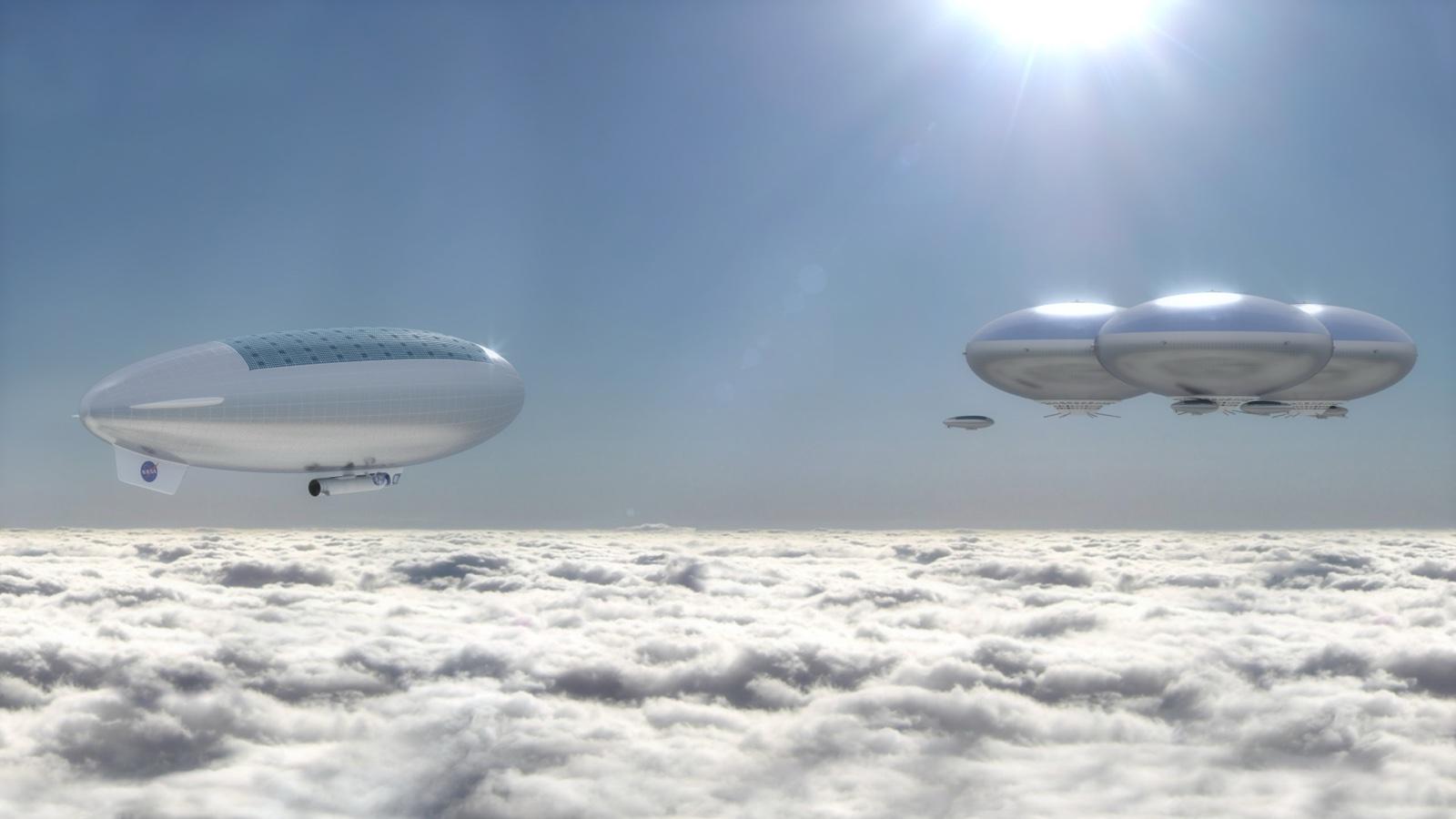
- 50 kmheight at which NASA Langley's HAVOC would float two astronauts for 30 days
Nobody has ever flown to Venus, yet for more than a decade from 1960 engineers near Moscow and in Huntsville, Houston, Cleveland and Washington drew up ships to take people there. The attraction was the calendar. In the Soviet plan of 1962 a crewed Mars flyby would last about two years and a Venus flyby a little over one. Some American planners came to see Venus as a proving ground for Mars, and on both sides ships were drawn to pass Venus on the way to or from Mars. Nothing on this page flew: what remains is mass estimates, trajectory tables, contractor reports, a few laboratory tests and at least one museum model. Soviet designs come first, then American ones, then the floating habitats of later decades.
Soviet crewed planning for Venus was written into government resolutions before any probe had reached the planet. A joint resolution of the Communist Party Central Committee and the Council of Ministers, No. 715-296 of 23 June 1960, provided for a heavy interplanetary ship for flights to Mars and Venus and for preparing expeditions to the surfaces of the Moon, Mars and Venus. Its contents are known here from the resolution that stopped them. No. 420-174 of 13 May 1961, whose scan Roscosmos has published, revised space plans toward tasks of defence significance. Clause 1(v) orders "the development of the heavy interplanetary ship for flight to Mars and Venus" stopped, and clause 1(d) stops "the work of preparing expeditions to the surface of the Moon, Mars and Venus".
Korolev's OKB-1 went on working all the same. V. Karfidov's 2021 survey of crewed ship projects (headed Kosmonavtika on the copy read here) says the bureau's interplanetary designs of 1959 to 1961 were gathered in the first half of 1962 into a "Plan for the mastery of Mars and Venus": flybys of both planets, then ships that would enter orbit, then landings, every stage launched by the N-1. A 2017 page on the site of a Bauman Moscow State Technical University research centre quotes the tasks in the N-1 draft project that Korolev approved on 16 May 1962, among them "a flyby of Mars and Venus by a crew of two or three and return to Earth" and "expeditions to the surface of Mars and Venus and the choice of a site for a research base". Karfidov is plain about how deep this went: the projects were estimates of mass, with no structural design behind the solutions they assumed.
TMK-V, the Venus flyby ship, was almost a copy of the Mars flyby ship TMK-M, and both grew from the flyby design Gleb Maksimov's sector had drawn in 1959. In Karfidov's figures one N-1 would put 75 t into a parking orbit, and a departure stage burning kerosene or liquid hydrogen would send away a ship of 15 or 19 t, about 12.5 m long and 3 m across, with a 2.5 t return capsule. Draft design was scheduled from July 1962 to December 1964, with two more years for building and testing. The Mars ship would leave early in 1967 and TMK-V would follow that summer. The Bauman page gives Maksimov's TMK as 12 m long, 6 m across and 75 t, leaving for Mars on 8 June 1971. Its 75 t equals Karfidov's figure for everything one N-1 put in orbit, departure stage included, while his 15 to 19 t is the ship alone; the diameters, 6 m against 3 m, and the Mars departure dates, 1971 against early 1967, do not reconcile.
The later stages of the plan leaned on electric propulsion. TMKE-V, a Venus orbiter assembled from two N-1 launches, would have weighed 100 t in Earth orbit, spiralled out under a reactor-powered electric engine, spent up to nine months in Venus orbit, dropped a 1 t landing probe and come home as a 66 t ship, three years in all. Though the harder project, it was proposed to leave before its Mars twin, in the first quarter of 1969, with three crew. STMKE-V went further. Sketched, Karfidov writes, when there were no accurate data on the pressure and temperature at the surface, it would have put three people on Venus for nine months and needed 960 t in Earth orbit, 14 N-1 launches; of the 795 t that would reach Venus orbit, 410 t was the landing and ascent module. Launch was possible no earlier than 1975. Two decisions ended the line. In the summer of 1962 Korolev ruled that the TMK would use liquid-propellant engines, because usable electric engines were not expected soon, and work on the heavy interplanetary ship went on only until 1964, when a government resolution set OKB-1 the task of a lunar expedition.
The Venus flyby came back in 1966 at TsNIIMash, formerly NII-88, the lead research institute of the Soviet rocket industry. M. D. Evtifyev, in a manuscript on the institute's Mars projects published by buran.ru, writes that in early June 1966 a group there was told to study OKB-1's TMK and draft its own ship for six people, this time for a flyby of two planets. The code name was Mavr, which Evtifyev reads as Mars and Venus at once; Karfidov reads it as MArs and VeneRa and gives the other reading in a footnote. The ship would leave in 1975 on an Earth, Mars, Venus, Earth path lasting 480 to 600 days, the pass of Venus shortening the flight home. Two spherical Venus probes, a lander and an orbiter, would ride beside a Mars probe with a 6 m heat shield. The crew would live in a block 6 m across with six cabins, a laboratory, a radiation shelter and a 14 m² greenhouse lit by a 30 m² solar concentrator that doubled as a radio telescope dish. The designers rejected spin gravity and, after consulting the Institute of Biomedical Problems, carried exercise equipment including a centrifuge.
The sources do not agree on Mavr's mass. Evtifyev gives the initial mass as 105,680 kg, yet the components in his own list, from the 71,500 kg living block to 37,250 kg of propellant, add up to about 150.7 t, and Karfidov gives 151 t from the same figures. Encyclopedia Astronautica describes a different Mavr altogether: a 1963 OKB-1 variation on Maksimov's TMK, 75 t on a single N-1 with three crew, passing Venus on the way back from Mars. TsNIIMash director Yu. A. Mozzhorin approved the report on the theme, design studies of crewed interplanetary complexes for an expedition with a flyby of Mars and Venus, on 12 July 1968. When the fourth and last N-1 failed on 23 November 1972, Evtifyev writes, the hopes for Mavr and the later Mars programme Aelita were buried with it.
Chelomei's OKB-52 had its own Venus craft, without a crew. Its kosmoplan family of modular winged probes was authorised by resolution No. 714-295 of 23 June 1960, and the Bauman page counts two kosmoplan variants for flights to Mars and Venus under the theme K. The 1961 resolution treated it much as it treated Korolev's ship. Clause 1(g) stops the automatic uncrewed kosmoplan for flights to Mars and Venus with return to Earth and landing at a set airfield, while a later point keeps the lunar kosmoplan K going only as far as a draft project due in 1963. Anton Pervushin writes that OKB-52 did issue a draft project in 1963 for an uncrewed kosmoplan K for flights to the Moon, Mars and Venus. The resolution had limited that draft to the Moon; whether Mars and Venus came back into it is not settled by the sources.
The earliest American study covered here was a Mars study that included Venus. In May 1962 the Future Projects Office at NASA's Marshall Space Flight Center awarded General Dynamics, Lockheed and the Aeronutronic Division of Ford study contracts worth $250,000 each under the name EMPIRE, for Early Manned Planetary-Interplanetary Roundtrip Expeditions. Aeronutronic drew flybys passing both Mars and Venus, comparing a trajectory the Italian engineer Gaetano Crocco had presented in 1956 with a symmetric one. Its final report of 21 December 1962 chose the symmetric path, leaving Earth between 16 July and 19 August 1970: the ship would pass Venus 97 to 102 days out, at 4,890 to 7,520 miles, pass Mars at the midpoint and be home after 611 to 631 days. It was a 188-ton ship with a NERVA nuclear engine, six crew in two spinning living modules and a lifting-body for reentry, and David Portree reports its cost estimate as $12.6 billion.
Apollo hardware replaced the nuclear ships in 1965. A Marshall team under Harry Ruppe, reporting in NASA TM X-53205 of 5 February 1965, put a modified Apollo Command and Service Module inside a hangar on a flyby ship for three. Its Venus example would leave Earth orbit in August 1978, pass low over the day side of Venus on 11 December 1978 and return on 16 August 1979. The team also ran a mission worth analysis and found that dropping crewed Venus flybys from a space programme would cost just 2% of its total worth, because it is not possible to land on Venus. North American Aviation, briefing its study in June 1965, went the other way and made Venus phase one: a crewed flyby leaving Earth orbit on 30 October 1973 for 415 days, launched directly by one three-stage Saturn V, at a cost of $2,301,700,000.
Bellcomm's Manned Venus Flyby is dated 1 February 1967. Feldman, Ferrara, Havenstein, Volonte and Whipple wrote it for NASA Manned Space Flight to guide the technical goals of the Apollo Applications Program. Three astronauts would leave on one standard Saturn V in a Command and Service Module similar in some respects to Apollo's, with an Environmental Support Module in the adapter where the lunar module rode and the spent S-IVB stage used as living space and as the frame for solar cells. Total injected weight was 106,775 lb. The reference mission would leave Earth on 31 October 1973, reach Venus after 123 days on 3 March 1974, pass 3,340 nautical miles above it and return on 1 December 1974. Four probes of about 500 lb each would be released about 24 hours before closest approach. The authors wrote that it was clearly not their intent to recommend that NASA undertake a Venus flyby in 1973 or at any time, only to show one was feasible and so guide the choice of long-duration systems.
Houston had its own plan the same month. Jack Funk and James Taylor of the Manned Spacecraft Center proposed, in MSC Internal Note 67-FM-25 of 13 February 1967, three single-launch Apollo Venus flybys as the final goal of the Apollo Applications Program, with launch periods opening on 4 April 1972, 14 November 1973 and 7 June 1975. In the 1972 example the crew would launch on 2 April, leave a 48-hour Earth orbit for Venus on 5 April, pass the day side on 23 August and reenter on 30 March 1973, 359 days after launch. Portree writes that Houston preferred a Venus flyby followed by a Venus orbiter to the Mars flybys then under study, because both would be shorter and need less propulsion.
A crewed Venus orbiter was worked out at NASA's Lewis Research Center in Cleveland. Edward A. Willis Jr.'s TM X-52311 of 1967 studied stopover missions for departures from 1975 to 1986 and found that an elongated parking orbit, 1.1 by 20.9 Venus radii, kept the mass down. For 1980, the hardest year, a 565-day trip with 40 days at Venus would need 1,412,000 lb in Earth orbit with Apollo-level chemical propulsion (Figure 6; the summary rounds it to about 1.5 million, the conclusions to 1.4 million), and the easiest Mars orbiting mission would be 70% heavier. A manned landing on Venus, Willis wrote, was not then under consideration, and in difficulty and timing the Venus orbiting mission had a place ahead of the Mars orbiting and landing missions. His introduction still allowed that scientific opinion did not reject life on Venus or suitable sites for a manned landing.
Some American plans passed Venus twice. NASA's Planetary Joint Action Group, reporting in October 1966, described a triple flyby past Venus, Mars and Venus again. At Bellcomm in September 1967 Bankovskis and Vanderveen found an opportunity leaving Earth orbit on 26 May 1981, passing Venus on 28 December 1981 and 1 March 1983 with Mars between, home after 790 days; a month later Vanderveen found another leaving on 28 November 1978, 800 days long, with Venus passes on 11 May 1979 and 29 January 1980. D. Cassidy, C. Davis and M. Skeer worked out what such ships would drop, in a Bellcomm report of 30 November 1967. At the first Venus pass of a 1977 triple flyby the crew would release 15 probes weighing 27,200 lb: six drop sondes, four meteorological balloons, two landers built to survive, two camera probes that would plunge to the surface and an 8,000 lb orbiter to map the planet by radar in about 120 days. For the third Venus pass of the sequence, on a 1978 Venus and Mars flyby, they added large balloons to filter the air for aerosol life, and they expected that crews might one day explore the atmosphere in propeller-driven cruising vehicles.
Little of it outlived 1967. Portree ties the end to politics more than to Venus: the Apollo 1 fire of 27 January 1967 damaged NASA's standing with Congress, and in August 1967 Congress cut all funds for crewed planetary mission planning from NASA's fiscal 1968 budget and slashed the Apollo Applications Program, which shrank into Skylab. Karfidov gives another reason for the Apollo-based projects: they were not approved because preference went to automatic probes. Science was closing in at the same time. Mariner 2 had measured, by Portree's account, at least 800 °F over the whole planet in December 1962, and on 18 October 1967 Venera 4 descended into the atmosphere; the next day Mariner 5 flew past, its radio occultation pointing to a surface pressure 75 to 100 times Earth's. Bellcomm's probe report was being finished as those results came in. Crewed planning revived in 1969 and 1970 inside NASA's much larger post-Apollo plan, Portree notes, and that plan had no place for a step as small as an Apollo flyby.
One Venus station study of the same year carried no crew at all. Martin Marietta's Buoyant Venus Station feasibility study, a six-volume final report of July 1967 under NASA contract NAS1-6607, examined an inflatable station released from a Venus orbiter, floating in the cooler upper atmosphere and dropping sondes toward the surface, in versions of 200, 2,000 and 5,000 lb. The report opens by saying that future NASA planetary exploration may require an unmanned capsule to probe the Venusian atmosphere. Balloons eventually reached Venus with the Vega balloons of June 1985.
Floating became the way people could still imagine living at Venus. In September 1971, according to a blog that reproduces the cover, the Soviet youth magazine Tekhnika Molodezhi printed flying islands of Venus proposed by the engineer and science fiction writer Sergei Zhitomirsky: platforms carrying soil, gardens and houses under a film envelope, with living quarters inside the platform and propellers underneath. A 2022 article in Nauchnaya Rossiya places his airships at 50 to 60 km, with a shell of thin corrugated metal and ammonia or water turned to vapour by the heat as the working fluid. Geoffrey Landis of NASA Glenn set out the case in a paper for a conference in Albuquerque in February 2003. At about 50 km, he wrote, Venus is the most Earthlike environment in the solar system other than Earth, and because breathable air is a lifting gas in carbon dioxide, lifting about half a kilogram per cubic metre, a habitat's whole envelope could be living space. He proposed exploring from aerostats first and, in the long term, cities built to float at about 50 km.
HAVOC, the High Altitude Venus Operational Concept, turned that into a campaign. Dale Arney and Chris Jones of NASA Langley's Space Mission Analysis Branch presented it at AIAA SPACE 2015 in Pasadena (31 August to 2 September 2015) in five phases from robotic exploration to a permanent human presence. A 31 m robotic airship would go first. The crewed airship would be 129 m long, carrying two astronauts for 30 days at 50 km, where the study gives gravity of 8.73 m/s². The round trip would take 440 days, 110 out, 30 at Venus and 300 home, with 348.5 t in low Earth orbit. The two proposals give different temperatures for almost the same level: Landis puts 0 to 50 °C where the pressure is one bar, slightly above 50 km, while HAVOC gives 75 °C and 1.05 atmospheres at 50 km. A companion paper found FEP Teflon kept 90% of its transmittance after 30 days in concentrated sulfuric acid. The proofs-of-concept paper calls HAVOC an internal NASA study.
Crewed Venus plans of the 2020s are Mars plans. A white paper for the 2023 to 2032 planetary science decadal survey by Noam Izenberg, Ralph McNutt and colleagues, posted on 8 June 2020, notes that some crewed Mars trajectories pass Venus and argues that astronauts on such a flyby could steer probes in real time. A NASA Langley and Marshall team designed a deep space habitat for such a flyby for a conference in November 2020, and a 2022 JPL concept for a crewed Mars orbital mission in 2033 would come home through a Venus flyby after about 30 days in high Mars orbit, 1.6 years in all. Karfidov notes that NASA's 1969 Mars expedition plan also returned past Venus, releasing two 900 kg probes there. Neither document featured on NASA's Moon to Mars architecture page, the 2025 Architecture Update and the April 2026 Moon Base users guide, mentioned Venus when checked on 26 September 2026. Robotic cloud missions are under Venus Life Finder.
Mission facts
Organisations
Soviet: Korolev's OKB-1, TsNIIMash and Chelomei's OKB-52. American: NASA's Marshall, Manned Spacecraft, Lewis and Langley centres with Bellcomm, Ford Aeronutronic, North American Aviation and Martin Marietta
Resolution No. 420-174, 13 May 1961
Central Committee and Council of Ministers resolution on revising space plans toward defence tasks. Clause 1(v) stops development of the heavy interplanetary ship for flight to Mars and Venus; clause 1(d) stops preparation of expeditions to the surfaces of the Moon, Mars and Venus; both had been provided for by resolution No. 715-296 of 23 June 1960. Clause letters are transliterated from the Russian. Read from the Roscosmos scan of stamped copy No. 16, which has no text layer; the translation is ours.
N-1 draft project, 16 May 1962
The draft project for N-1 rocket and space systems that Korolev approved on 16 May 1962 lists among its tasks a flyby of Mars and Venus by a crew of two or three with return to Earth, and expeditions to the surfaces of Mars and Venus with the choice of a site for a research base (as quoted on a Bauman University research centre's site).
OKB-1 plan, 1962: TMK-V (flyby)
First step of the Plan for the mastery of Mars and Venus (flybys, then orbiters, then landings, all on the N-1, as mass estimates without structural design). Near copy of the Mars flyby ship TMK-M: 15 t with a kerosene departure stage or 19 t with hydrogen, from 75 t in orbit; about 12.5 m long and 3 m across; 2.5 t return capsule; to leave in summer 1967 for a flight of a little over a year.
TMKE-V (orbiter)
Nuclear-electric ship from two N-1 launches: 100 t in Earth orbit, 82 t in Venus orbit, a 1 t landing probe, up to nine months at Venus, three years in all, three crew, proposed for the first quarter of 1969, before its Mars twin. In summer 1962 Korolev approved designing the TMK with liquid-propellant engines instead, as usable electric propulsion was not expected soon.
STMKE-V (landing)
960 t in Earth orbit from 14 N-1 launches, 795 t in Venus orbit including a 410 t landing and ascent module, three people on the surface for nine months; work to begin no earlier than 1971, launch no earlier than 1975. Sketched, Karfidov writes, when accurate surface pressure and temperature data did not yet exist.
Mavr (TsNIIMash, 1966 to 1968)
Six crew on an Earth, Mars, Venus, Earth path from 1975, 480 to 600 days; two spherical Venus probes, a lander and an orbiter (about 1,250 kg in the mass list), a Mars probe with a 6 m heat shield, a detachable telescope block and a greenhouse. Initial mass given as 105,680 kg, though the listed components add up to about 150.7 t. Report approved by director Yu. A. Mozzhorin on 12 July 1968.
Mavr in Encyclopedia Astronautica
Describes Mavr differently from the TsNIIMash accounts: a 1963 OKB-1 variation on Maksimov's TMK, 75 t on a single N-1 with three crew, passing Venus on the way home from Mars.
Kosmoplan (uncrewed), 1960 to 1961
Resolution No. 714-295 of 23 June 1960 provided for a guided automatic uncrewed kosmoplan for flights to Mars and Venus with return to Earth and landing at a set airfield. Resolution No. 420-174 stopped it in 1961 and kept the lunar kosmoplan K only to a draft project due in 1963.
EMPIRE, Ford Aeronutronic, 1962
In May 1962 Marshall awarded three firms study contracts worth $250,000 each; Aeronutronic studied Mars and Venus flybys. Its 21 December 1962 baseline: a 188-ton NERVA ship for six leaving 16 July to 19 August 1970, passing Venus 97 to 102 days out at 4,890 to 7,520 miles, 611 to 631 days in all.
Ruppe team, Marshall, 1965
NASA TM X-53205 (5 February 1965): a three-person flyby ship carrying a modified Apollo CSM in a hangar. Its Venus example leaves Earth orbit in August 1978, passes low over the day side of Venus on 11 December 1978 and returns on 16 August 1979.
North American Aviation, 1965
Briefed on 18 June 1965: phase one a Venus flyby leaving Earth orbit on 30 October 1973 for 415 days, launched directly by one three-stage Saturn V, costed at $2,301,700,000 through return on 19 December 1974.
Bellcomm Manned Venus Flyby, 1 February 1967
Three crew on one standard Saturn V; Apollo-like CSM, Environmental Support Module, spent S-IVB as living space; 106,775 lb injected. Leave 31 October 1973, pass Venus 3 March 1974 at 3,340 nautical miles, return 1 December 1974; four probes of about 500 lb.
MSC flybys, Funk and Taylor, 13 February 1967
MSC Internal Note 67-FM-25: three single-Saturn V Venus flybys with launch periods from 4 April 1972, 14 November 1973 and 7 June 1975. The 1972 example passes Venus on 23 August 1972 and reenters on 30 March 1973, 359 days after launch.
Willis Venus orbiter, NASA Lewis, 1967
TM X-52311: stopover trips for 1975 to 1986, parking orbit 1.1 by 20.9 Venus radii. In 1980, the hardest year, 565 days with 40 at Venus and 1,412,000 lb in Earth orbit (Figure 6; about 1.5 million in the summary, 1.4 million in the conclusions) with Apollo-level chemical propulsion.
Triple flybys, Bellcomm, 1967
Venus, Mars, Venus opportunities leaving Earth orbit on 26 May 1981 (790 days) and 28 November 1978 (800 days); the 1978 ship would pass Venus on 11 May 1979 and 29 January 1980 at about 1,200 miles.
Probes for crewed flybys, 30 November 1967
Cassidy, Davis and Skeer (Bellcomm TR-67-730-1): for a 1977 triple flyby, 15 probes of 27,200 lb, six drop sondes, four meteorological balloons, two landers, two camera impactors and an 8,000 lb radar orbiter mapping Venus in about 120 days.
Buoyant Venus Station (uncrewed)
Martin Marietta, six-volume final report of July 1967 under NASA contract NAS1-6607: an unmanned inflatable station released from a Venus orbiter, sized at 200, 2,000 and 5,000 lb.
Landis, Colonization of Venus, 2003
Geoffrey Landis (NASA Glenn, conference paper, Albuquerque, February 2003): at about 50 km Venus is the most Earthlike environment in the solar system other than Earth; breathable air lifts about half a kilogram per cubic metre there, so an aerostat's whole envelope could be living space; aerostats first, cities floating at about 50 km in the long term.
Mission timeline
- 23 June 1960Soviet resolution No. 715-296 provides for a heavy interplanetary ship for flights to Mars and Venus and for preparing expeditions to the surfaces of the Moon, Mars and Venus; No. 714-295 of the same day provides for an uncrewed kosmoplan for Mars and Venus.
- 13 May 1961Resolution No. 420-174 stops the heavy interplanetary ship for Mars and Venus, the surface expeditions and the Mars and Venus kosmoplan.
- 16 May 1962Korolev approves the N-1 draft project, whose tasks include a crewed flyby of Mars and Venus and expeditions to their surfaces.
- 14 December 1962Mariner 2 flies past Venus; its data show, in Portree's summary, a temperature of at least 800 °F over the whole planet (JPL's own reports range from about 400 K to about 700 K).
- 21 December 1962Ford Aeronutronic completes its EMPIRE report on crewed Mars and Venus flybys for a 1970 departure.
- 5 February 1965Marshall's Ruppe team reports on Apollo-based crewed Venus and Mars flybys (TM X-53205), with a Venus pass on 11 December 1978.
- 18 June 1965North American Aviation briefs its Mars and Venus flyby study; phase one is a Venus flyby leaving Earth orbit on 30 October 1973.
- June 1966TsNIIMash is tasked with Mavr, a six-person flyby of Mars and Venus.
- 1 February 1967Bellcomm issues Manned Venus Flyby (TR-67-600-1-1): three astronauts past Venus on 3 March 1974.
- 13 February 1967MSC's Funk and Taylor propose three Apollo Venus flybys for 1972, 1973 and 1975.
- August 1967Congress cuts all funds for crewed planetary mission planning from NASA's fiscal 1968 budget; by the time Bellcomm's Venus probe report went in, Portree writes, the crewed flyby concept was all but defunct.
- 18 to 19 October 1967Venera 4 descends into the atmosphere and Mariner 5 flies past; the occultation points to a surface pressure 75 to 100 times Earth's.
- 30 November 1967Bellcomm's Cassidy, Davis and Skeer describe the balloons, landers and radar orbiter a crewed triple flyby would drop at Venus.
- 12 July 1968TsNIIMash director Yu. A. Mozzhorin approves the Mavr report on a crewed expedition flying past Mars and Venus.
- 23 November 1972The fourth and last N-1 launch fails; Evtifyev writes that the hopes for Mavr and Aelita were buried with it.
- 2 to 6 February 2003Geoffrey Landis proposes human exploration from aerostats and cities floating at about 50 km, at a conference in Albuquerque.
- 31 August to 2 September 2015NASA Langley presents HAVOC at AIAA SPACE 2015: a 30-day crewed airship mission at 50 km.
- 8 June 2020Izenberg and colleagues post a decadal survey white paper on crewed Venus flybys during Mars missions.
A filled dot marks something that physically happened. A hollow one marks an announcement, a naming or a target.
In pictures
Tap a photo to enlarge.
Translated from the original sources
Passages from the Russian sources this page draws on, in azmth's translation. Tap Show original to read the original wording.
Resolution of the CPSU Central Committee and USSR Council of Ministers No. 420-174 of 13 May 1961, scan of stamped copy No. 16 published by Roscosmos
Russian · 3 passages
Resolution of the CPSU Central Committee and USSR Council of Ministers No. 420-174 of 13 May 1961, scan of stamped copy No. 16 published by Roscosmos (Wayback copy of 3 Feb 2022)
Open the source“(v) to stop the development of the heavy interplanetary ship for flight to Mars and Venus, provided for by the resolution of the CPSU Central Committee and the USSR Council of Ministers of 23 June 1960 No. 715-296;”
azmth's translation · Show originalHide original
Russian: «в) прекратить разработку тяжелого межпланетного корабля для полета к Марсу и Венере, предусмотренную постановлением ЦК КПСС и Совета Министров СССР от 23 июня 1960 г. № 715-296;»
“(d) to stop the work of preparing expeditions to the surface of the Moon, Mars and Venus, provided for by the resolution of the CPSU Central Committee and the USSR Council of Ministers of 23 June 1960 No. 715-296;”
azmth's translation · Show originalHide original
Russian: «д) прекратить работы по подготовке экспедиций на поверхность Луны, Марса и Венеры, предусмотренные постановлением ЦК КПСС и Совета Министров СССР от 23 июня 1960 г. № 715-296;»
“(g) to stop the development of the guided automatic uncrewed kosmoplan for the study of space and flights to Mars and Venus with return to Earth and landing at a set airfield, provided for by the resolution of the CPSU Central Committee and the USSR Council of Ministers of 23 June 1960 No. 714-295;”
azmth's translation · Show originalHide original
Russian: «г) прекратить разработку управляемого автоматического беспилотного космоплана для исследования космического пространства и полетов к Марсу и Венере с возвращением на Землю и посадкой на заданном аэродроме, предусмотренную постановлением ЦК КПСС и Совета Министров СССР от 23 июня 1960 г. № 714-295;»
V. Karfidov, Proekty KK 1961-1970 gg
Russian · 11 passages
V. Karfidov, Proekty KK 1961-1970 gg. (Crewed spacecraft projects 1961 to 1970), headed 'Kosmonavtika', 2021 (Wayback copy of epizodsspace)
Open the source“The projects for crewed interplanetary ships developed at OKB-1 in 1959 to 1961 were summarised in the first half of 1962 as the Plan for the mastery of Mars and Venus.”
azmth's translation · Show originalHide original
Russian: «Разработанные в ОКБ-1 в 1959-1961 годах проекты межпланетных пилотируемых кораблей были обобщены в первой половине 1962 года в виде «Плана освоения Марса и Венеры».»
“The projects were estimates of mass characteristics without structural working-out of the technical solutions assumed in them.”
azmth's translation · Show originalHide original
Russian: «Проекты представляли собой оценочные расчеты массовых характеристик без конструктивной проработки закладываемых в проект технических решений.»
“The expedition to Mars was planned to start early in 1967. After it, in the summer of 1967, TMK-V was to set off for Venus. The flight of TMK-M was to last about two years, that of TMK-V a little over a year.”
azmth's translation · Show originalHide original
Russian: «Старт экспедиции к Марсу планировался на начало 1967 года. Следом, летом 1967 года, должен был стартовать ТМК-В к Венере. Полет корабля ТМК-М должен был продлиться около двух лет, полет ТМК-В - несколько больше года.»
“Despite the project's greater technical complexity compared with the Mars project, the launch of TMKE-V to Venus with a crew of three was proposed earlier than the launch of TMKE-M to Mars: in the first quarter of 1969.”
azmth's translation · Show originalHide original
Russian: «Несмотря на повышенную техническую сложность проекта по сравнению с марсианским проектом, старт ТМКЭ-В с экипажем из трех человек к Венере предлагалось произвести раньше, чем старт ТМКЭ-М к Марсу - в первом квартале 1969 года.»
“In 1961 accurate data on the atmospheric pressure and temperature at the surface of Venus had not yet been obtained, so the designers of space technology boldly planned to land crewed expeditions on the surface of Venus.”
azmth's translation · Show originalHide original
Russian: «В 1961 году точных данных по атмосферному давлению и температуре на поверхности Венеры еще не было получено, поэтому разработчики космической техники смело планировали осуществить высадку пилотируемых экспедиций на поверхность Венеры.»
“Thus the initial mass of the STMKE-V ship in Earth orbit was estimated at 960 t, which required 14 launches of the N-1 rocket.”
azmth's translation · Show originalHide original
Russian: «Так, стартовая масса корабля СТМКЭ-В на орбите ИСЗ была оценена в 960 т, что требовало 14 запусков РН Н-1.»
“In the summer of 1962 S. P. Korolev approved the decision to design the TMK with liquid-propellant rocket engines, since electric propulsion units fit for use in spacecraft were not expected in the coming years.”
azmth's translation · Show originalHide original
Russian: «Летом 1962 года С.П. Королев утвердил решение проектировать ТМК с использованием ЖРД, т.к. появления ЭРДУ, пригодных к использованию в космических кораблях, в ближайшие годы не ожидалось.»
“Work on the heavy interplanetary ship project went on at OKB-1 until 1964, when a resolution of the USSR Council of Ministers and the CPSU Central Committee set the task of carrying out a lunar expedition, and work on the Mars expedition was therefore stopped.”
azmth's translation · Show originalHide original
Russian: «Проработка проекта тяжелого межпланетного корабля велась в ОКБ-1 вплоть до 1964 года, когда Постановлением Совета Министров СССР и ЦК КПСС была поставлена задача осуществления лунной экспедиции, в связи с чем работы по марсианской экспедиции были остановлены.»
“3 April 1974: flyby of Venus at a height of 4,800 to 6,400 km above the surface;”
azmth's translation · Show originalHide original
Russian: «03.04.1974 года - облет Венеры на высоте 4 800 - 6 400 км над поверхностью;»
“Mass of the [Mavr] ship in Earth orbit: 151 t,”
azmth's translation · Show originalHide original
Russian: «Масса корабля на орбите ИСЗ 151 т,»
“The projects were not approved, since preference was given to the development of automatic interplanetary stations.”
azmth's translation · Show originalHide original
Russian: «Проекты не были утверждены, так как предпочтение было отдано разработке АМС.»
Tyazhelye mezhplanetnye korabli dlya dalnikh pereletov
Russian · 3 passages
Tyazhelye mezhplanetnye korabli dlya dalnikh pereletov (Heavy interplanetary ships for long flights), Sborka v kosmose (Assembly in space), site of the Special Machine Building research and production centre of Bauman Moscow State Technical University, posted 5 November 2017, revised to May 2025
Open the source“It is known that in the draft project of rocket and space systems based on the N-1, which Chief Designer Sergei Pavlovich Korolev approved on 16 May 1962, the tasks set for these systems include the following: 'a flyby of Mars and Venus by a crew of two or three and return to Earth; expeditions to the surface of Mars and Venus and the choice of a site for a research base;”
azmth's translation · Show originalHide original
Russian: «Известно, что в эскизном проекте ракетно-космических систем на базе «Н-1», который Главный конструктор Сергей Павлович Королев утвердил 16 мая 1962 года, среди задач, которая ставилась перед этими системами, фигурируют и такие: «облет экипажем в два-три человека Марса, Венеры и возвращение на Землю; осуществление экспедиций на поверхность Марса и Венеры и выбор места для исследовательской базы;»
“In all, two variants of kosmoplans for flight to Mars and Venus were developed under Theme K.”
azmth's translation · Show originalHide original
Russian: «Всего в рамках «Темы К» было разработано два варианта космопланов для полета к Марсу и Венере.»
“The launch of the ship to Mars was even scheduled for 8 June 1971”
the great opposition, when the planets come closest
azmth's translation · Show originalHide original
Russian: «Запуск корабля к Марсу даже был запланирован на 8 июня 1971 года (великое противостояние, когда планеты сближаются на наименьшее расстояние)»
M. D. Evtifyev, A my mogli byt pervymi marsianami eshche v 80-kh godakh
Russian · 6 passages
M. D. Evtifyev, A my mogli byt pervymi marsianami eshche v 80-kh godakh (And we could have been the first Martians back in the 1980s), on the TsNIIMash Mavr and Aelita projects, published by buran.ru
Open the source“The project received the code name Mavr (Mars, Venus at once).”
azmth's translation · Show originalHide original
Russian: «Проект получил шифр "Мавр" (Марс, Венера - разом).»
“Flight scheme: Earth, Mars, Venus, Earth.”
azmth's translation · Show originalHide original
Russian: «Схема полета - Земля - Марс - Венера - Земля.»
“Initial mass of the interplanetary ship: 105,680 kg”
azmth's translation · Show originalHide original
Russian: «Начальный вес МК -105680 кг»
“Probe for the study of Venus: about 1,250 kg”
azmth's translation · Show originalHide original
Russian: «Зонд для исследования Венеры ~ 1250 кг»
“On 12 July 1968 TsNIIMash director Yu. A. Mozzhorin approved the scientific and technical report on the theme with the code name Mavr: 'Design studies of crewed interplanetary complexes for carrying out an expedition with a flyby of Mars and Venus'”
azmth's translation · Show originalHide original
Russian: «12 июля 1968 г. директором ЦНИИМаш Ю.А.Мозжориным был утвержден научно-технический отчет по теме шифр "Мавр": "Проектные исследования по пилотируемым межпланетным комплексам для осуществления экспедиции с облетом Марса и Венеры"»
“This theme was closed, and naturally all hopes for developing the N-1-L3 crewed lunar programme, and all the more so the Mavr and Aelita themes, were buried.”
azmth's translation · Show originalHide original
Russian: «Эта тема была закрыта и, естественно, все надежды на развитие лунной пилотируемой программы Н-1-ЛЗ, а тем более тем "Мавр" и "Аэлита", были похоронены.»
A. Pervushin, Boevye raketoplany Chelomeya
Russian · 1 passage
A. Pervushin, Boevye raketoplany Chelomeya (Chelomei's combat rocket planes), mirror on alternathistory.ru
Open the source“During 1963 OKB-52 issued a draft project for the uncrewed kosmoplan K for deep space research and flights to the Moon, Mars and Venus with return to an airfield on Earth!”
azmth's translation · Show originalHide original
Russian: «В течение 1963 года ОКБ-52 выпустило эскизный проект по беспилотному космоплану К для исследования дальнего космоса, полётов к Луне, Марсу и Венере с возвращением на земной аэродром!»
Maksim Mayorov, Vozvrashchenie na Veneru
Russian · 1 passage
Maksim Mayorov, Vozvrashchenie na Veneru (Return to Venus), Nauchnaya Rossiya, 16 January 2022
Open the source“Zhitomirsky proposed making the airship's envelope from thin corrugated metal, which would let it keep the necessary rigidity while allowing its volume to change.”
azmth's translation · Show originalHide original
Russian: «Оболочку дирижабля Житомирский предлагал делать из тонкого гофрированного металла, что позволило ей сохранять нужную жесткость и в то же время давало возможность изменять объем.»
Letayushchie ostrova Venery
Russian · 2 passages
Letayushchie ostrova Venery (Flying islands of Venus), LiveJournal blog budushchee, reproducing the Tekhnika Molodezhi cover
Open the source“And in September 1971 the 'Flying islands on Venus', an idea proposed by the Soviet engineer and science fiction writer Sergei Zhitomirsky, appeared on the cover of the popular magazine Tekhnika Molodezhi.”
azmth's translation · Show originalHide original
Russian: «А в сентябре 1971 года на обложке популярного журнала "Техника-молодежи" появились "Летающие острова на Венере", идею которых предложил советский инженер и писатель-фантаст Сергей Житомирский.»
“Flying islands of Venus”
azmth's translation · Show originalHide original
Russian: «Летающие острова Венеры»
Sources
- Resolution of the CPSU Central Committee and USSR Council of Ministers No. 420-174 of 13 May 1961, scan of stamped copy No. 16 published by Roscosmos (Wayback copy of 3 Feb 2022) · in Russian
- V. Karfidov, Proekty KK 1961-1970 gg. (Crewed spacecraft projects 1961 to 1970), headed 'Kosmonavtika', 2021 (Wayback copy of epizodsspace) · in Russian
- M. D. Evtifyev, A my mogli byt pervymi marsianami eshche v 80-kh godakh (And we could have been the first Martians back in the 1980s), on the TsNIIMash Mavr and Aelita projects, published by buran.ru · in Russian
- Tyazhelye mezhplanetnye korabli dlya dalnikh pereletov (Heavy interplanetary ships for long flights), Sborka v kosmose (Assembly in space), site of the Special Machine Building research and production centre of Bauman Moscow State Technical University, posted 5 November 2017, revised to May 2025 · in Russian
- A. Pervushin, Boevye raketoplany Chelomeya (Chelomei's combat rocket planes), mirror on alternathistory.ru · in Russian
- M. Wade, Encyclopedia Astronautica: Mavr
- M. S. Feldman et al., Manned Venus Flyby, Bellcomm TR-67-600-1-1, 1 February 1967 (NTRS)
- E. A. Willis Jr., Manned Venus Orbiting Mission, NASA TM X-52311, 1967 (NTRS)
- D. S. F. Portree, Apollo Ends at Venus: A 1967 Proposal for Single-Launch Piloted Venus Flybys in 1972, 1973, and 1975
- D. S. F. Portree, Triple-Flyby: Venus-Mars-Venus Piloted Missions in the Late 1970s/Early 1980s (1967)
- D. S. F. Portree, EMPIRE Building: Ford Aeronutronic's 1962 Plan for Piloted Mars/Venus Flybys
- D. S. F. Portree, After EMPIRE: Using Apollo Technology to Explore Mars and Venus (1965)
- D. S. F. Portree, Apollo to Mars & Venus: North American Aviation's 1965 Plan for Piloted Planetary Flybys
- D. S. F. Portree, Floaters, Armored Landers, Radar Orbiters, and Drop Sondes: Automated Probes for Piloted Venus Flybys (1967-1968)
- D. S. F. Portree, Venus As Proving Ground: A 1967 Proposal for a Piloted Venus Orbiter
- J. F. Baxter, Buoyant Venus Station Feasibility Study, Volume I, Martin Marietta, NASA CR-66404, July 1967 (NTRS)
- G. A. Landis, Colonization of Venus, STAIF conference, Albuquerque, February 2003 (NTRS)
- D. Arney and C. Jones, HAVOC: High Altitude Venus Operational Concept, AIAA SPACE 2015 slides (NTRS)
- C. A. Jones, D. C. Arney et al., High Altitude Venus Operational Concept (HAVOC): Proofs of Concept, NASA Langley (NTRS lists it under AIAA SPACE, Pasadena, 31 August to 2 September 2015)
- N. R. Izenberg et al., Human Assisted Science at Venus, decadal survey white paper, arXiv:2006.04900, 8 June 2020
- A. Prasad et al., Conceptual Design and Analysis of a Deep Space Habitat on a Venus Flyby, AIAA ASCEND 2020 (NTRS)
- R. Woolley, J. Mrozinski, R. Shishko and H. Price, Concept for 2033 Crewed Mars Orbital Mission with Venus Flyby, JPL, 2022 (NTRS)
- NASA, Moon to Mars Architecture: 2025 Architecture Update
- NASA, Moon Base Architecture Users Guide, April 2026
- NASA, Moon to Mars Architecture page (checked 26 September 2026)
- Maksim Mayorov, Vozvrashchenie na Veneru (Return to Venus), Nauchnaya Rossiya, 16 January 2022 · in Russian
- Letayushchie ostrova Venery (Flying islands of Venus), LiveJournal blog budushchee, reproducing the Tekhnika Molodezhi cover · in Russian
Facts on this page were verified on 26 September 2026. Where sources disagree, the disagreement is stated rather than resolved silently.
azmth is independent and is not affiliated with or endorsed by NASA, Roscosmos, NPO Lavochkin, ESA, JAXA, ISRO, CNSA, or any other space agency or company named on this page.