The Vega balloons
IKI, NPO Lavochkin and CNES · Multinational · Balloon · 1985 · The surface years Success
Ended. Both balloons fell silent when their batteries ran down, Vega 1's on 13 June and Vega 2's on 17 June 1985, and where they drifted after that is unknown. Their measurements and tracks have been free to download from NASA's Planetary Data System since 2020 (checked 26 September 2026).
TL;DR· 20 min read
In June 1985 the Soviet Vega 1 and Vega 2 missions each released a helium balloon 3.4 m across into the clouds of Venus. Floating 53 to 54 km up, the two gondolas measured pressure, temperature, up and down winds and light for about 46 hours while drifting some 11,000 km west into the morning. Twenty radio telescopes on Earth, organised by the Soviet Space Research Institute (IKI) and the French space agency CNES, tracked them to within about 10 km, and their tracks are free to download from NASA.
What were the Vega balloons?
The Vega balloons were two small helium balloons that the Soviet spacecraft Vega 1 and Vega 2 released into the clouds of Venus on 11 and 15 June 1985. The mission's Soviet science leaders called them the first balloons in the atmosphere of another planet. Each carried a gondola of instruments 53 to 54 km up for about 46 hours, until its battery ran down, and drifted some 11,000 km west, from local midnight into the morning, while twenty radio telescopes on Earth tracked it. Between them they measured winds of about 250 km/h, downdrafts that pushed them up to 2.5 km lower, and a sudden plunge by Vega 2 over the mountains of Aphrodite Terra.
Facts as of 26 September 2026, from the sources listed below.
- 46 hourseach balloon transmitted from the Venus clouds before its lithium battery ran down (46.5 h in the PDS archive)
- 11,600 and 11,100 kmdrifted by the Vega 1 and Vega 2 balloons in the 1986 Doppler reconstruction, about a third of the way round Venus
- 20radio telescopes, from Crimea to California, that tracked the balloons directly from Earth
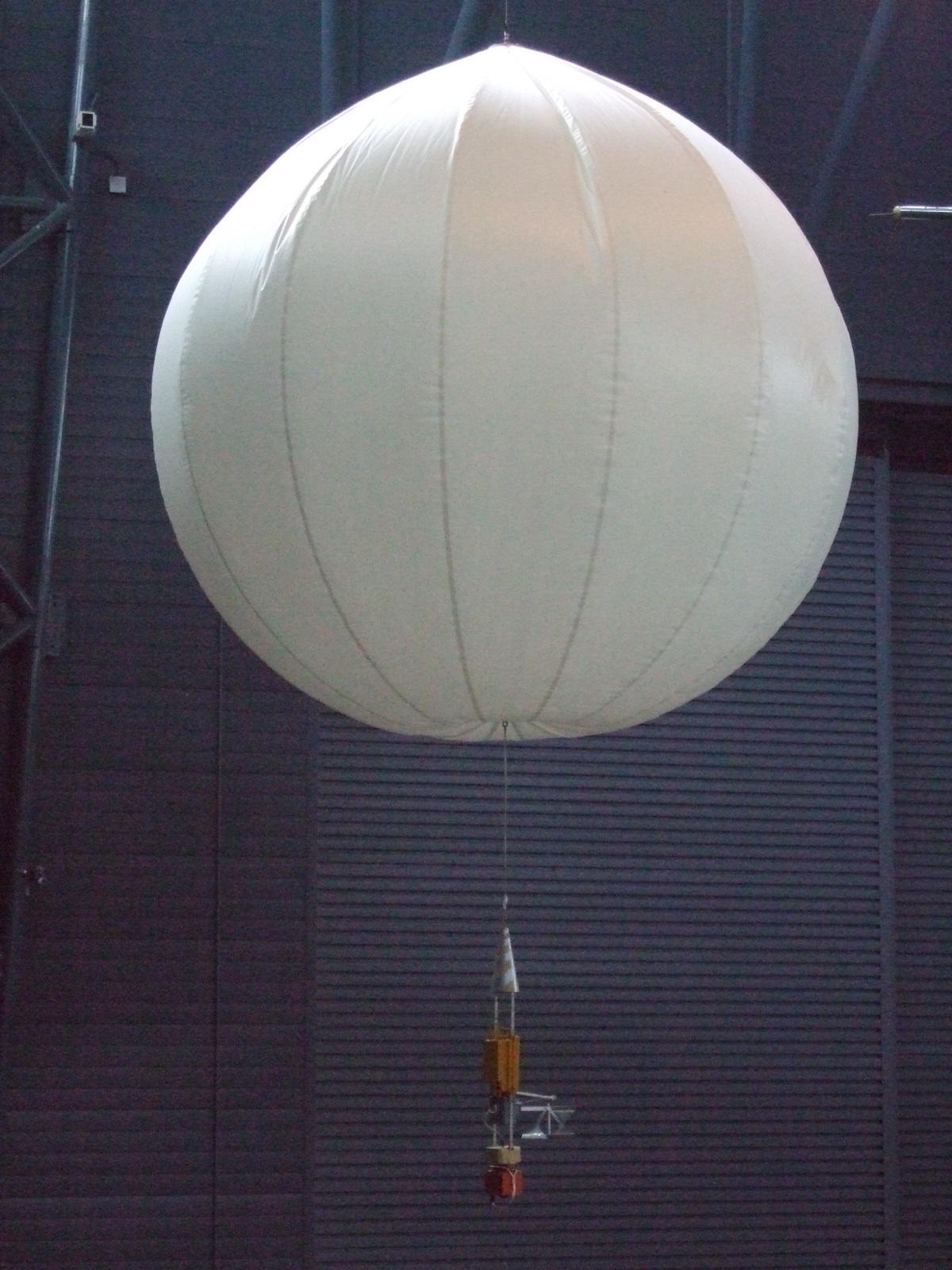
Two spheres of Teflon fabric, each about 3.4 m across, rode the winds of Venus for two Earth days in June 1985. The Soviet stations Vega 1 and Vega 2 released them on 11 and 15 June as their landers fell toward the surface, and each towed a small instrument gondola through the middle cloud deck, 53 to 54 km up. NPO Lavochkin, which built the stations, calls the balloon probe the first ever used as a research tool in spaceflight. Each balloon transmitted for about 46 hours, until its battery ran down, and drifted west some 11,000 km. Nothing relayed their faint signals: twenty radio telescopes on Earth listened directly and fixed their positions to about 10 km. This page also covers that network, the tracking papers and Jacques Blamont. The landers and the Halley flyby are on the Vega 1 and Vega 2 page.
The idea is older than the hardware by almost two decades. According to the balloon team's 1986 account in the Soviet journal Pis'ma v Astronomicheskii Zhurnal, translated by NASA as TM-88516, Blamont first proposed balloons for studying the dynamics of the Venus atmosphere in 1967. In April 1974, at the Soviet-French EOS-Venera symposium in Moscow, L. R. Kogan, V. M. Linkin, L. I. Matveenko and colleagues proposed following a transmitting balloon with ground interferometers. From 1974 to 1980 the Interkosmos Council and CNES, the French space agency, developed a much larger balloon whose data would be relayed through an orbiter; it is covered with the Soviet unflown Venus projects. Its ending depends on who tells it. The Soviet paper describes a next step proposed by R. Z. Sagdeev and Linkin: send the data straight to Earth, measure position by very long baseline interferometry (VLBI), and cut the mass. The Société astronomique de France, in its 2020 tribute to Blamont, says the Soviets preferred to replace the French EOS balloon, 9 m across with a 220 kg gondola, by two smaller ones. The mission note in NASA's Planetary Data System (PDS) attributes the change to the decision to send the carriers on to Comet Halley. The Russian State Archive of Scientific and Technical Documentation (RGANTD) holds the technical specification for the Vega complex, index 5VK, drawn up in May to September 1981; the minister of general machine building, S. A. Afanasyev, gave the project final approval on 24 February 1982.
The flown balloon was a sealed, pressurised sphere of Teflon fabric coated with Teflon film. Filled with helium to 30 mbar above the outside pressure, it measured 3.4 m across, according to R. S. Kremnev and the design team in 1986. Their mass budget is 21 kg: 12.5 kg of envelope and fittings, 2.0 kg of helium and a 6.5 kg gondola. NSSDCA gives 21.5 kg, with 2.1 kg of helium and a 6.9 kg gondola. The PDS mission note gives the diameter as 3.54 m, and Kremnev's own volume figures (19.6 cubic metres unpressurised, about 1 more per 10 mbar) put a sphere at 30 mbar near 3.5 m, a mismatch no source explains. The gondola, about 1.2 m long, hung 13 m below the envelope in Kremnev's paper and 12 m in the team's 1992 paper. A 37 cm conical spiral antenna sat on top. The middle box held the transmitter, timer, oscillator and the Meteo assembly, with a quartz-resonator pressure sensor good to about 0.5 mbar and a light sensor looking down through a cone; a folding arm carried a film thermometer good to 0.5 K and a two-fan anemometer that counted air moving up or down past the gondola. The bottom box held about 1 kg of lithium cells, rated at 250 watt-hours for 46 to 52 hours, and a nephelometer pulsing at 930 nm to gauge the density of the cloud.
Everything the gondola learned had to cross about 100 million km on 4.5 W. The transmitter worked at 1667.9 MHz, the 18 cm band where radio astronomers already observed hydroxyl masers. In telemetry mode it sent 30 s of pure carrier for tracking, then the data gathered over the previous half hour at 4 bits per second, in a session Kremnev gives as 332 s long and JPL rounds to 330 s. In coordinate mode it sent two tones 6.5 MHz apart, whose phase difference let the interferometers fix its position. Sessions came in bursts during the first 10 hours and for about 12 hours on the second day, and less often at other times, to save the battery. To fit 12-bit readings into so few bits, the gondola usually sent only the six least significant bits of each value. The Venus air proved livelier than expected, so the missing top bits sometimes had to be estimated on the ground, and the PDS archive credits Lee Elson and David Crisp with untangling the record.
Putting a balloon into the air took 15 to 25 minutes and a chain of parachutes. The folded balloon and gondola sat in a ring-shaped container around the lander's antenna, inside the upper half of the entry sphere, with helium tanks, parachute and timer on top; the kit weighed about 120 kg. NPO Lavochkin's project page gives the sequence. At about 64 km a parachute pulled off the upper hemisphere with the balloon package inside. The package dropped free 32 s later, rode a small stabilising parachute, then a 35 square metre main parachute. The container was cut apart and its lower half, serving as ballast, drew out the gondola, tether and envelope as it fell. A pyrotechnic valve let the helium in, the filling line was cut and sealed, and parachute and filling system dropped away. At 0.9 atmospheres or 60 °C the ballast fell, near 50 km, and the balloon climbed back to float height. Lavochkin also explains the choice of entry points: the balloon had to enter on the half of Venus visible from Earth and stay there through its drift, as far as possible from the subsolar meridian, where it might not survive.
The Vega 1 balloon went in first, at 02:06:10 UT on 11 June 1985 by Earth-received time, at 8.1° N, 176.9° E and 84.6° of longitude short of the morning terminator (Sagdeev and colleagues, 1992). It was just after local midnight, and the early hours were rough: the team's first report puts its biggest vertical swings in the first few hours, when a downdraft reached 3 m/s. Across both flights, downward winds as strong as 3.5 m/s occasionally pushed the balloons as much as 2.5 km below float level, the overview in Science adds. Along its whole drift Vega 1 found air about 6.5 K warmer, at the same pressure, than its twin found south of the equator. Its light sensor picked up sunlight about three Earth hours before the balloon crossed the terminator, and the signal climbed quickly on the day side. The Doppler reconstruction puts the terminator crossing at 12:20 UT on 12 June, after 8,500 km, and the last communication session at 00:38 UT on 13 June at 68.8° E, 11,600 km from the start, at about eight in the morning local solar time. Its nephelometer returned data from every session, and the only cloud-density record from the pair comes from it.
Vega 2's balloon followed four days later, at 02:06:04 UT on 15 June, placed by the same reconstruction at 7.5° S, 179.8° E, 75.4° of longitude short of the terminator, around 1 a.m. local time. For its first 20 hours it rode in calm air, rising and falling by less than 100 m. Then its motion turned as restless as its twin's. It crossed the terminator at 09:10 UT on 16 June, after 7,400 km, and between the 35th and 40th hours counted from 0 h UT, roughly 11:00 to 16:00 UT that day, it went through what the team called the great event. The Doppler signal strayed from the constant-wind model by up to 15 m/s, and in Andreev's early estimate the balloon sank about 2 km while the air around it warmed by 20 °C; the 1986 Soviet encyclopedia yearbook gives the drop as about 1.5 km. In the PDS archive the highest pressure after the balloon first reached float height is 884 hPa, at 12:56 UT on 16 June, a reading the archive flags as good but uncertain in decommutation, with its model altitude at 51.4 km four minutes later. Early in the flight it floated near 530 hPa. By the team's calculation the envelope lost its overpressure on the way down, making the balloon more sensitive to gusts, yet the last session, at 00:38:01 UT on 17 June, showed it back at float height; the Doppler model put it at 7.5° S, 76.3° E after 11,100 km.
The team's explanations for the plunge stayed tentative. The first analysis, led by Blamont, noted that it came as the balloon crossed the mountainous region of Aphrodite Terra, over terrain far rougher in Pioneer Venus altimetry than any under Vega 1, and that Vega 1 felt nothing comparable at its own terminator crossing; the Doppler team placed Vega 2 near a peak about 5 km high. The authors judged an erupting volcano the least likely cause and favoured waves in the atmosphere raised by air flowing over the mountains, while warning that their trajectory was preliminary and the altimetry coarse. The final VLBI paper of 1992 adds that Vega 2 turned north over the northern flank of the Aphrodite mountains before running parallel to the equator, and that the gondola recorded pronounced disturbances during that sideways drift. Even the balloon model behind the archived tracks is uncertain: the PDS extras note says its fill and leakage values may or may not match what happened, and points to an alternative, cloud droplets collecting on the envelope, set out by G. E. Dorrington in a 2013 paper on possible drizzle in the middle cloud layer.
Most of the science came out in seven papers in Science on 21 March 1986 and in the Soviet journal issue that NASA translated. Doppler tracking alone gave mean westward winds of 69 ± 1 m/s for Vega 1 and 66 ± 1 m/s for Vega 2, about 250 km/h, 5 to 10 m/s faster than earlier probes had found at that height (6 to 10 m/s in Blamont's analysis and the 1992 paper), a sign that the circulation varies over time. The departures from a steady wind rose and fell in step on both balloons, peaking near 3:30 a.m. Venus local time, which the authors tentatively tied to a feature fixed relative to the Sun, perhaps a thermal tide. Vertical winds were typically 1 to 2 m/s, in line with convection. Blamont's group put the persistent 6.5 K gap between the balloons down, probably, to large-scale disturbances travelling west around the planet. Lightning was the thinnest result. In about seven hours of combined observation spread along both tracks, the flash detector registered one signal, on Vega 2, which the team said could be lightning or a brief change in the light level. The PDS tables carry no light-sensor channel at all.
Two networks worked as one to track the balloons. The Soviet network, coordinated by IKI, used 70 m dishes at Yevpatoriya in Crimea and Ussuriysk in the Far East, finished just before the experiment according to the 1992 paper, a 64 m dish at Medvezhi Ozera near Moscow, and smaller antennas at Simeiz, Pushchino and Ulan-Ude. CNES organised the international network, with Blamont and R. A. Preston of JPL as its scientific leaders. Its backbone was NASA's three 64 m Deep Space Network dishes at Goldstone, Madrid and Canberra, joined by observatories including Arecibo, Effelsberg, Jodrell Bank, Onsala, Hartebeesthoek in South Africa, Atibaia in Brazil, Penticton in Canada and Haystack in Massachusetts. The two large Soviet dishes and the three DSN dishes took the telemetry, and CNES staff in Toulouse coordinated real-time work between JPL and IKI. Over the four days of the two flights the network made about 1,200 recordings. JPL's report says about 95 percent of the telemetry was decoded and differential VLBI was obtained for 120 of the 138 balloon transmissions.
Accounts of who ran which antenna do not agree. The team's 1986 paper and NSSDCA count 6 Soviet stations and 14 abroad coordinated by CNES. JPL's report says CNES was responsible for 15 of the 20, including the DSN, with five Soviet antennas taking part, although its own map shows six on Soviet soil. The station lists differ too. The Soviet encyclopedia yearbook for 1985 listed Green Bank and Parkes, which appear in neither JPL's 1986 map nor the team's 1992 table; both name North Liberty in Iowa and Owens Valley in California instead. The post-flight 1986 yearbook still names Green Bank among those used. JPL's January 1985 release spoke of at least ten antennas plus the Soviet network, and of 3 m balloons with 60-hour batteries.
Turning the recordings into tracks took years, and two versions still circulate. The older one, published in 1986 and repeated by NSSDCA, used Doppler shifts alone. The team fitted a model of purely east-west motion at constant speed along a parallel, which fixes each balloon's latitude by construction; that is why both catalogue end points sit exactly at the start latitudes, 8.1° N and 7.5° S. The newer one came from the phase of the signals recorded across the network, processed at IKI and JPL, and was published by Sagdeev and 34 co-authors in Astronomy and Astrophysics in 1992. Using each Vega flyby spacecraft as a reference transmitter, it reached an accuracy of about 10 km. It confirmed Vega 1's track as parallel to the equator, at 68.7 m/s westward with no measurable north-south wind, and showed Vega 2 moving 65.3 m/s westward and 3.4 m/s northward (3.5 m/s in its discussion), drifting toward the equator on its first day and holding latitude on its second; the text puts the total shift at 250 km. It also found a 7.4 s wobble, explained as the gondola swinging like a pendulum, and contradicts itself on where it was commoner: ten times more often in the southern hemisphere, says the abstract, and ten times more often for Vega 1, which flew in the north, says the discussion.
Those tracks became public in February 2020, when the Planetary Data System released a restored Vega archive compiled by Ralph Lorenz, David Crisp and Lyle Huber. For each balloon it holds a telemetry table and a second table that adds position from differential VLBI, altitude from a balloon model and the derived winds. Few of its 2,040 rows carry a position. Vega 1 has 61 fixes, from 8.32° N, 176.16° E at 02:18:27 UT on 11 June to 9.08° N, 77.41° E at 20:03:12 UT on 12 June. Vega 2 has 57, from 6.18° S, 177.95° E at 02:18:22 UT on 15 June to 3.22° S, 83.99° E at 20:03:07 UT on 16 June. All fixes carry the archive's top quality flag, 4; the other rows are zero-filled. Fixes arrive every half hour to hour, with gaps of up to 2.5 hours for Vega 1 and 5 hours for Vega 2. Both tables end a little after 21:00 UT on the second day, about three and a half hours before the last session. JPL's 1986 report fits that ending: it judged two Vega 1 transmissions at the end of the balloon's life probably too weak to use, and the last two Vega 2 recordings too weak to decode.
For Vega 1 the two products agree closely. The VLBI fixes keep it between 7.96° and 9.09° N, although over its last half-day of fixes it edged about 0.9° north. For Vega 2 they part company. The VLBI track begins at 6.18° S, 1.3° north of the model's 7.5° S, climbs to 3.22° S by the last fix and spans about 3.2° of latitude, roughly 340 km at float height, more than the 250 km given in the 1992 text. The widely quoted end point of 7.5° S, 76.3° E is therefore a model position at a latitude the measured track never touches. Anyone plotting the flights must choose, because the measured fixes stop about four and a half hours, roughly 1,100 km of drift, before the last contact, whose position comes only from the model. Where the balloons went after their batteries died is unknown. JPL's January 1985 release expected daytime heat to burst them; the 1986 team concluded instead that sunlight warming the envelope would offset the slow helium loss, so they probably flew on.
The Académie des sciences lists Jacques Blamont (1926 to 2020) as scientific and technical director of CNES from 1962 to 1972 and director of the CNRS Service d'aéronomie from 1962 to 1985, and names him promoter of the Eole programme of sealed balloons in Earth's lower atmosphere (1971). The Société astronomique de France adds that he brought instrumented ballooning back from the United States and that the balloon centre at Aire-sur-l'Adour began in his laboratory in 1963. The same tribute calls him principal experimenter for the nephelometer on the four Pioneer Venus atmospheric probes, whose results he published with Boris Ragent of NASA Ames. On Vega he co-led the balloon tracking, meteorology and nephelometer experiments, and his Vénus dévoilée (Odile Jacob, 1987) tells the story of the mission. He died on 13 April 2020, ten weeks after the restored balloon archive was released.
Engineers were still developing the idea in 2024. That year Jacob Izraelevitz and colleagues described two flights over Nevada's Black Rock desert of a subscale, altitude-controlled aerobot made of materials meant to survive Venus, flown at the air density of the 54 to 55 km cloud layer, near the Vega float level. JPL and Aerostar were developing it for a mission that would circle the planet several times. Other balloon plans are under Venus concepts.
Mission facts
Organisations
USSR (NPO Lavochkin, IKI) with France (CNES), tracked by a 20-antenna international radio network
Designations
Vega 1 balloon: COSPAR 1984-125F. Vega 2 balloon: COSPAR 1984-128F. Soviet sources call each a balloon probe (aerostatnyy zond, abbreviated AZ); the PDS instrument ids are VG1BL and VG2BL.
Builder and science lead
The Vega stations (index 5VK) were designed and built at NPO Lavochkin (RGANTD), and the team's 1986 paper says the balloon station was designed and developed in the USSR. JPL's 1986 report adds that CNES built some of the balloon instrumentation. R. Z. Sagdeev of IKI was in overall charge of the balloon science programme.
Envelope
Sealed sphere of Teflon fabric coated with Teflon film, 3.4 m across at the nominal 30 mbar overpressure, volume 19.6 cubic metres at zero overpressure (Kremnev and colleagues, 1986). The PDS mission note gives 3.54 m.
Floating mass
21 kg: envelope and fittings 12.5 kg, helium 2.0 kg, gondola 6.5 kg (Kremnev, 1986). NSSDCA: 21.5 kg, with 2.1 kg of helium and a 6.9 kg gondola; PDS also gives 6.9 kg for the gondola.
Balloon kit in the capsule
About 120 kg for the balloon probe with its parachutes and helium-filling system (RGANTD). NSSDCA lists balloon, gondola, parachute, ballast, helium tanks, timer and pyrotechnics, stored in a ring-shaped container around the lander's antenna in the upper hemisphere of the entry capsule.
Gondola
About 1.2 m long in three sections: a 37 cm conical spiral antenna, a 40.8 x 14.5 x 13.0 cm electronics and Meteo box, and a 9.0 x 14.5 x 15.0 cm box with batteries and nephelometer. Tether 13 m (Kremnev, NSSDCA) or 12 m (1985 Soviet yearbook, Sagdeev 1992).
Instruments
Quartz-resonator pressure sensor (about 0.5 mbar), film resistance thermometer (0.5 K), two-fan vertical anemometer, silicon light and flash sensor (400 to 1100 nm), backscatter nephelometer at 930 nm.
Radio and power
1667.9 MHz (18 cm), about 4.5 W, 4 bit/s telemetry. Sessions of 332 s (Kremnev) or 330 s (JPL; NSSDCA: 30 s of carrier, 270 s of data, 30 s of carrier); the PDS data-set note says 75 s, the interval at which Kremnev says the sensors were read. 1 kg of lithium cells, 250 Wh, designed for 46 to 52 hours.
Vega 1 balloon: flight
Injection 02:06:10 UT 11 June 1985 at 8.1° N, 176.9° E ('input' in the 1992 table; NSSDCA gives the same time for atmospheric entry at 125 km, Earth-received); morning terminator 12:20 UT 12 June after 8,500 km; last session 00:38 UT 13 June at 68.8° E, 11,600 km (Doppler model, constant latitude).
Vega 2 balloon: flight
Injection 02:06:04 UT 15 June 1985 at 7.5° S, 179.8° E; terminator 09:10 UT 16 June after 7,400 km; last session 00:38:01 UT 17 June at 76.3° E, 11,100 km (Doppler model). The 1986 overview table gives 11,500 and 11,000 km.
Duration
46 hours (1986 team table), about 46 hours (NSSDCA), 46.5 hours (PDS), 45 hours (Société astronomique de France), about two days (RGANTD). Injection at 02:06 UT to last session at 48 h 38 min gives 46 h 32 min.
Float level
53 to 54 km, mean 53.6 km at about 535 mbar (NSSDCA); the 1986 team says float pressure crept from about 535 to about 620 mbar by the end of day two. The balloons sank about 500 m as helium diffused out (Sagdeev 1992); the 1986 team put the helium loss under 0.5 percent of 2.1 kg, while NSSDCA says under 5 percent.
Winds
Doppler: 69 m/s (Vega 1) and 66 m/s (Vega 2) westward, each ± 1 m/s in the 1986 papers. VLBI (1992): Vega 1 68.7 m/s with no north-south wind; Vega 2 65.3 m/s west and 3.4 m/s north; its discussion gives mean speeds of up to 69 and 67 m/s.
Vertical motion
Downdrafts up to 3.5 m/s pushed the balloons up to 2.5 km below float level (Science overview, 1986).
Temperature
At the same pressure Vega 1 air was about 6.5 K warmer than Vega 2 air; Vega 1 read about 4 K warmer and Vega 2 about 2.5 K cooler than the Pioneer Venus Large Probe at those levels (Linkin and colleagues, 1986). The 1986 Soviet encyclopedia yearbook gives the gap as 8 degrees.
Lightning and clouds
One flash-sensor signal in about 7 hours of observation, on Vega 2, possibly lightning or a brief light change. Nephelometer data came from Vega 1 only.
Tracking network
20 radio telescopes. The 1986 team paper and NSSDCA: 6 Soviet (IKI) plus 14 abroad (CNES). JPL: CNES ran 15 of 20 including the three DSN 64 m dishes, with 5 Soviet antennas taking part.
Tracking results
About 95 percent of telemetry decoded; differential VLBI for 120 of 138 balloon transmissions (JPL, 1986). Position accuracy about 10 km in the coordinate mode (Sagdeev 1992).
Site: 8.321°N, 176.165°E · Vega 1 balloon, first position fix · position estimated, ±10 km (source)
See both tracks on the globe →Mission timeline
- 1967Jacques Blamont proposes balloons for studying the dynamics of the Venus atmosphere, as the 1986 balloon team paper records.
- Apr 1974At the Soviet-French EOS-Venera symposium in Moscow, Kogan, Linkin, Matveenko and colleagues propose tracking a transmitting balloon with a ground interferometer network.
- 24 Feb 1982Minister S. A. Afanasyev gives final approval to the Venus-Halley project, whose technical specification for the 5VK complex was drafted in May to September 1981 (RGANTD).
- 15 Dec 1984Vega 1 lifts off from Baikonur with its balloon packed inside the descent capsule.
- 21 Dec 1984Vega 2 follows with the second balloon.
- 21 Jan 1985The Goldstone 64 m antenna, part of the CNES-organised network, becomes the first NASA station to receive signals from the two Vega spacecraft.
- 9 and 13 Jun 1985The descent capsules separate from Vega 1 and Vega 2, two days before each reaches Venus.
- 11 Jun 1985, 02:06 UTThe Vega 1 capsule enters at 125 km; its balloon deploys near 8.1° N, 176.9° E, just after local midnight, and reaches float height 15 to 25 minutes later.
- 12 Jun 1985, 12:20 UTThe Vega 1 balloon crosses the morning terminator after about 8,500 km.
- 13 Jun 1985, 00:38 UTLast communication session with the Vega 1 balloon, near 8 a.m. local time; the battery is spent.
- 15 Jun 1985, 02:06 UTThe Vega 2 balloon deploys near 7.5° S, 179.8° E.
- 16 Jun 1985, 09:10 UTThe Vega 2 balloon crosses the terminator after about 7,400 km.
- 16 Jun 1985, about 11:00 to 16:00 UTThe 'great event': over Aphrodite Terra the Vega 2 balloon plunges, reaching about 884 hPa around 12:56 UT (near 51.4 km in the archive's altitude model), then recovers.
- 17 Jun 1985, 00:38 UTLast communication session with the Vega 2 balloon.
- 21 Mar 1986Science publishes seven papers on the balloon experiment, based on Doppler data and on-board measurements (listed in JPL's 1986 report).
- 1992Sagdeev and 34 co-authors publish the final VLBI trajectories in Astronomy and Astrophysics, showing Vega 2's northward drift.
- 1 Feb 2020NASA's Planetary Data System releases the restored Vega balloon and lander archive of Lorenz, Crisp and Huber.
- 13 Apr 2020Jacques Blamont dies, aged 93.
A filled dot marks something that physically happened. A hollow one marks an announcement, a naming or a target.
Where they drifted
Vega 1 balloon
- 10,419 kmflown between the first and the last radio fix
- 46.5 hfrom entering the atmosphere to the last radio session
- 61radio fixes of its position
Path: Lorenz, Crisp and Huber, NASA PDS, 2020. Heights at the fixes, from the archive's balloon model, 52.1 to 54.8 km.
Vega 2 balloon
- 9,990 kmflown between the first and the last radio fix
- 46.5 hfrom entering the atmosphere to the last radio session
- 57radio fixes of its position
Path: Lorenz, Crisp and Huber, NASA PDS, 2020. Heights at the fixes, from the archive's balloon model, 51.4 to 54.9 km.
Both balloons set off just after local midnight and drifted west into the morning: on their second day the terminator came over the horizon to meet them. On the globe the replay rides above each balloon or beside it in the cloud, with what it measured on the way.
Replay the Vega 1 balloon's drift on the globe → Replay the Vega 2 balloon's drift on the globe →Model: built by azmth in Blender from Smithsonian and Soviet photographs, a Soviet drawing and published dimensions, approximate
In pictures
Tap a photo to enlarge.
Translated from the original sources
Passages from the Russian and French sources this page draws on, in azmth's translation. Tap Show original to read the original wording.
NPO Lavochkin: 40 years since the launch of Vega-1 and Vega-2
Russian · 2 passages
NPO Lavochkin: 40 years since the launch of Vega-1 and Vega-2 (16 December 2024)
Open the source“For the first time in the practice of world spaceflight, a balloon probe was used as a research tool.”
azmth's translation · Show originalHide original
Russian: «Впервые в практике мировой космонавтики в качестве исследовательского средства был применен аэростатный зонд.»
“Information from the balloon probes was received by two networks of radio telescopes: a Soviet one, coordinated by IKI of the USSR Academy of Sciences, and an international one, coordinated by CNES (France).”
azmth's translation · Show originalHide original
Russian: «Приём информации с аэростатных зондов осуществляли две сети радиотелескопов: советская, координируемая ИКИ АН СССР, и международная, координируемая КНЕС (Франция).»
NPO Lavochkin: Vega-1 and Vega-2 project page
Russian · 2 passages
“The need to ensure one to two days of floating by the balloon probe required the entry point to be as far as possible from the subsolar meridian, where unfavourable conditions could end the balloon probe's existence.”
azmth's translation · Show originalHide original
Russian: «Необходимость обеспечения одно-, двухсуточного плавания A3 потребовала, чтобы точка входа была как можно дальше от подсолнечного меридиана, где из-за неблагоприятных условий A3 может прекратить свое существование.»
“On a command from the threshold device of the pressure sensors (P = 0.9 atm) or temperature sensors (T = 60 °C) the ballast is dropped.”
azmth's translation · Show originalHide original
Russian: «По команде порогового устройства датчиков давления (Р=0,9 атм) или температуры (Т=60°С) сбрасывается балласт.»
RGANTD: Vega-1 and -2, balloons on Venus and Comet Halley
Russian · 4 passages
“Minister of General Machine Building S. A. Afanasyev gave the project final approval on 24 February 1982.”
azmth's translation · Show originalHide original
Russian: «Министр общего машиностроения С.А. Афанасьев окончательно одобрил проект 24 февраля 1982 г.»
“The Vega spacecraft (index 5VK) were designed and manufactured at the S. A. Lavochkin NPO.”
azmth's translation · Show originalHide original
Russian: «Космические аппараты «Вега» (индекс 5ВК) были разработаны и изготовлены в НПО им. С.А. Лавочкина.»
“The probes worked for about two days each. Driven by the wind, they flew at a height of 53 to 55 km a distance of more than 11 thousand km at an average speed of 250 km/h.”
azmth's translation · Show originalHide original
Russian: «Зонды проработали около двух суток каждый. Под действием ветра они пролетели на высоте 53-55 км расстояние более 11 тысяч км со средней скоростью 250 км/ч.»
“Along their flight path the probes measured temperature, pressure, wind gusts and illumination and recorded light flashes from lightning.”
azmth's translation · Show originalHide original
Russian: «Вдоль трассы полета зонды измеряли температуру, давление, порывы ветра, освещенность и фиксировали световые вспышки от молний.»
Epizody kosmonavtiki: Vega-1
Russian · 6 passages
Epizody kosmonavtiki: Vega-1 (Soviet encyclopedia yearbooks 1985 to 1987), archived
Open the source“The international network includes radio telescopes with diameters: Goldstone (USA) 64 m, Canberra (Australia) 64 m, Madrid (Spain) 64 m, Green Bank (USA) 43 m [the 1985 yearbook list continues with Arecibo, Fort Davis, Penticton, Atibaia, Effelsberg, Onsala, Hartebeesthoek and Parkes, 64 m].”
azmth's translation · Show originalHide original
Russian: «Международная сеть включает радиотелескопы с диаметрами: Голдстон (США) - 64 м, Канберра (Австралия) - 64 м, Мадрид (Испания) - 64 м, Грин-Бэнк (США) - 43 м»
“The accuracy of the balloon probes' position measurements was about 10 km, of velocity about 1 m/s (Soviet encyclopedia yearbook 1986).”
azmth's translation · Show originalHide original
Russian: «Точность измерений координат AЗ составила ок. 10 км, скорость - ок. 1 м/сек.»
“When the second balloon probe flew over a 5 km high summit in the Aphrodite region, it fell into a peculiar air pocket, dropping sharply by about 1.5 km (Soviet encyclopedia yearbook 1986).”
azmth's translation · Show originalHide original
Russian: «Когда второй AЗ пролетал в районе Афродиты над вершиной высотой 5 км, он попал в своеобразную воздушную яму, резко снизившись на ~ 1,5 км.»
“Both balloon probes registered variations in illumination and light flashes on the night side (Soviet encyclopedia yearbook 1986).”
azmth's translation · Show originalHide original
Russian: «Оба AЗ зарегистрировали на ночной стороне вариации освещенности и световые вспышки.»
“Along the whole drift trajectory of the first balloon probe it was warmer by 8° (Soviet encyclopedia yearbook 1986).”
azmth's translation · Show originalHide original
Russian: «Вдоль всей траектории дрейфа первого AЗ было теплее на 8°.»
“Radio telescopes at Effelsberg (West Germany), Onsala (Sweden), Penticton (Canada), Arecibo (Puerto Rico), Green Bank, Fort Davis and Haystack (USA), Atibaia (Brazil) and Jodrell Bank (UK) were also used (Soviet encyclopedia yearbook 1986).”
azmth's translation · Show originalHide original
Russian: «Использовались также радиотелескопы в Эйфельсберге (ФРГ), Онсале (Швеция), Пентиктон (Канада), Аресибо (Пуэрто-Рико), Грин-Бэнк, Форт-Дейвис и Хайстек (США), Атибая (Бразилия), Джодрелл-Бэнк (Великобритания).»
Académie des sciences: In memoriam Jacques Blamont
French · 1 passage
“He developed and achieved the launch, in 1985, of balloons into the atmosphere of Venus by the Soviet Vega probes.”
azmth's translation · Show originalHide original
French: «Il a mis au point et réussi le lancement, en 1985, de ballons dans l'atmosphère de Vénus par les sondes soviétiques Vega.»
Société astronomique de France: Hommage au professeur Blamont
French · 3 passages
Société astronomique de France: Hommage au professeur Blamont (2020)
Open the source“In the end, however, the Soviets preferred to replace the French EOS balloon (9 m in diameter with a 220 kg gondola) with two smaller ones.”
azmth's translation · Show originalHide original
French: «Toutefois, au final, les Soviétiques ont préféré remplacer le ballon français EOS (de 9 m de diamètre avec une nacelle de 220 kg) par deux plus petits.»
“Blamont's concept was a success; the balloons returned data for 45 hours.”
azmth's translation · Show originalHide original
French: «Le concept de Blamont a été un succès ; les ballons ont permis d’obtenir des données durant 45 heures.»
“Thus, on the Pioneer Venus Multiprobe mission (1978), an American mission for the in situ study of the atmosphere of the planet Venus, he was principal experimenter for the nephelometer instrument (carried on the four atmospheric probes).”
azmth's translation · Show originalHide original
French: «Ainsi, sur la mission Pioneer-Venus Multiprobe (1978), une mission américaine d’étude in situ de l’atmosphère de la planète Vénus, il est expérimentateur principal pour l’instrument néphélomètre (placé sur les quatre sondes atmosphériques).»
CNESmag 89, Ballons
French · 1 passage
CNESmag 89, Ballons (July 2021)
Open the source“In 1985, moreover, the Russians sent two balloons into the atmosphere of Venus (Venera programme) with France's contribution.”
azmth's translation · Show originalHide original
French: «En 1985, les Russes ont d’ailleurs envoyé deux ballons dans l’atmosphère de Vénus (programme Venera) avec la contribution de la France.»
Vidéothèque CNES: De planètes en comète Vénus-Halley
French · 1 passage
Vidéothèque CNES: De planètes en comète Vénus-Halley (1984)
Open the source“Interview with Arlène Ammar-Israel (head of the Vega programme at CNES).”
Catalogue entry for a 1984 CNES film whose shot list includes an animated balloon diagram and a world map of the balloon data network.
azmth's translation · Show originalHide original
French: «Interview de Arlène Ammar-Israel (Responsable du Programme Véga au CNES).»
Sources
- PDS Atmospheres Node: Vega 1 and Vega 2 balloon and lander archive (summary page)
- PDS volume vega_5001 (tables, labels, catalogue, extras)
- PDS: Vega 1 balloon level 3 label (vg1bl_rdr.lbl), with R. Lorenz's local solar time note
- PDS: data set catalogue (dataset.cat)
- PDS: mission catalogue (mission.cat)
- PDS: extras description and image captions (extrinfo.txt)
- Sagdeev et al. 1992, Differential VLBI measurements of the Venus atmosphere dynamics by balloons: VEGA project, A&A 254, 387
- NASA TM-88516 (1986), translation of Pis'ma v Astronomicheskii Zhurnal 12(1): the Vega balloon papers
- Stelzried, Preston et al., The Venus Balloon Project, JPL TDA Progress Report 42-85 (1986)
- NSSDCA: Vega 1 Balloon, 1984-125F (archived June 2025)
- NSSDCA: Vega 2 Balloon, 1984-128F (archived June 2025)
- Sagdeev et al., The VEGA Venus Balloon Experiment, Science 231, 1407 (1986), PubMed abstract
- Sagdeev et al., Overview of VEGA Venus Balloon in Situ Meteorological Measurements, Science 231, 1411 (1986)
- Preston et al., Determination of Venus Winds by Ground-Based Radio Tracking of the VEGA Balloons, Science 231, 1414 (1986)
- Linkin et al., Thermal structure of the Venus atmosphere in the middle cloud layer, Science 231, 1420 (1986)
- Blamont et al., Implications of the VEGA Balloon Results for Venus Atmospheric Dynamics, Science 231, 1422 (1986)
- JPL news release, NASA receives first signals from Soviet Vega space probes (25 January 1985)
- NPO Lavochkin: Vega-1 and Vega-2 project page · in Russian
- NPO Lavochkin: 40 years since the launch of Vega-1 and Vega-2 (16 December 2024) · in Russian
- RGANTD: Vega-1 and -2, balloons on Venus and Comet Halley · in Russian
- Epizody kosmonavtiki: Vega-1 (Soviet encyclopedia yearbooks 1985 to 1987), archived · in Russian
- Académie des sciences: In memoriam Jacques Blamont · in French
- Société astronomique de France: Hommage au professeur Blamont (2020) · in French
- CNESmag 89, Ballons (July 2021) · in French
- Vidéothèque CNES: De planètes en comète Vénus-Halley (1984) · in French
- 19FortyFive, July 2026 article on the Vega balloons (checked for the claim discussed under commonly wrong)
- Izraelevitz et al., Flight Demonstration and Model Validation of a Prototype Variable-Altitude Venus Aerobot (arXiv, 2024)
- Ragent and Blamont, The structure of the clouds of Venus: results of the Pioneer Venus nephelometer experiment, J. Geophys. Res. 85 (1980), bibliographic record
Facts on this page were verified on 26 September 2026. Where sources disagree, the disagreement is stated rather than resolved silently.
azmth is independent and is not affiliated with or endorsed by NASA, Roscosmos, NPO Lavochkin, ESA, JAXA, ISRO, CNSA, or any other space agency or company named on this page.