Landing on Venus
Ten Soviet landers reached the surface of Venus from 1970 to 1985. How they got down, and why their published positions disagree by hundreds of km.
TL;DR· 20 min read
Ten Soviet landers, Venera 7 to 14 and Vega 1 and 2, sent data from the surface of Venus between 1970 and 1985, and none has landed there since. No one saw where they came down, so their positions were worked out from tracking data: the best seven are circles 150 km in radius on Magellan's radar map. Published coordinates for Vega 2 differ by up to about 1,750 km, because sources mix old and new maps, repeat unexplained values and make copying slips. A 2026 paper by Basilevsky and Head argues that the material the landers analysed may be windblown debris from distant craters, lying on top of the rock mapped beneath them.
How many spacecraft have landed on Venus?
Ten spacecraft have landed on Venus and sent data from the surface, all of them Soviet: Venera 7 to 14 and Vega 1 and 2, between December 1970 and June 1985. Each slowed from about 11 km/s in the upper air, came down into around 460 °C and 90 atmospheres, and kept working on the ground for up to about two hours. (NASA's Pioneer Venus Day Probe, built to study the air on the way down, also kept transmitting for 67 minutes after it hit the ground in 1978.) Where the landers rest is known only roughly: the best positions are circles 150 km in radius on Magellan's radar maps. This page explains how they got down, why published landing points disagree by hundreds of kilometres, what the clocks in the landing times measure, and why a 2026 paper argues that the material they analysed may have blown in from distant craters.
- 10landers that sent data from the surface, Venera 7 (1970) to Vega 2 (1985)
- 150 kmradius of the error circle around each of the seven best-located sites
- 1,390 kmgap between NSSDCA's Vega 2 landing point and the best solution on the Magellan map
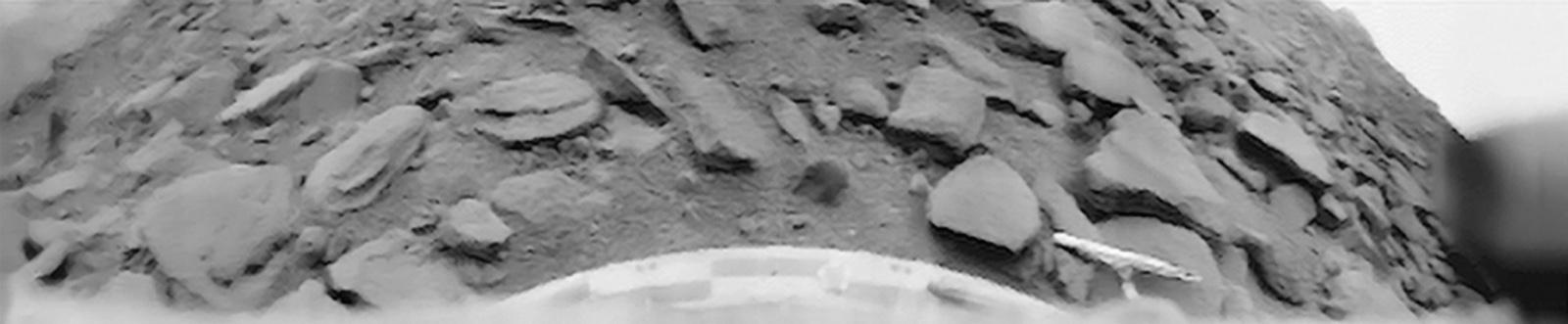
A lander reaches Venus at about 11 km/s, and the atmosphere does nearly all the braking. NPO Lavochkin's account of Venera 7 in 1970 gives the numbers: drag cut the capsule's speed from 11.5 km/s to 200 m/s with loads peaking at 350 g, and the parachute opened at about 55 km, where the outside pressure was near 0.7 atmospheres. NSSDCA gives the planned release pressure as 700 mb and says that level is now known to lie at about 52.5 km. The air lower down is so thick that later landers used parachutes only in the upper layers. NSSDCA's record of Vega 2 has the parachute released at 47 km, after which the lander fell under a disc-shaped aerobrake and touched down at 03:00:50 UT on 15 June 1985, some 51 minutes later. Conditions at the bottom vary little: Lavochkin gives 465 °C and 94.7 atmospheres for Venera 14, and 460 °C and 90 atmospheres at the Venera 9 and 10 sites.
Venera 7 ran into both halves of the problem, survival and communication, on the same day. Its parachute ripped about six minutes after opening fully, NSSDCA says, and the capsule struck the ground at roughly 16.5 m/s at 05:34:10 UT on 15 December 1970. The signal seemed to stop; only later analysis of the recordings found a weak signal that went on for 23 minutes. Lavochkin adds that the received signal fell almost thirtyfold at touchdown, which could mean wind acting on the capsule or the capsule tipping over, and NSSDCA suspects it bounced and came to rest on its side. Lavochkin calls it the first craft in the world to reach the surface of Venus, and NSSDCA the first to return data from the surface of another planet.
From Venera 9 and 10 in 1975 the landers took the shape they kept until 1985: an insulated pressure sphere, rated by Lavochkin for an outside pressure of 10 MPa, with an aerodynamic braking disc on top and a toroidal landing ring underneath. The Soviet yearbook for 1976, reproduced on the Epizody kosmonavtiki archive site, says the disc alone slowed the craft to about 7 m/s once the main parachute had been dropped below the clouds. A passage credited to Mikhail Marov on the same site has Venera 9 touching down at 7 to 8 m/s on a slope of 15 to 20 degrees and resting tilted by 10 to 15 degrees. Venera 8, still on a parachute in 1972, met the ground at 8.3 m/s, according to Lavochkin.
Radio geometry decided where a lander could come down long before geology had a say. Venera 4 to 7 all arrived on the night side, and Venera 7 landed 2,000 km from the morning terminator. Venera 8 was sent to the sunlit side, landing 500 km past the terminator, and Lavochkin explains the cost: in daylight Earth would stand 30 to 50 degrees from the local vertical, so a second antenna was thrown out after landing. From 1975 each lander talked to its own carrier instead, the orbiters of Venera 9 and 10 and the flyby buses of Venera 11 and 12, Venera 13 and 14 and Vega 1 and 2. That opened up the side of Venus lit by the Sun but invisible from Earth, in Lavochkin's words, and tied each lander's life to the relay. Venera 10 transmitted for 65 minutes, until its orbiter went out of range (NSSDCA), and Venera 13's panoramas ran for 127 minutes before reception was stopped by command from Earth. A weak burn sent Venera 14's bus past at 26,050 km (Lavochkin; Siddiqi says 36,000), 10,000 km closer than full reception needed, and data stopped in the 57th minute.
Inside those limits the scientists still had aims. Lavochkin says the Venera 13 and 14 sites were chosen to characterise the relief and rocks of the planet's most typical geological provinces, one on hilly upland and one on smooth lowland. The 1986 Soviet overview of the Vega results (NASA TM-88516) explains that Vega 2 went to the north-east of Aphrodite Terra because the high mountain regions had never been sampled, and that both Vega landers had to use the night side because of the flight geometry toward Halley's comet. An aim was a box on the map. Lavochkin lists Venera 14's nominal point as 16 S, plus or minus one degree, and 314 degrees, plus or minus one degree; the lander came down at 13 deg 15 min S, 310 deg 09 min, about 490 km away. Even a modern design has a long throw: at the 2019 Venera-D workshop, the planned lander's range from atmospheric entry to touchdown was given as 200 km.
No one watched the landers arrive from above, so every position is a calculation from tracking data: the incoming trajectory, the timing of each event and the Doppler shift of the radio signal, which, Lavochkin writes of Venera 7, let the team work out the distance travelled, tie each temperature to a height and fix the moment of touchdown. A computed position is only as good as its map. Before Magellan, the pole of Venus and its rotation rate came from Earth-based radar; Magellan's images gave M. E. Davies and colleagues a period of 243.0185 days and a new pole in 1992. Today's convention, in the IAU gazetteer, counts latitude planetocentrically and longitude east from 0 to 360 degrees, with zero longitude set by the central peak of the crater Ariadne. A point quoted in 1975 and a point read off a Magellan mosaic can differ for that reason alone, and most sources here never name their frame.
The positions used in modern studies come from one Russian paper that is hard to find. E. L. Akim and V. A. Stepanyants re-stated the landing points on the new Magellan map in Astronomicheskii Vestnik, the journal published in English as Solar System Research; both also appear as co-authors of the 1992 Davies paper. The citation year is unsettled: Basilevsky, Nikolaeva and Weitz dated the paper 1992 in October of that year, while Weitz and Basilevsky in 1993 and A. M. Abdrakhimov in 2001 dated it 1993. No online copy was found; the numbers survive in papers that quote them. Abdrakhimov repeated the same sentence for each site: 'Radius of ellipse of probable error in the lander position is 150 km.' The seven centres are Venera 8 at 10.70 S, 335.25 E; Venera 9 at 31.01 N, 291.64 E; Venera 10 at 15.42 N, 291.51 E; Venera 13 at 7.55 S, 303.69 E; Venera 14 at 13.05 S, 310.19 E; Vega 1 at 8.10 N, 175.85 E; and Vega 2 at 7.14 S, 177.67 E. These are the seven landers that analysed surface rock; Venera 7, 11 and 12, which did not, are still printed in whole degrees: 5 S, 351 E; 14 S, 299 E; and 7 S, 294 E.
A circle 150 km in radius covers about 70,700 square kilometres. Other authors describe the same uncertainty differently. The report of the 2019 Venera-D workshop at IKI speaks of 'the large (300-km-diameter) landing ellipse', which matches Abdrakhimov. The 2007 abstract by Aittola, Raitala, Basilevsky, Ivanov and Head gives the Venera and Vega error circles as D = 200 km, a third narrower. Neither source explains the difference. The circle is also what the geology rests on. Abdrakhimov's maps can say only that wrinkle-ridged plains fill about 60 percent of the Venera 9 circle, ridged and fractured plains about 21 percent and tessera about 14 percent, which makes the plains the likeliest ground under the lander and nothing more certain.
Published positions fall into families, and many disagreements come from mixing them. Soviet texts of the time carry their own figures: Lavochkin places Venera 13 at 7 deg 30 min S, 303 deg 11 min, about 53 km from the Magellan-frame centre, and Venera 14 at 13 deg 15 min S, 310 deg 09 min, about 22 km from it. NASA's NSSDCA catalogue prints values without saying where they came from, such as 16 N, 291 E for Venera 10, about 80 km off. Secondary books add slips of their own. Asif Siddiqi's NASA history Beyond Earth prints Venera 9 at 290.64 E, an apparent one-digit slip worth about 91 km, and describes Venera 8 as landing within 'a 10-mile radius' of 10.7 S, 335.25 E where the ballistics solution gives 150 km. Quoted distances between twins disagree too: the 1976 Soviet yearbook, Lavochkin and Siddiqi all put Venera 10 about 2,200 km from Venera 9, while every pair of coordinates quoted on this page, Siddiqi's included, gives about 1,650 km.
Vega 2 shows how far apart the families can drift. Five positions are in print: 7.14 S, 177.67 E in the Magellan frame; 7.5 S, 179.8 E in the 1986 Soviet overview; 6 deg 27 min S, 181 deg 5 min in the Soviet yearbook for 1986; 7.2 S, 179.4 E in Siddiqi; and 8.5 S, 164.5 E in NSSDCA. The first four lie within about 365 km of one another. NSSDCA's value sits about 1,390 km west of the Magellan-frame point and about 1,750 km from the yearbook's, and no Soviet or Russian source for it was found. The balloon that rode down in the same entry vehicle offers a check. Its first position in the Planetary Data System table, at 02:18:22 UT on 15 June 1985, is 6.18 S, 177.95 E, about 106 km from the Magellan-frame landing point: inside the 150 km circle, though just outside a 100 km radius if the 200 km reading is used. The table does not name its coordinate frame. The 1986 overview gives the same pair of numbers for the Vega 2 landing site and for the start of the balloon's drift, which suggests that its landing site marks the arrival area of the entry vehicle.
Landing times hide a second trap: different clocks. Soviet announcements gave Moscow time of reception on Earth, and Siddiqi notes for Venera 9 and 10 that only reception times were announced. NSSDCA often lists spacecraft event time, and for Venera 7 says it subtracted a light time of 3 minutes 22 seconds. For Vega 2 the conventions fit: the 1986 overview's touchdown at 6 h 6 min 46 s Moscow time, read as UT plus three hours, falls 5 min 56 s after NSSDCA's 03:00:50 UT, and JPL's Horizons ephemeris gives a light time of 5 min 59 s that morning. The 1976 Soviet yearbook, which names no time scale, has Venera 10 enter at 7 h 00 min and land at 8 h 13 min 06 s, or 04:00 and 05:13:06 UT if read as Moscow time. NSSDCA and a Russian text credited to Marov give 01:02 and 02:17 UT, close to three hours earlier, which looks like one time-zone conversion too many; Siddiqi pairs the 01:02 entry with a 05:17:06 landing. Venera 7 shows the reverse: Lavochkin's 8 h 34 min 10 s, again with no time scale, sits exactly three hours after NSSDCA's 05:34:10 UT, yet NSSDCA calls its figure spacecraft time, 3 min 22 s before reception. If Lavochkin's is Moscow time of reception, both cannot be right.
On azmth each landing pin keeps every published solution beside its source, and none is averaged or quietly dropped. Where the Magellan-frame solution exists it leads, drawn with its 150 km circle and a note on the 200 km reading. For Venera 7, 11 and 12 the whole-degree figures stand with no stated error; rounding alone can hide up to about 53 km in each coordinate. The capsules of Venera 4 and Venera 5 and 6 carry estimates only, and the four Pioneer Venus probes take their impact points from NASA's Planetary Data System. Each time on a pin says which clock it uses. The 2020 Venera-D workshop report still describes the Venera and Vega sites by their 300-km ellipse and points to the Mars remedy: descent imagers combined with panoramas after landing, 'to pinpoint the precise landing site'.
The circles were drawn on Magellan images so that geologists could ask what the landers had analysed. Catherine Weitz and Alexander Basilevsky mapped all seven in 1993 and found plains dominant at every one. At the five sites where the landers measured a tholeiitic basalt chemistry, they found lava flows whose shapes suggest low viscosity; at Venera 8 and 13, where the chemistry was non-tholeiitic, they found unusual volcanic features, and they judged a steep-sided dome, lamprophyre-like lavas or ash beds the likeliest material under Venera 8. Basilevsky's 1997 return to the Venera 8 site added an unusually dense field of small volcanic shields as a possible source, a conclusion he called very tentative. Abdrakhimov, who with Basilevsky later reviewed the geology of all seven regions in Solar System Research (2002), turned the maps into percentages circle by circle: shield plains about 75 percent of the Venera 8 circle, lobate plains about 53 percent of Venera 14's, wrinkle-ridged plains about 98 percent of Vega 1's and more than 99 percent of Vega 2's. Any sentence of the form 'Venera 14 sampled lobate plains' is shorthand for 'lobate plains cover most of a disc 300 km wide'.
A later argument asks whether the landers touched those units at all. In 1992 D. B. Campbell and colleagues catalogued 57 parabola-shaped features around young craters in Magellan data, several hundred to about 2,000 km across, and explained them as fine debris thrown into the upper atmosphere at impact and carried west by the zonal winds. Basilevsky, James Head and Abdrakhimov then drew model parabolas around every crater wider than 11 km near the Venera and Vega sites and found that they cover 80 to 90 percent of those regions. Their 2004 paper proposed that the layered, weak rocks in the Venera panoramas might be partly lithified parabola deposits, in which case the chemistry could describe material dug from depth somewhere else. Aittola and colleagues carried the idea into site selection in 2007, testing candidates against model parabolas, such as tessera near the crater Quimby at 5.7 S, 76.7 E and shield plains in western Sedna Planitia at 43.5 N, 333.5 E.
In May 2026 Basilevsky and Head restated the case in Solar System Research. The surface material at all seven sites, they wrote, 'may represent ejecta from impact craters located elsewhere, deposited from the atmosphere at the landing sites in the form of radar-dark parabolas', and future landers should drill several metres and avoid mapped parabolas. Russia's science ministry publicised the paper, and on 21 August 2026 Moskovsky Komsomolets ran an interview in which Basilevsky said that no Soviet lander had come down between parabolas and that about 20 to 30 percent of the surface would remain open once the parabolas were mapped. Three details in the newspaper need care. Basilevsky dates the discovery to the early 2000s, which fits the 2004 link to the landing sites; the parabolas themselves were described in 1992. It reports, citing him, that the landers drilled a few decimetres, while Siddiqi describes Venera 14's soil sample as taken from 30 mm down. The newspaper also prints Basilevsky saying the ejecta is blown from west to east, while Campbell's paper has the particles carried west by the zonal winds and the 2007 abstract places the source craters east of the sites they cover.
Behind the ballistics stood people who planned the arrivals. Mikhail Marov, who died on 30 November 2023, is described in the Russian Academy of Sciences obituary as one of the scientific leaders of the planetary missions who took part in working out the strategy and flight schemes of the landers; he held a Lenin Prize. Russian texts credited to him give positions and local times for the landings, among them Venera 9 at 31.01 N, 291.63 E with the Sun 33 degrees from the zenith at 13:12 local solar time. His longitude differs from the Magellan-frame value by a hundredth of a degree, less than a kilometre.
Nothing has landed since. IKI's page for Venera-D still cites the 'ten successful landings', with up to two hours of work on the surface, and notes that no lander or balloon has made direct measurements for the last 40 years; its instrument list includes a landing camera. A catalogue published online on 28 April 2026 by Luca Forassiepi and colleagues counts remains from 15 missions 'concentrated between 1965 and 1985' and argues that titanium, ceramic and aluminium parts are likely to survive, albeit oxidised, corroded and possibly deformed (see what we left at Venus). Where those parts lie is still a circle 300 km wide, and the case for the descent cameras planned for Venera-D and DAVINCI, neither of which had flown as of 26 September 2026, is written in those circles.
What we know
How many landings
Ten landers returned data from the surface: Venera 7, 8, 9, 10, 11, 12, 13 and 14 and Vega 1 and 2. A 2007 review abstract by Aittola, Raitala, Basilevsky, Ivanov and Head lists them as the ten successful landings and calls Venera 7 a partial success that returned only surface temperature and pressure data; Lavochkin and NSSDCA say a failed telemetry commutator let only temperature through, with the pressure worked out afterwards. IKI's Venera-D page uses the same count of ten.
Coordinate frame used today
The IAU gazetteer gives Venus coordinates as planetocentric, east-positive, 0 to 360 degrees. Zero longitude is defined by the central peak of the crater Ariadne, at 43.9 N.
Rotation model before and after Magellan
Before Magellan, the rotation rate and pole of Venus came from Earth-based radar. Davies and colleagues (1992) derived a period of 243.0185 plus or minus 0.0001 days and a north pole at right ascension 272.76 and declination 67.16 degrees from Magellan images. E. L. Akim and V. A. Stepanyantz are co-authors of that paper.
Akim and Stepanyants: the source of the seven best positions
Cited as 'Landing sites of automatic interplanetary probes on new map of Venus', Astronomicheskii Vestnik, dated 1992 by Basilevsky, Nikolaeva and Weitz (JGR, October 1992) and 1993 by Weitz and Basilevsky (1993) and by Abdrakhimov (2001), who spells the second name Stepanyanz (the Davies paper has Stepanyantz). No online copy was found for this page; its numbers are known through the papers that quote them.
The seven Magellan-frame centres
Venera 8, 10.70 S, 335.25 E; Venera 9, 31.01 N, 291.64 E; Venera 10, 15.42 N, 291.51 E; Venera 13, 7.55 S, 303.69 E; Venera 14, 13.05 S, 310.19 E; Vega 1, 8.10 N, 175.85 E; Vega 2, 7.14 S, 177.67 E (as quoted by A. M. Abdrakhimov, LPSC 2001 abstracts 1590 to 1719).
Size of the error, two readings
Abdrakhimov: 'Radius of ellipse of probable error in the lander position is 150 km', that is 300 km across; the 2019 Venera-D workshop report also speaks of a '300-km-diameter' ellipse. The 2007 abstract by Aittola and colleagues gives the Venera and Vega error circles as D = 200 km. Neither source explains the other's figure.
Whole-degree sites only
Venera 7, 11 and 12 returned no surface rock analysis and have no Magellan-frame solution in the papers that quote Akim and Stepanyants. Their published positions stay in whole degrees: 5 S, 351 E (Venera 7, NSSDCA), 14 S, 299 E (Venera 11) and 7 S, 294 E (Venera 12, both Siddiqi).
Vega 2: five published positions
7.14 S, 177.67 E (Magellan frame); 7.5 S, 179.8 E (Soviet overview, 1986); 6 deg 27 min S, 181 deg 5 min (Soviet yearbook, 1986); 7.2 S, 179.4 E (Siddiqi); 8.5 S, 164.5 E (NSSDCA). The first four lie within about 365 km of each other; NSSDCA's is about 1,390 km from the first and about 1,750 km from the yearbook's (azmth's calculation on a 6,051.8 km sphere).
Vega 2: check from the balloon
The first position of the Vega 2 balloon in the Planetary Data System table, at 02:18:22 UT on 15 June 1985 (t = 8,302.4 s), is 6.18 S, 177.95 E, about 106 km from the Magellan-frame landing point. The balloon rode down in the same entry vehicle as the lander.
Aim point against arrival
Lavochkin gives Venera 14's nominal point as 16 S plus or minus 1 degree and 314 plus or minus 1 degree, and its landing point as 13 deg 15 min S, 310 deg 09 min, about 490 km from the aim.
Three kinds of clock
NSSDCA lists Venera 7 in 'spacecraft time = Earth received time minus 3 minutes 22 seconds light travel time'. Siddiqi notes that for Venera 9 and 10 'Times were only announced for reception of landing signal on Earth'. The 1986 Soviet overview gives Vega touchdowns in Moscow time of reception on Earth.
Venera 10 touchdown, three readings
Soviet yearbook for 1976: entry at 7 h 00 min and landing at 8 h 13 min 06 s, with no time scale stated (04:00 and 05:13:06 UT if read as Moscow time, UT plus three hours). NSSDCA and a Russian text credited to Marov: entry 01:02 UT, landing 02:17 UT. Siddiqi: entry 01:02 UT, landing 05:17:06 UT.
Weitz and Basilevsky 1993
Geological maps of all seven circles on Magellan images: plains dominate at every site. Where the landers measured tholeiitic basalt chemistry (Venera 9, 10, 14, Vega 1, 2) the flows look like low-viscosity lava; at Venera 8 and 13 (non-tholeiitic) the circles hold unusual volcanic features such as steep-sided domes.
Abdrakhimov 2001: what fills each circle
Venera 9: wrinkle-ridged plains about 60 percent, ridged and fractured plains about 21, tessera about 14. Venera 8: shield plains about 75 percent. Venera 14: lobate plains about 53 percent. Vega 1: wrinkle-ridged plains about 98 percent. Vega 2: more than 99 percent.
Radar-dark parabolas
Campbell and colleagues (1992) found 57 parabola-shaped and 9 roughly circular features tied to young impact craters, several hundred to about 2,000 km across, and modelled them as fine debris lofted at impact and carried west by the zonal winds.
Basilevsky, Head and Abdrakhimov 2004
Model parabolas drawn around every crater wider than 11 km near the Venera and Vega sites cover 80 to 90 percent of those regions; the layered, mechanically weak rocks in the Venera panoramas may be partly lithified parabola deposits.
Basilevsky and Head 2026
Solar System Research 60 (3), online 19 May 2026: the surface material at the Venera 8, 9, 10, 13, 14 and Vega 1 and 2 sites 'may represent ejecta from impact craters located elsewhere'; future landers should drill several metres and land outside mapped parabolas.
Mikhail Marov (1933 to 2023)
The Russian Academy of Sciences obituary says he was among the scientific leaders of the planetary missions and took part in working out the strategy and flight schemes of the landers. He died on 30 November 2023; IKI's obituary gives his dates as 28 July 1933 to 30 November 2023.
What is left on the surface
Forassiepi and colleagues (Geoarchaeology 41(2), issue dated March 2026, published online 28 April 2026) count remains from 15 missions, 'concentrated between 1965 and 1985', and judge titanium, ceramic and aluminium parts likely to survive, albeit oxidised, corroded and possibly deformed.
What happened, and when
- 15 Dec 1970Venera 7 hits the night side at 16 to 17 m/s (16.5 in NSSDCA's descent-craft record) after its parachute tears; a weak signal continues for 23 minutes (about 20 on Lavochkin's project page). NSSDCA's position, 5 S, 351 E, is given in whole degrees.
- 22 Jul 1972Venera 8 lands on the sunlit side about 500 km from the morning terminator at a vertical speed of 8.3 m/s (Lavochkin; NSSDCA gives 6.5), then throws out a second antenna to reach Earth.
- 22 and 25 Oct 1975Venera 9 and 10 land on the sunlit side hidden from Earth and relay through their orbiters; Venera 9 comes down on a slope given as 15 to 20 degrees by Marov and Huntress and up to about 30 degrees in other sources.
- 9 Dec 1978The four Pioneer Venus probes strike the surface; the Day Probe keeps transmitting from 19:47:59 to 20:55:34 UT.
- 21 and 25 Dec 1978Venera 12 and 11 come down and relay through their flyby buses; Venera 12 sends data from the surface for 110 minutes. Their positions are published only in whole degrees.
- 1 and 5 Mar 1982Venera 13 and 14 land roughly 900 to 1,000 km apart, Venera 13 on plains east of Phoebe Regio; Venera 14 comes down about 490 km from its aim point.
- 11 and 15 Jun 1985Vega 1 and 2 land on the night side, a choice set by the flight on to Comet Halley.
- Aug 1992Davies and colleagues, with Akim and Stepanyantz as co-authors, publish the Magellan rotation period (243.0185 days) and pole.
- Oct 1992Campbell and colleagues catalogue the radar-dark parabolas; Basilevsky, Nikolaeva and Weitz map the Venera 8 circle and cite Akim's new-map landing sites.
- 25 Sep 1993Weitz and Basilevsky publish geological maps of all seven Venera and Vega landing circles.
- Mar 2001A. M. Abdrakhimov's seven LPSC abstracts give each circle's centre, its 150 km radius and the share of each terrain inside it.
- Dec 2004Basilevsky, Head and Abdrakhimov propose that the landers sampled lithified crater air-fall deposits.
- Mar and Nov 2007Aittola, Basilevsky and colleagues present 'Landing on Venus: past and future' at LPSC and in Planetary and Space Science, with candidate sites tested against model parabolas.
- 2 to 5 Oct 2019IKI hosts the Venera-D landing-site workshop; its report blames much of the controversy over Venera and Vega data on the 300-km ellipse.
- 30 Nov 2023Mikhail Marov, one of the scientific leaders of the Soviet planetary missions, dies at 90.
- 28 Apr 2026Forassiepi and colleagues publish an archaeological catalogue of all known landing and impact contexts on Venus (Geoarchaeology, issue dated March 2026).
- 19 May 2026Basilevsky and Head argue in Solar System Research that the seven sites may be covered by ejecta from distant craters.
- 21 Aug 2026Moskovsky Komsomolets interviews Basilevsky: none of the Soviet landers set down between parabolas.
In pictures
Tap a photo to enlarge.
Translated from the original sources
Passages from the Russian sources this page draws on, in azmth's translation. Tap Show original to read the original wording.
NPO Lavochkin, Venera-7 project page
Russian · 4 passages
“The descent craft of the Venera 7 station was the first in the world to reach the surface of the planet Venus. The craft landed on the night side of the planet.”
azmth's translation · Show originalHide original
Russian: «Спускаемый аппарат станции «Венера-7» впервые в мире достиг поверхности планеты Венера. Аппарат совершил посадку на ночной стороне планеты.»
“During aerodynamic braking the craft's speed relative to the planet fell from 11.5 km/s to 200 m/s. Maximum loads reached 350 g.”
azmth's translation · Show originalHide original
Russian: «Во время аэродинамического торможения скорость аппарата относительно планеты уменьшилась с 11,5 км/с до 200 м/с. При этом максимальные перегрузки достигали 350 единиц.»
“At the same time, radio measurements were made of the Doppler change of the signal received on Earth from the descent craft. It was these measurements that made it possible to calculate the distance travelled, 'tie' the temperature values to a definite altitude and fix the moment of contact with the surface of Venus.”
azmth's translation · Show originalHide original
Russian: «Одновременно проводились радиоизмерения доплеровского изменения сигнала, принимаемого на Земле от спускаемого аппарата. Именно эти измерения позволили вычислить пройденный путь, «привязать» значения температуры к определенной высоте и зафиксировать момент касания поверхности Венеры.»
“Continuous measurements of the signal-to-noise ratio of the signal received on Earth recorded a drop in signal level of almost 30 times at the moment of landing. This could have meant the effect of wind on the descent craft during landing, or its tipping over.”
azmth's translation · Show originalHide original
Russian: «Постоянные измерения соотношения сигнал/шум принимаемого на Земле сигнала позволили зафиксировать уменьшение в момент посадки уровня сигнала почти в 30 раз. Это могло означать влияние ветра на спускаемый аппарат во время посадки или его опрокидывание.»
NPO Lavochkin, Venera-8 project page
Russian · 3 passages
“After 55 minutes of smooth descent on the parachute in the atmosphere, the craft landed on the illuminated side of Venus 500 km from the morning terminator near the equator, the vertical speed at the moment of contact being 8.3 m/s.”
azmth's translation · Show originalHide original
Russian: «После 55 минут плавного спуска на парашюте в атмосфере аппарат совершил посадку на освещенной стороне Венеры в 500 км от утреннего терминатора вблизи экватора, причем вертикальная скорость в момент касания составила 8,3 м/с.»
“and landing on the illuminated side causes difficulties with radio communication”
the angle between the direction to Earth and the local vertical will be 30 to 50 degrees
azmth's translation · Show originalHide original
Russian: «а посадка на освещенную сторону вызывает трудности с радиосвязью (угол между направлением на Землю и местной вертикалью составит 30-50°)»
“Unlike the Venera 4, 5, 6 and 7 stations, the descent craft was to land on the day side of the planet.”
azmth's translation · Show originalHide original
Russian: «В отличие от станций "Венера-4, 5, 6, 7" спускаемый аппарат должен был совершить посадку на дневную сторону планеты.»
Epizody kosmonavtiki: Venera 9 page
Russian · 3 passages
Epizody kosmonavtiki: Venera 9 page (Soviet yearbook 1976 text and a passage credited to Marov), archived copy
Open the source“The descent craft passed through the cloud layer in about 20 minutes, after which the main parachute was separated and the further reduction of speed to about 7 m/s was achieved with the braking shield.”
Great Soviet Encyclopedia yearbook for 1976, as reproduced on the site.
azmth's translation · Show originalHide original
Russian: «СА прошел облачный слой за ~ 20 мин, после чего основной парашют был отделен и дальнейшее уменьшение скорости до значения ~7 м/сек происходило с помощью тормозного щитка.»
“The descent craft of Venera 9 and Venera 10 made soft landings on the side of Venus lit by the Sun but invisible from Earth on 22 and 25 October at 8 h 13 min 07 s and 8 h 13 min 06 s respectively. The distance between the landing points is about 2,200 km.”
Great Soviet Encyclopedia yearbook for 1976, as reproduced on the site.
azmth's translation · Show originalHide original
Russian: «СА станций «Венера-9» и «Венера-10» совершили мягкую посадку на освещенной Солнцем, но невидимой с Земли стороне Венеры соответственно 22 и 25 октября в 8 час 13 мин 07 сек и в 8 час 13 мин 06 сек. Расстояние между точками посадки составляет ~2200 км.»
“It made a successful descent through the atmosphere and on 22 October at 05:13 Universal Time touched the surface at 7 to 8 m/s on the day side of the planet at the point 31.01 N, 291.63 E. At this point the solar zenith angle was 33 degrees, corresponding to 13:12 Venus solar time. The landing site lay on a slope inclined at 15 to 20 degrees.”
Passage credited to Marov on the site.
azmth's translation · Show originalHide original
Russian: «Он произвел успешный спуск в атмосфере и 22 октября в 05:13 по Всемирному времени коснулся поверхности на скорости 7-8 м/с на дневной стороне планеты в точке с координатами 31,01 с. ш. и 291,63 в. д. В этой точке зенитный угол Солнца составлял 33°, что соответствовало 13:12 по венерианскому солнечному времени. Место посадки располагалось на откосе с наклоном от 15 до 20°»
NPO Lavochkin, Venera-13 and Venera-14 project page
Russian · 6 passages
“The landing site was chosen so as to determine the character of the relief and rocks in one of the most typical geological and morphological provinces of the planet, a hilly upland.”
Venera 13.
azmth's translation · Show originalHide original
Russian: «Место посадки выбрано таким образом, чтобы определить характер рельефа и пород в одном из наиболее типичных геолого-морфологических провинций планеты - холмистой возвышенности.»
“then the transmission of the panorama of the surface of Venus began, which lasted 127 minutes.”
Venera 13; the page adds that reception was ended by command from Earth.
azmth's translation · Show originalHide original
Russian: «затем началась передача панорамы поверхности Венеры, которая длилась 127 минут.»
“The landing sites were chosen so as to determine the character of the relief and rocks of the most typical geological and morphological provinces of the planet.”
azmth's translation · Show originalHide original
Russian: «Места посадки выбирались таким образом, чтобы определить характер рельефа и пород наиболее типичных геолого-морфологических провинций планеты.»
“The coordinates of the craft's landing point were 13 deg 15 min south latitude (nominal minus 16 deg plus or minus 1 deg) and 310 deg 09 min longitude (nominal 314 deg plus or minus 1 deg).”
azmth's translation · Show originalHide original
Russian: «Координаты точки посадки аппарата составили 13°15' южной широты (номинал –16°±1°) и 310°09' долготы (номинал 314°±1°).»
“62 minutes after the descent craft entered the atmosphere, the lander made a soft landing on plains east of Phoebe Regio (7 deg 30 min south latitude and 303 deg 11 min longitude).”
azmth's translation · Show originalHide original
Russian: «Спустя 62 минуты после входа СА в атмосферу ПА совершил мягкую посадку в равнинной местности к востоку от области Феба (7°30' южной широты и 303°11' долготы).»
“However, the impulse the engine delivered was enough for the orbital craft not to 'crash' into Venus but to pass it at a distance of 26,050 km. That is 10,000 km closer to the surface of Venus than needed to receive the full volume of information from the lander.”
azmth's translation · Show originalHide original
Russian: «Однако отработанного двигателем импульса хватило, чтобы ОА не «врезался» в Венеру, а прошел от неё на расстоянии 26050 км. Это на 10000 км ближе к поверхности Венеры, чем необходимо для приёма в полном объёме информации с посадочного аппарата.»
NPO Lavochkin, Venera-9 and Venera-10 project page
Russian · 3 passages
“After descending, first on a parachute and then with the help of an aerodynamic braking shield, the descent craft made a soft landing on the side of Venus lit by the Sun but invisible from Earth.”
azmth's translation · Show originalHide original
Russian: «После спуска - сначала на парашюте, а затем с помощью тормозного аэродинамического щитка - СА совершил мягкую посадку на освещенной Солнцем, но невидимой с Земли стороне Венеры.»
“An aerodynamic braking device is attached to the upper part of the descent craft, and a toroidal landing device to the lower part.”
azmth's translation · Show originalHide original
Russian: «В верхней части к СА крепится аэродинамическое тормозное устройство, в нижней - торовое посадочное устройство.»
“Two minutes after landing the transmission of the television panorama began. These were the world's first photographs transmitted from the surface of another planet.”
azmth's translation · Show originalHide original
Russian: «Спустя 2 минуты после посадки начиналась передача телевизионной панорамы. Это были первые в мире фотографии, переданные с поверхности другой планеты.»
NPO Lavochkin, Vega-1 and Vega-2 project page
Russian · 1 passage
“What sets this part of the mission scheme apart from its predecessors is the lander's touchdown on the night side of Venus and, accordingly, the relay craft's flyby also over the night side of the planet.”
azmth's translation · Show originalHide original
Russian: «Отличие этой части экспедиционной схемы от ей предшествующих - посадка ПА на ночную сторону Венеры и, соответственно, пролёт ретранслятора (ПрА) также над ночной стороной планеты.»
Epizody kosmonavtiki: Venera 10 page, archived copy
Russian · 1 passage
“The lander entered the atmosphere of Venus at an angle of 22.5 degrees on 25 October at 01:02 Universal Time and at 02:17 touched the surface at about 8 m/s at 15.42 N, 291.51 E.”
azmth's translation · Show originalHide original
Russian: «Посадочный аппарат вошел в атмосферу Венеры под углом 22,5° 25 октября в 01:02 по Всемирному времени и в 02:17 коснулся поверхности на скорости около 8 м/с на 15,42° с. ш. и 291,51° в. д.»
Epizody kosmonavtiki: Vega 2 page
Russian · 1 passage
Epizody kosmonavtiki: Vega 2 page (Soviet yearbook 1986 text), archived copy
Open the source“The landers of Vega 1 and Vega 2 made soft landings on the night side of Venus at the points 7 deg 11 min N, 177 deg 48 min longitude (Vega 1 lander) and 6 deg 27 min S, 181 deg 5 min longitude (Vega 2 lander) in the region of Rusalka Planitia.”
Great Soviet Encyclopedia yearbook for 1986, as reproduced on the site.
azmth's translation · Show originalHide original
Russian: «ПА станций «Вега-1», «Вега-2» совершили мягкую посадку на ночную сторону Венеры в точках с координатами 7°11' с. ш. и 177°48' долготы (ПА «Вега-1»), 6° 27' ю. ш. и 181° 5' долготы (ПА «Вега-2») в районе равнины Русалки.»
Russian Academy of Sciences, obituary of Academician Mikhail Marov
Russian · 2 passages
Russian Academy of Sciences, obituary of Academician Mikhail Marov (December 2023)
Open the source“He was among the scientific leaders of the planetary missions and took part in developing the strategy and flight schemes of the landers.”
azmth's translation · Show originalHide original
Russian: «Он был в числе научных руководителей планетных миссий, участвовал в разработке стратегии и схем полетов посадочных аппаратов.»
“On 30 November 2023 Academician Mikhail Yakovlevich Marov died, an outstanding scientist in the study of the Earth and the planets of the Solar System who made an enormous contribution to preparing and carrying out our country's space experiments on the surfaces of the Moon, Venus and Mars.”
azmth's translation · Show originalHide original
Russian: «30 ноября 2023 г. ушел из жизни академик РАН Михаил Яковлевич Маров – выдающийся ученый в области изучения Земли и планет Солнечной системы, внесший огромный вклад подготовку и реализацию отечественных космических экспериментов на поверхностях Луны, Венеры и Марса.»
Moskovsky Komsomolets, 'Soviet craft landed on Venus in radar-dark places'
Russian · 5 passages
Moskovsky Komsomolets, 'Soviet craft landed on Venus in radar-dark places' (21 August 2026)
Open the source“They found that at the landing places of the Soviet spacecraft that studied the composition of the surface material, what lay there was not the geological material of special interest for study but the impact-crater ejecta covering it.”
azmth's translation · Show originalHide original
Russian: «Они выяснили, что в местах посадок советских космических аппаратов, изучавших состав материала поверхности, находилось не то геологическое вещество, которое представляло особый интерес для изучения, а перекрывающий его материал выбросов из ударных кратеров.»
“No. We all came down on them [the parabolas], or even where two or three such ejecta deposits overlap; they were where the flattest ground was, and at a good distance, hundreds of kilometres from the craters themselves.”
Basilevsky's answer to whether any Soviet lander came down between parabolas; the newspaper prints the verb as 'surrendered', evidently a misprint for 'landed'.
azmth's translation · Show originalHide original
Russian: «Нет. Мы все сдались на них или даже на пересечении сразу двух-трех таких выбросов, – на них же были самые ровные площадки, причем на достаточном расстоянии, в сотнях километрах от самих кратеров.»
“According to Alexander Basilevsky, drilling at the landing sites was shallow, a few decimetres, and the drill, alas, did not reach the geological layers through the thickness of radar-dark crater ejecta.”
azmth's translation · Show originalHide original
Russian: «По словам Александра Базилевского, в местах посадки проводилось неглубокое, в несколько дециметров, бурение, но до геологических слоев сквозь толщу радиотемных выбросов из кратеров бур, увы, не доставал.»
“Since our craft landed on Venus and measured its chemical composition we have learned much that is new, including that when impact craters more than 11 km in diameter form, the ejecta is blown by the wind from west to east and forms the so-called radar-dark parabolas.”
Direction as printed; the 1992 and 2007 papers describe westward transport.
azmth's translation · Show originalHide original
Russian: «С тех пор как наши аппараты садились на Венеру и измеряли ее химический состав, мы уже узнали много нового, в том числе и то, что при образовании ударных кратеров более 11 километров в диаметре, выброс сдувается ветром с запада на восток и образует так называемые радиотемные параболы»
“There are many craters in general, and if you take them all into account, about 20 to 30 percent of open geological areas will remain.”
azmth's translation · Show originalHide original
Russian: «Вообще кратеров много, и если все учесть, то останется открытых геологических участков процентов 20-30.»
IKI RAN, Venera-D mission page
Russian · 2 passages
“As a result of ten successful landings and work on the surface of the planet lasting up to two hours, unique scientific results were obtained.”
azmth's translation · Show originalHide original
Russian: «В результате десяти успешных посадок и работ на поверхности планеты продолжительностью до двух часов, были получены уникальные научные результаты.»
“Direct measurements in the atmosphere and on the surface by a landing module and balloons have not been made for the last 40 years; they are a priority for Venera-D.”
azmth's translation · Show originalHide original
Russian: «Прямые измерения в атмосфере и на поверхности с помощью посадочного модуля и аэростатов не производились последние 40 лет, они являются приоритетными для «Венеры-Д».»
Sources
- Abdrakhimov, Geologic mapping of Venera 8 landing site region, LPSC XXXII abstract 1590 (2001)
- Abdrakhimov, Venera 9 landing site, LPSC XXXII abstract 1601 (2001)
- Abdrakhimov, Venera 10 landing site region, LPSC XXXII abstract 1632 (2001)
- Abdrakhimov, Venera 13 landing site region, LPSC XXXII abstract 1653 (2001)
- Abdrakhimov, Venera 14 landing site region, LPSC XXXII abstract 1670 (2001)
- Abdrakhimov, Vega 1 landing site region, LPSC XXXII abstract 1700 (2001)
- Abdrakhimov, Vega 2 landing site region, LPSC XXXII abstract 1719 (2001)
- Abdrakhimov and Basilevsky, Geology of the Venera and Vega landing-site regions, Solar System Research 36 (2002), metadata and reference list
- Aittola, Raitala, Basilevsky, Ivanov and Head, Landing on Venus: past and future, LPSC XXXVIII abstract 1330 (2007)
- Basilevsky, Ivanov, Head, Aittola and Raitala, Landing on Venus: Past and future, Planetary and Space Science 55 (2007), metadata and reference list
- Weitz and Basilevsky, Magellan observations of the Venera and Vega landing site regions, JGR 98 (1993), abstract and reference list
- Basilevsky, Nikolaeva and Weitz, Geology of the Venera 8 landing site region from Magellan data, JGR 97 (1992), abstract and reference list
- Basilevsky, Venera 8 landing site geology revisited, JGR 102 (1997), abstract
- Basilevsky, Head and Abdrakhimov, Impact crater air fall deposits on the surface of Venus, JGR 109 (2004), abstract
- Campbell et al., Magellan observations of extended impact crater related features on the surface of Venus, JGR 97 (1992), abstract
- Davies et al., The rotation period, direction of the North Pole, and geodetic control network of Venus, JGR 97 (1992), abstract
- Basilevsky and Head, On the composition of the material of geological-morphological units on Venus, Solar System Research 60 (2026), abstract
- Forassiepi et al., Planetary geoarchaeology of Venus, Geoarchaeology 41 (2026), abstract
- IAU Gazetteer of Planetary Nomenclature: Ariadne (zero longitude of Venus)
- Sagdeev et al., An overview of the Soviet Vega balloon experiment and studies of the atmosphere of Venus, NASA TM-88516 (translation of Pis'ma v Astronomicheskiy Zhurnal 12, 1986)
- NASA Planetary Data System, Vega 2 balloon level 3 table (vg2bl_rdr)
- PDS Atmospheres Node, Pioneer Venus probe entry and impact table
- NSSDCA, Venera 7 Descent Craft (1970-060D), archived copy
- NSSDCA, Venera 10 Descent Craft (1975-054D), archived copy
- NSSDCA, Vega 2 Descent Craft (1984-128E), archived copy
- Siddiqi, Beyond Earth: A Chronicle of Deep Space Exploration, 1958 to 2016 (NASA SP-2018-4041)
- JPL Horizons ephemeris system (Earth to Venus light time, 1970, 1975 and 1985)
- IKI, Venera-D Landing Sites Selection and Cloud Layer Habitability Workshop Report (2019 workshop, 2020 report)
- NPO Lavochkin, Venera-7 project page · in Russian
- NPO Lavochkin, Venera-8 project page · in Russian
- NPO Lavochkin, Venera-9 and Venera-10 project page · in Russian
- NPO Lavochkin, Venera-11 and Venera-12 project page · in Russian
- NPO Lavochkin, Venera-13 and Venera-14 project page · in Russian
- NPO Lavochkin, Vega-1 and Vega-2 project page · in Russian
- Epizody kosmonavtiki: Venera 9 page (Soviet yearbook 1976 text and a passage credited to Marov), archived copy · in Russian
- Epizody kosmonavtiki: Venera 10 page, archived copy · in Russian
- Epizody kosmonavtiki: Vega 2 page (Soviet yearbook 1986 text), archived copy · in Russian
- Russian Academy of Sciences, obituary of Academician Mikhail Marov (December 2023) · in Russian
- Moskovsky Komsomolets, 'Soviet craft landed on Venus in radar-dark places' (21 August 2026) · in Russian
- IKI RAN, Venera-D mission page · in Russian
- Marov and Huntress, Soviet Robots in the Solar System (Springer, 2011), catalogue record
- NASA Science, DAVINCI mission page (descent imaging of Alpha Regio)
- The Planetary Society, Every picture from Venus' surface, ever (Ted Stryk, 2021)
- IKI RAN, obituary: Mikhail Marov, 28 July 1933 to 30 November 2023
Checked on 26 September 2026. Where the science is unsettled this page says so rather than picking a winner.
azmth is independent and is not affiliated with or endorsed by NASA, Roscosmos, NPO Lavochkin, ESA, JAXA, ISRO, CNSA, or any other space agency or company named on this page.