Venera 5 and Venera 6
Lavochkin design bureau · Soviet Union · Atmospheric probe · 1969 · Into the atmosphere Success
Ended on 16 and 17 May 1969. Each capsule sent about 50 minutes of data from under its parachute on the night side, then its signal was lost about 18 km above the ground when the pressure reached 27 atmospheres.
TL;DR· 21 min read
Venera 5 and 6 were identical Soviet probes whose strengthened capsules entered the night side of Venus on 16 and 17 May 1969. Each sent about 50 minutes of data under its parachute and fell silent about 18 km above the ground, crushed at 27 atmospheres. They confirmed an atmosphere of almost pure carbon dioxide. Their altimeters disagreed by about 13 km, at first put down to uneven ground; Magellan's later maps show no such step at their published positions.
Did Venera 5 and 6 land on Venus?
Venera 5 and Venera 6 were twin Soviet probes that dropped capsules into the night side of Venus on 16 and 17 May 1969, one day apart. Neither landed: each sent about 50 minutes of temperature, pressure and gas readings from under its parachute, then fell silent about 18 km above the ground when the pressure reached 27 atmospheres. The Lavochkin design bureau (today NPO Lavochkin) had built them on a strengthened Venera 4 design, and between them they took direct readings deeper than Venera 4 had and confirmed an atmosphere of almost pure carbon dioxide.
Facts as of 5 November 2026, from the sources listed below.
- 27 atmoutside pressure when each capsule fell silent, above the 25 atmospheres it was built for
- 53 and 51 minutesof parachute descent data from Venera 5 and Venera 6 in the 1969 Soviet count (Lavochkin gives 52.5 and 50)
- about 18 kmheight above the surface at loss of signal in Lavochkin's account; the June 1969 figures were 24 to 26 km and 10 to 12 km
Venera 4 left a question behind. On 18 October 1967 its capsule hung under parachutes for 93 minutes sending temperature and pressure, and Soviet scientists first concluded it had measured all the way down: the radio altimeter read 28 km as the instruments came on (26 km in Mitchell's account), which matched the descent length they computed. Months of joint work with radar results and with the radio occultation data of the American Mariner 5 flyby pointed the other way. The altimeter's frequency modulation let any single reading correspond to two heights some 30 to 40 km apart, and the Soviet summary printed in Pravda on 4 June 1969 conceded that the capsule may have stopped well above the ground once the pressure pushed in the lid of its instrument container (Mitchell thinks its battery more likely ran out; Marov and Huntress call that less likely). The Great Soviet Encyclopedia's 1970 yearbook gave the revised result plainly: Venera 4 had measured pressure down to about 35 km and temperature down to about 26 km.
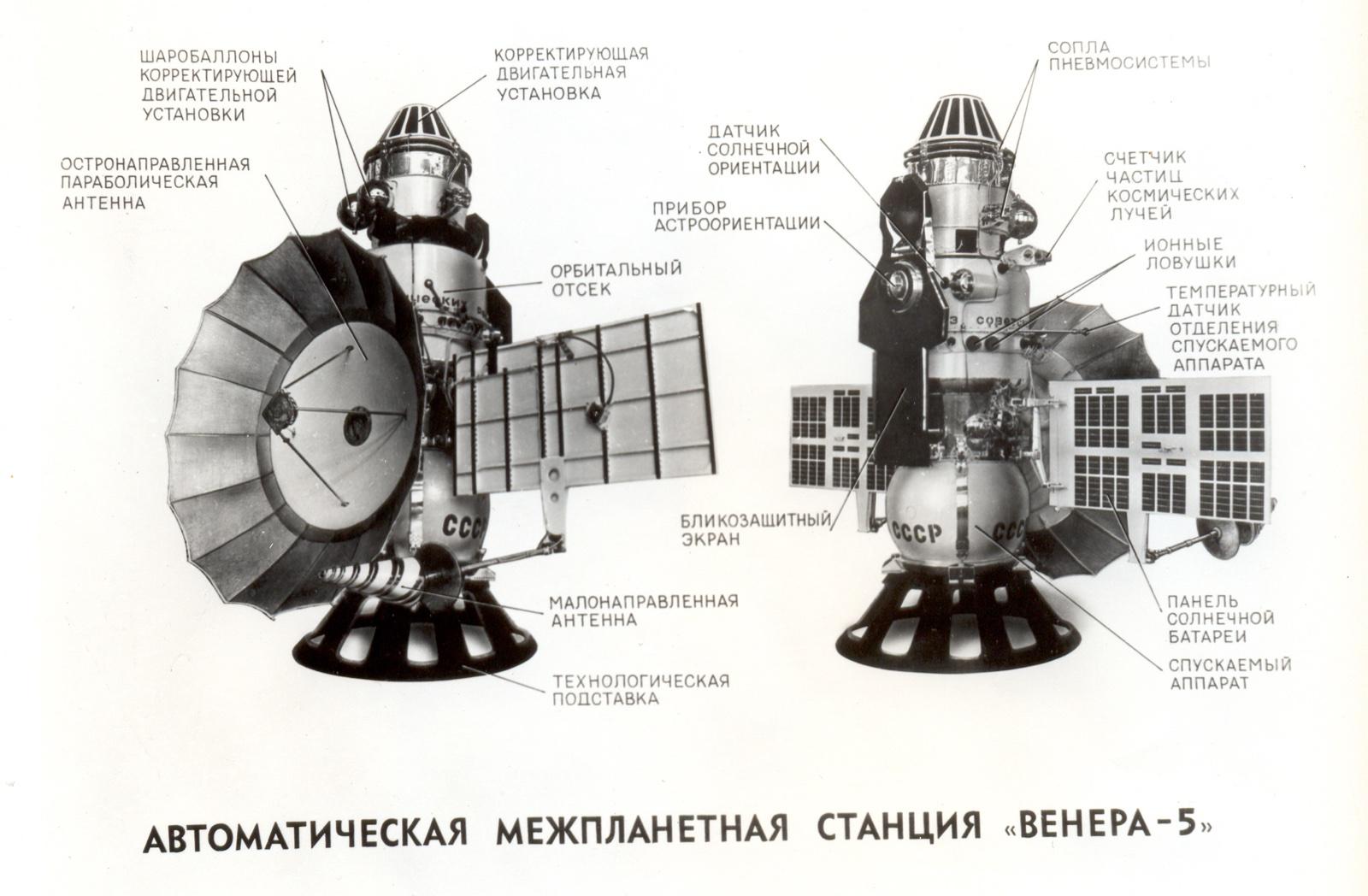
The next launch window came in January 1969, one Earth to Venus cycle of about 584 days later, which gave the Lavochkin design bureau under Georgy Babakin no time for a new capsule. It strengthened the one it had. According to NPO Lavochkin's own project page, the walls of the descent vehicle were thickened, its internal gas pressure was raised from 2 to 2.5 atmospheres to stiffen it, and it gained 33 kg; to keep within what the Molniya-M rocket and its Blok VL stage could send to Venus, the cruise stage shed 14 kg by giving up its magnetometer. The capsule was rated for 25 atmospheres outside. The June 1969 Pravda summary adds that it had to take decelerations of up to 450 g, one and a half times the Venera 4 figure, because the 1969 positions of Earth and Venus meant a faster arrival (Siddiqi gives the earlier figure as 300 g). Its parachutes shrank from 2.2 to 1.9 square metres for the drogue and from 55 to just 12 for the main canopy, so it would fall faster and, in Marov and Huntress's account, reach deeper layers while its battery lasted, and the canopy cloth was rated for more than 500 °C. The instruments were reworked too, according to Marov and Huntress and to Mitchell: six barometers in three overlapping ranges, three platinum thermometers, a tuning-fork densitometer, an improved altimeter and gas analysers retuned around what Venera 4 had found.
Accounts differ on what the engineers expected. Lavochkin's page says the Venera 4 data produced a revised atmosphere model and that the new capsule was designed for 25 atmospheres and a surface temperature of 290 °C, give or take 10, against 10 atmospheres and 425 °C in the earlier model, and that the smaller parachutes were meant to shorten the descent to touchdown, which reads as if the 1969 capsules might have reached the ground. Mikhail Marov, writing with William Huntress, remembers otherwise: it was already clear that the pressure far exceeded 18 bar, the bureau had no time for fundamental changes and could raise the capsule's strength only to 25 bar, and so the 1969 flights were treated as a chance to sound the atmosphere with better instruments while a new design waited for the next window. Don P. Mitchell's history of the programme is blunter still, saying no one expected these probes to reach the surface intact and that Soviet planetary scientists then put the surface pressure at 75 to 100 atmospheres. The account by Shubin that epizodsspace reproduces agrees that it was clear at launch they would not get down.
Venera 5 lifted off from Baikonur on 5 January 1969 at 06:28:08 UT and Venera 6 followed on 10 January at 05:51:52 UT. Each went first to a parking orbit; the Soviet yearbook puts Venera 5's departure for Venus at 10:47 (it names no time zone; its entry times are Moscow time), over Africa, after a 228 second burn that added about 3.6 km/s. The launch dates were picked within a window about a month long, and the resulting flight times of 131 and 127 days meant that launches five days apart would arrive one day apart. The same yearbook spells out the precision involved: an error of 1 m/s at departure, under 0.01 percent of the speed, meant missing Venus by about 70,000 km. Venera 5 was sent off with an aiming error of 25,000 km and Venera 6 with 150,000 km. Both were corrected in March, Venera 5 by 9.2 m/s on the 14th and Venera 6 by 37.4 m/s on the 16th, each some 15.5 million km from Earth in the yearbook's figures (Siddiqi and Marov with Huntress give 15.7 million km for Venera 6), and each after turning to hold the Sun and the star Sirius. Ground stations held 73 radio sessions with Venera 5 and 63 with Venera 6 during the cruise.
Along the way the cruise stages did science of their own. Their counters found galactic cosmic rays about 15 percent weaker than Venera 4 had measured in 1967 and about 40 percent weaker than in 1965, which the Soviet summary tied to the solar cycle, and over four months they logged a dozen significant bursts of solar protons. Close to the planet both stations saw the sudden change in the solar wind where it flows around Venus, at about 28,000 km from the surface in Lavochkin's account (the 1969 summary gives about 30,000 km without naming the reference point, next to a Venera 4 figure it measures from the centre), farther out than Venera 4 had met it nearer the terminator. Their ultraviolet photometers picked up hydrogen around Venus from about 25,000 km from its centre inward, reaching roughly 100 atoms per cubic centimetre at 10,000 km.
It was Venera 5 that arrived first, on 16 May. The best place to enter, the 1970 yearbook explains, lay in the middle of the planet's disc as seen from Earth, where a capsule hanging from its parachute would point its antenna home; both stations came in from the shadow side and entered on the night side, about 2,700 km from the morning terminator. At 07:08 Moscow time, 50,000 km out, the ground sent the command that opened the final session. The capsule separated 37,000 km from Venus and struck the atmosphere at 09:01 Moscow time, 06:01 UT, at about 11.2 km/s and 62 to 65 degrees to the local horizon. Braking cut the speed to 210 m/s; the parachutes opened, the transmitters switched on, the altimeter antennas unfolded, and data began to arrive from about 54 km up in NSSDCA's figure (55 km in Lavochkin's pages). For 53 minutes by the TASS count, 52.5 by Lavochkin's and Siddiqi's, readings came in. The altimeter gave three marks, at 40.4, 31.9 and 23.8 km, and the gas analysers sampled twice, near 0.6 atmospheres and 25 °C and again near 5 atmospheres and 150 °C. The densitometer returned nothing because of a fault in the instrument. Reception stopped at 27 atmospheres, beyond the 25 the capsule was built for.
Venera 6 did it again a day later. Lavochkin calls it a complete analogue of its sister in design, tasks, flight plan and instruments, and its capsule separated 25,000 km out and entered at 09:05 Moscow time, 06:05 UT, on 17 May. It transmitted for 51 minutes by the TASS count, 50 by Lavochkin's, and its altimeter gave two marks, at 32.1 and 21.2 km. Its gas analysers had been set to work lower in the atmosphere, and they sampled at about 2 atmospheres and 85 °C, then at about 10 atmospheres and 225 °C, although the June 1969 Pravda summary put the first sample at 1 atmosphere and 60 °C. It too fell silent at 27 atmospheres. Both cruise stages, left on course for the planet, kept transmitting until they reached the dense atmosphere and were destroyed there; no source read for this page gives a position for either.
Each capsule returned more than 70 pressure readings and more than 50 temperature readings, through a layer where the temperature climbed from about 25 °C to 320 °C and the pressure from about half an atmosphere to 27. The profile, the yearbook noted, stayed close to adiabatic. Mitchell describes the gas analysers as reconfigured after Venera 4 to work within narrower ranges; the yearbook's combined table put carbon dioxide at 97 percent (plus 3, minus 4), nitrogen with the inert gases at no more than 2 percent, oxygen at no more than 0.1 percent, and water at about 11 mg per litre at the 0.6 atmosphere level. The capsules also reported on themselves: the temperature inside rose only from 13 °C to 28 °C during the descent. That says the insulation worked and it was the outside pressure that broke them, which is Mitchell's reading of it.
Set beside today's values, the 1969 chemistry was close on carbon dioxide and off on the minor gases. NASA's current Venus fact sheet gives 96.5 percent carbon dioxide and 3.5 percent nitrogen, so the yearbook's ceiling of 2 percent nitrogen was too low (the wider range in the June 1969 summary, given below, brackets today's value). It lists water at 20 parts per million near the surface, while Marov and Huntress convert Venera 5's reading to about 1.1 percent, several hundred times more; the two figures refer to different heights, and none of the sources read for this page explains the gap. The preliminary Pravda summary had carried wider ranges (carbon dioxide 93 to 97 percent, nitrogen with inert gases 2 to 5 percent, oxygen up to 0.4 percent, water 4 to 11 mg per litre). NSSDCA's records (in copies archived in 2024 and 2025) say the missions confirmed a lack of water vapour, which is not what the Soviet results said: the same summary that gave 4 to 11 mg per litre concluded only that the air was not saturated with water vapour.
The height at which the signals stopped has been restated several times, and every version still circulates. The preliminary scientific summary, in Pravda on 4 June 1969, said the altimeters put the 27 atmosphere level at 24 to 26 km for Venera 5 and at 10 to 12 km for Venera 6. Because the same pressure should mark the same level in the atmosphere, the summary suggested the two capsules had come down over very uneven relief. The 1970 yearbook gave the difference as 13 km on average, called it a result needing further study, and placed the end of both descents at about 20 km above a mean surface defined as the average of the two altimeter solutions. Lavochkin's pages today say each capsule stopped with about 18 km still to fall, while keeping the 13 km difference and the relief explanation. NSSDCA held both generations at once in its most recent archived copies (2024 and 2025; the live catalogue returned an error when checked on 5 November 2026): its records for the two buses repeat the 1969 figures, and its descent craft records say Venera 5's 24 to 26 km was later determined to be closer to 18 km and that Venera 6's 10 to 12 km was revised to roughly 18 km.
Two explanations survive. Asif Siddiqi's NASA chronicle keeps the terrain reading, noting that Venera 6 reached 27 atmospheres lower than Venera 5 and so may have come down over a mountain or high plateau. Mitchell argues that the altimeters worked. They had been fitted with filters that triggered a message at set ranges, which he gives as about 35, 25 and 15 km with an ambiguity of about 30 km; Marov and Huntress give the design marks as 45, 35 and 25 km, accurate to about 1.3 km. When the temperatures and pressures reported at each mark are compared with a modern atmosphere model, Mitchell finds the heights come out normal and consistent, and he attributes the 10 or 11 km discrepancy of 1969 to the cruder atmosphere model of the day and possibly to confusion over which filter had fired. Marov and Huntress take the same side: the altimeter worked normally, and the temperatures and pressures at its marks agreed well with the atmosphere model built by then.
Magellan's radar altimetry, gathered two decades later, allows the terrain reading to be tested against the published positions. Read at 3 S, 18 E and 5 S, 23 E in the USGS release of the Magellan global topography, the two points lie about 76 m below and 196 m above the grid's 6,051 km reference sphere, some 270 m apart in height. Within 3 degrees of latitude and longitude of either point nothing in the grid rises more than about 2.4 km above that sphere, while the whole planet spans about 14.6 km from its lowest to its highest point. On these positions a 13 km step between the two descent areas finds no support, which fits the reading of Mitchell and of Marov and Huntress. The test is only as good as the coordinates, which are whole degrees of unstated origin in a frame that may differ from Magellan's; azmth ran it on 26 September 2026.
Where the wreckage lies is known only roughly. Every source read gives the same positions, 3 S, 18 E for Venera 5 and 5 S, 23 E for Venera 6, and none says how they were derived. Lavochkin, RGANTD and the 1970 yearbook say the two entry points were about 300 km apart; on a sphere of Venus's radius the published coordinates are about 570 km apart, and allowing each to be rounded by half a degree still leaves at least about 430 km, so the two statements cannot describe the same pair of points. Marov and Huntress give local solar times of 4:12 and 4:18 with the Sun 117 and 115 degrees from the zenith, before dawn, which fits the 2,700 km to the morning terminator; azmth's check with JPL Horizons at the entry times puts the published points about 330 km and 440 km from the centre of the Earth-facing disc, which the yearbook names as the aim. Doppler tracking of the capsules, analysed by V. V. Kerzhanovich, B. N. Andreyev and V. M. Gotlib, found vertical gusts within 0.3 to 0.5 m/s and bounded the horizontal wind at 3 to 25 m/s; even at the upper bound, 50 minutes of drift is about 75 km. After the signals stopped, the broken capsules fell the last 18 km or so unheard.
Below the last readings, conditions at the ground could only be extrapolated. Assuming the temperature went on rising adiabatically, the 1970 yearbook estimated 770 K, about 497 °C, and 100 atmospheres at the mean surface, with 60 K and 40 atmospheres of possible deviation for ground 7 km higher or lower. Siddiqi reports separate extrapolations giving 530 °C and 140 atmospheres from Venera 5 and about 400 °C and 60 atmospheres from Venera 6. Direct measurement at the ground came with Venera 7 in December 1970, and the values have been refined since; NASA's fact sheet now gives 92 bar and 464 °C, inside the yearbook's range.
One photometer reading remains unexplained. The light sensors were carried despite the night-side arrival because a faint glow of Venus's dark hemisphere had been reported from Earth and its source was unknown; they responded above 0.5 W per square metre, roughly twilight on Earth. In the 1969 and 1970 Soviet summaries nothing crossed that threshold except a single Venera 5 reading of about 25 W per square metre some four minutes before its signal ended. The 1969 summary left open whether it was chance or an atmospheric phenomenon, and Lavochkin's pages today mention only readings below the threshold. Marov and Huntress allow that it could have been lightning but think an electrical discharge from the capsule breaking up more likely, given the timing, and Mitchell offers the same two options. None of the sources read here settles it.
Soviet announcements left a phrase that still causes confusion. The TASS communique printed in Pravda on 17 May 1969, in the English translation NASA commissioned two days later, has Venera 5 effecting a soft landing in the atmosphere and delivering to Venus pennants bearing a bas-relief of Lenin and the Soviet coat of arms. The 1970 yearbook likewise says the pennants were delivered to the surface, and a 4 kopeck stamp of 1969 announced the two stations as on Venus. The pennants were real: the Russian State Archive of Scientific and Technical Documentation (RGANTD) holds 1968 photographs of the pentagonal emblem mounted on the Venera 5 capsule. What reached the surface, though, was whatever remained of two capsules broken open about 18 km up, and as late as 2006 the magazine Nauka i Zhizn still wrote that both had made a smooth landing on the night side.
After Venera 5 and 6, Lavochkin stopped strengthening the Venera 4 capsule and started over. Mitchell writes that Babakin and his deputy V. G. Perminov, no longer trusting the scientists' estimates of surface pressure, privately set the next capsule to survive 180 atmospheres, built a test chamber for 150 atmospheres and 540 °C, and put the instruments inside a titanium sphere. That capsule flew as Venera 7. How the Soviet engineers learned to get down alive is told on landing on Venus, and what the 1969 profiles contributed to the modern picture of the air they fell through is on the atmosphere of Venus.
Mission facts
Organisations
USSR: Lavochkin Machine Building Plant (now NPO Lavochkin), chief designer G. N. Babakin
Spacecraft (both)
Model V-69, serial numbers 2V No. 330 (Venera 5) and No. 331 (Venera 6), built at the Lavochkin Machine Building Plant under chief designer G. N. Babakin. Launch mass 1,130 kg each in Lavochkin's pages, the 1969 and 1970 Soviet summaries, NSSDCA and Siddiqi; Mitchell and Marov with Huntress give 1,138 kg.
Descent capsule (both)
A near-sphere about 1 m across (103 cm in NSSDCA's descent craft records). Mass 405 kg in the 1969 Soviet summaries and NSSDCA, 410 kg in Lavochkin's and RGANTD's pages; Siddiqi gives 410 kg in his Venera 5 entry and 405 kg in his Venera 6 entry. Two sealed compartments: one for the parachutes and antennas, one for the instruments, battery and radios, with a damper at the base to steady the swing.
What was strengthened
Thicker capsule walls, internal gas pressure raised from 2 to 2.5 atmospheres for stiffness, and 33 kg added to the capsule (Siddiqi says 27 kg). To stay within the rocket's capacity the cruise stage lost 14 kg by giving up its SG-59M magnetometer. Rated for 25 atmospheres outside; NSSDCA and Siddiqi give 450 g for entry.
Parachutes
Drogue cut from 2.2 to 1.9 square metres and main canopy from 55 to 12 square metres which Lavochkin says was meant to shorten the descent to the surface, in canopy cloth rated above 500 °C. NSSDCA's two bus records give the parachutes as 15 square metres; its descent craft records give 1.9 and 12.
Instruments
Capsule, in Siddiqi's list (Lavochkin's matches it except for the G-10): a radio altimeter, MDD-A aneroid barometers (MDDA-A in Siddiqi) covering 0.13 to 40 atmospheres in Lavochkin's figures, G-8 and G-10 gas analysers in 11 cartridges, IS-164D thermometers, a VIP densitometer and an FO-69 photometer. The 1970 yearbook describes the thermometers as resistance thermometers, the densitometer as a tuning-fork type and the altimeter as decimetre-band. Cruise stage: KS-18-3M cosmic ray counters and an LA-2U spectrometer, which Lavochkin describes as measuring the distribution of oxygen and hydrogen in the planet's atmosphere.
Venera 5: launch
5 January 1969 at 06:28:08 UT from Baikonur on a Molniya-M with Blok VL upper stage (8K78M), first to a parking orbit. The Soviet yearbook gives the departure for Venus as 10:47 (no time zone named; its entry times are Moscow time) over Africa, after a 228 second burn adding about 3.6 km/s.
Venera 6: launch
10 January 1969 at 05:51:52 UT from Baikonur on the same rocket type, five days after its twin. Siddiqi says the two were targeted to reach Venus a day apart; the 1970 yearbook gives flight times of 131 and 127 days.
Venera 5: descent
Capsule released 37,000 km out; entry at 06:01 UT (09:01 Moscow time) on 16 May 1969 (Siddiqi prints 06:02). Transmitted for 53 minutes by the TASS count, 52.5 by Lavochkin's. Altimeter marks at 40.4, 31.9 and 23.8 km; gas samples at about 0.6 atmospheres and 25 °C, then 5 atmospheres and 150 °C.
Venera 6: descent
Capsule released 25,000 km out; entry at 06:05 UT (09:05 Moscow time) on 17 May 1969. Transmitted for 51 minutes (Lavochkin: 50). Altimeter marks at 32.1 and 21.2 km; gas samples at about 2 atmospheres and 85 °C, then 10 atmospheres and 225 °C (the June 1969 Pravda summary gave the first as 1 atmosphere and 60 °C).
Where the signals stopped
Both at 27 atmospheres and about 320 °C outside. Height: 24 to 26 km (Venera 5) and 10 to 12 km (Venera 6) in the June 1969 summary; about 20 km above a mean surface in the 1970 Soviet yearbook; about 18 km for each in Lavochkin's and RGANTD's Venera 5 and 6 pages and in NSSDCA's descent craft records, although both organisations' Venera 7 pages still say about 20 km.
Inside the capsules
The internal temperature rose only from 13 °C at the start of the descent to 28 °C at the end, which the June 1969 summary took as proof that the external and internal insulation had worked. Mitchell reads it as the pressure breaking the capsules open long before the heat got in.
Measurements
More than 70 pressure and more than 50 temperature readings per capsule in the Soviet summaries and Lavochkin (Mitchell and Marov with Huntress reverse the two counts), across 25 to 320 °C and 0.6 to 27 atmospheres in the yearbook (0.5 to 27 in Lavochkin's pages), a profile the yearbook called close to adiabatic. Read-out interval: 45 s (Mitchell; Marov and Huntress), 48 s (NSSDCA descent craft records), 40 to 50 s on average (June 1969 summary). Densitometer data were lost to an instrument fault (Lavochkin).
Composition
Carbon dioxide 97 percent (plus 3, minus 4), nitrogen with inert gases at most 2 percent, oxygen at most 0.1 percent, water about 11 mg per litre at the 0.6 atmosphere level (1970 yearbook table). NASA's current fact sheet gives 96.5 percent carbon dioxide, 3.5 percent nitrogen and 20 ppm water near the surface.
Night-side light
Photometers with a 0.5 W per square metre threshold, about terrestrial twilight, saw nothing above it except one Venera 5 reading of about 25 W per square metre some four minutes before the signal ended. Unexplained: lightning or a discharge as the capsule broke up are both proposed. Lavochkin's pages mention only below-threshold readings, and NSSDCA's Venera 6 records say some reports have that photometer failing.
Published positions
Venera 5 at 3 S, 18 E; Venera 6 at 5 S, 23 E, whole degrees, no method or frame stated. Lavochkin, RGANTD and the 1970 yearbook put the two entry points about 300 km apart; the coordinates are about 570 km apart on a 6,051.8 km sphere, and at least 430 km even allowing half a degree of rounding.
Local time and Sun angle
Marov and Huntress: 4:12 local solar time and a solar zenith angle of 117 degrees for Venera 5, 4:18 and 115 degrees for Venera 6. azmth's check with JPL Horizons at the entry times gives about 4:24 and 114 degrees, and 4:16 and 116 degrees, at the published coordinates in today's IAU frame.
Terrain at the positions (azmth check)
Read on 26 September 2026 in the USGS GTDR v02 Magellan topography: -76 m at 3 S, 18 E and +196 m at 5 S, 23 E, relative to the grid's 6,051.0 km sphere. Within 3 degrees of latitude and longitude of either point the grid spans only -1.8 to +2.4 km, far short of a 13 km step.
Surface extrapolations
1970 yearbook: 770 K and 100 atmospheres at the mean surface, with possible deviations of 60 K and 40 atmospheres for ground 7 km higher or lower. Siddiqi: 530 °C and 140 atmospheres from Venera 5's data, about 400 °C and 60 atmospheres from Venera 6's. Today's fact sheet: 92 bar and 464 °C.
Winds from Doppler tracking
Kerzhanovich, Andreyev and Gotlib found vertical wind pulsations within 0.3 to 0.5 m/s through both descents and put an upper bound of 3 to 25 m/s on the horizontal wind, smaller values more probable.
Data in archives
Queried on 5 November 2026, NSSDCA's catalogue lists no data collection for either descent craft or either cruise stage. Copies archived on 31 May 2025 listed one set of particle count rates for each cruise stage, and those entries no longer appear in the live listing. The descent profiles survive as tables and figures in the 1969 to 1970 Soviet publications and later books.
Site: 3°S, 18°E · Venera 5 capsule, night side · position estimated (source)
Mission timeline
- 5 Jan 1969Venera 5 launches from Baikonur at 06:28:08 UT and leaves its parking orbit for Venus over Africa.
- 10 Jan 1969Venera 6 launches from Baikonur at 05:51:52 UT, five days behind its twin.
- 14 Mar 1969Venera 5 fires its correction engine for 9.2 m/s about 15.5 million km from Earth, after orienting on the Sun and Sirius.
- 16 Mar 1969Venera 6 makes a 37.4 m/s correction; its launch had left it heading about 150,000 km wide of Venus.
- 16 May 1969, 06:01 UTThe Venera 5 capsule, released 37,000 km out, enters the night-side atmosphere at about 11.2 km/s, opens its parachute at 210 m/s and transmits for 53 minutes until the signal stops at 27 atmospheres. The cruise stage is destroyed in the atmosphere.
- 17 May 1969, 06:05 UTThe Venera 6 capsule, released 25,000 km out, enters the atmosphere about 300 km from its sister's entry point (the yearbook's and Lavochkin's figure) and transmits for 51 minutes by the TASS count (50 in Lavochkin's pages) before falling silent at the same 27 atmospheres.
- 17 May 1969Pravda prints the TASS communique on Venera 5; in NASA's translation it speaks of a soft landing in the atmosphere and of pennants delivered to Venus.
- 4 Jun 1969Pravda publishes the preliminary results: 27 atmospheres at 24 to 26 km by Venera 5's altimeter and 10 to 12 km by Venera 6's, tentatively put down to uneven relief.
- 12 Dec 1969V. A. Kotel'nikov presents Kerzhanovich, Andreyev and Gotlib's Doppler analysis of winds during the two descents to Doklady of the USSR Academy of Sciences.
- 1970The Great Soviet Encyclopedia yearbook revises the heights: both capsules stopped about 20 km above a mean surface, and the surface is estimated at 770 K and 100 atmospheres.
- Jul 1970Avduevsky, Marov and Rozhdestvensky publish a tentative model of the Venus atmosphere based on Venera 5 and 6 in the Journal of the Atmospheric Sciences.
- 15 Dec 1970Venera 7, with a new capsule built around a titanium hull, reaches Venus and transmits from the surface.
A filled dot marks something that physically happened. A hollow one marks an announcement, a naming or a target.
In pictures
Tap a photo to enlarge.
Translated from the original sources
Passages from the Russian sources this page draws on, in azmth's translation. Tap Show original to read the original wording.
NPO Lavochkin: Automatic interplanetary station Venera-5
Russian · 8 passages
NPO Lavochkin: Automatic interplanetary station Venera-5 (project page)
Open the source“Therefore the descent vehicle of Venera-5 was designed for an external pressure of 25 atmospheres and a temperature at the planet's surface of 290 plus or minus 10 °C, against 10 atmospheres and 425 °C respectively in the previous model.”
azmth's translation · Show originalHide original
Russian: «Поэтому спускаемый аппарат станции «Венера-5» проектировался в расчете на внешнее давление 25 атмосфер и температуру у поверхности планеты 290±10°С против 10 атмосфер и 425°С соответственно в предыдущей модели.»
“All this forced a substantial increase in the strength of the descent vehicle's structure by thickening its walls. In addition, to make the vehicle stiffer, the gas pressure inside it was raised from 2 to 2.5 atmospheres. The vehicle's mass grew by 33 kg as a result.”
azmth's translation · Show originalHide original
Russian: «Все это вынудило существенно увеличить прочность конструкции СА за счет увеличения толщины стенок. Кроме того, для увеличения жесткости СА с 2 до 2,5 атмосфер было увеличено давление газа внутри спускаемого аппарата. При этом масса СА выросла на 33 кг.»
“(the areas of the drogue and main parachute canopies were reduced) to 1.9 instead of 2.2 square metres and 12 instead of 55 square metres respectively”
azmth's translation · Show originalHide original
Russian: «соответственно 1,9 вместо 2,2 м² и 12 вместо 55 м²»
“Throughout the descent of the vehicle in the atmosphere the radio altimeter worked properly and gave three altitude values: 40.4, 31.9 and 23.8 km.”
azmth's translation · Show originalHide original
Russian: «Все время спуска СА в атмосфере радиовысотомер работал исправно и выдал три значения высоты: 40,4; 31,9 и 23,8 км.»
“Data on the density of the atmosphere were not obtained because of a defect in the instrument.”
azmth's translation · Show originalHide original
Russian: «Данные по плотности атмосферы получены не были вследствие дефекта прибора.»
“Reception of the signal from the descent vehicle stopped at an external pressure of 27 atmospheres, which exceeded the design values for the vehicle (25 atmospheres). At that point about 18 km still remained to the surface of the planet.”
azmth's translation · Show originalHide original
Russian: «Прием сигнала со спускаемого аппарата прекратился при внешнем давлении 27 атмосфер, что превышало расчетные значения для СА (25 атмосфер). При этом до поверхности планеты оставалось еще около 18 км.»
“(the smaller canopies) which were to reduce the time of descent in the atmosphere until the descent vehicle touched the planet's surface”
azmth's translation · Show originalHide original
Russian: «что должно было привести к уменьшению времени спуска в атмосфере до касания СА поверхности планеты»
“The photometer registered illumination below the threshold value, which is characteristic of night time.”
azmth's translation · Show originalHide original
Russian: «Фотометр зарегистрировал освещенность ниже порогового значения, что характерно для ночного времени суток.»
NPO Lavochkin: Automatic interplanetary station Venera-6
Russian · 5 passages
NPO Lavochkin: Automatic interplanetary station Venera-6 (project page)
Open the source“The automatic station Venera-6 was a complete analogue of Venera-5 in design, tasks and flight plan as well as in its set of scientific instruments.”
azmth's translation · Show originalHide original
Russian: «Автоматическая станция «Венера-6» являлась полным аналогом станции «Венера-5», как по конструкции, задачам и схеме полета, так и по составу научной аппаратуры.»
“the station's point of entry into the atmosphere was on the night side of the planet about 2,700 km from the line of the morning terminator and 300 km from the point where the Venera-5 descent vehicle entered the atmosphere.”
azmth's translation · Show originalHide original
Russian: «место входа станции в атмосферу находилось на ночной стороне планеты на расстоянии примерно 2700 км от линии утреннего терминатора и в 300 км от места входа в атмосферу спускаемого аппарата «Венеры-5».»
“During the vehicle's descent in the atmosphere the radio altimeter gave two altitude values: 32.1 and 21.2 km.”
azmth's translation · Show originalHide original
Russian: «За время спуска СА в атмосфере радиовысотомер выдал два значения высоты: 32,1 и 21,2 км.»
“Different altitude values were recorded by the radio altimeters of Venera-5 and Venera-6 at identical values of temperature and pressure, differing by 13 km on average.”
azmth's translation · Show originalHide original
Russian: «Были зарегистрированы различные значения высот, выданные радиовысотомерами автоматических станций «Венера-5» и «Венера-6» при одинаковых значениях температуры и давления, которые отличаются в среднем на 13 км.»
“This result can be explained by the existence of marked unevenness in the relief of the surface of Venus in the descent areas of the vehicles, which are several hundred kilometres apart.”
azmth's translation · Show originalHide original
Russian: «Этот результат может быть объяснен существованием заметных неровностей рельефа поверхности Венеры в областях спуска аппаратов, отстоящих друг от друга на несколько сотен километров.»
epizodsspace: Venera-5 compilation
Russian · 16 passages
epizodsspace: Venera-5 compilation (Great Soviet Encyclopedia Yearbook 1970 text; Marov and Huntress, Russian edition; Siddiqi; Shubin), Wayback copy of 15 Jan 2025
Open the source“With an error of 1 m/s in speed, that is less than 0.01 percent of the total speed, the miss is about 70 thousand km.”
Great Soviet Encyclopedia Yearbook 1970, as reproduced on epizodsspace
azmth's translation · Show originalHide original
Russian: «При ошибке в величине скорости 1 м/сек, т. е. менее 0,01% от полной скорости, промах составляет ок. 70 тыс. км.»
“The altitudes recorded by the radio altimeters of Venera-5 and Venera-6 at identical values of temperature and pressure differ by 13 km on average. This result must be subjected to further study.”
Yearbook 1970
azmth's translation · Show originalHide original
Russian: «Высоты, зарегистрированные радиовысотомерами автоматических станций «Венера-5» и «Венера-6» при одинаковых значениях температуры и давления, различаются в среднем на 13 км. Этот результат должен быть подвергнут дополнительному изучению.»
“and Venera-5 and Venera-6 completed their measurements at a height of about 20 km above the mean surface level, defined as the arithmetic mean of the altitude measurements on Venera-5 and Venera-6.”
Yearbook 1970
azmth's translation · Show originalHide original
Russian: «а «Венера-5» и «Венера-6» завершили измерения на высоте ок. 20 км над средним уровнем поверхности, определяемым как среднее арифметическое по данным измерений высоты на «Венере-5» и «Венере-6».»
“Calculations show that in this case the mean surface level should have T = 770 K and p = 100 atm.”
Yearbook 1970
azmth's translation · Show originalHide original
Russian: «Расчеты показывают, что в этом случае на уровне средней поверхности должны быть Т = 770°К и р = 100 атм.»
“Pennants of the Soviet Union with a bas-relief of V. I. Lenin and the coat of arms of the USSR were delivered to the surface of the planet (fig. 2).”
Yearbook 1970
azmth's translation · Show originalHide original
Russian: «На поверхность планеты были доставлены вымпелы Советского Союза с барельефом В.И. Ленина и гербом СССР (рис. 2).»
“And although it was clear that the atmospheric pressure greatly exceeded 18 bar, NPO Lavochkin, having no time for fundamental improvements, was able to raise the strength of the descent vehicle only to 25 bar.”
Marov and Huntress, Russian edition, as reproduced on epizodsspace
azmth's translation · Show originalHide original
Russian: «И хотя было ясно, что давление атмосферы сильно превышает 18 бар, НПО имени Лавочкина, не имея времени на принципиальные усовершенствования, смогло увеличить прочность спускаемого аппарата только до 25 бар.»
“It was 4:12 by Venus solar time; the solar zenith angle was 117 degrees.”
Marov and Huntress, on Venera 5
azmth's translation · Show originalHide original
Russian: «Было 4:12 по солнечному времени Венеры, зенитный угол Солнца составлял 117°.»
“It could have been a flash of lightning, but given the timing it was most likely an electrical discharge caused by the inevitable destruction of the vehicle.”
Marov and Huntress
azmth's translation · Show originalHide original
Russian: «Это могла быть вспышка молнии, но, с учетом момента времени, это, скорее всего, был электрический разряд, обусловленный неизбежным разрушением аппарата.»
“Already at launch it was clear that they would not reach the surface.”
Shubin, as reproduced on epizodsspace
azmth's translation · Show originalHide original
Russian: «Уже при пуске было ясно, что до поверхности они не дойдут.»
“This happened at 4:18 by Venus solar time; the solar zenith angle was 115 degrees.”
Marov and Huntress, on Venera 6
azmth's translation · Show originalHide original
Russian: «Это произошло в 4:18 по солнечному времени Венеры, зенитный угол Солнца составлял 115°.»
“The distance between the entry points of the two stations was about 300 km.”
Yearbook 1970
azmth's translation · Show originalHide original
Russian: «Расстояние между точками входа двух станций составило ок. 300 км.»
“In the parts of the atmosphere where the Venera-5 and Venera-6 descent vehicles made measurements, the temperature varied from about 25 to 320 °C and the pressure from 0.6 to 27 atm.”
Yearbook 1970
azmth's translation · Show originalHide original
Russian: «На участках атмосферы, где спускаемые аппараты станций «Венера-5» и «Венера-6» произвели измерения, температура изменялась приблизительно от 25 до 320°С, а давление - от 0,6 до 27 атм.»
“The Venera-5 and Venera-6 descent vehicles transmitted data from more than 70 temperature and 50 pressure measurements during the descent from 55 to 18 km, where destruction occurred.”
Marov and Huntress; note the counts are reversed relative to the Soviet summaries
azmth's translation · Show originalHide original
Russian: «Спускаемые аппараты «Венеры-5» и «Венеры-6» передали данные более 70 измерений температуры и 50 измерений давления в ходе снижения высоты от 55 до 18 км, на которой произошло разрушение.»
“The radio altimeter worked normally, so the temperature and pressure measured near the altimeter marks were in good agreement with the model of the planet's atmosphere built by that time.”
Marov and Huntress
azmth's translation · Show originalHide original
Russian: «Радиовысотомер отработал в штатном режиме, так что температура и давление, измеренные около отметок радиовысотомера, находились в хорошем соответствии с построенной к этому времени моделью атмосферы планеты»
“As noted above, flat batteries could also have been the root cause of the loss of contact, but this assumption is less likely.”
Marov and Huntress, footnote on Venera 4
azmth's translation · Show originalHide original
Russian: «Как отмечалось выше, первопричиной прекращения связи могли быть также севшие аккумуляторы, но это предположение менее вероятно.»
“it was decided that the new descent vehicles should be stronger and descend faster, so as to reach deeper layers of the atmosphere while the batteries lasted.”
Marov and Huntress
azmth's translation · Show originalHide original
Russian: «было решено, что новые спускаемые аппараты должны быть прочнее и опускаться быстрее, чтобы за время работы аккумуляторов достичь более глубоких слоев атмосферы.»
RGANTD (Russian State Archive of Scientific and Technical Documentation): S. Kh. Shamsutdinov, 'Venera-5 and -6: storming the planet', with archive photographs 1-20475 to 1-20487
Russian · 5 passages
“The descent vehicle had a mass of 410 kg and was designed for an external pressure of no more than 25 atmospheres and a temperature of up to 290 degrees.”
azmth's translation · Show originalHide original
Russian: «Спускаемый аппарат имел массу 410 кг и был рассчитан на внешнее давление не более 25 атмосфер и температуру до 290 градусов.»
“The descent vehicles stopped transmitting to Earth when the pressure reached 27 atmospheres, which exceeded the design values. This happened at heights of about 18 km above the planet's surface.”
azmth's translation · Show originalHide original
Russian: «Спускаемые аппараты перестали передавать информацию на Землю, когда давление достигло значения 27 атмосфер, что превышало расчетные значения. Это произошло на высотах примерно 18 км от поверхности планеты.»
“The descent vehicles entered the atmosphere on the night side about 300 km from each other.”
azmth's translation · Show originalHide original
Russian: «Вход в атмосферу спускаемых аппаратов был выполнен на ночной стороне на расстоянии примерно 300 км друг от друга.»
“Descent vehicle of the automatic interplanetary station Venera-5. 1968. RGANTD. Archive No. 1-20475.”
RGANTD's caption for the cutaway drawing.
azmth's translation · Show originalHide original
Russian: «Спускаемый аппарат АМС «Венера-5». 1968 г. РГАНТД. Арх. № 1-20475»
“Pennant mounted on the descent vehicle of the automatic interplanetary station Venera-5. 1968. RGANTD. Archive No. 1-20479.”
RGANTD's caption for the pennant photograph.
azmth's translation · Show originalHide original
Russian: «Вымпел, установленный на спускаемом аппарате АМС «Венера-5». 1968 г. РГАНТД. Арх. № 1-20479»
Nauka i Zhizn No. 1, 2006: 'Otechestvennye issledovaniya Venery'
Russian · 1 passage
“The descent vehicles made a smooth landing on the 'night' side of the planet on 16 and 17 May 1969, transmitting information about the lower layers of its atmosphere.”
Nauka i Zhizn, 2006: quoted as an example of the error; the page takes no facts from it
azmth's translation · Show originalHide original
Russian: «Спускаемые аппараты совершили плавную посадку на "ночной" стороне планеты 16 и 17 мая 1969 года, передав сведения о нижних слоях ее атмосферы.»
NPO Lavochkin: Automatic interplanetary station Venera-5, annotated archive photograph
Russian · 2 passages
NPO Lavochkin: Automatic interplanetary station Venera-5, annotated archive photograph (image file from the Venera-5 project page)
Open the source“Automatic interplanetary station Venera-5.”
Title printed under Lavochkin's annotated archive photograph of the spacecraft.
azmth's translation · Show originalHide original
Russian: «АВТОМАТИЧЕСКАЯ МЕЖПЛАНЕТНАЯ СТАНЦИЯ «ВЕНЕРА-5»»
“USSR.”
Lettered on the descent capsule in the same photograph.
azmth's translation · Show originalHide original
Russian: «СССР»
RGANTD: Descent vehicle of the automatic interplanetary station Venera-5, 1968, cutaway drawing, archive No. 1-20475
Russian · 1 passage
RGANTD: Descent vehicle of the automatic interplanetary station Venera-5, 1968, cutaway drawing, archive No. 1-20475 (image file)
Open the source“Descent vehicle.”
Heading printed on the cutaway drawing.
azmth's translation · Show originalHide original
Russian: «СПУСКАЕМЫЙ АППАРАТ»
RGANTD: Pennant mounted on the descent vehicle of the automatic interplanetary station Venera-5, 1968, photograph, archive No. 1-20479
Russian · 1 passage
RGANTD: Pennant mounted on the descent vehicle of the automatic interplanetary station Venera-5, 1968, photograph, archive No. 1-20479 (image file)
Open the source“Union of Soviet Socialist Republics.”
The words around the coat of arms on the pennant.
azmth's translation · Show originalHide original
Russian: «Союз Советских Социалистических Республик»
Wikimedia Commons: USSR 1969 stamp CPA 3820, Venera 5 and 6
Russian · 1 passage
“Soviet stations Venera-5 16 May, Venera-6 17 May 1969 on Venus.”
Legend of the 1969 4 kopeck stamp.
azmth's translation · Show originalHide original
Russian: «Советские станции «Венера-5» 16.V «Венера-6» 17.V 1969 на Венере»
Sources
- NPO Lavochkin: Automatic interplanetary station Venera-5 (project page) · in Russian
- NPO Lavochkin: Automatic interplanetary station Venera-6 (project page) · in Russian
- RGANTD (Russian State Archive of Scientific and Technical Documentation): S. Kh. Shamsutdinov, 'Venera-5 and -6: storming the planet', with archive photographs 1-20475 to 1-20487 · in Russian
- NPO Lavochkin: Automatic interplanetary station Venera-5, annotated archive photograph (image file from the Venera-5 project page) · in Russian
- RGANTD: Descent vehicle of the automatic interplanetary station Venera-5, 1968, cutaway drawing, archive No. 1-20475 (image file) · in Russian
- RGANTD: Pennant mounted on the descent vehicle of the automatic interplanetary station Venera-5, 1968, photograph, archive No. 1-20479 (image file) · in Russian
- epizodsspace: Venera-5 compilation (Great Soviet Encyclopedia Yearbook 1970 text; Marov and Huntress, Russian edition; Siddiqi; Shubin), Wayback copy of 15 Jan 2025 · in Russian
- epizodsspace: Venera-6 compilation, Wayback copy of 27 May 2024 · in Russian
- TASS communique, Pravda No. 137, 17 May 1969: 'Automatic station Venera-5 smoothly descended in the atmosphere of Venus', NASA translation ST-PR-PS-10836 (NASA-CR-103439)
- Pravda No. 155, 4 June 1969: 'Important step in the knowledge of the universe', preliminary Venera 5 and 6 results, NASA translation and analysis ST-PR-PT-PA-10845
- Kerzhanovich, Andreyev and Gotlib, 'Study of the dynamics of the Venus atmosphere using Venera-5 and Venera-6', Doklady AN SSSR 194(2), 288-290 (1970), NASA translation
- NSSDCA Master Catalog: Venera 5 (1969-001A), Wayback copy of 3 Aug 2025 (the live record returned an error on 26 Sep and 5 Nov 2026; the 24 May 2026 Wayback entry is only a redirect)
- NSSDCA Master Catalog: Venera 5 Descent Craft (1969-001D), Wayback copy of 31 May 2025
- NSSDCA Master Catalog: Venera 6 (1969-002A), Wayback copy of 13 Dec 2024
- NSSDCA Master Catalog: Venera 6 Descent Craft (1969-002D), Wayback copy of 31 May 2025
- Asif A. Siddiqi, Beyond Earth: A Chronicle of Deep Space Exploration, 1958-2016 (NASA, 2018), entries for Venera 5 and Venera 6, pp. 83-84
- Don P. Mitchell, 'Plumbing the Atmosphere of Venus' (Soviet Venus programme history)
- Avduevsky, Marov and Rozhdestvensky, 'A Tentative Model of the Venus Atmosphere Based on the Measurements of Veneras 5 and 6', J. Atmos. Sci. 27, 561-568 (1970) (bibliographic record only; full text not reachable)
- NASA NSSDCA: Venus Fact Sheet (last updated 11 Jan 2024)
- USGS Astrogeology: Venus Magellan Global Topography 4641 m (GTDR v02), sampled by azmth on 26 Sep 2026
- JPL Horizons API (DE441, IAU_VENUS frame): subsolar and sub-Earth points at 06:01 UT 16 May and 06:05 UT 17 May 1969, queried 26 Sep 2026
- Nauka i Zhizn No. 1, 2006: 'Otechestvennye issledovaniya Venery' · in Russian
- Wikimedia Commons: USSR 1969 stamp CPA 3820, Venera 5 and 6 · in Russian
- NSSDCA Master Catalog: data collections for Venera 5 (1969-001A), live query of 5 Nov 2026 (none listed; the 31 May 2025 Wayback copy listed Particle Count Rates)
Facts on this page were verified on 5 November 2026. Where sources disagree, the disagreement is stated rather than resolved silently.
azmth is independent and is not affiliated with or endorsed by NASA, Roscosmos, NPO Lavochkin, ESA, JAXA, ISRO, CNSA, or any other space agency or company named on this page.