Zond 1 and the lost Soviet probes of 1962 to 1964
OKB-1 (Korolev) · Soviet Union · Flyby · 1964 · The first attempts Failure
Ended in 1964. Zond 1 fell silent in late May and passed Venus without a word on 19 July; it remains in orbit around the Sun with its unused lander. It was the only one of seven Soviet Venus probes and test probes launched from 1962 to 1964 to leave Earth orbit.
TL;DR· 19 min read
Between August 1962 and April 1964 the Soviet Union launched seven Venus probes and test probes, all built by Sergei Korolev's design bureau, OKB-1. Six never got away from Earth, most of them stranded when the rocket's escape stage failed. The seventh, a Venus lander, escaped on 2 April 1964 but sprang a leak within days, so it was announced under the test name Zond 1 instead of Venera 2. Controllers kept it going through its landing capsule's radio until late May, and it passed Venus in silence on 19 July 1964.
What happened to Zond 1?
Zond 1 was a Soviet Venus lander that escaped Earth on 2 April 1964, sprang a leak within days and passed Venus in silence on 19 July 1964. Built by Sergei Korolev's design bureau OKB-1, it was the only one of seven Venus probes and test probes launched from August 1962 to April 1964 to leave Earth orbit. Its sealed landing capsule kept working, so controllers flew the craft on through the capsule's radio until contact was lost in late May. With the craft failing, the Soviet Union shelved the name Venera 2 prepared for it and announced an engineering probe called Zond 1. Before it came two landers and a flyby craft stranded in Earth orbit in 1962, two stripped-down test craft that never got going, and Kosmos 27, a lander whose failure finally exposed a wiring fault in the rocket's escape stage.
Facts as of 3 November 2026, from the sources listed below.
- 1 of 7OKB-1 Venus craft and Venus test craft launched from August 1962 to April 1964 that left Earth orbit: Zond 1
- 1 mm Hgpressure left in Zond 1's orbital compartment a week after launch, according to the builder's own history
- 100,000 to 110,000 kmZond 1's silent miss distance at Venus on 19 July 1964: NSSDCA and LePage give the lower figure, Siddiqi and the Energiya history the higher
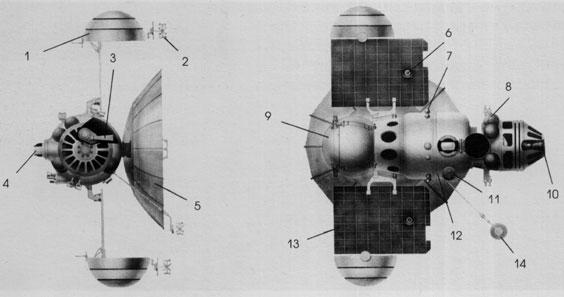
Between 25 August 1962 and 2 April 1964, Sergei Korolev's design bureau OKB-1 launched seven spacecraft that were bound for Venus or built to rehearse a Venus landing. Six never got clear of Earth. The seventh, 3MV-1 No. 4, escaped, sprang a leak at once and was announced as Zond 1, a name that let a failing Venus lander pass as an engineering test. None of the seven returned a measurement from Venus, and little about them was admitted at the time.
The family on this page took shape in February 1961, the month Venera 1 set off and fell silent. The corporate history of OKB-1's successor, RKK Energiya, has Korolev choosing a unified Mars and Venus station at the launch site while Venera 1 was being prepared, and also ties it to the review of that failure. The bureau had initial data for the new family, 2MV, by 30 July 1961 and working drawings for four versions by early 1962: 2MV-1 to land on Venus, 2MV-2 to fly past it, and 2MV-3 and 2MV-4 for the same two jobs at Mars. All four shared a pressurised orbital compartment with the radio, power and orientation systems. A flyby craft added a sealed camera module; a landing craft added a descent vehicle with a heat shield, parachutes and its own radio. Asif Siddiqi's NASA chronicle describes the Venus capsule as a pressurised sphere 90 cm across, cooled by ammonia and sterilised on the advice of the Academy of Sciences' Institute of Microbiology, and gives the first lander a mass of 1,097 kg, 350 kg of it capsule.
Opinions differed on what the capsule would land on. Don P. Mitchell's history of the OKB-1 probes lists a gamma-ray counter for surface rocks on the 2MV lander and a mercury switch to count rocking motion if it came down in an ocean, and he writes that the 3MV capsules were built to float and to survive 1.5 to 5 atmospheres and 57 to 77 °C. NPO Lavochkin's Venera 4 page gives the same pressures for the capsule of Venera 3 in 1965 but a design temperature of 330 to 350 °C. Mitchell writes of the 3MV capsules in general and Lavochkin of Venera 3 alone, and neither says whether the figure changed between the 1964 and 1965 capsules. Radio astronomers were arguing for a hot surface (Mitchell cites a 1962 radio measurement by D. V. Korol'kov), and in December 1962 Mariner 2 would report temperatures of 400 to 700 K. The planet those engineers pictured is the subject of Imagined Venus.
Parachutes, at least, could be proven close to home. The Energiya history explains that the atmospheres of Mars and Venus differ so much from Earth's that the canopies had to be tested at heights and speeds no aircraft could reach, so OKB-1 built an experimental rocket complex, the R-11A-MV, which lofted a mock-up of the descent vehicle to about 50 km. A series of these launches settled a three-stage parachute system with two braking canopies for the dense air of Venus and a two-stage system for thin Martian air. The book gives no dates, placing the campaign before the Mars launches of October 1960. According to Mitchell, multi-stage parachutes then flew on every Soviet Venus lander from the 2MV to the Vega craft.
Three 2MV craft reached the Baikonur range in August 1962, two landers and one flyby craft. 2MV-1 No. 3 went first, on 25 August, aboard the fifth four-stage 8K78 Molniya. Boris Chertok of OKB-1 recalled the telemetry ship in the Gulf of Guinea first reporting that the Blok L escape stage had started on schedule, then that its engine had run for only 45 seconds. Siddiqi puts the planned burn at 240 seconds and blames a tumble set off by the uneven firing of the small solid motors meant to settle the propellant. The stranded craft re-entered on 28 August, according to Jonathan McDowell's catalogue. Even its launch time is disputed: McDowell and the Russian compilation site epizodsspace give 02:18:45 UT, while Siddiqi prints 02:56:06 UT.
There was no time for a proper inquiry. The team launched 2MV-1 No. 4 on 1 September "without waiting for a detailed analysis of the causes of the previous failure", as Chertok put it, and this time the valve that fed fuel into the Blok L combustion chamber never opened; the probe fell back on 6 September. (Chertok's text dates this launch to 8 September, a slip the compilation flags.) The last of the three, 2MV-2 No. 1, lifted off at 00:59:13 UT on 12 September. It was the flyby version, with a camera and ultraviolet and infrared spectrometers in place of a lander. Siddiqi records that the third stage was destroyed between T+530.95 and T+531.03 seconds, leaving the escape stage tumbling; its engine ran for 0.8 seconds, and McDowell has the craft down on 14 September. In the middle of this sequence, on 27 August, NASA launched Mariner 2, which reached Venus that December.
Engineers put forward many theories for the escape-stage failures, the Energiya history admits, but with no data from the vehicle none could be confirmed. After two more Blok L failures on the Mars launches that autumn, and a Mars 1 crippled by leaking attitude-control gas, an inquiry found traces of rosin in valves from one supplier, and the reworked design was renamed 3MV. Siddiqi lists four operational versions (3MV-1 to land on Venus, 3MV-2 to fly past it, 3MV-3 and 3MV-4 for Mars) and two stripped variants, 3MV-1A and 3MV-4A, which he calls Object-Probes: test craft to be flown into deep space before any real attempt. A government decree of 21 March 1963 approved them.
Of the two Object-Probes, the first was meant to come home. Anatoly Zak's RussianSpaceWeb, working from documents published in 2011, describes the plan reported to the Kremlin on 31 October 1963: the escape stage would tilt the craft's solar orbit five degrees out of the ecliptic, it would drift 12 to 16 million km from Earth over three months, and after about six months a 270 kg lander would parachute back to Earth. Andrew LePage adds that the capsule would have met the atmosphere at more than 11.5 km/s, to reproduce the speed of an entry at Venus. On 4 November, LePage writes, the Central Committee approved two TASS press releases: one naming the craft Zond 1 if it left Earth orbit, the other giving it a Kosmos number if it did not.
In the end the second release was the one issued. 3MV-1A No. 2 lifted off at 06:23:34 UT on 11 November 1963 (Siddiqi; McDowell has 06:23:35), reached a parking orbit, and lost escape-stage telemetry at about 06:45:44 UT; the Energiya history says the fourth stage fired with the station in the wrong attitude, and Siddiqi adds that the stage's turbopump probably exploded at ignition. The craft became Kosmos 21, which Siddiqi identifies as the start of the Soviet practice of hiding stranded deep-space probes under Kosmos numbers. Its destination is argued over too. The Energiya history lists the launch among flights toward Mars, and Mitchell calls it a simulated Mars mission; Siddiqi, LePage and RussianSpaceWeb describe an Earth-return test of the Venus lander design, and RussianSpaceWeb points out that the date lay far outside any Mars launch window.
Delays pushed the second Object-Probe, 3MV-1A No. 4A, into 1964. It flew on 19 February 1964, at 05:47:40 UT in most catalogues, on the upgraded 8K78M and never reached orbit. Liquid oxygen leaking through a valve seal had frozen the propellant in a main pipeline while the rocket stood on the pad, Siddiqi writes; the line cracked and the third stage exploded. What it was meant to do is still argued. Siddiqi describes a four-month systems test toward Venus, out to about 40 million km. LePage argues that with the operational landers due five weeks later a six-month return trip would have been of little engineering value, and his trajectory analysis finds no fast path to Venus that day, only a slow one arriving around 30 August 1964. RussianSpaceWeb asks whether the craft might still have been meant for the original Earth-return flight, and cites a 1964 Soviet document describing an 800 kg Venus-directed Zond with no detachable lander. Whether a capsule was aboard is also unsettled: NSSDCA says no and Siddiqi says apparently not, McDowell's failed-launch catalogue lists a 400 kg descent craft, and the Energiya history calls the craft 3MV-4 and files it under Mars.
On 2 March 1964, RussianSpaceWeb reports, officials told the government that two 950 kg 3MV craft with 285 kg landers were ready for a 120-day flight, and a statement prepared in advance would announce the one that got away as Venera 2. 3MV-1 No. 5 lifted off at 03:24:42 UT on 27 March (03:24:43 in Siddiqi). Its escape stage again failed to fire, and it was announced as Kosmos 27. It re-entered a day or two later.
This failure explained some of the older ones. Kosmos 27 carried a new data recorder, which the compilation names Yakhont, and it had stored the escape stage's telemetry through the failed ignition. According to the Energiya history, the fourth stage had a separate ignition support unit, the BOZ, whose truss carried the attitude control system and its batteries. Seventy seconds before ignition, the control system was supposed to switch the attitude system's power from the BOZ batteries to Blok L's own. The switch never happened, so for those 70 seconds the stage drifted uncontrolled, and if it strayed beyond tolerance its gyroscopes hit their stops and the engine was blocked. Venera 1 and Mars 1 had departed only because their stages happened not to drift too far. "The error that had brought so much trouble was eliminated within 15 minutes," the history says; the other account in the compilation says 20 minutes with a soldering iron, and that the fault never came back.
3MV-1 No. 4 lifted off at 02:42:40 UT on 2 April 1964, and this time the rocket and escape stage both worked, putting the craft on a path around the Sun with a period of about 290 days. The good news lasted one communication session. From the slight push of escaping gas, engineers located a leak in the orbital compartment at the quartz dome over the Sun and star sensors, and the Energiya history records that within a week the pressure had fallen to 1 mm of mercury. The fault is described two ways: a bad weld in LePage and in Shubin's account on the Russian compilation, a cracked glass cover in Siddiqi, with NSSDCA allowing either. Mitchell explains the worst of the damage: the radio switched on while a thin atmosphere still remained, and corona discharge damaged the electronics. The lesson went into the factory rules, the Energiya history says: from then on every pressurised compartment was shaken at low frequencies and every weld was X-rayed.
Its capsule kept the mission alive. The sealed sphere still held pressure, and the design let its transmitters and batteries stand in for the ones that had failed. Controllers made two course corrections, which Siddiqi describes as the first performed by a Soviet interplanetary spacecraft: one on 3 April about 560,000 km from Earth (563,780 km in LePage), while the probe was still fully working by LePage's account, and another on 14 May at 13 to 14 million km. NSSDCA and LePage give the second as a change of 50 m/s; Siddiqi and LePage say it fell about 20 m/s short of what was needed to hit Venus, and RussianSpaceWeb that it was off by 20 m/s. Mitchell lists what came back: cosmic-ray counts from Vernov's sensors on the bus, Lyman-alpha readings of hydrogen from Kurt's spectrometer, and primary-proton counts from a detector inside the capsule. Siddiqi notes that some of the cosmic-ray results were later published.
When Zond 1 finally fell silent depends on the source. The Energiya history has regular contact through the capsule's radio until 25 May 1964, and says the craft was put into gyroscopic stabilisation but lost about a month before Venus. Siddiqi gives 25 May as the last contact, NSSDCA and LePage 24 May. RussianSpaceWeb keeps contact going until around mid-June, a date LePage presents only as the limit the capsule's radio could have reached, and Mitchell has telemetry from 2 April to 16 May and a failed correction attempt on 30 May.
Politics decided the name. With the compartment emptying, RussianSpaceWeb explains, the craft could not be announced as Venera 2, yet it had left Earth orbit and could not be hidden as a Kosmos either. The name Zond, drafted in November 1963 for the Earth-return test that became Kosmos 21, was used instead. A Soviet yearbook entry quoted on the Russian compilation described the launch only as being "for experimental purposes and for the study of outer space". Siddiqi remarks that the choice has confused historians, since Zond 1, a complete Venus lander, was not one of the Object-Probe test craft.
Zond 1 passed Venus on 19 July 1964. The distance comes in two versions: 110,000 km in the Energiya history, Siddiqi and RussianSpaceWeb, and 100,000 km in NSSDCA and LePage, with Mitchell writing that Soviet experts believed it missed by 100,000 km. No data came back from the pass. The craft, capsule still attached, went on around the Sun, and so did its spent escape stage. McDowell's heliocentric catalogue gives the probe's orbit before the flyby as 0.652 by 1.001 AU with an inclination of 3.70°, and a less certain 0.600 by 1.000 AU after it; LePage gives 0.65 by 1.06 AU, 3.92° and a period of 290 days.
NASA's records add two Venus launches that McDowell's launch list does not contain. NSSDCA's Venus chronology (last updated 11 March 2024) lists "Venera 1964A" on 19 February 1964, "Venera 1964B" on 1 March 1964 and "Venera 1965A" on 23 November 1965 as failed flybys. The first is real: it is 3MV-1A No. 4A. The second is missing from NSSDCA's own list of tentatively identified launches (last updated 22 February 2022). LePage, citing Timothy Varfolomeyev's 1998 articles in Spaceflight, says a 3MV-1 was set to fly on 1 March on 8K78M T15000-22, the serial he and McDowell also give for Kosmos 27's rocket, and was scrubbed after problems integrating it with the launcher. Encyclopedia Astronautica records a launch delayed by malfunctions in pre-launch servicing. McDowell's launch list, updated on 2 November 2026, has no Molniya launch between 19 February and 21 March 1964, and NPO Lavochkin counts nine 3MV launches from November 1963 to November 1965, the same nine McDowell lists.
Venera 1965A has a date problem of its own. NSSDCA's chronology puts it on 23 November, the day Kosmos 96 was launched, while the tentative list gives 26 November and says only that the launcher "is believed" to have failed. Encyclopedia Astronautica describes a 3MV-3 whose launch attempt on 26 November was abandoned after a launch vehicle fault in pre-launch preparations, and the Russian compilation's own timeline for Kosmos 96 carries the line "26 November 1965, launch attempt?". Against that, McDowell lists no Molniya launch between Kosmos 96 on 23 November and Luna 8 on 3 December 1965, the Chertok account quoted on the same compilation page mentions no launch after Kosmos 96, and Siddiqi calls that craft the third and last one prepared for Venus in 1965; NPO Lavochkin likewise counts three launches toward Venus that November. The two that did get away are on the Venera 2 and 3 page.
Secrecy also left the craft with names that still disagree. The Soviet Union never named the 1962 probes; "Sputnik 19, 20 and 21", still used in NSSDCA's chronology, are Western labels of the kind Siddiqi calls Western inventions. Their bureau serials split the catalogues too: Chertok, Siddiqi and RussianSpaceWeb write 2MV-1 No. 3, 2MV-1 No. 4 and 2MV-2 No. 1, while McDowell lists the landers as 2MV-1 No. 1 and No. 2. For 1963 and 1964 McDowell numbers the four craft 3MV-1 No. 1 to No. 4 in launch order. Siddiqi has 3MV-1A No. 2 (also No. 1) for Kosmos 21, 3MV-1A No. 4A (also No. 2) for the February launch, 3MV-1 No. 5 for Kosmos 27 and 3MV-1 No. 4 for Zond 1, and the Energiya history backs him on the last two, so No. 5 flew before No. 4.
Lavochkin-era names are no simpler. An article in NPO Lavochkin's journal Vestnik names its later Venus craft series V-70 and V-72 (Venera 7 and 8), 4V (Venera 9 and 10), 4V1 (11 and 12), 4V1M (13 and 14) and 5VK (the two Vegas), and its Venera 15 and 16 page uses 4V2; McDowell files every craft from Venera 4 to Venera 12 as "4V-1". In NSSDCA's chronology the numbered series ends with Venera 16 in June 1983, followed by the two Vegas in December 1984, and McDowell's launch list has no launch under the name Venera 17 or 18. The name Venera-17 does circulate: RussianSpaceWeb heads its section on the Russian Venera-D project "Venera-D (Venera-17)".
OKB-1 had one more Venus campaign in it, the three launches of November 1965. The Energiya history says all work on automatic interplanetary stations passed at the end of 1965 to the Lavochkin design bureau under its chief designer G. N. Babakin, "at the moment when the developers were already approaching the intended goal"; LePage dates the transfer of responsibility for future Venus and Mars probes to April 1965, before those last launches, and Lavochkin's own account says only 1965. Lavochkin adds that a little over a year remained before the 1967 Venus window, so the new owners built a craft on the 3MV base whose only job was to deliver a capsule into the atmosphere. The same Energiya chapter sums up OKB-1's record with automatic interplanetary stations: of 19 launches, only two could be called successful. Every Soviet Venus craft from Venera 4 onward is a Lavochkin machine.
Mission facts
Organisations
OKB-1 (the design bureau of S. P. Korolev), USSR
Builder
OKB-1, the design bureau of S. P. Korolev, built every craft on this page. Interplanetary work passed to the Lavochkin design bureau under G. N. Babakin at the end of 1965 (Energiya history) or, for future Venus and Mars probes, in April 1965 (LePage).
2MV-1 No. 3 (Western label Sputnik 19)
Venus lander, 1,097 kg with a 350 kg capsule. Launched 25 August 1962 on 8K78 T103-12 at 02:56:06 UT (Siddiqi) or 02:18:45 UT (McDowell, epizodsspace). Blok L burned 45 s of a planned 240 s.
2MV-1 No. 4 (Sputnik 20)
Venus lander, about 1,100 kg with a 370 kg capsule. Launched 1 September 1962 at 02:12:33 UT (Siddiqi) or 02:12:30 UT (McDowell). The Blok L fuel valve never opened; re-entered 6 September 1962 (McDowell).
2MV-2 No. 1 (Sputnik 21)
Venus flyby craft with a camera and ultraviolet and infrared spectrometers. Launched 12 September 1962 at 00:59:13 UT; the third stage broke up at about T+531 s and Blok L fired for 0.8 s. Re-entered 14 September 1962.
Kosmos 21 (3MV-1A No. 2)
About 800 kg test craft (Siddiqi) for an Earth-return flight with a 270 kg capsule. Launched 11 November 1963 at 06:23:34 UT (Siddiqi) or 06:23:35 (McDowell); stranded; re-entered 14 November (McDowell), 15 November (RussianSpaceWeb) or 15 or 16 November 1963 (the Russian compilation).
3MV-1A No. 4A (NSSDCA 'Venera 1964A')
About 800 kg test craft. Launched 19 February 1964 at 05:47:40 UT (Siddiqi, McDowell, NSSDCA), 05:45:40 (LePage) or 08:37:40 Moscow time, that is 05:37:40 UT (RussianSpaceWeb); a frozen pipeline burst and the third stage exploded before orbit. No lander per NSSDCA (Siddiqi: apparently none); a 400 kg descent craft per McDowell.
Kosmos 27 (3MV-1 No. 5)
Venus lander, about 950 kg with a 285 kg capsule (948 kg in Siddiqi). Launched 27 March 1964 at 03:24:42 UT (McDowell) or 03:24:43 (Siddiqi); Blok L did not fire. Re-entered 28 March (RussianSpaceWeb) or 29 March 1964 (McDowell).
Blok L fault
Power for the escape stage's attitude control was due to switch from the BOZ support unit's batteries to Blok L's own 70 s before ignition, and never did. Fixed in 15 minutes (Energiya history) or 20 (Shubin, quoted on epizodsspace).
Zond 1 (3MV-1 No. 4) launch
2 April 1964 at 02:42:40 UT from Site 1, Baikonur, on a Molniya (8K78M in McDowell, LePage and RussianSpaceWeb, 8K78 in Siddiqi). Rocket serial T15000-28 (Siddiqi), G15000-28 (RussianSpaceWeb's Zond 1 page), T15000-23 (LePage, RussianSpaceWeb's Venus launch table) or G 15000-28/23 (McDowell).
Zond 1 mass
948 kg including a 290 kg lander (Siddiqi and NSSDCA's description); NSSDCA's summary box says 890 kg, and McDowell lists a 490 kg bus and a 400 kg capsule, the capsule mass flagged as uncertain.
Zond 1 leak
Located from the torque of the escaping gas at the quartz dome of the Sun and star sensors. A faulty weld in LePage and Shubin, a cracked glass cover in Siddiqi; NSSDCA allows either. The orbital compartment was down to 1 mm of mercury within a week (Energiya history).
Zond 1 course corrections
3 April 1964 at about 560,000 km (Siddiqi; 563,780 km in LePage) and 14 May at 13 to 14 million km, a 50 m/s burn that LePage says fell 20 m/s short.
Zond 1 end of contact
25 May 1964 (Siddiqi; the Energiya history's end of regular contact), 24 May (NSSDCA, LePage), around mid-June (RussianSpaceWeb) or telemetry to 16 May (Mitchell).
Zond 1 at Venus
19 July 1964, silent. 110,000 km (Energiya history, Siddiqi, RussianSpaceWeb) or 100,000 km (NSSDCA, LePage; Mitchell attributes this figure to Soviet experts).
Zond 1 solar orbit
Before the flyby, 0.652 by 1.001 AU at 3.70° (McDowell's heliocentric catalogue, which gives a less certain 0.600 by 1.000 AU after it); 0.65 by 1.06 AU, 3.92° and 290 days (LePage). Its lander, still attached, and its Blok L stage are catalogued in solar orbit too.
NSSDCA 'Venera 1964B'
Listed as a failed launch on 1 March 1964. LePage describes a launch on rocket T15000-22 scrubbed during integration (the serial he and McDowell give for Kosmos 27's rocket), Encyclopedia Astronautica one delayed by pre-launch malfunctions; McDowell has no Molniya launch between 19 February and 21 March 1964.
NSSDCA 'Venera 1965A'
Dated 23 November 1965 in the chronology and 26 November on the tentative list. Encyclopedia Astronautica says the attempt was abandoned during pre-launch preparations, and the Russian compilation's Kosmos 96 timeline lists a '26 November 1965, launch attempt?' with a question mark; Siddiqi counts only three craft prepared for Venus in 1965.
Mission timeline
- 25 Aug 19622MV-1 No. 3 reaches Earth orbit, but its Blok L escape stage burns for 45 s and strands it; it re-enters on 28 August.
- 1 Sep 19622MV-1 No. 4 is stranded when the Blok L fuel valve fails to open.
- 12 Sep 19622MV-2 No. 1, the flyby version, is stranded after the third stage breaks up and Blok L fires for 0.8 s.
- 21 Mar 1963A government decree approves two or three 3MV test launches ('Object-Probes') in 1963 and six 3MV flights to Venus and Mars in 1964.
- 11 Nov 19633MV-1A No. 2 is stranded in Earth orbit and announced as Kosmos 21.
- 19 Feb 19643MV-1A No. 4A is lost when the third stage explodes; nothing reaches orbit.
- 1 Mar 1964A planned 3MV-1 launch is scrubbed during integration with its rocket, according to LePage; NSSDCA later lists it as 'Venera 1964B'.
- 27 Mar 19643MV-1 No. 5 is stranded as Kosmos 27; its recorder exposes the Blok L power-switch fault.
- 2 Apr 19643MV-1 No. 4 leaves Earth orbit for Venus and is announced as Zond 1.
- 3 Apr 1964First course correction, about 560,000 km from Earth.
- Early Apr 1964Within a week the orbital compartment leaks down to 1 mm of mercury; contact continues through the lander's transmitters.
- 14 May 1964Second course correction at about 14 million km, a 50 m/s burn about 20 m/s short.
- 24 to 25 May 1964End of regular contact with Zond 1 (24 May in NSSDCA and LePage, 25 May in Siddiqi and the Energiya history).
- 19 Jul 1964Zond 1 passes Venus in silence at 100,000 or 110,000 km and continues around the Sun.
- 26 Nov 1965Encyclopedia Astronautica records a 3MV launch attempt abandoned before liftoff, which NSSDCA lists as 'Venera 1965A' and which would have been a fourth for the window; Siddiqi and NPO Lavochkin account for only three craft that November.
- 1965OKB-1's interplanetary work passes to the Lavochkin design bureau under G. N. Babakin: in April 1965 according to LePage, at the end of 1965 according to the Energiya history.
A filled dot marks something that physically happened. A hollow one marks an announcement, a naming or a target.
In pictures
Tap a photo to enlarge.
Translated from the original sources
Passages from the Russian sources this page draws on, in azmth's translation. Tap Show original to read the original wording.
RKK Energiya, 'Raketno-kosmicheskaya korporatsiya Energiya imeni S. P. Koroleva 1946-1996'
Russian · 16 passages
RKK Energiya, 'Raketno-kosmicheskaya korporatsiya Energiya imeni S. P. Koroleva 1946-1996' (1996), chapter on automatic interplanetary stations, pp. 121 to 156 (Wayback copy of epizodsspace)
Open the source“By 30 July 1961 the initial data for developing the 2MV type of station had been prepared, and by the start of 1962 working drawings of the stations 2MV-1 (for landing on Venus), 2MV-2 (for flying past Venus), 2MV-3 (for landing on Mars) and 2MV-4 (for flying past Mars) had been made and sent to the factory.”
azmth's translation · Show originalHide original
Russian: «К 30 июля 1961 года были подготовлены исходные данные для разработки станции типа 2МВ, а к началу 1962 года разработаны рабочие чертежи станций 2МВ-1 (для посадки на Венеру), 2МВ-2 (для пролета около Венеры), 2МВ-3 (для посадки на Марс), 2МВ-4 (для пролета около Марса) и направлены на завод.»
“After this failure [of Venera 1] it was decided, jointly with the USSR Academy of Sciences, to carry out a detailed and thorough analysis of the main parameters of the station and its systems and to begin developing a station with more reliable systems.”
azmth's translation · Show originalHide original
Russian: «После этой неудачи приняли решение совместно с Академией наук СССР провести подробный и тщательный анализ основных параметров станции и ее систем и приступить к разработке станции с более надежными системами.»
“The decision to develop a unified station was taken by S. P. Korolev at the start of February 1961 at the launch range, during preparations for the launch of the 1V and 1VA stations.”
azmth's translation · Show originalHide original
Russian: «Решение о разработке унифицированной станции принято С.П. Королевым в начале февраля 1961 года на полигоне при подготовке к пуску станций 1В и 1ВА.»
“For this purpose OKB-1 created the experimental rocket complex R-11A-MV, which lifted a mock-up of the descent vehicle to an altitude of about 50 km. In a series of R-11A-MV launches a three-stage parachute system (two braking canopies) for descent in the dense atmosphere of Venus was worked out, and a two-stage system [the sentence continues: for the thin atmosphere of Mars].”
azmth's translation · Show originalHide original
Russian: «С этой целью в ОКБ-1 создается экспериментальный ракетный комплекс Р11А-МВ, выводивший макет СА на высоту около 50 км. В серии пусков ракет Р11А-МВ были отработаны трехкаскадная (два тормозных купола) парашютная система для спуска в плотной атмосфере Венеры и двухкаскадная система»
“In August 1962 three automatic interplanetary stations were delivered to the technical position of the range: two in the landing version and one in the flyby version.”
azmth's translation · Show originalHide original
Russian: «В августе 1962 года на техническую позицию полигона доставили три автоматические межпланетные станции: две в варианте для посадки и одна в пролетном варианте.»
“The first three launches of the 2MV automatic interplanetary station toward Venus were carried out on 25 August and 1 and 12 September 1962. All of them failed because Blok L did not start. Many hypotheses were put forward in analysing why the Blok L engine did not start, but for lack of information from the vehicle it was impossible to confirm them.”
azmth's translation · Show originalHide original
Russian: «Первые три запуска автоматической межпланетной станции 2МВ в сторону Венеры были осуществлены 25 августа, 1 и 12 сентября 1962 года. Все они оказались аварийными, так как не запускался блок Л. При анализе причин незапуска двигателя блока Л выдвигалось много гипотез, однако из-за отсутствия информации с борта подтвердить их было невозможно.»
“The next launches of automatic interplanetary stations toward Mars, on 11 November 1963 (3MV-1) and 19 February 1964 (3MV-4), again ended in failure: in November 1963 the fourth stage was started with the station in an off-design orientation in space, which led to the station entering the Earth's atmosphere, and in the February 1964 launch Blok I exploded because fuel froze in the pipeline.”
azmth's translation · Show originalHide original
Russian: «Следующие запуски АМС в сторону Марса 11 ноября 1963 года (3МВ-1) и 19 февраля 1964 года (3МВ-4) снова закончились неудачей: в ноябре 1963 года запуск IV ступени произошел при нерасчетной ориентации автоматической межпланетной станции в пространстве, что привело к входу станции в атмосферу Земли, а при запуске в феврале 1964 года произошел взрыв блока И из-за замерзания в трубопроводе горючего.»
“The launch of the station 3MV-1 No. 5 toward Venus on 27 March 1964 again failed. Analysis of the accident made it possible to identify the cause of the previous failures.”
azmth's translation · Show originalHide original
Russian: «Запуск АМС 3МВ-1 № 5 27 марта 1964 года в сторону Венеры опять был аварийным. Анализ аварии позволил выявить причину предыдущих неудач.»
“Seventy seconds before the fourth-stage engine was switched on, the control system was to switch the power supply of the orientation and stabilisation system from the batteries of the launch support unit to the batteries of Blok L. But the power was not switched, and for 70 seconds the fourth stage with the station was in an uncontrolled state.”
azmth's translation · Show originalHide original
Russian: «Система управления должна была за 70 с до включения двигателя IV ступени переключить электропитание системы ориентации и стабилизации с батарей блока обеспечения запуска на батареи блока Л. Однако переключения электропитания не произошло, и IV ступень с АМС в течение 70 с находилась в неуправляемом режиме.»
“The error that had brought so much trouble was eliminated within 15 minutes.”
azmth's translation · Show originalHide original
Russian: «Ошибку, принесшую столько бед, устранили в течение 15 мин.»
“The station 3MV-1 No. 4 was launched toward Venus on 24 April 1964 [sic: Siddiqi, NSSDCA and McDowell give 2 April], without remarks on the launch vehicle, but a leak was found in the station's orbital compartment, the pressure fell to 1 mm of mercury within a week, and the station did not accomplish its task.”
azmth's translation · Show originalHide original
Russian: «Запуск АМС 3МВ-1 № 4 произведен 24 апреля 1964 года в сторону Венеры, прошел без замечаний по ракете-носителю, но в орбитальном отсеке АМС обнаружилась негерметичность, давление в течение недели снизилось до 1 мм рт. ст., и станция свою задачу не выполнила.»
“Until 25 May 1964 regular contact with the station was maintained on the batteries and transmitters in the sealed descent vehicle. The station was switched to gyroscopic stabilisation, but despite this, contact with it was lost a month before it reached Venus. The station flew past at a distance of 110,000 km from Venus and received the name Zond-1.”
azmth's translation · Show originalHide original
Russian: «До 25 мая 1964 года проводилась систематическая связь со станцией на батареях и передатчиках, находящихся в герметичном спускаемом аппарате. Станцию перевели в режим гироскопической стабилизации, но, несмотря на это, за месяц до достижения планеты Венера связь с ней была потеряна. Станция пролетела на расстоянии 110 000 км от Венеры и получила наименование "Зонд-1".»
“As a result of this launch, the manufacturing process required every pressurised compartment to be tested by low-frequency vibration, with mandatory X-ray inspection of all welded seams.”
azmth's translation · Show originalHide original
Russian: «По результатам этого запуска каждый герметичный отсек по технологии изготовления должен был проверяться вибрацией на низких частотах с обязательной проверкой рентгеном всех сварных швов.»
“Of the 19 launches of automatic interplanetary stations carried out, only two can be called successful.”
azmth's translation · Show originalHide original
Russian: «Из 19 проведенных запусков автоматических межпланетных станций только два можно назвать удачными.»
“At the end of 1965 the work on automatic interplanetary stations was handed over to the Lavochkin design bureau (chief designer G. N. Babakin), that is, at the moment when the developers were already approaching the intended goal, having travelled a thorny path of mistakes, learning and accumulated experience.”
azmth's translation · Show originalHide original
Russian: «В конце 1965 года работы по АМС были переданы в ОКБ им. С.А. Лавочкина (главный конструктор Г.Н. Бабакин), т. е. тогда, когда разработчики уже подходили к намеченной цели, пройдя тернистый путь ошибок, обучения и накопления опыта.»
“Automatic interplanetary station 2MV-1 for landing on the surface of the planet Venus.”
the caption of the 2MV-1 drawing in the corporate history
azmth's translation · Show originalHide original
Russian: «Автоматическая межпланетная станция 2МВ-1 для посадки на поверхность планеты Венера»
epizodsspace compilation: 2MV-1 No. 3
Russian · 2 passages
epizodsspace compilation: 2MV-1 No. 3 (Chertok, Siddiqi, Shubin)
Open the source“On 25 August the fifth four-stage 8K78 launcher, carrying the station 2MV-1 No. 3 with a mass of 1,097 kg, worked normally on three stages.”
Chertok, quoted on the compilation page
azmth's translation · Show originalHide original
Russian: «25 августа пятый по счету четырехступенчатый носитель 8К78 с АМСом 2МВ-1 № 3 массой 1097 кг нормально отработал тремя ступенями.»
“This time there came first a reassuring message that the Blok L engine had started according to the programme, and soon an alarming one: the engine had worked for only 45 seconds.”
Chertok
azmth's translation · Show originalHide original
Russian: «На этот раз пришло вначале успокоительное сообщение, что двигатель блока "Л" включился по программе, а вскоре тревожное сообщение - двигатель работал всего 45 секунд.»
epizodsspace compilation: 2MV-1 No. 4
Russian · 2 passages
epizodsspace compilation: 2MV-1 No. 4 (Chertok, Siddiqi)
Open the source“On Blok L the valve feeding fuel into the combustion chamber of the escape engine did not open.”
Chertok
azmth's translation · Show originalHide original
Russian: «На блоке "Л" не открылся клапан подачи горючего в камеру сгорания разгонного двигателя.»
“Without waiting for a detailed analysis of the causes of the previous failure (there was physically not enough time), we carried out on 8 [compiler's note: error] September the launch toward Venus of the next object, 2MV-1 No. 4.”
Chertok
azmth's translation · Show originalHide original
Russian: «Не дожидаясь детального разбора причин неудачи предыдущего пуска - времени просто физически не хватало, - мы осуществили 8 (ошибка) сентября в сторону Венеры пуск следующего объекта 2МВ-1 № 4.»
epizodsspace compilation: 2MV-2 No. 1
Russian · 1 passage
epizodsspace compilation: 2MV-2 No. 1 (Chertok, Siddiqi)
Open the source“The last of the three Venus craft was launched on 12 September. It was 2MV-2 No. 1. The Blok L engine worked for only 0.8 seconds and shut down because of the unstabilised regime.”
Chertok
azmth's translation · Show originalHide original
Russian: «Последний из трех венерианских аппаратов был пущен 12 сентября. Это был 2МВ-2 № 1. Двигатель блока "Л" проработал всего 0,8 секунд и отключился из-за нестабилизированного режима.»
epizodsspace compilation: Kosmos-27
Russian · 2 passages
epizodsspace compilation: Kosmos-27 (Siddiqi, Shubin)
Open the source“the newest storage device, Yakhont, was installed on the spacecraft. And it reported that the power had not been switched, 70 seconds before the upper stage ignition, from the batteries of the launch support unit to the batteries of the upper stage.”
Shubin, quoted on the compilation page
azmth's translation · Show originalHide original
Russian: «на КА установили новейшее запоминающее устройство "Яхонт". И оно сообщило, что не произошло переключение электропитания за 70 сек до включения РБ с АКБ блока обеспечения запуска на АКБ РБ.»
“The error was corrected in 20 minutes with a soldering iron and never recurred.”
Shubin
azmth's translation · Show originalHide original
Russian: «Ошибка была исправлена за 20 минут с помощью паяльника и более не повторялась.»
epizodsspace compilation: Zond-1
Russian · 2 passages
epizodsspace compilation: Zond-1 (a Soviet yearbook entry headed 'Yearbook 1964', Energiya history, Siddiqi, Shubin, Marov)
Open the source“On 2 April, for experimental purposes and for the study of outer space, the automatic interplanetary station Zond-1 was launched. The launch was made from a heavy satellite placed beforehand in orbit around the Earth.”
from the Soviet yearbook entry that the compilation heads 'Yearbook 1964'
azmth's translation · Show originalHide original
Russian: «2 апреля в экспериментальных целях и для изучения космического пространства была запущена АМС «Зонд-1». Запуск произведен с борта тяжелого спутника, выведенного перед этим на орбиту вокруг Земли.»
“From analysis of the disturbances it was determined that the leak was coming from the astro-dome (most likely an incompletely fused weld seam).”
Shubin, quoted on the compilation page
azmth's translation · Show originalHide original
Russian: «По анализу возмущений определили, что утечка идёт из астрокупола (скорее всего непровар сварного шва).»
epizodsspace compilation: 3MV-4A, 19 February 1964
Russian · 1 passage
“A 'Zond' with a photo-television unit. Rebuilt from 3MV4 No. 1. Test of the radio link, photographs of Earth from 40 to 200 thousand km. It was to be launched toward Venus.”
the compiler's note on the 19 February 1964 craft; the compiler adds that he doubts the Earth photography
azmth's translation · Show originalHide original
Russian: «"Зонд" с ФТУ. Переделан из 3МВ4-№1. Проверка радиосвязи, фото Земли с расстояния 40-200 тыс км. Должен был быть запущен в сторону Венеры.»
epizodsspace compilation: Kosmos-21
Russian · 1 passage
“An automatic interplanetary station with a descent vehicle, tasked with testing atmospheric entry at the second cosmic velocity [Earth escape speed].”
the compiler's summary of Kosmos 21
azmth's translation · Show originalHide original
Russian: «АМС с СА с задачей проверки входа в атмосферу со 2-й космической скоростью.»
epizodsspace compilation: Kosmos-96
Russian · 2 passages
epizodsspace compilation: Kosmos-96 (Chertok, Marov, Siddiqi)
Open the source“On 23 November 1965, duplicating 3MV-4 No. 4, we launched 3MV-4 No. 6. But our luck had already run out.”
Chertok; the quoted passage mentions no later launch in that window
azmth's translation · Show originalHide original
Russian: «23 ноября 1965 года, дублируя 3МВ-4 №4 , мы осуществили запуск 3ВМ-4 №6. Но везение уже прекратилось.»
“26 November 1965: launch attempt?”
a line in the compilation's timeline for Kosmos 96; the question mark is in the original
azmth's translation · Show originalHide original
Russian: «26 ноября 1965 - попытка запуска?»
NPO Lavochkin, project page 'Venera-4'
Russian · 5 passages
NPO Lavochkin, project page 'Venera-4' (3MV flight tests and the 1965 hand-over)
Open the source“They [the 3MV stations] went through flight tests from 11 November 1963 to 23 November 1965. In the course of 9 launches the onboard systems were worked out, but for one reason or another none of the stations managed to study Venus or Mars.”
azmth's translation · Show originalHide original
Russian: «Они прошли летные испытания с 11 ноября 1963 года по 23 ноября 1965 года. В ходе 9 пусков были отработаны бортовые системы, однако ни одной из станций по тем или иным причинам не удалось исследовать Венеру или Марс.»
“In 1965 all work on creating automatic interplanetary and lunar stations was transferred from OKB-1 to the S. A. Lavochkin Machine Building Plant.”
azmth's translation · Show originalHide original
Russian: «В 1965 году все работы по созданию автоматических межпланетных и лунных станций были переданы из ОКБ-1 на Машиностроительный завод имени С. А. Лавочкина.»
“The automatic station Venera-4 was created on the basis of the 3MV automatic stations developed at OKB-1 under the leadership of S. P. Korolev.”
azmth's translation · Show originalHide original
Russian: «Автоматическая станция «Венера-4» была создана на базе автоматических станций 3МВ, разработанных в ОКБ-1 под руководством С. П. Королева.»
“Because since the launch of Venera-3 the Academy of Sciences had revised its model of the Venus atmosphere and, in the technical specification for the craft, gave higher design values of temperature (425 °C against 330 to 350 °C for Venera-3) and pressure (1 to 10 atmospheres against 1.5 to 5) at the planet's surface, the descent vehicle had to be designed anew.”
azmth's translation · Show originalHide original
Russian: «В связи с тем, что с момента старта «Венеры-3» Академия наук пересмотрела модель атмосферы Венеры и в техническом задании на аппарат привела более высокие расчетные значения температуры (425°С против 330-350°С для «Венеры-3») и давления (1-10 атмосфер против 1,5-5) у поверхности планеты, пришлось заново проектировать спускаемый аппарат.»
“The last three automatic stations of this series were launched toward Venus in November 1965.”
azmth's translation · Show originalHide original
Russian: «Последние три автоматические станции этой серии были запущены в ноябре 1965 года в сторону Венеры.»
Vestnik NPO imeni S. A. Lavochkina, 2022, No. 2
Russian · 1 passage
Vestnik NPO imeni S. A. Lavochkina, 2022, No. 2 (56) (series names V-70, V-72, 4V, 4V1, 4V1M, 5VK)
Open the source“The data on the atmosphere and surface of Venus obtained by the spacecraft of series V-70 and V-72 made possible the next generation of automatic spacecraft, series 4V (Venera-9, Venera-10), 4V1 (Venera-11 and Venera-12), 4V1M (Venera-13 and Venera-14) and 5VK (Vega-1 and Vega-2).”
azmth's translation · Show originalHide original
Russian: «Полученные КА серии В-70 и В-72 данные об атмосфере и поверхности Венеры обеспечили создание автоматических КА следующего поколения серий 4В («ВЕНЕРА-9», «ВЕНЕРА-10»), 4В1 («ВЕНЕРА-11» и «ВЕНЕРА-12»), 4В1М («ВЕНЕРА-13» и «ВЕНЕРА-14») и 5ВК («ВЕГА-1» и «ВЕГА-2»).»
NPO Lavochkin, project page 'Venera-15, Venera-16'
Russian · 1 passage
NPO Lavochkin, project page 'Venera-15, Venera-16' (series 4V2)
Open the source“The launch of the 4V2 spacecraft [Venera 15 and 16] was preceded on 23 March 1983 by the launch of the astrophysical observatory Astron, also developed at NPO Lavochkin on the basis of the 4V type of interplanetary spacecraft.”
azmth's translation · Show originalHide original
Russian: «Старту аппаратов 4В2 предшествовал запуск 23 марта 1983 года астрофизической обсерватории «Астрон», также разработанной в НПО имени С.А. Лавочкина на базе межпланетных аппаратов типа 4В.»
Sources
- RKK Energiya, 'Raketno-kosmicheskaya korporatsiya Energiya imeni S. P. Koroleva 1946-1996' (1996), chapter on automatic interplanetary stations, pp. 121 to 156 (Wayback copy of epizodsspace) · in Russian
- epizodsspace compilation: Zond-1 (a Soviet yearbook entry headed 'Yearbook 1964', Energiya history, Siddiqi, Shubin, Marov) · in Russian
- epizodsspace compilation: 2MV-1 No. 3 (Chertok, Siddiqi, Shubin) · in Russian
- epizodsspace compilation: 2MV-1 No. 4 (Chertok, Siddiqi) · in Russian
- epizodsspace compilation: 2MV-2 No. 1 (Chertok, Siddiqi) · in Russian
- epizodsspace compilation: Kosmos-21 · in Russian
- epizodsspace compilation: 3MV-4A, 19 February 1964 · in Russian
- epizodsspace compilation: Kosmos-27 (Siddiqi, Shubin) · in Russian
- epizodsspace compilation: Kosmos-96 (Chertok, Marov, Siddiqi) · in Russian
- NPO Lavochkin, project page 'Venera-4' (3MV flight tests and the 1965 hand-over) · in Russian
- NPO Lavochkin, project page 'Venera-15, Venera-16' (series 4V2) · in Russian
- Vestnik NPO imeni S. A. Lavochkina, 2022, No. 2 (56) (series names V-70, V-72, 4V, 4V1, 4V1M, 5VK) · in Russian
- Asif A. Siddiqi, Beyond Earth: A Chronicle of Deep Space Exploration, 1958 to 2016, NASA SP-2018-4041
- Jonathan McDowell, General Catalog of Artificial Space Objects: launch list (updated 2 November 2026)
- Jonathan McDowell, GCAT satellite catalogue (re-entry dates of the stranded craft)
- Jonathan McDowell, GCAT heliocentric catalogue (Zond 1, its lander and its Blok L)
- Jonathan McDowell, GCAT failed-to-orbit catalogue (19 February 1964)
- Anatoly Zak, RussianSpaceWeb: origin of the 3MV and Zond project
- Anatoly Zak, RussianSpaceWeb: Kosmos-21
- Anatoly Zak, RussianSpaceWeb: 3MV-1A No. 4A
- Anatoly Zak, RussianSpaceWeb: Kosmos-27
- Anatoly Zak, RussianSpaceWeb: Zond-1
- Anatoly Zak, RussianSpaceWeb: missions to Venus (launch table, Venera-D section)
- Don P. Mitchell, Inventing the Interplanetary Probe (OKB-1 Venus probes)
- Andrew LePage, The Soviet Zond Missions of 1963 to 65: Planetary Probe Test Flights (2019, Wayback copy)
- Andrew LePage, Trajectory Analysis of the Soviet 1964 Venus Missions (2014, Wayback copy)
- NSSDCA Master Catalog: Zond 1 (1964-016D), Wayback copy of 12 June 2025
- NSSDCA, Chronology of Venus Exploration (last updated 11 March 2024)
- NSSDCA, Tentatively Identified Missions and Launch Failures (last updated 22 February 2022)
- Mark Wade, Encyclopedia Astronautica, Venus chronology
Facts on this page were verified on 3 November 2026. Where sources disagree, the disagreement is stated rather than resolved silently.
azmth is independent and is not affiliated with or endorsed by NASA, Roscosmos, NPO Lavochkin, ESA, JAXA, ISRO, CNSA, or any other space agency or company named on this page.