Kosmos 482
Lavochkin design bureau · Soviet Union · Lander · 1972 · Into the atmosphere Failure
Ended. Stranded in Earth orbit since 1972, the Venus lander fell back on 10 May 2025. Exactly where it came down is unknown, and no sighting or recovered piece has been reported.
TL;DR· 17 min read
Kosmos 482 was Venera 8's twin, launched towards Venus on 31 March 1972 and stranded in Earth orbit when its escape stage cut out after 125 seconds. In June 1972 its Venus lander was cut loose on Soviet orders. The spacecraft fell in 1981, but the one-metre titanium sphere stayed up until 10 May 2025. Roscosmos placed the fall in the Indian Ocean, the times other teams published point anywhere from England to the seas south of Australia, and no sighting or recovered piece has been reported.
What happened to Kosmos 482?
Kosmos 482 was a Soviet Venus probe, the twin of Venera 8, stranded in Earth orbit when its escape stage cut out after 125 seconds on launch day, 31 March 1972. Its lander, a titanium sphere about a metre across, was cut loose from the spacecraft that June and circled Earth for 53 years before falling back on 10 May 2025. Radar in Germany saw it in orbit at 06:04 UTC that morning and missed it at the next pass, 07:32. At least seven teams published times for the fall, and the places those times imply run from England to the seas south of Australia. No sighting or recovered piece has been reported.
Facts as of 4 November 2026, from the sources listed below.
- 53 years, 40 daysfrom launch on 31 March 1972 to the lander's re-entry on 10 May 2025
- 125 show long the escape stage fired, of a burn RussianSpaceWeb gives as 243 seconds
- 7published re-entry times for 10 May 2025 from separate teams, ranging from 05:32 to about 06:40 UTC, none of them an observed time
Four days after Venera 8 left for Venus, its twin stood on the pad at Baikonur. The second Venera-72 spacecraft, vehicle V-72 No. 671, lifted off on 31 March 1972 at 07:02:33 Moscow time, 04:02:33 UT. It never left Earth. The escape stage shut down early, the Soviet press gave the stranded craft the routine name Kosmos 482, and its Venus lander spent the next 53 years and 40 days circling the planet it had been built to leave. It came down on 10 May 2025. When, to the minute, and where are still open.
Each of the pair was a flyby bus carrying a lander, to be released on approach to Venus. Lavochkin had rebuilt the 1972 lander around what Venera 7 found two years earlier, designing it for 105 atmospheres and 493 °C instead of 150 atmospheres and 540 °C and saving 38.5 kg. A new IOV-72 photometer was added because this pair was aimed at the day side, and the next generation of landers would need to know whether there was enough light for pictures.
Scans of a pre-launch review, held by the Russian State Archive of Scientific-Technical Documentation (RGANTD) and published by RussianSpaceWeb, set out the plan: a day-side landing about 1,000 km from the terminator and at least 30 minutes of work on the ground. The same pages record a trade that would matter within weeks. To save mass, the telemetry equipment had been taken off the 2VL escape stage, and the military acceptance office warned that without it, in an emergency, there would not be enough information.
The first three stages did their job, and the fourth, a Blok L variant that Lavochkin calls NVL and the commission papers 2VL, lit for Venus. It stopped after 125 seconds. RussianSpaceWeb gives the planned firing as 243 seconds; McDowell puts the cutoff 2 minutes into a 4 minute burn. Spacecraft and stage were left on a long ellipse of roughly 210 by 9,800 km, where the readings of the Great Soviet Encyclopedia yearbook for 1973, RussianSpaceWeb, McDowell and Langbroek differ only slightly.
As with other Soviet failures that reached orbit, the announcement gave a Kosmos number and said nothing of Venus. McDowell and RIA Novosti both write that it was to have been Venera 9, and RIA's 2018 account says the Kosmos name was used so as not to report a failure. Venera 8 flew on and landed on 22 July 1972; its lander, the one Kosmos 482 had duplicated, sent data for 50 minutes (63 in NSSDCA) after touchdown.
What stopped the engine is less settled than many summaries suggest. Lavochkin says only that an accident of the NVL stage cost the station its trajectory, and Roscosmos wrote in 2025 of an upper-stage malfunction. Asif Siddiqi's NASA chronology blames a failure in the on-board timer, and the Russian text of Mikhail Marov's account, on the epizodsspace archive, an erroneous command from the timer. RussianSpaceWeb cites reports that the stage fired earlier than planned; Langbroek (2022) wrote of an apparently wrongly set timer; RIA Novosti (2025) says the stage ran short for an unknown reason. None of the sources gathered here shows the analysis behind the timer explanation, and the stage flew without the telemetry the review had said would be needed to diagnose a failure.
Some of the launch hardware fell within days. Around 1 a.m. local time on 3 April 1972, people on New Zealand's South Island reported flaring objects in the sky, and titanium spheres about 38 cm across turned up south of Ashburton: three and a fourth five weeks later according to Langbroek, five according to RussianSpaceWeb (one of them 25 cm) and RIA Novosti (2025). Their origin is disputed. RussianSpaceWeb links them to the Block L stage; Langbroek argues for the escape stage's ullage unit, which re-entered on 2 April and which his modelling puts over Ashburton at about the right time, and notes that the Block L itself stayed in orbit until 1983.
The stranded spacecraft was still working four weeks later. On 28 April 1972 the State Commission, chaired by A. G. Mrykin, ordered Lavochkin and the GOGU flight-control group to separate the descent craft from the orbital compartment of V-72 No. 671 and then stop work with the vehicle, on a date to be agreed later. The decision gives no reason; RussianSpaceWeb, which published it, suggests a test or a way to reduce the mass that would eventually fall. Declassified on 10 August 2016, it did not reach the public, RussianSpaceWeb says, until 2022.
Western trackers saw the result without knowing what it was. Langbroek's orbit analysis puts the separation in mid-June 1972, some 80 to 85 days after launch, with a parting speed of about 8.5 m/s; McDowell's catalogue gives 15 June with a question mark, and the Russian text of Marov's account the end of June. The new object became number 6073, 1972-023E. RussianSpaceWeb says the US military catalogued it in June 1972; Langbroek dates its first catalogue entry to July.
The bus, 1972-023A, had far more drag area for its mass and re-entered on 5 May 1981. Object 6073, a dense ball, sank far more slowly. Catalogued as debris for decades, it was labelled the separated descent sphere by McDowell in September 2000 and by NORAD in June 2002. Langbroek later gathered the evidence: radar cross-sections of 0.72 square metres (the median in archived CSpOC data) and 1.3 (LeoLabs), and his own photometry, whose steady brightness matches a one-metre white sphere.
Not everyone accepted that the object was the lander alone. RussianSpaceWeb compared a 2011 image by the Dutch astrophotographer Ralf Vandebergh with the assembled spacecraft and suggested the lander was still attached to the bus. Langbroek's 2022 modelling showed that anything carrying much of the bus would have come down decades earlier, while the observed decay matched a one-metre sphere of about 495 kg. RussianSpaceWeb now calls the 2011 impression likely an illusion, and reads the elongated shape in Vandebergh's April 2025 images as possibly a partly deployed parachute, trailing insulation or an imaging artefact. Nobody has settled which.
The forecasts converged slowly. In July 2018 the astronomer and space historian Pavel Shubin told RIA Novosti the station would return within four to seven years, and RIA reported his graph as pointing to about 2023 to 2025. McDowell and Langbroek both rejected press claims of a 2019 re-entry, McDowell saying early to mid 2020s. Langbroek, writing in May 2022 when the orbit was 198 by 1,957 km, gave a window from mid-2024 to mid-2027 and leaned towards its early part.
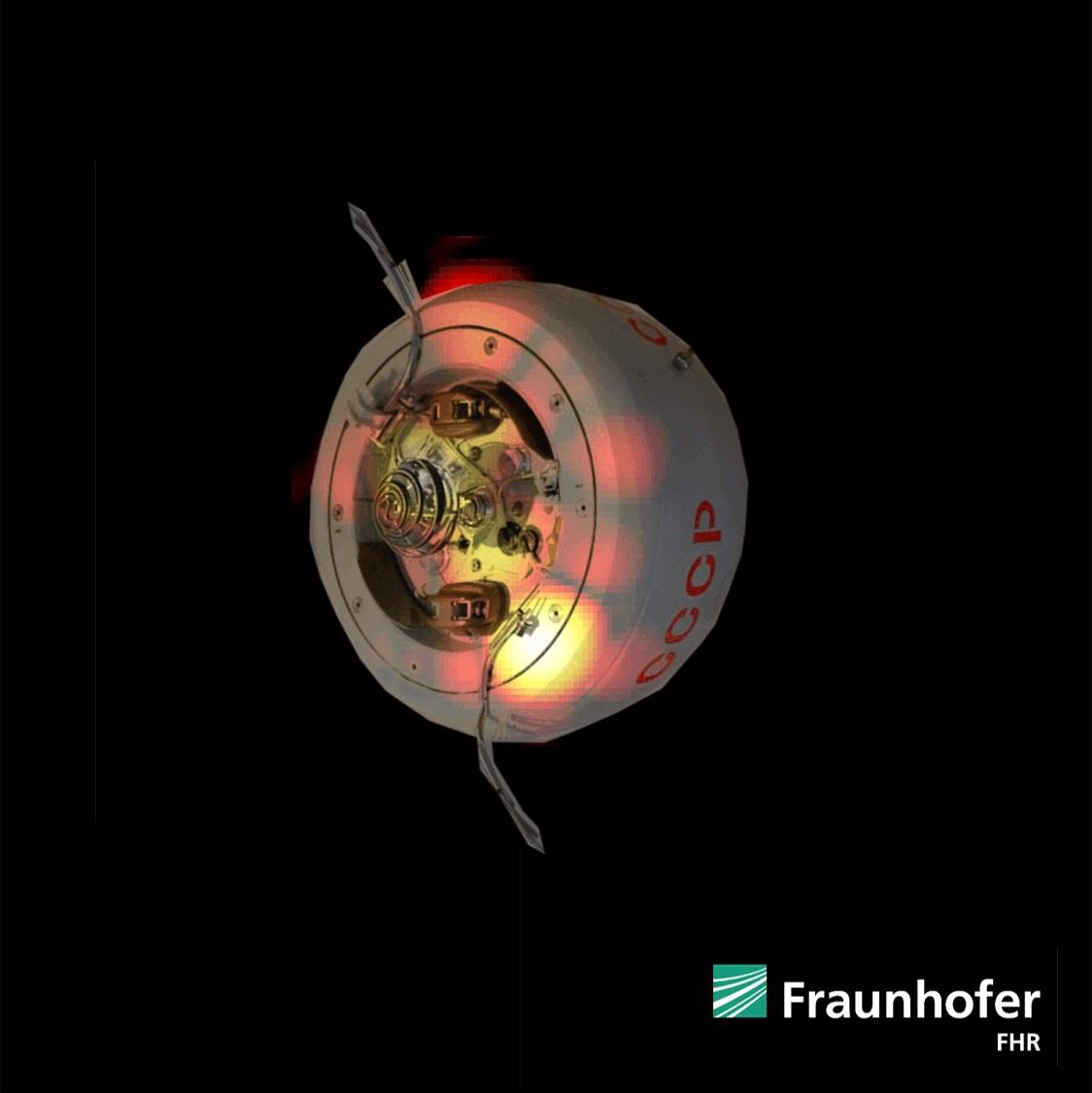
On 7 May 2025 Roscosmos said the craft would enter the dense atmosphere on 9 or 10 May. ESA's Space Debris Office opened a live forecast the same day; by the evening of 9 May it had narrowed to 06:37 UTC on 10 May, plus or minus 3.28 hours. On 8 May the TIRA radar at Fraunhofer FHR in Germany caught the capsule tumbling. On 10 May radar in Germany tracked it at about 04:30 and 06:04 UTC (ESA credits Fraunhofer FHR with the last detection, EU SST names TIRA); it was not seen at the next expected pass, 07:32 UTC.
Everything after 06:04 is modelling. Roscosmos, quoting a TsNIIMash calculation, put entry into the dense atmosphere at 06:24 UTC (09:24 Moscow time), with no uncertainty stated. ESA's aftercast was 06:16 UTC plus or minus 0.36 hours. EU SST, counting re-entry at 80 km, said the craft decayed within its final window, 06:04:48 UTC plus or minus 20 minutes. The Aerospace Corporation's last forecast was 06:29 plus or minus two hours, and the TU Delft Tudat model run by Marco Langbroek and Dominic Dirkx gave 06:40 plus or minus 91 minutes. McDowell's catalogue lists 06:34 with a question mark, his newsletter of 23 May 2025 about 06:38. The US Space Force's CSpOC prediction, 05:32 UTC plus or minus 12 minutes, cannot be right: the lander was still in orbit over Germany at 06:04. Read with that sighting, the EU SST window ends at about 06:25, and the Roscosmos time sits just inside it. Langbroek and Dirkx judge about 06:15 to 06:45 UTC most probable.
The place is even less certain: at that speed, as Langbroek and Dirkx put it, one minute of time is almost 500 km of ground track. Roscosmos named two separate points, entry into the dense atmosphere 560 km west of Middle Andaman Island and a fall into the Indian Ocean west of Jakarta. McDowell's catalogue gives 102 E, 10 S, with a question mark. Langbroek and Dirkx's nominal points for the other times scatter from England (EU SST) and southwest Asia (ESA's aftercast) to the seas south of Australia (their own aftercast and CSpOC's), with the Roscosmos time at 11 N 88 E and the Aerospace Corporation's at 5 S 99 E; RussianSpaceWeb reported the Space Force estimate as over the Pacific. The likely area, Langbroek and Dirkx add, was in daylight and mostly sea, which would explain the lack of ground observations. ESA's last word, on 13 May 2025, was that no precise time or location had been identified and no sightings or impacts on the ground reported.
Whether the lander survived is a matter of judgement, and judgements differ. ESA wrote beforehand that it might survive; EU SST afterwards that it most likely reached the ground almost intact. Langbroek and Dirkx called intact survival very likely and estimated an impact at 65 to 70 m/s. Shubin, described by RIA Novosti in 2025 as a mathematician at the Space Research Institute (IKI RAN), told it the lander would very probably survive a fall into water or sand and stay sealed even a kilometre deep. His IKI colleague Natan Eismont told Izvestia the opposite (in an article of 30 April 2025 that dates his remarks to 20 April): the craft would almost completely burn up, leaving at most heat-resistant parts such as gas bottles and engine pieces. The case for survival rests on the design: the lander was built to enter Venus's atmosphere at 11.6 km/s, and its twin took up to 335 g doing so, while Shubin put the Earth entry speed at about 8 km/s. Langbroek, though, had judged in 2022 that the parachute was extremely unlikely to work after 50 years in space.
Even the mass has several readings. The literature usually gives 495 kg, as did ESA; Roscosmos said under 500 kg, EU SST approximately 500, RussianSpaceWeb 480, and McDowell's catalogue 475, with 495 as a queried total. Langbroek and Dirkx found that 480 kg best reproduced the 53-year decay but noted that a 3 percent change in drag coefficient or area would do the same, so the fit cannot pin the mass down. Design limits vary too: Lavochkin and Siddiqi give 105 atmospheres and 493 °C, while ESA and Shubin give 100 atmospheres and up to 300 g.
Kosmos 482 had a forerunner. In August 1970 the twin of Venera 7 was stranded the same way and announced as Kosmos 359; Siddiqi records that its Blok NVL engine ignited late and cut off after 25 seconds, and that the spacecraft re-entered on 6 November 1970. Its descent sphere, listed separately by McDowell as 1970-065D, came down from a 206 by 836 km orbit on 6 October 1971. Kosmos 482's longer burn threw its payload almost 10,000 km out, and that apogee kept its lander up for 53 years where the Kosmos 359 sphere lasted about 13 months.
Nearly eighteen months after the fall, the picture has not changed. Checks made for this page on 4 November 2026 found no report of a sighting or of recovered hardware, and McDowell's catalogue, updated on 2 November 2026, still carries question marks on both the time and the place. What survives with certainty is paper: a flight plan for a lander that never went, a warning about a stage without telemetry, and a short order to cut the lander loose and stop work.
Mission facts
Organisations
Lavochkin design bureau (USSR); 2025 re-entry tracked by Roscosmos and TsNIIMash, ESA, EU SST and independent analysts
Spacecraft
Vehicle V-72 No. 671, the second of the two 1972 Venera spacecraft. NPO Lavochkin says it matched Venera 8 (No. 670) in design, on-board systems and scientific instruments. The index varies by source: Siddiqi writes 3V no. 671, RussianSpaceWeb 3V1, McDowell's catalogue 4V-1 No. 671 and his notes V-71; the 1972 State Commission papers write V-72 No. 671.
Launch
31 March 1972 at 04:02:33 UT (07:02:33 Moscow time) from Site 31 at Baikonur (NIIP-5) on Molniya-M 8K78M No. S1500-64. Venera 8 had left on 27 March at 04:15:06 UT.
Mass at launch
1,184 kg in RussianSpaceWeb's text (its summary table says 1,182 kg); 1,184 kg is also the figure Lavochkin and Siddiqi give for Venera 8. Siddiqi gives about 1,180 kg for this vehicle.
Escape burn
The fourth stage (a Blok L variant that Lavochkin calls NVL and the 1972 commission papers call 2VL) fired for 125 seconds. RussianSpaceWeb gives the planned firing as 243 seconds; McDowell describes the cutoff as 2 minutes into a 4 minute burn.
Stranded orbit
Great Soviet Encyclopedia yearbook for 1973: 9,813 by 210 km, 52 degrees, 201.4 minutes. RussianSpaceWeb: 205 by 9,805 km at 52.22 degrees. McDowell: 206 by 9,800 km. Langbroek: 206 by 9,802 km. The readings differ by a few kilometres and describe the same orbit.
Cause of the cutoff
Lavochkin says only 'an accident of the NVL upper stage' and Roscosmos (2025) 'a malfunction of the upper stage'. Siddiqi and the Russian text of Marov's account blame the on-board timer. RIA Novosti (2025) says the stage ran short 'for an unknown reason'.
Stage telemetry
A pre-launch review paper in RGANTD records that telemetry had been removed from the 2VL stage to save weight, and that the military acceptance office warned it would leave too little information if something went wrong.
Other launch objects
McDowell's catalogue: third stage 1972-023B re-entered 1 April 1972; the ullage unit (BOZ) 1972-023 °C on 2 April 1972; the Blok L stage 1972-023D stayed up until 20 February 1983.
Separation order
On 28 April 1972 the State Commission, chaired by A. G. Mrykin, told Lavochkin's technical leadership (Kryukov) and the GOGU flight-control group (Brontman) to separate the descent craft from the orbital compartment of V-72 No. 671 and then stop work with the vehicle. The document was declassified on 10 August 2016.
Separation date
Not recorded in any source fetched here. Langbroek's orbit analysis puts it in mid-June 1972, about 80 to 85 days after launch, at about 8.5 m/s; McDowell's catalogue gives 15 June with a question mark; the Russian text of Marov's account says the end of June.
Bus re-entry
The main spacecraft, 1972-023A, re-entered on 5 May 1981 (Siddiqi, McDowell's catalogue).
Descent craft
Catalogue number 6073, designation 1972-023E, which McDowell describes as a half-ton sphere about one metre in diameter. He began labelling 6073 as the Venera descent sphere in September 2000; the NORAD catalogue followed in June 2002.
Descent craft mass
495 kg, the figure the literature generally cites (Langbroek and Dirkx) and ESA uses; 'less than 500 kg' (Roscosmos); 'approximately 500 kilograms' (EU SST); 480 kg (RussianSpaceWeb, and the value that best fits the 53-year decay for Langbroek and Dirkx); 475 kg with 495 kg as a queried total in McDowell's catalogue.
Design limits
Lavochkin and Siddiqi: designed for 105 atmospheres and 493 °C, down from 150 atmospheres and 540 °C for Venera 7. ESA: 300 g and 100 atmospheres. Venera 8's identical lander took up to 335 g entering Venus's atmosphere at 11.6 km/s.
Last radar detections
Radar in Germany detected the lander at about 04:30 and 06:04 UTC on 10 May 2025 and did not find it at the expected 07:32 UTC pass. ESA credits the last detection to Fraunhofer FHR; EU SST names its TIRA radar.
Re-entry time readings
Roscosmos (TsNIIMash calculation) 06:24 UTC; ESA aftercast 06:16 UTC plus or minus 0.36 h; EU SST 06:04 UTC plus or minus 20 min; Aerospace Corporation 06:29 UTC plus or minus 2 h; TU Delft Tudat 06:40 UTC plus or minus 91 min (aftercast; the team's forecast was 06:39 in Langbroek and Dirkx's table and 06:42 plus or minus 1.52 h in its IAC 2025 paper); McDowell 06:34? (catalogue) and about 06:38 (newsletter); CSpOC 05:32 UTC plus or minus 12 min, its last published prediction, ruled out by the 06:04 radar sighting (Langbroek and Dirkx and the IAC 2025 paper both note that CSpOC published no high-accuracy final prediction this time).
Re-entry place readings
Roscosmos: entry into the dense atmosphere 560 km west of Middle Andaman Island, fall into the Indian Ocean west of Jakarta. McDowell: 102 E, 10 S, with a question mark. Nominal points for the other predictions, as estimated by Langbroek and Dirkx from each central time, run from 52 N 0 E (EU SST) and 35 N 65 E (ESA aftercast) to 38 S 130 E (TU Delft) and 40 S 111 E (CSpOC); they put the Roscosmos time at 11 N 88 E and the Aerospace Corporation time at 5 S 99 E. RussianSpaceWeb reported the CSpOC estimate as over the Pacific.
Mission timeline
- 31 Mar 1972Launch at 04:02:33 UT from Baikonur, four days after Venera 8. The escape stage fires for 125 seconds and strands the spacecraft in an orbit of roughly 210 by 9,800 km; the Soviet press names it Kosmos 482.
- 1 to 2 Apr 1972The Molniya third stage (1 April) and the ullage unit of the escape stage (2 April) re-enter.
- 3 Apr 1972About 1 a.m. local time, observers on New Zealand's South Island see flaring objects; titanium spheres about 38 cm across are later found near Ashburton. Langbroek attributes them to the ullage unit, RussianSpaceWeb to the Block L stage.
- 28 Apr 1972The State Commission orders the descent craft separated from the orbital compartment of V-72 No. 671, after which work with the vehicle is to stop.
- Jun 1972The lander comes away from the bus. Langbroek's orbit analysis points to mid-June; McDowell gives 15 June with a question mark; Marov's account and RussianSpaceWeb say the end of June. Tracked as object 6073.
- 22 Jul 1972The twin, Venera 8, lands on the day side of Venus and transmits from the surface for about 50 minutes (NSSDCA gives 63).
- 5 May 1981The main spacecraft, 1972-023A, re-enters. The lander stays up.
- 20 Feb 1983The Blok L escape stage, 1972-023D, re-enters.
- Sep 2000 to Jun 2002McDowell starts labelling object 6073 as the separated descent sphere; the NORAD catalogue does the same from June 2002.
- 1 Aug 2011Ralf Vandebergh images Kosmos 482 from the ground. RussianSpaceWeb compares the picture with the assembled spacecraft, suggesting the lander is still attached to the bus; it now calls that impression likely an illusion.
- 6 Jul 2018Pavel Shubin tells RIA Novosti the station will return within four to seven years; his graph points to about 2023 to 2025.
- 16 May 2022Langbroek publishes a re-entry window of mid-2024 to mid-2027 for the lander, then in a 198 by 1,957 km orbit.
- 7 May 2025Roscosmos predicts entry on 9 or 10 May; ESA opens live forecasts, centred on 06:18 UTC on 10 May plus or minus 18.07 hours.
- 8 May 2025The TIRA radar images the lander tumbling, about two days before re-entry.
- 10 May 2025Last radar detection over Germany at 06:04 UTC; no-show at 07:32 UTC. The lander re-enters somewhere on the track between the two passes.
- 10 May 2025At 09:02 UTC Roscosmos posts that, by TsNIIMash's calculation, the craft entered the dense atmosphere at 09:24 Moscow time (06:24 UTC) and fell in the Indian Ocean west of Jakarta.
- 13 May 2025ESA posts its final update: no precise time or place identified so far, and no reports of sightings or of impacts on the ground. EU SST's final update of the same day confirms decay within its last window, 06:04 UTC plus or minus 20 minutes.
- 27 May 2025Langbroek and Dirkx compare every prediction and judge re-entry most probable between about 06:15 and 06:45 UTC, over southwest Asia or the Indian Ocean.
- Oct 2025The Tudat team's paper for the International Astronautical Congress in Sydney gives its final forecast as 06:42 UTC plus or minus 1.52 hours, inside the window set by the two German radar passes, and notes that CSpOC issued no final high-accuracy prediction this time.
A filled dot marks something that physically happened. A hollow one marks an announcement, a naming or a target.
In pictures
Tap a photo to enlarge.
Translated from the original sources
Passages from the Russian sources this page draws on, in azmth's translation. Tap Show original to read the original wording.
NPO Lavochkin: Venera-8 project page, with the note on the second 1972 station
Russian · 6 passages
“On 31 March 1972 at 7 h 2 min 33 s the Molniya-M launch vehicle was launched with the second station, which in design, on-board systems and scientific instruments was the same as the Venera-8 station.”
azmth's translation · Show originalHide original
Russian: «31 марта 1972 года в 7 часов 2 минуты 33 секунды был произведен запуск ракеты-носителя "Молния-М" со второй станцией, которая по конструкции, составу бортовых систем и научной аппаратуре была аналогична станции "Венера-8".»
“However, the station did not reach the interplanetary trajectory because of an accident of the NVL upper stage. The craft, which received the name Kosmos-482, remained in Earth orbit.”
azmth's translation · Show originalHide original
Russian: «Однако на межпланетную траекторию станция не вышла вследствие аварии разгонного блока НВЛ. Аппарат, получивший название "Космос-482", остался на околоземной орбите.»
“Instead of a design pressure of 150 atmospheres, 105 atmospheres was adopted, and instead of 540 degrees, 493 °C.”
azmth's translation · Show originalHide original
Russian: «Вместо расчетного давления 150 атмосфер было принято 105 атмосфер, а вместо 540° - 493°С.»
“In the lower part of the compartment the wall thickness was reduced from 25 to 12 mm, in the upper part from 8.7 to 5.7 mm, which made it possible to cut the weight of the descent craft by 38.5 kg.”
azmth's translation · Show originalHide original
Russian: «В нижней части отсека толщина стенки была уменьшена с 25 до 12 мм, в верхней - с 8,7 до 5,7 мм, что дало возможность снизить вес спускаемого аппарата на 38,5 кг.»
“To improve the thermal conditions of the equipment, beryllium shells acting as heat accumulators were fitted on the inside of the titanium hull of the descent craft”
azmth's translation · Show originalHide original
Russian: «Для улучшения теплового режима оборудования на внутренней стороне титанового корпуса спускаемого аппарата были установлены бериллиевые оболочки - аккумуляторы тепла»
“(Venera 8) During aerodynamic braking in the atmosphere, in which the craft experienced loads of up to 335 g, its speed fell from 11.6 km/s to 250 m/s”
azmth's translation · Show originalHide original
Russian: «В процессе аэродинамического торможения в атмосфере, при котором аппарат испытывал перегрузки до 335 g, его скорость снизилась с 11,6 км/с до 250 м/с»
RGANTD: State Commission decision of 28 April 1972
Russian · 2 passages
RGANTD: State Commission decision of 28 April 1972 (scan published by RussianSpaceWeb)
Open the source“The technical leadership (Comrade Kryukov) and GOGU (Comrade Brontman) are to carry out the separation of the descent craft and the orbital compartment of object V-72 No. 671, after which further work with this object is to stop. The date of separation is to be chosen and agreed with the State Commission in the ordinary course of work.”
State Commission decision of 28 April 1972, item 5; transcribed from the archival scan
azmth's translation · Show originalHide original
Russian: «Техническому руководству (т.Крюков) и ГОГУ (т.Бронтман) произвести разделение спускаемого аппарата и орбитального отсека объекта В-72 № 671, после чего дальнейшие работы с этим объектом прекратить. Дату разделения выбрать и согласовать с Госкомиссией в рабочем порядке.»
“Declassified by decision No. 766 rs of the Interdepartmental Commission for the Protection of State Secrets of 10 August 2016.”
stamp on the same document
azmth's translation · Show originalHide original
Russian: «РАССЕКРЕЧЕНО ПО РЕШЕНИЮ МВК ПО ЗАЩИТЕ ГОСУДАРСТВЕННОЙ ТАЙНЫ № 766 рс от 10.08.2016 г.»
RGANTD: pre-launch review minutes, page 2
Russian · 2 passages
RGANTD: pre-launch review minutes, page 2 (scan published by RussianSpaceWeb)
Open the source“Landing of the craft is planned on the day side of the planet, 1,000 km from the terminator. The time of descent on the parachute, from an altitude of 64 km, is 40 to 60 min; the active life of the descent craft after landing is not less than 30 min.”
pre-launch review, page 2; transcribed from the archival scan
azmth's translation · Show originalHide original
Russian: «Посадка аппарата предусмотрена на дневную сторону планеты, в 1000 км от терминатора. Время снижения на парашюте, с высоты 64 км, составляет 40÷60 мин, время активного существования СА после посадки не менее 30 мин.»
“the telemetry equipment has been removed from block 2VL in order to reduce weight (because of the tight ballistic conditions).”
pre-launch review, page 2
azmth's translation · Show originalHide original
Russian: «с блока 2ВЛ снята телеметрическая аппаратура с целью уменьшения веса (в связи с жесткими баллистическими условиями).»
RGANTD: pre-launch review minutes, page 7
Russian · 2 passages
RGANTD: pre-launch review minutes, page 7 (scan published by RussianSpaceWeb)
Open the source“The absence of telemetry equipment on block 2VL will, in the event of an emergency, make it impossible to obtain sufficient information.”
pre-launch review, page 7, conclusion of the military acceptance office VP 4116
azmth's translation · Show originalHide original
Russian: «Отсутствие телеметрической аппаратуры на блоке 2ВЛ, в случае аварийной ситуации, не позволит получить достаточной информации.»
“The flight vehicles were fitted with units that had not completed development testing, which led to their being taken apart more than once.”
pre-launch review, page 7
azmth's translation · Show originalHide original
Russian: «Летные объекты комплектовались неотработанными агрегатами, что приводило к неоднократному раскомплектованию.»
Roscosmos Telegram post of 10 May 2025
Russian · 2 passages
“According to calculations by specialists of TsNIIMash (part of Roscosmos), the craft entered the dense layers of the atmosphere at 9:24 Moscow time 560 km west of Middle Andaman Island and fell in the Indian Ocean west of Jakarta.”
azmth's translation · Show originalHide original
Russian: «В соответствии с расчетами специалистов ЦНИИмаш (входит в Роскосмос), аппарат вошел в плотные слои атмосферы в 9:24 мск в 560 км западнее острова Средний Андаман и упал в Индийском океане западнее Джакарты.»
“The craft was launched in the spring of 1972 to study Venus, but because of a malfunction of the upper stage it remained in a high elliptical orbit of the Earth, gradually approaching the planet.”
azmth's translation · Show originalHide original
Russian: «Аппарат был запущен весной 1972 года для исследования Венеры, однако из-за неисправности разгонного блока остался на высокой эллиптической орбите Земли, постепенно приближаясь к планете.»
RIA Novosti, 7 May 2025: Roscosmos press service forecast
Russian · 1 passage
“According to ballistic calculations, Kosmos-482 should enter the dense layers of the atmosphere on 9 to 10 May.”
Roscosmos press service, 7 May 2025
azmth's translation · Show originalHide original
Russian: «По данным баллистических расчётов, "Космос-482" должен войти в плотные слои атмосферы 9-10 мая.»
Interfax, 10 May 2025: report quoting the Roscosmos statement
Russian · 1 passage
“The craft's diameter is about a metre, its mass less than 500 kg.”
Interfax's own summary on 10 May 2025; RIA Novosti of 7 May 2025 quotes the Roscosmos press service giving the same two figures
azmth's translation · Show originalHide original
Russian: «Диаметр аппарата - около метра, масса - менее 500 кг.»
RIA Novosti, 6 July 2018: Pavel Shubin's re-entry forecast
Russian · 2 passages
“The Kosmos-482 station will come back to us within the next four to seven years.”
Pavel Shubin to RIA Novosti
azmth's translation · Show originalHide original
Russian: «Станция "Космос-482" вернется к нам в ближайшие четыре-семь лет»
“So as not to report a failure, the craft was given the name Kosmos-482 instead of Venera-9.”
azmth's translation · Show originalHide original
Russian: «Чтобы не сообщать о неудаче, аппарату вместо имени "Венера-9" дали название "Космос-482".»
RIA Novosti, 12 March 2019: McDowell and Shubin forecasts
Russian · 2 passages
“According to the graph he built, the station will fall to Earth in approximately 2023 to 2025.”
on Pavel Shubin's 2018 analysis
azmth's translation · Show originalHide original
Russian: «Согласно построенному им графику, падение станции на Землю произойдет приблизительно в 2023-2025 годах.»
“The unsuccessfully launched station, together with the upper stage, remained in an orbit of 220 by 9,800 km, and over the past half century lost about 7,400 km, lowering its apogee (the highest point of the orbit) to 2,400 km.”
azmth's translation · Show originalHide original
Russian: «Неудачно запущенная станция запуска вместе с разгонным блоком осталась на орбите с параметрами 220 километров на 9800 километрах, а за прошедшие полвека потеряла около 7400 километров, снизив апогей (высшую точку орбиты) до 2400 километров.»
RIA Novosti, 8 May 2025: feature with Pavel Shubin
Russian · 2 passages
“(the upper stage) for an unknown reason ran for less time than required”
azmth's translation · Show originalHide original
Russian: «по неизвестной причине отработал меньше, чем нужно»
“Even if it sinks to a depth of a kilometre, it will most likely remain sealed.”
Pavel Shubin, IKI RAN
azmth's translation · Show originalHide original
Russian: «Даже если он затонет на глубине в километр, то, скорее всего, останется герметичным»
Izvestia, 30 April 2025: Natan Eismont
Russian · 2 passages
Izvestia, 30 April 2025: Natan Eismont (IKI RAN) on the re-entry
Open the source“Kosmos-482 will enter the Earth's atmosphere and almost completely burn up. This happens to practically all spent spacecraft.”
Natan Eismont, leading researcher at IKI RAN; Izvestia, 30 April 2025, which dates the remarks to 20 April
azmth's translation · Show originalHide original
Russian: ««Космос-482» войдет в атмосферу Земли и почти полностью сгорит. Такое происходит практически со всеми отработавшими аппаратами.»
“However, in his words, some structural elements really may reach the Earth's surface. These are heat-resistant components, for example compressed-gas bottles and parts of rocket engines.”
azmth's translation · Show originalHide original
Russian: «Однако, по его словам, некоторые элементы конструкции действительно могут достичь поверхности Земли. Это жаростойкие компоненты. Например, баллоны со сжатым газом и части ракетных двигателей.»
Meduza, 9 May 2025: explainer on the falling lander
Russian · 1 passage
“It will enter the dense layers of the atmosphere at about eight kilometres per second, and the possible speed of impact with the ground may be up to 240 kilometres per hour.”
azmth's translation · Show originalHide original
Russian: «В плотные слои атмосферы он войдет на скорости около восьми километров в секунду, а возможная скорость удара о землю может составить до 240 километров в час.»
epizodsspace: Kosmos-482 compilation page
Russian · 3 passages
epizodsspace: Kosmos-482 compilation page (archived 18 April 2025)
Open the source“The station could not leave its parking orbit because of problems with the fourth stage caused by an erroneous command from the on-board timer, which led to the engine shutting down after only 125 seconds of operation.”
Russian text of Marov's account as reproduced on the page
azmth's translation · Show originalHide original
Russian: «Станция не смогла покинуть опорную околоземную орбиту из-за неполадок в работе четвертой ступени, вызванных ошибочной командой от бортового таймера, что привело к отключению двигателя спустя всего 125 секунд работы.»
“At the end of June a fragment separated from it which presumably could have been the descent craft, and which remained in orbit for some time after the main spacecraft entered the atmosphere on 5 May 1981.”
same page, Marov's account
azmth's translation · Show originalHide original
Russian: «В конце июня от нее отделился фрагмент, который предположительно мог быть спускаемым аппаратом, который оставался на орбите еще некоторое время после того, как основная космическая станция вошла в атмосферу 5 мая 1981 года.»
“31 March, Kosmos-482: 9,813 by 210 km, 52 degrees, period 201.4 min.”
orbit as printed in the Great Soviet Encyclopedia Yearbook for 1973, quoted on the page
azmth's translation · Show originalHide original
Russian: «31 марта "Космос-482" 9813 х 210 52° Т - 201,4 мин»
Sources
- NPO Lavochkin: Venera-8 project page, with the note on the second 1972 station · in Russian
- RGANTD: State Commission decision of 28 April 1972 (scan published by RussianSpaceWeb) · in Russian
- RGANTD: pre-launch review minutes, page 2 (scan published by RussianSpaceWeb) · in Russian
- RGANTD: pre-launch review minutes, page 7 (scan published by RussianSpaceWeb) · in Russian
- Roscosmos Telegram post of 10 May 2025 · in Russian
- Interfax, 10 May 2025: report quoting the Roscosmos statement · in Russian
- RIA Novosti, 7 May 2025: Roscosmos press service forecast · in Russian
- RIA Novosti, 6 July 2018: Pavel Shubin's re-entry forecast · in Russian
- RIA Novosti, 12 March 2019: McDowell and Shubin forecasts · in Russian
- RIA Novosti, 8 May 2025: feature with Pavel Shubin · in Russian
- Izvestia, 30 April 2025: Natan Eismont (IKI RAN) on the re-entry · in Russian
- Meduza, 9 May 2025: explainer on the falling lander · in Russian
- epizodsspace: Kosmos-482 compilation page (archived 18 April 2025) · in Russian
- Anatoly Zak, RussianSpaceWeb: Venera-72 No. 671 (Kosmos-482)
- Asif Siddiqi, Beyond Earth: A Chronicle of Deep Space Exploration, 1958 to 2016 (NASA SP-2018-4041)
- ESA Rocket Science blog: re-entry prediction for the Cosmos-482 descent craft (updated 13 May 2025)
- EU SST: re-entry of the Cosmos-482 descent craft (updated 13 May 2025)
- Marco Langbroek and Dominic Dirkx, The Space Review, 27 May 2025: post-mortem of the re-entry
- Luigi Gisolfi, Dominic Dirkx and 30 co-authors including Marco Langbroek: Tudat orbit estimation paper, International Astronautical Congress 2025, Sydney (arXiv 2510.23179, 27 October 2025)
- Marco Langbroek, The Space Review, 16 May 2022: questions around a failed Venera lander
- Jonathan McDowell, GCAT satellite catalogue (updated 2 November 2026)
- Jonathan McDowell, Jonathan's Space Report No. 845 (23 May 2025)
- Jonathan McDowell, notes on the Kosmos-482 capsule (April 2025)
Facts on this page were verified on 4 November 2026. Where sources disagree, the disagreement is stated rather than resolved silently.
azmth is independent and is not affiliated with or endorsed by NASA, Roscosmos, NPO Lavochkin, ESA, JAXA, ISRO, CNSA, or any other space agency or company named on this page.