The Face on Mars
The Face on Mars is an eroded Cydonia mesa. Viking saw it at 46 m per pixel in 1976; HiRISE at 30 cm in 2007. Why we see faces anyway.
TL;DR· 23 min read
The Face on Mars is an eroded, flat-topped hill about two kilometres long in Cydonia, photographed by the Viking 1 orbiter on 25 July 1976 at about 46 metres per pixel, with transmission bit errors forming part of one eye and one nostril. Every far sharper look, from Mars Global Surveyor in 1998 and 2001 through Mars Express in 2006 to HiRISE at 29.9 centimetres per pixel in 2007, shows a hill with no eyes, nose or mouth in its topography. The open question is now about perception: why thirty pixels read as a face.
It is a hill. Specifically it is an eroded, flat-topped remnant mound about two kilometres long in Cydonia Mensae, one of thousands of similar mounds along the boundary between the old cratered highlands of Mars and the young northern plains, and every spacecraft that has looked at it since 1998 has seen a hill. That is the boring half of the answer and it has been settled for a quarter of a century. The interesting half is the question nobody asks: why did a competent, sceptical species look at thirty pixels of low-contrast greyscale with transmission errors in it and see, immediately and unanimously, a human face? That question is not settled, it is a live research field, and it turns out to be about you rather than about Mars.
- 64 x 64pixels: the whole Face, in the Viking data the 1988 three-dimensional analysis was computed from
- 154xsharper: HiRISE saw the same hill at 29.9 cm per pixel in 2007, against Viking's 46 m
- 34%of pure-noise images in which people expecting faces reported seeing one (Liu et al., 2014)
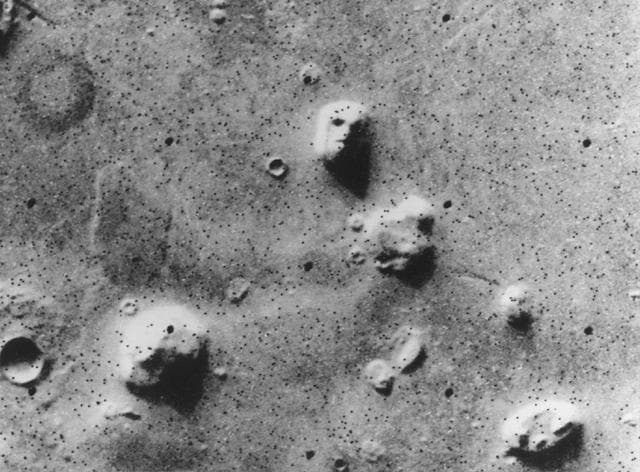
Nearly everything about the Face follows from what kind of picture it was. Frame 035A72 was taken by the Viking 1 orbiter at 15:25:14 GMT on 25 July 1976, through a clear filter, with a 34 millisecond exposure, while the mission was hunting for somewhere safe to put Viking 2 down. The mission's own ancillary record gives the scale as 46 metres per pixel and the incidence angle as 79 degrees, which puts the Sun about 11 degrees above the horizon and throws long shadows across everything. At that scale a landform the press release measured at 1.5 kilometres (about a mile) across is roughly thirty pixels wide. Thirty pixels is about the size of an emoji on a phone. It is enough to establish that there is a raised thing there casting a shadow. It is nowhere near enough to establish what shape the raised thing is. Malin Space Science Systems' comparison of Viking and MOC brightness histograms shows the archived Viking data carry only 128 real brightness levels, because the cameras returned seven bits and NASA stored eight. And the radio link dropped bits on the way home, sprinkling black dots through the frame. NASA's own catalogue caption for the image states it flatly: bit errors make up part of one of the eyes and part of one of the nostrils. One of the two most recognisable features of the Face is a transmission error.
NASA released it, and NASA meant to. The Jet Propulsion Laboratory put the frame out on 31 July 1976 as press release P-17384, and the caption is worth reading in full because it is more careful than its reputation: eroded mesa-like landforms, a rock formation resembling a human head, formed by shadows giving the illusion of eyes, nose and mouth, with speckling due to bit errors. Malin Space Science Systems, which built the camera that would later settle the matter, has been candid about the motive. Amid the craters and unfamiliar terrain of a landing site survey, there was a desire to give the public one landform that looked like something. It worked far better than intended. If you have heard that a second picture taken a few hours later showed the face gone, the image record does not support it. The second Viking 1 orbiter image of the hill, frame 070A13, came thirty-six days and thirty-five orbits afterwards, on 30 August 1976, with the Sun seventeen degrees higher in the sky, and the face is still plainly there. That is precisely why Vincent DiPietro and Gregory Molenaar, who dug both frames out of the archives in the late 1970s, read the second image as confirmation. On the evidence available in 1976 they were not being stupid. They were being wrong for a reason that only more data could expose.
The strongest scientific case ever made for artificiality was published in a real journal and deserves to be described accurately rather than dismissed. Mark Carlotto's paper in Applied Optics in May 1988 removed the salt-and-pepper noise, applied local contrast enhancement, and then reconstructed the hill's three-dimensional shape from a single image by shape-from-shading, a technique planetary scientists call photoclinometry, which infers slope from brightness. He then re-lit that reconstructed surface from arbitrary directions and re-rendered it from arbitrary viewpoints, and reported that the facial impression persisted, so it could not be a transient trick of light and shadow. His measured dimensions were 2.54 by 2.05 kilometres with a peak height of about 412 metres. What makes the paper honest is that it states its own limits. Stereo was impossible: the two Viking frames were only 6.08 degrees apart in viewing angle, giving a minimum resolvable height of about 772 metres, taller than the hill itself. Photometric stereo failed on noise. The single-image method assumes a uniformly reflecting Lambertian surface of constant albedo sitting on a flat background, and it was applied to a chip 64 pixels square. A 64 by 64 grid of seven-bit numbers with transmission errors in it is not enough to establish the shape of a two-kilometre mountain, and no amount of correct mathematics downstream can add information that the data never contained.
What settled the question was more photons. Better arguments would not have done it. Mars Global Surveyor caught the Face on its first attempt, on 5 April 1998, at 4.3 metres per pixel, ten times better than Viking, and it looked like a hill. That did not close the case, and reasonably so: it was Martian winter above 40 degrees north, the scene was hazy, and the strip had been binned two pixels by two to trade resolution for enough downtrack coverage to guarantee hitting the target at all. So on 8 April 2001, in clear summer air, the spacecraft was rolled 24.8 degrees to look 165 kilometres sideways and returned image E03-00824 at roughly 1.56 to 2 metres per pixel, plus a stereo anaglyph built with a frame from June 2000. Jim Garvin and Jim Frawley then did the thing that actually finishes the argument: they combined the image with MOLA laser altimetry, which measures height directly with 20 to 30 centimetres of vertical precision and needs no light at all, and rendered the landform as pure topography. There are no eyes, no nose and no mouth in the shape. Mars Express added a stereo terrain model from orbit 3253 in July 2006, and the HiRISE camera on the Mars Reconnaissance Orbiter photographed the hill at 29.9 centimetres per pixel in April 2007, resolving objects under a metre, with the Sun 17 degrees above the horizon, low, though from the southwest rather than the west-northwest, and against a Viking figure that the sources themselves put anywhere between 11 and 20 degrees. Low light was never the whole story. Coarse pixels did most of the work, and on the evidence here we cannot cleanly separate the two.
Which leaves the interesting question. Pareidolia is the perception of a meaningful pattern, most often a face, in something that has none, and the evidence now says it is a perceptual event rather than a lapse of judgement: the seeing happens before the thinking, and knowing better does not switch it off. Newborns preferentially track a top-heavy, three-blob face-like arrangement, and Reid and colleagues reported in 2017 that third-trimester fetuses turn towards the upright version of the same pattern projected through the uterine wall, which is difficult to explain by learning. Liu and colleagues showed people pure visual noise, told them half the images contained faces, and got face reports 34 per cent of the time, with the right fusiform face area lighting up specifically for the face illusion and the averaged behavioural response resembling an actual face. Wardle and colleagues found illusory faces represented in face-selective visual cortex, more similar to real faces than to matched objects for the first quarter of a second before the representation collapses into ordinary-object territory. Palmer and Clifford showed the illusion drives real social-attention machinery: stare at pareidolia faces looking one way and your judgement of where real human faces are looking shifts. Face-selective cortex responds to a face-like object within roughly 170 milliseconds, on the same early component it uses for real faces, as Hadjikhani and colleagues reported in 2009. Wardle's team read their own result as a broadly tuned face detector that privileges sensitivity over selectivity, which is the technical way of saying that a false alarm is cheap and a miss is not.
Two honest caveats, one about the brain and one about the rock. On the brain, the field is not tidy. Whether other primates experience the illusion is genuinely unresolved: rhesus macaques looked longer at pareidolic objects in a 2017 study, but a 2023 comparison found only children, not rhesus or capuchin monkeys, choosing pareidolia images above chance, and chimpanzees show the configural signature without evidence that they see a face. In November 2025 an Italian group reported a failure to replicate the claim that illusory faces automatically capture attention, finding that illusory faces were actually harder to find than butterflies. And on the rock, the mesa is a real object with a real and partly unsolved history. Cydonia sits on the boundary between the rugged southern highlands and the smoother northern lowlands, and the mounds there are usually described as erosional remnants of a stripped-back plateau, though the 1977 Viking-era survey that framing comes from said plainly that no single mechanism had been established for their origin, and the USGS map of the area published in 2005 was drawn in part to revisit exactly that question. Whether the northern plains were ever an ocean, and whether Cydonia was ever a coast, is still argued: Sholes, Montgomery and Catling reexamined a proposed shoreline in Cydonia Mensae at high resolution in 2019 and found the features inconsistent with a wave-cut origin, without ruling out an ocean elsewhere. The Face has no mystery left in it. The ground it stands on still does.
What we know
The short answer
A natural landform. NASA's own catalogue caption for the Viking frame says planetary geologists attribute the origin of the formation to purely natural processes, and after the high-resolution imaging NASA's position was that the landform is an ordinary Martian mesa whose face-like appearance depends on the viewing angle and the angle of illumination. ESA's position after the 2006 Mars Express stereo pass was the same: a remnant massif, heavily eroded. We found no peer-reviewed planetary science paper published since the 2001 image arguing otherwise, and no space agency has ever claimed the feature was anything but geology, including in 1976.↗
The image that started it, and how coarse it was
Viking 1 orbiter frame 035A72, taken at 15:25:14 GMT on 25 July 1976 through the clear filter with a 34 millisecond exposure, while the mission was searching for a landing site for Viking 2. The mission's own ancillary record gives an image centre of 40.90 N, 9.52 W, an emission angle of 10 degrees and a solar longitude of 99.2 degrees, which is northern summer; each raw Viking Orbiter frame is 1204 samples by 1056 lines. Published pixel scales differ: the ancillary record says 46 m per pixel, the Malin Space Science Systems catalogue table says 47 m, and Carlotto's 1988 paper, drawing on the Science Data Block, says 51.73 m. For the second frame, 070A13, the first two give 43 m and Carlotto gives 48.13 m. Whichever you take, a feature the press release called 1.5 km across is about thirty pixels wide. Malin Space Science Systems' published side-by-side comparison of Viking and MOC brightness histograms also shows that the archived Viking data carry only 128 real shades of grey, because the cameras returned seven bits of brightness that NASA stored in eight.↗
What NASA actually said, in full
JPL Viking press release P-17384, dated 31 July 1976: 'This picture is one of many taken in the northern latitudes of Mars by the Viking 1 Orbiter in search of a landing site for Viking 2. The picture shows eroded mesa-like landforms. The huge rock formation in the center, which resembles a human head, is formed by shadows giving the illusion of eyes, nose and mouth. The feature is 1.5 kilometers (one mile) across, with the sun angle at approximately 20 degrees. The speckled appearance of the image is due to bit errors, emphasized by enlargement of the photo. The picture was taken on July 25 from a range of 1873 kilometers (1162 miles). Viking 2 will arrive in Mars orbit next Saturday (August 7) with a landing scheduled for early September.'↗
The nostril is a transmission error
NASA's later catalogue caption for the same image is more specific than the 1976 one. The speckling, it says, is missing data called bit errors, caused by problems in transmitting the photographic data from Mars to Earth, and those bit errors comprise part of one of the eyes and one of the nostrils on the eroded rock that resembles a human face near the centre of the image. The caption puts eyes and nostrils in scare quotes. One of the two most recognisable features of the Face is a dropped bit.↗
The sun angle does not reconcile
Two published figures, and we could not make them agree. The 1976 press release says 'the sun angle at approximately 20 degrees'. The mission's own ancillary record for 035A72 gives an incidence angle of 79 degrees at image centre, which puts the Sun about 11 degrees above the horizon, and Carlotto's independent reading of the Science Data Block gives 79.93 degrees. The press release does not say which convention it is using and gives no source. We report both and pick neither. Either way the Sun was low and in the west-northwest: the label's north and Sun azimuths give a solar bearing of 294 degrees from north, and Carlotto's Table I, read from the Science Data Block, publishes 294.28 degrees. Long shadows ran across the hill.↗
The second Viking image
Frame 070A13, taken at 12:38:33 GMT on 30 August 1976, thirty-six days and thirty-five orbits after the first. Incidence angle 62 degrees, so the Sun was about 28 degrees up, seventeen degrees higher than in the original. Scale 43 m/pixel. The range is published two ways and we could not reconcile them either: the ancillary record gives a slant range of 5085 km, which does not square with its own 51 km field of view, while Carlotto's Table I, read from the Science Data Block, gives 1725 km, the figure consistent with the field of view and with the 1873 km the 1976 press release quoted for the first frame. It is the sharpest Viking image of the landform, and it still looks like a face. That is important: the appearance did not vanish when the light changed by seventeen degrees, which is exactly why the people who found the second frame in the archives treated it as confirmation rather than refutation.↗
How big it is
Contested, and the numbers matter because they were used as evidence. The 1976 press release says 1.5 km across. NASA's 2001 Science@NASA write-up describes the head in the Viking image as nearly two miles (about three kilometres) from end to end. Carlotto's 1988 photoclinometric measurements give 2.54 km long by 2.045 km wide and a peak height of 412.5 metres, plus or minus 17.5. NASA's Jim Garvin, working from Mars Orbiter Laser Altimeter data with 20 to 30 cm of vertical precision but only 150 m of horizontal resolution, described it in 2001 as an 800-foot-high mass of rock, roughly 240 m, comparable to Middle Butte in the Snake River Plain of Idaho, and said its height, volume and aspect ratio are similar to the other Cydonia mesas. Carlotto's height is derived from shading in a noisy 64 by 64 pixel image chip against an assumed flat background; Garvin's is laser ranging. They are not measuring the same thing to the same standard.↗
Who found it again
Vincent DiPietro, an electrical engineer, came across the released Viking photograph in 1977 and did not believe it. With Gregory Molenaar he located the two frames in the NASA archives, applied image enhancement, and in 1982 published a 77-page book, 'Unusual Martian Surface Features', outside the planetary science literature. An excerpt ran in Omni in April 1982. Their claim was that enhancement revealed an eyeball with a pupil in the right eye cavity and a teardrop below it. Martin Gardner's Skeptical Inquirer column of Fall 1985 is the earliest full sceptical treatment we found.↗
The peer-reviewed case for artificiality
Mark J. Carlotto, 'Digital imagery analysis of unusual Martian surface features', Applied Optics 27(10):1926-1933, 15 May 1988. It is real peer-reviewed work in a real optics journal, and it is the fullest version of the argument, though not the only peer-reviewed one: Carlotto restated the case in Digital Signal Processing 3(2):139-144 in April 1993. In the 1988 paper he cleaned the salt-and-pepper noise, applied local contrast enhancement, and reconstructed a three-dimensional surface by single-image shape-from-shading, then re-lit and re-viewed that surface from arbitrary angles. His conclusion was that the facial impression persists across illumination and viewpoint and therefore is not a transient trick of light, and that the objects 'may not be natural'. He also stated the limits himself: the whole Face is 64 by 64 pixels, stereoscopy was impossible because the minimum height the two frames could resolve was about 772 m, greater than the hill, and the model assumes a Lambertian surface of constant albedo above a flat background.↗
Mars Global Surveyor, 1998
The first re-imaging, on 5 April 1998 at 12:39 AM PST, 375 seconds after the spacecraft's 220th close approach. Range 444 km, morning Sun 25 degrees above the horizon, resolution 4.3 m per pixel, ten times better than the best Viking frame, covering 4.4 km by 41.5 km. Michael Malin's team processed it and sent the raw image straight to JPL for immediate release on the internet. The scene was hazy: it was winter above 40 N and the wide-angle context frame shows cloud over much of the area.↗
Why the 1998 image was not sharper
Worth knowing, because it was read as sabotage. The camera's intrinsic resolution at that range was 2.1 m per pixel, but at full resolution the 9.8 megabyte image buffer allowed only 11 km of downtrack coverage, and the pointing uncertainty was larger than that. Summing pixels two by two dropped the resolution to 4.3 m but stretched the strip to over 44 km, which is what made hitting a three-kilometre target realistic. Lossless compression, the alternative, occasionally lost 7 to 15 per cent of the data to black bands, which the project would not accept for this target.↗
Mars Global Surveyor, 2001
On 8 April 2001 at 20:54 UTC the spacecraft was rolled 24.8 degrees to the left to look 165 km off-track from a distance of about 450 km, producing MOC image E03-00824. Malin Space Science Systems describes the resolution as about 2 metres per pixel; NASA's own 2001 write-up, quoting Jim Garvin, gives 1.56 metres per pixel against 43 metres per pixel for the best Viking frame. The image was combined with an earlier June 2000 frame, M16-00184, to make a stereo anaglyph of the western half of the hill. This is the observation that ended the argument in public.↗
Mars Express, 2006
Attempts to image Cydonia with the High Resolution Stereo Camera failed from April 2004 to July 2006, three times because the spacecraft was too high (orbits 0262, 2533, 2872) and twice because of dust and haze (orbits 1216, 2872). Orbit 3253 on 22 July 2006 succeeded, at about 13.7 metres per pixel, in colour and in stereo, giving a digital terrain model from which the landform can be rendered from any direction under any lighting. ESA released it on 21 September 2006, along with colour, anaglyph and perspective renderings.↗
HiRISE, 2007
Observation PSP_003234_2210, taken on 5 April 2007 from 299.4 km at 29.9 cm per pixel, resolving objects about 90 cm across, centred at 40.745 N, 350.543 E. Local Mars time 15:28, solar incidence 73 degrees, so the Sun was about 17 degrees above the horizon: comparably low to the Viking image that started this, though from a different direction. Alfred McEwen's caption calls it an eroded mesa made famous by its similarity to a human face in a Viking image with much lower spatial resolution and a different lighting geometry.↗
Pareidolia is a perceptual event, not a mistake in reasoning
The seeing happens before the thinking. Palmer and Clifford showed in Psychological Science in 2020 that repeatedly viewing pareidolia faces that appear to look in one direction biases where you then judge real human faces to be looking, a cross-adaptation effect that is significantly reduced when the face-like features are removed, which means the same sensory machinery is running. Wardle and colleagues, combining fMRI and magnetoencephalography in Nature Communications in 2020, found illusory faces represented in occipital-temporal face-selective cortex, initially more like real faces than like matched objects, with the representation collapsing to ordinary-object status within about 250 milliseconds. Their reading is a broadly tuned face detector that privileges sensitivity over selectivity. The illusion also carries social content it has no business carrying: in behavioural experiments with 3,815 adults, reported separately in PNAS in 2022, Wardle, Paranjape, Taubert and Baker found illusory faces are readily assigned an expression, an age and a gender, with a strong bias towards male. Cydonia's hill has been read as a male face, often a pharaonic one, since 1976.↗
What the field is still arguing about
Three open threads as of August 2026, in a literature that is still moving: at least two further papers appeared in 2026, Bourgaux and colleagues in the Journal of Cognitive Neuroscience in February reporting that surrounding real faces interfere with rather than help illusory-face categorisation, and Goebel and colleagues in Scientific Reports in April finding that what people see in ambiguous images depends on whether the image is natural or pure noise. Whether other primates experience it: Taubert and colleagues reported pareidolia in rhesus macaques in 2017, but Flessert, Taubert and Beran found in 2023 that only children, not rhesus or capuchin monkeys, chose pareidolia images above chance, and Tomonaga and Kawakami found configural effects in chimpanzees in 2023 with no substantial evidence they saw the objects as faces, before Tomonaga reported in 2025 that chimpanzees choosing among pure-noise patterns produced non-random difference images, which he reads as chimpanzees possibly searching for faces or letters through some form of top-down processing. Whether illusory faces automatically capture attention: Miti, Ciaramidaro, Rubichi and Iani reported a failure to replicate in Psychological Research in November 2025, finding that neither real nor illusory faces captured attention in visual search. And why the detector is tuned the way it is: Gupta and Dobs showed in 2025 that human-like pareidolia emerges in deep networks trained on face identification alongside general object categorisation, which is a mechanistic answer rather than an evolutionary story. Why the detector evolved this way is a separate question the page does not settle.↗
What happened, and when
- 25 Jul 197615:25:14 GMT: the Viking 1 orbiter takes frame 035A72 of Cydonia while surveying landing sites for Viking 2. Sun low, scale about 46 metres per pixel, transmission dropping bits across the frame. Somebody scanning the images for a safe place to land notices a hill that looks like a face.
- 31 Jul 1976JPL issues press release P-17384 with the image. The caption says the resemblance is formed by shadows giving the illusion of eyes, nose and mouth, and that the speckling is bit errors. Malin Space Science Systems, writing in 1995, describes the motive plainly: given the importance of the landing site search, and with a desire to provide the public with at least one familiar-looking landform amid the craters and exotic terrains, the image was released as part of JPL's public relations effort. That is a retrospective account written nineteen years later rather than a 1976 statement by the people who wrote the release.
- 30 Aug 197612:38:33 GMT: frame 070A13, thirty-six days and thirty-five orbits later, with the Sun seventeen degrees higher. It is the sharpest Viking view of the hill at 43 metres per pixel, and the face is still there.
- 30 Sep 1977Guest, Butterworth and Greeley publish geological observations of the Cydonia region from Viking in the Journal of Geophysical Research. Carlotto's 1988 paper takes its geological framing from them: mesas 5 to 10 km wide as remnants of cratered plateau material stripped back by erosion, smaller knobs about two kilometres across, and no single mechanism established for their origin. On that classification the Face is a knob rather than a mesa. We were unable to open the paper itself, so the description here is Carlotto's reading of it, and Carlotto cites it as Guest and Butterworth, without Greeley. The region has been mapped since: George E. McGill's USGS geologic map of Cydonia Mensae and southern Acidalia Planitia, published in 2005, was made specifically to address the crustal history implied by the knobs and mesas and the validity of the putative shorelines there.
- 1982Vincent DiPietro and Gregory Molenaar, who had located both Viking frames in the NASA archives, publish 'Unusual Martian Surface Features' independently of the planetary science literature. An excerpt appears in Omni in April. The claim escalates from a curious hill to a deliberately shaped object.
- Fall 1985Martin Gardner devotes his Skeptical Inquirer column, 'The Great Stone Face and Other Nonmysteries', to the Face. His argument is statistical rather than geological: search enough chaotic data and remarkable-looking patterns are guaranteed, and a pattern is only impressive if you specify it before you look.
- 15 May 1988Mark Carlotto publishes shape-from-shading reconstructions of the Face in Applied Optics, arguing the facial impression survives re-lighting and re-viewing and so is not a transient artefact. It is the fullest peer-reviewed statement of the case, though not the only one (Carlotto restated it in Digital Signal Processing in 1993), and it is honest about working from a 64 by 64 pixel chip.
- 1995Michael Malin, principal investigator for the Mars Orbiter Camera, publishes a page setting out exactly why hitting a three-kilometre target is hard, and committing in advance to release any image of the Face that is acquired. Carl Sagan devotes a chapter of 'The Demon-Haunted World' to the Man in the Moon and the Face on Mars the same year.
- 5 Apr 1998Mars Global Surveyor photographs the Face at 4.3 metres per pixel on its first attempt, ten times better than Viking. The raw image goes to JPL and onto the internet the next morning. It shows a hill. Because the scene was hazy and the strip was binned two by two, the result does not end the argument.
- 8 Apr 2001Mars Global Surveyor is rolled 24.8 degrees to catch the Face in clear summer air, returning image E03-00824 at about 1.56 to 2 metres per pixel, with a stereo anaglyph built from a June 2000 frame. Jim Garvin and Jim Frawley combine it with MOLA laser altimetry to render the landform in three dimensions with no lighting at all. There are no eyes, no nose and no mouth in the topography.
- Jul 2006 to Apr 2007Mars Express finally catches Cydonia on orbit 3253 on 22 July 2006 at 13.7 metres per pixel in colour and stereo, after several failed attempts since April 2004, and produces a terrain model and perspective views. On 5 April 2007 HiRISE images the same hill at 29.9 centimetres per pixel from 299 km, resolving objects under a metre. Nothing new appears.
- 9 Sep 2020Wardle, Taubert, Teichmann and Baker publish the imaging study that locates illusory faces in face-selective visual cortex and times the illusion: for the first quarter of a second the brain treats a pareidolic face more like a real face than like the object it actually is. The Mars question had been closed for nineteen years; the human question had barely started.
In pictures
Tap a photo to enlarge.
Sources
- JPL Viking News Center press release Viking 1-61 / P-17384 (35A72), 31 July 1976
- NASA JPL Photojournal PIA01141, 'Geologic Face on Mars Formation'
- Malin Space Science Systems: Viking Orbiter ancillary data (labels)
- Malin Space Science Systems: 'The Face on Mars'
- Michael C. Malin (1995): 'Observations of the Face on Mars and similar features by the Mars Global Surveyor Orbiter Camera'
- Mark J. Carlotto, 'Digital imagery analysis of unusual Martian surface features', Applied Optics 27(10):1926-1933, 15 May 1988
- MGS MOC Release MOC2-41 (April 1998): 'Mars Orbiter Camera Views the Face on Mars'
- Malin Space Science Systems: 'Why is the image of Cydonia only 1024 pixels wide?'
- MGS MOC Release MOC2-283, 24 May 2001: 'Highest-Resolution View of Face on Mars'
- Tony Phillips, 'Unmasking the Face on Mars', Science@NASA, 24 May 2001
- ESA: 'Cydonia, the face on Mars', 21 September 2006
- HiRISE PSP_003234_2210, 'Popular Landform in Cydonia Region', 5 April 2007
- Jiangang Liu, Jun Li, Lu Feng, Ling Li, Jie Tian and Kang Lee, 'Seeing Jesus in toast: neural and behavioral correlates of face pareidolia', Cortex 53:60-77 (2014)
- Susan G. Wardle, Jessica Taubert, Lina Teichmann and Chris I. Baker, 'Rapid and dynamic processing of face pareidolia in the human brain', Nature Communications 11:4518 (2020)
- Mark J. Carlotto, 'Digital image analysis of possible extraterrestrial artifacts on Mars', Digital Signal Processing 3(2):139-144, April 1993
- Mark J. Carlotto, 'Symmetry and Geometry of the Face on Mars Revealed: A New Analysis Based on the April 2001 Image', SSRN preprint, 2023
- J. E. Guest, P. S. Butterworth and R. Greeley, 'Geological observations in the Cydonia region of Mars from Viking', Journal of Geophysical Research 82(28):4111-4120, 30 September 1977
- George E. McGill, 'Geologic map of Cydonia Mensae - southern Acidalia Planitia, Mars', USGS Geologic Investigations Series I-2811, 2005
- Steven F. Sholes, David R. Montgomery and David C. Catling, 'Quantitative high-resolution reexamination of a hypothesized ocean shoreline in Cydonia Mensae on Mars', JGR Planets 124(2):316-336 (2019)
- Malin Space Science Systems: 'What about the histograms?'
- Susan G. Wardle, Sanika Paranjape, Jessica Taubert and Chris I. Baker, 'Illusory faces are more likely to be perceived as male than female', PNAS 119(5):e2117413119 (2022)
- Colin J. Palmer and Colin W. G. Clifford, 'Face pareidolia recruits mechanisms for detecting human social attention', Psychological Science 31(8):1001-1012 (2020)
- Nouchine Hadjikhani, Kestutis Kveraga, Paulami Naik and Seppo P. Ahlfors, 'Early (M170) activation of face-specific cortex by face-like objects', NeuroReport 20(4):403-407 (2009)
- Mark H. Johnson, Suzanne Dziurawiec, Hadyn Ellis and John Morton, 'Newborns' preferential tracking of face-like stimuli and its subsequent decline', Cognition 40(1-2):1-19 (1991)
- Vincent M. Reid and colleagues, 'The human fetus preferentially engages with face-like visual stimuli', Current Biology 27(12):1825-1828 (2017)
- Jessica Taubert, Susan G. Wardle, Molly Flessert, David A. Leopold and Leslie G. Ungerleider, 'Face pareidolia in the rhesus monkey', Current Biology 27(16):2505-2509 (2017)
- Molly Flessert, Jessica Taubert and Michael J. Beran, 'Assessing the perception of face pareidolia in children, rhesus monkeys and capuchin monkeys', Journal of Comparative Psychology 137(2):90-101 (2023)
- Masaki Tomonaga and Fumito Kawakami, 'Do chimpanzees see a face on Mars? A search for face pareidolia in chimpanzees', Animal Cognition 26:885-905 (2023, online 30 December 2022)
- Masaki Tomonaga, 'I've just seen a face: further search for face pareidolia in chimpanzees', Frontiers in Psychology 15:1508867, 28 January 2025
- Pranjul Gupta and Katharina Dobs, 'Human-like face pareidolia emerges in deep neural networks optimized for face and object recognition', PLOS Computational Biology 21(1):e1012751, 27 January 2025
- Francesca Miti, Angela Ciaramidaro, Sandro Rubichi and Cristina Iani, 'Attentional capture by real and illusory faces: a failure to replicate', Psychological Research 89(6):181, 28 November 2025
- Laura Bourgaux, Diane Rekow, Arnaud Leleu and Adelaide de Heering, 'Context matters: human faces hinder face pareidolia', Journal of Cognitive Neuroscience 38(2):213-225, February 2026
- N. Göbel and colleagues, 'Image type reveals evolutionarily shaped perceptual and conceptual mechanisms of pareidolia', Scientific Reports 16:17606, 15 April 2026
- NASA Image of the Day Gallery, 'The Face on Mars' (archived 27 December 2007)
Checked on 24 September 2026. Where the science is unsettled this page says so rather than picking a winner.