Methane on Mars
Curiosity measures methane at Gale crater. ExoMars TGO, built to find it, measures none. Both teams stand by their data. The argument is open.
TL;DR· 22 min read
Nobody knows. Curiosity's laser spectrometer has reported methane in Gale crater since 2013, a night-time background near 0.41 parts per billion with spikes up to 20.5, while the ExoMars Trace Gas Orbiter, built to check exactly that and far more sensitive, reports none, at upper limits down to 0.02 ppbv. Neither team has withdrawn anything. In April 2025 Viscardy, Catling and Zahnle argued that the rover may be measuring a leak inside its own instrument.
Nobody knows, and the reason nobody knows is the most interesting thing about the question. One instrument standing on the floor of Gale crater has measured methane in Martian air more than thirty times since 2013. Two instruments in orbit, built after those measurements and specifically to check them, sweep the whole planet at far higher sensitivity and have measured nothing at all. Both are excellent instruments. Both teams stand by their numbers. In April 2025 a third group argued that the rover may be measuring a leak inside its own spectrometer. The standoff is the story here, more than the gas itself.
- 0.41 ppbvmean background methane Curiosity reports in Gale crater, measured a metre above the ground at night
- 0.02 ppbvbest annual-mean upper limit from the Trace Gas Orbiter's ACS spectrometer, twenty times lower
- 330 yearshow long methane should survive on Mars, which is why it ought to be everywhere or nowhere
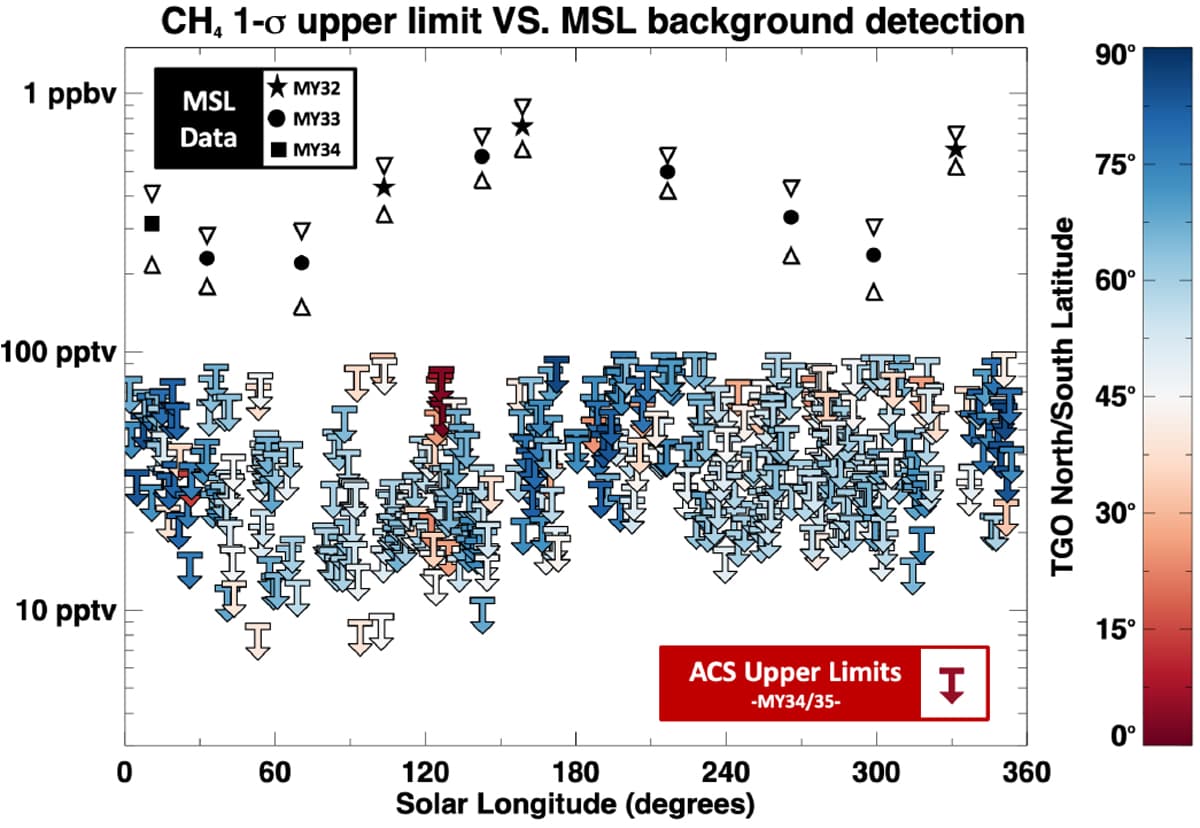
The honest answer to whether there is methane on Mars is that one instrument says yes and two instruments say no, and neither answer can be dismissed. Curiosity's Tunable Laser Spectrometer sits on the floor of Gale crater and samples the air a metre above the ground. Since 2013 it has reported a background of a few tenths of a part per billion by volume, punctuated by occasional spikes of several ppbv and one of 20.5. The ExoMars Trace Gas Orbiter was designed and flown for the specific purpose of confirming or killing those numbers, and carries two spectrometers far more sensitive than anything that had looked before. Since 2018 it has found nothing, at upper limits that in the best conditions reach 20 parts per trillion, twenty times below Curiosity's mean background. That is the disagreement. It is not a case of a good measurement versus a bad one, and anyone who tells you otherwise is choosing a side rather than describing the evidence. What makes it genuinely hard is that both results cannot be simple readings of the same atmosphere, because methane on Mars should have a lifetime of about 330 years, and 330 years is long enough for the winds to smear any release evenly across the planet. A gas that behaves like this needs both a source nobody has found and a destruction process nobody has demonstrated.
The history of finding out is a history of results that looked solid and then had to be defended. The first Mars methane detection was announced two days after the Mariner 7 flyby in August 1969 and retracted within weeks: the 3.3 micrometre absorption that looked exactly like methane turned out to be an unreported band of thick carbon dioxide ice. In 2004 two teams reported methane at almost the same abundance from completely different platforms, Krasnopolsky, Maillard and Owen at 10 plus or minus 3 ppb from Mauna Kea and Formisano's group at 10 plus or minus 5 ppbv from Mars Express, and the coincidence carried enormous weight. In 2009 Michael Mumma's team reported plumes venting 19,000 tonnes at a rate comparable to a Californian oil seep. Then the counter-argument arrived. Lefèvre and Forget showed that no known chemistry could make methane come and go like that. Zahnle, Freedman and Catling went further and questioned whether it was ever there: every detection, they pointed out, hung on a single spectral line, the Mars Express instrument could not resolve individual methane lines at all, and the ground-based lines sat directly beneath terrestrial carbon-13 methane absorptions ten to fifty times stronger that had to be modelled away before the Martian signal appeared. Their phrase for it was that a single line of a spectrum is not a fingerprint.
Curiosity was supposed to end this. Its spectrometer is not a remote sounder looking through two atmospheres; it draws Martian air into a cell and shines a laser through it 81 times. It resolves the three-line R(3) pattern of methane rather than inferring the gas from a single absorption feature. But it has one known problem, and both sides agree on the facts of it. A leak at the launch site in 2011 filled the foreoptics chamber, which the laser passes through on its way to the sample cell, with terrestrial air carrying roughly 10 parts per million of methane. Early in the mission methane was seen diffusing out of that chamber and into the sample cell during runs, which is why every measurement before sol 79 was thrown away. The Curiosity team argues the chamber holds far too little methane, about a thousand trillion molecules, to be the bulk source of a 7 ppbv cloud around the rover, and that five years of housekeeping data show no gross leakage. In April 2025 Viscardy, Catling and Zahnle agreed it is too small to be a bulk source and argued that it does not need to be: the concentration in the chamber runs three to four orders of magnitude above what is reported from the cell, so a leak of under a tenth of one per cent would do it, invisibly.
The orbiter's side needs the same care. A solar occultation measurement looks sideways through the limb of the atmosphere at sunrise and sunset, and the NOMAD methane search covers tangent altitudes of roughly 5 to 50 kilometres. It is a superb way to measure a well-mixed gas and a poor way to measure the lowest few hundred metres, which is precisely where Curiosity's air is. That gap is what the leading reconciliation exploits. John Moores and colleagues in 2019, and Webster's team in 2021 with the measurement that motivated it, proposed that methane seeps continuously from below at a very small rate, accumulates overnight inside the collapsed boundary layer where an inversion and downslope winds pin it to the crater floor, then is stirred into invisibility after sunrise. The measurement behind it is striking: two daytime runs averaging 0.05 plus or minus 0.22 ppbv against four night-time runs in the same season at 0.52 plus or minus 0.10. If that is right, both instruments are correct. What meters the gas out is a separate question. Webster's 2018 paper argued for temperature-driven adsorption and release on dust or soil grains. In March 2024 Alexander Pavlov's group at NASA Goddard reported Mars-chamber experiments in which perchlorate-rich soil cements into a gas-tight seal within 3 to 13 days, trapping gas that escapes abruptly when the seal cracks. Their seals needed 5 to 10 per cent perchlorate in the soil, well above the levels Curiosity has reported at Gale. The orbiter's own limits are also softer than the headline figures suggest. A NOMAD reanalysis published online in December 2025 by Escudero-Jiménez and colleagues, which propagates calibration systematics rather than random noise alone, reports 1 sigma limits typically near 0.5 ppbv, above Curiosity's background rather than below it. That reanalysis covers NOMAD rather than the ACS occultations behind the 20 pptv figure, and its authors say the looseness comes from their own baseline treatment and that a narrower spectral window recovers a factor of three.
Three problems keep the reconciliation from closing. The first is arithmetic. Yangcheng Luo's group ran the winds backwards from seven Curiosity spikes and found that if methane really lasts 330 years, the orbiter's ceiling limits the whole planet to about 530 kilograms of methane released per year, which forces every spike to come from a patch of 1,560 square kilometres around the rover, 1.1 in 100,000 of the surface of Mars. They call landing on top of that patch almost an impossibility. The second is the missing sink. Nobody has demonstrated a process that destroys methane fast enough, and the field has been losing candidates as often as gaining them: in July 2025 Bregnhøj and colleagues showed that the leading mechanical candidate, sequestration by wind-blown sand, does nothing over 100 days in an all-basalt chamber, and that earlier positive results came from the glass walls of the apparatus, though methane was still oxidised when reactive hypochlorite salt was present. On 14 August 2026, ten days before this page was written, Alian Wang's group published discharge experiments suggesting dust-driven electrochemistry could be hundreds to thousands of times faster than photochemistry, while saying plainly that the extrapolation to Mars spans orders of magnitude. The third is that the seasonal cycle everyone quotes rests on ten measurements over 1.7 Mars years, and Gillen, Rimmer and Catling showed in 2020 that ten points cannot distinguish a cycle from noise.
What would settle it is unusually concrete, and mostly not funded. Viscardy's group proposed a specific experiment Curiosity could run: pump the cell down, ingest Martian air, measure it, hold the same sample overnight, and measure it again the next night. Real atmospheric methane stays put or drops. Methane diffusing from the foreoptics chamber rises. One sol is enough, and no result has been published. Separately, models of barometric pumping predict a short methane pulse just before sunrise that TLS could look for, though a 2026 paper by Zafrir and colleagues argues that Mars's pressure swings are far too weak to pump gas at all and that temperature gradients drive the transport instead, which is itself an open disagreement. Beyond Curiosity there is very little. Carbon isotopes could in principle separate biological from geological methane, but Yuk Yung's 2018 review in Astrobiology is emphatic that isotope ratios alone are not diagnostic and would need to be paired with the isotopes of the candidate carbon sources and with other products of hydrocarbon synthesis such as ethane and propane, at abundances far above what Mars offers. Curiosity's spectrometer is still the only instrument on the Martian surface able to measure atmospheric methane at these levels; the ExoMars Rosalind Franklin rover's Pasteur payload analyses drilled rock and its evolved gas, leaving the free atmosphere unsampled; and none of the seven instruments on Perseverance measures atmospheric methane. Until someone runs the two-night test or lands a second spectrometer, the correct answer to whether there is methane on Mars is that nobody knows, and saying so is the answer.
What we know
The short answer
Curiosity's Tunable Laser Spectrometer, part of the Sample Analysis at Mars suite, has reported methane in Gale crater across 36 published experiments: a background of roughly 0.2 to 0.75 parts per billion by volume, plus episodic spikes of several ppbv and one of 20.5. No other lander or rover has carried an instrument able to measure methane at these levels, and no orbiter or telescope has confirmed the background it reports. The ExoMars Trace Gas Orbiter, purpose-built for the job, reports non-detection. Nobody has retracted anything, and nobody has reconciled it.↗
Why anyone cares
On Earth more than 90 per cent of atmospheric methane is made by living things. Mars is an oxidising environment where a reduced gas like methane is chemically out of place, so its presence at all implies something released it recently. Biology is one candidate. So are serpentinisation, in which water reacting with olivine-rich rock releases hydrogen that can then reduce carbon dioxide to methane; release from subsurface clathrates or adsorbed reservoirs laid down long ago; and ultraviolet breakdown of organic material delivered by meteorites and interplanetary dust. Methane on its own cannot distinguish between these.↗
Why the question is hard
Standard photochemistry gives methane a lifetime on Mars of roughly 300 to 340 years. Krasnopolsky and colleagues computed 340 years in 2004; Lefèvre and Forget used 330 in the global model that framed the modern debate. Three centuries is far longer than the time it takes Martian air to mix, so any methane released anywhere should spread into a smooth, uniform, planet-wide background within a year or two. Methane that appears in one place, at one time of day, and then vanishes is not merely surprising. It requires both an unknown source and an unknown destruction process, and the second is the harder problem.↗
The detections, 1999 to 2009
Two independent detections appeared within months of each other. Vladimir Krasnopolsky, Jean-Pierre Maillard and Tobias Owen observed Mars with the Fourier Transform Spectrometer at the Canada-France-Hawaii Telescope on 24 and 27 January 1999, summed the fifteen strongest Doppler-shifted Martian lines, and reported absorption at 3.7 sigma giving 10 plus or minus 3 ppb. Vittorio Formisano and colleagues, using the Planetary Fourier Spectrometer on Mars Express, reported a global average of 10 plus or minus 5 ppbv varying between 0 and 30 across the planet. Their agreement, from utterly different platforms, is what made the result stick. Then in February 2009 Michael Mumma and colleagues, using three ground-based telescopes, reported methane arriving in extended plumes from discrete regions in northern summer 2003: the principal plume held about 19,000 metric tons, the implied source strength of at least 0.6 kilograms per second was comparable to the Coal Oil Point hydrocarbon seep off Santa Barbara, and the summertime maximum was around 45 ppbv near the equator.↗
The 2011 challenge
Kevin Zahnle, Richard Freedman and David Catling argued in Icarus that variable methane at Mars is implausible on both chemical and observational grounds. Chemically: if some unknown reaction destroys methane fast, the same oxidising power would strip the oxygen out of Mars's atmosphere in under 10,000 years, and any sink relying on physical trapping is inconsistent with xenon still sitting in the atmosphere at 60 ppbv. Observationally: every detection rests on a single wavelength, the Planetary Fourier Spectrometer's resolution of 1.3 reciprocal centimetres is too coarse to resolve individual methane lines at all, and the Mumma detections fall exactly where terrestrial carbon-13 methane lines, ten to fifty times stronger, must be modelled away. Their summary is blunt: “A single line of a spectrum is not a fingerprint.”↗
How Curiosity measures it
The Tunable Laser Spectrometer shines an infrared laser 81 times between two mirrors down a 20 cm Herriott cell and looks for methane's distinctive three-line R(3) pattern at 3.3 micrometres. That resolving power matters, and it has already survived one challenge. In 2020 Kevin Olsen and colleagues, working from Trace Gas Orbiter spectra, suggested that ozone lines overlapping the R(3) triplet at 3057.7 reciprocal centimetres might account for methane detections by orbiters, telescopes and the rover alike. Webster's team replied in the same journal five weeks later, arguing that at TLS resolution the two are readily distinguishable, that no ozone lines appear in the recorded Martian spectra, and that the carbon dioxide scrubber used in the enrichment method destroys ozone before it reaches the cell. No further exchange has been published. The reply stands, but it stands as the instrument team's own defence rather than an independent adjudication.↗
What Curiosity reports, and how
Air enters the cell two ways. A direct ingest fills it in about 20 minutes and gives roughly 2 ppbv precision. An enrichment ingest passes air over a carbon dioxide scrubber for about two hours, stripping the carbon dioxide but not the methane and concentrating it by 25 plus or minus 4, which allows sub-ppbv work. Every value is a difference, a full-cell run minus an empty-cell run, because the instrument's own foreoptics chamber holds terrestrial methane the laser passes through either way. In 2015 Christopher Webster and colleagues reported a background of 0.69 plus or minus 0.25 ppbv over 20 months with four elevated measurements averaging 7.2 plus or minus 2.1 ppbv on sols 467, 475, 505 and 525. In 2018, with five years of data, the background became 0.41 plus or minus 0.16 ppbv and the spike mean 7.6 plus or minus 1.6. In 2021 they reported 20.5 plus or minus 4 ppbv in June 2019, the largest of the mission.↗
The seasonal cycle, disputed
The 2018 seasonal cycle rests on ten high-precision enrichment measurements spread over 1,136 sols, about 1.7 Mars years. Edward Gillen, Paul Rimmer and David Catling reanalysed exactly those numbers with Gaussian process regression and reported in Icarus in 2020 that the data, taken as a whole, are not statistically consistent with seasonal variability, and that the enrichment subset on its own is about equally consistent with random variation or with periodic variation at no particular period. Their argument is not that the methane is not there. It is that ten points over 1.7 cycles cannot establish a cycle, and that three or more cycles of denser sampling would be the minimum.↗
The one independent confirmation
On 15 June 2013 Curiosity measured a spike of 5.78 ppbv. The next day, 16 June, the Planetary Fourier Spectrometer on Mars Express observed 15.5 plus or minus 2.5 ppbv over Gale crater. Marco Giuranna and colleagues published this in Nature Geoscience in April 2019 as the first Mars methane detection confirmed by an independent measurement, and located a probable source east of the crater where faults of Aeolis Mensae may reach into shallow ice of the Medusae Fossae Formation. As of 24 August 2026 no second such coincidence has been published, and it comes from the instrument whose resolution Zahnle's group had argued was too coarse to identify methane at all.↗
What the Trace Gas Orbiter reports
Nothing. Oleg Korablev and colleagues published in Nature on 10 April 2019 that the ACS and NOMAD spectrometers, observing from April to August 2018 at a range of latitudes in both hemispheres, detected no methane, with an upper limit of about 0.05 ppbv, which they state is ten times below the background level Curiosity measured at the same season. Franck Montmessin and colleagues then processed 640 ACS solar occultations covering 1.44 Mars years and reached 1 sigma upper limits near 10 pptv in the clear northern summer, with an annual mean of the smallest limits of 20 pptv. Their paper notes that observations near Gale specifically reached limits up to four times below Curiosity's background for the matching seasons.↗
What that limit actually covers
Solar occultation looks sideways through the atmosphere at sunrise and sunset, along a very long slant path, and it is blind to the bottom of the atmosphere. The NOMAD methane search covers tangent altitudes of roughly 5 to 50 km. Curiosity samples air about a metre above the crater floor. The two are not measuring the same air, and the orbiter's limit is a limit on well-mixed methane in the middle atmosphere rather than a measurement of the near-surface. A NOMAD reanalysis by Escudero-Jiménez and colleagues, published online in December 2025, which folds calibration systematics into the error budget rather than treating noise alone, reports 1 sigma upper limits typically around 0.5 ppbv, reaching 0.2 ppbv at some altitudes: considerably looser than the headline NOMAD numbers, and above Curiosity's background. Two cautions on that. It reanalyses NOMAD, leaving untouched the ACS occultations that produce the 20 pptv figure. And its authors attribute the looseness to the residual baseline shape in their own processing, and report that narrowing the analysed spectral interval lowers the uncertainty by a factor of three.↗
The day and night difference
In 2021 Webster and colleagues reported the measurement that changed the shape of the argument. Two daytime TLS runs averaged 0.05 plus or minus 0.22 ppbv, a non-detection. Four night-time runs in the same season averaged 0.52 plus or minus 0.10 ppbv. Their proposal is micro-seepage that accumulates under the collapsed nocturnal boundary layer, held in place by temperature inversion and downslope winds converging on the crater floor, then diluted after sunrise by convective mixing and upslope flow that carries it out of the crater. If that is right, both instruments are correct and both are measuring what they say they are measuring. Their own paper attaches a condition: if near-surface production is happening widely across Mars, it must be accompanied by a fast destruction or sequestration mechanism, or both.↗
The instrument challenge, 2025
Sébastien Viscardy, David Catling and Kevin Zahnle published a reanalysis of the TLS data in JGR Planets on 13 April 2025. Their case has two parts. First, the foreoptics chamber, sealed against the sample cell by an O-ring, holds methane at 3 to 4 orders of magnitude above the levels reported from the cell, and housekeeping data show unexplained pressure changes in both compartments; a leak of under 0.1 per cent of the foreoptics methane would reproduce every published detection while remaining invisible. Second, the retrieval averages the three R(3) triplet lines as if they were independent measurements rather than fitting the triplet's known pattern, and in five experiments with full data the three lines disagree at a probability of about one in a thousand, implying unaccounted systematic error.↗
Where the instrument's methane came from
This part is not disputed by anyone, and the detail comes from the Curiosity team's own supplementary material, compiled by Viscardy's group. A leak at the launch site in 2011 let terrestrial air, carrying an estimated 10 ppmv of methane against a global mean of 1.8 ppmv that year, into the TLS foreoptics chamber, raising its pressure by about 76 mbar by the time Curiosity landed. Early on, methane was seen visibly diffusing from the foreoptics into the sample cell during runs, which is why all data before sol 79 were discarded. Two pump-out campaigns followed. The Curiosity team's position, stated in 2018, is that the total methane in the chamber, about a thousand trillion molecules, is far too small to be the bulk source of the observed spikes and that no gross leakage appears in the housekeeping record. Viscardy's group agrees it is too small to be a bulk source, and argues that it does not need to be.↗
The coincidence problem
Yangcheng Luo and colleagues ran inverse Lagrangian transport modelling backwards from seven Curiosity spikes to find where the gas could have come from. If methane really has a 330-year lifetime, the orbiter's 0.02 ppbv ceiling caps the whole planet's annual methane release at about 530 kilograms, which means each spike must come from a small nearby patch. The qualifying area works out at 1,560 square kilometres, 8.4 per cent of Gale crater and 1.1 in 100,000 of the surface of Mars. Their conclusion is that this would require Curiosity to have been landed almost on top of a methane seep, which they call almost an impossibility, and that the escape routes are a fast removal mechanism, or an error in the rover data, or an error in the orbiter data.↗
The missing sink
Lefèvre and Forget showed in 2009 that reproducing the reported local enhancements needs an atmospheric lifetime under 200 days, a destruction process 600 times faster than known photochemistry, or about one hour if the destruction happens only at the surface. Candidates have come and gone. A leading one, chemical sequestration by wind-driven saltation, was tested again in 2025 by Bregnhøj and colleagues in an all-basalt tumbling chamber and largely failed: methane survived more than 100 days of simulated saltation, and survived it in the presence of excess oxygen and perchlorate, while the earlier positive results appear to have been an artefact of quartz and glass container walls. The same experiments did oxidise methane when reactive hypochlorite salt was present, so the mechanism is narrowed rather than eliminated. On 14 August 2026 Alian Wang and colleagues published, online in Earth and Planetary Science Letters, electrostatic-discharge experiments suggesting dust-driven heterogeneous electrochemistry could destroy methane hundreds to thousands of times faster than photochemistry, while stating that the extrapolation to Mars carries uncertainties spanning orders of magnitude.↗
What happened, and when
- Aug 1969Two days after the Mariner 7 flyby, the infrared spectrometer team announces methane and ammonia at the edge of the south polar cap. Kenneth Herr and George Pimentel publish the correction in Science that October: both features are absorptions of solid carbon dioxide. The first Mars methane detection lasts about eleven weeks.
- Oct to Dec 2004Two detections land within weeks. Formisano and colleagues report 10 plus or minus 5 ppbv from the Planetary Fourier Spectrometer on Mars Express, published online in Science on 28 October and in print that December. Krasnopolsky, Maillard and Owen report 10 plus or minus 3 ppb in Icarus from Canada-France-Hawaii Telescope observations taken on 24 and 27 January 1999, and put the word life in their title with a question mark. Independent platforms, near-identical numbers.
- 20 Feb 2009Mumma and colleagues publish plumes in Science: methane released from discrete regions in northern summer 2003, the principal plume holding about 19,000 metric tons, source strength at least 0.6 kg per second, summertime maximum around 45 ppbv near the equator. Mars appears to be venting.
- 6 Aug 2009Franck Lefèvre and François Forget publish the paper that turns a discovery into a problem. Running a Mars global climate model with coupled chemistry, they find that no known photochemistry can produce the reported variations, and that matching them needs a lifetime under 200 days, a loss process 600 times faster than standard chemistry allows, or destruction on a timescale near one hour if it happens at the surface.
- Apr 2011Zahnle, Freedman and Catling publish 'Is there methane on Mars?' in Icarus, arguing that a fast sink would strip Mars of atmospheric oxygen within 10,000 years, that physical trapping is ruled out by the survival of xenon, and that each reported detection rests on a single spectral line sitting under stronger terrestrial absorption. The scepticism becomes a permanent feature of the field.
- 15 to 16 Jun 2013Curiosity measures 5.78 ppbv on sol 306. The next day the Planetary Fourier Spectrometer on Mars Express measures 15.5 plus or minus 2.5 ppbv over Gale. It takes until 2019 for the orbital result to be published, and it remains the only occasion on which two instruments have seen the same methane event.
- 23 Jan 2015Webster and colleagues report Curiosity's first in-situ background, 0.69 plus or minus 0.25 ppbv, plus four elevated measurements averaging 7.2 plus or minus 2.1 ppbv. In the same issue of Science, Zahnle publishes a commentary titled 'Play it again, SAM', arguing that the rover's own instrument is the more likely source.
- 8 Jun 2018Webster and colleagues report a repeatable seasonal cycle in the Gale background, 0.24 to 0.65 ppbv around a mean of 0.41, peaking in late northern summer, larger than either ultraviolet breakdown of infalling organics or the annual pressure cycle can explain. It is the most-quoted Mars methane result of the decade, and it rests on ten enrichment measurements.
- 1 to 10 Apr 2019Nine days apart, the two most consequential papers in the field appear. Giuranna and colleagues publish the Mars Express confirmation of the 2013 spike in Nature Geoscience. Korablev and colleagues publish the Trace Gas Orbiter non-detection in Nature, upper limit about 0.05 ppbv, and state that reconciling it with Curiosity would need an unknown process that removes methane before it spreads globally.
- Aug 2019 to Jan 2020The reconciliation attempts begin. John Moores and colleagues propose in Geophysical Research Letters that methane accumulates within metres of the ground overnight and is mixed below detection by dawn, deriving a Gale seepage rate of 1.5 times 10 to the minus 10 kilograms per square metre per sol. Gillen, Rimmer and Catling publish the statistical reanalysis finding no support for a strong seasonal cycle.
- Jun 2021Two papers in the same volume of Astronomy and Astrophysics. Montmessin and colleagues push the ACS upper limit to 20 pptv across 1.44 Mars years and note that limits near Gale run four times below Curiosity's background. Webster and colleagues report the day-night contrast, 0.05 plus or minus 0.22 ppbv by day against 0.52 plus or minus 0.10 by night, and propose nocturnal containment as the way both can be true.
- 13 Apr 2025Viscardy, Catling and Zahnle publish in JGR Planets, arguing that the TLS foreoptics chamber holds methane 3 to 4 orders of magnitude above the reported sample-cell levels, that leaks of under 0.1 per cent would reproduce every detection undetectably, and that the triplet retrieval understates uncertainty. They propose a two-night test: measure the same trapped air sample twice, a sol apart. If the second night reads higher, the methane is coming from inside the instrument. As of 24 August 2026 no result of that test has been published.
- 6 to 14 Aug 2026Two papers nine days apart, both about mechanism rather than measurement. Zafrir and colleagues argue in Icarus that Martian pressure swings are far too weak to pump gas out of the subsurface at all, and that temperature gradients drive the transport instead. Wang and colleagues report electrostatic-discharge experiments in Earth and Planetary Science Letters suggesting that dust-driven heterogeneous electrochemistry could destroy methane hundreds to thousands of times faster than photochemistry, while stating that the extrapolation to Mars carries uncertainties spanning orders of magnitude. Neither is a measurement of Martian methane, and neither closes anything.
In pictures
Tap a photo to enlarge.
Sources
- Krasnopolsky, Maillard and Owen (2004), Icarus 172, 537-547: Detection of methane in the martian atmosphere: evidence for life?
- Formisano, Atreya, Encrenaz, Ignatiev and Giuranna (2004), Science 306, 1758-1761: Detection of Methane in the Atmosphere of Mars
- Mumma et al. (2009), Science 323, 1041-1045: Strong Release of Methane on Mars in Northern Summer 2003
- Lefèvre and Forget (2009), Nature 460, 720-723: Observed variations of methane on Mars unexplained by known atmospheric chemistry and physics
- Zahnle, Freedman and Catling (2011), Icarus 212, 493-503: Is there methane on Mars?
- Pavlov et al. (2024), JGR Planets 129, e2023JE007841: Formation and Stability of Salty Soil Seals in Mars-Like Conditions
- Webster et al. (2018), Science 360, 1093-1096: Background levels of methane in Mars' atmosphere show strong seasonal variations
- Gillen, Rimmer and Catling (2020), Icarus 336, 113407: Statistical analysis of Curiosity data shows no evidence for a strong seasonal cycle of martian methane
- Korablev et al. (2019), Nature 568, 517-520: No detection of methane on Mars from early ExoMars Trace Gas Orbiter observations
- Giuranna et al. (2019), Nature Geoscience 12, 326-332: Independent confirmation of a methane spike on Mars and a source region east of Gale Crater
- Montmessin et al. (2021), Astronomy and Astrophysics 650, A140: A stringent upper limit of 20 pptv for methane on Mars
- Webster et al. (2021), Astronomy and Astrophysics 650, A166: Day-night differences in Mars methane suggest nighttime containment at Gale crater
- Luo, Mischna, Lin, Fasoli, Cai and Yung (2021), Earth and Space Science 8, e2021EA001915: Mars Methane Sources in Northwestern Gale Crater Inferred From Back Trajectory Modeling
- Viscardy, Catling and Zahnle (2025), JGR Planets 130, e2024JE008441: Questioning the Reliability of Methane Detections on Mars by the Curiosity Rover
- Herr and Pimentel (1969), Science 166, 496-499: Infrared Absorptions near Three Microns Recorded over the Polar Cap of Mars
- Yung et al. (2018), Astrobiology 18, 1221-1242: Methane on Mars and Habitability: Challenges and Responses
- Olsen, Lefevre, Montmessin et al. (2020), Astronomy and Astrophysics 639, A141: First detection of ozone in the mid-infrared at Mars: implications for methane detection
- Webster et al. (2020), Astronomy and Astrophysics 641, L3: Curiosity Mars methane measurements are not confused by ozone
- Moores et al. (2019), Geophysical Research Letters 46, 9430-9438: The Methane Diurnal Variation and Microseepage Flux at Gale Crater, Mars
- Bregnhoj et al. (2025), Icarus 441, 116734: Exploring the impact of wind-driven saltation on methane in the atmosphere of Mars
- Escudero-Jimenez et al. (2026), Icarus 448, 116923 (online 29 December 2025): Upper limits of CH4 and OCS in the Martian atmosphere from NOMAD/TGO solar occultation
- Zafrir et al. (2026), Icarus (online 6 August 2026): The thermal constraint behind methane emissions into the Martian atmosphere from Earth-based studies
- Wang et al. (2026), Earth and Planetary Science Letters 693, 120263 (online 14 August 2026): The fast destruction of methane by heterogeneous electrochemistry induced by martian dust activity
Checked on 3 September 2026. Where the science is unsettled this page says so rather than picking a winner.